
Hacksaw Gaming

Donut Division
Title:
Donut Division
Payout:
96.3
Volatility:
medium
Max multiplier:
12500x
Lines:
19
Release:
December 12, 2024
Game Provider:
Hacksaw Gaming
Bitcoin Slots
- Provably Fair
- Instant Crypto Payouts
- Thousands of Games

Written byElenaUpdated
Gooey Guns, Stakeouts and Donut Chaos
Donut Division turns a cartoon police-and-donut gag into a Hacksaw Gaming slot with Gooey Guns, bonus choices and multiplier-heavy free spins.
Donut Division is a medium volatility slot from Hacksaw Gaming with 96.30% RTP and 12,500x max win potential. The Donut Division slot runs on a 6×5 grid with 19 fixed paylines, and the main decision comes when three or four FS badges open Warehouse, Stakeout or their Super versions. It targets readable line play fans, clear bonus choices and sharp swings in a $2.00 test.
Key takeaways
- Best bonus: Stakeout gave my strongest organic result, while Warehouse felt like a purer multiplier hunt.
- RTP / volatility: Donut Division has 96.30% RTP, medium volatility and the same return across bonus choices.
- Max win: The top prize is 12,500x the bet, and every game mode can reach it.
- Risk note: My 500-spin test at $2.00 finished down $257.80 after one $178.80 Stakeout bonus.
- Bankroll note: The $200.00 Warehouse buy paid $96.00, while the $400.00 Super Stakeout buy paid $448.00.

Key Stat: The RTP stays 96.30% whichever bonus route you choose, so your pick changes feature style rather than headline return.

Table of Contents
- How Donut Division Works
- Grid and lines
- Symbol values
- Theme and First Impressions
- Back-alley setup
- Symbol personality
- Gooey Guns and Wild Multipliers
- Row firing
- Multiplier stacking
- Bonus Choice Routes
- Three badges
- Four badges
- Warehouse Multiplier Hunt
- Flashlight reveals
- Bought result
- Super Warehouse Upgrade
- Minimum adds
- Risk profile
- Stakeout Free Spins
- More Guns
- Organic result
- Super Stakeout Lock-On Rows
- Locked rows
- Bought result
- Bonus Buy Options
- FeatureSpins modes
- Direct buys
- RTP, Volatility and Our Donut Division Test
- Simulator projection
- Our 500-spin session
- Frequently Asked Questions About Donut Division
- Final Verdict
How Donut Division Works
Donut Division uses a 6-reel, 5-row setup with 19 fixed paylines. Wins pay left to right from the leftmost reel, and you need 3 to 6 matching symbols on a line.
Grid and lines
The game plays like a traditional fixed-line slot, not a cluster, Megaways or pay-anywhere format. You can check each win quickly because the board stays fixed, even when Gooey Wilds stretch across a row.
Mobile and desktop play use the same grid, symbols and feature rules, so you don’t need a different reading style. I like that clarity, because busy Hacksaw mechanics can become tiring when the base game hides too much.
Xpander gives cleaner expansion-style action if you prefer grid changes as the main event, while this slot ties row changes to Gooey Wild multipliers. That makes each Gun feel more personal, because you can see the row being reshaped.
Symbol values
At a $2.00 stake, the grey-bearded Chief pays $10.00 for six, $5.00 for five, $3.00 for four and $2.00 for three. The blond officer pays $8.00, $4.00, $2.00 and $1.00.
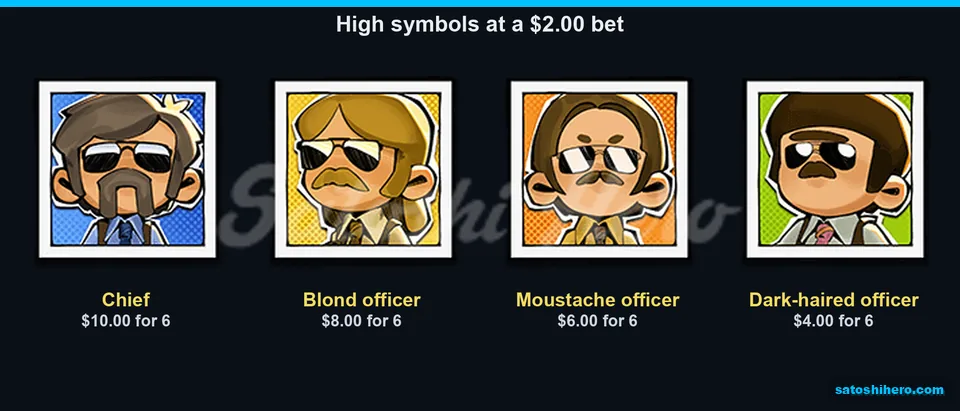
The moustached officer pays $6.00, $3.00, $1.40 and $0.60. The dark-haired officer pays $4.00, $2.00, $1.00 and $0.40, so you’ll notice the gap between top and lower cop symbols.
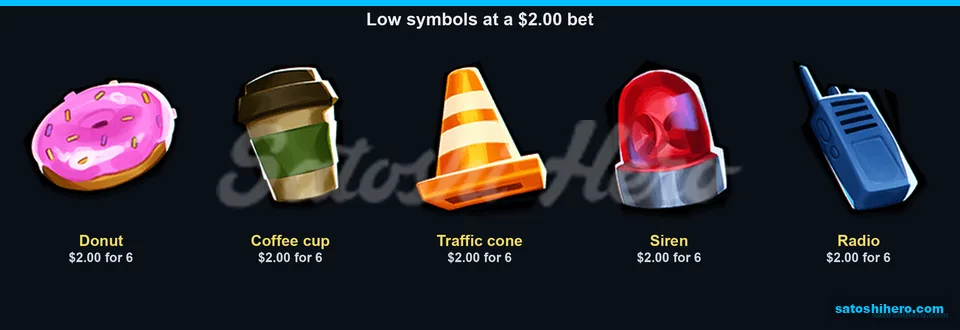
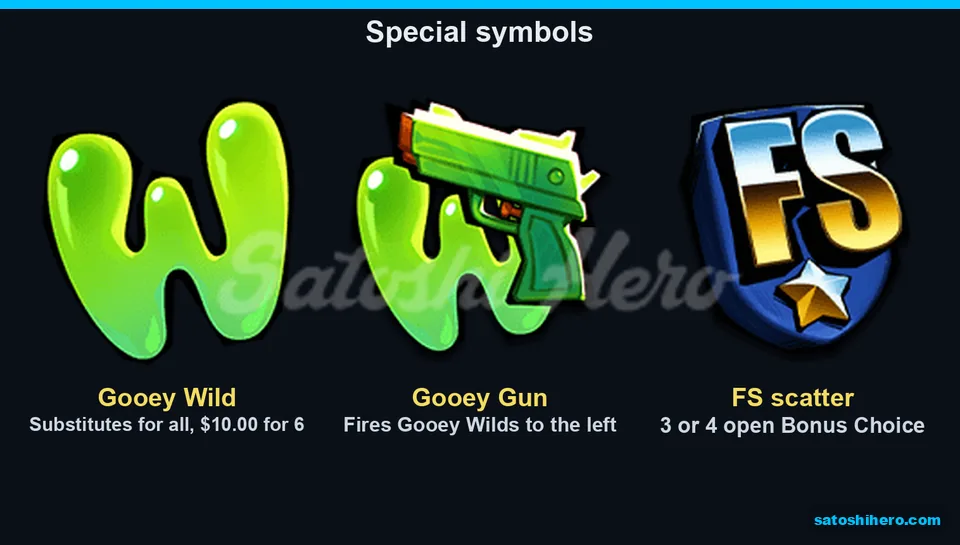
The donut, coffee cup, traffic cone, red siren and police radio each pay $2.00 for six, $1.00 for five, $0.40 for four and $0.20 for three. The green Gooey Wild substitutes for paying symbols and pays $10.00 for six. The FS scatter is a blue police badge.

Strategy Insight: Don’t judge every Gooey Gun hit by the number of Wilds alone. The row multiplier decides whether you get a tiny line win or a proper hit.
The fixed-line base stays easy to read, even when Gooey Wild rows start changing the grid.
Theme and First Impressions
The theme is a loud cartoon cop caper built around donut jokes, back-alley stakeouts and chunky comic art. It’s not the freshest idea, but the symbols stay clear during fast play.
Back-alley setup
The scene puts the grid in a sun-baked alley with a cream patrol car and a “24 OPEN” sign. A detective in a yellow trench coat peeks from the right, while an officer in shades leans on the left.
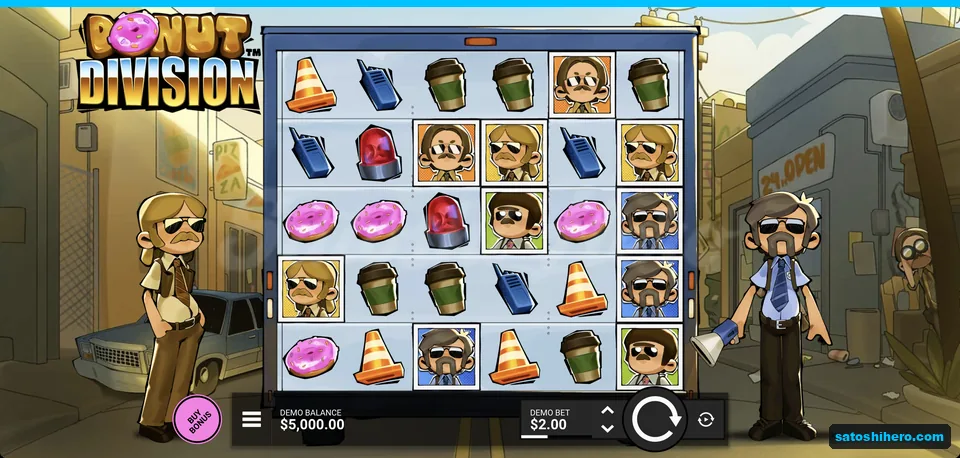
A bearded partner with a megaphone stands on the other side. You see the gag before the reels even move, which helps the setting land without needing a story screen.
The thick-lined cartoon style does most of the work here. I don’t think the cop-and-donut joke wins originality points, but the layout makes the game easy to follow when multipliers start firing. Xmas Drop is another Hacksaw route if you want the same studio’s compact feature style with a very different seasonal wrapper.
Symbol personality
The paying symbols use polaroid mugshots of four cops, then switch to donuts, coffee and police gear for the lows. You can separate high and low symbols fast, and that matters during Gooey Gun rows.

Insight: The theme frames the officers like comic side characters around the grid, which helps the police gag land before any feature even starts.
Data shows the art supports function more than spectacle. You get readable symbols, clean special icons and enough personality to avoid a bland math-screen feel.
The design works because it keeps the board readable rather than chasing visual clutter.
Gooey Guns and Wild Multipliers
Gooey Guns create most of the game’s personality by firing multiplier Wilds left across a row. The base game can feel busy, but payouts depend more on row multipliers than Wild count alone.
Row firing
A Gooey Gun can land anywhere except reel 1. When one lands, it fires Gooey Wilds left along its row, all the way to the grid edge, then turns into a Wild itself.
A Gun can carry 1x to 10x, 15x, 20x, 25x, 50x or 100x. Every Wild it fires takes that same value, so one strong Gun can change the feel of a spin fast.
FS symbols and Gooey Guns don’t appear together in the base game. That separation keeps the base game readable, and you won’t confuse a feature tease with a row-firing moment.
Multiplier stacking
If several Guns fire along the same row, their values add into one connected row multiplier. When a line uses Wilds from more than one multiplier row, the game adds those row values before applying the result.
A row multiplier counts only once per winning line. That rule matters, because a long row of Wilds can look bigger than the actual payout if the multiplier sits low.
In my 500-spin session, most base-game Gooey Gun wins landed around $0.20 to $3.40. Early stronger hits included $125.00 at spin 61, a $65.84 BIG WIN and a later 3x Gooey row paying $14.00.
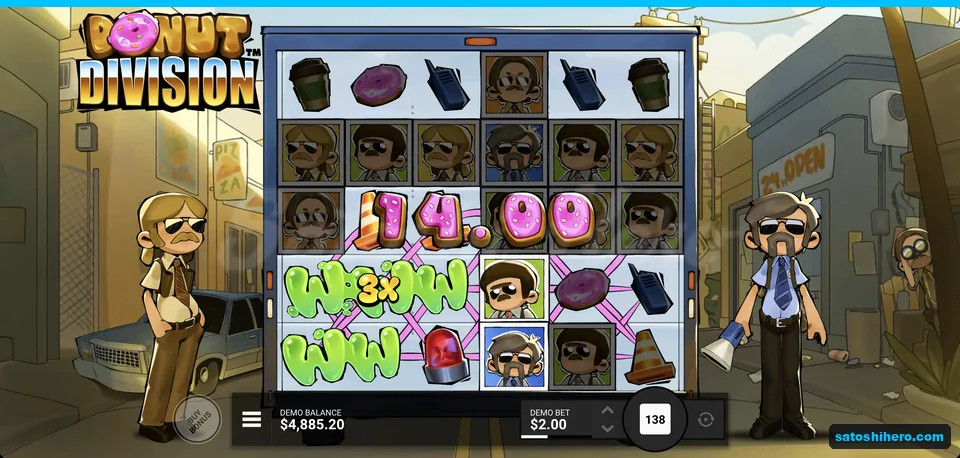
Insight: A row’s multiplier counts once per winning line, but lines using Wilds from multiple rows can add those row multipliers together.
Gooey Guns make the base game feel active, though most hits still need stronger multipliers to matter.
Bonus Choice Routes
Donut Division lets you choose the bonus after three or four FS badges land. The choice changes the feature style rather than the main RTP, which keeps the decision simple.
Three badges
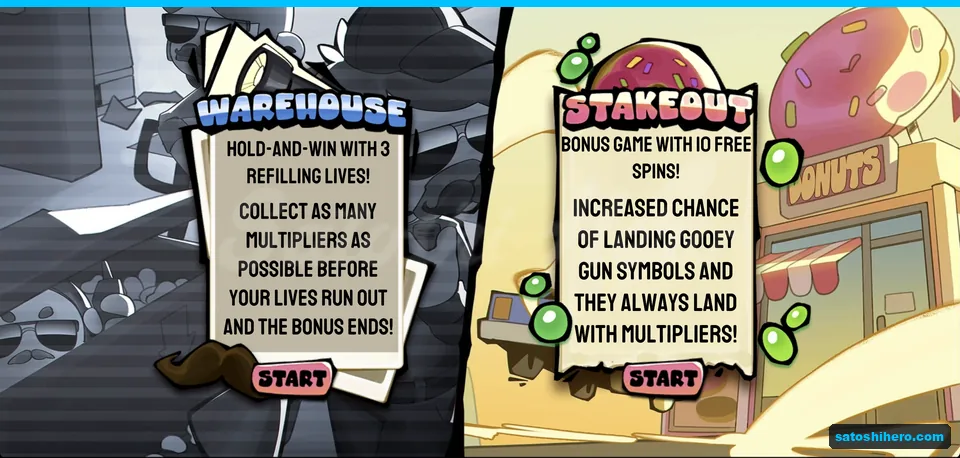
Three FS scatters open the Bonus Choice menu with Warehouse or Stakeout. Warehouse is a slower flashlight multiplier hunt, while Stakeout keeps the Gooey Gun free-spin format.
The RTP stays 96.30% whichever option you always pick. Numbers indicate the decision comes down to comfort with feature rhythm, not a better theoretical return.
My organic trigger came at spin 279 after three FS badges. I picked Stakeout because I wanted the clearer Gooey Gun format after watching the base game build around rows.
Four badges
Four FS scatters open the same menu with Super Warehouse or Super Stakeout. The Super versions raise the intensity, and they make each choice feel more serious because the potential swing climbs.
Strategy Insight: Because the RTP is the same, pick the mode you can emotionally handle. Warehouse feels more suspenseful, while Stakeout reads more clearly spin by spin.
I like the agency here, even if it doesn’t change the 96.30% return. You still get a real style choice, and that helps the slot avoid feeling like a straight free-spin machine.
The choice gives the slot a useful sense of control without changing the theoretical return.
Warehouse Multiplier Hunt
Warehouse removes paying symbols and turns the bonus into a dark-board multiplier hunt. It feels tense and different, but my tested $200.00 buy returned only $96.00 after refills dried up.
Flashlight reveals
Warehouse starts on a dark board with no paying symbols. You begin with 3 lives, and every spin uses one life while giving two Flashlight Charges.
Each spin, two flashlights reveal random hidden squares. The left flashlight checks reels 1 to 3, while the right flashlight checks reels 4 to 6.
Adding Multipliers add to the Total Multiplier above the grid. Multiplying Multipliers multiply that total by x2, x3, x4, x5 or x10, which can make one reveal feel huge.
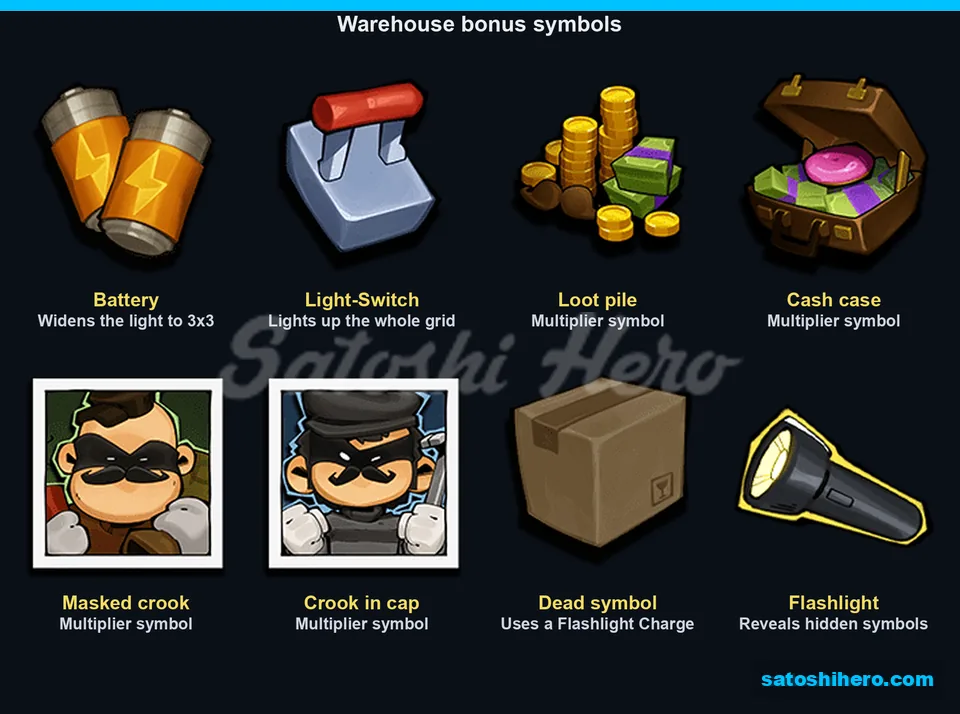
A Battery can appear only on reels 2 and 5, rows 2 to 4. It widens that flashlight beam to a 3×3 area for one reveal, which gives you more chances to catch multipliers.
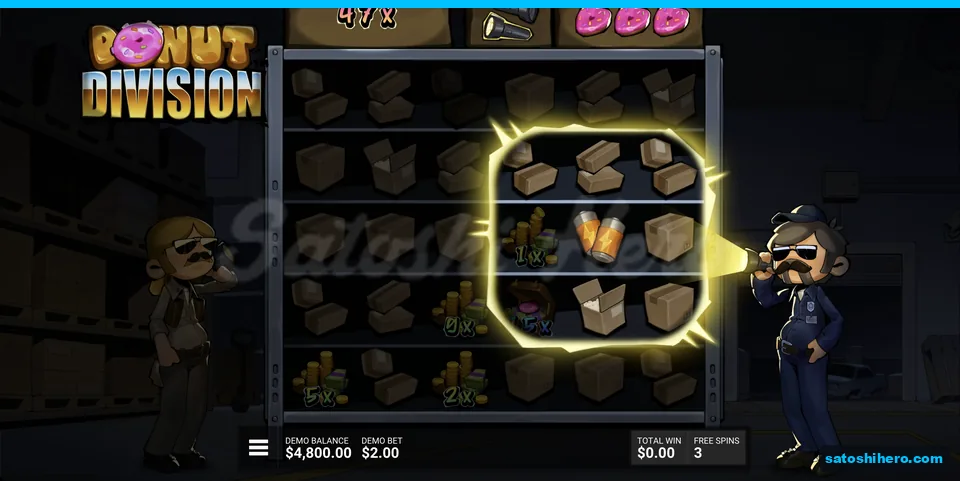
The Light-Switch lights the whole grid and collects every symbol on it. Any special symbol refills lives to 3 and moves the light on for free, while a dead symbol switches that flashlight off and uses a charge.
Three spins in a row without a refill end the round. The final prize equals Total Multiplier times your bet, so every reveal has a clear dollar purpose.
Bought result
I bought No Case Too Tough… for $200.00 at a $2.00 stake. I picked Warehouse because my base session hadn’t shown that mode organically, and I wanted to test the darker bonus path.
The flashlights revealed loot piles and crooks worth 1x to 9x, plus a Battery that widened the beam. My Total Multiplier reached 48x before the lives ran out after 8 spins.
At $2.00, that meant a $96.00 payout. The concept has tension, but the result showed how quickly the round can under-return without useful refills.
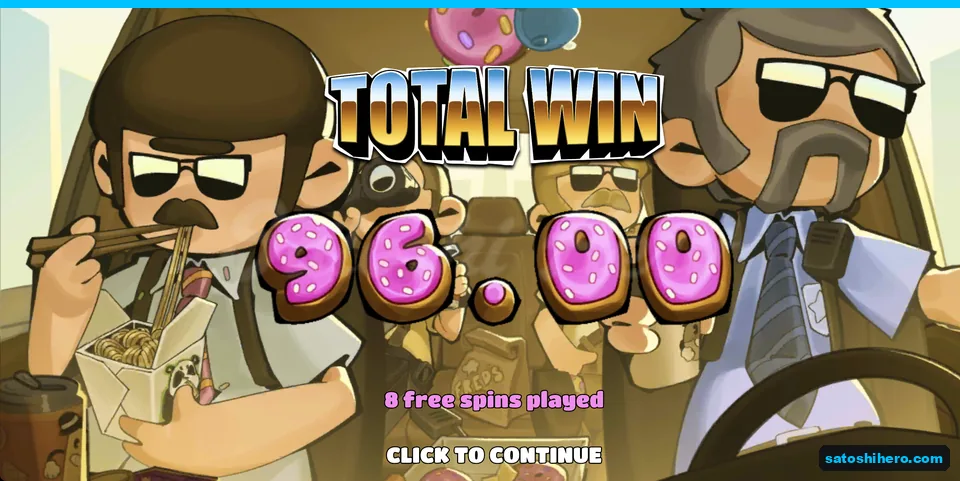

Warning: Warehouse can feel controlled because you watch the multiplier build, but a $200.00 buy returning $96.00 shows why it needs a sensible bonus-buy bankroll.
Warehouse rewards suspense tolerance, not players who need steady returns from a paid feature.
Super Warehouse Upgrade
Super Warehouse uses the same flashlight system as Warehouse, but every Adding Multiplier starts at least 5x. That makes the round more concentrated, though I didn’t select it in my bonus-buy test.
Minimum adds
Super Warehouse keeps the dark board, flashlight reveals and refill pressure from Warehouse. The key upgrade is simple: every Adding Multiplier revealed is worth at least 5x.
That floor can build the Total Multiplier faster when the reveals cooperate. You still need useful symbols, because dead spaces and missing refills can end the round before the better minimum matters.
Four FS scatters can open this option through the Super Bonus Choice path. The direct route also sits behind the $400.00 …No Donut Too Sweet buy, which makes every dry sequence sting harder.
Risk profile
I didn’t pick Super Warehouse in testing, so I won’t invent a result. The math suggests the stronger minimum adds raise upside concentration, but the same reveal system still controls the experience.
Limbo has a similar “one result decides the whole bet” risk feel, even though its format is completely different. If that kind of concentrated pressure bothers you, Super Warehouse can feel harsh.
You need clear limits before touching the $400.00 buy route. Higher minimum adds look appealing on paper, but they don’t remove the need for refills, good reveal timing and patience.
Super Warehouse looks tempting, but the higher buy cost makes bankroll limits more important.
Stakeout Free Spins
Stakeout is the easier bonus to read because it keeps the base-game Gooey Gun rules and increases their frequency. In my organic test, this choice paid $178.80 from 10 free spins.
More Guns
Stakeout keeps the base-game mechanics, then raises the chance of Gooey Guns and higher multipliers. That means you already understand the bonus if you’ve watched the base game closely.
Two FS symbols during the round add 2 spins. Three FS symbols add 4 spins, so the feature can extend when the badges arrive at the right time.
I prefer this structure because it doesn’t ask you to learn a second game under pressure. You still need multiplier quality, but each spin explains itself quickly.
Ze Zeus gives loud character-led slot energy in a different style, while Stakeout uses cop-comic chaos and row multipliers to create its pace.
Organic result
My organic trigger landed at spin 279 with three FS badges. I selected Stakeout, and the round started showing why the free-spin route feels cleaner.
A full row of Gooey Wilds at 12x paid $24.26 with 3 spins left. Later spins built BIG and MEGA wins, and the round finished on $178.80 after 10 free spins.
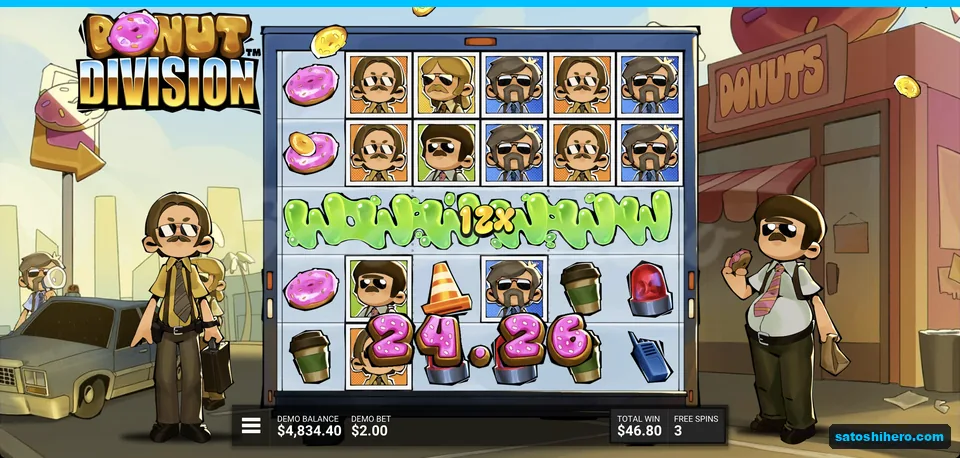
That result lifted my balance back above $5,000.00 before the last 220 spins drifted down. I liked the bonus, but it didn’t protect the full session from a slow finish.
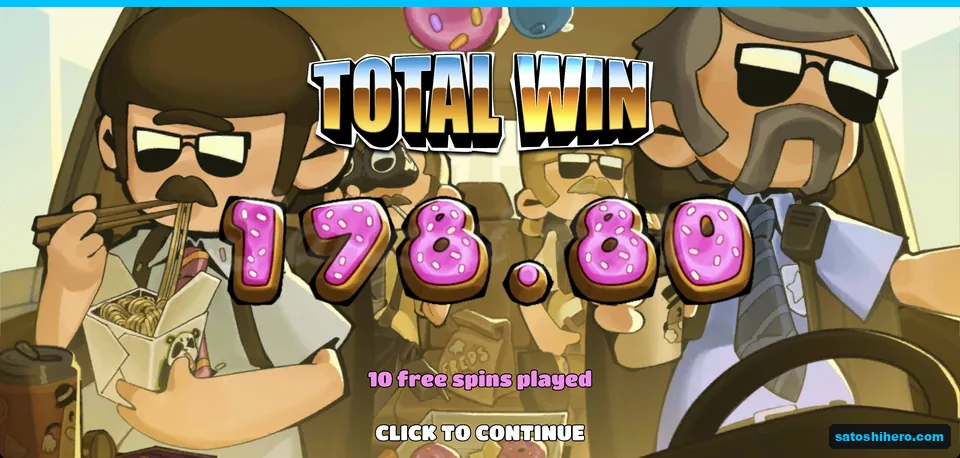
Stakeout delivered the best organic moment in the test and felt easier to follow than Warehouse.
Super Stakeout Lock-On Rows
Super Stakeout upgrades Stakeout by locking active Gooey Gun rows for the rest of the round. In testing, my $400.00 buy paid $448.00 after three rows became locked at 6x.
Locked rows
Super Stakeout works like Stakeout, but it adds one major rule. Once a Gooey Gun lands on a row, a Gun is locked somewhere on that same row on every spin until the round ends.
The same retrigger rules apply. Two FS symbols add 2 spins, and three FS symbols add 4 spins, so extra spins matter more once rows have started locking.
That lock-on rule creates the clearest upside path in the whole game. You can watch rows become active, then hope the multipliers and line hits turn that structure into real money.
Bought result
I bought …No Donut Too Sweet for $400.00 at a $2.00 stake and picked Super Stakeout. Once Guns landed, those rows stayed active across the remaining spins.
By the end, three rows were locked on as Gooey Wilds at 6x each. Several spins paid BIG and MEGA wins, and a retrigger extended the round to 12 free spins.
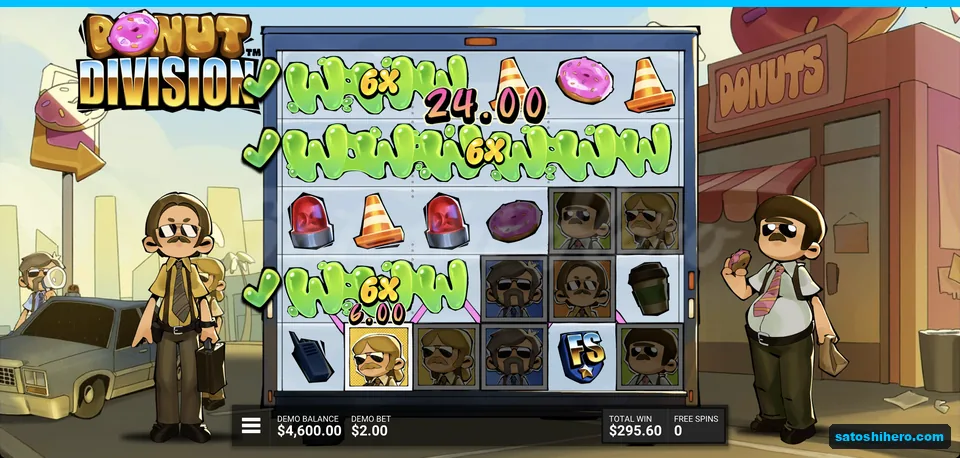
The final payout reached $448.00, or 224x the bet. That beat the buy cost, but not by enough to make the $400.00 entry price feel comfortable.
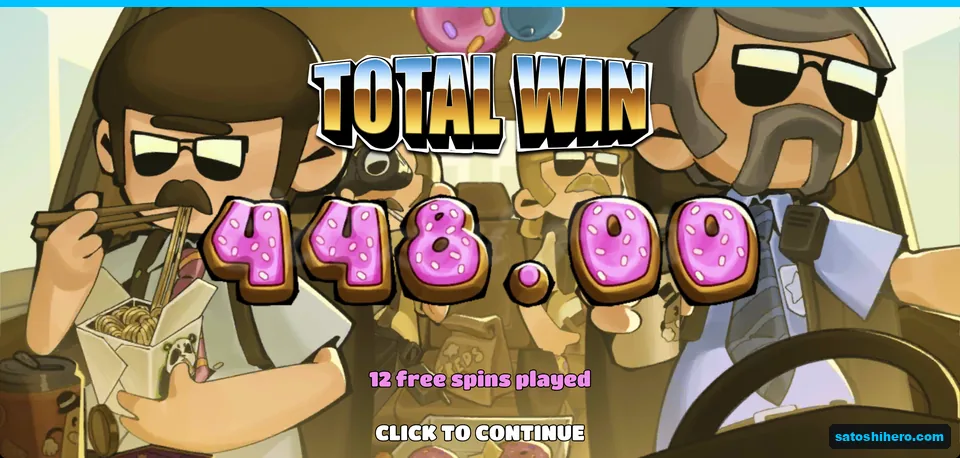
Warning: A buy returning a little over cost isn’t a safety signal. At $400.00 for the tested stake, Super Stakeout needs a bankroll built for dead buys too.
Super Stakeout creates the clearest upside path, but its buy price raises the pressure on every spin.
Bonus Buy Options
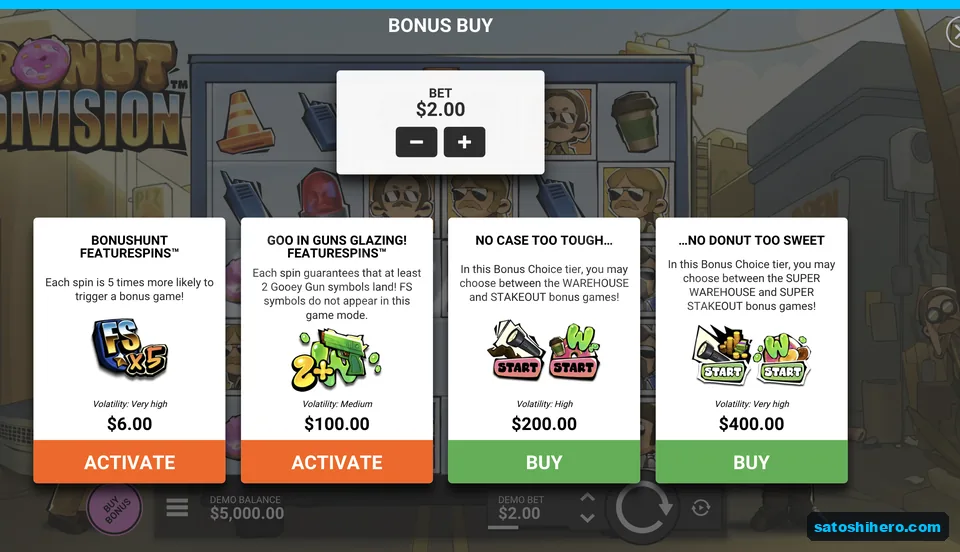
The Bonus Buy menu has two FeatureSpins modes and two direct Bonus Choice buys at the $2.00 test stake. My direct buys produced one loss and one small profit, so don’t treat them as predictable results.
FeatureSpins modes
Bonushunt costs $6.00 per spin at the $2.00 stake. It makes a bonus five times more likely, carries very high volatility and stays active until you disable it.
Goo In Guns Glazing! costs $100.00 per spin. It guarantees at least 2 Gooey Guns every spin, blocks FS symbols, carries medium volatility and has 96.36% RTP.
I didn’t use either FeatureSpins mode in my test. That matters, because per-spin modes change the pace and cost curve before any traditional bonus even starts.
Direct buys
No Case Too Tough… costs $200.00, or 100x, and opens Bonus Choice for Warehouse or Stakeout. My Warehouse pick paid $96.00, which was less than half the buy price.
…No Donut Too Sweet costs $400.00, or 200x, and opens Super Warehouse or Super Stakeout. My Super Stakeout pick paid $448.00, which gave a small profit but still felt emotionally sharp.
Numbers indicate these buys magnify decision quality and bankroll pressure. You get convenience and intensity, but you also compress many spins of risk into one paid feature.
Bonus buys offer speed and spectacle, but they magnify bankroll mistakes.
RTP, Volatility and Our Donut Division Test
Donut Division has 96.30% RTP, medium volatility and a 12,500x maximum win. My 500-spin test still finished down $257.80, which shows medium volatility doesn’t mean flat play.
The maximum win can land in every game mode. The base game delivered many small hits, while larger movement came from Gooey Gun multiplier rows and Stakeout.
SatoshiHero checks game data regularly against the live game and operator-published figures. You can try the game in demo or real play on SatoshiHero, and the demo opens at $2.00.
Simulator projection
I ran 1,000 simulated spins at $2.00 with 96.3% RTP, medium volatility and the 12,500x cap. The median run finished $87.20 down, and most runs ended between $431.30 down and $336.00 up.
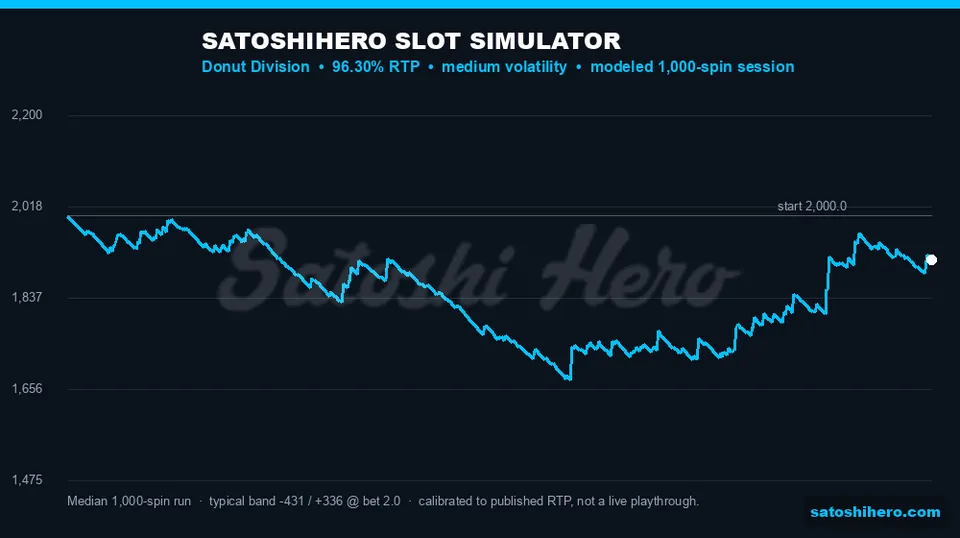
The model expects a feature-sized hit about once every 50 spins. A 100x+ win appears about once in 13,333 spins, so you shouldn’t expect one during a short session.
This is a many-session model, not a forecast for your next set of spins. Data shows the middle range can still include a meaningful loss, even before rare big-win math enters the picture.
Our 500-spin session
I played 500 spins at $2.00 from $5,000.00 and finished on $4,742.20. That put me down $257.80, a little worse than the simulator’s median but still inside its range.
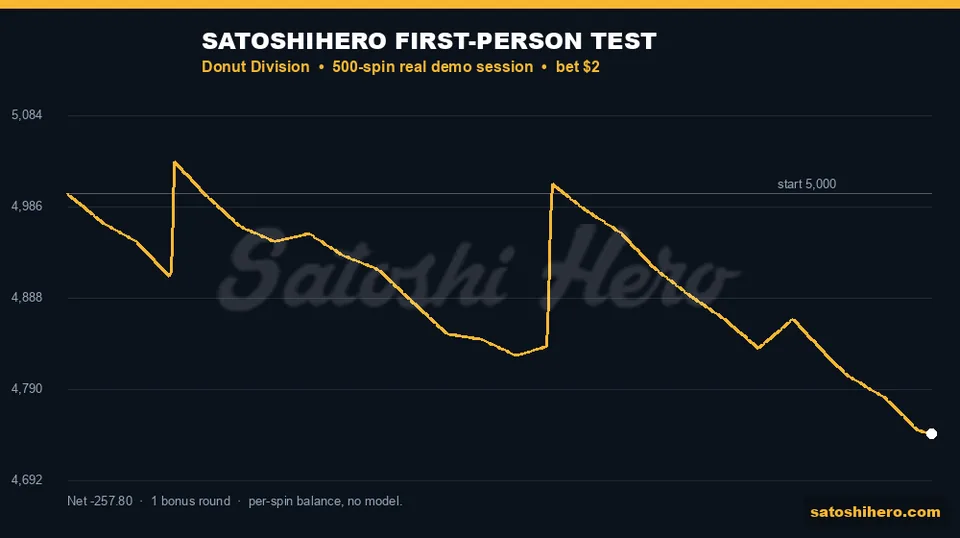
The static-live demo stopped after 442 spins with my balance at $4,821.60. I played the last 58 spins on another demo server, then joined the balance line by carrying the first result forward.
The base game stayed busy. Most Gooey Gun rows carried 1x to 3x, and typical wins sat around $0.20 to $3.40.
The Guns still delivered twice early. I hit $125.00 at spin 61, then took a $65.84 BIG WIN and a later $14.00 result from a 3x Gooey row.
Spin 279 brought the lone organic bonus. I picked Stakeout, watched a 12x full row pay $24.26, then finished the round at $178.80 after 10 free spins.
Warning: Medium volatility doesn’t mean low risk. This 500-spin test still finished $257.80 down despite a $178.80 bonus and a $125.00 base-game hit.
The 96.30% RTP is the operator-published theoretical return over simulated rounds. A single 500-spin live-style session doesn’t prove or disprove that return, and bonus-choice RTPs or FeatureSpins can sit slightly differently by design, including the 96.36% figure for Goo In Guns Glazing!.
The numbers make the slot feel fair enough on paper, but session results still depend heavily on stronger Gooey multipliers.
Frequently Asked Questions About Donut Division
What happened in 500 real spins of Donut Division?
I played 500 spins at $2.00 from $5,000.00 and finished on $4,742.20, down $257.80. One organic Stakeout at spin 279 paid $178.80, and a Gooey Gun hit paid $125.00 early on.
How do Gooey Guns work in Donut Division?
A Gooey Gun lands on reels 2 to 6 and fires Gooey Wilds to the left along its row. It then turns into a Wild itself, every fired Wild carries the Gun’s multiplier, and Guns on the same row add their values together.
Should you pick Warehouse or Stakeout in Donut Division?
The RTP is 96.30% either way. Warehouse is a flashlight hunt for multipliers on a dark board with 3 refilling lives, while Stakeout is 10 free spins with more Gooey Guns that always carry multipliers.
How did the Donut Division bonus buys do?
No Case Too Tough… cost $200.00, and my Warehouse pick paid $96.00. …No Donut Too Sweet cost $400.00, and my Super Stakeout pick paid $448.00.
What does the simulator predict for Donut Division?
Over 1,000 spins at $2.00, the median run ended $87.20 down. Most runs finished between $431.30 down and $336.00 up, so the model shows plenty of normal spread.
What are the RTP and max win of Donut Division?
The RTP is 96.30% whichever bonus you choose. The maximum win is 12,500x the bet, and the game can reach that cap in every mode.
Final Verdict
Donut Division stands out because the bonus choice actually changes how the feature feels. The drawback is simple: the same readable setup can still drain a session when multipliers stay small.

My Take
I’d play this at modest stakes and treat Stakeout as the clearest bonus path. Expect active base-game spins, but don’t mistake frequent Gooey Gun rows for guaranteed progress.
I like the way the game shows its math through rows, multipliers and visible bonus choices. I don’t like how quickly Warehouse can under-return after a paid entry, and my $96.00 result made that weakness obvious.
Donut Division earns trust through clear rules, exact numbers and testable features. SatoshiHero game data is updated periodically, and my test suggests the slot feels fair on paper but still swingy in practice.

Pros:
 Clear Line Play: The 19 paylines make every base-game result easy to track.
- Meaningful Bonus Choice: Warehouse and Stakeout give you different pressure and pacing.
- Active Base Game: Gooey Guns create frequent movement without hiding the result.
- Strong Test Detail: Real spin results show the slot’s swings clearly.

Cons:
 Paid Feature Risk: The $200.00 Warehouse buy returned only $96.00.
- Small Common Hits: Many Gooey Gun wins landed between $0.20 and $3.40.
- Sharp Buy Costs: Super routes raise pressure fast at the $2.00 stake.

Best For: Data-minded slot fans focused on visible mechanics, bonus decisions and medium volatility with bite get the most from this game. If you enjoy row multipliers and can set firm buy limits, the slot gives you enough structure to stay engaged.























































Bets
All Bets
Game
Player
Date
Wager
Mult.Multiplier
Prize
 Rich Piggies: Bonus Combo
 mdp0fxo
- 16:18:15
- 0×
- Royal Fruits 9: Hold 'n' Link
- nina87
- 16:18:14
- 0×
- Rich Piggies: Bonus Combo
- mdp0fxo
- 16:18:12
- 0×
- Rich Piggies: Bonus Combo
- mdp0fxo
- 16:18:12
- 0×
- Red Hot 50
 mbongigycolombe
- 16:18:11
- 0×
- Merry Cash Splash: Hold 'N' Link
- Hidden
- 16:18:11
- 0.49×
- Merry Cash Splash: Hold 'N' Link
- Hidden
- 16:18:11
- 0×
- Red Hot 50
- mbongigycolombe
- 16:18:10
- 0×
- Merry Cash Splash: Hold 'N' Link
- Hidden
- 16:18:10
- 0×
- Merry Cash Splash: Hold 'N' Link
- Hidden
- 16:18:10
- 0×