

Ze Zeus
RTP94.23%
VolatilityMedium
Max winx10,000
Hit rate32.49%
ThemeAncient civilizations
ReleasedJun 2024

Lightning, Coins and Cluster Chaos on Olympus
Ze Zeus slot turns a bright Olympus grid into a cluster game built around cascades, coins and Zeus-powered collection symbols.
Ze Zeus is a medium volatility slot from Hacksaw Gaming with 96.34% RTP and 10,000x max win potential. The game uses a 6-reel, 5-row cluster grid with Super Cascades and Divine Squares. Feature-led slot fans get steady coin action, bonus tiers and a Ze Zeus slot demo path on SatoshiHero. Stakes run from $0.10 to $100.00 per spin, so the same feature set works across cautious demo sessions and higher-stake real play.
Key takeaways
- Best bonus: What If Zeus Was One Of Us? returned $164.80 from a $200 buy at a $2 stake, so it entertained but still missed cost.
- RTP / volatility: Ze Zeus slot carries 96.34% RTP and medium volatility, which matched my steadier test pace.
- Max win: The top prize reaches 10,000x, so the ceiling stays serious without high-volatility brutality.
- Risk note: Bonus buys compress risk because you pay 100x or 250x before seeing a spin.
- Bankroll note: My 500-spin run gained $186.80, but that hot feature pace shouldn’t shape your expectations.

Table of Contents
- How Ze Zeus slot Works
- Cluster wins
- Symbol values
- Super Cascade System
- Full-symbol clears
- Chain potential
- Theme & First Impressions
- Olympus setting
- Visual clarity
- Divine Squares and Coin Collects
- Coin reveal values
- Collectors and multipliers
- Free Spins
- Three bonus tiers
- Upgrade potential
- Bonus Buy Tested
- Buy prices
- Test result
- How the 500 Spins Played
- Session result
- What stood out
- RTP, Volatility & Our Ze Zeus slot Test
- Simulator projection
- Our 500-spin session
- Frequently Asked Questions About Ze Zeus
- Final Verdict
How Ze Zeus slot Works
Ze Zeus slot pays through connected clusters across a 6-reel, 5-row grid, not fixed paylines. You need five or more matching symbols touching anywhere on the board. That means you watch the whole layout, not just the centre. The format makes every refill matter because a symbol dropping near the edge can still connect into a paid group.
Cluster wins
Clusters can form in corners, across the middle or down awkward side paths. I like that because weak-looking boards can still connect after drops. You also get a clean view on mobile and desktop, so clusters, coins and wilds stay easy to track.
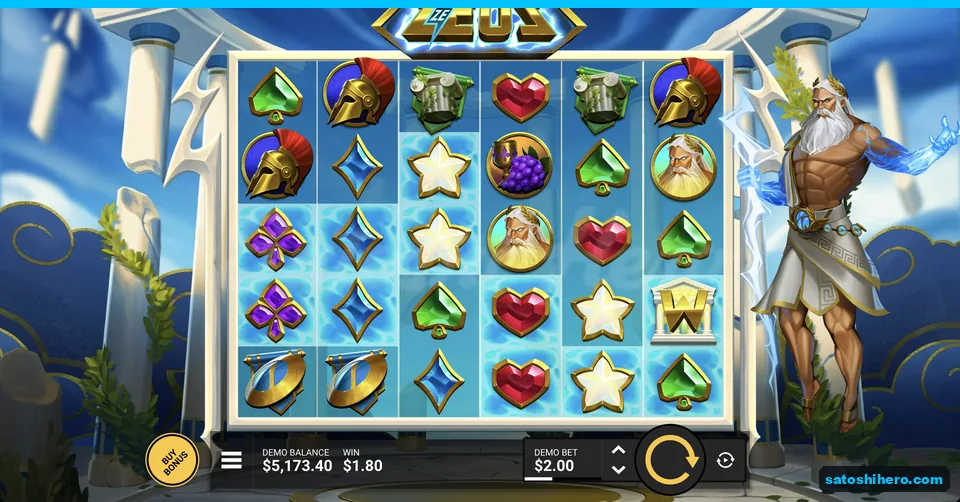
This isn’t a lines game, and that matters for bankroll feel. Xpander can appeal if you like board-wide mechanics, while this Olympus grid puts the focus on clusters and coin collection. You should scan every symbol before judging a spin. A single paid cluster can become more useful than its first value suggests because it also sets up the clear, the refill and any Divine Square activity that follows.
Symbol values
The low symbols are green, blue and purple gems, a red heart and a gold star. At my $2 stake, those symbols paid $30.00 for thirteen or more and $0.20 for five. That spread makes small hits common, but the paytable doesn’t flatter every cluster. The lower tier felt most useful when it opened room for a cascade or lit several spaces behind the win.
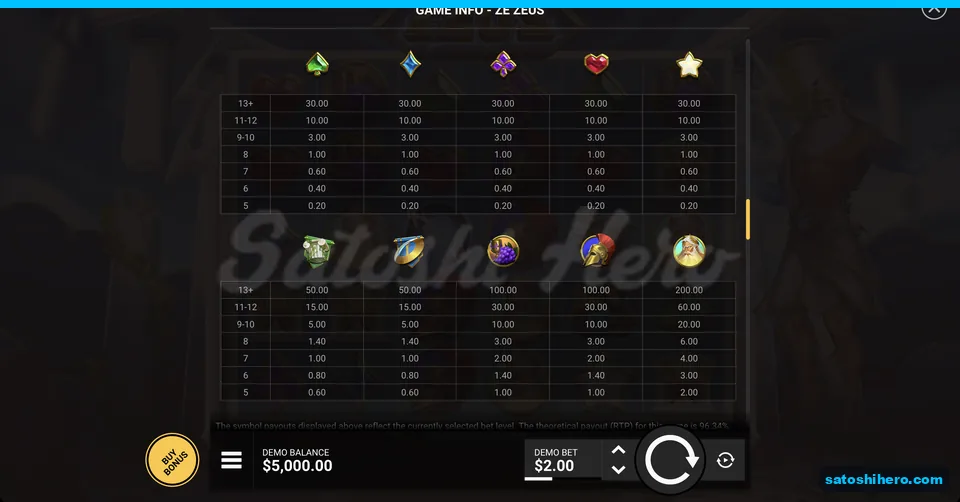
Premiums carry the better numbers. The green scroll and gold lyre paid up to $50.00, grapes and the spartan helmet paid up to $100.00, and the golden laurel wreath reached $200.00 for thirteen or more. The gold W wild substitutes for paying symbols, while FS scatters open the bonus tiers.
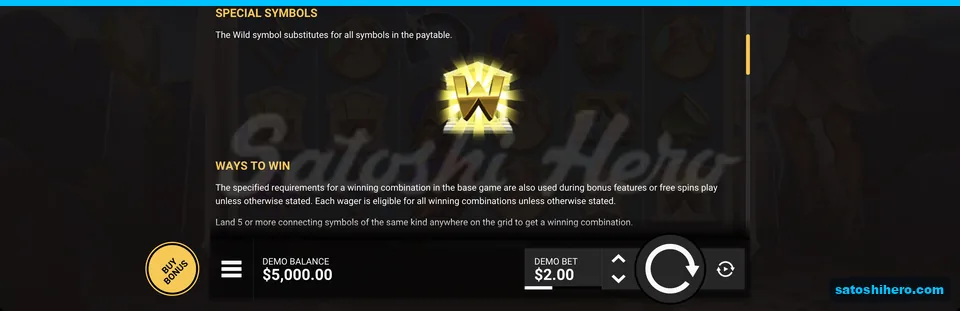
You don’t need a paylines mindset here. Watch the full grid, because one wild in the right spot can turn loose symbols into a paid cluster. The best base-game moments came when the wild did not just finish a cluster, but also helped clear enough of one symbol type to create a wider refill.
Super Cascade System
Super Cascade clears every regular symbol of the winning type after a cluster pays. It doesn’t only remove the connected winning block, which gives small hits more room to grow. You can see why that changes the feel of each spin. The mechanic also makes low-symbol wins less disposable, because a cheap cluster can still remove a large number of matching symbols from the whole grid.
Full-symbol clears
A green gem cluster, for example, removes all regular green gems from the grid. New symbols then drop into those empty spaces. That wider clear gives the base game most of its rhythm, and I found it more engaging than a basic collapse.
You shouldn’t expect every clear to become a big chain. Many cascades stop quickly, and that keeps the feature honest. Still, the mechanic adds motion even when the first hit looks modest. It also helps explain why the board can feel busier than a standard cluster slot, because the game is checking the whole symbol type rather than only one connected patch.

Key Stat: A Super Cascade clears all regular symbols of the winning type from the grid, not only the paying cluster.
Chain potential
Extra clusters can form from the refill after each clear. That makes a dull-looking paid spin more interesting, especially when several low symbols vanish at once. You get a fair amount of visual feedback before the result settles.
Numbers indicate the feature works best as a base-game pace builder, not a jackpot engine by itself. I liked the way it kept small wins alive without pretending every spin had huge potential. The mechanic gives the base game most of its movement. In practical terms, I treated cascades as a way to extend ordinary spins and create more chances for feature symbols to matter, not as the main path to the 10,000x ceiling.
Theme & First Impressions
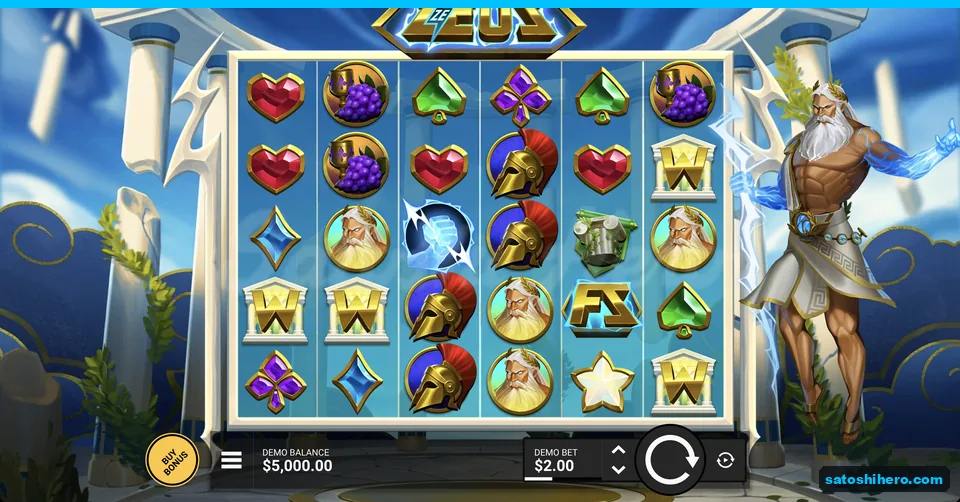
The game places a cloud-wrapped Mount Olympus grid inside marble columns, with Zeus throwing lightning beside the reels. You get polished gems, laurels, Greek relics and electric-blue feature glow. The Zeus angle won’t win originality awards, but the execution stays clean.
Olympus setting
Zeus looks bold without taking over the board. The symbols use simple shapes and bright colours, so you can read clusters quickly. That matters because the coin engine can make the grid busy once features start firing.
Le Zeus gives mythology fans another Olympus-style take, though this game feels more focused on coin collection than pure theme. The Zeus Ze Zecond comparison also makes sense if you care about Zeus branding and tone. I prefer this game’s clearer grid.
Visual clarity
The board stays readable during cluster wins, coin reveals and wild connections. That sounds basic, but many feature-heavy slots make you squint. Here, you can follow the action without needing to pause every drop.

Insight: Mount Olympus themes often lean on lightning and marble, but clarity matters more than decoration when clusters and coin reveals share the same grid.
Hacksaw’s art style keeps the familiar theme from becoming dead weight. You get enough spectacle to feel the setting, but not so much that the mechanics get buried. The game looks familiar and plays clearly enough to support its busy feature system. I also liked that the Zeus character sits to the side instead of blocking the reels, because the important information remains on the grid and in the win readouts.
Divine Squares and Coin Collects
Divine Squares create the main coin engine after wins light up the squares behind paying symbols. Hand of Zeus activates those squares, then coins, multipliers or collectors can appear. You need that activation step, so lit squares alone don’t pay. That makes the feature feel tense in a useful way, because a promising board still needs the right symbol to convert potential into money.
Coin reveal values
Bronze coins show 0.2x to 4x, Silver coins show 5x to 20x, and Gold coins show 25x to 500x. Those values add together and pay as a multiple of your bet. I liked how even smaller coin hits made the base game feel less flat.
You should still treat coin reveals as bonus texture, not guaranteed rescue. The best screens need useful activations, not just several lit spaces. In my session, these hits topped up the balance between bonus triggers and kept the grind moving. The lower coin values helped soften dead patches, while the higher colours created the moments where I actually leaned in and watched the collector symbols closely.

Strategy Insight: Watch for Hand of Zeus and Vessel of Wealth together. Divine Squares only matter when the game activates or collects their values.
Collectors and multipliers
Zap of Zeus can multiply adjacent coins by x2 to x10. Vessel of Wealth collects every coin and vessel value on screen. That combo gives the feature real punch when the grid holds enough values.
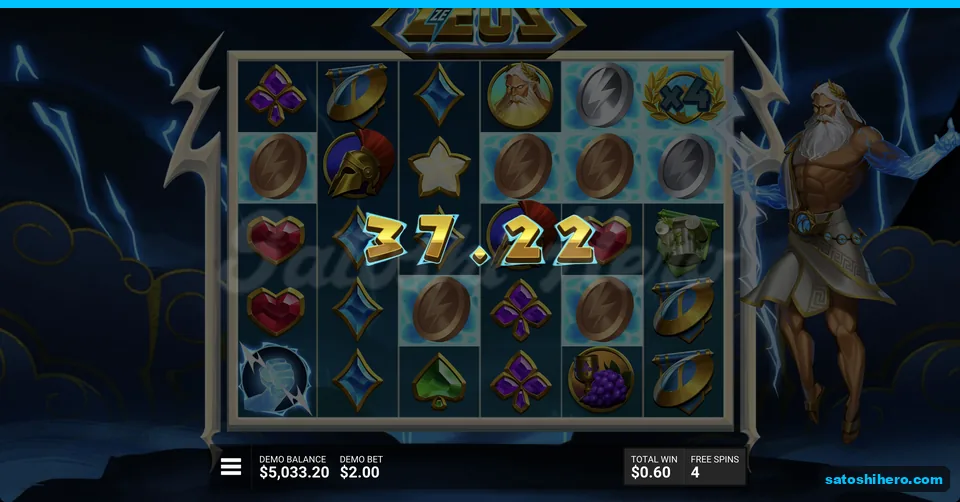
I don’t love waiting on lit squares that never convert, but that tension gives the system its edge. You can feel the difference between a basic cluster win and a cluster that creates useful squares. The coin engine gives the slot its personality. It also makes the bonus rounds easier to judge while they play, because every activated square, multiplied coin and collected value changes the shape of the result before the final screen arrives.
Free Spins
Three FS scatters trigger What If Zeus Was One Of Us?, four trigger Ze Zeus Take the Wheel, and five trigger Ze Zeus Might Superstar. Each tier improves how Divine Squares behave. You can judge the bonus before it starts because scatter count matters.
Three bonus tiers
What If Zeus Was One Of Us? gives 8 free spins, with Divine Squares staying lit until Hand of Zeus activates them. Take the Wheel gives 12 free spins, and those squares stay lit for the full round. Might Superstar gives 12 free spins, a guaranteed Hand of Zeus every spin and no Bronze coins.
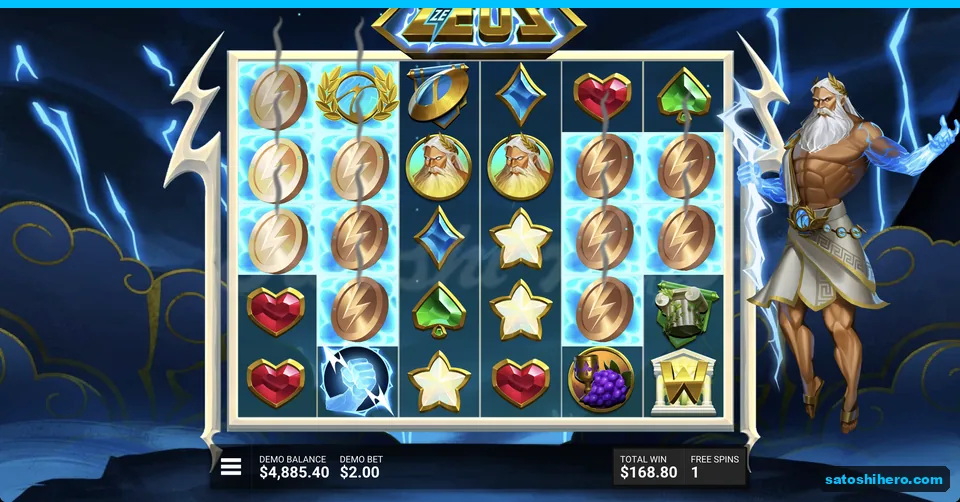
That top mode sounds clearly stronger, and the design backs that up. Removing Bronze coins raises the value profile, while the guaranteed Hand helps activation pace. You still need coin values and collectors to line up well. The middle tier also matters because persistent squares give the round more time to convert early wins into later collections.
Upgrade potential
Extra scatters inside a round can add spins. Four scatters can upgrade the lower mode to Take the Wheel, which made a real difference in my test. One triggered bonus upgraded and paid $229.80, my biggest 500-spin hit.
That Ze Zeus slot demo session showed why scatter count feels meaningful before the round starts. You don’t just wait for any bonus, you care about which tier opens. The upgrades make scatters feel important before the first free spin lands. A three-scatter trigger can still become memorable, but four or five scatters change the expectation immediately because the Divine Square rules improve before the first result appears.
Bonus Buy Tested
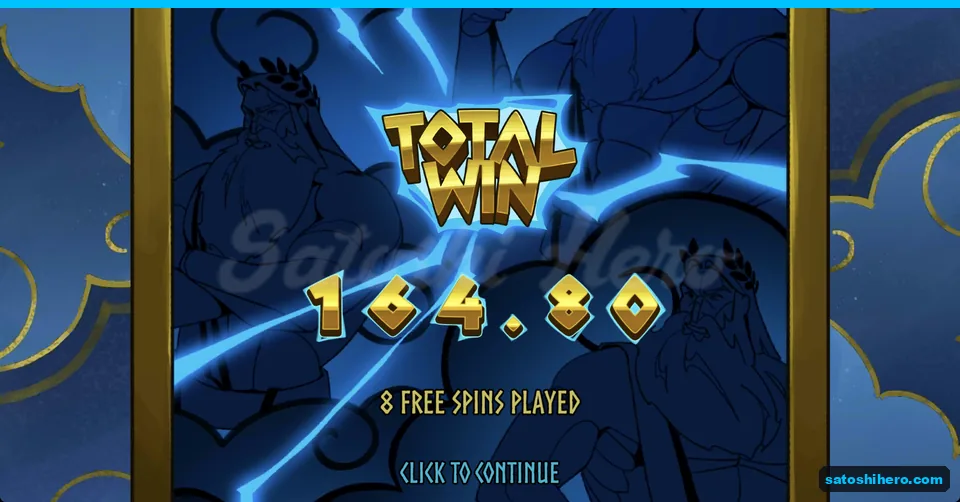
The tested What If Zeus Was One Of Us? buy returned $164.80 from a $200 cost at a $2 stake. That result felt entertaining, but it still lost against the buy price. You get action quickly, yet you also pay for that shortcut.
Buy prices
What If Zeus Was One Of Us? costs 100x the bet. At my $2 stake, that meant a $200 buy from a clean $5,000 balance. Take the Wheel costs 250x the bet, so the same stake would price it at $500.
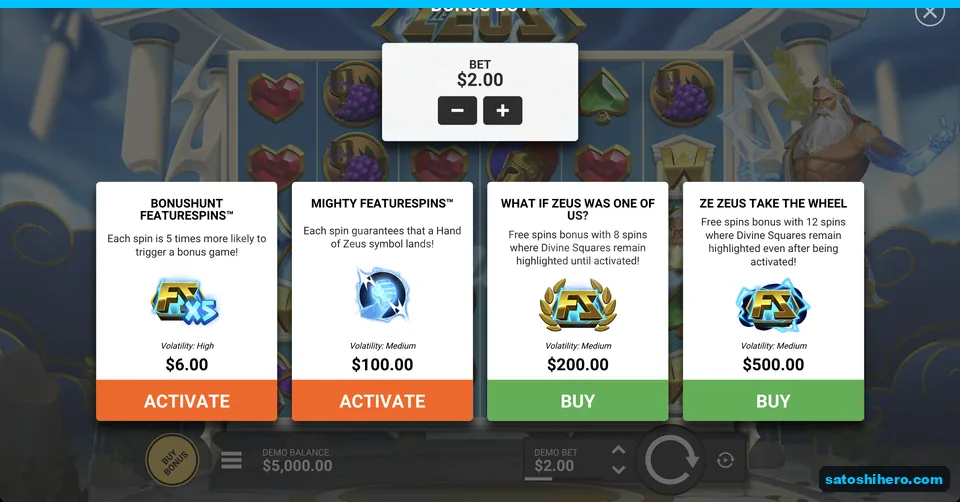
Might Superstar can’t be bought directly. That matters because the strongest free-spin tier stays locked behind five scatters in normal play. Bonushunt and Mighty FeatureSpins appeared as premium per-spin options at $6.00 and $100.00 in the menu. I treated those menu options as risk controls rather than upgrades you should automatically press, because each one changes how quickly the play-money balance moves.

Warning: The tested buy looked entertaining, but it still returned less than the $200 price. Bonus buys can drain a bankroll faster than normal spins.
Test result
The buy opened 8 free spins with Divine Squares staying lit until Hand of Zeus activated them. A mid-round Hand of Zeus trigger created a Mega Win of $139.82 from a grid full of coins. The round closed at $164.80, equal to 82.4x the bet.
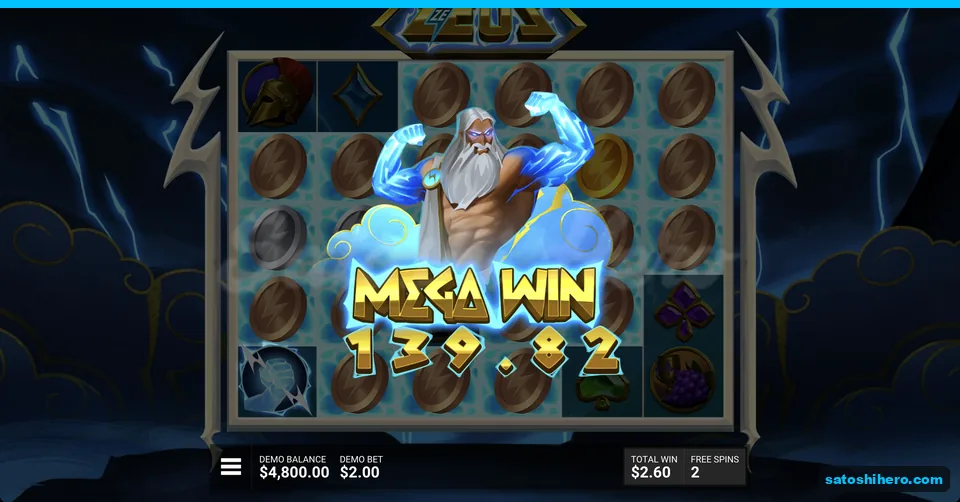
I wouldn’t call that poor, but it wasn’t profitable. You got a full-feature sample with coins, activation and a meaningful headline hit. The buy fits aggressive bankroll choices because it compresses risk into one upfront cost. I would rather use the buy as a controlled demo of the feature than a default way to play, since even a good-looking round can finish below price.
How the 500 Spins Played
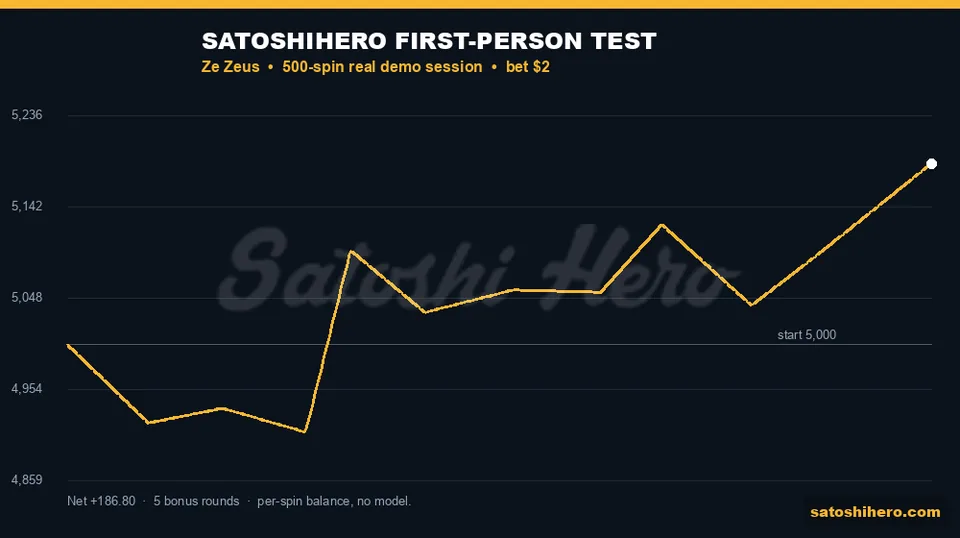
My 500-spin test at $2 started from $5,000.00 and ended at $5,186.80. That produced a $186.80 gain. You should treat that as one lively run, not a normal outcome. The result came from feature frequency and steady coin top-ups, not from one huge hit carrying the whole session.
Session result
The bonus triggered five separate times across the session. One round upgraded to Take the Wheel and paid $229.80, which became my biggest hit. Divine Square coins also topped up the balance during base play.
I liked the rhythm because the session stayed above water almost the whole way. That doesn’t make the slot soft, though. It means this specific run landed on the generous side of its variance curve. The useful part of the test was seeing how often small feature payments interrupted the base grind, because that shaped the session feel more than the final profit number alone.
What stood out
The game felt feature-friendly during my test, with enough coin collects to break up dry patches. That matched medium volatility better than a brutal high-volatility grind. If you prefer direct risk choices, Limbo strips the experience down to a simpler multiplier chase, while this game gives visible progress through clusters and coin features.
You still need patience because the biggest prizes sit far above normal bonus returns. My best hit landed at $229.80, not near the ceiling. The test showed the game at its livelier end, not its guaranteed rhythm. I came away liking the pace, but the gap between my best bonus and the top prize shows how much space sits between a good session and the rare headline result.
RTP, Volatility & Our Ze Zeus slot Test
Ze Zeus slot has 96.34% RTP, medium volatility and a 10,000x max win. Those numbers frame the game before you judge any single session. You should use them as context, not a forecast.
Simulator projection
Our simulator model ran 1,000 spins at $2 and showed a median result about $86.40 down. The middle 90% band stretched from roughly $430.60 down to $337.00 up. That spread fits a medium-volatility slot with meaningful bonus swings.
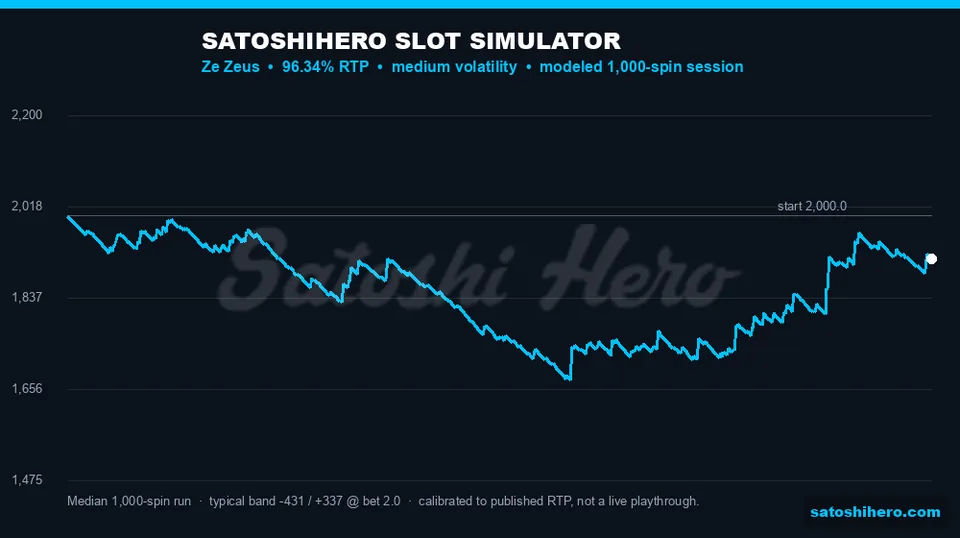
The model placed a bonus about once every 50 spins. A 100x-plus win appeared about once every 13,000 spins. Numbers indicate the game can feel active while still making larger outcomes rare. That mix matches my table experience, where several bonuses arrived but the biggest return stayed in normal feature territory.
Insight: A 96.34% RTP is a theoretical return, not a session target. A 500-spin test can land above or below it very easily.
Our 500-spin session
My real run finished $186.80 up after five bonuses and a $229.80 best hit. That result beat the simulator median, but it doesn’t change the math. One session can land hot, cold or somewhere boringly close to flat.
Testing notes and simulator checks are checked regularly when new play data or settings checks justify it. The theoretical RTP is the operator-published figure, a single live or demo session has no bearing on return, and bonus-buy or feature-spin settings can sit slightly differently from the base game by design. Treat the math as context, not a forecast. For my own staking, the lesson is simple: the base game can stay entertaining, but buys and premium spins deserve a separate limit before the first click.
Frequently Asked Questions About Ze Zeus
What is the RTP and top win of Ze Zeus slot?
Ze Zeus slot has 96.34% RTP and a maximum win of 10,000x your bet. The volatility is medium, so the swings felt moderate in my test rather than punishing. You still need a bankroll that can handle bonus gaps.
How do the free spins work in Ze Zeus slot?
Three FS scatters trigger What If Zeus Was One Of Us? with 8 free spins. Four scatters trigger Take the Wheel with 12 free spins, while five trigger Might Superstar with 12 spins and a guaranteed Hand of Zeus every spin. Extra scatters can add spins during a round.
What are Divine Squares in Ze Zeus slot?
Divine Squares appear behind winning symbols after a paid cluster. Hand of Zeus can activate them into Bronze, Silver or Gold coins, Zap of Zeus can multiply adjacent coins from x2 to x10, and Vessel of Wealth collects every coin and vessel value on screen. You need activations and collectors to turn those squares into strong results.
Can you buy the bonus in Ze Zeus slot?
Yes, What If Zeus costs 100x the bet, and Take the Wheel costs 250x the bet. At my $2 stake, those prices meant $200 and $500. Might Superstar can’t be bought directly, so five scatters must trigger it in normal play.
Is Ze Zeus slot a cluster slot?
Yes, Ze Zeus slot uses a 6×5 cluster setup. Five or more connected matching symbols create wins anywhere on the grid. Super Cascade then clears every regular symbol of that winning type.
What happened in your 500 spin test of Ze Zeus slot?
I started with $5,000.00 at $2 spins and finished at $5,186.80. That made a $186.80 gain, with five bonus rounds and a $229.80 best hit. My bought What If Zeus round returned $164.80 from a $200 buy.
Final Verdict
Ze Zeus stands out because it mixes cluster wins, full-symbol cascades and a clear coin-collection engine. Its main drawback is simple: the best features still need timing, and the tested bonus buy didn’t cover its cost.

My Take
Medium-volatility slot fans get a lively game with visible progress, not just dead spins and waiting. I’d play it with measured stakes and treat bonus buys as entertainment, not a shortcut. The math suggests patience matters more than chasing the next Hand of Zeus.
I like the way Divine Squares kept my balance alive during the 500-spin test. I don’t like how a strong-looking $139.82 Mega Win still left the $200 buy short. That mix tells you plenty about the game’s appeal and its risk. The strongest reason to try it is the readable feature flow, while the clearest reason to stay cautious is how quickly the paid shortcuts can underperform.
The Ze Zeus slot guide here stays grounded in real test notes, simulator checks and exact game settings, with figures updated periodically.

Pros:
 Clear cluster play: Whole-grid wins make every symbol position matter.
- Active coin engine: Divine Squares add interest between bonus rounds.
- Fair volatility feel: Medium swings made my test easier to manage.
- Useful bonus tiers: Scatter count changes the round before it starts.

Cons:
 Buy risk: The tested $200 buy returned only $164.80.
- Familiar theme: Zeus visuals look clean but not very original.
- Rare big jumps: The simulator placed 100x-plus wins far apart.

Best For: Cluster-slot regulars and coin-feature fans get the most from this game. You’ll enjoy it more if you like watching grids build through cascades, lit squares and collectors. Keep stakes controlled, because even medium volatility can punish rushed bonus buying.
Similar Games




























































Bets
All Bets
Game
Player
Date
Wager
Mult.Multiplier
Prize
 Luck of Panda: Bonus Combo
 Hidden
- 18:35:36
- 0×
- San Chong Baozha Blue: Bonus Combo
 mike_721
- 18:35:36
- 0.74×
- Blazing Stallion
 whodey39311
- 18:35:33
- 0.39×
- Luck of Panda: Bonus Combo
- Hidden
- 18:35:33
- 0×
- San Chong Baozha Blue: Bonus Combo
- mike_721
- 18:35:33
- 1.2×
- Blazing Stallion
- whodey39311
- 18:35:31
- 0×
- Blazing Stallion
- whodey39311
- 18:35:30
- 0.39×
- Luck of Panda: Bonus Combo
- josh1998
- 18:35:30
- 0×
- Luck of Panda: Bonus Combo
- Hidden
- 18:35:30
- 0×
- San Chong Baozha Blue: Bonus Combo
- mike_721
- 18:35:30
- 0×