

Lobster Hot Pot
By pressing play, you agree that you are above legal age in your jurisdiction and that your jurisdiction allows online gambling.

Lobster Hot Pot
RTP94.2%
VolatilityMedium
Max winx2,000
Lines10
Hit rate14.05%
ThemeFood
ReleasedNov 2023

Diving for Loaded Lobster Pots
Lobster Hot Pot slot drops its reels beneath a fishing boat and turns each bonus into a race to collect Fish prizes.
This Gaming Corps underwater fishing game uses a 5×3 grid, 10 fixed paylines, medium volatility, 96.24% RTP, and a 2,000x max win available only in Free Spins. I started the SatoshiHero demo with $1,000.00, made 100 manual $0.20 spins, and finished at $1,001.50, up $1.50 or 7.5x. Two Free Spins rounds drove the result, while most base wins stayed small.
Key Takeaways
- Best bonus: Standard spins were my only tested mode, so Lobster Spins remained disabled and unranked.
- RTP / volatility: The theoretical RTP is 96.24%, paired with medium volatility.
- Max win: The 2,000x cap can occur only inside Free Spins.
- Risk note: The model ranged from a $43.00 loss to a $32.70 gain across 1,000 $0.20 spins.
- Bankroll note: Lobster Spins raises each selected $0.20 wager to $0.30, so budget for that full price.

Table of Contents
- How the Lobster Hot Pot slot Works
- Symbol values
- Theme Beneath the Boat
- Lobster Spins Booster
- Free Spins Results
- First trigger
- Second trigger
- Wild Collect
- Lobster Grab
- Lobster Hotpot
- Resolution order
- RTP, Volatility and Our Test
- Simulator projection
- Our 100-spin session
- Frequently Asked Questions About Lobster Hot Pot
- Wrap-Up
How the Lobster Hot Pot slot Works
Lobster Hot Pot slot is a traditional 10-payline game, not a cluster or pay-anywhere setup. You need matching symbols on adjacent reels, beginning at the leftmost reel. Only the highest combination on each drawn line pays. I find that structure easy to read because you can trace every result against a fixed path.
The 5×3 grid shows all 10 lines through the paytable controls. Every listed value uses the total wager as its base, so a 2x line at $0.20 returns $0.40. I captured that exact result during extra spins after my counted test. It appears in the image below, but I excluded it from the 100-spin totals.
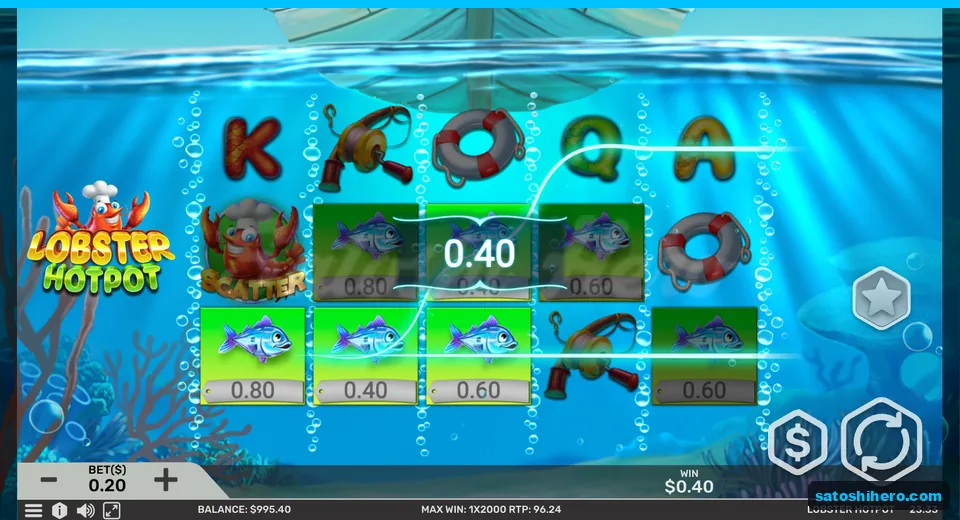
You can play the free demo or switch to real play on the SatoshiHero game page. The game displays the stake and payout clearly, which helps you check the multiplier without mental guesswork. Honestly, fixed lines feel plain beside the bonus engine, yet their clarity keeps the base game understandable.
Symbol values
The regular paytable scales directly with your selected total stake:
- Fish Tackle: 200x for five, 20x for four, 5x for three, and 0.5x for two.
- Rubber Ring: 100x for five, 15x for four, and 3x for three.
- Fishing Rod: 50x for five, 10x for four, and 2x for three.
- Bait Box: 50x for five, 10x for four, and 2x for three.
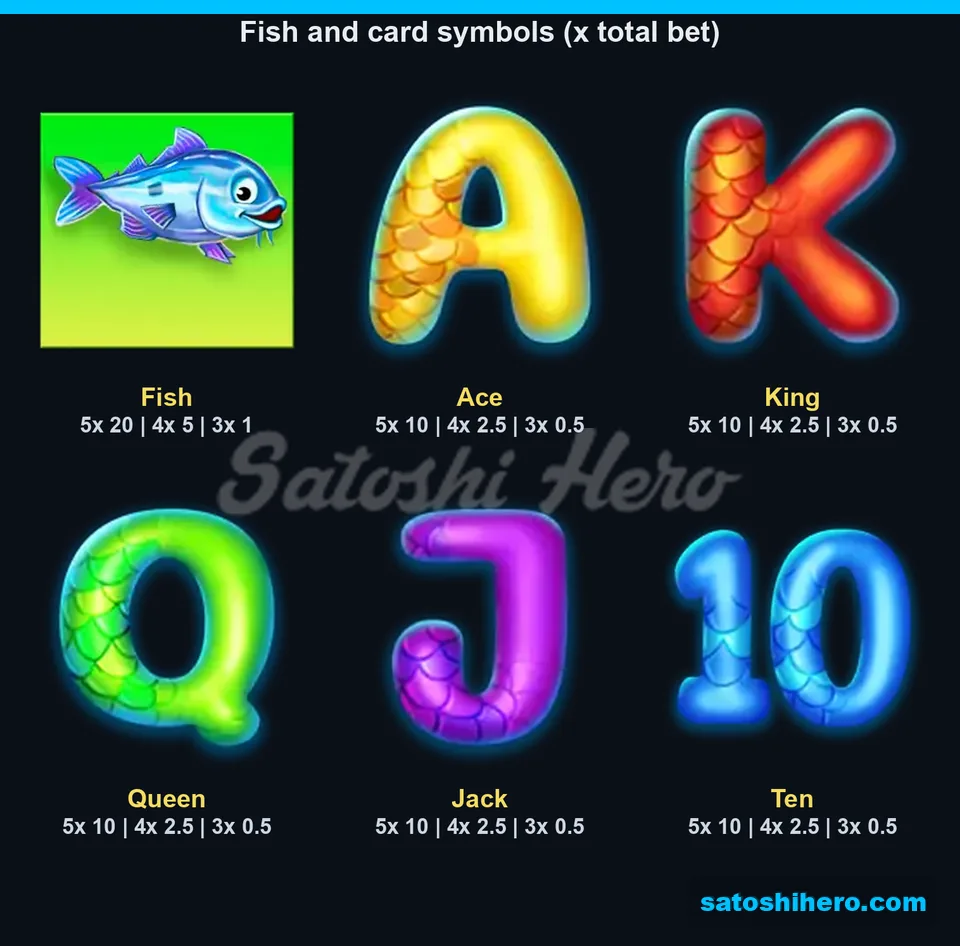
- Fish: 20x for five, 5x for four, and 1x for three.
- A, K, Q, J, and 10: 10x for five, 2.5x for four, and 0.5x for three.
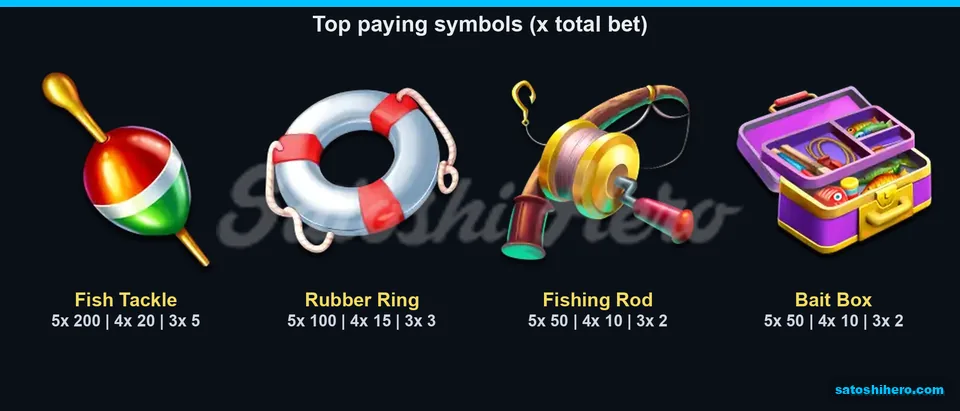
Five Fish Tackle showed $40.00 at my $0.20 stake, confirming the 200x top regular-symbol value. At the opposite end, my smallest $0.10 results equaled 0.5x. You won’t mistake those tiny line returns for feature wins, and that contrast gives the bonus most of its drama.
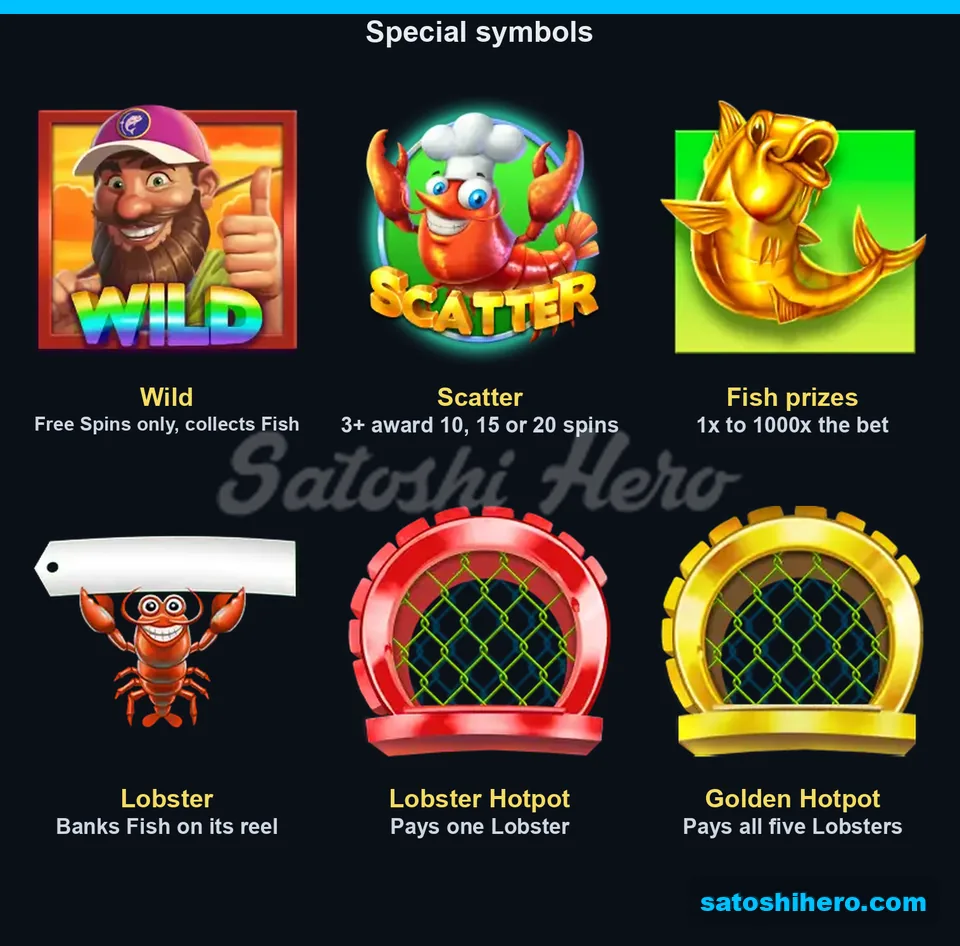
The chef-lobster Scatter can appear on any reel. A smiling fisherman acts as the Wild, but he appears only during Free Spins and replaces everything except the Scatter. Those special symbols carry far more weight than the ordinary tackle.

Stat Check: The 200x Fish Tackle line is the largest listed regular-symbol payout, while the 2,000x game maximum is confined to Free Spins.
Regular symbols keep the balance moving between bonuses, but Free Spins contain the real payout engine. In my run, that gap felt obvious after several $0.10 to $0.40 base returns.
Theme Beneath the Boat
The reels hang beneath a wooden boat, placing you inside bright blue water as bubbles drift between the columns. A cartoon chef lobster waves beside the grid, while floats, life rings, rods, and bait boxes fill the paytable.
Green Fish tiles carry prize tags and signal the collection system before you learn its rules. They stand apart from the regular tackle without crowding the screen. Inflated A, K, Q, J, and 10 symbols use fish-scale textures, giving low symbols more personality than flat card letters.
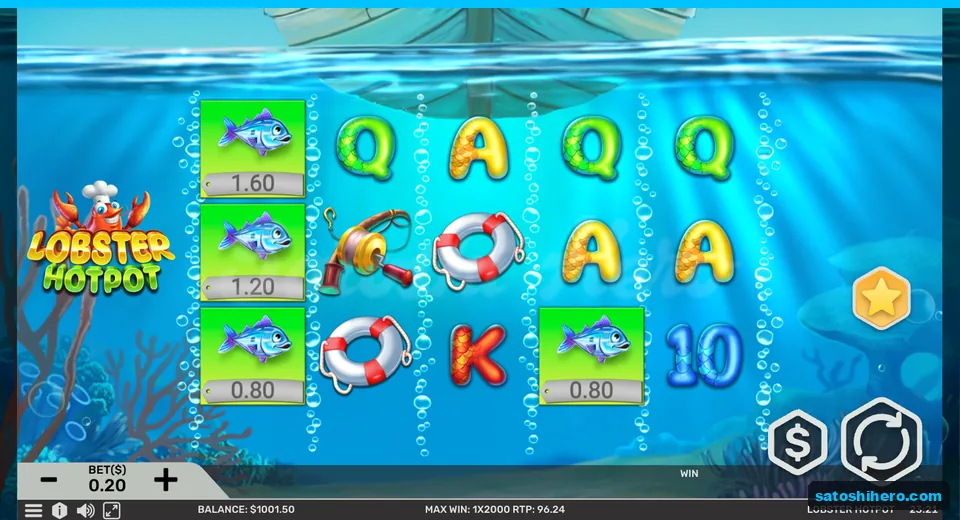
The settled screen also shows the $0.20 stake and my $1,001.50 ending balance. You can see the full 5×3 layout and green Fish tiles at once. This clean hierarchy matters because busy Free Spins can combine several feature symbols on one result.
Ice Lobster offers another icy take on lobster imagery, whereas this game stays beneath a warm blue sea. Lobster House also leans into a character-led lobster setting, though this one makes the chef a bright visual anchor beside the reels. I wouldn’t claim shared mechanics from appearance alone.

Fun Detail: Placing the reels beneath the boat makes your viewpoint feel submerged, rather than positioned on the deck.
The fishing concept won’t win originality prizes, and it has nothing to do with lobster balls hot pot or cooking. Still, the bold palette and expressive lobster make every important symbol readable. That visual order beats novelty once the feature sequence gets busy.
Lobster Spins Booster
Lobster Spins doubles the chance of triggering Free Spins, but every boosted spin costs 1.5 times your selected stake. A chosen $0.20 wager becomes $0.30 immediately. I kept the booster disabled throughout my 100-spin session.
The documented benefit concerns trigger chance alone. It doesn’t change Fish values, feature payouts, the theoretical return, or the payout ceiling. Let me be real: the trade-off sounds simple, yet a 50% price increase can drain a fixed budget much faster.
I don’t have a boosted result to compare. My two observed Free Spins triggers came from standard $0.20 play, so you shouldn’t treat them as evidence for the booster.

Beware: Lobster Spins increases every spin’s cost by 50%. Set your budget using the boosted $0.30 price, not the standard $0.20 stake.
Think of the mode as an optional exchange between spin cost and more trigger opportunities. It doesn’t promise that extra access offsets the added spend. Since I didn’t test it, I would set a firm total outlay before enabling the switch.
Free Spins Results
Three, four, or five Scatters award 10, 15, or 20 Free Spins. My two observed rounds paid $8.80 and $4.20, making them the session’s strongest feature events. Each feature runs automatically at the triggering stake, so you don’t select a new wager inside it.
An extra Scatter adds one spin, and retriggers can extend the round to 50 spins. The Wild, Fish prizes, Lobsters, and Hotpots all become active here. That concentrated design makes the base game feel sparse, but it also gives each trigger a clear change of pace.
First trigger
Spin 20 landed three Scatters and opened 10 Free Spins. Two extra Scatters added one spin each, extending my round to 12. It returned $8.80, equal to 44x my $0.20 wager, and became my biggest result.
The strongest single Free Spin paid $6.00, or 30x, inside that first round. Watching most of the round’s value arrive through one result underlined how uneven a short feature can feel. I liked the layered symbols, though the automatic sequence moved quickly.
Second trigger
Spin 83 started another 10-spin feature and paid $4.20, equal to 21x. It arrived after my balance dipped below its starting point, so the timing made the session feel more dramatic. You shouldn’t read that rescue as a repeatable pattern.
Two triggers across 100 counted spins form a short observation, not a published trigger rate. Your run can behave very differently because each spin resolves independently. My result records what happened once, nothing more.

Player Hint: Read the feature as a sequence. Fish prizes build or pay according to the symbols present, then any relevant Hotpot settles a Lobster stack automatically.
The two rounds shaped my profitable finish, while standard line wins mostly filled the gaps. I found them entertaining, but they can’t forecast the next session.
Wild Collect
A fisherman Wild landing with at least one Fish tile collects and pays every visible Fish prize. Those Fish values range from 1x to 1,000x the total stake, and collection only works during Free Spins. I didn’t record a standalone Wild Collect amount, so you can’t compare it alone.
The Wild also substitutes for every symbol except the Scatter. That gives it two distinct jobs:
- It can complete ordinary left-to-right payline combinations.
- It can collect every visible Fish prize on the same spin.
No Fish collection applies in the base game, even when green Fish tiles appear there visually. The restriction makes the ordinary reels less eventful than the feature. In my view, that choice keeps the rules clean but withholds too much action between triggers.
I won’t attach an invented payout to it. My session evidence supports only the overall round totals and best single Free Spin. You can still see its potential: more visible Fish create more value for one collecting Wild.
Wild Collect doesn’t automatically change stored Lobster stacks. Both systems follow the documented event order only when the required symbols share a spin. That collection role gives the fisherman more influence than a standard substitute, and it creates the feature’s sharpest instant-pay moment.
Lobster Grab
Five Lobsters build stored stacks during Free Spins, with one Lobster assigned to each reel. Every stack begins at 1x the total wager. I tracked them separately because each reel keeps its own running value.
When a Fish lands without the Wild, the Lobster on that same reel grabs its prize. It adds the Fish value to its stack instead of paying it immediately. This one-reel relationship makes the screen readable, though the delayed reward adds tension.
A stack remains stored until the matching red Hotpot or a golden Hotpot settles it. That means a high stored amount isn’t cash in your balance yet. You still need the correct pot event before the accumulated value turns into a payout.
Lobster Grab forms part of the automatic Free Spins sequence. It isn’t a separate bonus, a purchase, or a player decision. I like the build-up because you can follow five small stories across the reels, but you can’t control which one gets paid.
During my two rounds, the mechanic supported the combined $8.80 and $4.20 feature totals. I didn’t isolate each grab as a separate logged amount, so those round figures remain the honest evidence. The key practical point stays simple: a valuable stack still needs a Hotpot before it counts.
Lobster Hotpot
A red Hotpot pays the Lobster stack on its own reel, while a golden Hotpot pays all five stacks. Any paid Lobster resets to its starting 1x value. In my rounds, every settlement happened automatically without a cash-out choice.
Red pots gain importance after their matching reel builds a strong total. When one lands, it settles only that reel and resets only that Lobster. A weak matching stack produces less excitement, which makes the feature’s timing matter even though you have no control.
Golden pots resolve every stored stack together, then reset all five Lobsters. That’s the cleaner full-screen event and the one I most wanted to see with several loaded reels. Honestly, this all-stack collection is the bonus engine’s strongest idea.
Resolution order
Busy spins resolve in a fixed sequence you can follow:
- If Fish and a Hotpot land together, Lobster Grab adds the Fish first, then the Hotpot pays.
- If the Wild, Fish, and a Hotpot land together, Wild Collect pays first, then the Hotpot settles its stack.
That order prevents a same-spin Fish from missing the relevant payout stage. It also explains why several animations can run before the final total appears. You only watch the sequence; every grab, collection, settlement, and reset happens automatically.
The layered engine creates the route toward the 2,000x ceiling, although my test never approached that cap. Restricting it to Free Spins leaves standard play comparatively plain. Hot to burn keeps its appeal rooted in simpler fiery slot action, while this game asks you to follow stored reel values.
Hot To Burn Multiplier points more directly toward multiplier-led play, whereas the pots here settle accumulated stacks. Hot to Burn Extreme presents another choice for a hotter visual style without implying the same feature logic. Those contrasts make the automatic Lobster and Hotpot sequence feel genuinely distinct.
RTP, Volatility and Our Test
Lobster Hot Pot slot carries a 96.24% theoretical RTP, medium volatility, and a 2,000x maximum win. My small base-game returns dominated the session count, while two Free Spins rounds made the largest balance moves. You should treat both modeled and observed figures as context, never promises.
Medium volatility doesn’t guarantee a session near the theoretical figure. My profitable ending came from a brief sample shaped by two feature rounds. I think the profile felt balanced overall, but the plain base game still produced noticeable dry stretches.
Simulator projection
The SatoshiHero Slot Simulator modeled 1,000 spins at $0.20 using the documented math profile and win cap. Its typical path finished $9.20 down. The central 5th-to-95th-percentile range stretched from $43.00 down to $32.70 up, showing how widely equal-length sessions can separate.
About 25 spins per 100 paid in the model. A feature-sized win appeared roughly once every 50 spins, while a very large modeled win appeared around once every 12,195 spins. These frequencies describe the simulation, not a countdown for your play.
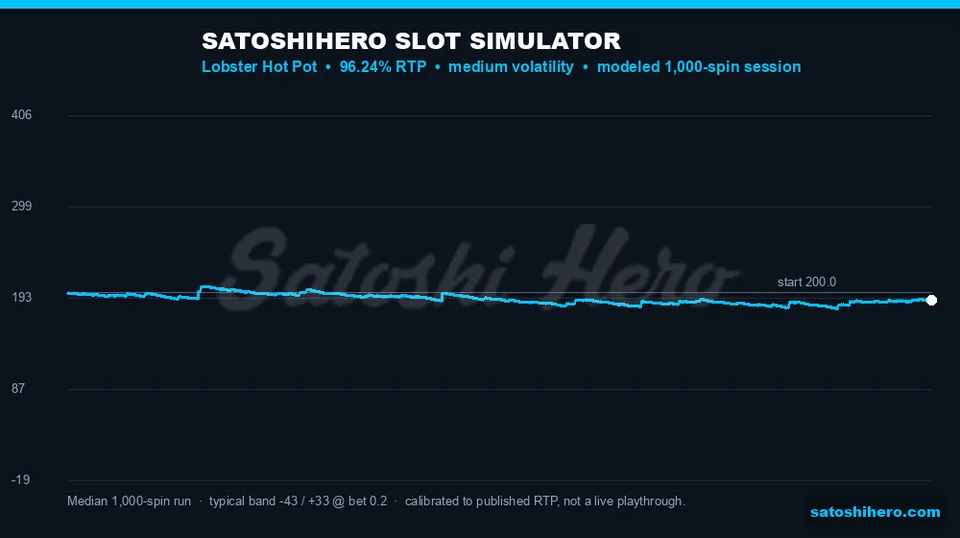
The blue curve represents one modeled path. I care more about the surrounding range because one line can look smoother or rougher by chance. The model has no knowledge of the live random number generator and can’t predict your outcome.
Our 100-spin session
I finished 100 manual $0.20 spins at $1,001.50 after starting with $1,000.00. That equals a $1.50 profit, or 7.5x the stake. The tested version offered no autoplay, so I pressed every spin myself and tracked the balance path.
Only 14 of 100 spins produced base-game wins. Most returned between $0.10 and $0.40, pulling my balance down to $997.40 by spin 13. Spin 14 then delivered the strongest plain result at $4.40, or 22x, and moved me above the starting line.
The first Free Spins round started on spin 20 and returned $8.80, equal to 44x. That feature lifted my balance to its $1,009.20 session high. From there, the curve drifted downward and crossed below the initial balance on spins 72 through 74.
My balance dipped under the start again on spin 82. The second feature began one spin afterward and paid $4.20, or 21x. That late result helped secure the small profit, yet it also showed how heavily two events shaped the final number.
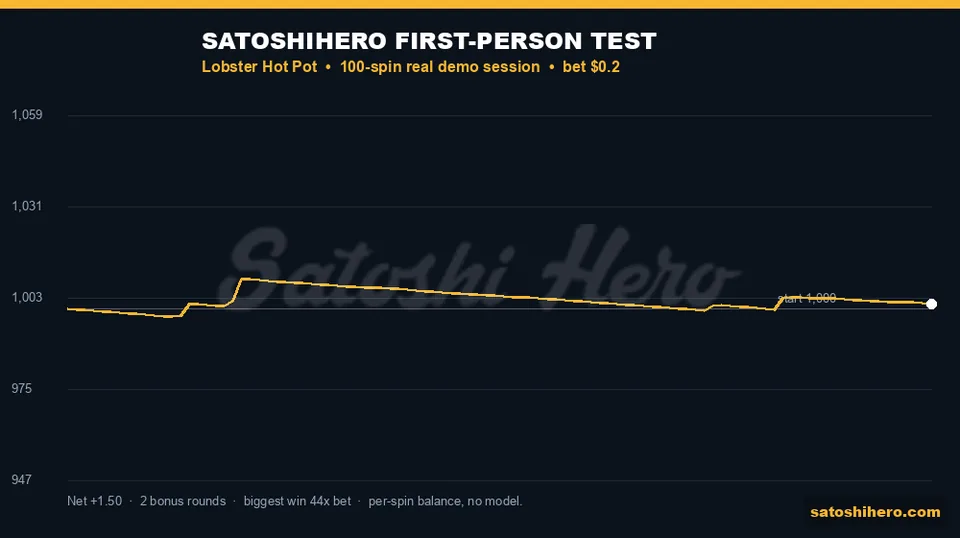
The gold curve records my observed balance and ends at $1,001.50. Extra spins used to capture a clean $0.40 base-win image don’t appear in these totals. I checked the rules and game details against the playable version, keeping captured examples separate from counted evidence.
Finishing 7.5x up over 100 spins doesn’t mean the game beat its theoretical return.
The 96.24% RTP is the operator-published figure, and one live session can’t confirm, disprove, or alter it. Simulator values are modeled projections, while my session values are observed results. Mode-specific returns can differ by design, but I won’t assign an unsupported figure to Lobster Spins.
This profitable test demonstrates short-session variance rather than an expected outcome. You could finish the same spin count on either side of the model’s broad range.
Frequently Asked Questions About Lobster Hot Pot
How many paylines does the Lobster Hot Pot slot have?
Lobster Hot Pot slot has 10 fixed paylines across a 5×3 grid. Matching symbols pay left to right from the leftmost reel, and only the highest win on each line pays.
What are the RTP, volatility, and max win of the Lobster Hot Pot slot?
The game uses 96.24% theoretical RTP, medium volatility, and a 2,000x maximum win. That maximum can occur only during Free Spins.
How do I trigger Free Spins in the Lobster Hot Pot slot?
Three, four, or five Scatters award 10, 15, or 20 Free Spins. Each feature Scatter adds one spin up to 50 total, while my triggers occurred on spins 20 and 83.
What does the Wild do in the Lobster Hot Pot slot?
The fisherman Wild appears only during Free Spins and replaces every symbol except the Scatter. When it lands with Fish, it collects all visible Fish prizes.
How do Lobsters and Hotpots work in Lobster Hot Pot?
Each reel has a Lobster stack beginning at 1x. Fish build those stacks, red Hotpots pay one matching reel, and golden Hotpots pay all five before settled stacks reset.
What is Lobster Spins in the Lobster Hot Pot slot?
Lobster Spins costs 1.5 times the selected stake and doubles the Free Spins trigger chance. It raises a $0.20 spin to $0.30, but I didn’t use it.
How much do symbols pay in the Lobster Hot Pot slot?
Five Fish Tackle pay 200x, Rubber Rings pay 100x, and Fishing Rods or Bait Boxes pay 50x. Five Fish pay 20x, while five matching card symbols pay 10x.
What did the 1,000-spin Lobster Hot Pot simulation show?
The typical modeled result was a $9.20 loss at $0.20 per spin. Its central range ran from $43.00 down to $32.70 up, so it isn’t a prediction.
How did the 100-spin Lobster Hot Pot slot test go?
I gained $1.50 from a $1,000.00 start. The largest result was an $8.80 Free Spins round, while my strongest plain base spin paid $4.40.
Wrap-Up
Lobster Hot Pot makes its mark with five stored stacks, two pot types, and a Wild that collects visible Fish. Its main drawback is a quiet base game that reserves nearly every interesting interaction for Free Spins.

My Verdict
Bonus-focused players should appreciate the clear collection order and readable underwater screen. Expect many modest line results between richer feature sequences, and don’t treat my two triggers as a normal rate.
I liked how the $8.80 first feature combined retriggers with my $6.00 best Free Spin. I didn’t like watching most ordinary wins stay between $0.10 and $0.40, even though the $4.40 base hit briefly broke that pattern.
The Lobster Hot Pot slot rules and test details are checked regularly, while every session result remains a one-off observation.

Pros:
 Clear feature order: Grab, collect, and pot events resolve in an understandable sequence.
- Readable design: Bright symbols help you track Fish, Wilds, Lobsters, and pots.
- Useful retriggers: Extra Scatters can extend Free Spins up to 50 rounds.
- Strong regular symbol: Five Fish Tackle offer a notable 200x line payout.

Cons:
 Plain base game: Most engaging mechanics stay locked inside Free Spins.
- Costly booster: Lobster Spins raises every selected stake by 50%.
- Modest ceiling: The 2,000x cap trails many feature-heavy alternatives.

Best For: Patient bonus hunters who enjoy tracking stored values should feel comfortable here. The medium volatility and fixed paylines keep the structure approachable, while the feature offers enough layered action to reward close attention.
































































Bets
All Bets
Game
Player
Date
Wager
Mult.Multiplier
Prize
 Royal Fruits 9: Hold 'n' Link
 tess1973
- 00:19:27
- 0×
- Royal Fruits 9: Hold 'n' Link
 Hidden
- 00:19:26
- 3.99×
- Royal Fruits 9: Hold 'n' Link
- Hidden
- 00:19:23
- 0×
- San Chong Baozha Blue: Bonus Combo
 mdp0fxo
- 00:19:20
- 0.09×
- Royal Fruits 9: Hold 'n' Link
- Hidden
- 00:19:20
- 0×
- Galaxy Glitter
 nina87
- 00:19:19
- 0×
- Galaxy Glitter
- josh1998
- 00:19:19
- 0×
- Funky Time
 thomas032172
- 00:19:17
- 0.74×
- Funky Time
 PeerLe
- 00:19:17
- 0.18×
- Royal Fruits 9: Hold 'n' Link
- Hidden
- 00:19:17
- 0×