

Lucky Borscht
By pressing play, you agree that you are above legal age in your jurisdiction and that your jurisdiction allows online gambling.

Lucky Borscht
RTP95%
VolatilityMedium
Max winx4,103
Lines5
Hit rate12.8%
ThemeFood
ReleasedApr 2024

Lucky Borscht slot: A Kitchen Full of Fixed Lines and Jackpot Coins
The Lucky Borscht slot from Onlyplay serves a compact Ukrainian kitchen theme on a 3-reel, 3-row grid with 5 fixed paylines. Its straightforward base game uses food symbols, while a Borscht Wild, Hold and Win bonus, Power Bonus values and jackpot coins create the main prize potential. This guide covers the paytable, feature rules, recorded 100-spin test and 1000-spin simulator, separating observed outcomes from modelled results so the risks remain clear.
Key takeaways
- The Lucky Borscht slot uses a compact 3-reel, 3-row grid with 5 fixed paylines.
- RTP is 95%, volatility is medium and the maximum win is 4,103x the bet.
- The Hold and Win feature starts with 3 bonus symbols and 3 re-spins, while new symbols reset the counter.
- My 100-spin test at a $1.00 bet finished $24.00 down after 17 winning spins and no bonus trigger.
- The 1000-spin model produced a $60.60 median loss but also showed a wide spread of possible outcomes.
What are the main Lucky Borscht game facts?
The Lucky Borscht slot is a deliberately small game built around a 3-reel, 3-row window and 5 fixed paylines. Every line remains active, so there is no line selector or changing ways system to manage. A winning line needs three matching symbols, with the Wild able to substitute for the food symbols. The result is a base game that can be read quickly without tracing dozens of possible routes across the grid.
According to Onlyplay, the game pairs this compact format with a Ukrainian kitchen built around borscht and its ingredients. Beet, tomato, cabbage, carrot, salo, onion and mustard form the regular symbol set. A bowl of red borscht topped with sour cream acts as the Wild. Bonus symbols, Power Bonus symbols and three jackpot symbols handle the Hold and Win feature instead of participating as normal line symbols.
The mathematical profile requires more caution than the cheerful artwork suggests. The theoretical return is not a promise that any session will return the stated proportion of the amount wagered. A short run can finish far above or below that figure because wins, bonus triggers and larger events arrive unevenly. My live test and the separate simulator illustrate that difference without treating either result as a forecast.
The default $1.00 wager made every multiplier easy to interpret during testing. A 1x award was worth $1.00, a 2x line was worth $2.00 and the recorded 40x combined result paid $40.00. That direct relationship helped me check the paytable against the displayed win counter. The game has no Buy Bonus option, so every Hold and Win round has to begin through the normal reel trigger.
The demo includes autoplay and a quick spin option. I used quick spin during the counted run because it shortened the reel animation without changing the wager or feature rules. The starting play-money balance was $10,000.00, which gave enough room to record the session without a deposit or balance limit affecting the result. The test conditions remained consistent from the first counted spin through the last.
The facts and calculations in this guide are checked regularly and updated periodically if the provider rules or verified game behavior changes. Modelled results remain labelled separately from first-person play because the two evidence types answer different questions. The live test shows what happened in one fixed run, while the simulator describes a broader range generated from the supplied mathematical assumptions.
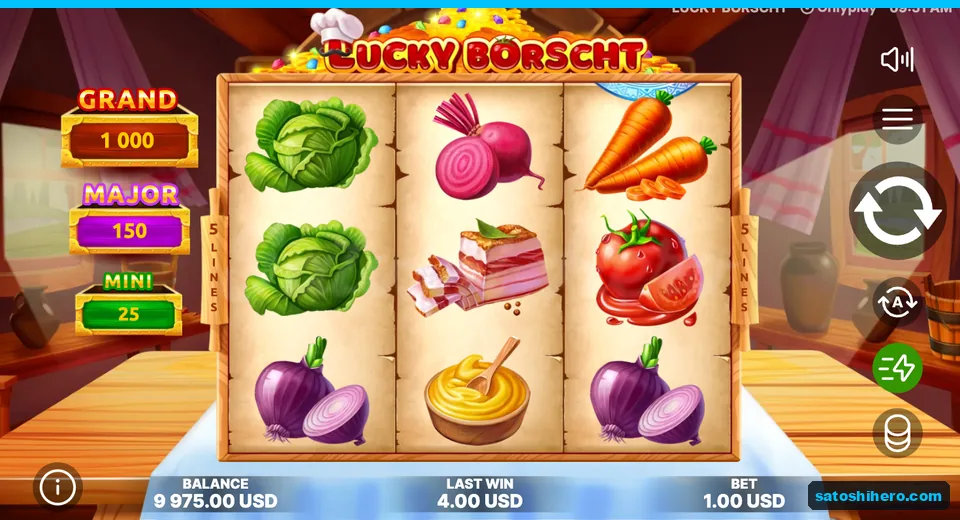
How does the Ukrainian kitchen theme look?
The theme places the reels on a rustic wooden table inside a cosy farmhouse kitchen. Curtains, clay jugs and a wooden barrel surround the game frame, while jackpot signs stand to the left of the reels. The design is bright, cartoonish and friendly rather than realistic. That light presentation makes the Lucky Borscht slot immediately recognizable without hiding its controls or crowding the small reel window.
The food symbols carry most of the visual identity. A glossy beet serves as the highest regular symbol, followed by a tomato, cabbage and a pair of carrots. Salo, onion and a bowl of mustard fill the lower end of the paytable. Each item has a distinct shape and color, so I could identify line combinations quickly even when quick spin reduced the time between settled grids.
The borscht bowl is the clearest special symbol because it includes a visible WILD banner. Its red soup, white sour cream and serving bowl connect the mechanic directly to the title. The bonus artwork uses a different visual language, including plain Bonus symbols, Power Bonus values and named jackpot symbols. That separation reduces the chance of mistaking an ordinary substitute for a feature trigger.
The jackpot display also contributes useful information rather than acting as decoration. Grand, Major and Mini signs remain visible beside the reels, with each sign showing the award at the selected bet. Keeping those amounts on screen makes the hierarchy easy to understand before a bonus begins. Players still need the relevant jackpot symbol during the feature, so the visible signs should not be read as active balance meters.
The small layout helps the farmhouse scene remain legible. Larger reel sets often leave little room for environmental detail, but this game uses the surrounding space to establish its kitchen setting. The grid never overwhelms the barrel, table, crockery or curtains. At the same time, the background stays subdued enough that the beet, tomato and other paying pictures remain the focus once a spin stops.
The theme does not change the game’s underlying uncertainty. Friendly vegetables and warm colors can make the session feel gentle even when the balance is drifting downward. My counted run did exactly that, with many quiet stretches and mostly modest line hits. The art gives the slot character, but bankroll decisions should still come from the paytable, feature frequency and observed balance movement.
What do the symbols pay?
The Lucky Borscht slot has a concise paytable in which every regular award requires three matching symbols on a payline. The beet is the strongest ordinary symbol and pays 30x the total bet. The tomato pays 20x, while the cabbage and carrot each pay 10x. These four pictures form the upper half of the regular symbol hierarchy and can produce noticeably stronger results than the low symbols.
Salo, onion and mustard each pay 2x for a qualifying line. At the $1.00 test wager, one such line returned $2.00. Those low awards appeared often enough to interrupt losing sequences, but they did not necessarily recover the cost of several preceding spins. A winning-spin count therefore says little about profitability unless the size of each award and the amount wagered are considered together.
The game evaluates 5 fixed paylines on every spin. There are no adjustable lines, expanding ways or cluster rules, and all three matching symbols must sit on one of the defined routes. The compact grid makes those routes easier to check than a much larger reel system. A result can include more than one paying line, so the total win may combine separate awards from the same settled frame.
Spin 57 provided the strongest example from my test. It paid $40.00 through a 30x beet line and a separate 10x line on the same spin. The combined result confirmed that the listed multipliers apply to the total bet and that multiple valid lines can contribute to one displayed win. I did not treat that outcome as a standalone 40x symbol because the grid showed two contributing line awards.
That distinction matters when reading the win counter. A $40.00 total at a $1.00 bet does not always mean one symbol carries a 40x pay. It can represent several lower awards added together after the reels settle. Checking the line presentation and paytable prevents a combined result from being attributed to the wrong symbol or feature.
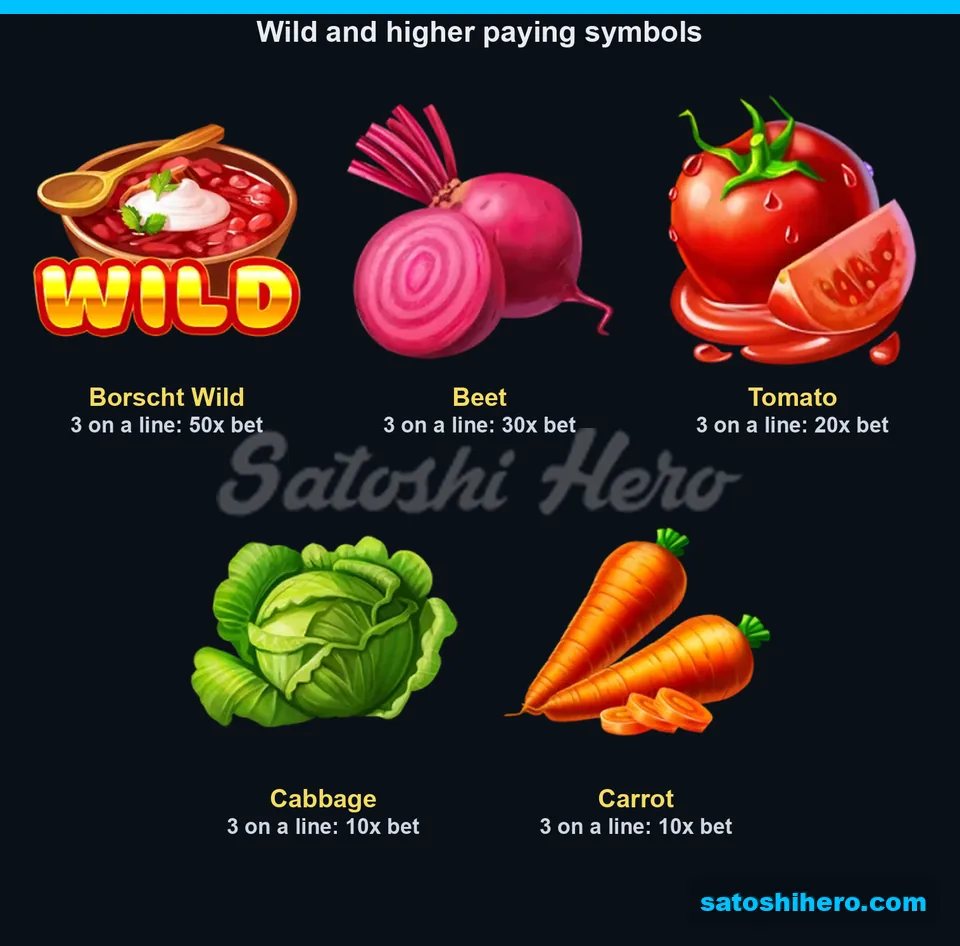
The paytable’s short list is a practical strength because there are few values to memorize. Beet and tomato are the line symbols that matter most for larger base-game returns, while cabbage and carrot form the middle tier. The three 2x symbols mainly provide smaller interruptions to losing stretches. None of those regular pictures opens the Hold and Win feature, regardless of how many appear elsewhere on the grid.
How does the Borscht Wild affect line wins?
The Borscht Wild substitutes for every regular symbol needed to complete a valid payline. It can stand in for a missing beet, tomato, cabbage, carrot, salo, onion or mustard when the other positions support a winning combination. Its role is positional rather than universal. A Wild does not transform unrelated pictures elsewhere on the grid or make every line containing it pay.
Three Wilds on one payline can produce a direct 50x award. That is higher than the beet’s regular-symbol value, making a complete Wild line the strongest listed base-game symbol combination. A Wild-assisted vegetable line still pays according to the completed vegetable symbol unless the reels form the separate three-Wild result. The paytable image makes that distinction visible through the Wild’s own caption and artwork.
The screenshot of a $2.00 result shows how a substitute can participate in an ordinary line outcome. At the $1.00 bet, the win counter reads $2.00, which equals twice the stake. That frame is useful proof that the soup bowl belongs to the base-game substitution system rather than functioning only as decoration. It also shows why the entire payline must be checked before assigning a value to the Wild itself.
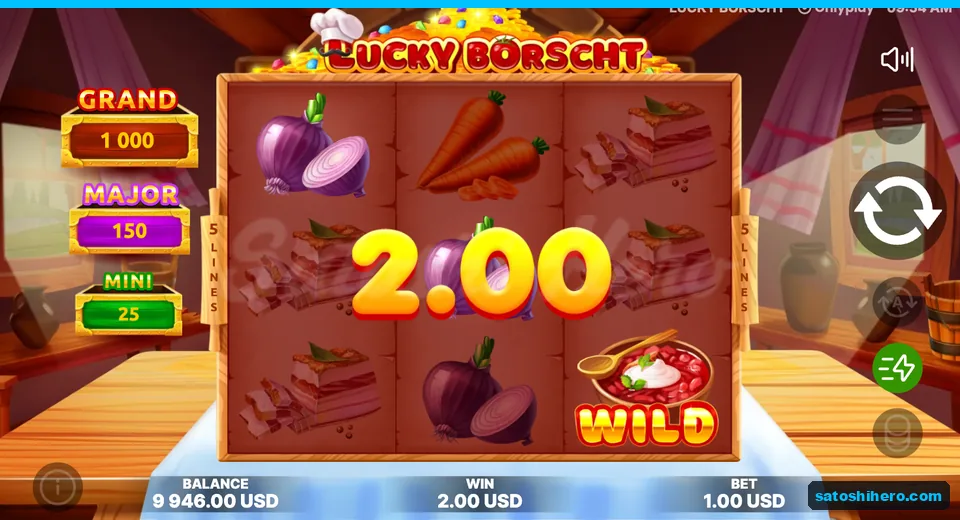
I played a few extra manual spins after the 100-spin test to obtain that clean win frame. Those extra spins are not included in the recorded starting balance, finishing balance, number of wins or net result. Keeping them separate prevents the evidence image from changing the fixed test outcome. The screenshot demonstrates a mechanic, while the session graph documents the counted run.
The Wild can improve the usefulness of surrounding food symbols, but it does not remove the need for a valid route. Several matching pictures may appear close together without occupying one of the 5 paylines. The simplest checking method is to identify the Wild, trace each active line through its position and then compare any completed combination with the paytable. That process avoids reading visual proximity as a win.
No scatter symbol exists in the game. The Hold and Win round is opened through Bonus symbols instead, so the Wild cannot replace a missing feature trigger. This separation keeps the normal pay system and the collection bonus mechanically distinct. Wilds support base-game lines, while the Bonus and Power Bonus symbols govern the re-spin sequence.
How does the Hold and Win bonus game work?
The Hold and Win bonus can begin when at least one Bonus symbol appears on each of the three reels. Their row positions can differ because the requirement concerns reel coverage rather than a single horizontal line. Once all three reels contribute, the feature opens with 3 bonus symbols already on the grid and 3 re-spins available. This trigger is separate from the game’s normal fixed-payline evaluation.
Only Bonus and Power Bonus symbols land during the feature. Every new symbol that appears remains in place and resets the re-spin counter to 3. A blank re-spin reduces the remaining count, while another landing restores the full set. The round ends once the counter reaches zero without a new symbol extending the sequence.
The reset behavior creates the feature’s tension. Early additions can keep the grid active and create more chances for values or jackpot symbols to appear. A sequence can also end quickly if the empty positions stop producing new symbols. More resets increase the number of attempts, but they do not guarantee a jackpot or a particular final total.
Power Bonus symbols can appear only on reel 2 and remain locked after landing. Each carries one of the stated cash values, and those values are added to the feature total when the re-spins finish. Their middle-reel restriction makes them easy to distinguish from ordinary Bonus symbols. It also means a Power Bonus value should not be expected on the outer reels.
The available Power Bonus values are 1x, 2x, 5x, 10x and 15x the bet. At the default stake, each multiplier has a direct dollar equivalent, but increasing the wager scales the amount exposed on every base spin as well. A higher stake does not change the listed multiplier. It changes the money attached to that multiplier and the cost of reaching the feature through ordinary play.
The feature never triggered during my 100 counted spins. I therefore did not observe the re-spin resets, sticky symbols, Power Bonus values or jackpot awards inside that fixed session. The mechanical description comes from the game rules and symbol information rather than an invented live result. That evidence boundary matters because seeing the trigger in the rules is not the same as recording it during play.
There is no Buy Bonus option. The only route into the Hold and Win round is the natural three-reel Bonus condition. Bonus hunters cannot pay a separate purchase price to skip the base game, and I did not buy any feature during testing. Session planning should account for the possibility that the entire run stays in the base game, as mine did.
What are the Power Bonus and jackpot awards?
The feature’s largest named prizes come from jackpot symbols that can appear during the re-spin sequence. A jackpot coin may pay its labelled amount when it lands. Mini pays 25x the bet, Major pays 150x and Grand pays 1000x. These are fixed multipliers rather than changing progressive balances, so their relative scale remains clear at every wager.
The three amounts appear on signs to the left of the main reels. That persistent display lets the wager screen show what each jackpot is worth before the bonus begins. The signs do not indicate that a jackpot has been won or is close to appearing. A relevant jackpot coin still has to land during the active bonus game.
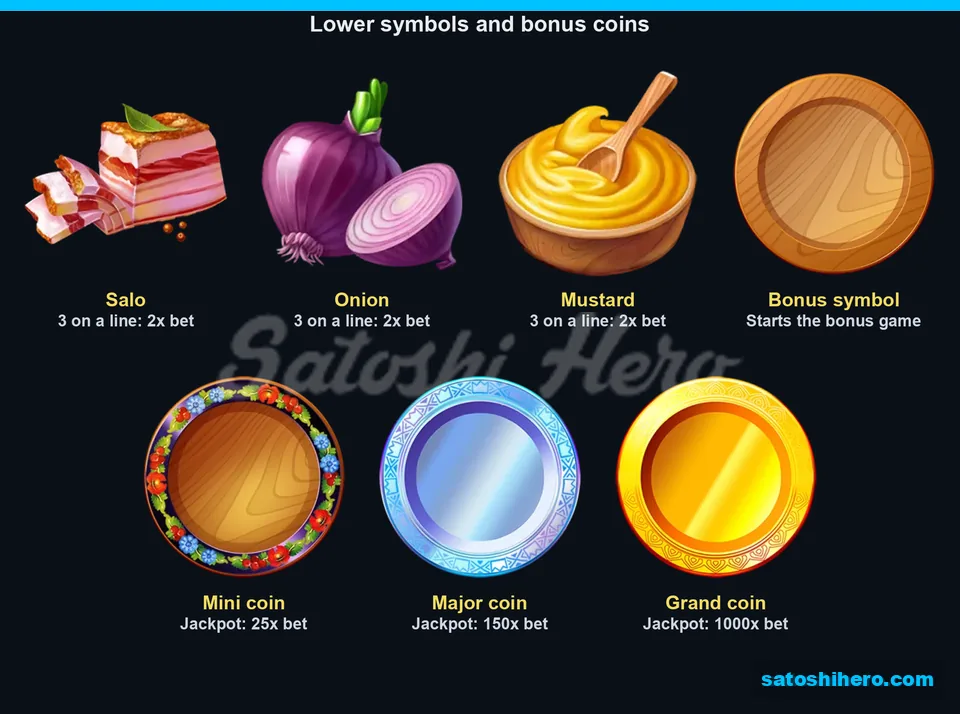
The plain Bonus symbol has a different job from the jackpot variants. In the base game, Bonus symbols can establish the trigger by covering all three reels. During the Hold and Win round, newly landed symbols stay in place and restore the re-spins. A jackpot version can contribute its named prize, while a Power Bonus on reel 2 can contribute its displayed value to the total.
These mechanics create several possible sources of value inside one feature. A round can collect ordinary locked symbols, middle-reel Power Bonus values and one or more named jackpots before the counter expires. The presence of multiple prize types does not imply that every bonus contains all of them. The final amount depends entirely on the symbols that actually arrive during that individual sequence.
The Grand is the headline jackpot because its listed multiplier is substantially larger than Mini and Major. Even so, the broader game cap and feature structure should prevent the jackpot artwork from becoming the only basis for play. My counted session never entered the bonus, which is a practical reminder that access itself can be absent from a short run. A visible prize is not evidence that the corresponding symbol is due.
The Lucky Borscht slot keeps the jackpot system easier to understand than a progressive meter with changing values. Each sign states a fixed multiple of the active bet, and the symbol board identifies the relevant jackpot artwork. That clarity helps with rule interpretation. It does not reduce the random nature of the trigger, re-spin sequence or final collection.
What happened in my 100-spin test?
My Lucky Borscht slot test ended with a $24.00 loss after 100 spins at the default $1.00 wager. I started with $10,000.00 in play-money balance and finished with $9,976.00. Of the 100 spins, 17 produced a win. The Hold and Win feature did not trigger, so every counted result came from the base game.
Most winning spins returned $2.00 or $4.00 through low-value line hits. Those awards interrupted the downward movement but rarely compensated for several losing spins around them. The balance therefore tended to creep lower rather than collapsing through one dramatic sequence. This pattern explains how a session can contain multiple visible wins yet still finish below its starting point.
Spin 57 produced the largest return at $40.00. The result combined a 30x beet line with a second 10x line, creating the only clear upward jump in the recorded balance graph. That win improved the session temporarily but did not erase the cumulative cost of the complete run. The final balance still settled $24.00 below the opening amount.
The 17 winning spins represent a 17% observed hit rate within this sample, but that isolated percentage should not replace the modelled rate. One hundred spins are too few to expect a smooth match with a broader simulation. Clusters of losing spins, modest wins and one stronger result can distort a short-session percentage in either direction.
The missing bonus was equally important to the character of the test. I never saw the three triggering Bonus symbols cover all reels, so I could not record re-spin behavior or jackpot landings as live events. Rather than extend the session until the feature appeared, I stopped at the planned boundary. That preserves a less exciting but more honest account of the run.
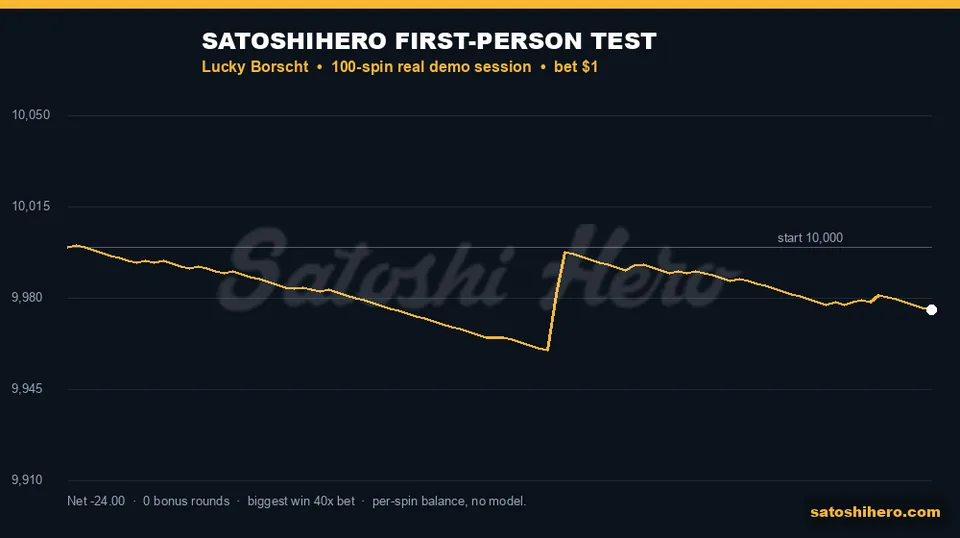
The graph shows a gradual decline from $10,000.00 to $9,976.00, interrupted by small recoveries and the larger movement around the best win. It does not show a feature spike because none occurred. That shape matches my notes: repeated $2.00 and $4.00 returns, one $40.00 high point and long enough gaps between wins for the balance to trend downward.
I made extra manual spins after the test only to capture a clean base-game win screenshot. They remain outside the reported 100 spins and do not alter the $24.00 loss, 17-win count or best result. Drawing that boundary avoids extending a losing sample until it looks better or continuing until the missing feature finally appears.
What does the 1000-spin simulator show?
The 1000-spin model produced a median ending result of $60.60 down at a $1.00 wager. Its 5th-percentile outcome was $216.10 down, while its 95th-percentile outcome was $155.90 up. This broad band matters more than the middle figure alone because it demonstrates how far individual modelled sessions can separate despite sharing the same game assumptions.
The median does not predict that a player must lose exactly $60.60. It identifies the middle outcome across the simulation distribution. Half of the modelled results sit on one side of that point and half sit on the other. A live run can finish much lower, near the center or well into positive territory without the median functioning as a target.
The model estimated that about 25% of spins produced a win. It placed a bonus round at roughly once in 51 spins and a big win at about once in 10,417 spins. These figures are modelled frequencies, not countdowns. Reaching 51 spins without a bonus does not force the next spin to open one, and a long quiet sequence does not make a big win owed.
My 100-spin result lost $24.00, while one tenth of the simulator’s median session loss would be $6.06. That comparison does not mean my run underperformed a guaranteed pace because the model is not linear at every sample length. The shorter test contained fewer opportunities for results to spread out. A modest change in one or two spins could have altered its final position substantially.
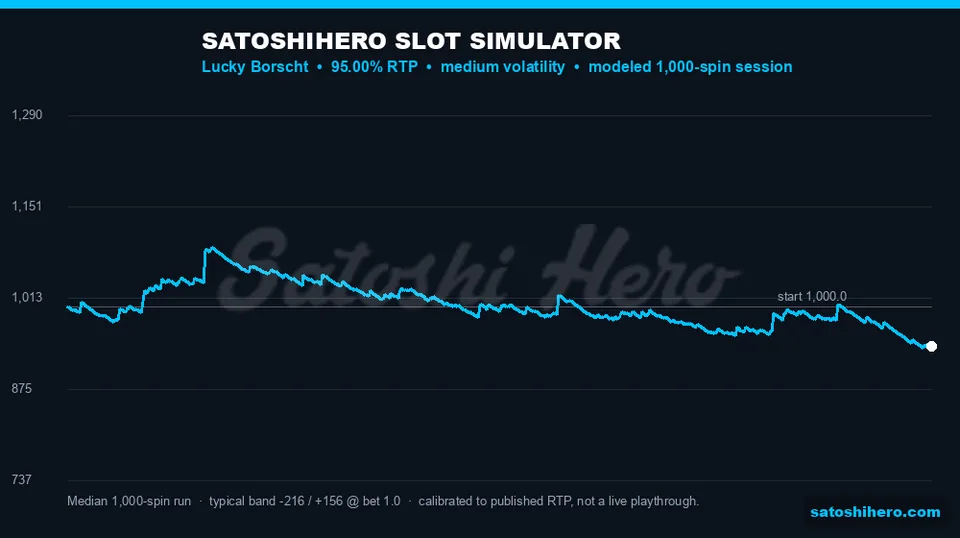
The 5th and 95th percentiles offer useful boundaries for interpreting risk. The lower figure shows a modelled session that lost considerably more than the median, while the upper figure finished in profit. Neither edge is a guaranteed worst or best case. They describe selected points within the simulated spread rather than hard limits on every possible result.
The bonus estimate also helps explain why my test could end without entering the feature. A rough frequency can produce several bonuses in one sample and none in another because the events are not scheduled. The same reasoning applies to the 25% win estimate. Actual hit rates can cluster above or below the model during a limited run.
For the Lucky Borscht slot, the simulator is most useful as a budgeting and expectation tool. It shows that the compact grid and friendly design can still generate materially different session endings. It also places the rare big-win estimate in perspective beside the more common ordinary hit and bonus estimates. None of those rates should be treated as a recovery system after losses.
How does it compare with related Onlyplay games?
Lucky Punch is another Onlyplay title available through SatoshiHero, but its mechanics should be judged from its own rules rather than inferred from the shared provider. The useful comparison is structural. Lucky Borscht emphasizes a tiny fixed-line grid, food symbols and a Hold and Win collection feature, giving it a clear identity among the provider’s other games.
Lucky Punch Megaways signals a more changeable reel format through its name. By contrast, the Lucky Borscht slot keeps the same 3-by-3 window and fixed routes on every base spin. Readers who value a stable visual layout can understand the borscht game quickly, while anyone seeking a larger reel system may find the compact format restrictive.
Zombolics offers a different Onlyplay theme and another point of comparison on SatoshiHero. Theme preferences can separate the titles immediately, but artwork alone does not establish volatility, return or feature behavior. Each game needs its own paytable and test evidence. The borscht title distinguishes itself through a Ukrainian kitchen, ingredient symbols and jackpot signs beside the reels.
Low-complexity slot fans get the clearest value from this game’s readable layout. The regular paytable is short, all lines remain active and the bonus trigger can be described through one symbol on each reel. Feature-focused bonus hunters face a less certain experience because the counted test ended without any Hold and Win round. That gap between simple rules and uncertain access defines much of the game’s appeal and frustration.
The absence of a feature purchase also separates the experience from slots built around repeated bonus buying. Every feature attempt begins with a normal paid spin, and no shortcut bypasses the base game. This structure keeps the listed bet as the full cost of each spin. It also means patience does not create a right to a trigger after a dry sequence.
Budget-conscious play benefits from the game’s transparent stake and multiplier relationship. At the tested $1.00 amount, every listed multiple converted directly into dollars, making wins easy to audit. The same clarity cannot control the order of results. A fixed stop point remains more useful than increasing the wager because a bonus or jackpot has not appeared.
Frequently Asked Questions
Where I Land

My Take
The game succeeds when judged as a compact, readable food slot rather than a feature-heavy spectacle. Its symbol values are easy to learn, the Wild has a clear purpose and the three-reel Bonus trigger is simple to recognize. The Hold and Win rules add enough depth through locked symbols, resets, Power Bonus values and fixed jackpots without making the feature difficult to follow.
The weaker side is feature access. My counted run lost $24.00 despite 17 wins and never reached the bonus, so most of the session consisted of modest line returns and gradual balance decline. The simulator also shows a broad outcome spread. Players focused mainly on the Grand jackpot need to accept that a short session can finish without showing the bonus at all.

Pros:
 The 3-reel, 3-row grid and 5 fixed paylines are easy to inspect.
- The Ukrainian kitchen theme gives the game a distinct visual identity.
- The concise paytable makes every regular symbol value easy to remember.
- The Wild supports line wins and has its own three-symbol award.
- The bonus combines re-spin resets, sticky values and three jackpot levels.

Cons:
 The recorded test ended at a loss and never opened the bonus game.
- Most observed wins were small compared with the total session cost.
- The tiny grid may feel restrictive beside larger or changing reel formats.
- No Buy Bonus option exists for direct feature access.
- The simulator shows a meaningful gap between unfavorable and favorable outcomes.

Best For
Fixed-line traditionalists get a clear grid, a short paytable and results that can be checked without tracing a large number of routes. Theme-led slot fans also get a specific Ukrainian kitchen rather than a generic fruit or card-rank design. Patient bonus hunters can appreciate the reset mechanic, but anyone demanding frequent feature action may find the base-game stretches too quiet.
The strongest reason to play is the combination of visual clarity, distinctive food symbols and a Hold and Win feature with several prize layers. The main reason for restraint is the uncertain path to that feature, demonstrated by a complete 100-spin test without a trigger and a model containing both substantial losses and profitable outcomes. Set a firm wager and stopping point, treat every frequency as an estimate rather than a countdown, and judge the Lucky Borscht slot by its actual rules instead of its cheerful kitchen presentation.

































































Bets
All Bets
Game
Player
Date
Wager
Mult.Multiplier
Prize
 Elephant's Gold: Bonus Combo
 Hidden
- 22:19:21
- 0.24×
- THE VIP
 bCreative79
- 22:19:15
- 7.79×
- Galaxy Glitter
- josh1998
- 22:19:15
- 0×
- Mr. Crystalman: Hold 'N' Link
 Hidden
- 22:19:15
- 0×
- Master Joker
 Aiiken
- 22:19:14
- 0×
- Master Joker
- Aiiken
- 22:19:12
- 1×
- THE VIP
- bCreative79
- 22:19:12
- 0×
- THE VIP
- bCreative79
- 22:19:10
- 0×
- Master Joker
- Aiiken
- 22:19:10
- 0×
- Master Joker
- Aiiken
- 22:19:09
- 0×