

Cluster Tumble
By pressing play, you agree that you are above legal age in your jurisdiction and that your jurisdiction allows online gambling.

Cluster Tumble
RTP96.57%
VolatilityVery high
Max winx20,000
Hit rate20.29%
ThemeFantasy
ReleasedNov 2021

Cracking Stones in the Temple Grid
Cluster Tumble drops you into a very-high volatility Relax Gaming tumble slot built around an 8×8 temple grid, breakable stone blocks and bonus rounds that can either fizzle or explode. In my test, 500-spin base play at $2.00 missed free spins and finished $356.00 down, while the two buys showed both sides of the risk: $17.20 from regular Free Spins and $918.80 from Volatile Free Spins. The appeal is visible board progress, not steady payouts.
Key takeaways
Cluster Tumble is a very-high volatility slot from Relax Gaming with 96.4% RTP and 20,000x max win potential. The game features an 8×8 cluster-pay layout with stone blocks and bonus testing built from 500 base-game spins at $2.00, plus one regular Free Spins buy and one Volatile Free Spins buy. Aimed at patient bankroll managers who can handle dry patches and prefer board clears over steady base-game hits.
- Best bonus: Volatile Free Spins paid $918.80 from a $400.00 buy, but one result doesn’t make it safer.
- RTP / volatility: Official RTP is 96.4%, and the Volatile Free Spins buy RTP is 96.57% with very-high volatility, so you should expect long dead stretches.
- Max win: Wins cap at 20,000x, which gives the slot a sharp ceiling.
- Risk note: My 500-spin test finished $356.00 down with no free spins triggered.
- Bankroll note: At $2.00 stakes, the bonus buys cost $200.00 and $400.00, so strict limits matter.

Table of Contents
- Theme & First Impressions
- Temple setting
- Symbol style
- How Cluster Tumble Works
- Cluster wins
- Symbol values
- Stone Blocks and Special Symbols
- Breaking stones
- Special blocks
- Free Spins and Multipliers
- Trigger routes
- Multiplier ladder
- Bonus Buy Options
- Regular option
- Volatile option
- Regular Free Spins Buy Result
- Round setup
- Final payout
- Volatile Free Spins Buy Result
- Multiplier start
- Final payout
- RTP, Volatility & Our Test
- Simulator projection
- Our 500-spin session
- Frequently Asked Questions About Cluster Tumble
- Final Verdict
Theme & First Impressions
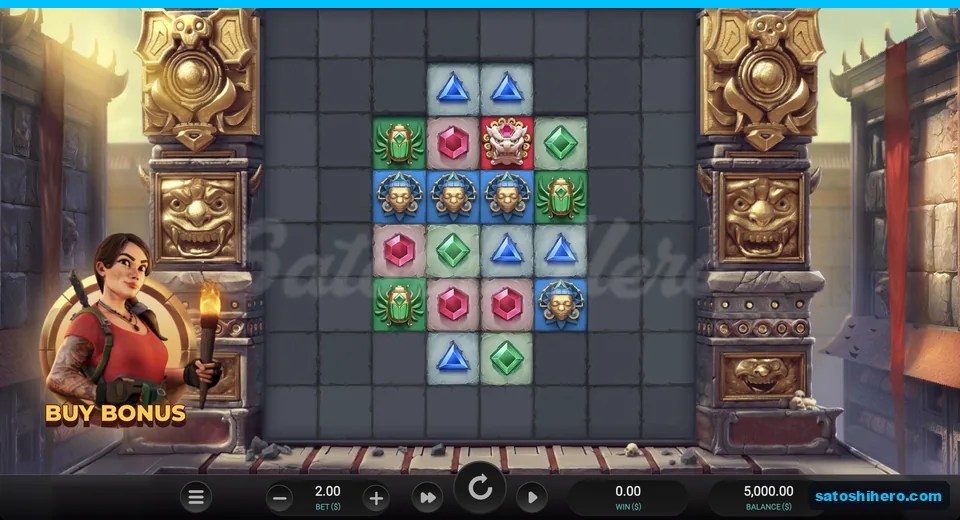
Cluster Tumble looks like an adventure slot where the temple board itself matters, because grey stones block part of the 8×8 grid from the first spin. You aren’t just waiting for treasure symbols to land. You’re watching the board slowly open.
Temple setting
A sharp-featured explorer stands left of the grid with a rope, pistol and torch. The board sits inside an ancient temple wall, flanked by carved golden guardian faces, ruined stone towers and red banners. The setup looks simple at first, but this isn’t a gentle tumble slot; most excitement sits behind board clears and multiplier rounds.
Grey stone blocks give the screen its best hook. They make every small hit feel like excavation, not just a symbol match. If you like a temple tumble demo where the board opens up gradually, this one gets that feel right.
Symbol style
High symbols use carved treasure art: a jade lion with a pink jewel, a golden scarab and a blue stone mask. Low symbols keep the same weathered feel through pink, green and blue cut gems. The theme won’t win originality awards, but the stone-covered board gives it more bite than a plain treasure slot.
Torii Tumble gives visually distinctive tumble fans a different mood, while this game leans harder into ancient ruins and board cracking. I prefer the stone grid here, because you can read progress at a glance. The screenshots and rules-screen figures are checked regularly.

Insight: The stones aren’t just decoration; they directly shape how much of the board can open during a spin.
How Cluster Tumble Works
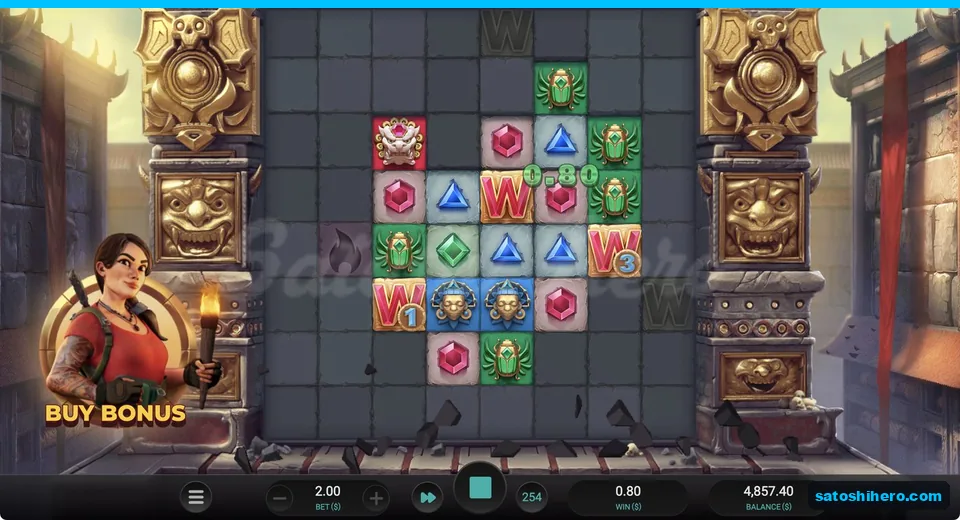
Cluster Tumble uses cluster pays on an 8-column by 8-row grid, so 4 or more matching symbols must touch horizontally or vertically to form a win. There are no fixed paylines. You should read it as a Cluster Tumble slot, not a line game.
Cluster wins
Winning symbols disappear after a hit. Normal symbols and stone blocks next to that win can also break, then new symbols drop into the empty spaces. Each cascade can expose more board space, which gives small wins more purpose than their first payout suggests.
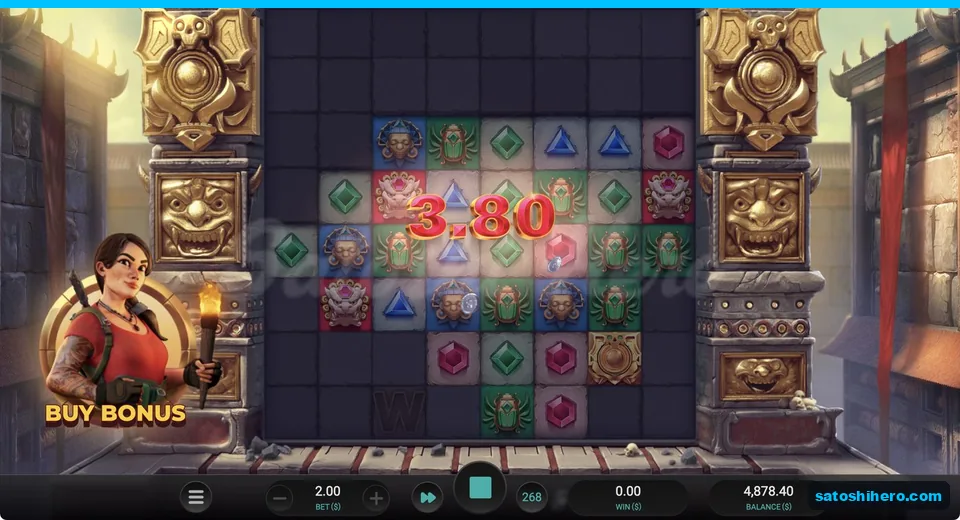
The grid and controls played clearly in my desktop test. The same compact layout should make sense on mobile because you don’t need to track long left-to-right lines. I like that clarity, especially when stones and Wild lives start stacking on screen.
Symbol values
At a $2.00 bet, the jade lion pays $2.00 for 4 symbols, $4.40 for 10, $30.00 for 20, $140.00 for 30 and $4,000.00 for 40 or more. That top cluster is the symbol table’s real prize. You need space, cascades and luck to see it.
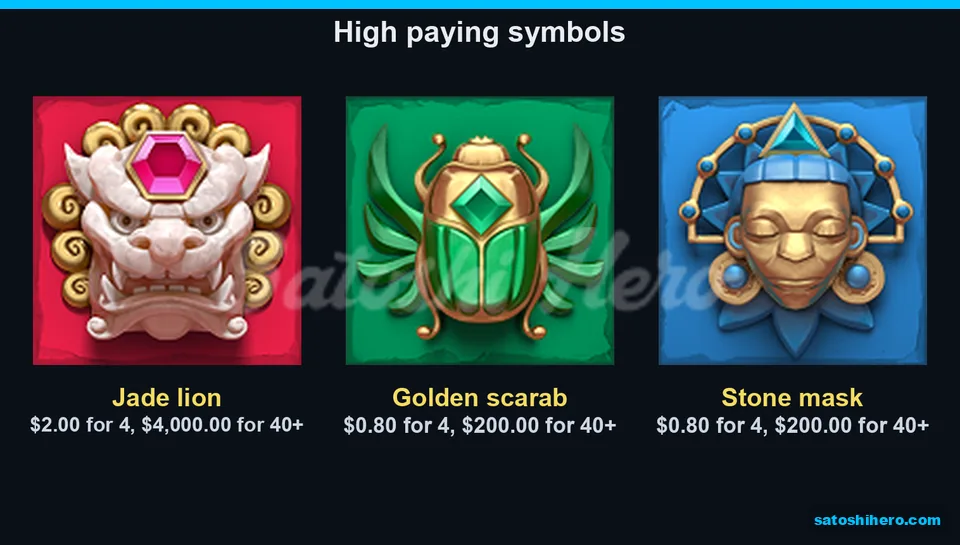
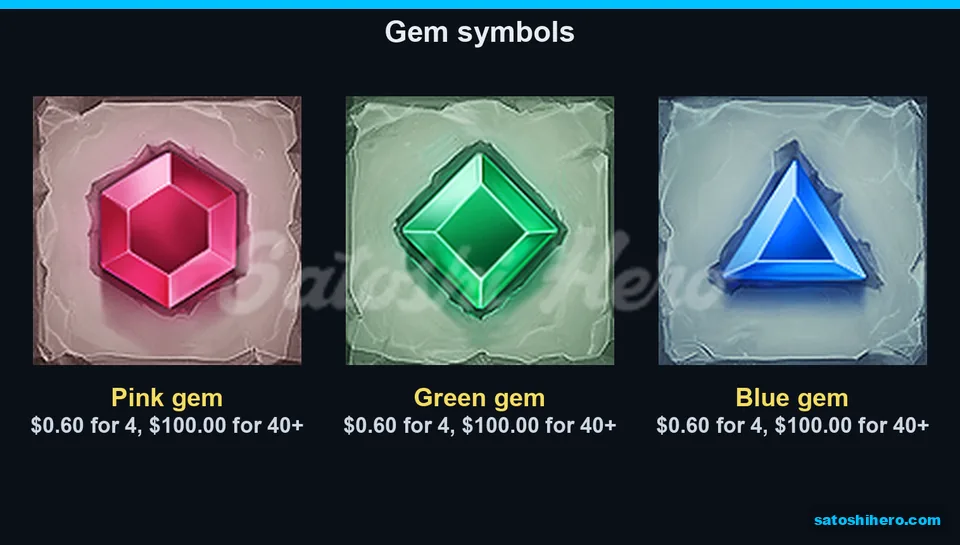
The golden scarab and blue stone mask each pay $0.80 for 4, $2.80 for 10, $12.00 for 20, $32.00 for 30 and $200.00 for 40 or more. Pink, green and blue gems each pay $0.60 for 4, $1.60 for 10, $7.00 for 20, $18.00 for 30 and $100.00 for 40 or more.
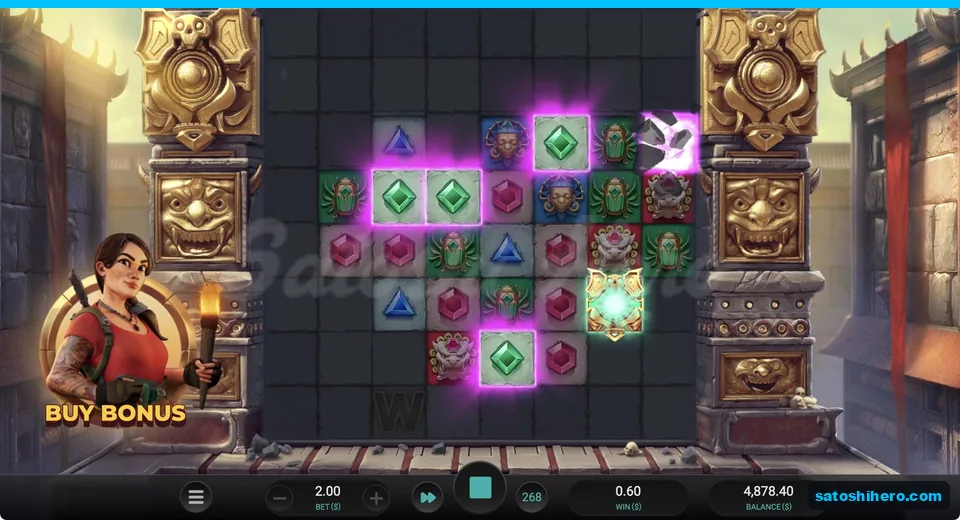
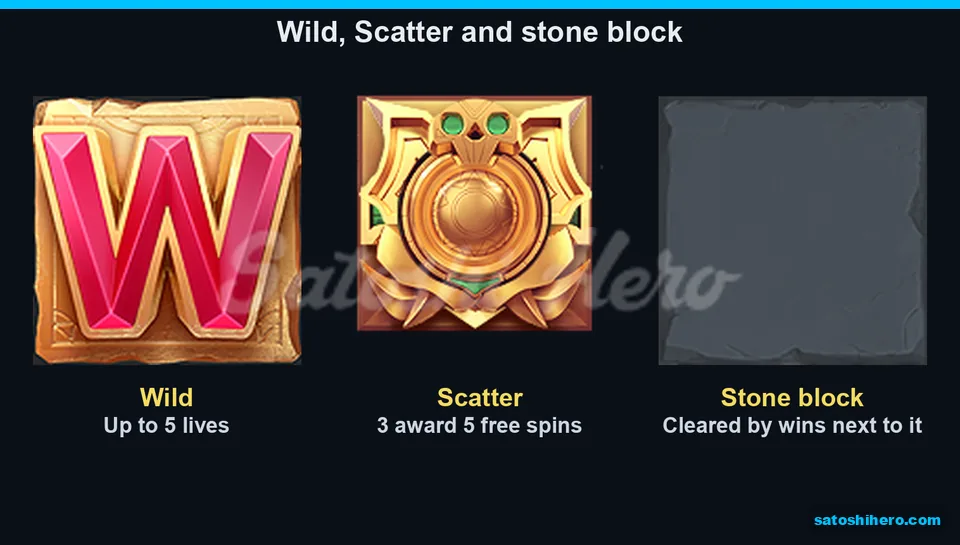
The W Wild substitutes for normal symbols and can carry up to 5 lives. It loses one life each time it helps create a win. I like that design because a Wild can matter across several cascades, not only on the drop where it appears.

Key Stat: Four matching symbols can pay, but the real money comes from opening enough space for large clusters and repeat cascades.
Stone Blocks and Special Symbols
The stone blocks control much of the game’s momentum, because every useful cascade can crack the board open and expose stronger effects. You should watch what a win unlocks, not just what it pays first.
Breaking stones
Every spin starts with part of the board hidden under grey stone. Normal stones break when wins land beside them, and that can create more space for fresh symbols. In my base-game run, most spins cleared a few stones and paid small amounts before the chain ran cold.
That rhythm gives the slot a gritty feel. You often see a possible path, then the board refuses to give the next match. I found that more engaging than a flat grid, though it can tease you during cold stretches.
Special blocks
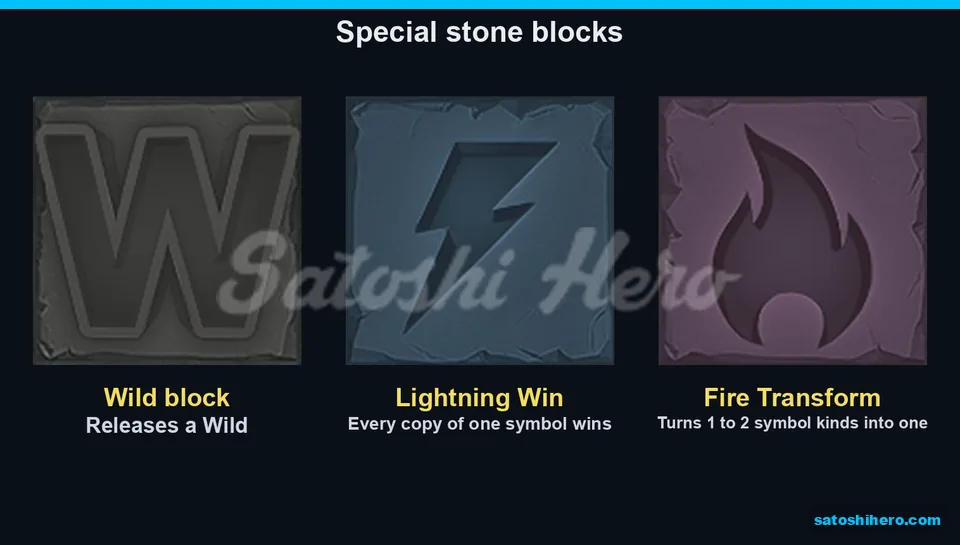
Special stones activate when an adjacent win uncovers them. A Wild block releases a Wild. A Lightning Win block turns into a target symbol, then every copy of that symbol on the board wins after the next cascade, together with any Wilds.
The Fire Transform block also chooses a target symbol. It turns 1 or 2 other symbol types into that target on the following cascade. Near spin 232, a Lightning Win block turned every green gem on my board into one win, which was one of the cleaner base-game moments.

Strategy Insight: Don’t judge a spin only by the first cluster. The valuable part is often whether that win cracks stones and exposes a special block.
Free Spins and Multipliers
Free spins start from 3 Scatters or a full board clear, then the round only gets exciting if more full clears raise the persistent multiplier. You can hit the feature without seeing the game’s best idea come alive.
Trigger routes
The first route is simple: land 3 Scatters. The second route asks you to clear every stone block from the base-game board. Both routes award 5 free spins, which sounds lean until the multiplier starts moving.
My 500-spin base-game run never triggered free spins. I also never cleared the full board and never landed 3 Scatters. That dry outcome tells you plenty about the rating, because the feature can stay out of reach for a long stretch.
Multiplier ladder
During free spins, a full board clear adds 3 extra spins and raises the persistent multiplier by 3. The ladder goes x3, x6, x9 and onward in regular Free Spins. Each Scatter during the round adds 1 extra spin.
The regular buy reached free spins, but it never cleared every stone. That meant the multiplier column stayed dark, and the round felt active without becoming dangerous. Templar Tumble may interest you if you like tumble-style bonus rounds with rising upside, but this game makes board clears the whole argument.
I don’t mind a tough feature when the reward feels clear. Here, the multiplier is the difference-maker. Without it, the bonus can look busy while paying very little.
Bonus Buy Options
Cluster Tumble offers two bonus buys, but both are expensive at $2.00 stakes and deserve strict limits. You’re paying for a shortcut into variance, not a shortcut into profit.
Regular option
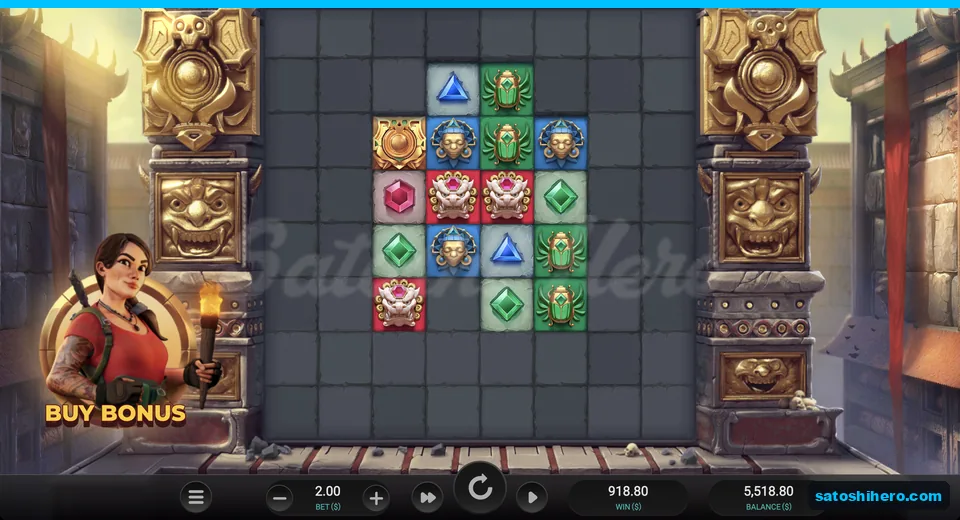
The Buy Bonus sign sits beside the explorer. It opens a Select Mode screen with two options side by side, the $2.00 bet per spin, CANCEL and BUY buttons. In my tested version, no second confirmation appeared, so the click flow felt fast.

Regular Free Spins cost 100 times the bet, which equals $200.00 at $2.00. The rules screen listed 96.48% return for this mode. The cheaper price helps, but the round can collapse if the board doesn’t clear.
Volatile option
Volatile Free Spins cost 200 times the bet, which equals $400.00 at $2.00. The rules screen listed 96.57% return for this mode. The multiplier grows twice as fast, moving x6, x12, x18 and onward.
Numbers indicate the volatile option matches the game’s risk profile better, but it also hits the bankroll harder. At $2.00, one click equals 200 base spins. I’d treat that as a separate high-risk decision, not just another way to start the bonus.

Warning: At $2.00 stakes, the volatile buy costs $400.00. That is 200 base spins in one click, so treat it as high risk.
Regular Free Spins Buy Result
The regular Free Spins buy was a poor result in testing, paying only $17.20 from a $200.00 buy. You can get movement, cascades and a full feature screen while still losing most of the buy cost.
Round setup
I started this buy on a fresh $5,000 balance at a $2.00 bet. The regular option cost $200.00, and a card announced 5 free spins before the round began. The board filled well enough to keep me watching.
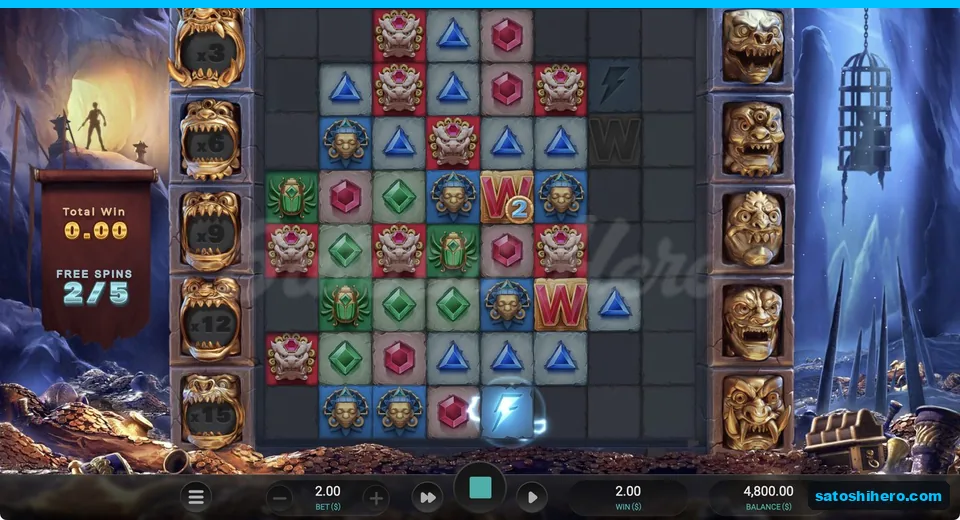
The problem came from the stones. I never cleared every stone block, so the multiplier never started. That made the round feel like a base-game extension with more attention, not a true bonus climb.
Final payout
The final payout was $17.20. That equals 8.6x bet, far below the $200.00 cost. I don’t mind losing a buy when the path was there, but this one showed how thin the regular option can feel without a full clear.

You should measure this buy by board progress, not by spin count. Five spins can vanish quickly if cascades don’t crack enough stones. My honest take: the regular buy may frustrate you because it can look lively while returning little.
Volatile Free Spins Buy Result
The Volatile Free Spins buy showed the slot’s upside, paying $918.80 from a $400.00 buy in one successful test round. That result looked exciting, but one strong round doesn’t define the expected outcome.
Multiplier start
I opened this buy on another fresh $5,000 balance with the same $2.00 bet. The Volatile Free Spins option cost $400.00, then the round moved much faster than the regular version. The board cleared early, and the multiplier jumped straight to x6.
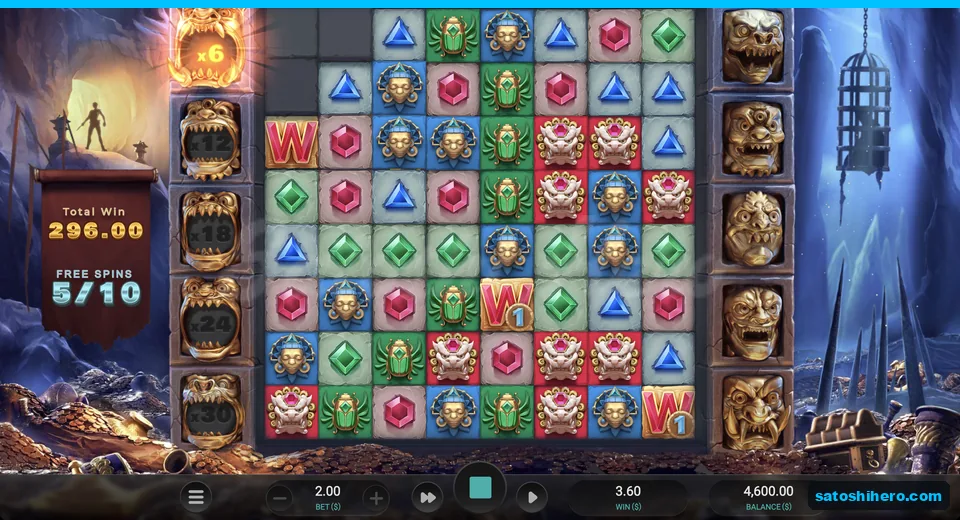
That early clear changed everything. Spins climbed to 10, and the total reached $296.00 by halfway. You could feel the math shift once every cascade carried multiplier weight.
Final payout
A late Epic Win cascade added the major value. The total pushed past $800 before finishing at $918.80. That equaled 459.4x bet and more than twice the buy cost.
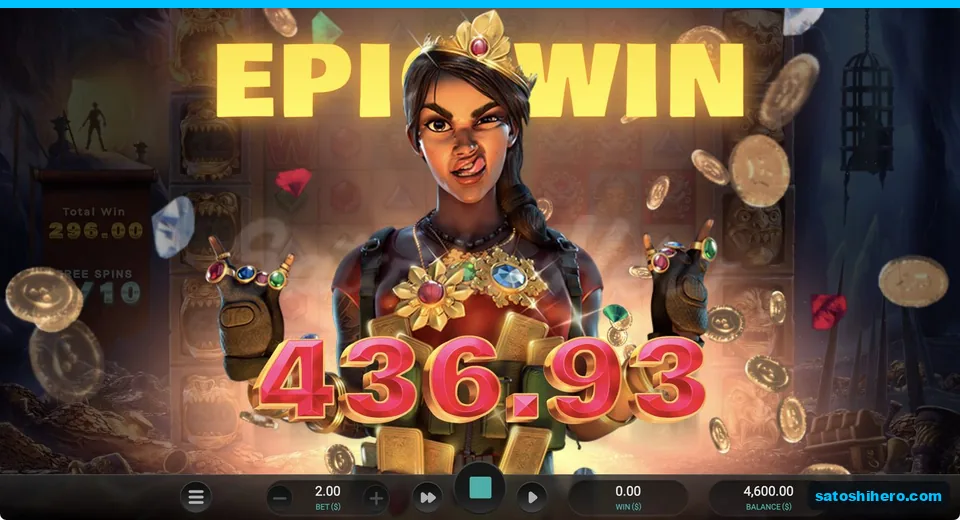
This was the round where the slot showed its teeth. The volatile buy can create the kind of swing you’re hoping for, but it also costs twice the regular option. I liked the momentum, yet I wouldn’t mistake this hit for a normal result.
RTP, Volatility & Our Test
Cluster Tumble has official 96.4% RTP, very-high volatility and a 20,000x max win, and the Volatile Free Spins buy is 96.57%. My test matched the swingy profile that rating suggests. Relax Gaming built a game where long quiet spells can sit between the meaningful hits.
Simulator projection
Our simulator ran at 96.4% RTP, very-high volatility and the 20,000x ceiling at my $2.00 stake for 1,000 spins. The median session finished $202.70 down. The middle 90% of runs landed between $868.40 down and $1,361.00 up.
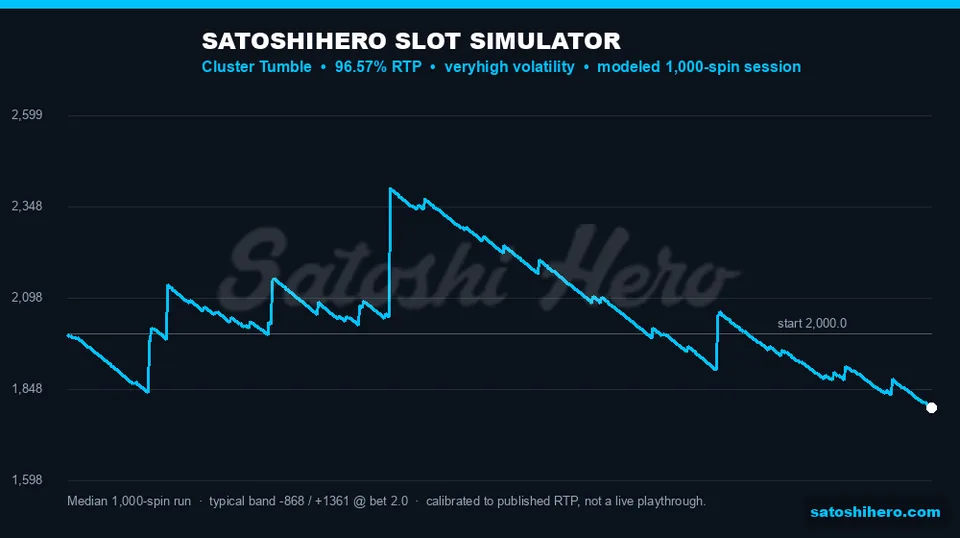
Only about 14% of spins returned anything. A feature-sized hit appeared roughly once every 54 spins, while a 100x win appeared about once every 807 spins. That spread describes possible session shape, not what your next session may do.
The math suggests a slot that can test patience before it pays anything memorable. You should plan for dead space, especially if you skip the buys and chase the feature naturally. Sloth Tumble gives tumble fans another demo feel to compare, though this game’s stone blocks make bankroll swings feel more directly tied to board progress.
Our 500-spin session
I played 500 spins at $2.00 in one autoplay run with quick spin on. The balance started at $5,000 and finished at $4,644.00, so I ended $356.00 down. No free spins triggered.
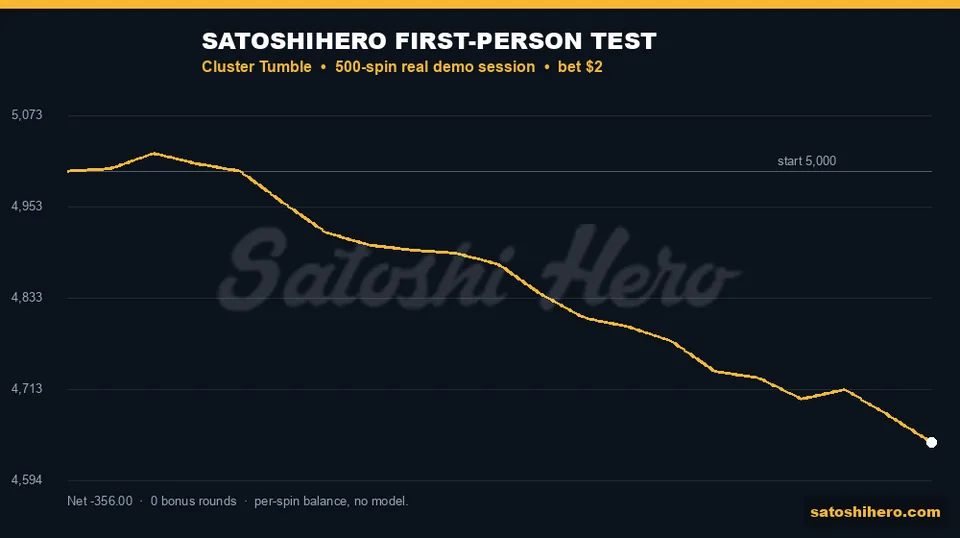
The first 100 spins were the best part. Small clusters kept the balance around or just above the start, helped by a $43.40 chain near spin 24. After that, the session turned into a long slide.
Most spins cracked a few stones and paid $1.00 or $2.00 before the board ran out of matches. I saw special blocks several times, including the Lightning Win near spin 232 and Wilds carrying lives from cascade to cascade. My best late hit was $31.80 near spin 431.
Warning: The 500-spin test lost $356.00 without seeing free spins, which is exactly the dry run very-high volatility can produce.
I never cleared the full board and never landed 3 Scatters. That matters more than the small base hits, because the multiplier round carries the real upside. If you play Cluster Tumble online at SatoshiHero, demo mode gives you a clean way to feel those gaps before real play.
Theoretical RTP is the operator-published return figure, and a single 500-spin session doesn’t prove or disprove it. This guide uses official 96.4% RTP as the headline spec.
Frequently Asked Questions About Cluster Tumble
How do wins work in Cluster Tumble?
Cluster Tumble uses an 8×8 grid with cluster pays. You need 4 or more matching symbols touching horizontally or vertically, and bigger clusters pay more.
What are the stone blocks in Cluster Tumble?
Stone blocks cover part of the board and break when wins land beside them. Special stones can release a Wild, trigger a Lightning Win or create a Fire Transform.
How do Cluster Tumble free spins work?
Three Scatters or a full base-game board clear award 5 free spins. Full clears inside the feature add 3 spins and raise the persistent multiplier by 3.
How much are the Cluster Tumble bonus buys?
Regular Free Spins cost 100x bet, so $200.00 at $2.00. Volatile Free Spins cost 200x bet, so $400.00, and my tested buys paid $17.20 and $918.80.
What did the 1000 spin simulator show for Cluster Tumble?
At $2.00, the median 1,000-spin simulator run finished $202.70 down. The middle 90% of runs ranged from $868.40 down to $1,361.00 up.
How did your 500-spin test of Cluster Tumble go?
I finished $356.00 down after 500 spins at $2.00. I saw no free spins, and my best win was a $43.40 chain near spin 24.
What are the RTP and max win of Cluster Tumble?
The official headline RTP is 96.4%, and the max win is 20,000x. The rules screen showed 96.40% for base play, 96.48% for regular Free Spins and 96.57% for Volatile Free Spins.
Is Cluster Tumble a paylines slot?
No, Cluster Tumble doesn’t use fixed paylines. It uses cluster pays, so matching symbols must touch horizontally or vertically.
Can you play Cluster Tumble online at SatoshiHero?
Yes, you can play it here on SatoshiHero in demo and real-money modes. Demo play helps you test the stone blocks, cascades and bonus-buy rhythm first.
Final Verdict
Cluster Tumble stands out because the 8×8 stone grid gives every cascade a clear job. The drawback is just as clear: the base game can grind for hundreds of spins without reaching free spins.

My Take
I’d approach this as a volatile board-clear game, not a steady base-game earner. The bonus buys create the strongest moments, but the $200.00 and $400.00 costs demand firm limits. You should expect long flat stretches before any serious movement.
I like the way small hits can crack stones and expose special blocks. I don’t like how the regular buy paid only $17.20 after a $200.00 cost in my test. The Volatile Free Spins result was far better, but that $918.80 hit came from one strong round.
Cluster Tumble earns attention from players who enjoy measurable risk and visible board progress. This guide is updated periodically so the rules-screen figures and first-hand notes stay aligned with the game page.

Pros:
 Stone Grid: Breakable stones make small cascades feel useful and readable.
- Clear Math: RTP, buy costs and test results give you firm numbers.
- Volatile Upside: The volatile buy can build fast when multipliers start early.
- No Paylines: Cluster pays keep the win condition simple and visual.

Cons:
 Harsh Base Game: My 500 spins missed free spins entirely.
- Expensive Buys: The $400.00 volatile buy can drain a bankroll fast.
- Flat Regular Bonus: My regular buy never started the multiplier.

Best For: High-volatility hunters and bonus-buy fans get the most from this slot’s stone-clearing rhythm. Careful bankroll players should start in demo mode, because the dry patches can feel long. If you need frequent wins, this one may test your patience.












Other Relax Gaming Games






















































Bets
All Bets
Game
Player
Date
Wager
Mult.Multiplier
Prize
 Luck of Panda: Bonus Combo
 Hidden
- 07:56:54
- 0×
- Luck of Panda: Bonus Combo
 mike_721
- 07:56:54
- 0.64×
- Book of Hidden Tombs
 kidkodi1111
- 07:56:53
- 0×
- Book of Hidden Tombs
- kidkodi1111
- 07:56:51
- 0×
- Luck of Panda: Bonus Combo
- Hidden
- 07:56:51
- 0.29×
- Luck of Panda: Bonus Combo
- mike_721
- 07:56:51
- 0×
- Book of Hidden Tombs
- kidkodi1111
- 07:56:50
- 0×
- Great Ghosts!
 davidm5
- 07:56:49
- 1.04×
- Great Ghosts!
- davidm5
- 07:56:48
- 0×
- Luck of Panda: Bonus Combo
- mike_721
- 07:56:48
- 0×