

Templar Tumble
By pressing play, you agree that you are above legal age in your jurisdiction and that your jurisdiction allows online gambling.

Templar Tumble
RTP96.25%
VolatilityHigh
Max winx17,371
Ways117,649
Hit rate20%
ThemeAncient civilizations
ReleasedMar 2021

Templar Tumble Guide: Free Spins, Mystery Reveals and 500-Spin Test
Relax Gaming drops a blocked medieval grid where every tumble tries to smash sandstone out of the way.
Templar Tumble is a high volatility slot from Relax Gaming with 96.25% RTP and 17,371x max win potential. The game features a 6-reel, 7-row grid with up to 117,649 ways to win and blocker-clearing Free Spins. Aimed at patient feature chasers who can handle dry base-game stretches, the SatoshiHero test used $2.00 spins, a $5,000 demo balance, 500 base spins, and one $160.00 buy.
Key takeaways
- RTP / volatility: Templar Tumble is a high volatility Relax Gaming slot with 96.25% base RTP and a 17,371x max win.
- Best play: The game pays up to 117,649 ways on a 6-reel, 7-row grid, not fixed paylines.
- Best bonus: Free Spins trigger by clearing every sandstone blocker, but my 500-spin SatoshiHero test didn’t trigger them once.
- Buy cost: The Free Spins buy costs 80x the bet; at $2.00, my $160.00 buy returned $58.80.
- Risk note: Keep stakes conservative because the base game can grind down hard between meaningful hits.

Table of Contents
- How Templar Tumble Works
- Ways, not lines
- Symbol values
- Theme & First Impressions
- Chapel setting
- Blocked-grid feel
- Blockers and Tumbles
- Breaking the wall
- Cascade rhythm
- Mystery Reveal
- Wild-triggered reveals
- Coins or symbols
- Free Spins
- Natural trigger
- No-blocker grid
- Bonus Buy Tested
- Buy cost
- Tested result
- Base Game Session
- Best base hit
- Late-session slide
- RTP, Volatility & Our Test
- Simulator projection
- Our 500-spin session
- Bankroll Notes
- Stake sizing
- Buy risk
- Frequently Asked Questions About Templar Tumble
- Final Verdict
How Templar Tumble Works
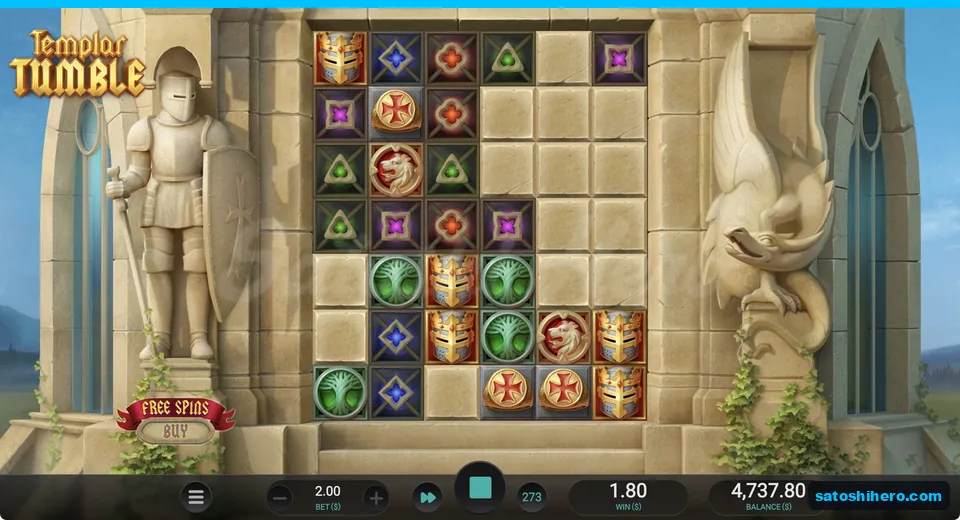
Templar Tumble uses adjacent-reel ways wins, not fixed paylines. You need matching symbols from the leftmost reel across adjacent reels, and duplicate symbols on a reel multiply the payout. That structure feels simple to read, but you’ll notice the blockers decide most of the drama.
The grid has 6 reels and 7 rows, with up to 117,649 ways to win. Row position doesn’t matter, so a symbol can land anywhere on the next adjacent reel and still connect. Only the longest match for each symbol counts, which keeps the paytable clean rather than messy.
SatoshiHero’s version plays cleanly on desktop and mobile because the grid, balance panel, and paytable remain readable. You don’t need to hunt for tiny rule text, which matters when cascades move quickly.
Ways, not lines
Numbers indicate this is a ways-to-win slot, not a fixed-payline game. If one helm lands on reel 1 and three helms land on reel 2, those copies multiply the same symbol path. Cluster Tumble feels different because it uses a grid-clearing format built around grouped wins, while this slot leans on left-to-right adjacent reels.
The gold Wild substitutes for all paying symbols. It can only appear during cascades after the first drop, only on reels 2 to 6, and only once per cascade. That limit matters because Wilds also connect to Mystery Reveal, so you shouldn’t expect them on every tumble.
Symbol values
At a $2.00 bet, the symbol values stay modest in the base game. The math suggests the feature system, not raw symbol pay, carries the upside.
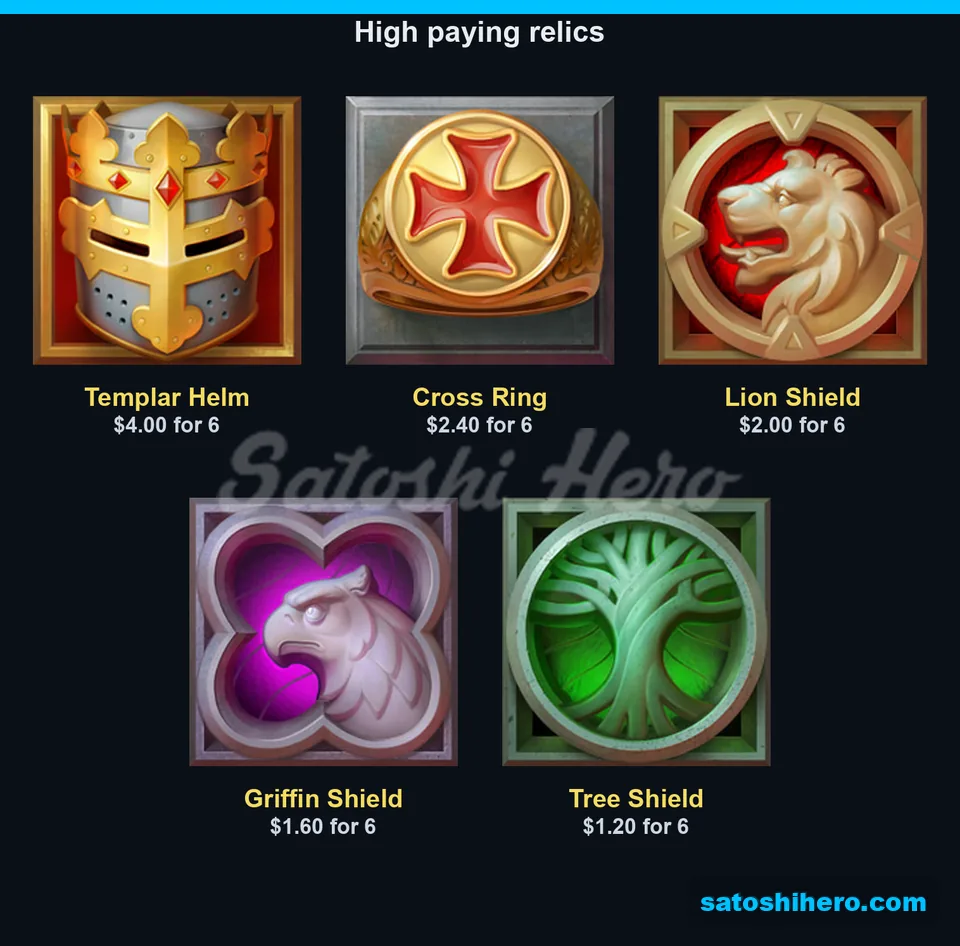
| Symbol | 6 | 5 | 4 |
|---|---|---|---|
| Golden Templar helm | $4.00 | $3.20 | $2.00 |
| Red cross ring | $2.40 | $1.60 | $1.20 |
| Lion shield | $2.00 | $1.40 | $1.00 |
| Griffin shield | $1.60 | $1.20 | $0.80 |
| Tree shield | $1.20 | $0.80 | $0.60 |
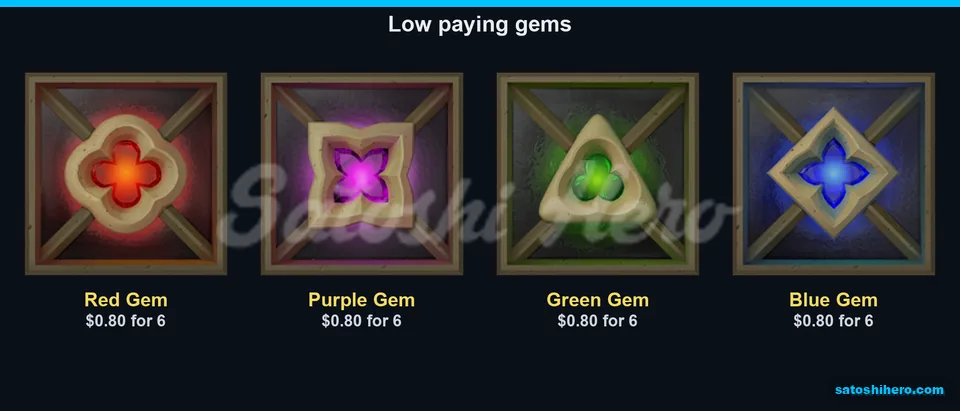
| Red, purple, green, blue gems | $0.80 | $0.60 | $0.40 |
You can read the pay system in a few spins, which I like. The harder part is watching whether the blockers break in the right places, because that decides how exciting each spin feels.
Theme & First Impressions
The slot uses a clean sandstone chapel theme with a blocked grid that gives the base game its personality. You see a stone knight holding a sword and shield on the left, a carved griffin on the right, and tall gothic windows behind the reels.
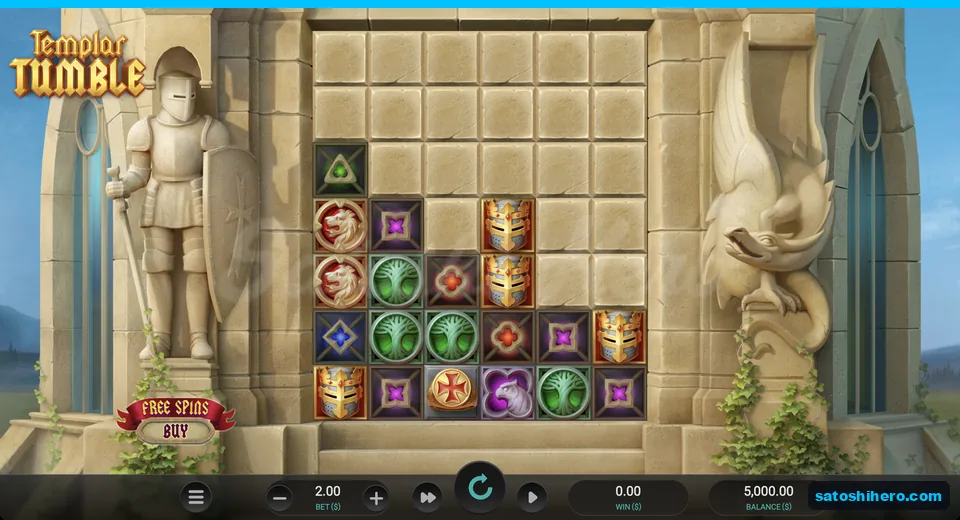
Crusader relics and carved gems fill the symbol set. Many spins start with plain sandstone blocks covering much of the grid, which makes the game look tighter than most ways slots. The visual idea isn’t wildly original, but the wall of blockers gives it a sharper identity than another relic-only setup.
Chapel setting
The medieval chapel frame works because it supports the blocker mechanic. You aren’t just spinning over a pretty background; you’re trying to crack through a stone wall. Ancient Tumble has a broader temple feel, while this game keeps the focus on a smaller, heavier chapel space.
I liked the readability more than the theme itself. The helm, shields, rings, and gems separate clearly, even when cascades move fast. You won’t confuse the top symbol with the low gems after a few spins.
Blocked-grid feel
Free Spins shift to a gilded version of the same grid with no blockers. That contrast matters because the bonus immediately looks more open and faster. You can feel the difference before the first paid cascade lands.
The theme won’t win originality awards, and that’s fair criticism. Still, the blocked grid adds tension to nearly every base spin, which makes the chapel setting feel tied to the game rather than pasted behind it.
Blockers and Tumbles
Blockers drive the whole game because they don’t pay, but they control access to Free Spins. Every winning cascade can destroy nearby sandstone, and clearing every blocker triggers the bonus. That makes even a small $0.40 win feel more useful than the payout suggests.
Each spin places sandstone blockers alongside normal symbols. Winning symbols disappear, and blockers next to winning symbols disappear too. Remaining symbols fall down, new symbols fill the gaps, and the cascade keeps going until no further win appears.
Breaking the wall
No new blockers fall during a cascade. That rule gives every cleared block extra value, since a good tumble can only make the grid more open during that spin. You’ll start watching empty spaces more closely than the small pay amounts.

Key Stat: No new blockers appear during a cascade, so every cleared block matters for that spin.
My 500-spin session showed the pain in that setup. Many tumbles broke open part of the wall, but I never cleared the full grid. The game kept offering partial progress, then stopping short of the bonus.
Cascade rhythm
The rhythm feels stop-start. A win breaks symbols, nearby blockers crack, and then you wait to see if the next fall connects. When it does, the grid can open quickly. When it doesn’t, you stare at one or two stubborn blocks and reload.
I found this mechanic more engaging than a plain tumble loop. But it also makes missed clears feel rough, because the screen often looks close enough to tempt you into one more spin.
Mystery Reveal
Mystery Reveal starts when a Wild lands in the base game and changes 3 to 8 blockers into red Mystery symbols. Those Mysteries wait until the cascade stops, then reveal together. This is the base game’s best suspense trigger, and you’ll feel it most when the wall already looks thin.

Mysteries can’t be destroyed by normal wins. They remain on the grid until no more wins appear, then activate together. They either all become the same normal symbol, or each becomes a Coin symbol paying 1x to 1,000x the bet.
Wild-triggered reveals
A Mystery Reveal always creates at least one more cascade. That matters because even a weak reveal keeps the spin alive, while a matching-symbol reveal can connect across the opened grid. Numbers indicate the best base-game moments come from this chain, not from standard symbol drops.
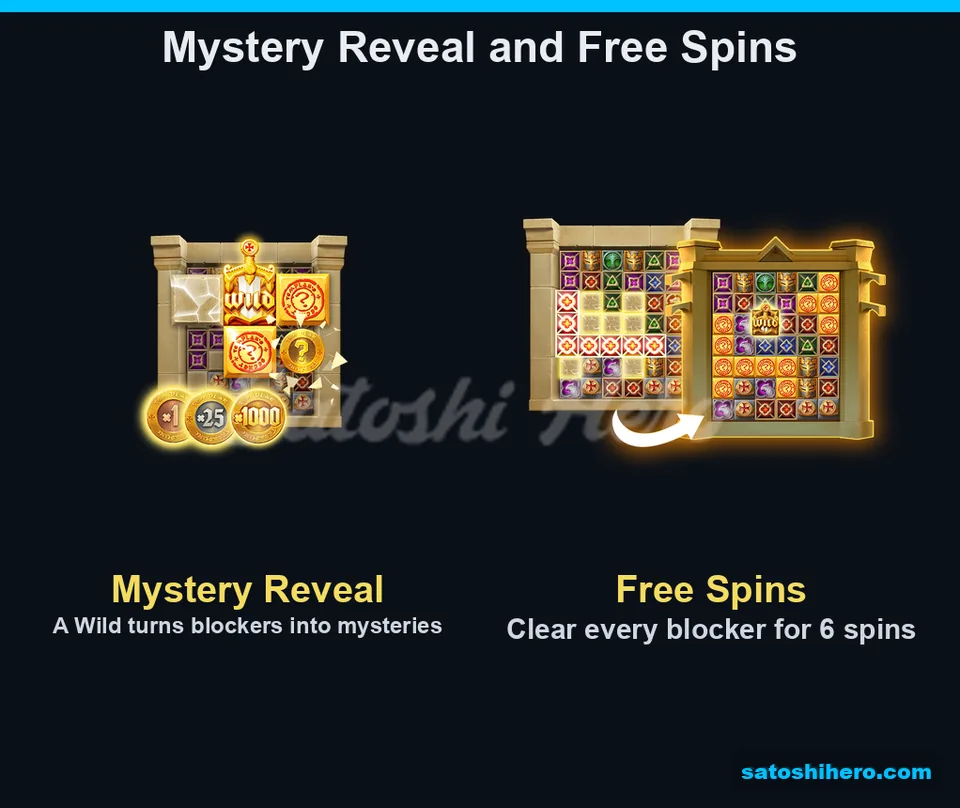
Mysteries appeared several times in my run. Around spin 141, one reveal became matching relics worth about $31. That was one of the few moments where the base game felt like it might turn around.

Insight: Mystery symbols don’t disappear with normal wins; they wait until the cascade stops, then reveal together.
Coins or symbols
Coin symbols add a clean hit of potential because they pay 1x to 1,000x the bet. They disappear after the reveal, so they don’t hang around as sticky values. I like that design because it keeps the feature sharp, not bloated.
The feature creates real tension, but it didn’t rescue my test session. You’ll get suspense from the red symbols, yet you still need the grid and follow-up cascade to cooperate.
Free Spins
Free Spins trigger only when you clear every blocker from the grid in one spin. My 500-spin test didn’t trigger them naturally, which shows the high volatility clearly. You shouldn’t size your bet around quick bonus access here.
The award is 6 free spins with no blockers on the grid. That open layout feels faster than the base game because each cascade focuses on wins and Mystery conversions rather than wall clearing. Torii Tumble may appeal to readers comparing Relax-style Tumble feature chasing, but this slot’s trigger feels harsher because the full blocker clear asks more from one spin.
Natural trigger
The trigger condition sounds simple, yet it plays tough. You need every sandstone block gone before the spin ends. A few misses hurt because the screen can look close, but close pays nothing extra by itself.

Warning: In my 500-spin test, I never cleared every blocker once. Don’t size your bet assuming Free Spins may arrive quickly.
High volatility feels real when the main feature stays out of reach that long. I don’t read that as a flaw by itself, but it changes how you should approach the stake.
No-blocker grid
During Free Spins, a falling Wild turns 3 to 6 normal symbols into Mysteries. Wilds don’t convert symbols already involved in a win, which stops the feature from feeling too loose. Mysteries can reveal as one matching symbol, Coin symbols paying 1x to 1,000x the bet, or extra free spins.
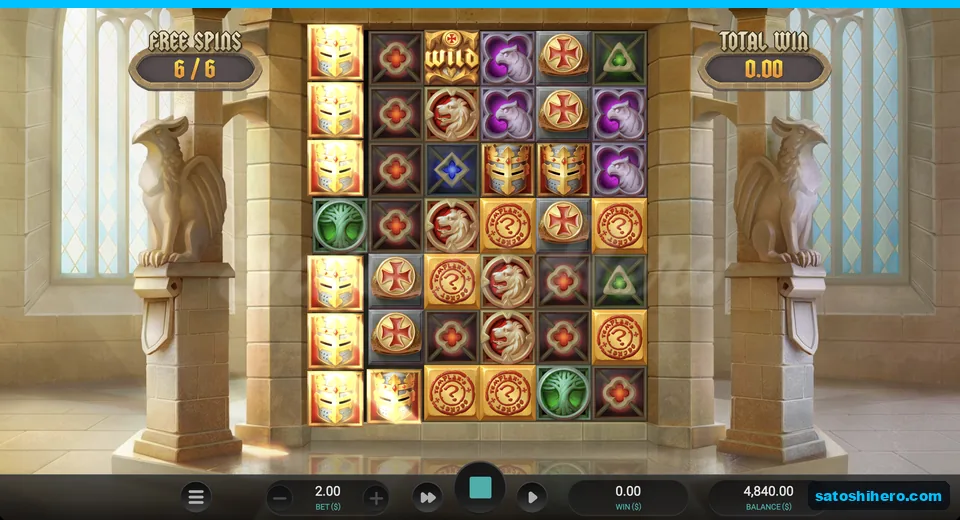
The no-blocker version looks like the game finally opens its hands. You get cleaner cascades and quicker reads. Still, the route there can feel harsh, and that’s the main thing you need to accept.
Bonus Buy Tested
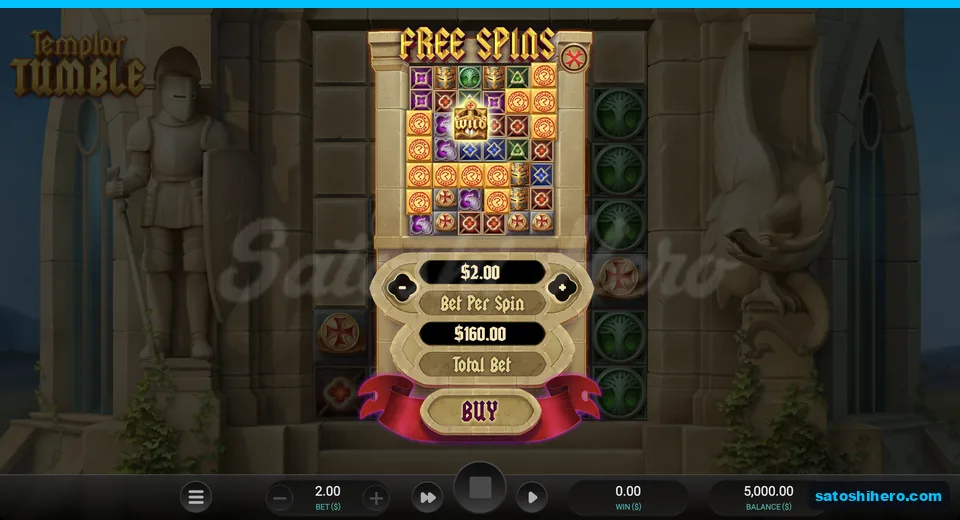
The Free Spins buy costs 80x the bet and starts the round straight away. At my $2.00 stake, one buy cost $160.00. That creates instant action, but it doesn’t make the feature safe.
The buy panel shows the $2.00 bet per spin, the $160.00 total, and a red BUY button. After purchase, the game moves to a chapel entry screen that asks you to press to enter. I tested one buy on a fresh $5,000 balance.
Buy cost

Strategy Insight: If you use the buy, think in buy-cost units, not spin-cost units. At $2.00, one click risks $160.00.
That framing matters because 80x can vanish in seconds. You aren’t making one normal spin decision; you’re committing a large chunk of bankroll to one feature round. I don’t mind bonus buys, but this one demands discipline.
Tested result
A Wild landed on the first spin of my bought round. It turned a column of symbols into Mysteries, and those revealed as golden Templar helms. That cascade paid $52.39, which gave the round a strong opening.
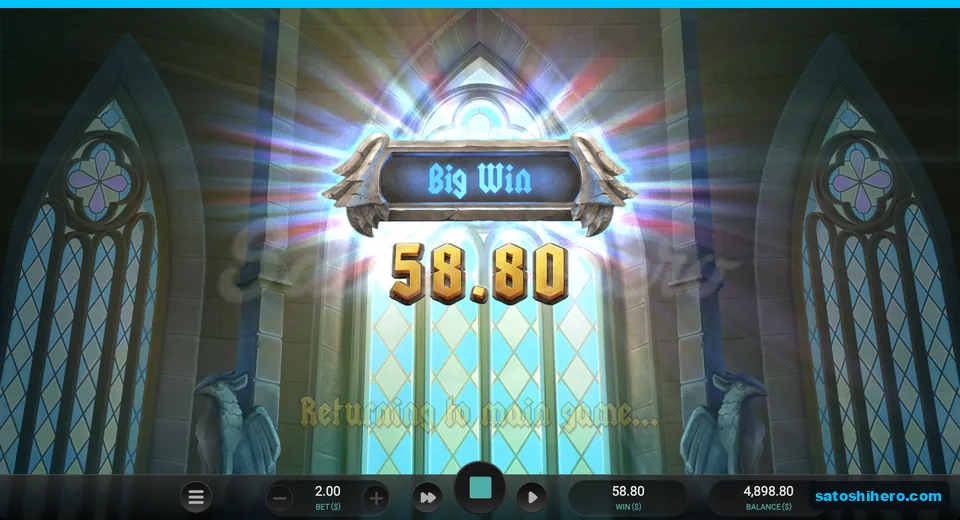
The full buy paid $58.80 in total, or 29.4x the bet. That was a little over one third of the $160.00 cost. The buy felt exciting immediately, but paying 80x didn’t reduce the risk at all.
Base Game Session
My 500-spin base-game session finished $668.40 down with no Free Spins. The base game produced moments, but not enough to offset the missing feature. That result makes the high volatility easier to understand than any label on a paytable.
I played 500 spins at $2.00 in one autoplay run with quick spin on. The balance moved from $5,000 to $4,331.60. I didn’t clear every sandstone block once, so the main feature never arrived.
Best base hit
The best spin came around spin 106. A longer chain turned into a $36.40 Big Win, which looked good on screen but still covered fewer than 19 spins at my stake. That’s the kind of hit that keeps the session breathing without changing its direction.
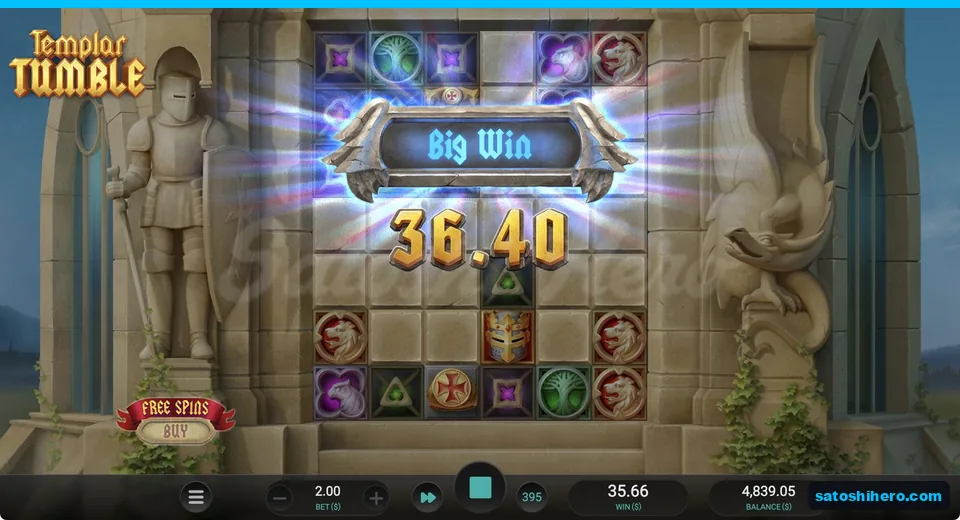
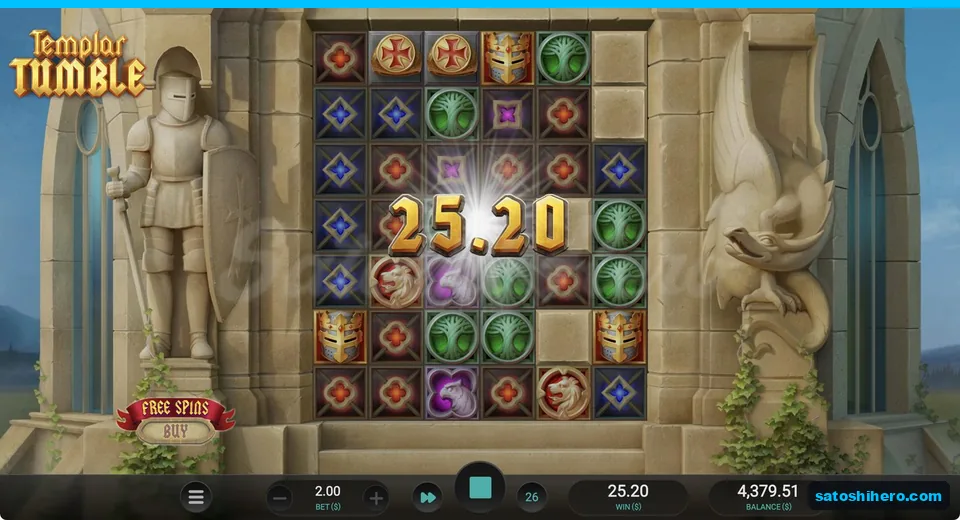
Around spin 141, a Mystery Reveal became matching relics worth about $31. I liked that moment more than the Big Win because it showed the feature logic working. Still, two decent base hits couldn’t carry the run.
Late-session slide
After spin 150, the balance slid almost without a break. The base game wasn’t dead, and plenty of tumbles broke part of the wall. The problem was that the small wins didn’t offset the missing Free Spins.
Sloth Tumble creates a different mood, but the stop-start Tumble pacing makes the comparison useful if you track session feel. Here, the feature chase felt sharper and less forgiving. You should judge this slot by bankroll swings, not only by feature potential.
RTP, Volatility & Our Test
The official base RTP is 96.25%, the bonus buy RTP is 96.92%, volatility is high, and the max win is 17,371x the bet. My real test landed worse than the simulator’s bottom 5%, so short sessions can differ sharply from the theoretical return.
Data shows the math profile has serious upside, but it also allows rough short runs. You need to read the RTP beside the hit spread, not apart from it. The slot’s headline numbers look fair, yet the route to value can feel uneven.
Simulator projection
The SatoshiHero Slot Simulator used 96.25% return, high volatility, the 17,371x ceiling, and a $2.00 stake across 1,000 spins. The median session ended $132.60 down. The central 90% of runs landed between $638.30 down and $730.80 up.
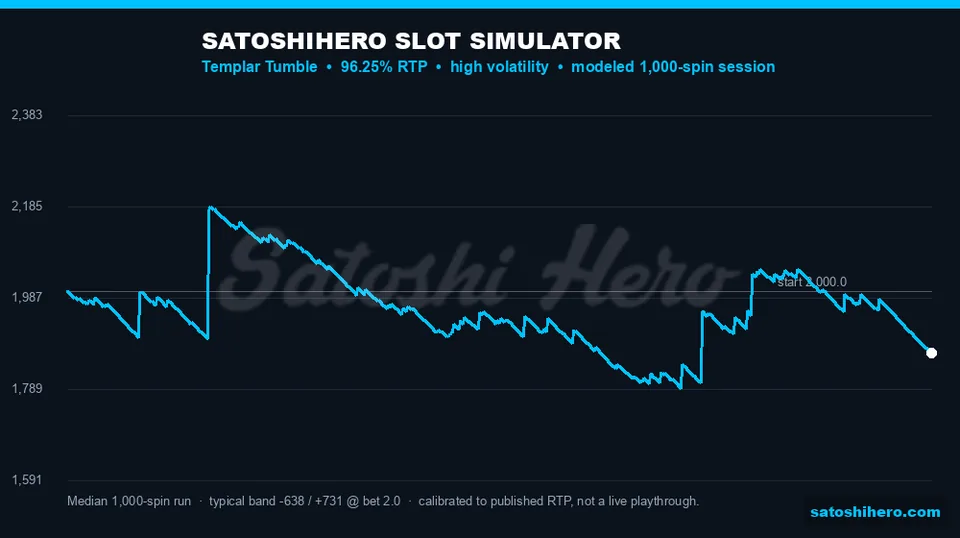
Around 18% of spins returned something. A feature-sized hit appeared about once every 45 spins, while a 100x win appeared roughly once every 1,751 spins. That spread gives you a map of risk, not a promise about your own balance.
The simulator makes the slot look playable but swingy. A $2.00 stake can produce a large range over 1,000 spins, and that range still doesn’t cover every possible outcome. You’ll need enough balance to survive the dry side.
Our 500-spin session
My 500-spin session finished $668.40 down, which sat beyond the model’s worst 5% of sessions. I never triggered Free Spins naturally. The best result was $36.40, and that wasn’t enough to slow the late-session drop.
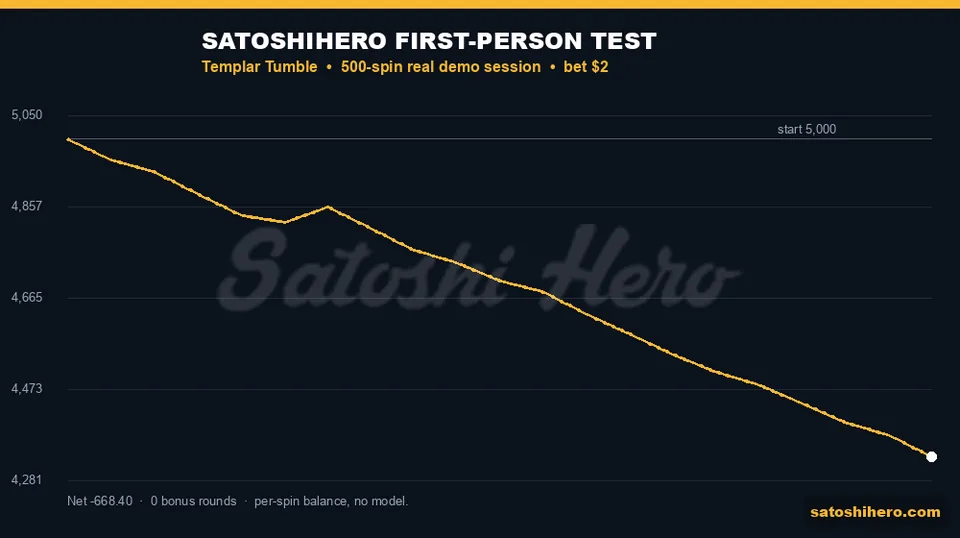
Warning: A 96.25% RTP doesn’t protect a short session. My 500 spins landed worse than the model’s bottom 5%.
I’m not treating that result as proof the slot pays poorly. It shows how base-game grind can dominate a short test when the blocker clear never lands. The math gives strong upside, but my session proves you still need room for rough stretches.
Theoretical RTP is the operator-published figure, one live session doesn’t change or prove the return, and bonus-buy RTP can differ slightly from base-game RTP by design. Here, those figures are 96.25% for the base game and 96.92% for the buy.
Bankroll Notes
Use smaller stakes if you mainly want to see the mechanics. High volatility, an 80x buy cost, and a rough 500-spin result make stake control important. The game can look calm for long stretches, then ask for a big bankroll decision through the buy button.
At $2.00, my base session lost $668.40 over 500 spins. The simulator’s 90% band still allowed a $638.30 downside over 1,000 spins. Those numbers suggest you shouldn’t treat $2.00 as casual if your balance can’t absorb extended dry patches.
Stake sizing
Smaller stakes give you more time to see blockers, tumbles, Mysteries, and the Free Spins chase. That matters because the main trigger can take far longer than you expect. I’d rather lower the stake and watch 200 spins properly than push too hard and quit before the mechanics show up.
The 17,371x ceiling gives the slot strong upside. But the game asks you to tolerate a lot of base-game dead air to chase it. That trade-off won’t fit every bankroll.
Buy risk
The $160.00 buy returned only $58.80 in my test. That result doesn’t make the buy bad, but it shows how quickly an 80x feature can underpay. You need to accept that one buy can land below half its cost.
Wildchemy has a different bonus structure, yet it makes a useful comparison for volatile feature-driven play. In both cases, you need to price the feature before chasing the excitement. The safest way to learn this game is to lower stake size before chasing the blocker clear.
Frequently Asked Questions About Templar Tumble
How does Templar Tumble pay?
Templar Tumble pays up to 117,649 ways on a 6 by 7 grid. Sandstone blockers fill much of the grid and break next to wins, so each tumble can open more ways.
What is Mystery Reveal in Templar Tumble?
Mystery Reveal starts when a Wild falls in and turns 3 to 8 blockers into Mysteries. They reveal together as one matching symbol, or as Coin symbols paying 1x to 1,000x the bet.
How do you trigger Templar Tumble Free Spins?
You trigger Free Spins by clearing every blocker on the grid in one spin. That awards 6 free spins with no blockers, where Mysteries can also award extra spins.
How much is the Templar Tumble bonus buy?
The Free Spins buy costs 80 times the bet. At a $2.00 stake, that means one buy costs $160.00.
What did the 1000 spin simulator show for Templar Tumble?
At $2.00, the median 1,000-spin session ended $132.60 down. The central 90% of runs landed between $638.30 down and $730.80 up.
How did your 500-spin test of Templar Tumble go?
I finished $668.40 down with no Free Spins, since I never cleared every block. My best spin was a $36.40 Big Win.
What are the RTP and max win of Templar Tumble?
The base game returns 96.25%, the buy returns 96.92%, and the top win is 17,371 times the bet.
Final Verdict
Templar Tumble stands out because its blockers turn a standard ways grid into a real feature chase. The drawback is simple: the game can grind hard when Free Spins stay locked behind the wall.

My Take
Patient high-volatility players get the most from this slot because the best moments need time and balance. You should expect small tumbles, long blocker chases, and occasional Mystery spikes rather than steady comfort.
I like the way Mystery Reveal adds tension to the base game, especially when a Wild lands near a damaged wall. I don’t like how my 500-spin run never reached Free Spins, and the $160.00 buy paying $58.80 shows the bonus carries real bite.
Templar Tumble is a sharp, numbers-first choice if you respect the variance and keep stake size under control. SatoshiHero game information and test notes are checked regularly.

Pros:
 Clear ways system: Adjacent-reel wins are easy to read during fast cascades.
- Strong blocker tension: Every cleared stone gives small wins extra purpose.
- Meaningful Mystery Reveal: Wild-triggered Mysteries create the base game’s best suspense.
- High upside: The 17,371x ceiling gives patient players a serious target.

Cons:
 Harsh trigger path: Free Spins need a full blocker clear in one spin.
- Swingy buy: The 80x cost can underpay sharply.
- Base grind: Small tumbles may not offset long feature droughts.

Best For: Patient feature chasers, high-volatility regulars, and blocker-clearing fans get the most from this slot. If you want smooth balance movement, this one can feel too punishing.












Other Relax Gaming Games




















































Bets
All Bets
Game
Player
Date
Wager
Mult.Multiplier
Prize
 Luck of Panda: Bonus Combo
 Hidden
- 08:01:21
- 0×
- Luck of Panda: Bonus Combo
 mike_721
- 08:01:21
- 0×
- Almighty Diamonds: Hold 'N' Link
- Hidden
- 08:01:20
- 0×
- Luck of Panda: Bonus Combo
- mike_721
- 08:01:18
- 2.5×
- Luck of Panda: Bonus Combo
- Hidden
- 08:01:18
- 0×
- Grand Koala: Hold ‘N’ Link
- nina87
- 08:01:16
- 0×
- Great Ghosts!
 davidm5
- 08:01:14
- 0×
- Big Bass Amazon Xtreme
 Hidden
- 08:01:14
- 0×
- Tempting Treats
 Hidden
- 08:01:12
- 0×
- Big Bass Amazon Xtreme
- Hidden
- 08:01:11
- 0×