

DJ Fox
By pressing play, you agree that you are above legal age in your jurisdiction and that your jurisdiction allows online gambling.


Spinning Neon Numbers With a Fox Behind the Decks
Glowing number chips turn every DJ Fox spin into visible arithmetic instead of a conventional symbol match.
The DJ Fox slot is a high volatility slot from Push Gaming with 96.28% RTP and 10,000x maximum win potential. Arithmetic-slot fans get a three-reel, five-row layout, one active starting line, VIP-opened rows, escalating multipliers, and costly Push-Up access. There are no free spins or feature buy; my 100 $0.50 spins staked $50.00, returned $44.55, and lost $5.45 with a 22.2x best hit.
Key Takeaways
- Best play: Standard play kept Push-Up off throughout my test; there are no free spins or feature buy.
- RTP / volatility: The theoretical return is 96.28%, paired with high volatility and uneven session movement.
- Max win: The prize ceiling reaches 10,000x the base bet in one game round.
- Risk note: Push-Up can charge 10x the base bet while every prize still uses that base.
- Bankroll note: My 100 spins staked $50.00, returned $44.55, and finished $5.45 down.

Table of Contents
- How the DJ Fox slot Works
- Chip values
- Special symbols
- Neon Nightclub Theme & First Impressions
- Win What You See in the DJ Fox slot
- Number building
- Tested examples
- RTP, Volatility & Our 100-Spin Test
- Simulator projection
- Our 100-spin session
- How Row Activation Works
- How the Multiplier Meter Works
- How Meter Lock Holds Progress
- How Push-Up Changes the Round Cost
- DJ Fox slot Frequently Asked Questions
- Final Verdict
How the DJ Fox slot Works
DJ Fox uses three reels, five rows, and five fixed left-to-right prize lines, one per row. Only the bottom line starts active, so visible symbols above it don’t pay until VIP activity or Push-Up opens their rows. Every paytable amount uses the base bet, which keeps the arithmetic consistent once you know which rows count.
The DJ Fox slot runs smoothly across desktop and mobile screens, and the number chips remain easy to inspect. You can try the free demo or play for real here on SatoshiHero. I like that the compact board exposes every possible row without pretending each dimmed line already has value.
Chip values
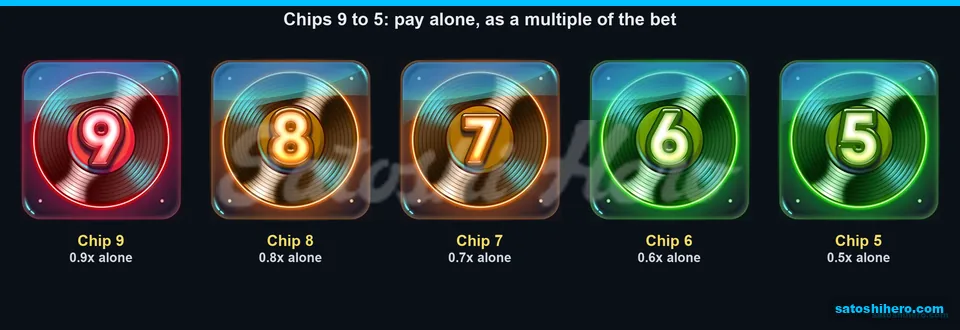
Chips 9 through 5 pay 0.9x, 0.8x, 0.7x, 0.6x, and 0.5x when they land alone. At my $0.50 base bet, those values equal $0.45 through $0.25. Spin 36 confirmed the top example when one 9 paid exactly $0.45.
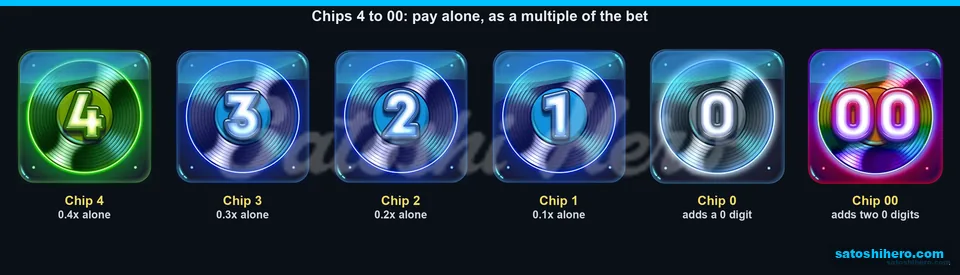
Chips 4 through 1 continue downward from 0.4x to 0.1x. That makes their $0.50-bet values $0.20, $0.15, $0.10, and $0.05. A 0 or rainbow 00 pays nothing alone, but it appends one or two zeros beside another digit.
Position matters more than symbol rank because 5 beside 00 becomes far stronger than isolated high chips. You should read the row as a complete number before assigning any prize. That design feels clever, though careless scanning can make an ordinary board look much richer.
Special symbols
A dud is a blank, valueless position that splits adjacent digits. The VIP badge also pays nothing directly, yet it fills the multiplier meter and opens the next row. There is no wild or scatter, which keeps your attention on digit placement and active lines.


Key Stat: A normal round starts with only the bottom prize line active, even though the board contains five genuine lines.
Wild Swarm asks you to watch for familiar symbol combinations, while DJ Fox asks you to interpret adjacent digits as visible values. I find the latter more mentally active, although it demands closer reading. Check the active row and chip positions first, then judge what the board paid.
Neon Nightclub Theme & First Impressions
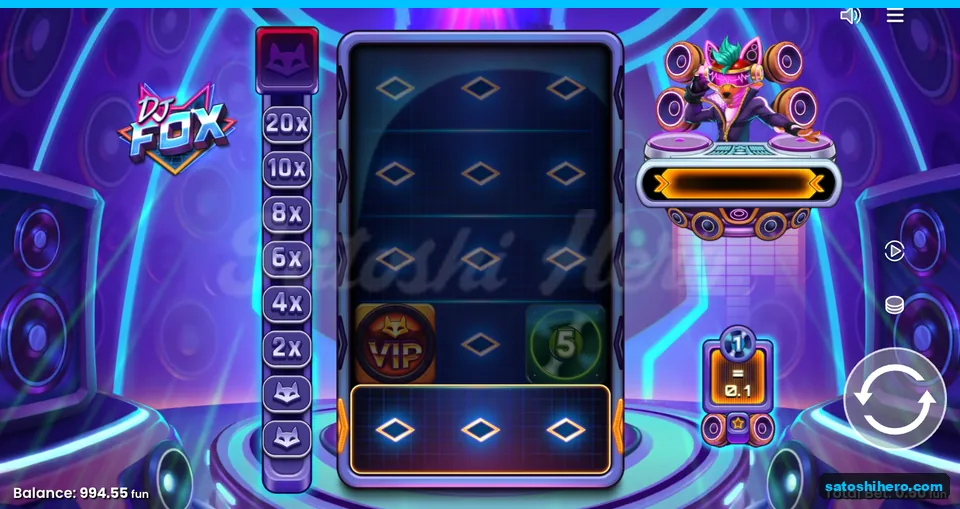
A dark neon nightclub gives the number system strong visual order rather than mere decoration. The fox DJ wears sunglasses beside stacked speakers, while glowing vinyl-record chips fill the board. Dim upper rows stay visible, preparing you for possible openings without competing with the active bottom line.
The multiplier meter runs up the left edge with clearly empty positions. At rest, the board shows one bright row, four muted rows, an empty meter, and my $0.50 bet. You can read that state in seconds, and I think the interface communicates more cleanly than many louder music slots.
The fox-at-the-decks concept won’t win originality awards, but the records make number building unusually clear. Tiki Tumble offers a brighter tropical visual alternative if dark club lighting isn’t your preference.

Insight: The vinyl-record chips connect the nightclub theme to the payout system, keeping important numbers readable against the dark background.
Here, strong contrast helps you spot joined digits, open rows, and meter progress before the result animation ends.
Win What You See in the DJ Fox slot
Each active row forms a left-to-right number, then the game divides that number by 10 before applying your base bet. Adjacent chips join into two-digit or three-digit values. A dud breaks that connection, so separated numbers receive individual values and are then added.
This rule makes position decisive, especially around 0 and 00 chips. You aren’t collecting conventional matches; you’re reading the exact digits that remain on every active line. I enjoy the transparency, but the mental calculation can feel busy when several rows open together.
Number building
The official examples show the logic without guesswork:
- 5, dud, 0 pays 0.5x because the isolated zero adds nothing.
- 5, 0, dud forms 50 and pays 5x.
- 5, dud, 3 pays 0.8x after both separate values combine.
- 5, 00, dud forms 500 and pays 50x.
A zero beside another digit changes the entire number. Place a dud between them and that connection disappears. You should solve each uninterrupted digit group first, then add separate values within the row.
Tested examples
Spin 75 gave my clearest unmultiplied result. Adjacent 9 and 5 chips formed 95, which became 9.5x and paid $4.75 from a $0.50 bet. Nothing about that hit needed a payline chart or hidden symbol table.
Spin 45 required two stages because several rows and the meter mattered. The bottom row formed 36, while a separate 1 sat on an upper active row. Those values totaled 3.7x before the lit 6x meter produced $11.10, or 22.2x my base bet.
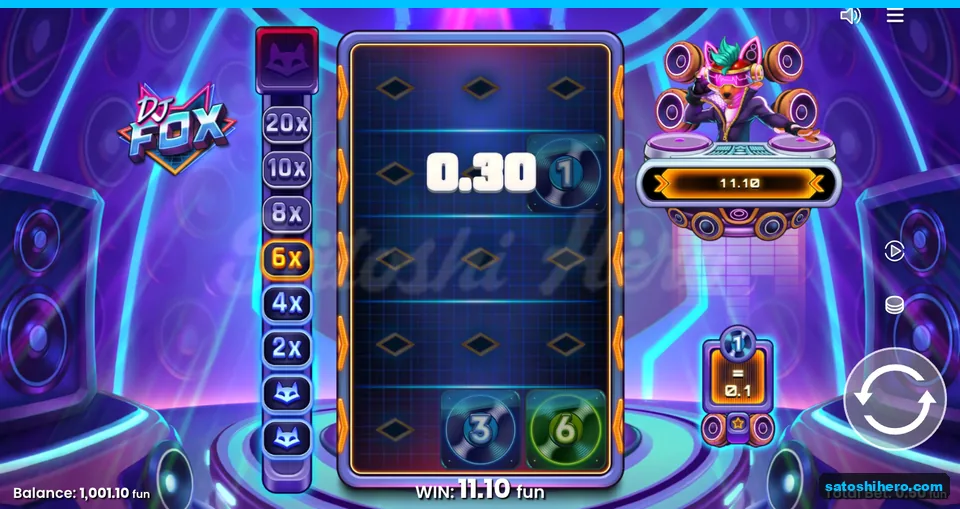
The calculation order is simple: build each active row, total their prizes, then apply the meter. You can avoid most mistakes by never multiplying one row separately. That sequence turns a crowded board into manageable arithmetic.
RTP, Volatility & Our 100-Spin Test
The DJ Fox slot combines 96.28% theoretical RTP, high volatility, and a 10,000x maximum win. Those figures describe its math profile, while my simulator run and live session show two very different evidence types. You shouldn’t treat either short result as a promise about your next spin.
Simulator projection
Our 1,000-spin simulator produced a median finish 79.9x the bet down. Its p5-to-p95 band stretched from 317x down to 384.3x up, showing how widely a high-volatility session can move. The modeled paying-spin rate was 18%, and the feature tier appeared about once every 46 spins.
A modeled result of 100x or larger appeared about once every 1,592 spins. That frequency isn’t a countdown, and the model doesn’t replay recorded live rounds. It works from published inputs, so you should read its spread as a risk illustration rather than a forecast.
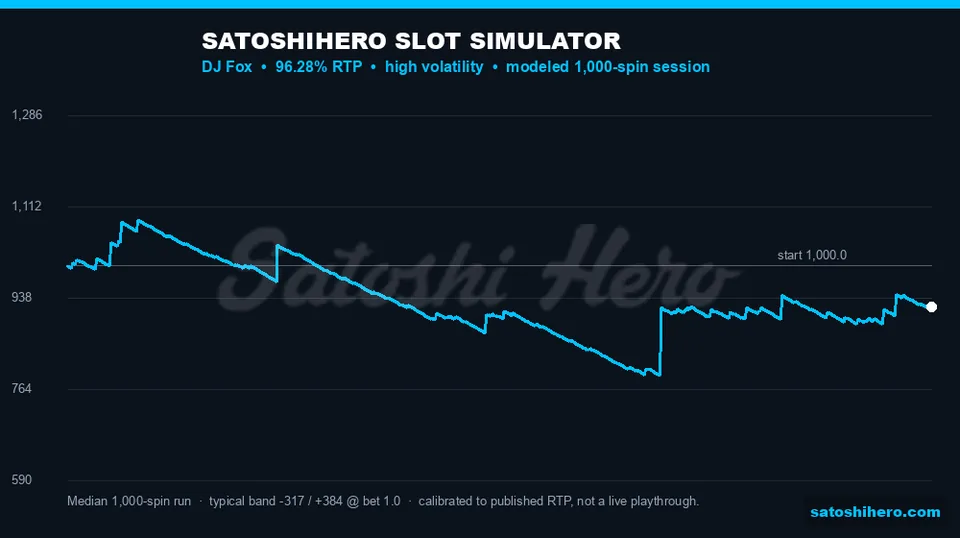
Numbers indicate substantial upside and deep downside around the median. I find the broad band more informative than the central result because it exposes how little one average can describe. The model’s sparse 100x outcomes also make the large prize ceiling look remote in ordinary play.
Our 100-spin session
My 100 spins at $0.50 lost $5.45, equal to 10.9x the base bet. I began with $1,000.00, staked $50.00, received $44.55, and ended on $994.55. That outcome felt relatively gentle for this volatility level, although Meter Lock drove the recovery.
Among 39 paying spins, 27 returned under 1x. Two paid from 1x to below 2x, nine landed from 2x to below 10x, and one exceeded 10x. You shouldn’t substitute that 39% observed rate for the simulator’s 18% modeled estimate because they measure different samples.
My longest losing run lasted eight spins, covering spins 12 through 19. The balance reached $984.00 after spin 42, then climbed to $1,001.10 after spin 45. That quick reversal came from the held meter sequence rather than steady base-line payouts.
The top hit was $11.10, or 22.2x, on spin 45 under a 6x meter. Spin 75 supplied the largest unmultiplied win at $4.75, equal to 9.5x. I liked the recovery, but one concentrated sequence carried too much of the result for the session to feel consistently rewarding.
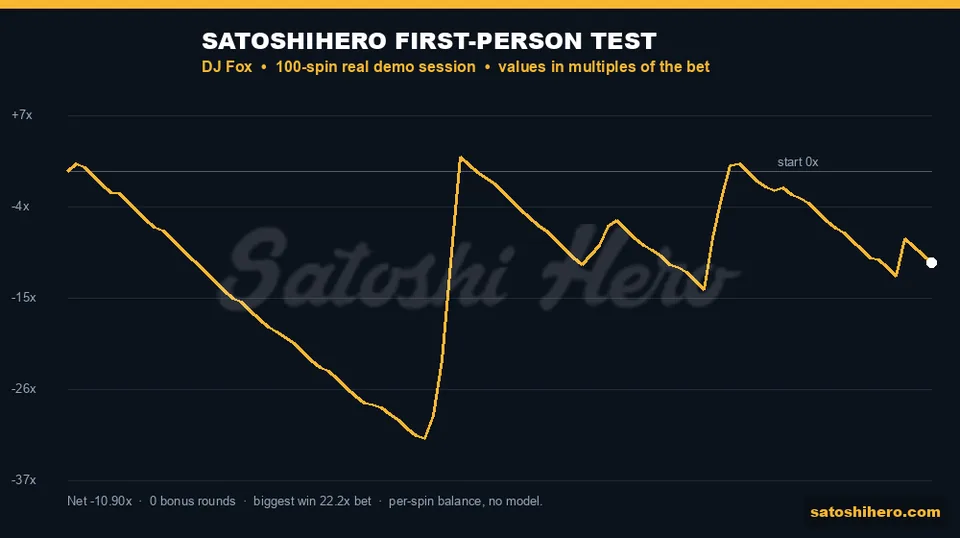

Warning: The 10.9x session loss and 39 paying spins shouldn’t make the risk look mild. The simulator’s broad range and sparse modeled 100x results show how uneven play can become.
The 96.28% figure is the operator’s theoretical return. One 100-spin session can’t verify or alter it, and the simulator projects distributions instead of replaying live rounds. No free-spins or feature-buy RTP variants exist here, so you only need to size stakes for the sharp base-game swings.
How Row Activation Works
A VIP on an active row fills the next meter position and opens the row immediately above. Any VIP already visible on that new row also enters the meter and grants a respin, but it doesn’t open another row. You can’t build an unlimited opening chain from exposed badges.
During the respin, duds spin again while every number chip remains locked. The game evaluates all active rows after respins finish. An ordinary new round resets to the bottom row unless Meter Lock holds the developed state.
The round ends once number chips occupy every position and nothing remains to spin. In my test, VIPs appeared on 12 spins and opened at least one extra row each time. Dimmed VIPs did nothing until their row became active, a restriction I found sensible because it keeps the sequence readable.
A newly opened row can expose more VIPs, but those extra badges only grant the respin. They can’t continue an unlimited row-opening chain.
Activation gives you more prize lines for the current round while building the multiplier at the same time. Watch the lowest active VIP first, then follow newly exposed badges. That order shows exactly why each row joined the calculation.
How the Multiplier Meter Works
Every collected VIP fills one meter position, and the highest lit value multiplies the combined win from all active rows. Three VIPs activate 2x, four activate 4x, and five activate 6x. Six, seven, and eight VIPs raise the meter to 8x, 10x, and 20x.
The meter usually clears when a new game round starts. Empty positions also cap how many VIPs can appear, while only one VIP can land after the meter reaches 20x. You should count free spaces before imagining a higher threshold from the visible board.
Spins 43 through 45 gave me the best meter evidence. A fifth VIP raised the held meter to 6x and kept all five rows open. On spin 45, the multiplier turned 3.7x of row value into $11.10, or 22.2x the $0.50 base bet.
I like how the meter transforms otherwise small row values, but reaching its stronger levels requires enough VIPs first. You still need worthwhile digits across active rows because a large multiplier can’t create value from blanks. The meter rewards developed boards, not badges alone.
How Meter Lock Holds Progress
Meter Lock can trigger after a round that added VIPs, preserving open rows and filled meter positions for another paid round. A padlock above the meter marks the held state, and the next spin still costs your selected stake. Changing that stake or enabling Push-Up clears everything.
My main sequence started on spin 42 with four VIPs, four open rows, and 4x. A lone 2 then paid $0.40 after the multiplier. Meter Lock held that state, and spin 43 added a fifth VIP, opened every row, activated 6x, and returned $3.90.
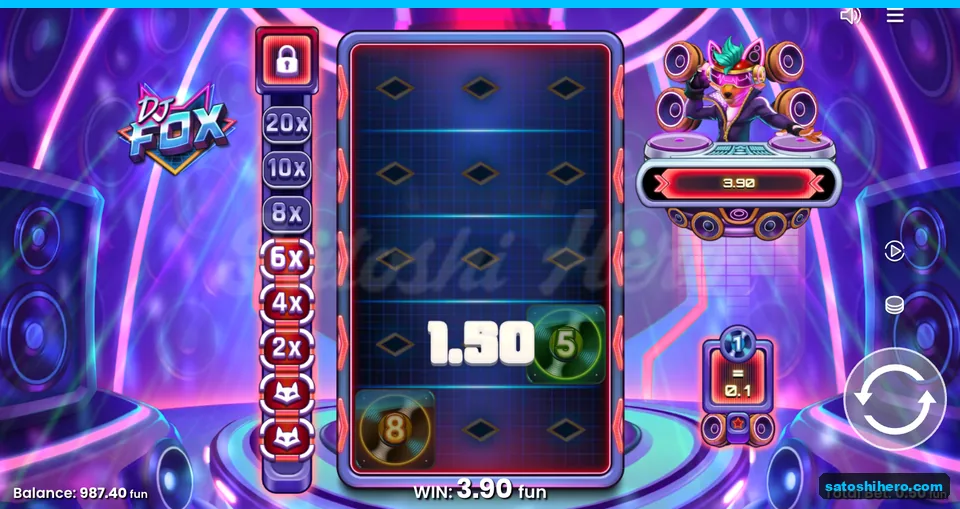
The lock carried 6x through spins 44 and 45, which paid $3.60 and $11.10. The meter cleared on spin 46. Across those three held rounds, I saw how one productive VIP event could become a much more consequential sequence.
Two smaller locks showed the downside. After spin 36, one VIP and the second row remained open, yet spin 37 paid nothing. The same state held after spin 60, and spin 61 returned $1.65 from 29 on the second row plus 4 below.

Strategy Insight: Don’t change the selected bet or switch Push-Up on while Meter Lock is active. Either action clears the held meter and open rows.
Meter Lock was my most important tested feature because it extended one useful VIP round across four spins. Still, it guarantees no prize, as spin 37 demonstrated. You get more paid rounds with a developed board, not a promised return.
How Push-Up Changes the Round Cost
Push-Up opens extra rows before a spin, but it sharply raises the complete round cost. Two active rows cost 2.5x the base bet, three cost 5x, four cost 7.5x, and all five cost 10x. Prizes still use the base bet rather than that enlarged expense.
You can disable Push-Up after a completed round. I kept it off for all 100 test spins, so I won’t claim that any level improves results. Calculate the full cost before selecting extra rows because a bankroll funds far fewer rounds at the highest setting.
Enabling Push-Up also clears an active Meter Lock. Paying 10x for a fully open board feels aggressive in a high-volatility game without comparative test evidence. Shamrock Saints offers a different visual presentation if you prefer another theme, but that choice says nothing about untested costs or feature strength.
Standard play gave me clearer bankroll control and a clean view of natural VIP activation. Push-Up gives you more starting lines, yet it demands substantially more expensive rounds. Treat access and value as separate questions.
DJ Fox slot Frequently Asked Questions
How does Win What You See pay in the DJ Fox slot?
Each active row forms a left-to-right number, with adjacent chips joining and duds separating values. The game divides the completed number by 10 before applying the base bet. On spin 75, 9 and 5 formed 95, paying 9.5x or $4.75 from my $0.50 bet.
What does the VIP symbol do in the DJ Fox slot?
A VIP fills the meter and opens the next row. VIPs exposed on that row trigger a dud-only respin while number chips stay locked, but they don’t continue an unlimited opening chain. Badges appeared on 12 of my 100 spins, opening at least one extra row each time.
How does the multiplier meter work in the DJ Fox slot?
Three VIPs activate 2x, four activate 4x, five activate 6x, six activate 8x, seven activate 10x, and eight activate 20x. The lit value applies to the complete spin win across all active rows. My 6x meter stayed held through spins 43 to 45.
What is Meter Lock in the DJ Fox slot?
Meter Lock randomly preserves open rows and filled meter positions for another paid round. My main sequence held 6x through spins 44 and 45, with the last paying $11.10, or 22.2x. Changing your bet or enabling Push-Up clears the stored state.
What is Push-Up in the DJ Fox slot?
Push-Up opens two, three, four, or five rows for round costs of 2.5x, 5x, 7.5x, or 10x the base bet. Every prize still uses the base bet. I left Push-Up off throughout my test, so those levels carry no firsthand performance ranking.
What did the 1,000-spin simulator show for the DJ Fox slot?
The simulator’s median session ended 79.9x down, with a range from 317x down to 384.3x up. It modeled an 18% paying-spin rate and one 100x-or-larger result per 1,592 spins. These projections aren’t guarantees, live rounds, or trigger countdowns.
How did the 100-spin DJ Fox slot test go?
My $0.50 spins staked $50.00 and returned $44.55, leaving a $5.45 loss. I recorded 39 paying spins, while the biggest returned $11.10, or 22.2x. That session describes my test only and doesn’t predict yours.
What are the RTP and maximum win of the DJ Fox slot?
DJ Fox has 96.28% theoretical RTP, high volatility, and a 10,000x maximum win per game round. Its layout uses three reels, five rows, and five fixed prize lines. Only the bottom line begins active.
Final Verdict
The DJ Fox slot stands out because visible arithmetic replaces ordinary matching symbols with numbers you can verify. Its readable meter and memorable lock sequence add identity, while aggressive Push-Up pricing remains the largest drawback.

My Take
Number-building fans with patience should try standard play before touching Push-Up. Expect many small returns, abrupt meter-driven swings, and no free-spins detour from the core system.
My spin 75 result showed the 9.5x calculation without hidden steps. I don’t like how strongly the recovery depended on one held 6x sequence.
The DJ Fox slot guide is checked regularly so its mechanics and practical explanations remain accurate. You should still treat my results as one observed session, not a target for your play.

Pros:
 Readable payouts: Joined digits reveal the prize logic before the final calculation.
- Useful visual hierarchy: Dim rows and bright chips keep active information clear.
- Meaningful Meter Lock: Held rows and multipliers can extend one developed game state.
- Distinct arithmetic: Win What You See creates more involvement than routine symbol matching.

Cons:
 Aggressive Push-Up: Five starting rows cost 10x while prizes retain base-bet values.
- Concentrated recoveries: My strongest sequence carried much of the short session’s return.
- Busy open boards: Several active rows require careful reading before applying the meter.

Best For: Arithmetic-slot fans who enjoy checking every digit and tracking meter progress get the clearest appeal. You also need patience for high-volatility movement and discipline around the expensive Push-Up settings.












Other Push Gaming Games























































Bets
All Bets
Game
Player
Date
Wager
Mult.Multiplier
Prize
 Mardi Gras Queen
 Hidden
- 12:17:42
- 0×
- Pelican's Bay: Rapid Link
 Hidden
- 12:17:42
- 0×
- Fortune Skulls
 mdp0fxo
- 12:17:42
- 0×
- Mardi Gras Queen
- Hidden
- 12:17:41
- 0×
- Elephant's Gold: Bonus Combo
 mike_721
- 12:17:40
- 0×
- Mardi Gras Queen
- Hidden
- 12:17:39
- 0×
- Galaxy Glitter
- maya_81
- 12:17:39
- 0×
- Fortune Skulls
- mdp0fxo
- 12:17:39
- 0×
- Mardi Gras Queen
- Hidden
- 12:17:38
- 0×
- Mardi Gras Queen
- Hidden
- 12:17:36
- 0×