

POP O'Gold
By pressing play, you agree that you are above legal age in your jurisdiction and that your jurisdiction allows online gambling.

POP O'Gold
RTP96%
VolatilityHigh
Max winx20,000
Ways16,807
Hit rate24.57%
ThemeParty
ReleasedMar 2023

Chasing Sticky Gold Through a Haunted Forest
POP O’Gold slot fuses sticky wins, expanding reels, and dark Irish folklore.
According to AvatarUX, the high-volatility slot has a 96% theoretical RTP and 20,000x maximum win; reaching that cap ends the round. Its five-reel board grows from three rows to five, or seven in free spins. The SatoshiHero demo opened at $10,000.00 with a $1 default bet; my 100 spins lost $15.60, triggered one feature, and peaked at 25.2x, making this a sharp-swing choice for patient chain fans.
Key takeaways
- Best bonus: Take five free spins if you won’t risk losing the entire trigger on the Enchanted wheel.
- RTP / volatility: The 96% theoretical return accompanies high volatility, so your short results can swing far from that figure.
- Max win: The 20,000x ceiling is substantial, but the round ends when you reach that cap.
- Risk note: Neither the 100x Magic bonus nor the 400x Max magic bonus entered my test, so I won’t rank them.
- Bankroll note: The larger buy commits 400 base bets to one feature, which can drain your budget quickly.
Those choices make risk control more important than chasing the headline ceiling. I favour the guaranteed feature as a starting point.

Table of Contents
- How the POP O’Gold slot Works
- Win conditions
- Symbol values
- Theme and First Impressions
- Forest setting
- Visual presentation
- The StickyPop Engine
- Sticky win cycle
- Splits and boosts
- RTP, Volatility and Test Data
- Simulator projection
- Our 100-spin session
- Free Spins and Enchanted Wheel
- Wheel choices
- Tested result
- Bonus Buy Options
- Magic bonus
- Max magic bonus
- Ante Bet and Stake Control
- Extra spin cost
- Test setting
- How the 100 Spins Played
- Session rhythm
- Player fit
- POP O’Gold slot FAQs
- The Takeaway
How the POP O’Gold slot Works
Three or more identical symbols win across adjacent reels from either the left or right. They don’t need to share one horizontal row, but a one-reel gap breaks the combination. The game has no fixed paylines, so you should watch the changing ways counter instead.
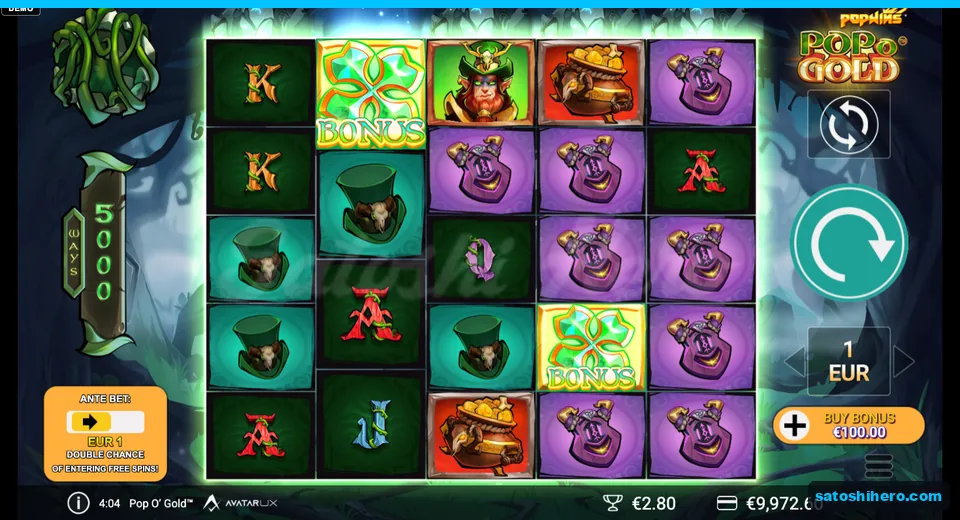
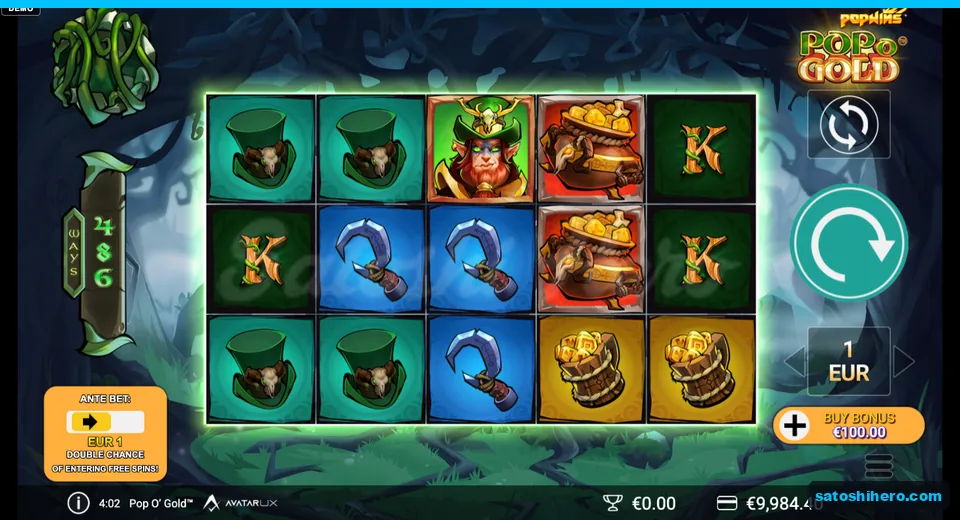
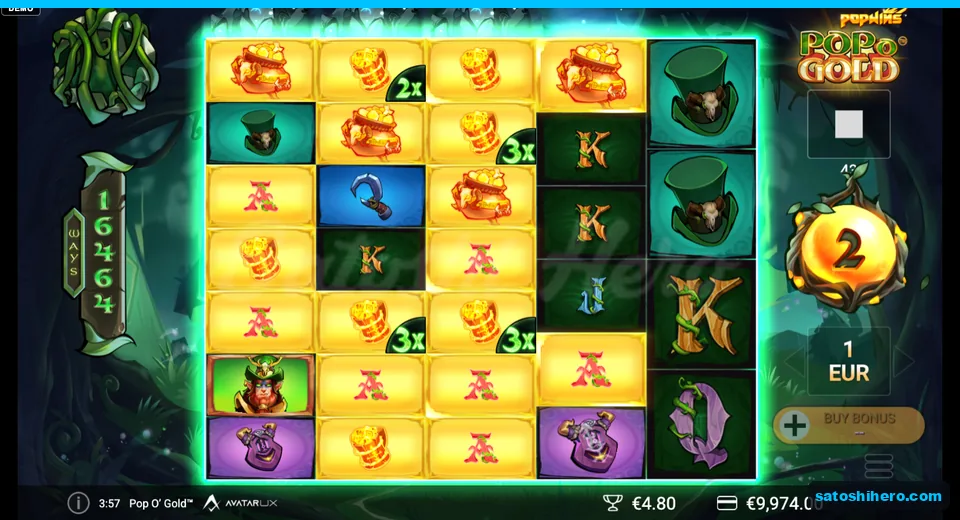
The board begins with five reels and three rows, showing 486 ways at rest. Sticky wins increase individual reel heights, and I saw 2,048 and 5,000 ways on expanded boards. My free spins reached 16,464 ways, while the stated limit is 16,807. Compatible desktop and mobile browsers retain the same core mechanics wherever you play.
Win conditions
Imagine matching hats on reels one, two, and three. That sequence qualifies even when each hat occupies a different row. Hats on reels one, two, and four don’t connect because reel three creates a gap.
Right-to-left wins follow the same adjacent-reel rule, so matching symbols across reels five, four, and three can pay. Mechanically speaking, this arrangement rewards symbol density rather than marked line patterns. You should follow reel growth and the displayed ways total, because both can change during one paid spin.
Symbol values
Every pay below uses a multiple of your stake:
| Symbols | Three | Four | Five |
|---|---|---|---|
| Leprechaun, pot of gold | 0.3x | 1x | 2.5x |
| Barrel, potion, green hat, hook | 0.2x | 0.5x | 1.5x |
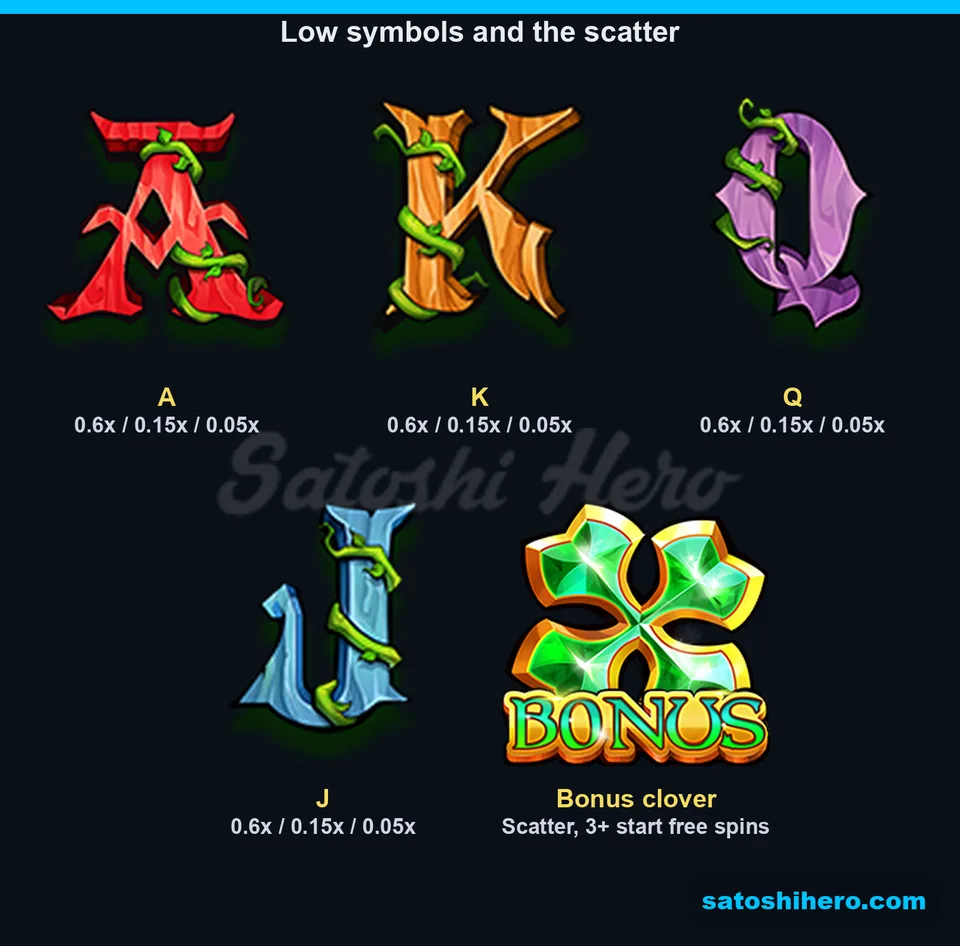
| A, K, Q, J | 0.05x | 0.15x | 0.6x |
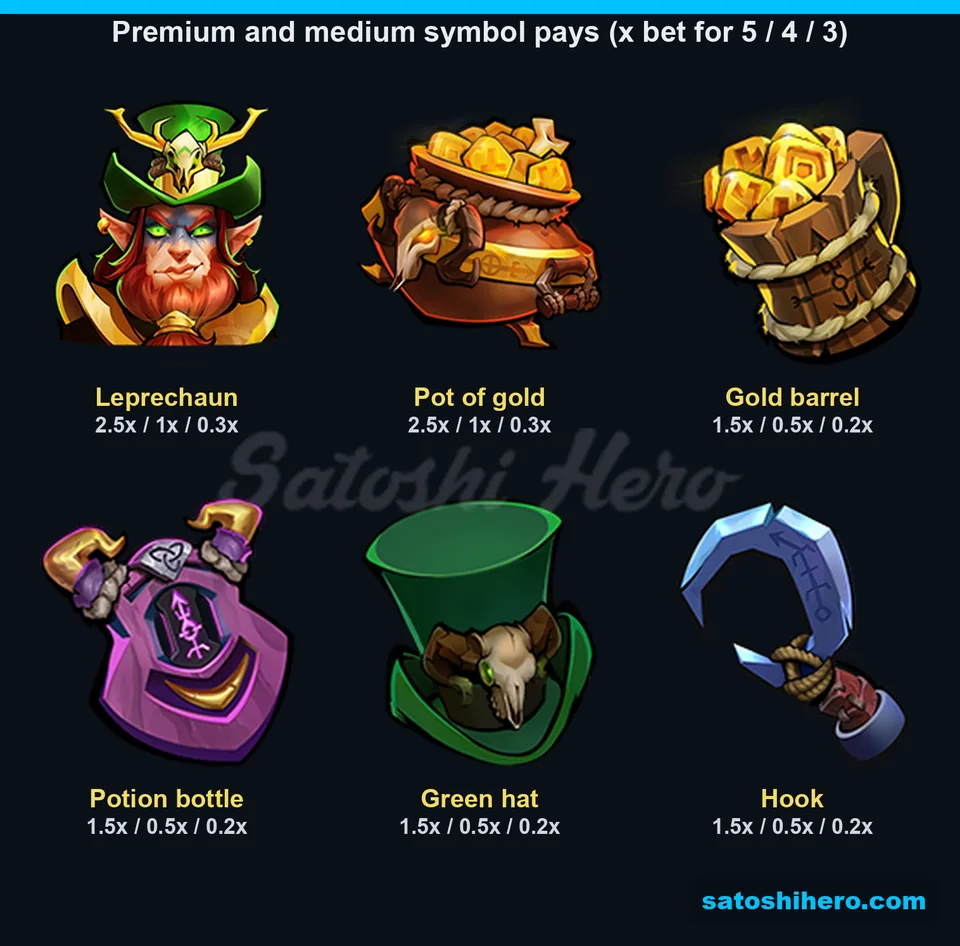
The Bonus clover has no direct payout, though three or more trigger free spins. I found no wild in the paytable or my test, and the game doesn’t need one to make growing reels work.
A separate $2.80 win on a five-row, 5,000-way board helped illustrate the mechanic, but I excluded it from my logged session.

Key Number: Matching symbols can pay from either direction without lining up on one row.
Changing reel heights make the ways counter relevant throughout every StickyPop chain. You can’t assess a sequence properly by staring at one row.
Theme and First Impressions
Familiar Irish-gold imagery gets a darker fantasy-horror treatment here. Before your first spin, you’ll notice a moss-covered forest, a green-glowing board, and twisting vines around the reels. I find that mood far more distinctive than another cheerful rainbow scene.
The leprechaun wears a skull-and-antler hat, immediately setting the rough folklore tone. Other pictures include a pot of gold, rune-marked barrel, purple potion, green skull hat, and blue hook. Card letters fill the low-value positions without fighting the stronger artwork.
Forest setting
A shadowy forest sits behind the bright reel area, while the green glow keeps its edges readable. The dark palette supports the eerie theme without hiding symbols when reels grow. You see the compact five-by-three board clearly before any chain begins.
No invented spectacle is needed because the visible contrast already does useful work. From a design perspective, the restrained background gives expanding reels room to become the focus. I think the art understands when to step back.
Visual presentation
The settled board looks controlled at three rows, then becomes notably busier as StickyPop raises separate reels. That visual growth lets you read progress at a glance, even before checking the ways counter. Wheel O’Gold puts more emphasis on its wheel-led gold concept, while Pop, Idol Pop Fever, and Tiki Pop provide related alternatives with different themes and feature structures; this game makes reel expansion the central visual event.

Lore: The skull-and-antler leprechaun gives familiar Irish folklore an unusually dark fantasy look.
The theme isn’t original at its roots, but the skull details give it sharper character. You get personality without losing sight of the changing board.
The StickyPop Engine
StickyPop holds every winning symbol, expands its reel, and replaces everything else for another connection attempt. The cycle continues while each respin adds a new sticky winner. This is the strongest piece of engineering in the game, because one simple rule drives height, ways, and anticipation together.
The sequence follows a clear order:
- Winning symbols become sticky.
- Each reel holding a new sticky winner grows upward by one position.
- A free space opens below that reel.
- Non-winning symbols disappear.
- Fresh symbols arrive in a respin.
- The process repeats while new sticky winners connect.
- The accumulated amount pays after a respin adds nothing new.
Reels can reach five symbols in the base game and seven during free spins. An early match can begin a long chain, but it doesn’t promise another connection. You need to treat growth as opportunity, not stored value.
Sticky win cycle
Suppose reels one through three create a win, but only reel two adds another sticky symbol next. That reel grows while its neighbours remain shorter, changing the board shape inside one paid spin. The ways counter can rise before the cycle settles.
Your accumulated total stays pending until a respin fails to produce a new win. I like that pause because every replacement has a clear job, yet several blank refreshes can make a promising opener feel flat. The mechanic remains readable even when the board becomes uneven.
Splits and boosts
Any symbol can carry a 2x or 3x split badge that multiplies its value. I saw both badges during my test, mainly inside free spins, where they made expanded connections easier to follow. Their visible badges add excitement without changing the basic win rule.
Boosted Reels can select two to five reels at a spin’s start. Every symbol on an affected reel receives a split multiplier, and this event has a greater chance during free spins. My 16,464-way feature board showed how quickly growth and split badges can combine.
Filling every reel in the base game activates a global 2x multiplier, then each additional win raises it by 1x during that cycle. I didn’t reach this full unlock, so that detail comes from the game information rather than observed play. StickyPop supplies the identity, while splits provide the clearest multiplier drama for you to track.
RTP, Volatility and Test Data
POP O’Gold slot carries a 96% theoretical RTP, high volatility, and a 20,000x maximum win. Extended losing stretches can follow, while one feature or sizeable base hit can reshape a short session. I consider the ceiling exciting but remote.
Simulator projection
The SatoshiHero Slot Simulator modelled 1,000 spins at a $1 stake as a range, not a prediction. Its median session finished $67.30 down, while the middle 90% ran from $310.50 down to $364.80 up. That wide spread shows why you shouldn’t treat the headline return as a session target.
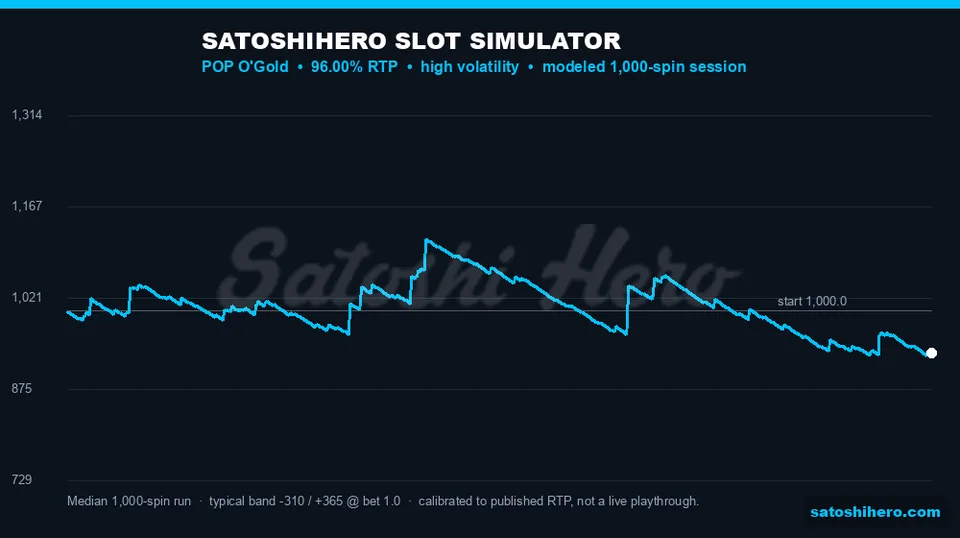
About 18% of modelled spins paid. A feature-sized win appeared roughly once per 46 spins, and a very large result appeared about once per 1,621 spins. These frequencies don’t create a countdown, so 45 misses don’t make the next outcome due.
Our 100-spin session
I started with $10,000.00 and finished at $9,984.40 after 100 spins at $1, losing $15.60. Twenty-seven spins paid, which sounds active until you examine how small many returns were. My balance hit $10,012.20 after spin 9, then dropped to $9,975.00 after spin 56.
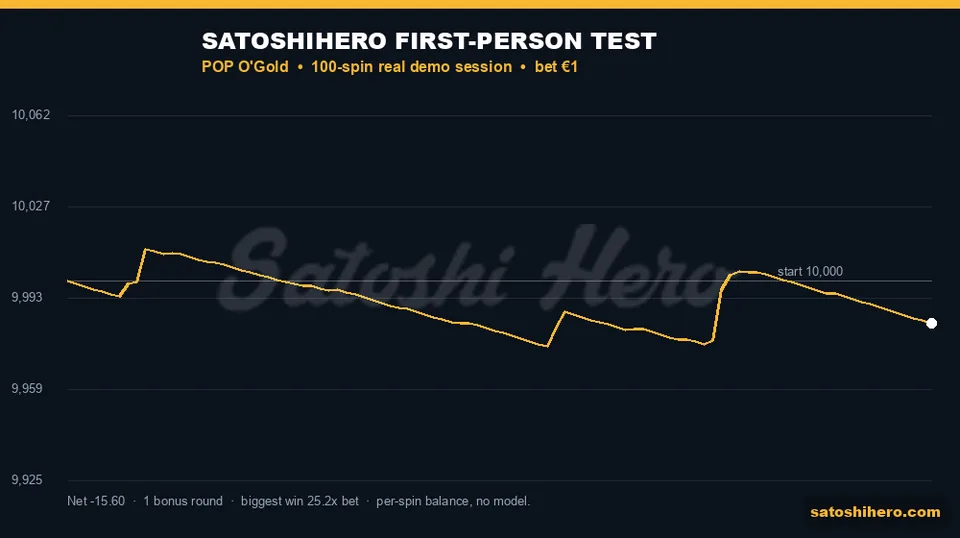
Free spins triggered once on spin 57. My largest result came later on spin 76, when a base-game chain paid $25.20, or 25.2x. I found that reversal more memorable than the whole feature because it arrived after the deepest decline.

Red Flag: A 96% theoretical RTP can’t protect your short session from high-volatility swings. Set a firm spending limit before you chase reel growth.
The theoretical RTP is the operator-published return figure, and my single live session doesn’t alter it. Our simulator projects possible outcomes rather than recording live spins. Bonus modes and buy configurations can use slightly different designed returns.
The model’s broad range matched the uneven rhythm I recorded. You should expect uncertainty rather than a smooth path toward any percentage.
Free Spins and Enchanted Wheel
Three or more Bonus clovers trigger free spins, but those clovers don’t pay cash themselves. You can take five spins, gamble once for eight, then gamble again for 12. Losing either gamble forfeits the feature, which makes this choice more serious than its colourful wheel suggests.
Golden fields can award up to 10 spins on the first gamble or 14 on the second. Those fields add upside, but the wheel doesn’t provide a free upgrade. I prefer the guaranteed route unless losing the entire trigger already fits your spending plan.
Wheel choices
Taking five spins removes the pre-feature loss risk. Gambling can increase the count, although no outcome promises better overall value. Cautious readers can protect the trigger, while risk-tolerant readers can accept an all-or-nothing attempt.
Free spins let reels grow to seven positions, and Boosted Reels appear more often. Filling the board awards two extra spins and starts a global 2x multiplier. Each later win raises that multiplier by 1x until the feature ends, giving you a strong reason to watch late-stage connections.
Tested result
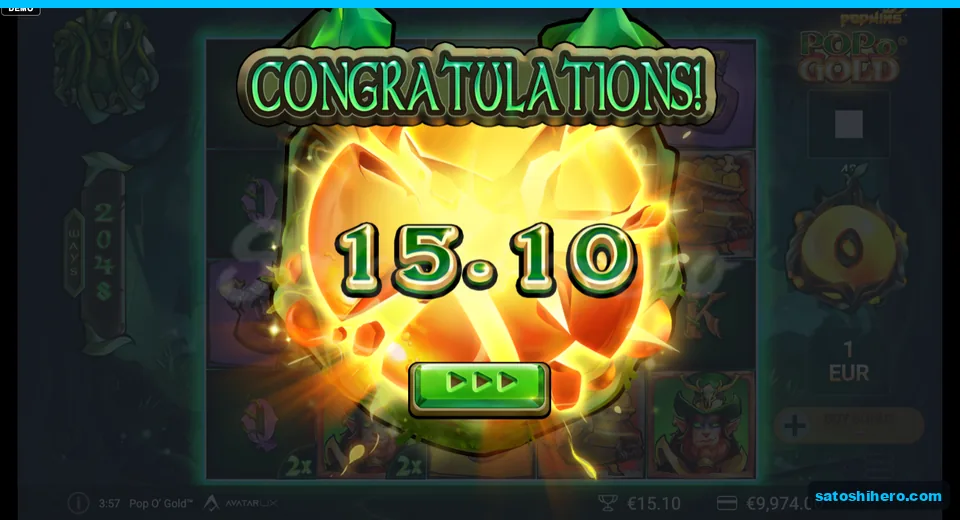
My feature triggered on spin 57, and I selected the guaranteed five spins without touching the wheel. The trigger spin paid $2.40, while the free spins added $12.70. Together they returned $15.10, equal to 15.1x my stake.
Both 2x and 3x split badges appeared as the board expanded, including a seven-row view with a $4.80 running win. The sequence looked busy and entertaining, but its final return wasn’t especially lucrative. In fact, my later $25.20 base hit beat the entire feature.

Smart Move: Taking five spins protects your trigger. The wheel adds upside, but you can lose the whole feature before it starts.
The wheel changes your risk before the first free spin arrives. You should decide whether extra spins justify that possibility before pressing gamble.
Bonus Buy Options
Magic bonus costs 100x for five free spins, while Max magic bonus costs 400x for 12. At my $1 stake, the displayed prices were $100 and $400. Availability can vary by bet size, and I purchased neither option.
That evidence limit matters because structure alone can’t establish value. I won’t rank two buys I didn’t test, and you shouldn’t assume the larger price produces a proportional return.
Magic bonus
Magic bonus starts the standard five-spin feature without waiting for three clovers. Its 100x price commits 100 base bets to one purchased round. Structurally, you begin from the same five-spin position I chose after my natural trigger.
The buy removes trigger waiting, not outcome uncertainty. My naturally triggered five-spin round returned only 15.1x, which shows why starting a feature doesn’t promise recovery. I find the price difficult to justify without a strict feature budget.
Max magic bonus
Max magic bonus begins with 12 free spins and removes the Enchanted wheel decision. It costs four times as much as the standard buy, placing $400 into one round at the tested stake. More starting spins create extra opportunities, but they don’t guarantee profit.
Compare that concentrated outlay with your personal spending limit before buying. If $400 already exceeds the planned session cost, the feature structure shouldn’t change your answer. The differences are clear, yet my test established no value advantage for either purchase.
Ante Bet and Stake Control
The ante adds 0.25x to every spin and increases the Bonus clover hit rate. A nominal $1 spin therefore costs $1.25 when you activate it. I left the setting off throughout all 100 logged spins, so my results represent ordinary $1 play.
Extra spin cost
The added cost applies before any outcome appears. Readers prioritising feature access can appreciate the trade-off, but faster spending leaves less room for dry patches. I don’t like paying extra unless the feature is the session’s main purpose.
Ante play doesn’t raise prize values or alter the maximum win. The rules also give no numerical increase for clover frequency, so you can’t calculate a reliable trigger schedule. Treat the option as paid access pressure, not a stronger payout setting.
Test setting
My logged trigger rate came from 100 standard spins with the ante disabled. You shouldn’t apply that one-in-100 observation directly to ante play because the setting changes clover frequency. One sample also can’t define a dependable rate.
At a $1 nominal stake, 100 ante spins cost $125 instead of $100. That extra $25 changes session cost without predicting any return. The ante affects feature access and bankroll speed, not bonus certainty.
How the 100 Spins Played
A strong first nine spins gave way to a long decline, one modest feature, and a 25.2x recovery hit. I found the expanding chains engaging, but the gaps between meaningful returns made the middle stretch feel slow. You can see high volatility in that rhythm more clearly than in any label.
Spin 7 paid $6.00, then spin 9 added $14.40 and lifted my balance to $10,012.20. From there, repeated small results failed to hold the line. The balance reached $9,975.00 after spin 56, its lowest point in my log.
Session rhythm
Free spins arrived on spin 57 and interrupted the slide with a $15.10 total return. That feature didn’t restore the opening high, and the $25.20 base-game win on spin 76 later exceeded it. Without the feature, the same logged sequence would have ended about $30 down.
Twenty-seven paying spins didn’t prevent a loss because many wins returned too little to offset misses. This distinction matters when you assess activity: frequent flashes aren’t the same as useful balance movement. I liked watching reels grow, though several chains ended before their larger boards converted.
The separate $2.80 manual-spin image came after the 100 logged spins. I excluded it from every session calculation, so it serves only as a mechanics example. Keeping that result separate makes the account cleaner for you to judge.
Player fit
Chain-reaction fans get plenty to read in sticky symbols, uneven reel heights, and changing ways. Readers seeking frequent bonuses or predictable movement can find the pace frustrating. My 15.1x feature proved that a trigger can still feel modest.
You can use the free demo here before choosing real play. I think that step matters because the mechanism feels lively even when the balance trends downward. The entertaining system and losing session both support the game’s high-risk classification.
Frequently Asked Questions
How does StickyPop work in the POP O’Gold slot?
Winning symbols stay sticky while their reels grow upward by one position. All other symbols get replaced, and the cycle repeats until no new sticky winner connects. Reels can reach five positions in base play and seven during free spins, creating up to 16,807 ways.
How do you trigger free spins in the POP O’Gold slot?
Three or more Bonus clovers trigger the feature. You can take five spins or gamble for eight, then 12, while golden fields can produce up to 10 or 14. A lost gamble forfeits everything; I triggered once on spin 57 and chose five guaranteed spins.
What do split symbols and Boosted Reels do?
Split symbols carry 2x or 3x badges that multiply their value. Boosted Reels select two to five reels and place split multipliers on every symbol there. The event has a greater chance during free spins, and I saw both badge values in my feature.
Can you buy free spins in the POP O’Gold slot?
Yes. Magic bonus costs 100x for five spins, while Max magic bonus costs 400x for 12. At my $1 stake they displayed $100 and $400, but I didn’t purchase either buy.
What does the POP O’Gold slot simulator show at a $1 bet?
The 1,000-spin model produced a $67.30 median loss. Its middle 90% ranged from $310.50 down to $364.80 up, and about 18% of spins paid. A feature-sized win appeared roughly once per 46 spins, but the model can’t predict your next result.
What happened in the 100-spin POP O’Gold slot test?
My balance fell from $10,000.00 to $9,984.40, creating a $15.60 loss. Twenty-seven spins paid, one feature returned $15.10, and my largest single hit paid $25.20. The session showed how several small wins can coexist with an overall loss.
What are the POP O’Gold slot RTP and maximum win?
The game uses a 96% theoretical RTP, high volatility, and a 20,000x maximum win. A round ends immediately when it reaches that cap. Treat the maximum as a limit rather than a typical result.
The Takeaway
The POP O’Gold slot stands out because StickyPop links reel growth, changing ways, and multiplier badges through one readable cycle. Its harsh balance movement remains the main drawback.

My Call
Try the standard game first if expanding chains interest you, and keep your stake small enough for quiet stretches. Don’t mistake a busy board for a profitable session, because even free spins can return modestly.
I like how every sticky connection visibly changes the board. I don’t like the 400x buy concentration, and my $15.10 feature trailed the later $25.20 base hit.
The POP O’Gold slot information is updated periodically, with test evidence kept separate from mechanics examples. You should judge the game by its chain-driven play and demanding risk profile, not by the ceiling alone.

Pros:
 Readable chains: Sticky symbols make each reel-growth step easy to follow.
- Dynamic board: Uneven reel heights create visible progress and changing ways.
- Meaningful choice: The wheel lets you protect or risk a natural trigger.
- Distinctive art: Skull details sharpen a familiar Irish-gold theme.

Cons:
 Sharp swings: Small pays couldn’t prevent my balance from drifting downward.
- Modest feature: Five free spins returned less than my best base hit.
- Expensive buy: The larger option concentrates 400 base bets into one round.

Best For: Patient chain-reaction fans who enjoy sticky symbols, growing reels, and visible multiplier badges. If you prefer steady movement or low-cost features, this game can feel too severe.

































































Bets
All Bets
Game
Player
Date
Wager
Mult.Multiplier
Prize
 Galaxy Glitter
 mike_721
- 16:20:56
- 0×
- Carnival Cat: Bonus Combo
 Hidden
- 16:20:55
- 3.58×
- Mighty Stars
- nina87
- 16:20:53
- 0×
- Red Hot 100
 mbongigycolombe
- 16:20:50
- 4.99×
- Frontier Falcon: Hold 'N' Link
- josh1998
- 16:20:50
- 0×
- Rocket Dice
 djkita1234
- 16:20:49
- 0×
- Galaxy Glitter
- mike_721
- 16:20:49
- 0×
- Red Hot 100
- mbongigycolombe
- 16:20:47
- 0×
- Rocket Dice
- djkita1234
- 16:20:46
- 0×
- Elephant's Gold: Bonus Combo
- mdp0fxo
- 16:20:46
- 0.23×