

DJ Cat
By pressing play, you agree that you are above legal age in your jurisdiction and that your jurisdiction allows online gambling.


Mixing Numbers Under Neon Lights
Build visible numbers from record-style chips while Arrows unlock higher rows and VIPs raise their multipliers.
DJ Cat slot is a high volatility slot from Push Gaming with 96.32% RTP and 10,000x maximum win potential. Its four-position-by-five-row layout and unusual arithmetic reward patient number-game fans prepared for lean sessions. My test finished 57.2x the bet down.
Key Takeaways
These are the essential facts to understand before you play.
- Best play: Keep Push-Up off while learning how adjacent chips, zeroes, and duds change each active row.
- Best bonus: There are no free spins or bonus buy; Arrows, VIPs, Double VIPs, and respins drive the action.
- RTP / volatility: The official math combines 96.32% RTP with high volatility and broad possible session outcomes.
- Max win: The top prize reaches 10,000x the base bet per game round.
- Risk note: My test returned $21.40 from $50.00 staked, while five-row Push-Up costs 10x the base bet.

Table of Contents
- DJ Cat slot at a Glance
- How DJ Cat Works
- Number chip values
- Special symbol roles
- Win What You See
- Joining the digits
- How duds split
- Multiplier Meter
- Meter limits
- What testing showed
- Theme and First Impressions
- Neon club setting
- Clarity during play
- Row Activation
- Opening higher rows
- Arrows in testing
- Push-Up Betting
- Extra-row costs
- Bankroll trade-off
- RTP, Volatility and Our Test
- Simulator projection
- Our 100-spin session
- Frequently Asked Questions About DJ Cat
- Final Verdict
DJ Cat slot at a Glance
The DJ Cat slot turns four positions on each active row into a left-to-right number. Its five rows serve as five genuine lines. Standard play starts with only the bottom row active, which can make cold periods feel sparse.
Number chips create the row value, Arrows open higher rows, and VIP symbols raise row multipliers. Each collected special symbol also starts a respin within the same paid round. You won’t find free spins, a bonus buy, wilds, or scatters here. That stripped-back structure keeps your attention on placement rather than familiar matching patterns.
I started the free demo with $1,000.00 and a $0.50 total bet. Push-Up stayed off for one continuous session with no reloads, while the settings menu offered sound controls only. You can try the demo or real play here on SatoshiHero. The arithmetic feels fresh, but tiny single-chip returns can test your patience.
Push-Up can activate more starting rows for a higher total charge. You should first learn why a zero extends a number while a blank dud divides it. Once you can spot that difference quickly, every later feature becomes much easier to follow.
How DJ Cat Works
Each active row acts as a separate left-to-right line, and its visible number determines the payout. The board has four positions across and five rows high, but inactive rows can’t score. All five rows are real lines rather than decorative spaces. You should scan only the illuminated rows before adding any multiplier.
Every row receives its own evaluation. A single chip returns its face value divided by ten as a base-bet multiple, while zero has no standalone value. The logic feels clean once you stop seeking matching symbols.
Number chip values
The standalone chip scale runs in simple tenth-bet steps:
- Chip 9 pays 0.9x, shown as $0.45 at my $0.50 stake.
- Chip 8 pays 0.8x, while chip 7 pays 0.7x.
- Chip 6 pays 0.6x, while chip 5 pays 0.5x.
- Chip 4 pays 0.4x, while chip 3 pays 0.3x.
- Chip 2 pays 0.2x, while chip 1 pays 0.1x.
- Chip 0 pays $0.00 alone but can extend another number.
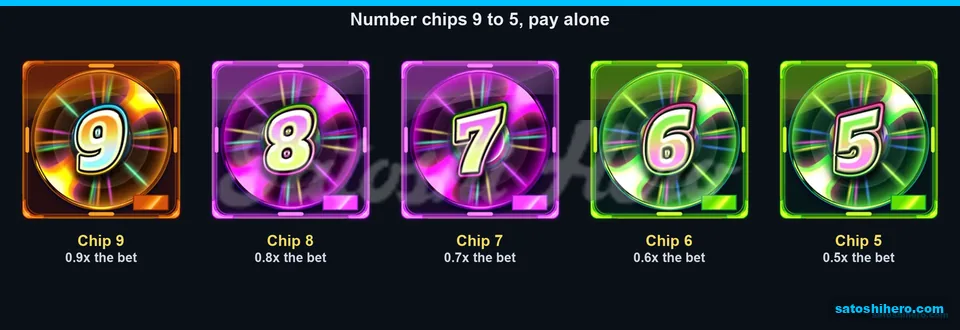
Spin 18 validated the scale when a single 8 returned $0.40, exactly 0.8x my bet. You can verify these small returns easily, though one low chip barely dents a losing stretch.
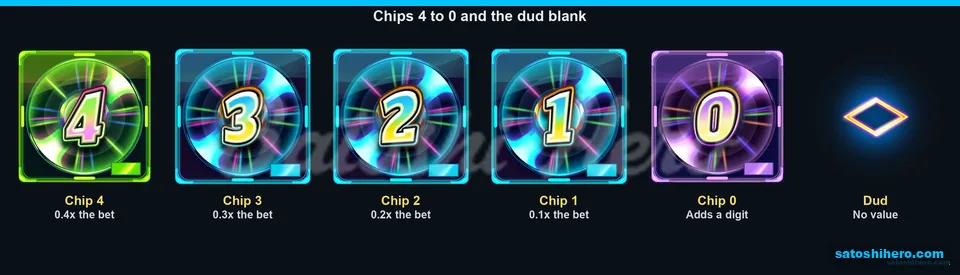

Key Stat: A zero chip has no standalone payout, but placing it beside another chip can increase that number tenfold.
Special symbol roles
A blank dud carries no value and separates neighboring chips into groups. Arrow, VIP, and Double VIP symbols alter the paid round through activation, meters, and respins. No wild or scatter appears. You need to distinguish zeroes from duds because they perform opposite jobs.
This DJ Cat slot rewards careful reading. Zero keeps place value intact, while a dud forces separate group totals. I think that contrast supplies the game’s best mental hook.
Win What You See
Win What You See converts each active row into a visible number worth one tenth of the base bet per numerical point. Adjacent chips concatenate rather than adding their faces. A 5 beside 0 becomes 50 and returns 5x, while 1, 7, 8, 0 becomes 1,780 and returns 178x. You can read the result directly from the board, which makes the unusual system surprisingly transparent.
A dud ends one group and starts another. For example, 5, dud, dud, 0 returns 0.5x. The sequence 5, dud, 3, dud creates separate 5 and 3 groups, producing 0.8x. I like this visible arithmetic, although mistakes can exaggerate a result.
Joining the digits
Joined digits use place value, not addition. Five and 0 create 50, while 1 and 0 create 10 and return 1x. A worthless standalone zero becomes useful beside another chip. Calculate the number before checking its multiplier.
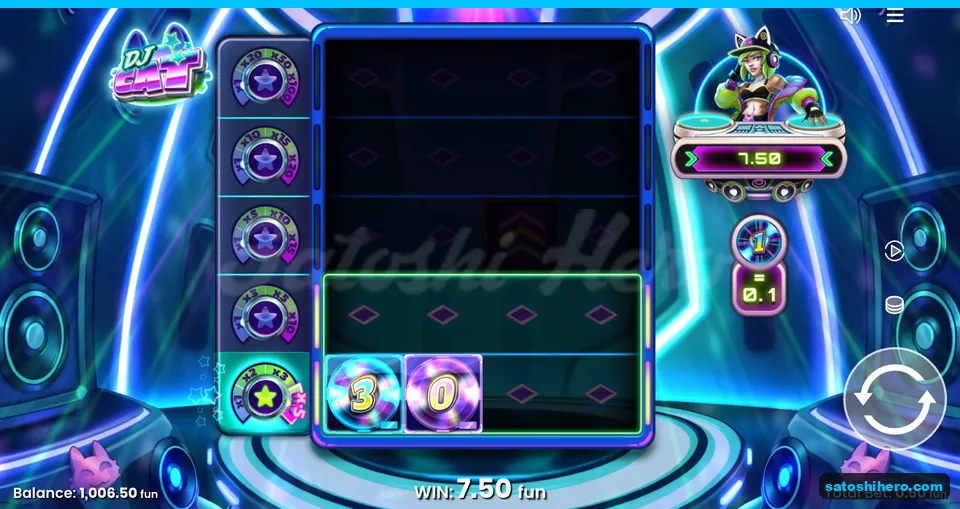
Spin 2 gave my clearest proof. Chips 3 and 0 joined into 30 on the bottom row, creating a 3x base result. Three collected VIPs raised that row’s meter to x5, so the final 15x result returned $7.50 from my $0.50 bet. The clean calculation made my biggest win easy to verify.
How duds split
Duds divide a row into smaller groups, which the game adds. A sequence of 5, dud, 3, dud produces 5 plus 3, while 5, 0, dud, dud preserves 50. You should never treat a dud as zero. That contrast matters more than memorizing every chip value.

Strategy Insight: Read each active row in groups separated by duds. Add those groups, then apply the highest lit row multiplier.
The DJ Cat slot doesn’t use clusters, pay-anywhere wins, or Megaways. Five fixed row lines each evaluate one visible number. Group the digits, add split groups, then multiply. Follow that order and the board stops feeling cryptic.
Multiplier Meter
VIP symbols charge a row’s multiplier meter, but that row still needs a numerical payout for the multiplier to matter. A VIP leaves an active row, lights one segment, and awards a respin. Double VIP lights two segments and also gives a respin. You can build an impressive meter yet receive nothing when the final row contains no paying number.

Each row has a three-step ladder:
- Row 1 uses x2, x3, and x5.
- Row 2 uses x3, x5, and x10.
- Row 3 uses x5, x10, and x15.
- Row 4 uses x10, x15, and x20.
- Row 5 uses x20, x50, and x100.
Meter limits
The highest illuminated segment multiplies that row’s completed return. A row can’t collect beyond its remaining unlit segments, and every meter resets before the next paid spin. Nothing carries forward. I find the reset harsh, though it keeps each round self-contained.
Higher rows offer stronger multipliers, but you must activate them first. The bottom row sees more practical meter action during standard play. A row-five x100 looks dramatic, though access and a paying number must align.
What testing showed
I collected VIPs on 12 spins, always on the bottom row. Its meter reached x5 on spins 2 and 73, but only spins 2 and 14 paired a multiplier with a paying number. You can see why appearances overstate practical value.
Spin 2 combined a 3x number with x5 for $7.50. Spin 73 reached x5 without a paying number, so its progress produced nothing. I don’t love that outcome, but it exposes the feature’s risk.
Theme and First Impressions
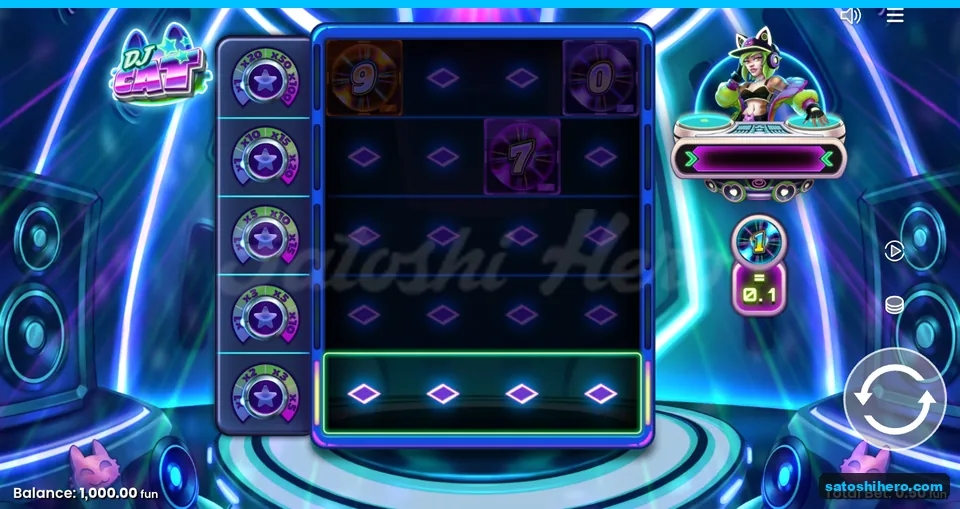
The neon nightclub design makes number building easy to follow, although the animal-DJ theme won’t appeal to everyone. Blue and violet arches curve over the stage, with speakers on both sides. A cat-eared DJ in a green jacket works the decks. You get a clear club setting without unrelated icons.
Neon club setting
Record-style chips connect the digits to the music theme. Their circular design resembles vinyl, while the decks and speakers reinforce that link. DJ Fox fans might recognize the same character-led club appeal. Other Push Gaming alternatives on SatoshiHero include Wild Swarm, Tiki Tumble, Shamrock Saints, and Samurai’s Katana. I prefer the record idea here because it supports the mechanic.

Insight: A disc jockey plays recorded music for an audience, so the vinyl-style number chips tie the visual theme directly to the cat’s role.
The animal setup lacks fruit-machine charm, with most originality coming from the arithmetic presentation. You can understand the scene without losing track of the board. I think clarity matters more than novelty here.
Clarity during play
Five multiplier meters sit on the left, each aligned with its matching row. The active bottom row glows brightly, while inactive rows fade into the background. That contrast tells you exactly which numbers can score. You won’t waste time calculating a value on a row that hasn’t opened.
The DJ Cat slot displays all five rows, although standard play activates only the lowest one. Arrows brighten higher rows as they open. You can track each meter beside its row. Visual readability ranks above the familiar animal-club concept.
Row Activation
An Arrow on an active row opens the row above and starts a respin, creating another scoring chance in the same round. The Arrow then leaves the board, while existing number chips remain locked and dud positions spin again. An Arrow already sitting on the newly opened row can activate the next row. You should treat the full chain as one paid round, not separate spins.
Arrows can’t land on the top or an active row. After respins finish, the game evaluates each active row independently. The next paid spin returns to one active bottom row unless Push-Up changes it. I like the visible expansion, but extra rows don’t promise strong numbers.
Opening higher rows
The activation flow stays consistent:
- An Arrow lands on an active row.
- The next row above lights up.
- The Arrow disappears and a respin begins.
- Number chips lock while dud positions spin again.
- Another visible Arrow can continue the chain upward.
- Every active row receives evaluation after respins stop.
You can gain lines while keeping useful digits. Yet locked weak chips can limit final values, so opening a row doesn’t rescue every round. Its value depends on what remains after respins.
Arrows in testing
Arrows appeared on spins 2, 13, 30, 72, 73, 93, and 96. Three active rows marked my maximum. You might expect similar three-row returns, but my results varied sharply.
Spin 13 used two Arrows to open three rows. Values of 23, 84, and 6 returned $1.15, $4.20, and $0.30, producing $5.65 or 11.3x. By contrast, spin 72 reached three rows but returned only $1.80, equal to 3.6x. Its third-row 24 paid $1.20, while single 6 chips on both lower rows added $0.30 each.
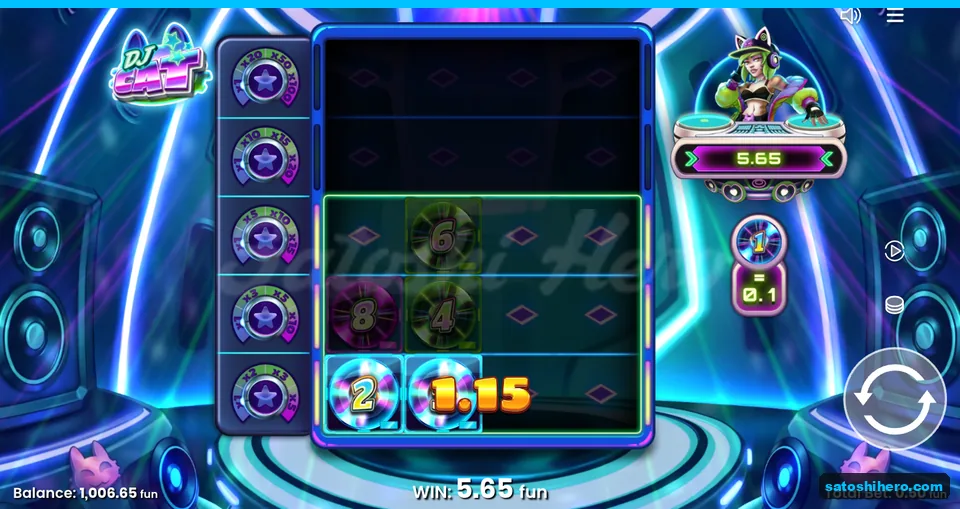
The DJ Cat slot makes combined results easy to audit. I found spin 13 exciting, while spin 72 showed the modest side. Judge activation by finished numbers, not row count alone.
Push-Up Betting
Push-Up activates extra rows before a spin, but it raises the total stake much faster than standard one-row play. Two active rows cost 2.5x the base bet, while five active rows cost 10x. Resulting wins still use the original base bet for their calculations. You need to track the complete charge rather than focus on the displayed base unit.
Extra-row costs
The four available starting levels are straightforward:
- Two active rows cost 2.5x the base bet.
- Three active rows cost 5x the base bet.
- Four active rows cost 7.5x the base bet.
- Five active rows cost 10x the base bet.
A full-board start consumes ten standard units. You gain more row evaluations, but the payout formula doesn’t scale to the larger charge. I consider that distinction essential. Push-Up changes access, not the base used for wins.
Bankroll trade-off
I kept Push-Up off throughout my test, so every observed result came from one starting row. You can’t use my session to judge Push-Up performance. The baseline better explains normal play.
Push-Up is the only paid option that changes the opening board. More active rows create chances, yet the higher charge shortens your session. At a $0.50 base, five rows cost $5.00 while results still derive from $0.50. I wouldn’t increase it before mastering standard play.
The DJ Cat slot asks you to balance visibility against session length. Compare Push-Up’s full cost with your planned spend. A brighter board isn’t evidence of better expected results. Choose from affordable total spending, not visual appeal.
RTP, Volatility and Our Test
DJ Cat uses a 96.32% theoretical RTP, high volatility, and a 10,000x maximum win per game round. Those figures allow major differences between sessions, while my top result reached only 15x. One short test can’t establish the game’s full payout range. You should treat both my results and the simulation as risk evidence, not a promise.
Simulator projection
The SatoshiHero Slot Simulator modelled 1,000 spins at a bet of 1, so each result reads directly as a bet multiple. Its median session finished 61.3x down. Five percent ended 320.5x or more down, while another five percent ended 324.0x or more up. I find that spread more informative than the headline cap because it shows how widely your session can move.
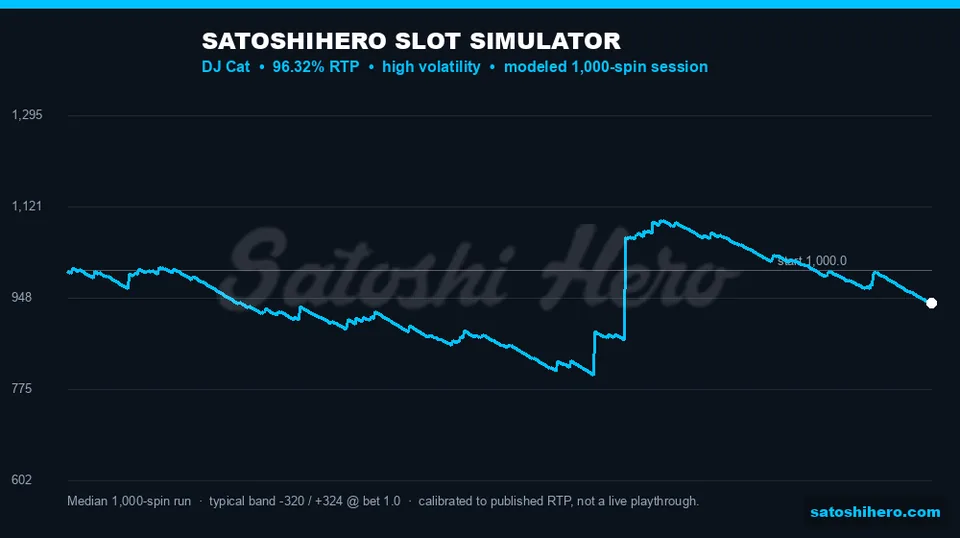
About 18% of modelled spins returned something. A result of at least 10x appeared roughly once per 46 spins, while at least 100x appeared roughly once per 1,531 spins. These are distribution estimates across many modelled runs, not countdowns for your next hit. The numbers suggest patience won’t remove variance.
Modelled frequency explains why smaller returns dominate. A broad range can include a losing median despite positive outliers. You shouldn’t treat the upper band as a session target. The model works best as a bankroll stress test.
Our 100-spin session
My DJ Cat slot session returned $21.40 from $50.00 staked and ended $28.60 down. I played 100 paid spins at $0.50 each, starting from $1,000.00 with Push-Up off. The run stayed continuous with no reloads. My closing $971.40 balance represented both the session low and a 57.2x deficit.
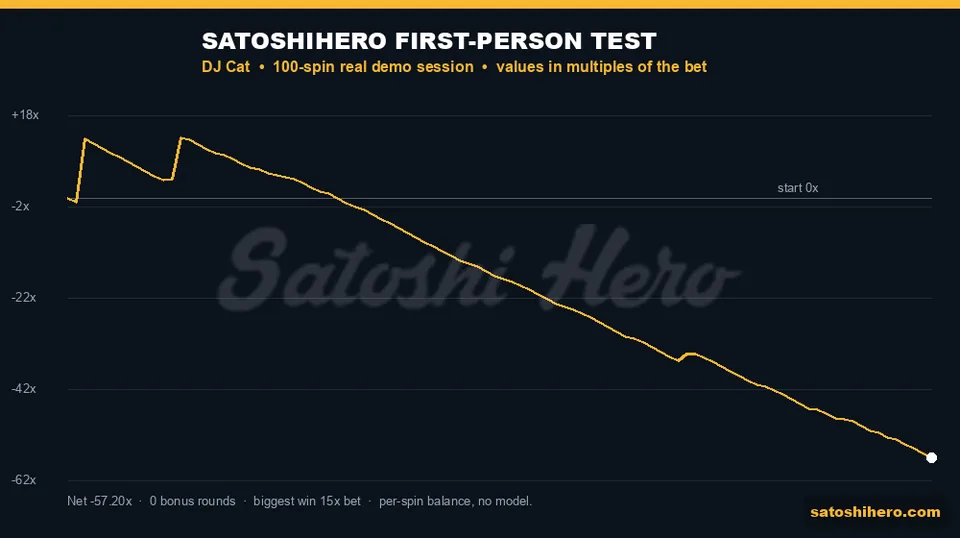
Twenty-six spins paid: 23 below 1x, one between 1x and 10x, and two above 10x. Tiny returns made the raw 26% paid-spin count look stronger than it felt. I found that imbalance frustrating.
Spin 2 produced my largest result at $7.50, equal to 15x. An Arrow opened row two, and three VIPs lifted the bottom meter to x5 during respins. The bottom row ended as 3, 0, dud, dud, so 30 created 3x before multiplication. That round moved my balance from $999.50 to $1,006.50.
Spin 13 ranked second at $5.65 or 11.3x. Two Arrows opened three rows, producing 23 below, 84 in the middle, and a single 6 above. The three rows returned $1.15, $4.20, and $0.30. My balance then reached its $1,006.65 session peak.
The balance stayed above its start through spin 31, crossed below on spin 32, and never recovered. My longest dry run covered 11 spins, from spin 36 through spin 46. You could face a different drought. The late decline outweighed the early peak.

Warning: High volatility can create long losing stretches and widely different session outcomes. Neither the 10,000x cap nor the 96.32% theoretical RTP guarantees recovery within your chosen bankroll.
All outcomes came from normal paid spins because the game contains no free spins or bonus buy. The theoretical RTP is Push Gaming’s published return, and one live session neither measures nor changes it. The simulator illustrates risk rather than predicting results. There is no separate bonus-buy return to test.
Frequently Asked Questions About DJ Cat
How did my 100-spin DJ Cat slot test go?
My $0.50 session began at $1,000.00 and ended at $971.40, a $28.60 loss equal to 57.2x the bet. Twenty-six spins paid, and spin 2 delivered the largest result at $7.50 or 15x. A bottom-row 30 received an x5 multiplier.
How does Win What You See pay in the DJ Cat slot?
Each active row forms a left-to-right number worth one tenth of the base bet per numerical point. A 5 beside 0 becomes 50 and returns 5x, while 5, dud, 3 becomes separate groups worth 0.8x. Standalone chips range from 0.1x for 1 to 0.9x for 9.
What does the Arrow do in the DJ Cat slot?
An Arrow on an active row opens the row above and starts a respin. Number chips remain locked while dud positions spin again, and chained Arrows can open another row. I saw Arrows on seven spins, with three active rows as my test maximum.
How do VIP multipliers work in the DJ Cat slot?
VIP lights one meter segment, Double VIP lights two, and each collection awards a respin. Row 1 progresses through x2, x3, and x5, while row 5 uses x20, x50, and x100. On spin 2, an x5 meter turned my 3x row into a $7.50 return.
What is Push-Up in the DJ Cat slot?
Push-Up opens extra starting rows for a higher total charge. Two rows cost 2.5x, three cost 5x, four cost 7.5x, and five cost 10x the base bet. Wins still use the base bet, and I kept Push-Up off during testing.
What did the 1,000-spin simulator show?
The model produced a 61.3x median loss, with outer bands running from 320.5x down to 324.0x up. Results of at least 10x appeared about once per 46 spins, while 100x or more appeared about once per 1,531 spins. These modelled frequencies don’t guarantee any session outcome.
What are the DJ Cat slot RTP, volatility and maximum win?
The DJ Cat slot has a 96.32% theoretical RTP, high volatility, and a maximum win of 10,000x the base bet per game round. Its four-position-by-five-row board provides five fixed lines, one per row.
Final Verdict
DJ Cat stands out through transparent number building, row activation, and meters that amplify visible values. Tiny chip returns made my session feel colder than its paid-spin count implied.

My Take
Arithmetic-minded players should try the standard one-row mode before considering Push-Up. Expect easy-to-check outcomes, occasional feature chains, and many returns too small to offset the base bet.
I like how every joined digit and multiplier remains visible enough to verify. I don’t like that 12 VIP appearances produced only two multiplied paying rows in my test. That gap made promising meter action feel less useful than it first appeared.
The DJ Cat slot offers a different system, but you need patience and strict spending control. Its game details are checked regularly.

Pros:
 Readable arithmetic: Visible digits make every completed row result easy to verify.
- Original win method: Concatenated chips replace routine matching symbols with meaningful placement.
- Clear feature flow: Arrows, locked chips, and meters remain easy to track.
- Flexible opening board: Push-Up offers extra starting rows at clearly stated costs.

Cons:
 Weak small returns: Most test wins failed to cover one base bet.
- Resetting meters: VIP progress disappears before the next paid round.
- Expensive Push-Up: Full-board starts consume ten base units per spin.

Best For: Patient number-game fans who enjoy verifying outcomes directly can appreciate this design. You should accept lean stretches, avoid chasing meter progress, and judge Push-Up by its full cost.











Other Push Gaming Games























































Bets
All Bets
Game
Player
Date
Wager
Mult.Multiplier
Prize
 Mardi Gras Queen
 Hidden
- 12:17:42
- 0×
- Pelican's Bay: Rapid Link
 Hidden
- 12:17:42
- 0×
- Fortune Skulls
 mdp0fxo
- 12:17:42
- 0×
- Mardi Gras Queen
- Hidden
- 12:17:41
- 0×
- Elephant's Gold: Bonus Combo
 mike_721
- 12:17:40
- 0×
- Mardi Gras Queen
- Hidden
- 12:17:39
- 0×
- Galaxy Glitter
- maya_81
- 12:17:39
- 0×
- Fortune Skulls
- mdp0fxo
- 12:17:39
- 0×
- Mardi Gras Queen
- Hidden
- 12:17:38
- 0×
- Mardi Gras Queen
- Hidden
- 12:17:36
- 0×