

Pirate's Legacy
By pressing play, you agree that you are above legal age in your jurisdiction and that your jurisdiction allows online gambling.


Chasing the Treasure Chest in Pirate’s Legacy
Spin through Pirate’s Legacy slot, a 5×3, 30-payline pirate game from Platipus.
According to Platipus, Pirate’s Legacy slot is a medium-high volatility game with a 95% RTP and 3,267x maximum win. You collect cash or jackpot coins through a chest, while scrolls and chests start Free Spins. My 100 spins at $0.90 lost $29.34, with one weak bonus and a 15x best hit, so you get accessible mechanics but a debatable risk-to-reward balance.
Key Takeaways
- Best bonus: I tested organic base play only, so you can’t rank the three unpurchased bonus buys from my evidence.
- RTP / volatility: Pirate’s Legacy slot has a 95% RTP and medium-high volatility, creating meaningful short-session risk for you.
- Max win: The maximum win reaches 3,267x the bet, a modest ceiling beside the game’s risk level.
- Risk note: My 100 spins at $0.90 lost $29.34, and the only Free Spins round returned just $1.35.
- Bankroll note: The three buys cost $90, $135, or $225 at my stake, far beyond ordinary spin costs.

Table of Contents
- How Pirate’s Legacy Works
- Lines and win rules
- Symbols and payouts
- Collect Feature and Jackpot Coins
- Coin values
- Jackpot amounts
- Theme and First Impressions
- Treasure-cave setting
- Interface and controls
- Free Spins
- Trigger and spin count
- Moving collection chests
- Bonus Buy Options
- Prices and guarantees
- Cost versus risk
- Betting Range and Autoplay Controls
- Stake ladder
- Autoplay settings
- How It Played Across 100 Spins
- Balance and hit rate
- Largest recorded wins
- RTP, Volatility and Our Test
- Simulator projection
- Our 100-spin session
- Frequently Asked Questions
- Bottom Line
How Pirate’s Legacy Works
Pirate’s Legacy slot uses a 5×3 grid and 30 fixed paylines. Wins run left to right across adjacent reels, beginning on reel 1, and only the highest combination per line pays.
Lines and win rules
The game calculates prizes from the line bet rather than the displayed total stake. I played $0.03 on each of 30 lines, making every spin cost $0.90. Five Anchors or five Rum bottles proved the calculation during my test. That combination paid 75 line bets, so $0.03 multiplied by 75 returned $2.25.
You should watch the total bet before spinning because the smaller line figure can mislead at first glance. Moving the line bet changes all 30 lines together, not one selected payline.

Data Point: At my $0.90 total bet, each of the 30 lines carried a $0.03 line stake.
Symbols and payouts
Thirteen symbols fill the reels, led by five nautical premiums and four card ranks. The Ship wheel pays 6x, 1.5x, or 0.3x the total bet for five, four, or three. Compass combinations return 4x, 1x, or 0.3x, while Flintlocks pay 3x, 0.8x, or 0.2x. Anchors and Rum bottles each return 2.5x, 0.5x, or 0.2x.
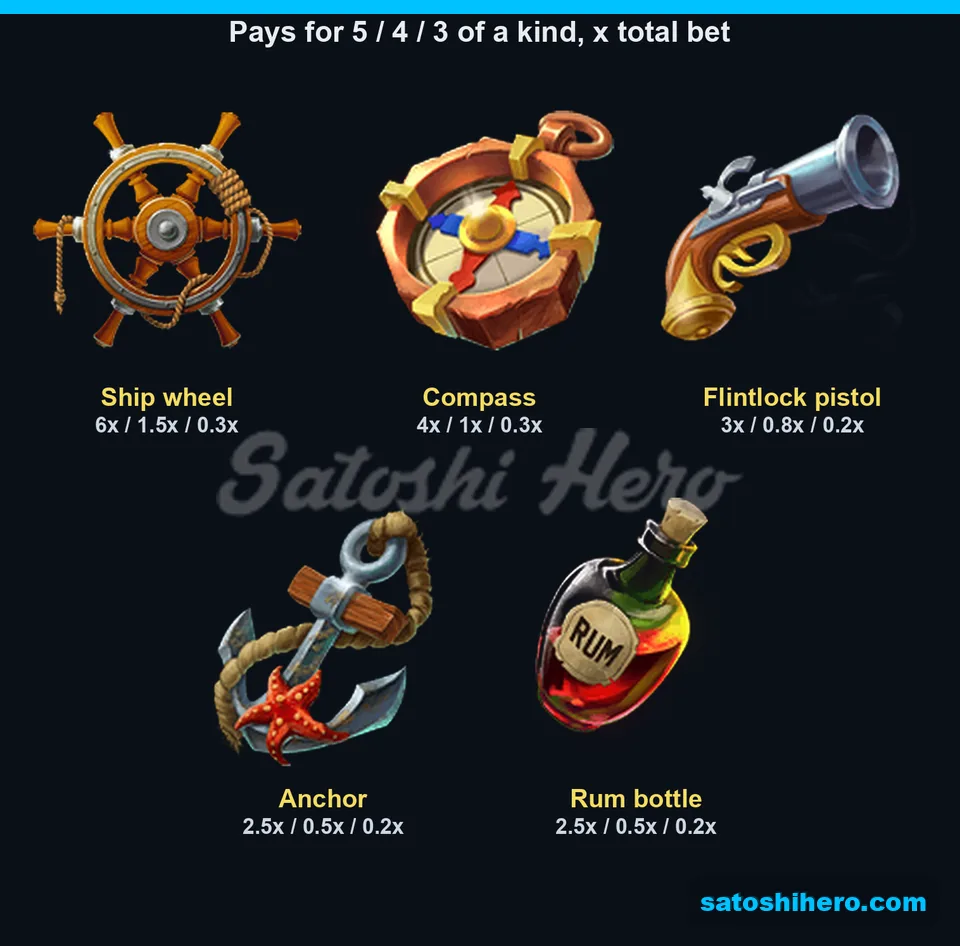
Ace, King, Queen, and Jack combinations each pay 1.5x, 0.4x, or 0.1x for five, four, or three. You can check each outcome against the line calculation rather than guessing what several crossing lines produced. Stacked hits created my $9.90 best line-win event.
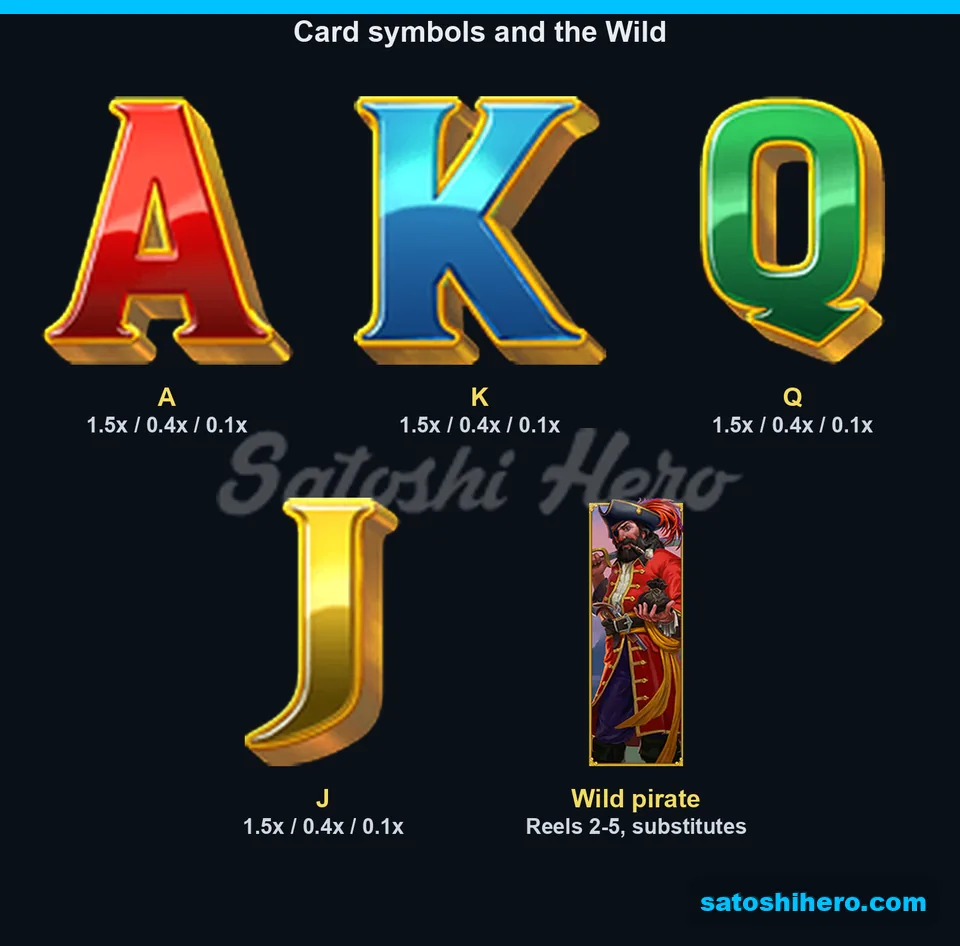
The red-coated pirate Wild appears only on reels 2 through 5. It replaces regular paying symbols but can’t replace Bonus coins, Collect chests, or Free Spins scrolls. During base play, coins and scrolls occupy reels 1 through 4, while the chest stays on reel 5. That restriction gives you a simple line game with useful feature tension.
Collect Feature and Jackpot Coins
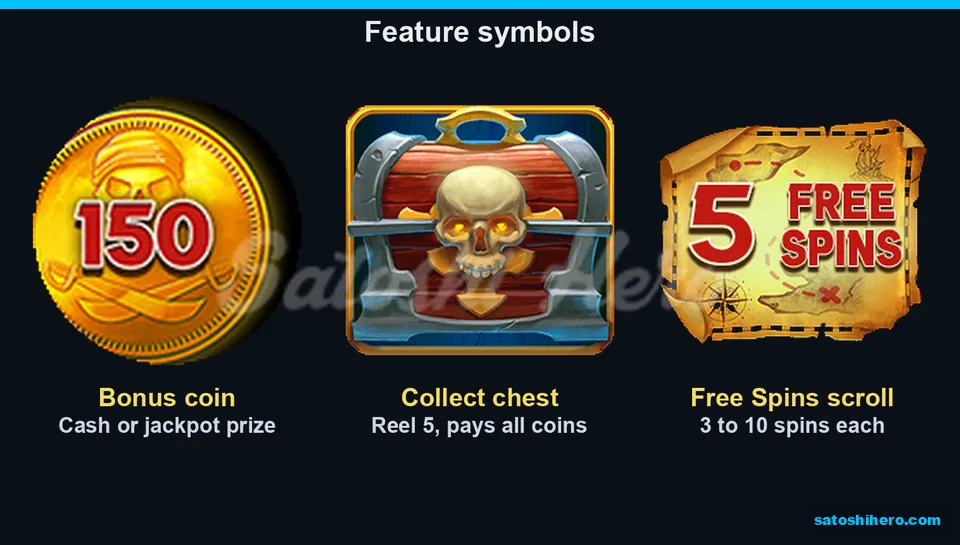
The Collect feature pays when one or more Bonus coins appear with a Collect chest on reel 5. That chest adds every visible coin value and awards the total, even without a normal line win. You can see the potential amount before collection.
Coin values
Every Bonus coin carries either a cash prize or one of four jackpots. Cash values span 30 to 450 line bets. At my $0.90 stake, that range became $0.90 to $13.50, equal to 1x through 15x the total bet. The same collection mechanic operates during base play and Free Spins.
Five counted spins paid only from collections, with no standard line win attached. They returned $1.80, $4.50, $5.40, $5.40, and $13.50. You need the chest on the same spin, so a valuable coin alone pays nothing.
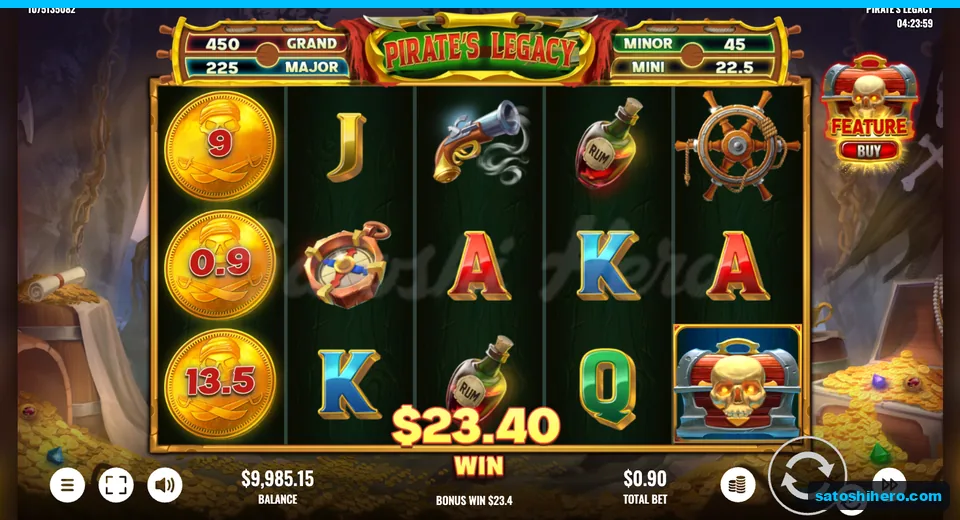
My largest counted result came from the $13.50 prize on a Bonus coin during spin 12 and pushed the balance to its session peak. I also captured a $23.40 collection during extra photo spins after the counted test. It wasn’t part of any 100-spin statistic.
Jackpot amounts
Four jackpot values remain posted above the reels throughout play. At a $0.90 total bet, Mini pays $22.50, Minor pays $45, Major pays $225, and Grand pays $450. A jackpot name must appear on a Bonus coin, then a Collect chest must land to award it.
You can collect several cash coins together because the chest totals every visible value. The feature can also pay while the paylines return nothing, as my five collection-only spins proved. I think that clear dependency makes collections satisfying without hiding how they work.
Theme and First Impressions
Pirate’s Legacy slot places gold-framed reels inside a cave packed with coins and barrels. Four jackpot plaques hang overhead, and a bright red Feature Buy chest occupies the right side.
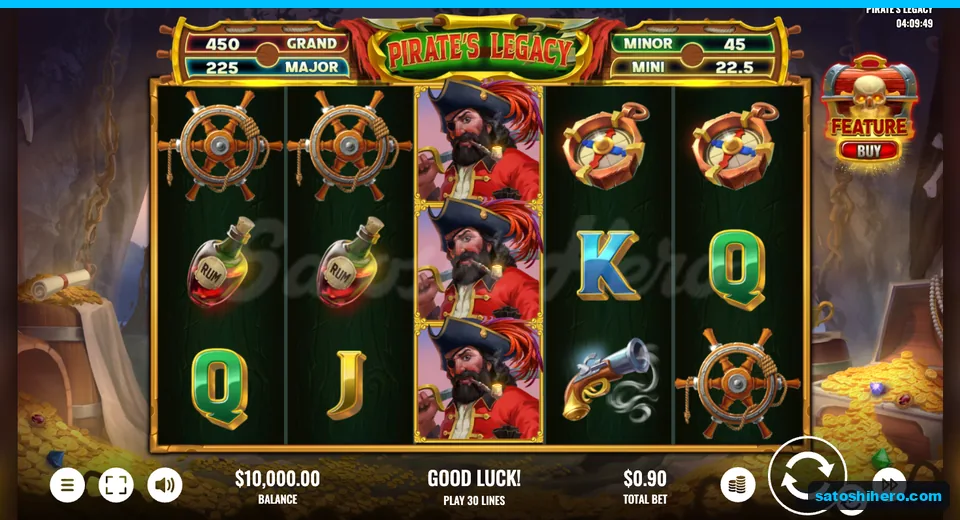
Treasure-cave setting
Nautical props, treasure piles, wooden barrels, and a red-coated pirate captain fill the scene. Each decorative choice supports the same core idea: move coin values into a chest. The jackpot plaques reinforce that hoard fantasy above every spin.
Coins carry printed values, the chest stands apart on reel 5, and jackpot names remain visible above.

Fun Fact: The four jackpot plaques form part of the treasure-cave display, keeping the pirate-hoard theme visible above every spin.
Interface and controls
Balance and total bet sit along the bottom beside spin, autoplay, and speed controls. The interface also gives the Feature Buy chest strong visual weight without hiding the main reels. I could read the $0.90 stake and track symbols without strain.
The starting demo balance showed $10,000, but that figure supported testing rather than sensible bankroll planning. I fixed every counted spin at $0.90 and used the free demo available here on SatoshiHero. Real play also sits on the same site. You can locate the reels and stake quickly, and you get clarity rather than fresh ideas. You can compare its direct collect mechanic with the different themes in Xmas Avalanche, WondeReels, Wizard of the Wild, Wild Spin Deluxe, and Wild Spin.
Free Spins
Free Spins start when at least one scroll lands on reels 1 through 4 with a Collect chest on reel 5. Each scroll carries 3, 4, 5, 7, or 10 spins, and multiple values combine. My only trigger arrived on spin 22, awarded three spins, and returned $1.35.
Trigger and spin count
An award card appears before the round, then a start button launches it at the triggering stake. The same 30 paylines remain active throughout the feature. Coins, chests, and scrolls can land anywhere during these spins, unlike their tighter base-game reel positions. A chest landing with a scroll can add more Free Spins.
My three-spin round paid only 1.5x the $0.90 stake. It supplied no evidence about stronger combinations, so one weak trigger doesn’t show the full range of feature performance.
Moving collection chests
The triggering chest freezes on its row, then moves one reel left after each free spin. It exits after crossing the grid, while extra chests can remain active at the same time. Each frozen chest separately collects every coin and scroll that appears. An earlier position leaves more reels to cross, creating more future collection chances without promising a payout.

Suggestion: Count the reels remaining before a frozen chest exits. That tells you how many later collection chances it can receive.
Every chest movement reduces its remaining life. My round ended before the system developed and stayed brief and unrewarding. You still get a clever visual mechanic, even when the outcome disappoints.
Bonus Buy Options
The three Free Spins purchases cost 100x, 150x, or 250x the total bet. At my $0.90 stake, those prices equal $90, $135, and $225. I didn’t purchase any option, so you won’t find an evidence-free ranking here.
Prices and guarantees
The 100x option costs $90 and guarantees at least three scrolls. Paying 150x costs $135 and guarantees at least five, while 250x costs $225 and guarantees at least seven. More scrolls can raise the starting spin count because their printed awards combine. They don’t guarantee profit or a particular chest setup.
The three choices cost as much as 100, 150, or 250 ordinary $0.90 spins respectively.
Cost versus risk
Medium-high risk still applies after you pay the entry fee. A higher purchase can start with more scrolls, yet coin and chest outcomes still determine the return. The $225 option demands the same cash as 250 ordinary spins at my stake.

Watch Out: The largest buy costs 250x your stake. Medium-high volatility can still leave the feature far below its purchase price.
Since I tested organic entry only, every buy remains untested in this guide. Any claim that one option offers better value would go beyond my evidence.
Betting Range and Autoplay Controls
The slot provides eight line-bet settings, producing total stakes from $0.90 to $90 across 30 paylines. You can change the line stake quickly, but every step affects all lines together. I used the $0.90 minimum throughout the controlled run. The ladder is simple, while autoplay needs attention before a batch begins.
Stake ladder
The available line bets are:
- $0.03
- $0.05
- $0.10
- $0.20
- $0.50
- $1
- $2
- $3
Those settings produce these total bets:
- $0.90
- $1.50
- $3
- $6
- $15
- $30
- $60
- $90
Choosing $0.03 across 30 lines created my fixed $0.90 spin cost. The minimum kept the test consistent and limited each individual wager, though 100 spins still put $90 through the game. You should confirm the total field after changing one ladder step. I think the wide jump from $30 to $60 deserves particular care.
Autoplay settings
Autoplay includes a plays slider plus one win limit and one loss limit. Both default limits interrupted my planned batches, so I raised them solely to complete this controlled session. That temporary setup wasn’t personal bankroll advice. You should set those controls around your own boundaries before starting any automated run.
The menu lacked a 100-spin choice. So I used one batch of 75 and another of 25, keeping the same $0.90 stake throughout. That workaround preserved the counted total without mixing bet levels. In my view, a direct 100 option would make structured testing cleaner.
Speed controls sit beside autoplay and the main spin button. The layout stays readable, but a fast batch can hide how quickly the balance changes. Check the play count, win limit, and loss limit before pressing start. The stake ladder behaves plainly, while autoplay rewards a careful final check.
How It Played Across 100 Spins
My 100 spins at $0.90 wagered $90 and ended $29.34 down. The demo balance moved from $10,000 to $9,970.66, despite spending much of the first half above its starting point. You can see how quickly a positive opening can reverse. I found the late slide more revealing than the early peak.
Balance and hit rate
Thirty-six spins paid something, but a paying spin could return less than the $0.90 stake. The balance peaked at $10,016.47 on spin 12 after my $13.50 collection. It remained above $10,000 through spin 55, then declined without another substantial hit. That path felt active early and flat during the closing stretch.
A 36-spin payment count doesn’t mean a 36% profit rate. Small line returns and coin values can still leave you behind after the wager. Several visible prizes kept the action understandable, yet they couldn’t prevent the second-half loss. I think that distinction matters more than the raw number of paying spins.
The $23.40 collection from later photo spins remains outside every counted result. Mixing it into the test would falsely improve the final balance and largest-win figure. You should judge the session only by events inside the fixed 100 spins. The early surplus offered no protection once the stronger hits stopped.
Largest recorded wins
My largest counted win was the $13.50 prize from a Bonus coin on spin 12, equal to 15x the stake. Spin 7 supplied the best line-win event at $9.90 through several stacked combinations. Free Spins triggered once on spin 22 and returned only $1.35. None of those results approached the game’s headline ceiling.
Visible coin values made collection events simple to understand before the chest awarded them. This structure can appeal when you prefer clear cash amounts and interaction between base spins and feature symbols. Still, anyone expecting a huge ceiling for medium-high risk could find 3,267x modest. I enjoyed the readable activity, but the second half lacked any meaningful recovery.
You can also see that one bonus trigger didn’t rescue the run. The biggest result came from an ordinary collection, not the Free Spins round. That outcome isn’t a forecast, though it describes my session honestly. The test delivered enough small movement to stay legible, then finished with a sustained downturn.
RTP, Volatility and Our Test
Pirate’s Legacy slot has a 95% theoretical RTP, medium-high volatility, and a 3,267x maximum win. That return describes the game’s theoretical performance rather than predicting your next short session. Low line wins and coin collections can sit between stronger feature outcomes. I saw that pattern when an early peak gave way to a longer decline.
Simulator projection
The SatoshiHero Slot Simulator modelled 1,000 spins at $0.90 using those official settings. Its middle session ended $61.40 down. Nine runs in ten finished between $240.50 down and $201.80 up, showing a broad outcome range. You should treat that spread as modelled variation rather than an expected personal result.
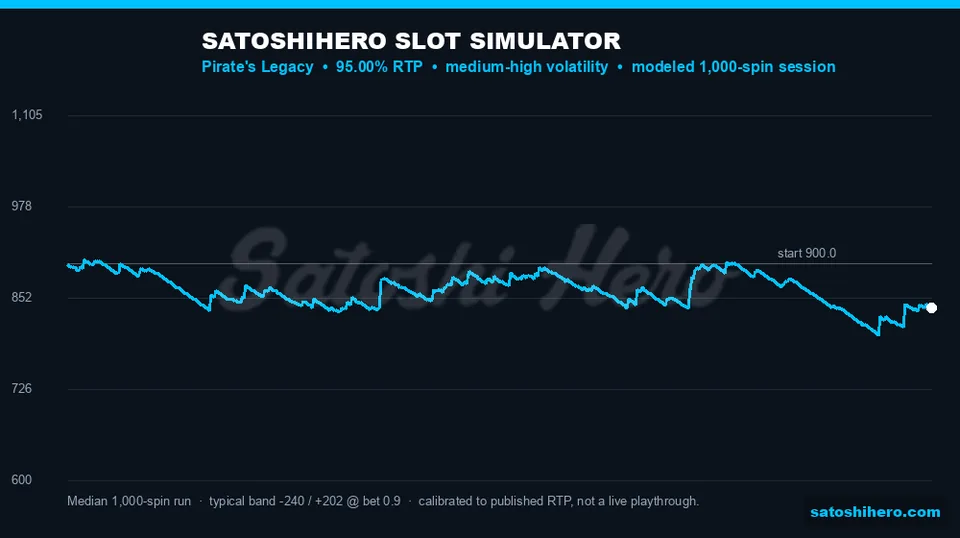
A feature-sized result appeared once per 46 simulated spins. Results of 100x or higher appeared about once per 3,891 simulated spins. Those frequencies aren’t trigger rates, promises, or countdowns. I think the second figure gives a blunt warning against expecting quick triple-digit returns.
The model covers far more spins than my live test, but it still doesn’t forecast the next batch. Its main value lies in showing how widely sessions can separate under the same stake and game settings. You can finish well above the middle outcome or far below it. The range makes the risk profile easier to grasp than one average alone.
Our 100-spin session
My observed run ended $29.34 down after 36 paying spins. Free Spins triggered once, and the largest counted win reached 15x. Unlike the simulator, these events came from actual play at a fixed $0.90 stake. You get a concrete session story, not a new statistical rule.
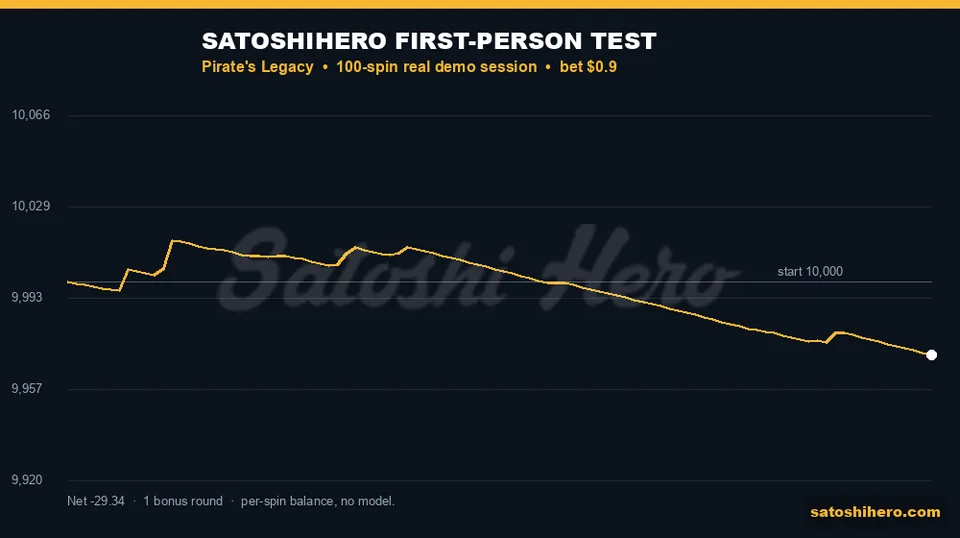
A 100-spin sample can show rhythm, controls, and short-term balance movement. It can’t redefine the theoretical return or establish a dependable feature frequency. My run stayed positive through spin 55, then lost ground without another large result. In my opinion, that swing captures the practical discomfort of medium-high volatility well.
The 95% figure is the operator-published theoretical RTP, and one live session doesn’t alter it. Simulator outcomes illustrate possible variation rather than forecasting your next play. Bonus modes can use slightly different returns by design, but no verified separate figure applies here. This test shows one short downside case, not a guaranteed future pattern.
Frequently Asked Questions
What is Pirate’s Legacy slot?
Pirate’s Legacy slot is a pirate-themed Platipus game using a 5×3 grid and 30 fixed paylines. It includes a pirate Wild, Bonus-coin collections, four jackpots, and Free Spins with moving chests. You get conventional line rules around a more distinctive collect system. I think the feature symbols carry most of its appeal.
How does the Collect feature work in Pirate’s Legacy slot?
Bonus coins appear on reels 1 through 4 and need a Collect chest on reel 5 during the same base spin. The chest adds every displayed cash or jackpot value. Cash coins pay 1x through 15x the total bet. You can receive a collection without landing a normal line win.
How do Free Spins work in Pirate’s Legacy slot?
A scroll on reels 1 through 4 and a chest on reel 5 trigger the feature. Scrolls award 3, 4, 5, 7, or 10 spins, and multiple values combine. Frozen chests move left, collect coins and scrolls, and can help retrigger. My only round lasted three spins and paid $1.35.
What are the jackpots in Pirate’s Legacy slot?
At a $0.90 stake, Mini pays $22.50, Minor pays $45, Major pays $225, and Grand pays $450. Jackpot names appear on Bonus coins and need the Collect feature to pay. You should treat those values as tied to the tested stake. The clear overhead plaques make them easy to track.
Does Pirate’s Legacy slot have a bonus buy?
Yes. Its three buys cost 100x, 150x, and 250x, equal to $90, $135, and $225 at my $0.90 stake. They guarantee at least three, five, or seven scrolls respectively. I purchased none of them, so you shouldn’t infer performance from this test.
What did the 1,000-spin simulator show?
The middle modelled session ended $61.40 down at a $0.90 stake. Nine runs in ten ranged from $240.50 down to $201.80 up. These simulator outcomes illustrate possible variation rather than a prediction. In my view, that wide spread fits the stated risk level.
How did the 100-spin test go?
My balance fell from $10,000 to $9,970.66, producing a $29.34 loss. One Free Spins round returned $1.35, while the largest counted win was the $13.50 prize from a Bonus coin. You should separate that observed run from the simulator distribution. It was a weak session, not a fixed play pattern.
What are the RTP and maximum win in Pirate’s Legacy slot?
Pirate’s Legacy slot has a 95% theoretical RTP, medium-high volatility, and a 3,267x maximum win. At the tested $0.90 stake, that ceiling equals about $2,940.30. You won’t see that figure predicted by my short sample. I find the ceiling restrained for this risk level.
Bottom Line
Pirate’s Legacy offers collection values, moving bonus chests, and familiar 30-line play. Its drawback is a modest top-win ceiling beside medium-high risk, and you need patience through weaker stretches.

My Verdict
Try the demo if coin collections and transparent cash values appeal to you. Expect small returns between rarer feature events, and don’t assume Free Spins can rescue a short session.
I like how quickly the chest mechanics make sense and how clearly each coin shows its value. I don’t like that my only bonus returned $1.35, while the run still ended $29.34 down. The unpaid buys also leave no honest basis for ranking them.
Our Pirate’s Legacy slot testing notes and game details are checked regularly, so you can assess the mechanics beside the observed session evidence.

Pros:
 Clear collections: Printed coin values make potential feature returns easy to follow.
- Simple paylines: Familiar left-to-right rules reduce the learning curve.
- Moving chests: Free Spins add tension through visible reel-by-reel movement.
- Useful controls: Stake and autoplay settings support structured play sessions.

Cons:
 Low tested bonus: My only Free Spins round returned just $1.35.
- Demanding buys: The largest purchase costs $225 at the tested stake.
- Restrained ceiling: A 3,267x cap feels modest beside medium-high risk.

Best For: Clear-value feature fans and patient medium-high risk players match this game. You should prefer transparent coin prizes over complex transformations, and you must accept that a bonus can pay very little.

































































Bets
All Bets
Game
Player
Date
Wager
Mult.Multiplier
Prize
 Mighty Stars
 josh1998
- 16:54:06
- 0×
- Amazing Diamonds: Hold 'N' Link
- nina87
- 16:54:05
- 16×
- Book Of Nile: Lost Chapter
 Hidden
- 16:54:05
- 0×
- Pelican's Bay: Rapid Link
- Hidden
- 16:54:04
- 1.4×
- Mighty Stars
- josh1998
- 16:54:03
- 0.5×
- The Aristocrats
 alexanderpaukner33
- 16:54:01
- 0×
- Slime Bonanza
 thomas032172
- 16:54:01
- 0.29×
- Pompeii Gold: Rapid Link Bonus Buy
- mike_721
- 16:54:01
- 0×
- Book Of Nile: Lost Chapter
- Hidden
- 16:54:01
- 0.49×
- Mighty Stars
- josh1998
- 16:54:00
- 0×