

Xmas Avalanche
By pressing play, you agree that you are above legal age in your jurisdiction and that your jurisdiction allows online gambling.

Xmas Avalanche
RTP95.69%
VolatilityMedium
Max winx5,100
ThemeChristmas & New Year
ReleasedDec 2022

Breaking the Ice With Festive Cluster Wins
Build connected festive clusters in the Xmas Avalanche slot, then watch each win clear space for another cascade.
According to Platipus, Xmas Avalanche is a medium-volatility slot with 95.69% RTP and 5,100x maximum win potential. Its 7×7 cluster grid combines active cascades with persistent Wild multipliers. It targets cascade fans who prefer measured risk and features that can grow across one paid spin.
Key takeaways
- Evidence-backed play: I tested only the base game, so you get no invented bonus result or purchase claim.
- Lowest-cost bonus entry: The 3+ Scatter option costs 65x your bet, but its lower price doesn’t prove better value.
- RTP / volatility: You get a 95.69% theoretical return with medium volatility and meaningful short-session swings.
- Max win: The 5,100x ceiling is respectable, though you shouldn’t treat it as a routine target.
- Bankroll note: My test lost 39.95 stakes, while buying free spins costs 65 to 150 stakes upfront.

Table of Contents
- Xmas Avalanche slot at a Glance
- Cluster Pays and Cascades
- Building a cluster
- Symbol values
- Random Wild Multiplier
- Growing the multiplier
- Combining Wilds
- Winter Theme and First Impressions
- Cabin setting
- Festive symbols
- Free Spins
- Trigger requirements
- Multiplier ladder
- How the 100 Spins Played
- Session result
- Win pattern
- Buy Feature Options
- Four entry levels
- Bankroll impact
- RTP, Volatility and Test Results
- Simulator projection
- Our 100-spin session
- Frequently Asked Questions
- Bottom Line
Xmas Avalanche slot at a Glance
The Xmas Avalanche slot uses cluster pays, cascades, and multiplier Wilds instead of traditional paylines. You need at least five matching symbols connected horizontally or vertically, and each win creates room for replacements.
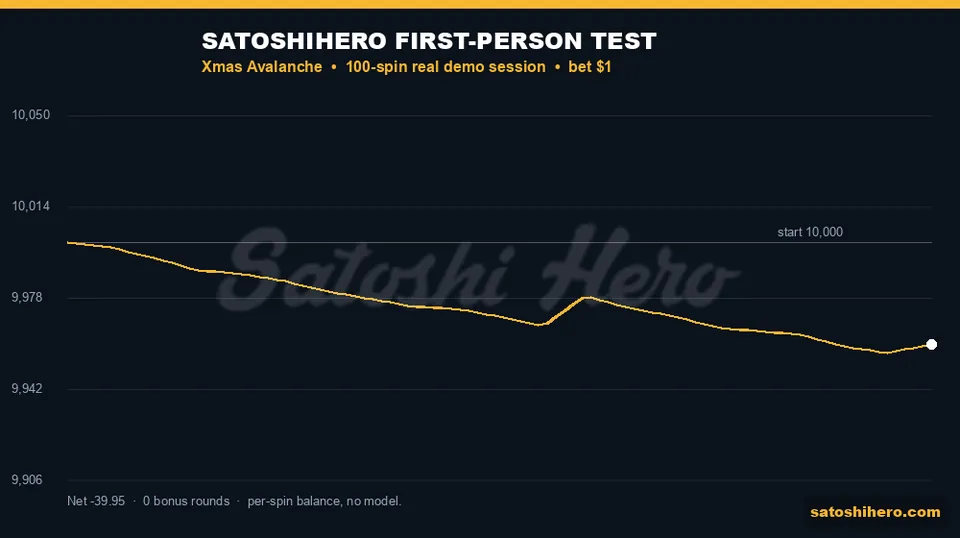
Platipus built the Xmas Avalanche slot as a Slots title, and I tested 100 spins at $1.00. I lost $39.95, logged a $15.60 top win, and never triggered free spins. Those observations describe my run, not the theoretical return.
You can try the free demo or real-play version here on SatoshiHero. Plain and simple, the Wild system feels more distinctive than the familiar Christmas presentation. This guide separates documented rules from what I actually saw, so you can judge the mechanics without mistaking one short session for a forecast.
Cluster Pays and Cascades
Wins in the Xmas Avalanche slot require groups of five or more matching symbols touching horizontally or vertically. Diagonal contact doesn’t count, only the highest win for each block pays, and you won’t find fixed paylines here.
Winning symbols explode before replacements fall into the empty spaces. That sequence can create several cascade wins from one paid spin. The 7×7 interface stays readable on desktop and mobile screens, which helps you spot valid links before the blocks disappear.
Sweet Bonanza Xmas uses a scatter-pays tumble system, so don’t assume every festive cascade game scores symbols identically. Here, connection and block size decide the opening value before Wild multipliers alter it. I prefer this clearer spatial rule because you can see exactly why a block qualifies.
Building a cluster
Picture five wreaths running across a row, with two more continuing downward from its final wreath. That bent shape forms one valid cluster because every symbol keeps an edge-to-edge connection. Two matching ornaments touching only at their corners remain separate, even when they look close.
A valid block can snake across several rows and columns. You only need each piece to connect horizontally or vertically with another piece in the group. Sugar Rush Xmas offers a broadly familiar cluster concept, but you still need to learn this game’s persistent Wild ladder.
Star Scatters stay on the board during cascades rather than exploding with ordinary winners. You should watch edges, not corners, while replacements settle.
Symbol values
At my $1.00 stake, blocks of five paid these amounts:
- Gingerbread man: $1.00
- Wreath: $0.75
- Snowflake: $0.50
- Red ornament: $0.40
- Green ornament: $0.30
- Pink ornament: $0.25
- Blue ornament: $0.20
Blocks of at least 15 increased sharply:
- Gingerbread man: $150
- Wreath: $100
- Snowflake: $90
- Red ornament: $80
- Green ornament: $60
- Pink ornament: $40
- Blue ornament: $20
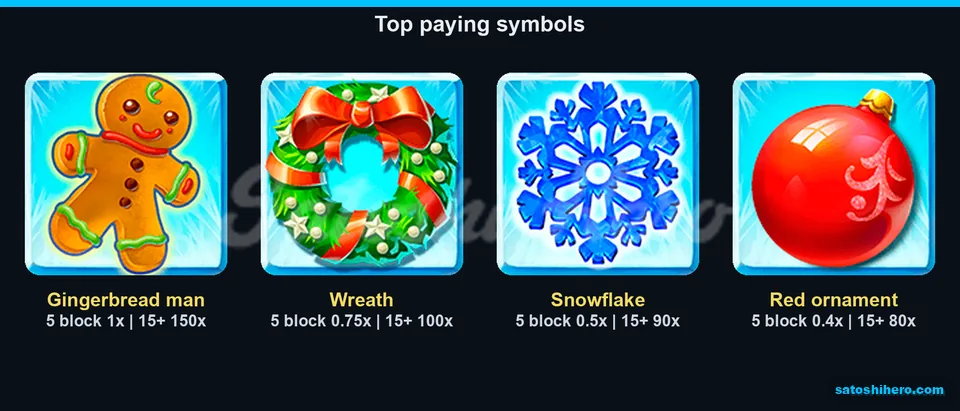
Block size matters most for gingerbread men and wreaths. You should count the whole connected shape, while remembering that lower ornaments start modestly.
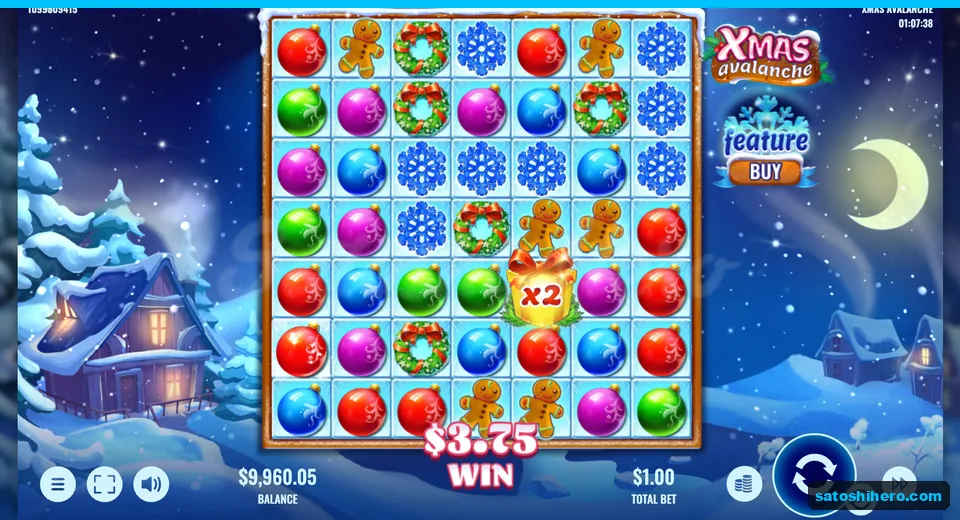
The Gift Wild substitutes for every symbol except the Scatter and can appear anywhere. Star Scatters pay wherever they land: three pay 3x, four pay 5x, five pay 10x, six pay 20x, and seven pay 100x. My settled final cascade paid $3.75, left an x2 Wild, and finished with a $9,960.05 balance.


Data Point: Xmas Avalanche has no fixed paylines: it pays for clusters of 5+ connected matching symbols.
Valid connections and block size set the first payout, so you should confirm both before considering any Wild boost.
Random Wild Multiplier
An exploding winning block can leave a Wild in a random empty position, creating multiplier potential during later cascades. A fresh base-game Wild starts at x2, then progresses through x4, x8, x16, x32, x64, x128, and x256.
The Wild advances only when it joins another winning block. Several Wilds in one block add before the payout multiplier applies. One touching separate valid blocks can contribute to each.
My final tested spin showed an x2 Wild and returned $3.75. I never reached the higher stages, so I won’t pretend the full ladder appeared during my session. Xmas Drop offers similar holiday symbols falling into open spaces, though its drop-style appeal doesn’t imply matching Wild rules.
Growing the multiplier
You can’t choose where a Wild appears or force it to progress. Repeat participation moves it through the ladder, while a cascade without that Wild leaves its level unchanged. The main-game ceiling is x256 per block, while free spins raise it to x729.
Any combined value above the relevant limit drops to that cap. That rule stops stacked Wilds from exceeding the mode’s stated ceiling. I like the visible progression because it gives you a reason to follow one board beyond its first cluster.
Combining Wilds
Suppose an x4 Wild and an x8 Wild join the same winning cluster. The rules combine them into x12 before applying the multiplier. This is a mechanics example, not a result from my test.
One well-positioned Wild can touch more than one valid block during the same cascade sequence. You can benefit from that placement, but you can’t influence where it lands. No sugarcoating, random positioning creates the excitement and removes any claim of player control.

Suggestion: Watch each Wild’s position and nearby symbols during a cascade. One Wild can join several blocks, although you can’t influence its location.
This persistent ladder gives the base game more identity than its conventional festive artwork, especially when you follow each surviving Wild closely.
Winter Theme and First Impressions
The 7×7 board places every symbol on an individual ice block before a snowy cabin. A crescent moon, drifting snow, and a dark winter sky frame the reels without pulling your attention away.
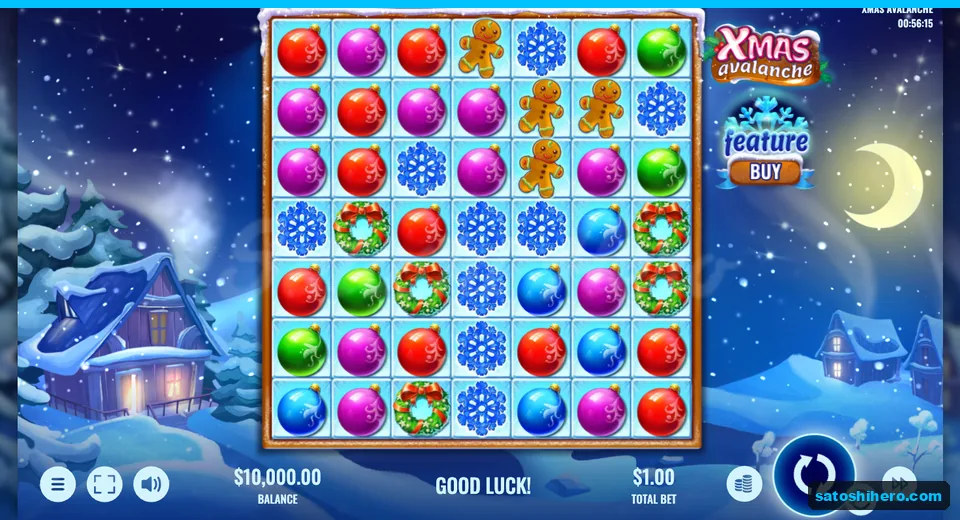
Gingerbread men, wreaths, snowflakes, and four colors of glass ornaments fill the grid. Winning blocks explode, then replacements drop into the gaps like a small avalanche. The Christmas theme won’t win originality awards, but the icy grid and cascading animation give it a coherent identity.
I started with $10,000.00 at $1.00 per spin, so clear balance and stake displays mattered. You can read the board quickly without losing those controls.
Cabin setting
The snowbound cabin and cool palette create a quiet nighttime backdrop. Separate ice blocks make horizontal and vertical connections easier to trace. Your eye stays on the grid instead of wandering through the scenery.
Santa’s Xmas Rush offers a more overt Santa-led presentation if you prefer a louder holiday character. Xmas Express shifts the festive setting toward transport, while this game keeps you outside a still cabin. I find the quieter scene more readable, though it also feels less adventurous.
Festive symbols
Gingerbread men and wreaths stand apart as the premium symbols. Color-coded ornaments remain easy to track when several cascades happen quickly. Strong differences in shape and color help you follow forming clusters before they explode.

Fun Fact: Each symbol sits on its own ice block, visually reinforcing horizontal and vertical cluster connections.
You won’t find much thematic surprise here, but you get clean information from every symbol. The artwork favors readability and consistency over novelty, which is the right trade for a busy cluster grid.
Free Spins
Three to seven Scatters in the Xmas Avalanche slot award between 10 and 25 free spins. My 100-spin session never triggered the feature, so every bonus detail below comes from the documented rules rather than firsthand bonus play.
The natural awards are straightforward:
- Three Scatters: 10 free spins
- Four Scatters: 12 free spins
- Five Scatters: 15 free spins
- Six Scatters: 20 free spins
- Seven Scatters: 25 free spins
Three more Scatters during the round add five spins. You need all three together for that retrigger, just as you need at least three to enter naturally. More triggering Scatters increase the starting allowance, but they don’t promise a profitable round.
Trigger requirements
Scatters remain on the grid while ordinary winning symbols disappear. That persistence can keep a developing trigger visible across cascades. You should still treat each completed spin as random rather than reading a near miss as progress.
My run produced no three-Scatter combination across 100 spins. I can’t judge the round’s real payout rhythm from that absence. The lack of a trigger felt disappointing, though it provides a useful limit on what I can claim.
Multiplier ladder
New Wilds begin at x3 during free spins. Repeat winning participation can move them through x9, x27, x81, x243, and x729. This ladder starts above the base game’s x2 and ends beyond its x256 cap.
The x729 figure is the free-spins ceiling per block, not a promised result. You still need a Wild to join repeated winning clusters for growth. I like the stronger progression on paper, but my short test gave me no bonus result to support a payout verdict.
The bonus offers a more aggressive Wild ladder, yet you should separate that attractive rule from the unobserved result in my test.
How the 100 Spins Played
My $1.00-per-spin session ended $39.95 down after 100 spins and produced no free-spin trigger. You could see plenty of movement from cascades, but the activity didn’t prevent a meaningful loss.
| Test detail | Observed result |
|---|---|
| Starting balance | $10,000.00 |
| Stake | $1.00 per spin |
| Spins played | 100 |
| Ending balance | $9,960.05 |
| Net result | $39.95 loss |
| Paying spins | 39 |
| Returned by paying spins | $60.05 |
| Largest logged win | $15.60 on spin 60 |
| Final spin | $3.75 with an x2 Wild |
| Free-spin triggers | None |
Those 39 paying spins describe only my short run, not an official hit frequency. A spin can return some money without covering its $1.00 cost. You should distinguish any payout from an actual profit, especially when small cascades keep the screen busy.
Session result
I wagered $100.00 across the full test and received $60.05 back. Subtracting those returns from the wager produced the $39.95 loss. The ending balance therefore moved from $10,000.00 to $9,960.05.
Most declines arrived in small steps rather than one sudden collapse. That pattern felt calmer than a single brutal hit, though the final cost remained the same. You shouldn’t let frequent animations hide what the balance is doing.
Win pattern
Small-paying cascades set the session’s rhythm. My largest logged win reached $15.60 on spin 60, while the final spin returned $3.75 with an x2 Wild. No other result approached a large multiplier payout.
I found the Xmas Avalanche slot busier than its final result suggests. Still, repeated small returns couldn’t stop a decline worth 39.95 stakes. The practical takeaway is blunt: active-looking play can lose substantial money over a short run.
Buy Feature Options
The Buy Feature offers four entries costing 65x, 75x, 95x, or 150x your total bet. I didn’t purchase any option, so you get prices and rules here rather than unsupported performance rankings.
Each price includes the starting spin, and the purchased round follows the natural free-spin rules. A higher entry provides a larger minimum starting award, but it doesn’t establish better returns. I think that distinction matters because the menu can make cost look like quality.
Four entry levels
| Entry | Cost | Minimum spins | Cost at $1.00 |
|---|---|---|---|
| 3+ Scatters | 65x | 10 | $65 |
| 4+ Scatters | 75x | 12 | $75 |
| 5+ Scatters | 95x | 15 | $95 |
| 6+ Scatters | 150x | 20 | $150 |
The 65x route is the lowest-cost entry, while 150x is the highest. Cost order alone tells you nothing about relative performance. You should compare the full upfront amount with your planned session budget before selecting anything.
Bankroll impact
One purchase costs as much as 65 to 150 ordinary $1.00 spins. The $150 top option exceeds the $100.00 I wagered during my entire test. That comparison makes the upfront exposure clearer.
You can’t assume a larger buy improves your chance of finishing ahead. I prefer ordinary spins when evidence for the purchased rounds isn’t available, because the lower commitment preserves more control over session length.

Watch Out: At a $1.00 stake, the most expensive purchase costs $150. That’s 150 standard spins upfront, and the round doesn’t guarantee a profit.
Treat every purchase as a separate high-cost wager, not a shortcut to a winning session. You should budget for the whole charge before pressing the button.
RTP, Volatility and Test Results
The three core figures are 95.69% RTP, medium volatility, and a 5,100x maximum win. The RTP states the theoretical return, while volatility describes the intended risk pattern and the maximum marks a ceiling rather than a routine target.
Medium volatility can still produce losing streaks and uncommon larger hits. I consider the 5,100x cap respectable for this risk level, though RTP carries more weight when you compare mathematical profiles. You shouldn’t turn any headline figure into a prediction for your next session.
Simulator projection
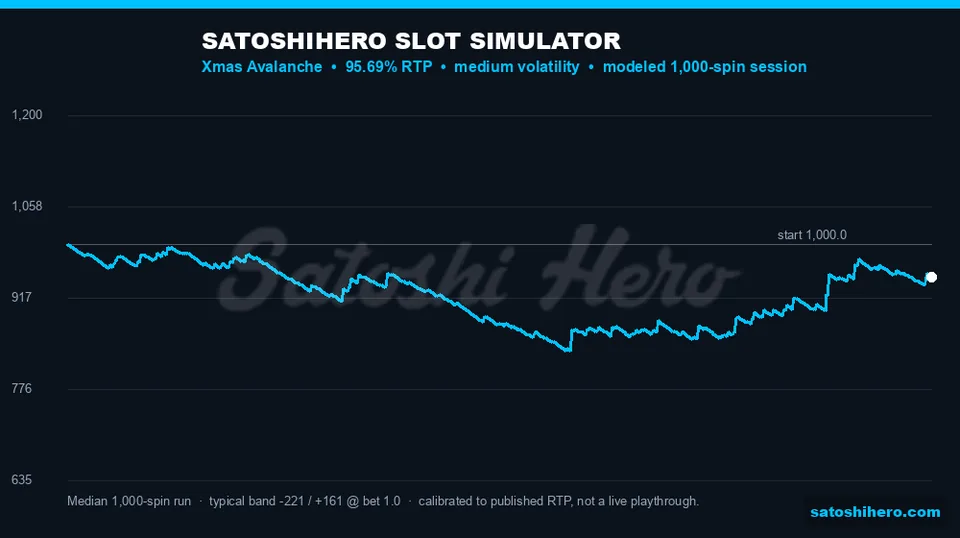
The SatoshiHero Slot Simulator used the official profile across 1,000 spins at $1.00. Its median modeled finish was $49.60 down, with a broad 5th-to-95th-percentile band from $220.60 down to $160.60 up.
The model estimated an approximate 25% paying-spin frequency. It placed bonus-tier outcomes at roughly once per 50 spins and 100x-or-higher results at roughly once per 13,514 spins. Those outputs can’t count down to your next event or tell you what one session produces.
A blue balance line in the projection represents one modeled path, not a guaranteed pattern. I find the wide range more useful than the median alone because it shows how sharply equal starting conditions can diverge. You should read the simulator as a risk illustration, not a forecast.
Our 100-spin session
My observed loss reached $39.95, with 39 paying spins and a $15.60 largest logged win. Free spins never triggered. My paying-spin share exceeded the model’s approximation, yet my balance declined.
That contrast shows why payout count and profitability aren’t the same measure. Many returns failed to recover the full stake, while none delivered a large multiplier result. You can have a busy session and still finish well below your starting balance.
One hundred spins can’t validate or contradict the theoretical return or the simulator’s broader assumptions. The gold balance line shows a gradual move from $10,000.00 to $9,960.05. I value that path as a transparent example, not proof of typical behavior.
The 95.69% figure is the operator-published theoretical RTP, and one live session doesn’t alter it. Bonus-purchase modes can use slightly different designed returns, so use the official profile for comparison and my test only as a short-session example.
Frequently Asked Questions
How do wins work in the Xmas Avalanche slot?
Five or more matching symbols must touch horizontally or vertically on the 7×7 grid. Winning symbols explode and replacements cascade down, allowing several wins from one paid spin. Diagonal contact doesn’t count, and the game has no fixed paylines.
What does the Random Wild multiplier do in the Xmas Avalanche slot?
A winning block can leave an x2 Wild in an empty position. Repeat participation can raise it through x4, x8, x16, x32, x64, x128, and x256. Several Wilds in one block add their multipliers before the payout multiplier applies.
How are free spins triggered in the Xmas Avalanche slot?
Three, four, five, six, or seven Scatters award 10, 12, 15, 20, or 25 spins. New Wilds begin at x3 and can grow to x729 during the round. Three additional Scatters add five spins.
How much does the Xmas Avalanche Buy Feature cost?
The four prices are 65x, 75x, 95x, and 150x your total bet. At $1.00, those entries cost $65, $75, $95, and $150. I purchased none during my test.
What did the 1,000-spin simulator show?
The median modeled result finished $49.60 down. Its 5th-to-95th-percentile range stretched from $220.60 down to $160.60 up. The simulator provides a model, not a prediction for your play.
How did the 100-spin Xmas Avalanche slot test go?
I started with $10,000.00 and finished with $9,960.05 after staking $1.00 per spin. That produced a $39.95 loss, while my largest logged win reached $15.60. No free spins triggered.
What are the RTP and maximum win in the Xmas Avalanche slot?
The game has 95.69% RTP, medium volatility, and a 5,100x maximum win. RTP is theoretical, and the maximum represents a ceiling rather than an expected result.
Bottom Line
Xmas Avalanche stands out through persistent Wilds that can grow across connected cascade wins. Its main drawback is familiar holiday styling, and my short base-game run never reached the bonus.

My Verdict
Cluster fans should try the free game first and watch how the Wild ladder changes each cascade. Expect frequent visual activity, modest returns in many spins, and no assurance that the bonus appears during a short session.
I like how one surviving Wild can turn a routine cluster into a more interesting sequence. I don’t like that 39 paying spins still returned only $60.05 from $100.00 wagered, while the free-spin feature stayed absent.
The Xmas Avalanche slot facts and rules are checked regularly. You should use the mathematics for comparison, then treat my session as one example.

Pros:
 Clear cluster rules: Edge connections make valid wins easy to identify.
- Persistent Wild ladder: Repeat cascade involvement can raise multipliers sharply.
- Readable presentation: Distinct symbols remain clear during fast cascades.
- Flexible bonus entries: Four purchase levels offer different upfront costs and starting spins.

Cons:
 Familiar theme: Cabin scenery and ornaments bring little visual surprise.
- Costly top purchase: A $150 buy exceeds my full test wager.
- Untriggered bonus: My 100 spins provided no firsthand free-spin result.

Best For: Cluster-pay fans and measured risk takers get the clearest appeal here. You should enjoy tracking persistent Wild positions and accept that busy cascades can still end with a loss.
































































Bets
All Bets
Game
Player
Date
Wager
Mult.Multiplier
Prize
 Halloween Harvest: Rapid Link
 Hidden
- 00:21:13
- 2.39×
- 3 Witches: Bonus Combo
 bjgrandy149
- 00:21:12
- 0×
- Halloween Harvest: Rapid Link
- Hidden
- 00:21:12
- 0×
- Big Banker Bonanza
 josh1998
- 00:21:11
- 0×
- Halloween Harvest: Rapid Link
- Hidden
- 00:21:11
- 0.99×
- Halloween Harvest: Rapid Link
- Hidden
- 00:21:10
- 0×
- Aztec Magic Deluxe
 RicoSoul
- 00:21:09
- 0×
- 4 Lucky Nuggets
 whodey39311
- 00:21:08
- 0×
- 4 Lucky Nuggets
- whodey39311
- 00:21:07
- 0×
- Aztec Magic Deluxe
- RicoSoul
- 00:21:05
- 0×