

Wizard of the Wild
By pressing play, you agree that you are above legal age in your jurisdiction and that your jurisdiction allows online gambling.

Wizard of the Wild
RTP95%
VolatilityMedium
Max winx2,300
Hit rate47.18%
ThemeFantasy
ReleasedSep 2023

Casting Wilds in the Wizard’s Workshop
Selected symbols transform into wilds across the five-reel, three-row Wizard of the Wild slot layout.
Wizard of the Wild slot is a Platipus fantasy game with 95% RTP, medium volatility, 20 fixed paylines, and 2,300x max win potential. Its nine-spin bonus locks landed wilds, appealing to you if frequent small connections matter more than a huge prize ceiling. My bonus returned $11.10 at a $1 total bet.
Key takeaways
- Best bonus: Nine free spins lock every naturally landed Spellbook Wild through the round’s final spin.
- RTP / volatility: The 95% theoretical return pairs with medium volatility across 20 fixed paylines.
- Max win: The prize ceiling is exactly 2,300x the total bet.
- Risk note: The 50x feature cost $50 at my $1 stake, and I didn’t purchase it.
- Bankroll note: My 100-spin session lost $38.20 despite one free-spins round.

Table of Contents
- How Wizard of the Wild Works
- Premium symbol values
- Card symbol values
- The Wild Spell
- Theme and First Impressions
- Free Spins With Locked Wilds
- Trigger and setup
- Tested bonus result
- Maximum Win and Payout Context
- Buying the Feature
- What 100 Spins Revealed
- Hit pattern
- Bankroll movement
- RTP, Volatility and Our Test
- Simulator projection
- Our 100-spin session
- Frequently Asked Questions
- Bottom Line
How Wizard of the Wild Works
Wins run left to right across 20 fixed paylines on a five-reel, three-row board. You need matching symbols from reel 1, and only the highest combination on each active line pays.
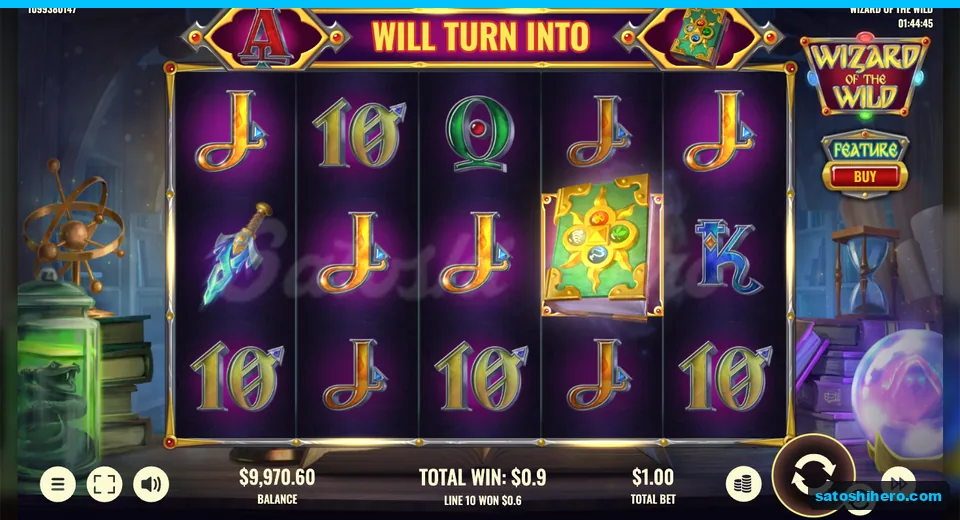
My $1 total test bet split into a $0.05 line bet across all 20 lines. That distinction matters because the paytable displays units before the game converts them into dollars. Five Crystal Daggers on line 4 showed 50 units, then paid $2.50 after multiplication by $0.05. Plain and simple, the large paytable number wasn’t the final cash return.
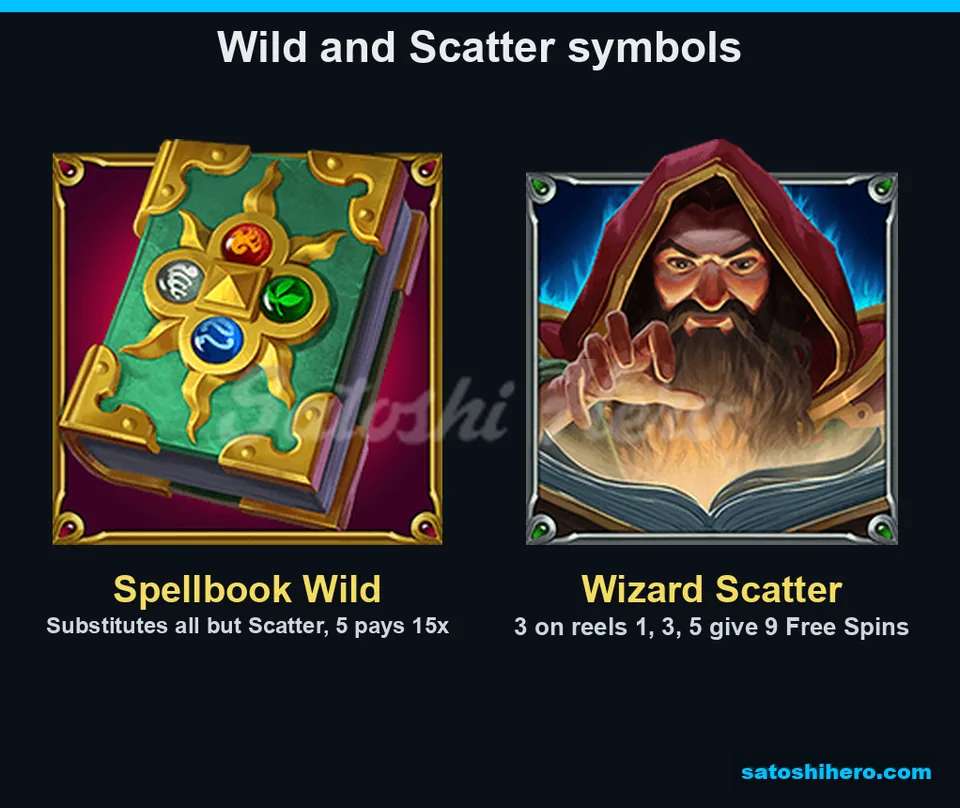
The Spellbook Wild substitutes for everything except the Wizard Scatter and can appear on any reel. Five Spellbook Wilds together pay 15x the total bet. Wizard Scatters appear only on reels 1, 3, and 5 during base play. One on each eligible reel starts nine free spins, so you can identify the trigger immediately.
Controls along the bottom cover balance, stake, spin, and autoplay. You can set a $1 to $100 total bet through $0.05 to $5 line bets. Autoplay offers 25, 50, 75, 500, or 1,000 plays, plus adjustable single-win and loss limits. I raised both limits during testing, which kept the planned run moving without interruption.

Suggestion: Check the winning payline and the $0.05 line bet when verifying a result. Paytable units don’t represent the final dollar payout alone.
Premium symbol values
The Ruby Amulet leads the regular symbols, paying 7.5x, 3.5x, or 1.5x for five, four, or three. Green Potions return 4x, 2x, or 1x, while Crystal Daggers pay 2.5x, 1.2x, or 0.6x. Sapphire Rings provide 2x, 1x, or 0.5x across the same counts.
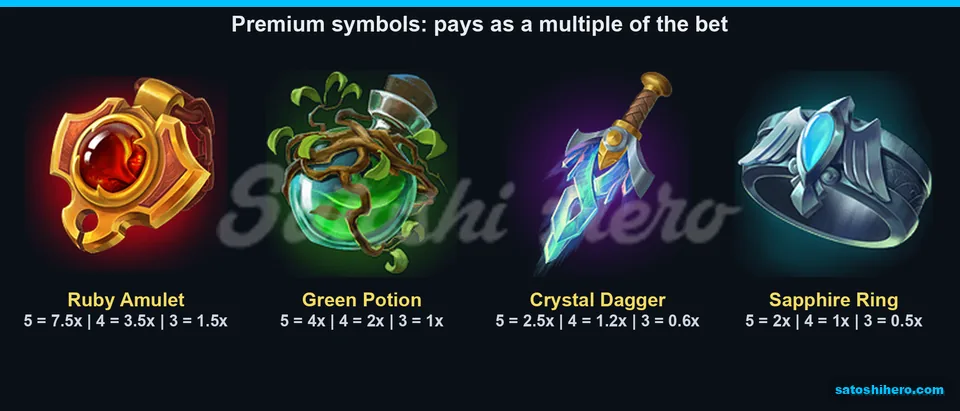
Those single-symbol figures can look restrained, but wild substitutions can complete several paylines together. You should inspect the complete line summary rather than judging a result from one visible combination. I found that approach much clearer than trying to calculate every crossing line from the stopped board.
Card symbol values
The Ace pays 0.9x, 0.6x, or 0.3x for five, four, or three. King values are 0.8x, 0.5x, and 0.2x, while Queen values are 0.7x, 0.4x, and 0.2x.
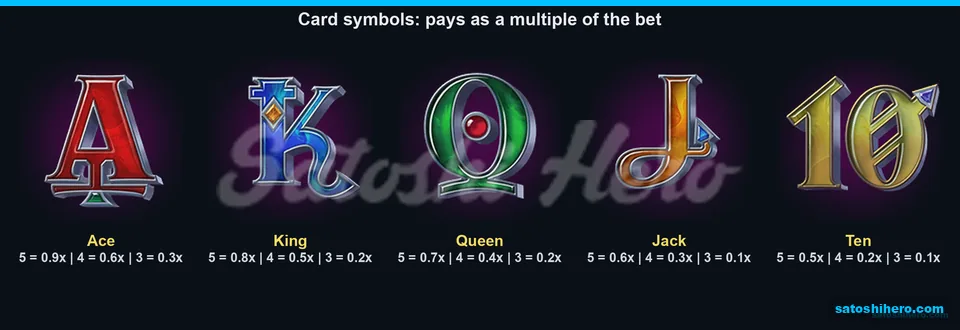
Five Jacks return 0.6x, 0.3x, or 0.1x. Tens sit lowest at 0.5x, 0.2x, or 0.1x. These modest card values help explain why so many tested hits returned less than the stake. You get regular movement, but you shouldn’t confuse activity with profit.
The Wild Spell
The spell bar selects one random regular symbol before every paid spin. Every landed copy becomes a Spellbook Wild before the game checks paylines, while the Wizard Scatter never enters the selection.
I watched one stopped board change when a whole group of selected symbols transformed. Separated icons suddenly connected through the new wilds, and only then did the line results appear. That sequence makes Wizard of the Wild slot easier to read if you watch the bar first. You can miss why a line paid when you focus only on the original symbols.
This transformation gives the base game its strongest identity. In my view, it’s more engaging than a standard wild dropping without context. The mechanic created frequent low-value connections during my test, but it didn’t make every conversion profitable. Several transformed boards still returned less than my $1 stake.

Data Point: Selected symbols transform before wins are calculated, so a disconnected icon can join one or several winning paylines.
The spell changes on each paid spin, which keeps the board logic active without adding complicated choices. You don’t control its selection, and a promising target can still miss the reels completely. Watch the spell bar before each spin settles because it changes how you should read the final layout.
Theme and First Impressions
Wizard of the Wild slot places its readable reel area inside a detailed wizard’s study. Gold-framed reels sit among old books, a brass armillary sphere, a creature jar, an hourglass, and a crystal ball.
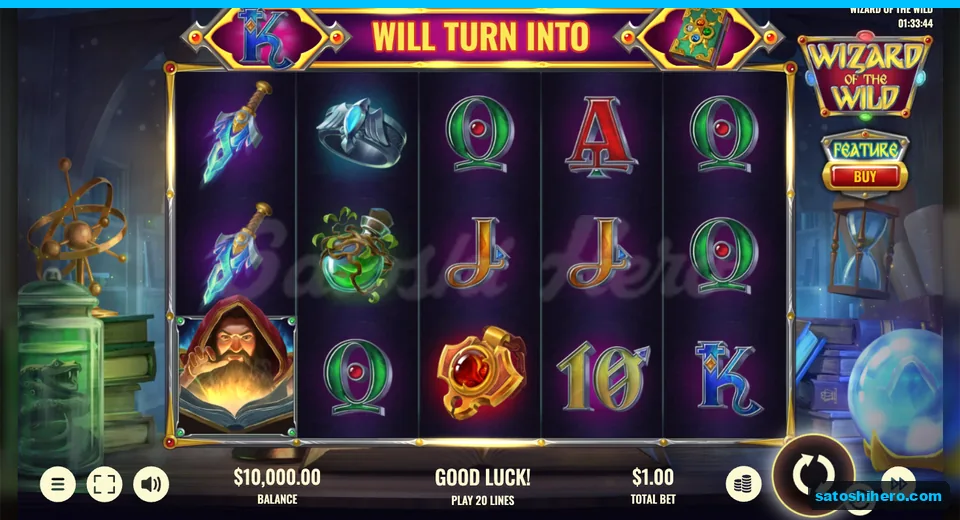
Ruby Amulets, Green Potions, Crystal Daggers, and Sapphire Rings support the magical workshop setting. The theme won’t win originality awards, but the cluttered study has more character than a plain fantasy backdrop. You can understand each premium symbol quickly, and the strong colors stop the busy scenery from muddying the reels.
The interface also maps every important function clearly. A spell bar sits above the reels, the red FEATURE BUY sign hangs to the right, and balance, stake, and spin controls run below. You always see the selected spell symbol before the reels resolve. I like that practical layout because the main mechanic never hides behind decorative effects.

Fun Fact: The brass armillary sphere reflects an old astronomical instrument used to model objects and circles in the sky.
Fantasy fans get familiar imagery rather than a strange new world. Still, the workshop props make the screen feel lived in, and the functional bar remains the visual focus. The design serves Wizard of the Wild gameplay without hiding information you need.
Free Spins With Locked Wilds
Wizard Scatters on reels 1, 3, and 5 award exactly nine free spins. Every Spellbook Wild that lands naturally stays locked in place until the last bonus spin.
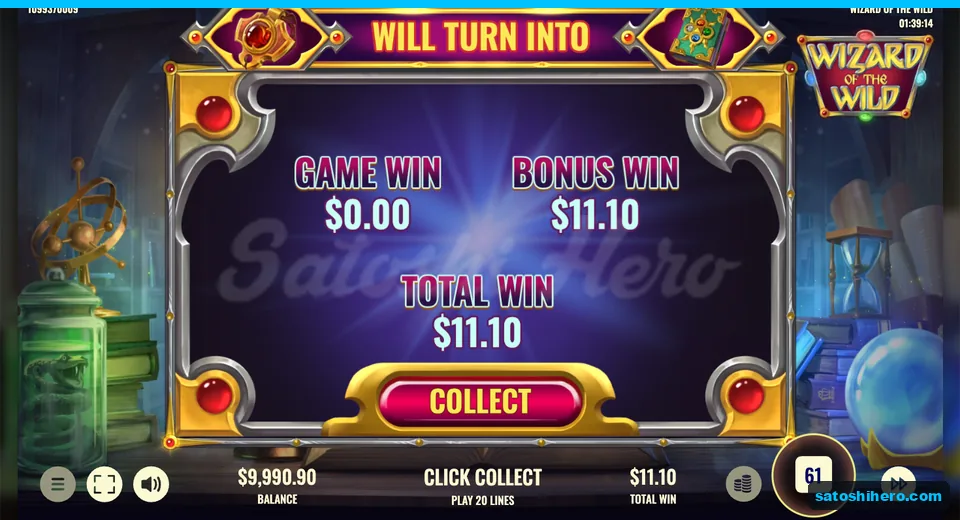
The trigger opens a nine-free-spins card with a manual START button. Autoplay paused on that screen during my session, so you need to start the round yourself. Afterward, a closing card separates Game Win, Bonus Win, and Total Win before collection. I prefer that clear accounting because it shows exactly what the feature contributed.
Trigger and setup
The feature triggered once for me on paid spin 14. Three Wizard Scatters occupied their eligible reels, and the remaining autoplay counter waited behind the trigger card. Clicking START moved directly into the nine-spin round.
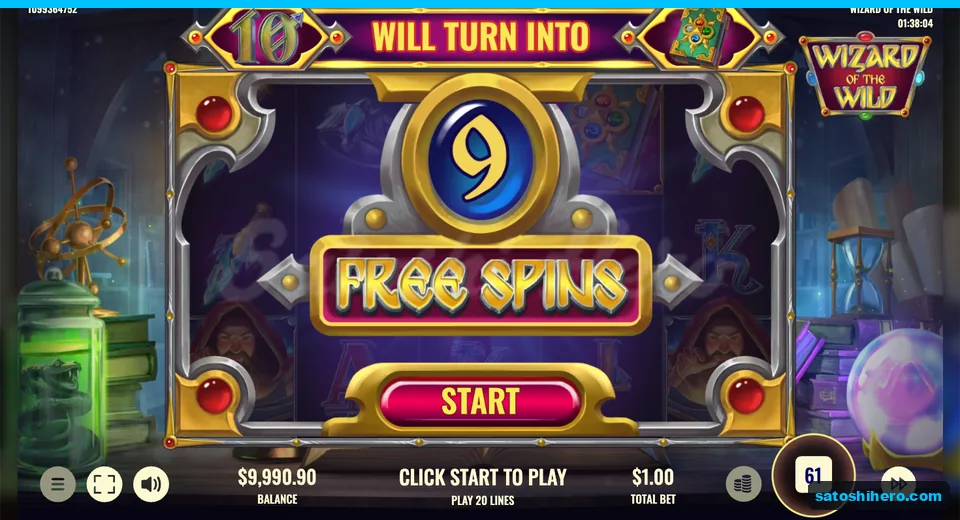
You should expect a pause rather than an automatic jump into the feature. That break makes the trigger obvious and gives you time to see the awarded spin count. My balance had slipped from $10,000 to $9,990.90 before the round, so the bonus arrived during an early decline.
The trigger felt timely, but one appearance in 100 spins doesn’t establish a normal frequency. You could see a very different pattern across another short run. Treat my result as a firsthand snapshot, not a schedule for your play.
Tested bonus result
Six locked Spellbook Wilds had accumulated with four free spins remaining. The crowded board looked promising, yet the complete round paid $11.10 at my $1 total bet. Collecting it lifted my balance to $10,003.40 on spin 15, the session’s highest point.
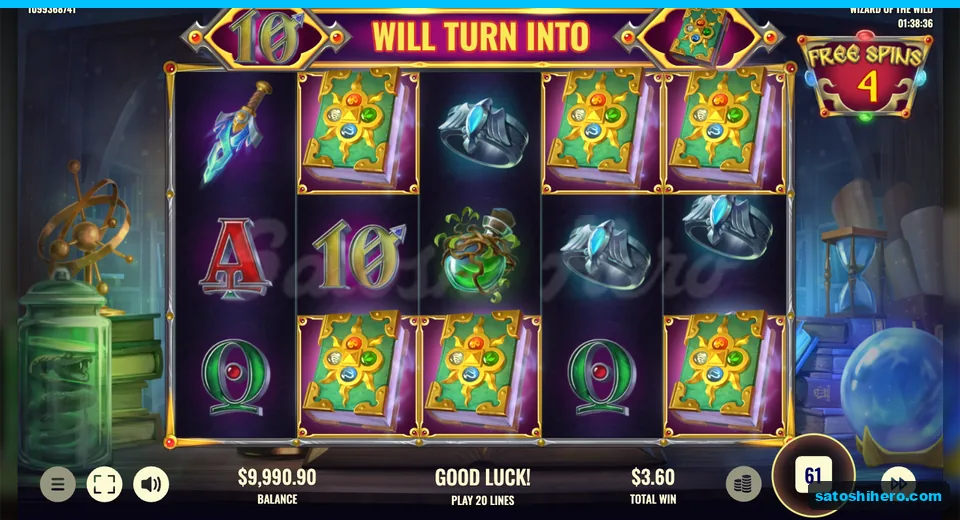
Building a wild-covered board feels satisfying because each new lock remains useful for every remaining spin. No sugarcoating, my final return stayed modest despite that visual buildup. You can enjoy the growing tension without assuming that several locked positions must create a large payout.
The closing card showed the $11.10 total before I collected it. That result can’t define the feature’s usual performance, and it can’t predict your next round. The locked-wild buildup remains the game’s main attraction, not a promise of a major win.
Maximum Win and Payout Context
Exactly 2,300x the bet is the maximum win, equal to $2,300 at my tested $1 stake. You shouldn’t treat that ceiling as a likely session target.
My best base-game spin paid $6.40, or 6.4x, while the free-spins round returned $11.10, or 11.1x. No tested result came remotely close to the cap. Five Ruby Amulets pay 7.5x before wild substitutions and multiple paylines combine, which helps explain the more modest regular outcomes I saw.
The SatoshiHero Slot Simulator projected a 100x-or-higher result approximately once per 13,889 modeled spins. That figure describes the model, not a probability published for Wizard of the Wild slot. It also doesn’t identify how often the maximum appears. You can use the projection to understand rarity, but not to count down toward a hit.
I find the 2,300x ceiling restrained beside slots built around extreme jackpot potential. Yet a simpler medium-risk structure can appeal when you value readable paylines and an active wild mechanic. Judge this game by its recurring spell transformations and locked-wild bonus, not the remote headline prize alone. Wild-focused alternatives on SatoshiHero include The Wild Machine and The Wild Gang, while The Hand of Midas and Return of the Dead offer different feature themes.
Buying the Feature
The red FEATURE BUY sign sells the free-spins trigger for 50 times your total bet. At my $1 stake, the complete purchase price was $50 and included the activating spin.
I didn’t buy the feature, so I can’t claim a tested return, hit pattern, or value advantage. My organic round paid $11.10, but that one result doesn’t forecast a purchased round. You buy access to the trigger, not a promised profit. In my view, that distinction matters more than the bright menu presentation.
Lower the base stake first when the full purchase exceeds your intended spend. The visible $1 spin cost can make the option look smaller than it is, although one purchase costs as much as 50 standard spins. You should budget around the complete menu price before opening it.

Watch Out: At a $1 stake, one $50 purchase equals 50 standard spins and half my entire test outlay. Set your stake around the full feature cost.
The buy option offers speed, not proof of better value. Since I skipped it, the organic trigger remains the only bonus evidence in this guide. That limit keeps the comparison honest and gives you a clear cost reference.
What 100 Spins Revealed
My 100-spin test finished $38.20 down after many small paying spins and one free-spins trigger. The run felt busy, but most returns failed to cover the $1 stake.
I started with a fresh $10,000 demo balance and kept every spin at $1. One 75-spin autoplay batch came first, followed by 25 more spins. I raised the single-win and loss limits so neither setting could stop the run. You can play the demo or real-play mode on SatoshiHero, using the same visible controls.
Hit pattern
Forty of my 100 spins returned something, and 36 of those 40 paid less than $3. The best base-game result was $6.40 on spin 91. One free-spins trigger added $11.10, making it the session’s largest completed round.
That observed 40% hit rate belongs only to this short test. It isn’t an official game frequency, and you shouldn’t expect the same split. The frequent responses made Wizard of the Wild gameplay feel active, though many wins still meant a net loss on that spin.
I liked seeing regular line activity because long dead stretches never defined the session. The downside was blunt: small returns softened losses rather than reversing them. A busy screen can feel encouraging even while your balance moves lower.
Bankroll movement
My balance fell from $10,000 to $9,990.90 before the bonus arrived. Collecting $11.10 then pushed it to $10,003.40, the high point reached on spin 15. From there, the bankroll declined through many small steps instead of one dramatic hit.
The final balance was $9,961.80, producing a $38.20 net loss. That equals 38.2 tested stakes across the full run. You could easily overlook the decline if you watched only the number of paying spins, because 40 returns created plenty of visible action.
I found the pace more engaging than the closing balance suggested. Yet the figures matter more than the animation: most hits came in below the stake or failed to build lasting recovery. You should track net movement, not just celebratory line flashes.
RTP, Volatility and Our Test
Wizard of the Wild slot uses a 95% theoretical RTP, medium volatility, a 2,300x ceiling, and 20 fixed paylines. Those figures frame the game, while my live run and the simulator show two different forms of evidence.
Medium volatility matched the practical texture I saw: frequent small hits, one bonus, and a controlled but meaningful 38.2-stake loss. You still face bankroll swings, even without the brutal droughts associated with harder variance. I think the low-value hit pattern matters more here than the label alone.
Simulator projection
The SatoshiHero Slot Simulator modeled 1,000 spins at a $1 stake. Its median session ended $56.50 down, while the 5th-percentile outcome finished $226.20 down. The 95th-percentile result reached $152.20 up, showing a broad range around that central path.
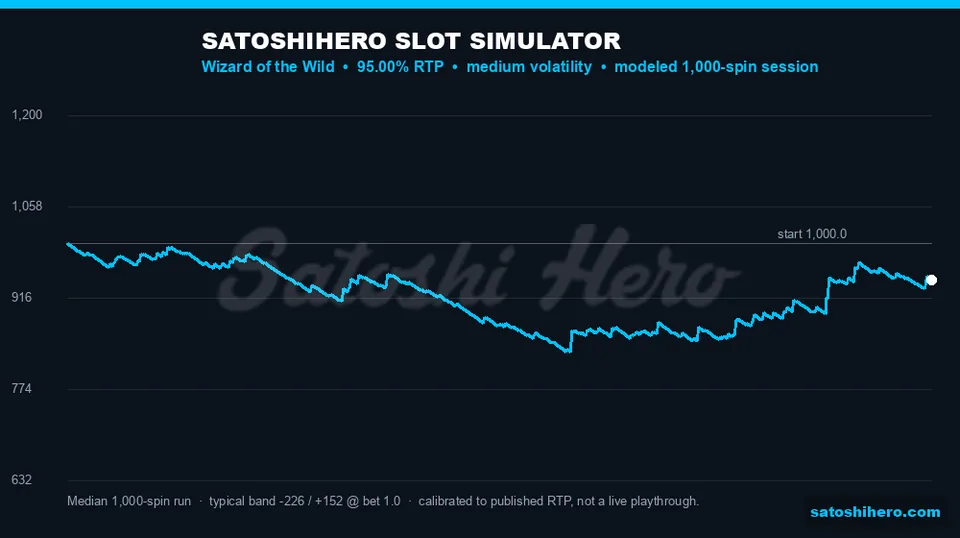
Approximately 25% of modeled spins paid, and the feature tier appeared about once per 51 spins. A 100x-or-higher result appeared approximately once per 13,889 modeled spins. You should read those rates as model outputs, not the slot’s hidden probabilities.
The model uses the published return, volatility band, and prize cap as general inputs. It illustrates possible swing shapes but doesn’t reproduce proprietary feature calculations. In my opinion, its most useful detail is the spread between downside and upside, not any single projected frequency.
Our 100-spin session
My live test lost $38.20 across 100 spins, compared with the model’s $56.50 median loss across 1,000 spins. Those sample sizes aren’t equivalent, so you can’t treat the smaller loss as better performance against the projection.
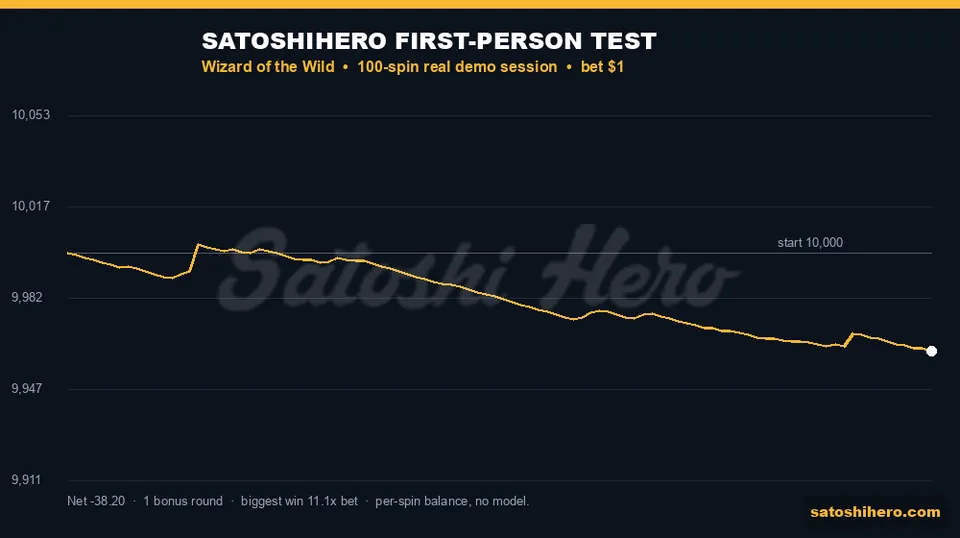
I saw one free-spins round worth $11.10 and a $6.40 best base-game spin. Short tests can finish far above or below the theoretical return because a few wins carry heavy influence. You should treat the recorded path as evidence of how one session felt, not a forecast.
The theoretical RTP is Platipus’s published return, and my single live session doesn’t alter it. Feature-specific returns can differ slightly from standard play by design. The simulator uses broad published inputs, doesn’t expose proprietary bonus math, and shouldn’t replace your own spending limits.
Frequently Asked Questions
How do free spins work in the Wizard of the Wild slot?
Wizard Scatters on reels 1, 3, and 5 award nine free spins. Every Spellbook Wild landing during the round stays locked through the last spin. I triggered the feature on spin 14, and it returned $11.10 at a $1 bet. You should treat that amount as one observed outcome.
What does the spell bar do in the Wizard of the Wild slot?
The spell bar selects one regular symbol before every paid spin. Landed copies transform into Spellbook Wilds before paylines are evaluated, while the Wizard Scatter can’t be selected. You can watch the chosen icon above the reels and then read the changed board.
Can you buy free spins in the Wizard of the Wild slot?
Yes, you can buy the feature for 50x the total bet. That equaled $50 at my tested $1 stake. I didn’t purchase it, so this guide makes no claim about its returns. You should judge the option by its complete upfront price.
What are the key figures for the Wizard of the Wild slot?
The game has 95% RTP, medium volatility, and a 2,300x maximum win. It evaluates left-to-right combinations across 20 fixed paylines. You need matching symbols to begin on reel 1, and only the highest win on each line pays.
How did the Wizard of the Wild slot simulator compare with live play?
The 1,000-spin model produced a $56.50 median loss. Its range ran from $226.20 down at the 5th percentile to $152.20 up at the 95th percentile. My 100-spin test lost $38.20, but you can’t make a direct like-for-like conclusion from different sample sizes.
What happened during the 100-spin Wizard of the Wild slot test?
I started at $10,000 and finished at $9,961.80 while staking $1 per spin. Forty spins paid, 36 returned less than $3, and my best base-game result was $6.40. One free-spins round paid $11.10, so you saw activity without a profitable finish.
How do you play Wizard of the Wild slot?
Choose a total bet, spin five reels, and form left-to-right combinations from reel 1 across 20 fixed paylines. The spell bar can turn selected symbols into wilds before wins count. Three Wizard Scatters on reels 1, 3, and 5 start nine free spins, giving you the main feature target.
Bottom Line
Wizard of the Wild stands out through visible symbol transformations and a bonus that keeps landed wilds locked. Its main drawback is a restrained prize ceiling beside a low theoretical return, so you get activity without huge tested rewards.

My Verdict
Play it for the changing spell bar and the satisfying locked-wild buildup, not for extreme jackpot hunting. Expect many small line connections, and keep your spending tied to net results rather than hit count.
I like how the base spell explains each transformation before the paylines count. Yet I don’t like that 36 of 40 paying spins returned less than $3, while my only bonus stopped at $11.10. The $38.20 closing loss captured that trade-off clearly.
Overall, the Wizard of the Wild slot remains a readable medium-risk choice, and this page is updated periodically.

Pros:
 Active base game: Every spin can transform a new regular symbol into wilds.
- Persistent bonus wilds: Landed Spellbook Wilds remain useful through all remaining free spins.
- Clear interface: Visible controls make stakes, spells, and feature costs easy to follow.
- Frequent test activity: Forty paying spins kept my short session moving.

Cons:
 Low theoretical return: The 95% figure leaves less value than stronger alternatives.
- Restrained ceiling: A 2,300x maximum won’t excite dedicated jackpot hunters.
- Small tested payouts: Most paying spins failed to build meaningful bankroll recovery.

Best For: Fans of classic paylines, visible wild transformations, and medium volatility get the clearest value here. You’ll appreciate the active pace if you can accept modest regular returns and a contained prize cap.































































Bets
All Bets
Game
Player
Date
Wager
Mult.Multiplier
Prize
 Mardi Gras Queen
 nina87
- 02:22:27
- 0×
- Wild Clusters
 Hidden
- 02:22:26
- 0.09×
- Mardi Gras Queen
- nina87
- 02:22:24
- 0×
- Mardi Gras Queen
- nina87
- 02:22:21
- 0×
- Piggy Tap
 Hidden
- 02:22:19
- 0×
- Piggy Tap
- Hidden
- 02:22:19
- 0×
- Piggy Tap
- Hidden
- 02:22:18
- 0×
- Piggy Tap
- Hidden
- 02:22:18
- 0×
- Aztec Magic Bonanza
 PeerLe
- 02:22:18
- 0×
- Piggy Tap
- Hidden
- 02:22:18
- 1×