

Toshi Ways Club
RTP94.37%
VolatilityHigh
Max winx10,000
Ways1,000,000
Hit rate28.52%
ThemeAsia
ReleasedDec 2025

CRT Static, Flash Frames and Tokyo Heat
Hacksaw Gaming drops Toshi Ways Club into a scratched manga video-club feed, then lets Flash Frames and Swap symbols decide the money. Toshi Ways Club is a high volatility slot from Hacksaw Gaming with 96.09% RTP and 10,000x max win potential.
Toshi Ways Club uses 6 reels, stacked symbol heights and up to 1,000,000 ways instead of paylines, with wins paying left to right from the leftmost reel. Aimed at bonus hunters who like volatile mechanics, it opened in my demo at $2.00 with a $5,000 balance.
Key takeaways
- Best bonus: The strongest tested outcome came from Retro Reboot on spin 32, paying $755.60, or 377.8x, at $2.00.
- RTP / volatility: The slot has 96.09% RTP, high volatility and clear dry spells between meaningful hits.
- Max win: The top prize is 10,000x the bet in every game mode.
- Risk note: Retro Reboot costs 100x and SUCKR Punch costs 200x, but both bought tests underpaid badly.
- Bankroll note: The simulator’s median 1,000-spin session finished $135.70 down at $2.00, so smaller stakes make sense when testing the demo.

Table of Contents
- How Toshi Ways Club Works
- Symbol pay table
- Frames and swaps
- Theme & First Impressions
- Visual style
- Symbol personality
- Retro Reboot Free Spins
- Trigger and spins
- Best organic hit
- SUCKR Punch Free Spins
- Slicing Swap role
- Cost and return
- Tokyo Data Drift
- Hidden trigger
- Guaranteed swaps
- FeatureSpins Options
- Bonushunt mode
- Toshi mode
- What The Bonus Buys Paid
- Retro buy result
- SUCKR buy result
- How The 500 Spins Played
- Biggest swing
- Base-game rhythm
- RTP, Volatility & Our Test
- Simulator projection
- Our 500-spin session
- Playing The Demo On SatoshiHero
- Demo testing
- Stake control
- Frequently Asked Questions About Toshi Ways Club
- Final Verdict
How Toshi Ways Club Works
Toshi Ways Club is a ways-paying slot, not a paylines game. You get 6 reels with stacked symbol heights, from 2 to 10 symbols per reel, and the HACKWAYS counter tracks up to 1,000,000 ways. Wins pay left to right from the leftmost reel, so you’re watching connected symbols rather than fixed lines.
The mechanic feels simple once you stop looking for paylines. You need matching symbols across consecutive reels, then the number of visible symbol positions decides how many ways connect. The game ran smoothly for me on mobile and desktop, and you can read the frames clearly on both screens.
Symbol pay table
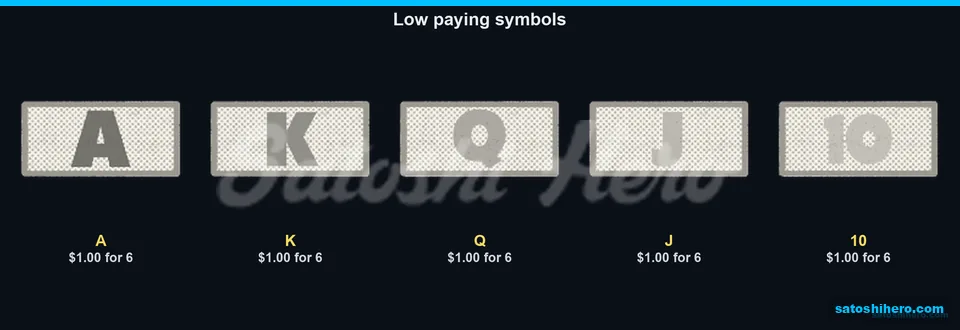
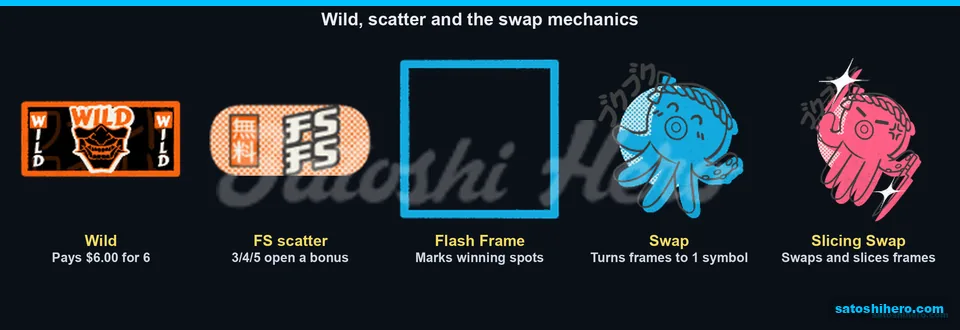
At my $2.00 stake, six mecha robots paid $6.00. Six dragons or oni masks paid $3.00, while lucky cats and fox masks paid $2.00 for six. The A, K, Q, J and 10 symbols paid $1.00 for six, which explains why many base-game chains felt small.
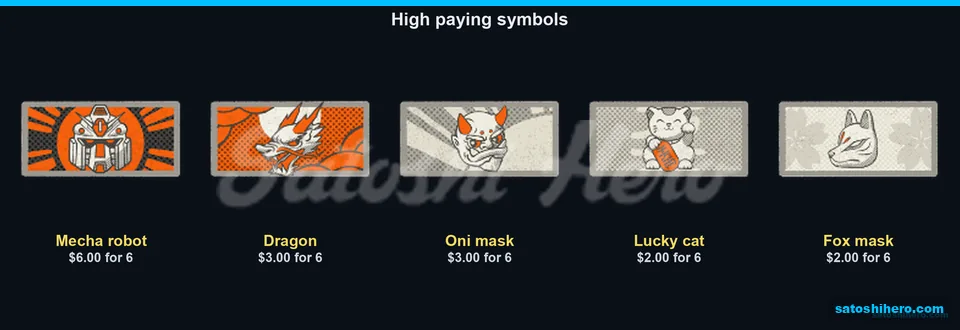
The orange oni-faced WILD tile substitutes for every paying symbol. It also pays $6.00 for six at the tested stake, so it matters more than the grey royals. The orange FS scatter starts bonus paths, but it can’t land with a Swap symbol or inside a Flash Frame.

Key Stat: This is a ways slot with up to 1,000,000 ways, not a fixed-payline slot.
Frames and swaps
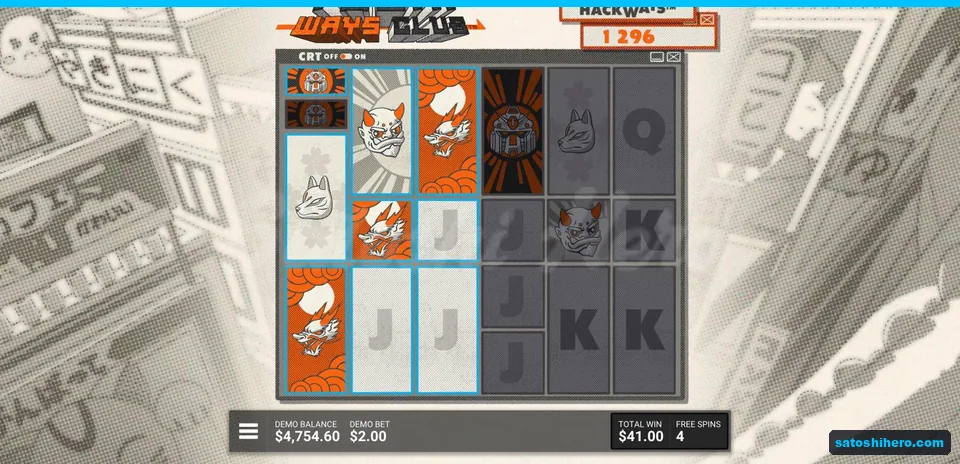
Every winning position gets a blue Flash Frame. Winning symbols then disappear, new symbols drop into those spots, and the chain repeats while new wins appear. I liked how visible the blue frames stayed, because you can instantly spot where a Swap symbol may matter.
The Swap scatter is a blue octopus. When it lands with existing Flash Frames, it reveals one paying symbol and turns every framed position, including itself, into that symbol. Only one Swap can appear at once, Swap-made wins don’t reveal new symbols, and all frames clear before the next spin.
Theme & First Impressions
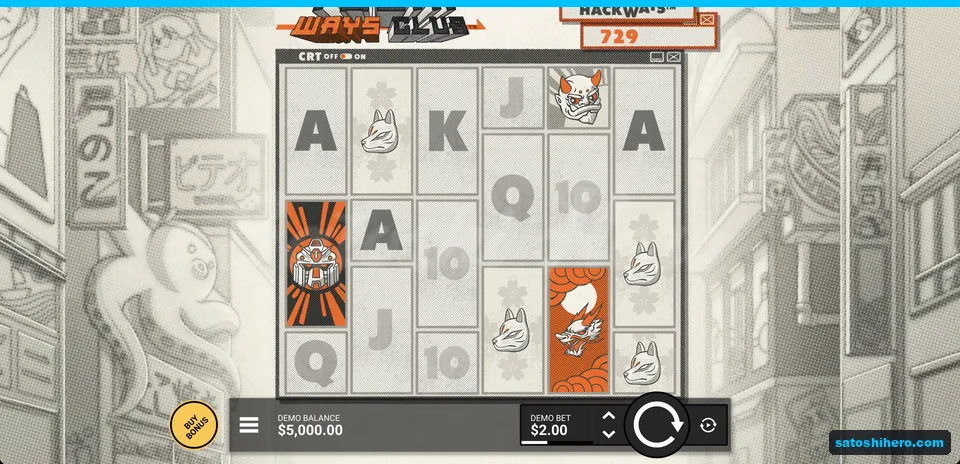
The strongest non-math feature is the worn manga video-club style. Toshi Ways Club Hacksaw presentation uses beige, black, white and ember orange, with CRT static and pop-up windows around the board. It has more bite than many dark-anime slots, though you may find the palette flat if you prefer glossy color.
Visual style
The setting feels like an underground Tokyo tape room, not a clean neon arcade. You see rough print textures, window overlays and a HACKWAYS counter above the reels. That dirty look helps the mechanics, because blue Flash Frames and orange feature symbols stand out fast.
Toshi Video Club makes a natural comparison if you like the same retro video-club mood. This game adds HACKWAYS, Flash Frames and Swap symbols, so the link is more about style than identical play. I prefer this one’s sharper mechanical identity, even if the base game can feel thin.

Insight: CRT-window styling echoes old video rental screens and late-night anime bootlegs, which fits the underground club theme neatly.
Symbol personality
The symbol set leans into Japanese pop charms without turning messy. You get a mecha robot helmet, dragon, oni mask, beckoning lucky cat and kitsune fox mask. Grey royals fill the lower pay spots, and they’re plain enough that you won’t confuse them with the feature tiles.
Numbers indicate the art serves the mechanic better than decoration alone. Orange marks the Wild, FS scatter and major feature cues, while blue tells you where framed value may build. That clarity matters when you’re tracking fast chains on a small screen.
Retro Reboot Free Spins
Retro Reboot is the three-scatter bonus, and it gave me the best result in testing. Three FS scatters award 10 free spins with base-game rules and a higher chance of Swap symbols. Two extra FS scatters add 2 spins, while three extra scatters add 4 spins.
Trigger and spins
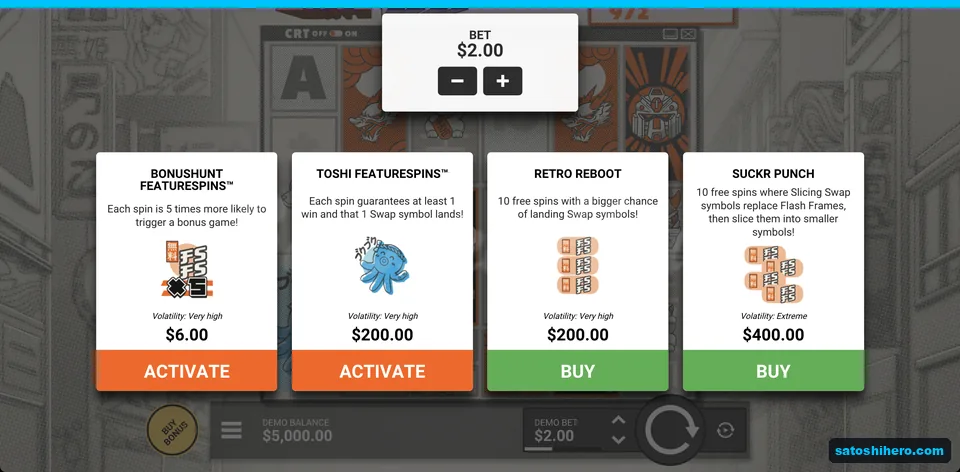
Retro Reboot can also be bought for 100x the bet. At my $2.00 stake, that meant a $200.00 cost and a 96.3% return. The math suggests the buy isn’t automatically better than waiting, because your paid entry still needs framed premium symbols and helpful Swaps.

Strategy Insight: Don’t judge Retro Reboot by the first few spins. Swap symbols matter most when several Flash Frames already sit on useful positions.
Best organic hit
My organic trigger landed on spin 32. The bonus climbed past $530 with three spins left, then closed at $755.60, or 377.8x the bet. That result looked dramatic because Swaps kept hitting after frames had already marked useful positions.
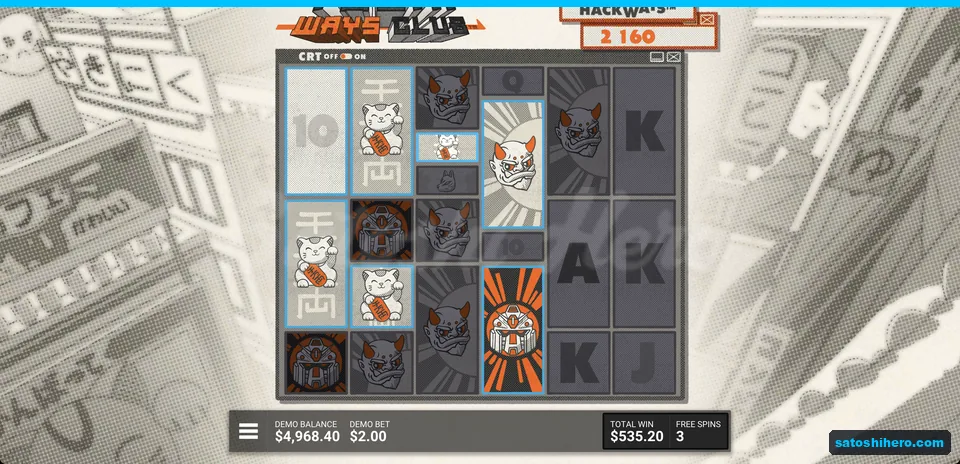
You shouldn’t treat that hit as normal. It shaped nearly the whole 500-spin profit, and later bonuses came in lower. Still, Retro Reboot felt more practical than the other bought paths because the best test result came without paying the $200.00 entry price.
SUCKR Punch Free Spins
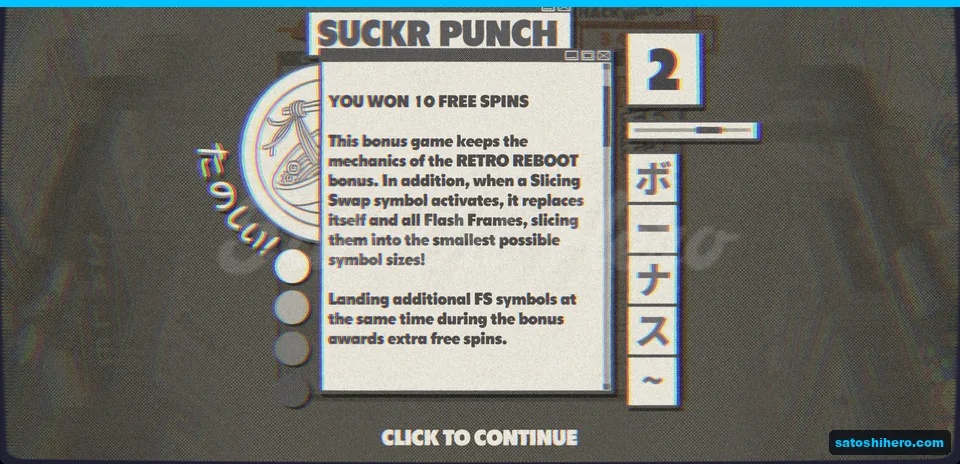
SUCKR Punch is the four-scatter bonus with Slicing Swap. It gives 10 free spins using Retro Reboot rules, then adds a pink octopus with a knife that can cut framed symbols into the smallest symbol size. That extra cut can increase ways, but it still needs the right symbols.
Slicing Swap role
The Slicing Swap changes every Flash Frame and itself into one paying symbol. Then it slices those positions into small tiles, which can multiply the number of ways across the reels. On paper, that sounds stronger than Retro Reboot, and the feature has more drama when frames stack.
In play, the bigger mechanic didn’t beat the simpler bonus. Warrior Ways fans may understand the appeal, because both games lean into high-swing ways action and stacked-symbol potential. My issue is that exciting transformations don’t mean much when the final connections stay weak.
Cost and return
SUCKR Punch costs 200x the bet as a bonus buy. At my $2.00 stake, that meant $400.00, with a 96.3% return. The bought test paid only $66.80, or 33.4x, which returned about a sixth of the price.
That result felt harsh because the Slicing Swap fired more than once. One spin paid $14.40 on 24 ways, but the symbols never lined up into a major hit. You get better theatre here than Retro Reboot, yet the risk felt sharper in my sample.
Tokyo Data Drift
Tokyo Data Drift is the hidden five-scatter bonus, and it’s the hardest feature to reach. It gives 10 free spins with SUCKR Punch rules, plus one Swap or Slicing Swap on every spin. That structure fits the 10,000x ceiling better than the regular base-game rhythm.
Guaranteed swaps
The guaranteed Swap or Slicing Swap gives every free spin a live mechanic. That doesn’t mean every spin pays strongly, because weak symbols can still land in the wrong places. I like the design, though, because it removes the dead-spin feel that can hit other bonus rounds.
This feature also explains why the max win stays believable. The base game alone rarely felt built for extreme hits, while Tokyo Data Drift has the repeated Swap pressure to chase them. It’s a smart hidden prize, not a mode you should build your session around.
FeatureSpins Options
FeatureSpins are enhanced spin modes, not bonus rounds. They stay switched on until you disable them, so you need to treat each click as a priced decision. Bonushunt looks more practical, while Toshi FeatureSpins felt too expensive for my normal testing rhythm.
Bonushunt mode
Bonushunt FeatureSpins cost $6.00 per spin at a $2.00 base stake. They make each spin five times more likely to trigger a bonus, with a 96.26% return. You pay triple the base stake, so the mode aims at feature hunting rather than casual spinning.
I didn’t buy Bonushunt during the first-person test. Still, the pricing looks easier to understand than the heavier mode. If you’re testing mechanics, you can see bonus frequency faster without jumping straight into a $200.00 spin cost.
Toshi mode
Toshi FeatureSpins cost $200.00 per spin at the tested $2.00 base stake. Each spin includes at least one win and one Swap symbol, with a 96.31% return. FS scatters can’t land in this mode, so you’re buying enhanced base action rather than bonus access.

Warning: Toshi FeatureSpins cost $200.00 per spin at the tested $2.00 stake, and scatters can’t land in that mode.
I don’t see this as normal spinning. It’s a high-cost experiment for watching Flash Frames and Swaps combine under pressure. You should reduce stake before touching it, because one casual click can equal a full Retro Reboot buy.
What The Bonus Buys Paid
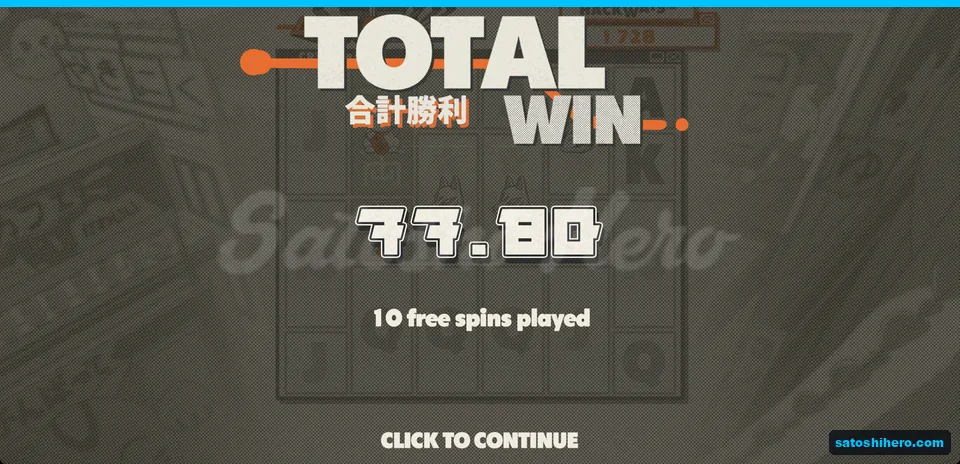
Both bought bonuses performed poorly in my small sample. Retro Reboot returned $77.80 from a $200.00 cost, while SUCKR Punch returned $66.80 from a $400.00 cost. The organic trigger did the heavy lifting, not the paid entries.
Retro buy result
On a fresh $5,000 balance, I opened BUY BONUS and pressed BUY on Retro Reboot at $200.00. I confirmed with OK, clicked through the green 10 free spins card, then watched several Swap symbols turn frames into lucky cats and fox masks. One Swap spin paid $26.00 on 19 ways.
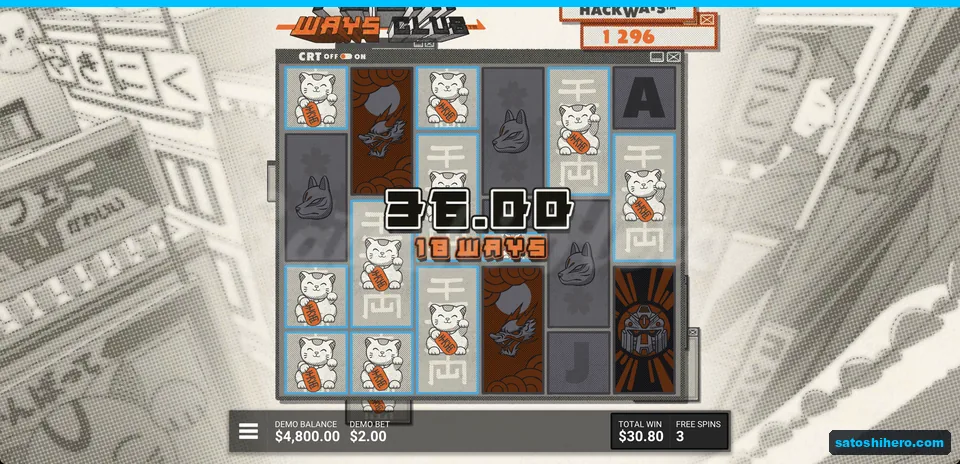
The round closed at $77.80, or 38.9x the bet. That returned a little over a third of the buy cost, which felt underwhelming after the strong organic feature. The mechanic looked alive, but the final number didn’t back up the animation.
SUCKR buy result
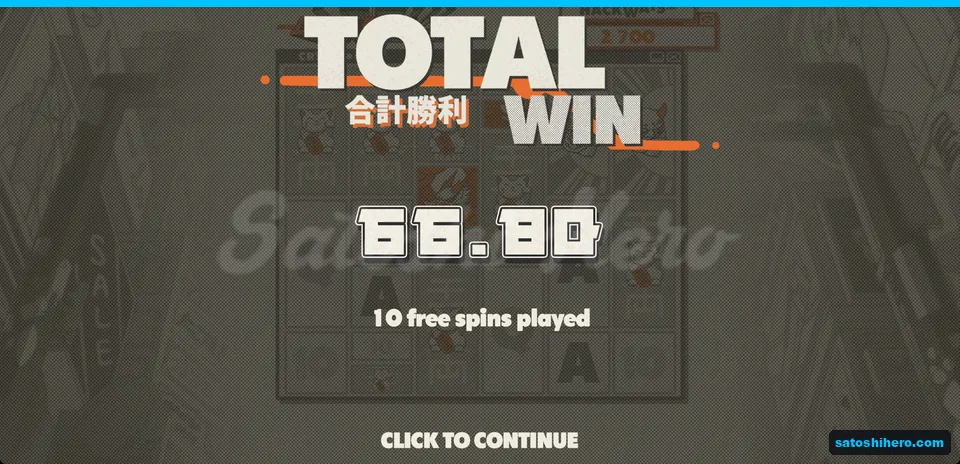
On another fresh balance, I bought SUCKR Punch for $400.00. Slicing Swap cut framed symbols into small tiles more than once, and one spin paid $14.40 on 24 ways. The bigger combinations never lined up, so the round finished at $66.80.
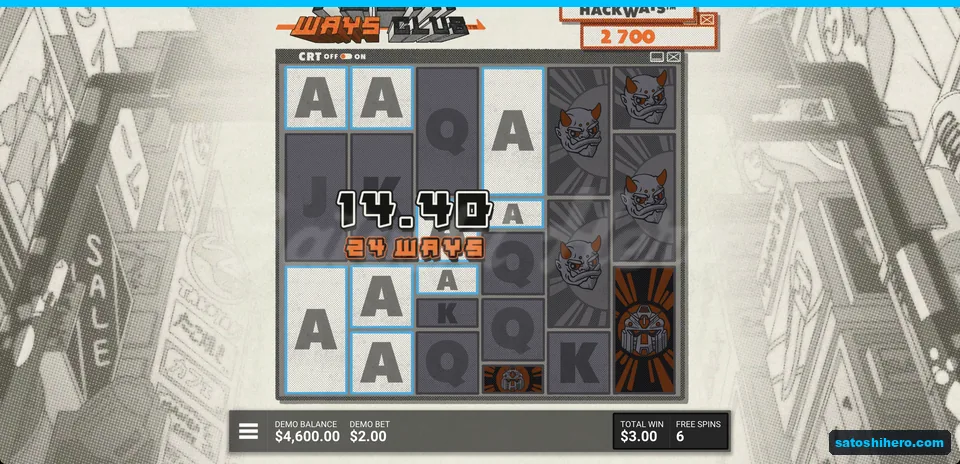
That was only 33.4x the bet and about a sixth of the price. I don’t mind a feature missing, because high volatility works that way. But this buy reminded me that stronger rules can still land weak when the symbol spread refuses to cooperate.
How The 500 Spins Played
The 500-spin test finished strongly, but one early bonus shaped almost everything. I started with $5,000 at $2.00 per spin and finished at $5,779.80, up $779.80. That landed above the simulator’s 95th percentile, so I’d call it a lucky session rather than a baseline.
Biggest swing
Spin 32 changed the whole test. Three FS scatters triggered Retro Reboot, and the round climbed past $530 with three spins left. It finished at $755.60, or 377.8x, which covered most of the profit on its own.
Four more bonuses landed in the 500 spins. I hit $51.20 around spin 122, then $203.40 at spin 158, $197.80 at spin 183 and $109.20 at spin 258. Those are useful wins, but none came close to the early breakout.
Base-game rhythm
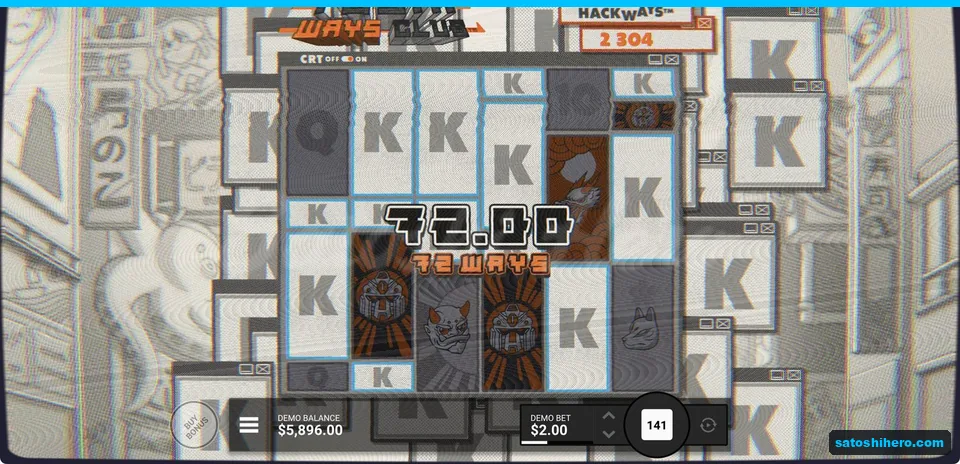
Between bonuses, the base game drifted down steadily. Flash Frame chains often paid under $3.00, which made the quieter stretches feel longer than the spin count suggests. My best base hit was $72.00 on 72 ways near spin 359, helped by framed kings and robots.
From spin 258 onward, no further bonus landed. The balance slid about $250 back before the finish, which exposed the colder side after the lucky start. Xpander comes to mind for the same broad reason: the base game needs a feature to wake up.
Two earlier demo attempts don’t count toward the test. One stopped at spin 86 because of a daily limit, and another ended at spin 184 after a session error. I kept them out because clean data matters more than a bigger-looking sample.
RTP, Volatility & Our Test
Toshi Ways Club has 96.09% RTP, high volatility and a 10,000x maximum win. That mix means one strong bonus can carry you, but long quiet spells and weak feature outcomes remain part of the deal. The max win feels fair for the risk level, though the path there looks rough.
Simulator projection
I ran our simulator at a $2.00 stake over 1,000 spins. The model used 96.09% RTP, high volatility and the 10,000x cap. Median results finished $135.70 down, while the middle 90% ranged from $640.50 down to $726.20 up.
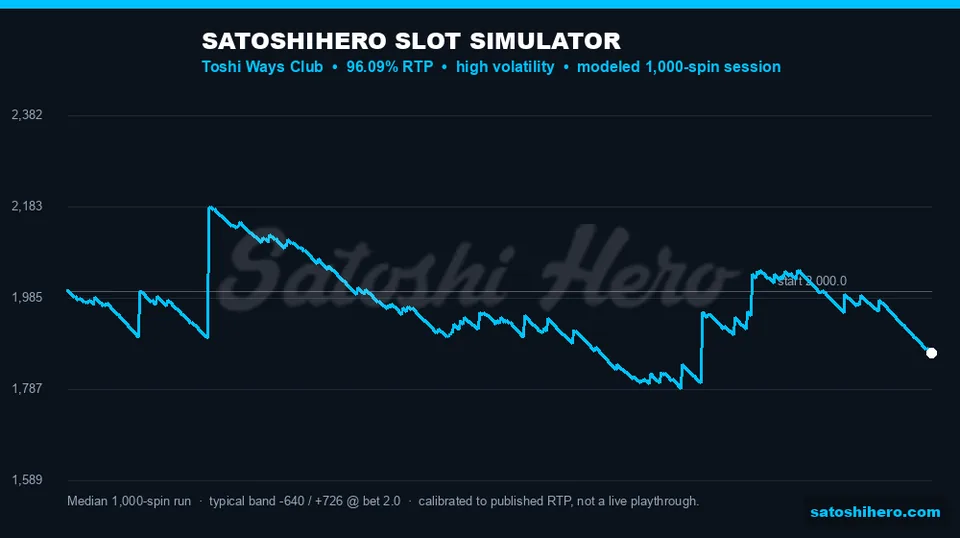
About 18% of spins returned something. A feature-sized hit appeared about once every 45 spins, while a 100x or higher win appeared roughly once every 1,754 spins. That spread tells you why a short session can feel cold even when the headline RTP looks healthy.
Warning: A profitable 500-spin result doesn’t make the game low-risk. The simulator still shows a median loss over 1,000 spins at the tested stake.
Our 500-spin session
My 500-spin run went from $5,000 to $5,779.80. That was a $779.80 profit, and it sat above the simulator’s 95th percentile. Five bonuses landed, but the first $755.60 Retro Reboot shaped the entire curve.
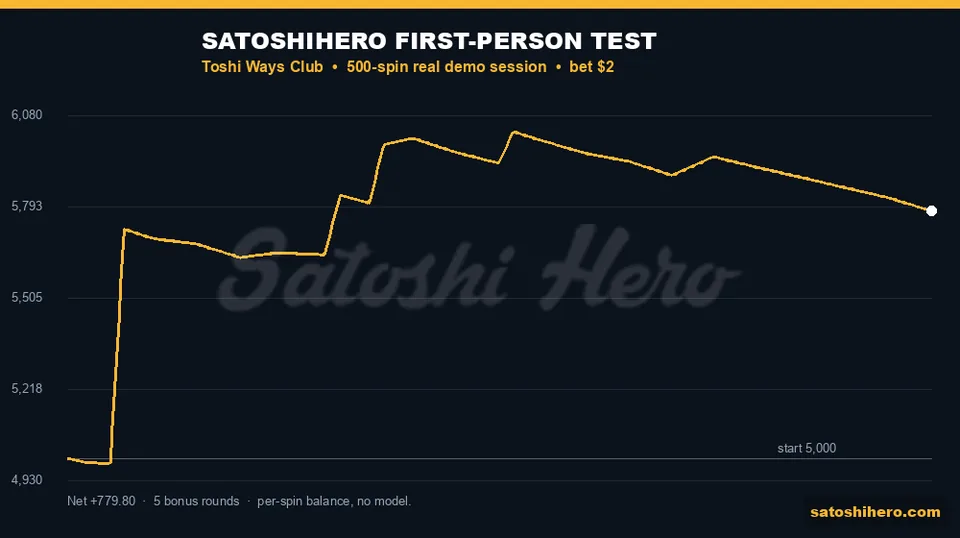
The base game gave money back between features. Most Flash Frame chains stayed small, and the best base hit reached $72.00. Ze Zeus may appeal to the same high-volatility crowd, but this slot’s risk comes more from waiting on framed Swap sequences than pure max-win chasing.
The 96.09% RTP is the operator-published theoretical figure, based on simulated rounds. One live or demo session doesn’t change that return, and bonus-buy or FeatureSpins RTPs differ slightly from base RTP by design.
Playing The Demo On SatoshiHero
The Toshi Ways Club demo is the cleanest way to test Flash Frame and Swap rhythm before you risk real money. You can use it on SatoshiHero to inspect mixed-height reels, frame chains, Swap timing and buy-panel pricing at your selected stake. I’d do that before touching the expensive modes.
Demo testing
Demo play helps you learn what the HACKWAYS counter actually means. You can watch large symbols reduce visible positions, then see smaller tiles open more ways. The lesson lands faster when you stop thinking about paylines and start reading symbol height.
You should also watch how often Swaps arrive too early. A Swap with only one or two weak frames rarely changes much. The best-looking moments came when frames already covered useful premium spots before the octopus landed.
Stake control
At $2.00, Retro Reboot cost $200.00 and SUCKR Punch cost $400.00. Those prices scale with stake, so a lower setup can make mechanic testing less stressful. Toshi FeatureSpins looked especially severe because one enhanced spin cost $200.00 at my test level.
I’d use the demo to test appetite, not to chase confidence. The mechanics can look exciting while the balance still falls between bonuses. If you like the rhythm after a few hundred spins, real play makes more sense with a stake that can survive dry patches.
Frequently Asked Questions About Toshi Ways Club
How do Flash Frames and Swap symbols work in Toshi Ways Club?
Every winning position gets a sticky Flash Frame, then new symbols replace the winners. If a Swap lands with frames in view, it turns every framed position and itself into one paying symbol.
What does the Slicing Swap do in Toshi Ways Club?
Slicing Swap appears in SUCKR Punch and Tokyo Data Drift. It changes every Flash Frame to one symbol, then slices those symbols into the smallest size to add ways.
How much do the Toshi Ways Club bonus buys cost at $2.00?
Retro Reboot costs $200.00 at a $2.00 stake, and SUCKR Punch costs $400.00. Tokyo Data Drift can’t be bought.
What did the 1000-spin simulator show for Toshi Ways Club?
At $2.00 with 96.09% return, the median 1,000-spin session ended $135.70 down. The middle 90% landed between $640.50 down and $726.20 up.
How did your 500-spin Toshi Ways Club session go?
I went from $5,000 to $5,779.80, up $779.80. Five bonuses landed, and the first one on spin 32 paid $755.60.
What happened when you bought the bonuses?
Retro Reboot cost $200.00 and paid $77.80. SUCKR Punch cost $400.00 and paid $66.80.
What is the Toshi Ways Club RTP and max win?
The RTP is 96.09% and the maximum win is 10,000x the bet in every game mode.
Is Toshi Ways Club a paylines slot?
No. It uses up to 1,000,000 ways, with wins paying left to right from the leftmost reel.
Can Tokyo Data Drift be bought?
No. Tokyo Data Drift is the hidden five-scatter bonus, and the buy menu doesn’t offer it.
Final Verdict
Toshi Ways Club stands out because its Flash Frames and Swap symbols create a distinct rhythm, not just another ways setup. The drawback is clear: the base game can feel thin until a bonus or useful Swap sequence arrives.

My Take
High-volatility bonus hunters get the sharpest experience here, especially if they enjoy unusual mechanics over constant small hits. Expect cold stretches, uneven features and the chance that one round decides the whole session. I’d test the demo first, then keep real stakes modest.
I like how the spin 32 Retro Reboot proved the mechanic can explode when frames and Swaps line up. I don’t like how both bought bonuses underpaid in my sample, because $77.80 from $200.00 and $66.80 from $400.00 felt rough. The game has personality, but it doesn’t hand out comfort.
Toshi Ways Club is checked regularly against game data, and the numbers still frame it as a high-risk feature chase.

Pros:
 Distinct mechanic: Flash Frames and Swaps give every win chain a clear purpose.
- Strong top prize: The 10,000x cap matches the high volatility profile.
- Readable design: Blue frames and orange feature symbols stay clear during fast play.
- Real bonus drama: My organic Retro Reboot paid $755.60 from a $2.00 stake.

Cons:
 Thin base play: Many Flash Frame chains paid under $3.00 in testing.
- Costly buys: The $400.00 SUCKR Punch buy returned only $66.80.
- High swing: Simulator results showed a median 1,000-spin loss at $2.00.

Best For: Patient bankroll managers and bonus-first slot fans get the most value from this game. You need comfort with high volatility, because the base game can drift and paid features can miss badly. The theme adds real flavor, but the math demands discipline.
Similar Games





























































Bets
All Bets
Game
Player
Date
Wager
Mult.Multiplier
Prize
 Royal Fruits 9: Hold 'n' Link
 Hidden
- 07:01:54
- 0×
- Wild Buffalo Megaways: Hold N Link
 lakidd1987
- 07:01:51
- 0×
- Wild Buffalo Megaways: Hold N Link
- lakidd1987
- 07:01:43
- 74.16×
- Rich Piggies: Bonus Combo
 josh1998
- 07:01:41
- 0×
- Royal Fruits 9: Hold 'n' Link
- Hidden
- 07:01:40
- 0×
- Bunny's Bounty: Hold`n`Link
- mdp0fxo
- 07:01:36
- 0×
- Rich Piggies: Bonus Combo
- josh1998
- 07:01:36
- 0.24×
- Leopatra: Bonus Combo
 Katzilla
- 07:01:35
- 0×
- Leopatra: Bonus Combo
- Katzilla
- 07:01:33
- 0×
- Wild Buffalo Megaways: Hold N Link
- nina87
- 07:01:32
- 0×