
Hacksaw Gaming
Dragon's Domain
Title:
Dragon's Domain
Payout:
96.31
Volatility:
medium-high
Max multiplier:
10000x
Release:
August 1, 2024
Game Provider:
Hacksaw Gaming
Bitcoin Slots
- Provably Fair
- Instant Crypto Payouts
- Thousands of Games

Written byElenaUpdated
Dragonfire teeth in Dragon’s Domain slot
I tested Dragon’s Domain slot at $2.00 a spin with a fresh $5,000.00 demo balance to see whether its Dragonfire mechanics and buy bonuses actually deliver.
Dragon’s Domain slot is a medium-high volatility Hacksaw Gaming slot with 96.31% RTP and 10,000x max win potential. It uses a 6-reel, 5-row pay-anywhere grid where 8 or more matching symbols anywhere can pay, then cascades may keep the spin moving. Bonus-buy fans get wild multipliers, Dragonfire clears and two very different feature formats.
Key takeaways
Hacksaw Gaming classifies it as Slots, with $0.10 to $100.00 demo betting and SatoshiHero offering demo and real play. The theme feels familiar, but Charred Land and Dragonfire give Dragon’s Domain slot real mechanical bite.
- Best bonus: Dragon’s Lair cost $200.00 at a $2.00 stake and paid $372.20, which was 186.1x my stake.
- RTP / volatility: The official RTP is 96.31% with medium-high volatility, so you should expect dry patches between stronger feature hits.
- Max win: The game caps at 10,000x, and the cap can land in the base game, Dragon’s Lair or The Hatchery.
- Core mechanic: Wins need 8 or more matching symbols anywhere, then cascades and Dragonfire can extend a spin.
- Bankroll note: My 500-spin $2.00 test lost $426.80, so you shouldn’t attack it with a thin balance.

Key Stat: The 10,000x max win can land in every game mode, not only the bought bonuses.

Table of Contents
- Dragon’s Domain slot theme & first impressions
- How Dragon’s Domain Works
- Pay-anywhere wins
- Symbols and values
- Charred Land Wild
- Charges and multipliers
- Stacked wild wins
- Dragon Symbols and Dragonfire
- Cross-pattern clears
- Gold Dragon boosts
- Dragon’s Lair
- Trigger and format
- My bought round
- The Hatchery
- Egg values
- My bought round
- Bonus buys and feature costs
- Buy menu prices
- Which buy felt better
- RTP, volatility and our test
- Simulator projection
- Our 500-spin session
- Frequently Asked Questions About Dragon’s Domain
- Final Verdict
Dragon’s Domain slot theme & first impressions
Dragon’s Domain slot starts as a familiar knight-versus-dragon fantasy game, but the board symbols matter more than the theme alone. You see a stone archway, a red dragon, an armoured knight and a hoard-style setup around the 6-reel, 5-row grid.
I played at $2.00 per spin from a fresh $5,000.00 demo balance. The base game view shows the full grid clearly, which helps because you need to track Dragon, Charred Land and egg symbols later. If you like big creature-led themes, Ze Zeus scratches a similar mythic itch, though this Hacksaw slot leans harder into feature symbols.
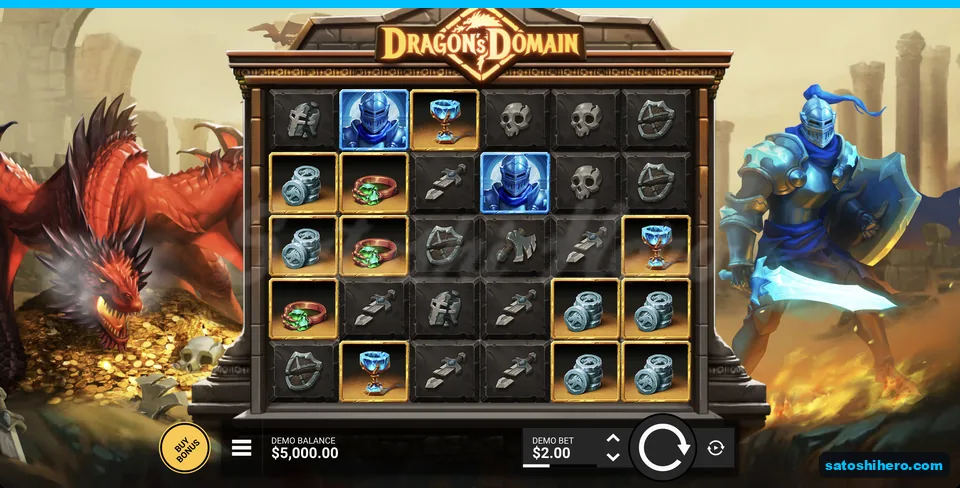
The art direction is solid rather than surprising. You won’t find a new fantasy universe here, but you can read the important pieces fast. That matters when the board starts cascading and Dragonfire cuts through the grid.

Insight: Classic dragon-hoard fantasy works because it gives every feature symbol a clear job. The knight, dragon and eggs aren’t just decoration here.
The theme won’t win originality awards, but Charred Land charges and Dragonfire give the game more bite than a basic dragon reskin. That practical clarity leads straight into the pay-anywhere mechanics.
How Dragon’s Domain Works
Dragon’s Domain uses pay-anywhere wins, not paylines, so 8 or more matching symbols anywhere on the grid can pay. Cascades continue until no new winning group appears.
Pay-anywhere wins
The layout uses 6 reels and 5 rows. Winning symbols disappear, new symbols drop into place and the spin keeps running while fresh wins land. You get movement on plenty of boards, but that activity doesn’t equal steady profit.
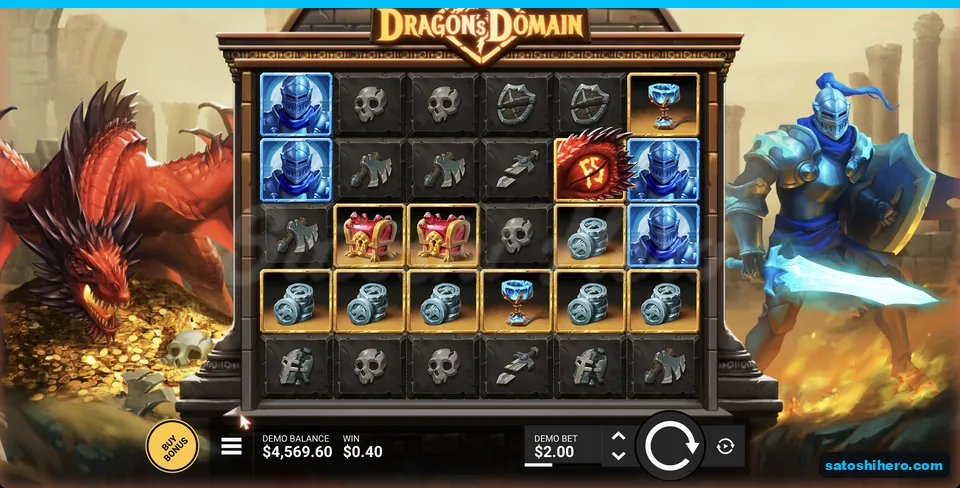
This pay-anywhere structure feels more alive than fixed-line slots because matches can form across the whole screen. Xpander may interest you if you prefer non-standard win structures over fixed paylines, though the two games don’t share the same engine. Checked regularly, the playable paytable keeps the 8-symbol trigger and cascade logic clear.
The game plays cleanly on mobile and desktop with the same 6-reel view and buy menu logic. I like that consistency because you don’t relearn the board when changing screen size.
Symbols and values
At my $2.00 stake, the top regular symbols paid neatly by rank. Twin Rings and the Emerald Ring paid $400.00 for 19 or more. The Sapphire Chalice and Purple Potion paid $600.00, while the Treasure Chest paid $800.00.
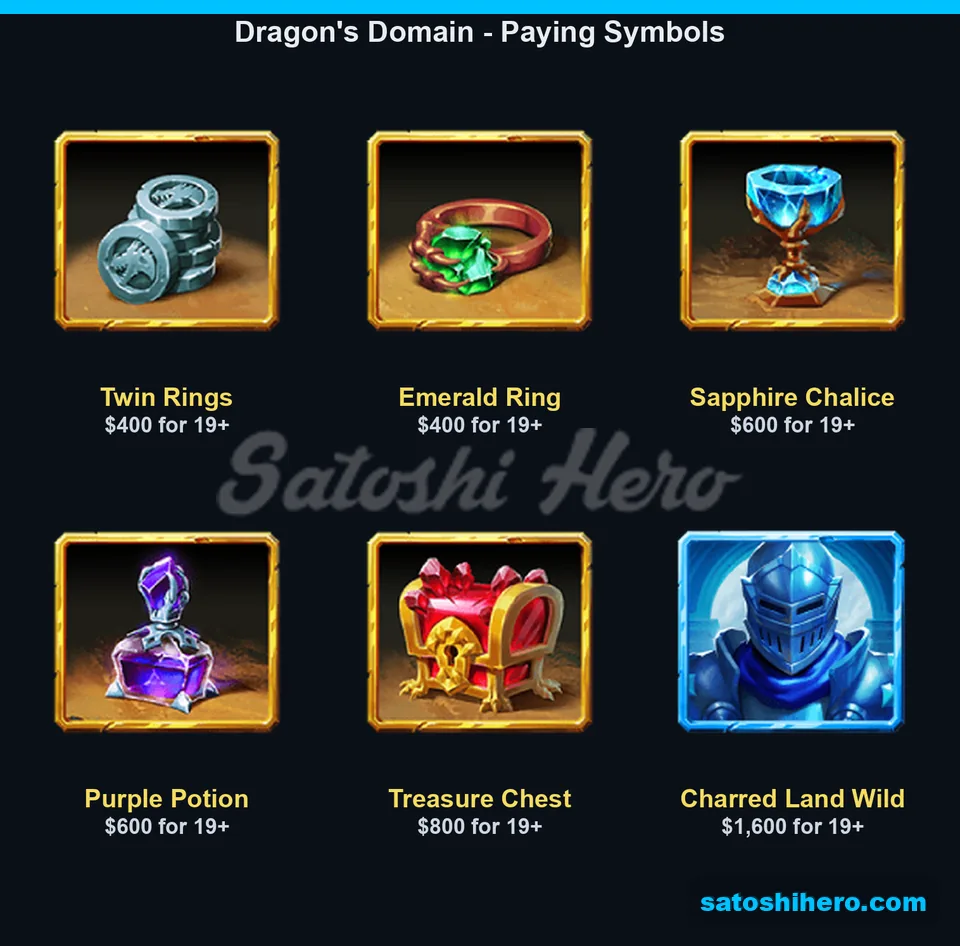
The five lows, skull, cross helm, round shield, sword and axe, all paid $100.00 for 19 or more. That flat low-symbol value makes small wins easy to read. The red-eyed FS scatter triggers the two bonus games and doesn’t pay on its own.
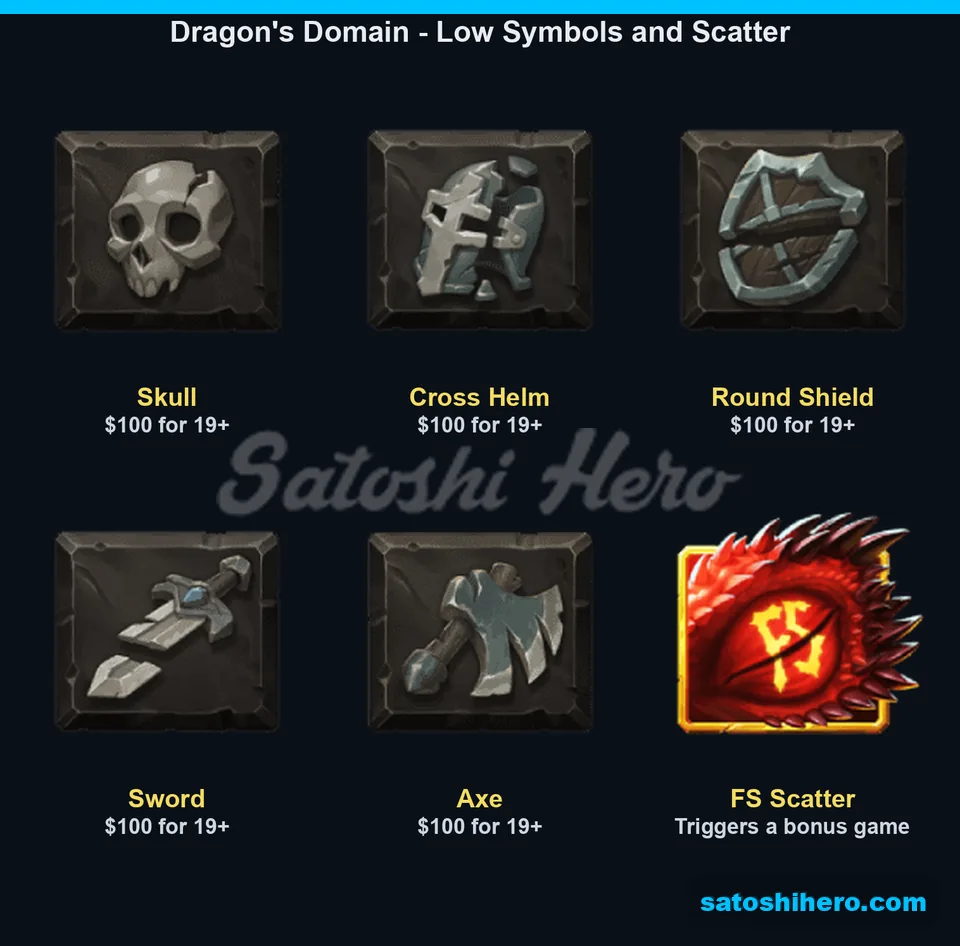
The base game can throw many small links at you. Bigger movement needs Charred Land wilds, multipliers and Dragonfire clears. You should treat the ordinary symbols as fuel, not the main show.
Charred Land Wild
Charred Land is the blue-armoured knight wild, and it drives most of the base game’s excitement. It substitutes for every paytable symbol and can carry multipliers through cascades while its charges last.
Charges and multipliers
At my $2.00 stake, Charred Land paid $1,600.00 for 19 or more on its own. Every Charred Land lands with 3 charges and starts with a 2x, 3x, 4x, 5x or 10x multiplier. If it joins a win, it loses one charge before the next cascade.
Every cascade adds +1 to the multiplier of every Charred Land still on the grid. That means a modest 2x wild can become more useful if it survives several drops. You need to watch the charge count as closely as the multiplier.

Strategy Insight: Watch the charges, not just the multiplier. A 10x Charred Land with one charge left can disappear faster than a smaller multiplier with more cascade potential.
Stacked wild wins
Two or more Charred Lands in the same win add their multipliers together. Numbers indicate why the base game feels tense after even a small opening hit. One wild can keep the spin alive, but stacked wilds can turn a plain cascade into something worth watching.
I don’t want to oversell it. Many Charred Land appearances still fade quickly, especially when the board doesn’t feed them matching symbols. The mechanic works because it gives you a reason to care after the first win drops.
My honest take: this wild is the base game’s main hook. Without it, the fantasy setup would feel much flatter.
Dragon Symbols and Dragonfire
Dragonfire activates after the grid settles, and it can turn a dead-looking board into another cascade. Any Dragon symbol breathes fire in a cross pattern from its position.
Cross-pattern clears
Dragonfire triggers once there are no more wins. The fire clears regular paying symbols it touches, then the cleared spaces trigger a fresh cascade. Red Dragon symbols mainly extend the sequence by cutting through clutter.
This matters because a board can look finished before the dragon acts. You may see no ordinary win left, then a cross clear opens a new drop. Limbo gives a much simpler multiplier chase, while this game builds its medium-high volatility around layered feature events.
A red Dragon won’t always create meaningful money. Sometimes it just clears low symbols and fizzles. Still, the pause before Dragonfire adds a nice second beat to each spin.
Gold Dragon boosts
Gold Dragon symbols carry a 2x, 3x, 4x, 5x or 10x multiplier. If Gold Dragonfire hits a Charred Land or Dragon Egg, it multiplies that symbol’s value by the Gold Dragon’s number. That boost matters most when it touches something with real value.
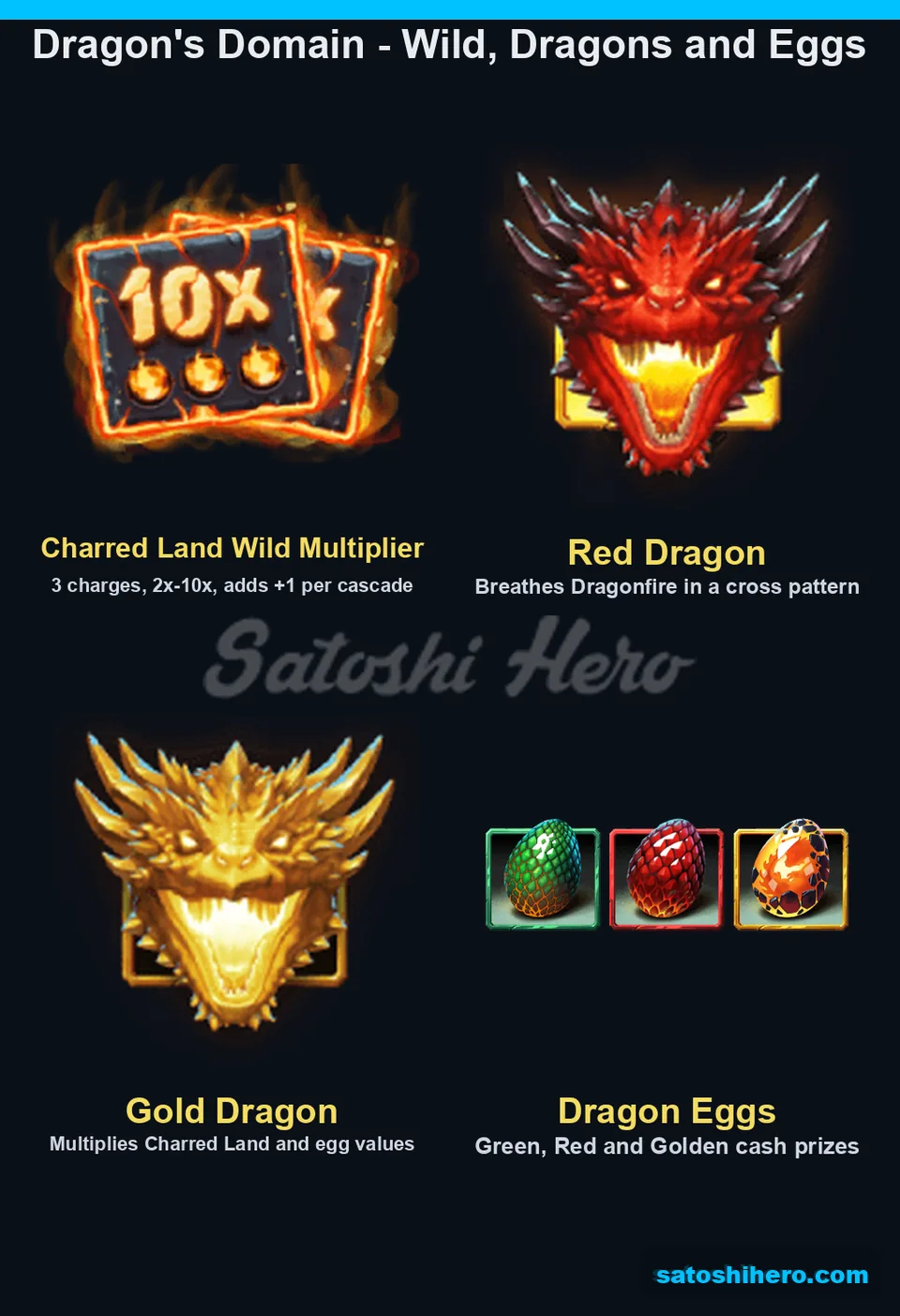
A Gold Dragon that only clears low-value clutter can look dramatic but pay little. You should watch where the cross pattern lands, not just whether gold appears. The mechanic explains why quiet boards can still produce movement after the last ordinary win.
Dragonfire doesn’t guarantee a strong result. It does make the feature symbols feel connected, which sets up the two bonus rounds well.
Dragon’s Lair
Dragon’s Lair is the 3-scatter free-spin feature, and it performed best in my bonus-buy test. It gives 10 free spins where Charred Land wilds can carry over while they still have charges.
Trigger and format
Landing 3 FS scatters at once opens Dragon’s Lair. The round starts with 10 free spins, and Charred Land wilds can stay in play between spins while charges remain. Their multipliers can keep climbing if cascades keep feeding them.
A 4th scatter during the round adds 4 extra spins. A 2nd scatter adds 2 extra spins. You should watch carried wilds, charge counts and retriggers before judging whether the round has real life.
The format can still land flat. My organic trigger during the 500-spin session paid only $3.20 over 10 free spins. That felt harsh, but it also matched the medium-high volatility profile.
My bought round
I bought Dragon’s Lair for $200.00 at a $2.00 stake. The trigger spin dropped 3 FS scatters, then the feature opened with the 10 free spins intro. Charred Land wilds carried charges and multipliers into later spins.
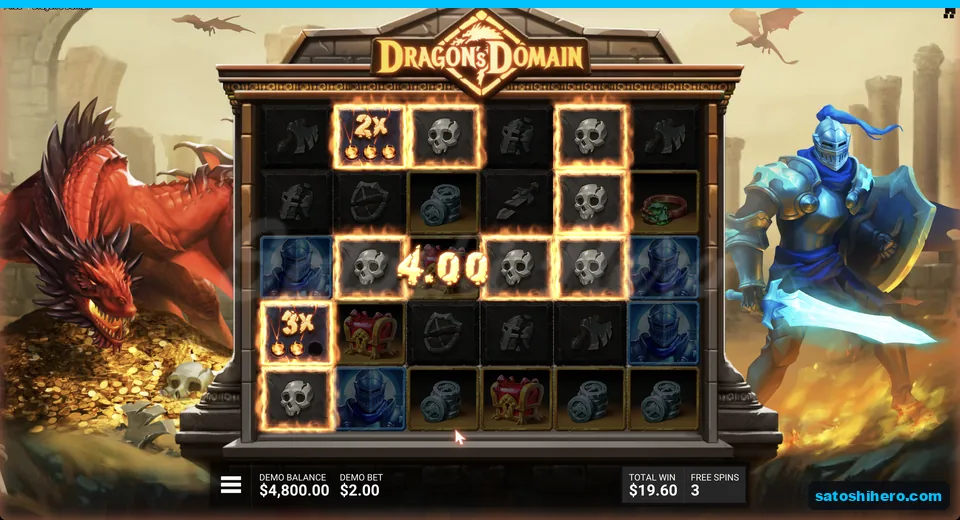
A retrigger added 4 extra spins, so the round played 14 spins total. My Charred Land multipliers built to 2x, 3x and 4x on separate wilds before the feature ended. The final result paid $372.20, or 186.1x my stake.
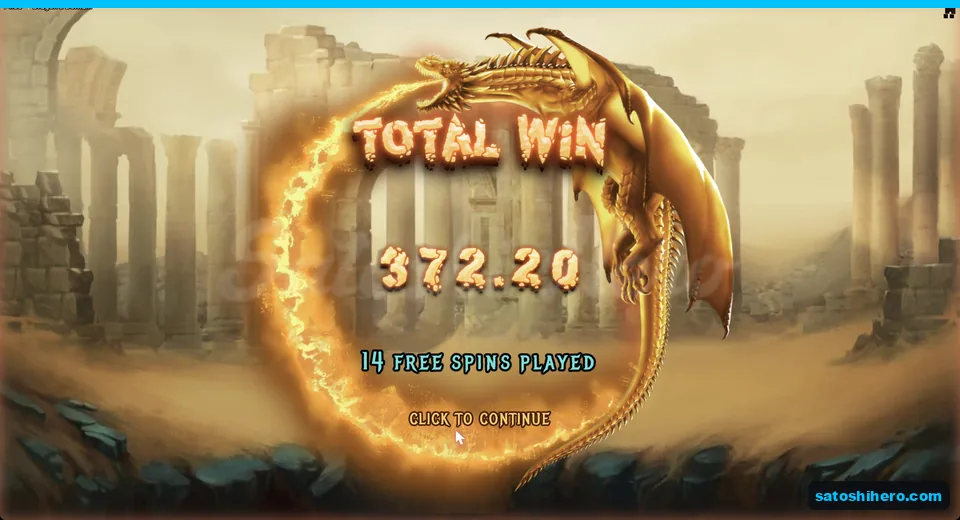
Insight: My bought Dragon’s Lair round lasted 14 spins because a retrigger added 4 extra spins.
This was the better tested buy because it actually used the wild-carryover idea. The organic trigger showed the downside, though. You can enter the same feature and barely get a spark.
The Hatchery
The Hatchery is the 4-scatter bonus, and it swaps normal paying symbols for Dragon Eggs and Dragon symbols. It looked more dramatic than Dragon’s Lair in my test, but it returned less than the buy cost.
Egg values
Landing 4 FS scatters opens The Hatchery for 10 spins. Only non-paying symbols, Dragon Eggs and Dragon symbols appear. The whole round depends on Dragonfire collecting egg values at the right time.
Green Eggs hold 1x, 2x, 5x or 10x my bet. Red Eggs hold 20x, 30x or 40x. Golden Eggs hold 50x, 100x or 200x, which makes them the symbols you really want Dragonfire to touch.
Dragon Eggs pay when Dragonfire’s cross pattern hits them. Gold Dragonfire multiplies an egg’s value by the Gold Dragon’s number before collection. The idea is simple, but the round needs meaningful eggs or strong gold boosts.
My bought round
I bought The Hatchery for $400.00 at a $2.00 stake. The trigger spin locked in 4 FS scatters, then the 10-spin round replaced every paying symbol with eggs and dragons. Red and Gold Dragons both appeared during the feature.
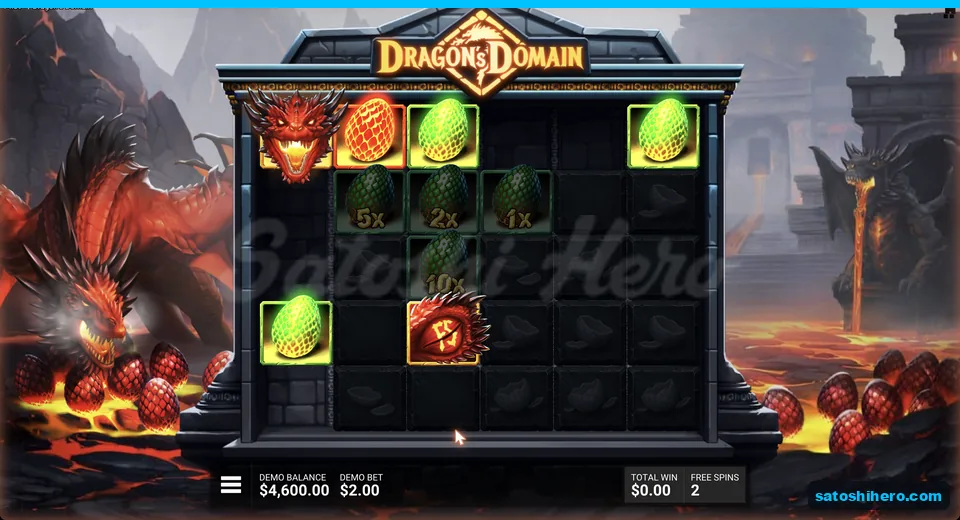
Several Green and Red Eggs were collected across the round. The final result was $288.00, or 144x my stake. That meant a $112.00 loss against the $400.00 buy cost.
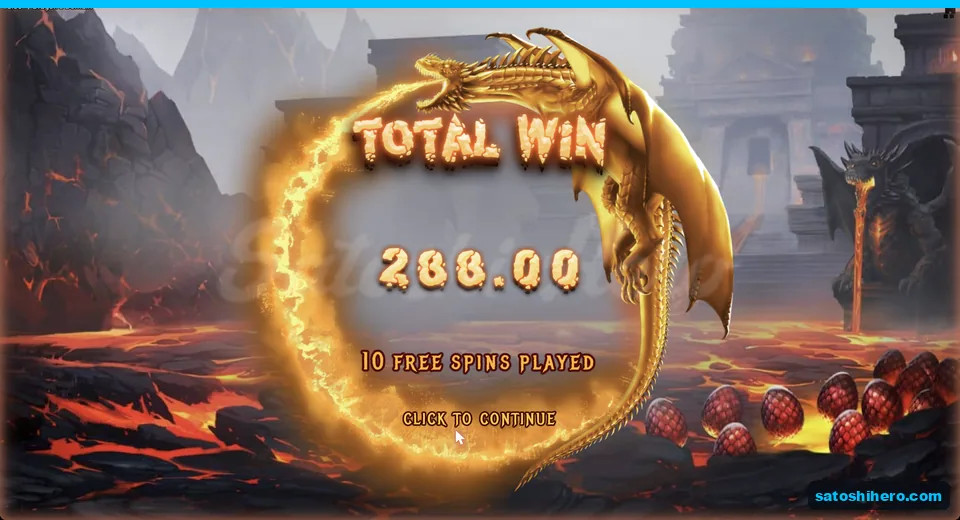

Warning: The $400.00 Hatchery buy at a $2.00 stake needs a meaningful egg hit or Gold Dragon multiplier to justify the cost. My test still lost $112.00 on the buy.
The Hatchery has bigger visual drama, and I liked watching eggs collect almost every spin. But it asks more from your balance because 200x buy cost leaves little room for a weak collection pattern.
Bonus buys and feature costs
The buy menu gives four feature options, but the RTPs sit close enough that cost and feature style matter more than a tiny RTP difference. At a $2.00 stake, the cheapest option cost $6.00 and the most expensive cost $400.00.
Buy menu prices
At my tested stake, Bonushunt FeatureSpins cost $6.00. Scorched Earth FeatureSpins cost $100.00. Dragon’s Lair cost $200.00, while The Hatchery cost $400.00.
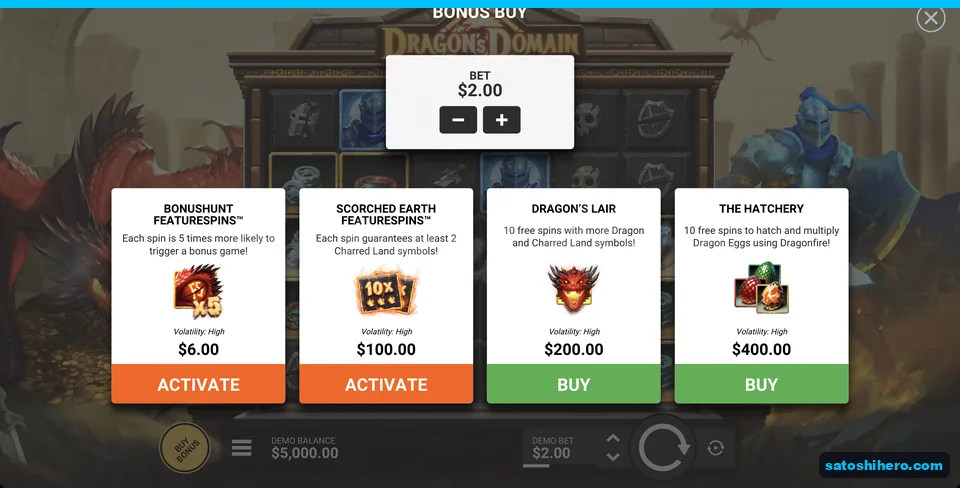
Those prices change the risk profile fast. A $6.00 feature-spin option lets you sample enhanced entry conditions without risking a huge chunk of balance. The $400.00 Hatchery buy is 200x the $2.00 stake, so it can chew through demo or real balance quickly.
Xmas Drop also attracts feature-buy fans who like faster bonus pacing. Here, the key choice feels sharper because the two premium buys play very differently.
Which buy felt better
The buy-feature RTPs cluster tightly around the base 96.31% RTP. Bonushunt FeatureSpins runs at 96.26%, Scorched Earth FeatureSpins at 96.25%, Dragon’s Lair at 96.36% and The Hatchery at 96.29%. The math suggests no buy has a huge RTP edge.
Choose by cost, volatility appetite and feature style. Dragon’s Lair felt like the more accessible direct bonus buy at this stake because it cost half as much as The Hatchery and paid above its cost in my test. The Hatchery depended heavily on Dragonfire collecting useful eggs.
I don’t mind the buy menu because the options feel distinct. Still, you should use demo play first if a $200.00 or $400.00 click feels uncomfortable.
RTP, volatility and our test
Dragon’s Domain has 96.31% RTP, medium-high volatility and a 10,000x max win, so it can grind before the better bonus outcomes arrive. My 500-spin test matched that shape: plenty of base-game movement, but a clear session loss.
Simulator projection
Our simulator modelled 1,000 spins at $2.00 per spin using 96.31% RTP and medium-high volatility. The median session net came out at -$87.00. The 5th-to-95th percentile band ran roughly from -$431.10 to +$336.20.
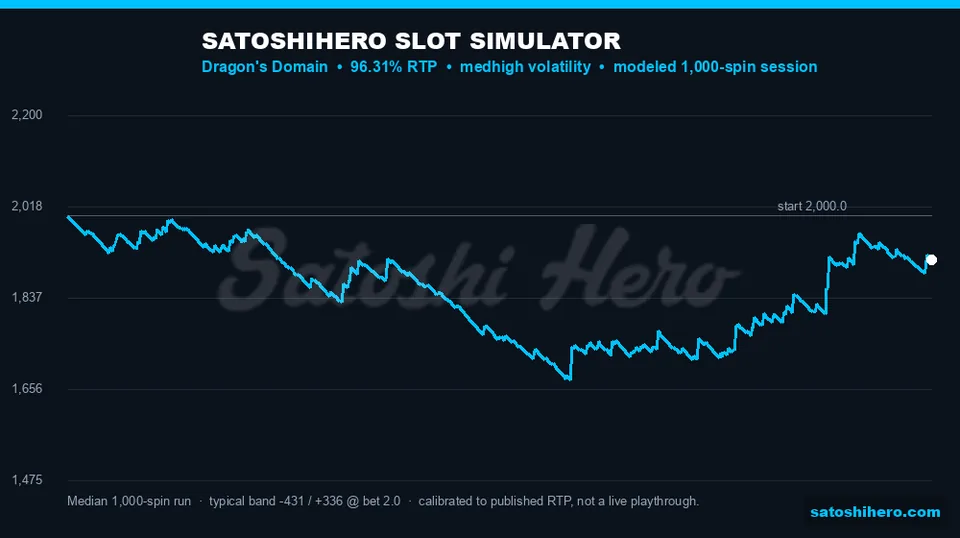
The model put a feature-tier hit around once every 50 spins. It also placed a big win around once every 13,333 spins. That spread tells you the game can look busy while still leaving many sessions behind.
The max win can land in every game mode, not just a premium buy. Numbers indicate the upside is real, but the route there asks for patience. The model describes outcome shape, not your next session.
Our 500-spin session
I played 500 spins at $2.00 per spin from a fresh $5,000.00 balance. I finished at $4,573.20, a net result of -$426.80. One organic Dragon’s Lair trigger paid only $3.20 over 10 free spins.
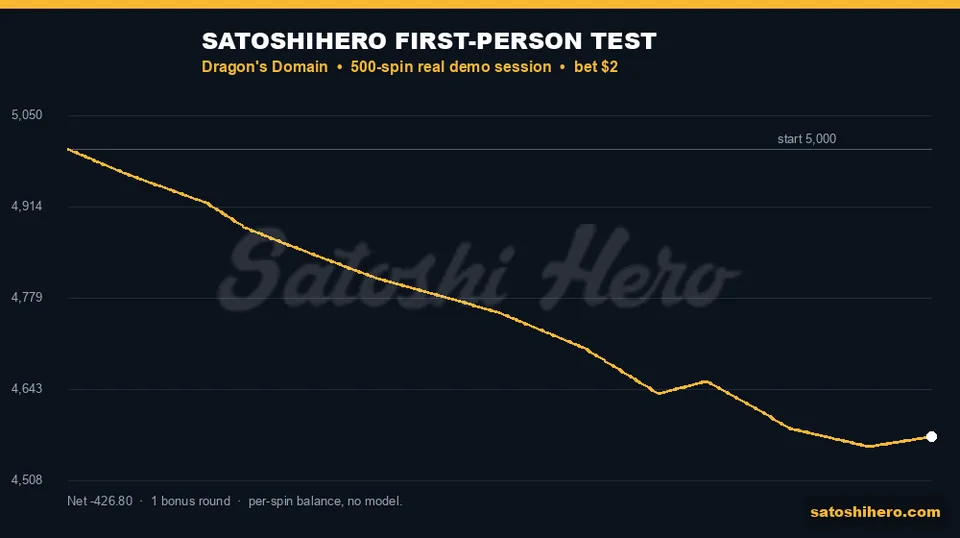
Most of the session felt like a base-game grind. Small Charred Land wins and occasional Dragonfire clears kept the screen moving, but the balance kept sliding. That is exactly the shape I’d expect from a medium-high volatility pay-anywhere game leaning on bonus rounds for bigger numbers.
Warning: My 500-spin test lost $426.80 at $2.00 a spin, so set a hard stop before chasing bonus rounds.
The 96.31% RTP is the operator-published theoretical figure. One live or demo session doesn’t change that return figure, and bonus-buy RTPs differ slightly from the base game by design. The simulator models possible session shape and doesn’t predict your next 500 or 1,000 spins.
Frequently Asked Questions About Dragon’s Domain
What is the RTP and volatility of Dragon’s Domain slot?
Dragon’s Domain slot runs at 96.31% RTP with medium-high volatility. Dragon’s Lair has 96.36% RTP when bought, while The Hatchery has 96.29%.
How do I trigger free spins in Dragon’s Domain slot?
You trigger free spins in Dragon’s Domain slot by landing FS scatters. Three FS scatters open Dragon’s Lair with 10 free spins and carried Charred Land multipliers, while 4 FS scatters open The Hatchery with 10 spins using Dragon Eggs and Dragon symbols.
What does the Charred Land wild do in Dragon’s Domain slot?
The Charred Land wild substitutes for paytable symbols, lands with 3 charges and starts with a 2x, 3x, 4x, 5x or 10x multiplier. It loses a charge when used in a win, gains +1 multiplier per cascade and can combine multipliers with other Charred Lands.
What is the maximum win in Dragon’s Domain slot?
The maximum win in Dragon’s Domain slot is 10,000x. Hacksaw Gaming states that this cap can land in the base game, Dragon’s Lair or The Hatchery.
How much does it cost to buy the bonus rounds in Dragon’s Domain?
At the tested $2.00 stake, Bonushunt FeatureSpins cost $6.00, Scorched Earth FeatureSpins cost $100.00, Dragon’s Lair cost $200.00 and The Hatchery cost $400.00. The higher-cost buys need a thicker balance because one weak round can hit hard.
What did I actually win testing Dragon’s Domain?
My 500-spin session finished at $4,573.20 from a $5,000.00 start, which meant a net loss of $426.80. The bought Dragon’s Lair paid $372.20, and the bought Hatchery paid $288.00.
Does Dragon’s Domain slot have paylines?
No, Dragon’s Domain slot doesn’t have paylines. It uses pay-anywhere wins, so 8 or more matching symbols anywhere on the 6-reel, 5-row grid can pay.
Is The Hatchery better than Dragon’s Lair?
In this test, Dragon’s Lair performed better because the $200.00 buy paid $372.20. The Hatchery cost $400.00 and paid $288.00, though its egg-collection mechanic still has higher-cost potential.
Final Verdict
Dragon’s Domain has real bite because its wild charges, Dragonfire clears and two bonus styles all connect to the same core idea. The main drawback is cost pressure, especially when The Hatchery asks for $400.00 at a $2.00 stake.

My Take
Feature hunters with patient bankroll habits should enjoy the moving parts here. You should expect long grind patches, then judge the game by whether Charred Land and Dragonfire actually connect. I wouldn’t treat the premium buys casually.
I like the way Dragon’s Lair carried wilds across spins in my bought round. I don’t like how quickly the base game can drain a balance when the organic bonus lands flat. My 500-spin loss and Hatchery underperformance kept the verdict grounded.
Dragon’s Domain slot is checked regularly for paytable, feature and buy-menu accuracy. The best reason to play is the layered mechanics, not the familiar dragon skin.

Pros:
 Readable grid: The 6-reel layout makes Dragonfire and wild positions easy to track.
- Strong wild hook: Charred Land charges add tension after small opening wins.
- Distinct bonuses: Dragon’s Lair and The Hatchery play differently enough to matter.
- Clear math: The 96.31% RTP and buy RTPs make comparison simple.

Cons:
 Costly Hatchery: The $400.00 buy can miss value without strong egg collections.
- Flat organic rounds: My natural Dragon’s Lair trigger paid only $3.20.
- Familiar theme: The dragon setup feels solid, but not especially fresh.

Best For: Bonus-buy fans and patient feature chasers get the most value from this Hacksaw slot. You need comfort with medium-high volatility, pay-anywhere cascades and sessions where the board moves without paying enough. If you prefer smooth balance curves, this one may feel too sharp.
















































Bets
All Bets
Game
Player
Date
Wager
Mult.Multiplier
Prize
 Fruit Cash: Hold 'N' Link NG
 Hidden
- 00:16:34
- 1.39×
- Gold Train
 cristianarroyo843
- 00:16:32
- 0×
- Aztec Gems
 Kiss_My_Ace
- 00:16:32
- 0×
- Mr. Crystalman: Hold 'N' Link
 mdp0fxo
- 00:16:30
- 0×
- Gold Train
- cristianarroyo843
- 00:16:29
- 0×
- Aztec Gems
- Kiss_My_Ace
- 00:16:29
- 0×
- Galaxy Glitter
- josh1998
- 00:16:29
- 0×
- Fruit Cash: Hold 'N' Link NG
- Hidden
- 00:16:28
- 0×
- Gold Train
- cristianarroyo843
- 00:16:27
- 1.33×
- Fortune Skulls: Bonus Buy
- Hidden
- 00:16:26
- 0×