

Tree of Light: Fabled Fruits
By pressing play, you agree that you are above legal age in your jurisdiction and that your jurisdiction allows online gambling.

Tree of Light: Fabled Fruits
RTP96.2%
VolatilityMedium–high
Max winx1,650
Lines25
Hit rate27.93%
ThemeFantasy
ReleasedFeb 2025

Chasing Glowing Fruit Beneath the Fabled Tree
Tree of Light: Fabled Fruits takes you beneath a glowing tree for fixed-payline spins and fruit-filled Hold & Win respins.
Evoplay’s Tree of Light: Fabled Fruits is a medium-high volatility fantasy slot using a 5×3 grid, 25 fixed paylines, 96.2% RTP, and 1,650x maximum win potential. Hold & Win drives the swings, while Bonus Chance and a 64x Bonus Buy offer optional routes. Fixed-line fans who favor lock-and-respin play and a restrained ceiling can try demo or real mode here on SatoshiHero.
Key Takeaways
- Best bonus: My natural Hold & Win paid 34x and caused the only major balance lift; I didn’t test the 64x buy.
- RTP / volatility: The math profile combines 96.2% RTP with medium-high volatility.
- Max win: The official maximum reaches 1,650x the bet.
- Risk note: Base-game returns stayed small, and my balance fell again after the feature payout.
- Bankroll note: My 100 spins at $10.00 ended $276.00 down despite briefly moving above the starting balance.

Table of Contents
- Theme and First Impressions
- How Tree of Light: Fabled Fruits Works
- High-Paying Creatures
- Runes and Wilds
- Fabled Fruit Values
- Bonus Chance
- Bonus Buy
- Hold & Win
- Test Setup and Controls
- RTP, Volatility and Our Test
- Simulator Projection
- Our 100-Spin Session
- FAQ
- Closing Thoughts
Theme and First Impressions
A moonlit fantasy forest surrounds the reels, with a glowing tree above a vine-wrapped stone frame. Misty blue mountains stretch behind the 5×3 grid, while blue-green lighting pulls the scene together. You’ll spot the feature because five bright jackpot panels sit directly above the reels. I think that clear focus helps more than extra decorative animation would.
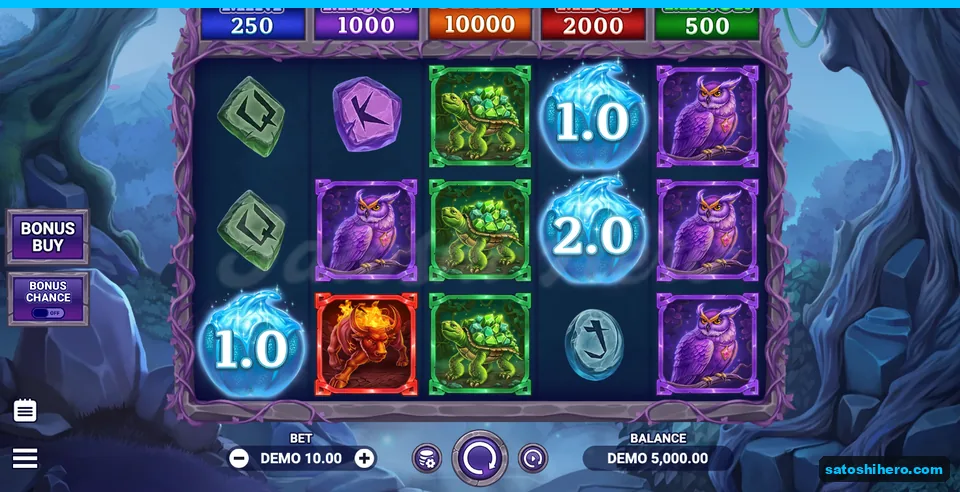
Four creatures occupy the high-paying positions: a fire bull, an owl, a crystal-shelled turtle, and a frog. Carved rune stones handle the lower ranks, while a small wizard-cloaked mouse serves as the Wild. Glowing fruit orbs stand apart from both groups and immediately direct your eye toward Hold & Win. You won’t mistake them for ordinary line symbols, which keeps the board easy to read.
The enchanted-forest theme isn’t unusual, but the creature art and heavy stone frame give it a recognizable identity. Tree Of Light shares that luminous-tree presentation, making it a useful visual comparison without implying that both games use identical mechanics. If bright produce matters more to you than woodland atmosphere, Fruits Land takes the fruit imagery in a more colorful direction. These alternatives clarify what this game does well: it makes the bonus objects look important from the start.

Fast Fact: Evoplay developed the game, and the glowing fruit panels keep its central bonus visible throughout base play.
That emphasis keeps the bonus easy to identify during ordinary spins. By the first few rounds, the visuals have explained the game’s priorities to you.
How Tree of Light: Fabled Fruits Works
This traditional slot uses five reels, three rows, and 25 fixed paylines. Winning combinations start on reel one, continue left to right across adjacent reels, and pay only the highest result on each line. You don’t need to count clusters here. I found the familiar structure quick to follow, though it feels conventional.
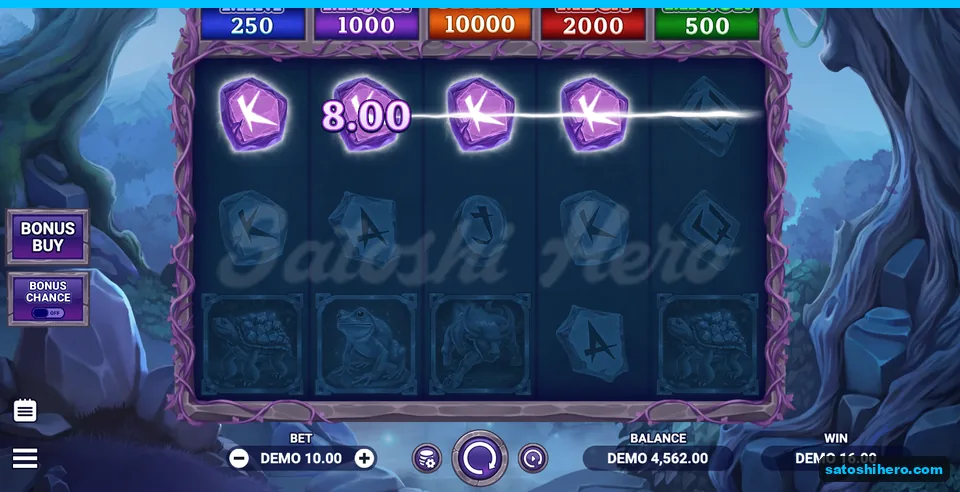
Every paytable figure represents a multiple of your total bet, not a fixed dollar award. During my extra screenshot spins, four Kings showed an $8.00 line award at a $10.00 bet, matching the listed 0.8x multiplier. The whole spin returned $16.00 because another line also paid. You can open the game through SatoshiHero, then compare each displayed award with your chosen total stake.
High-Paying Creatures
The fire bull leads the normal symbols, followed by the owl, turtle, and frog. Their prizes scale with three, four, or five matching symbols on adjacent reels:
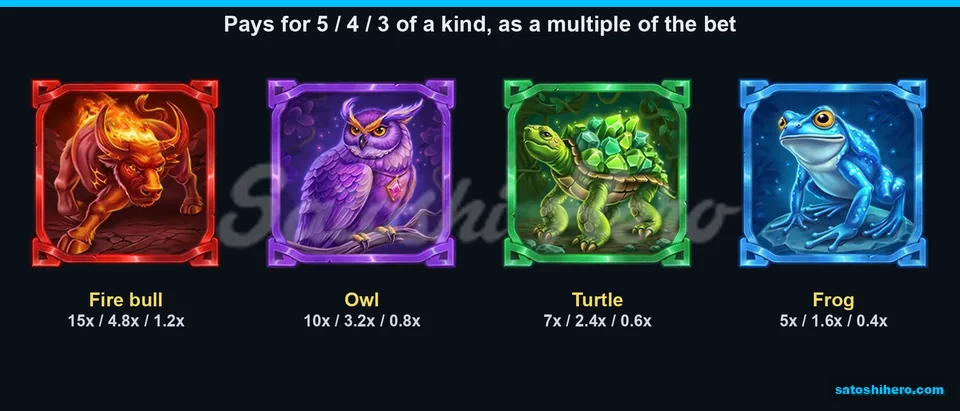
- Fire bull: 15x for five, 4.8x for four, and 1.2x for three.
- Owl: 10x for five, 3.2x for four, and 0.8x for three.
- Turtle: 7x for five, 2.4x for four, and 0.6x for three.
- Frog: 5x for five, 1.6x for four, and 0.4x for three.
You should treat these creatures as base-game support rather than the main prize engine. My largest regular win reached $48.00, or 4.8x the stake. That gap made the feature feel more important than any standard symbol.
Runes and Wilds
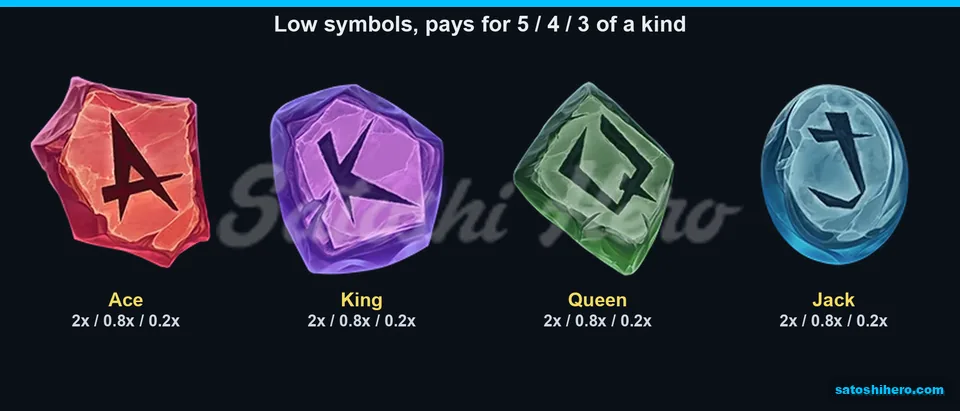
Ace, King, Queen, and Jack rune stones each pay 2x, 0.8x, or 0.2x for five, four, or three. The Wild mouse can appear on any reel during base play and substitutes for everything except Fabled Fruits. Five Wilds on one payline pay 15x, matching the fire bull’s top line value. I didn’t notice the mouse complete a line during my formal sample, so you shouldn’t read more into its practical impact.
Fabled Fruits carry no ordinary line value. They trigger or contribute prizes inside Hold & Win, keeping line wins and bonus awards separate. You can read connected symbols for immediate wins while scattered fruits build feature potential.

Tip: Compare every displayed win with your total bet. The paytable shows multipliers, not fixed dollar prizes.
Fabled Fruit Values
Plain fruits carry variable cash prizes, while four named fruits award fixed jackpot values. A regular Fabled Fruit may show 1x, 2x, 3x, 5x, 7x, or 10x the bet. You collect those values only through Hold & Win, not through paylines. I like the distinction because you can understand a locked fruit’s value at a glance.
The named fruits use fixed multipliers:
- Mini: 25x the bet.
- Minor: 50x the bet.
- Major: 100x the bet.
- Mega: 200x the bet.
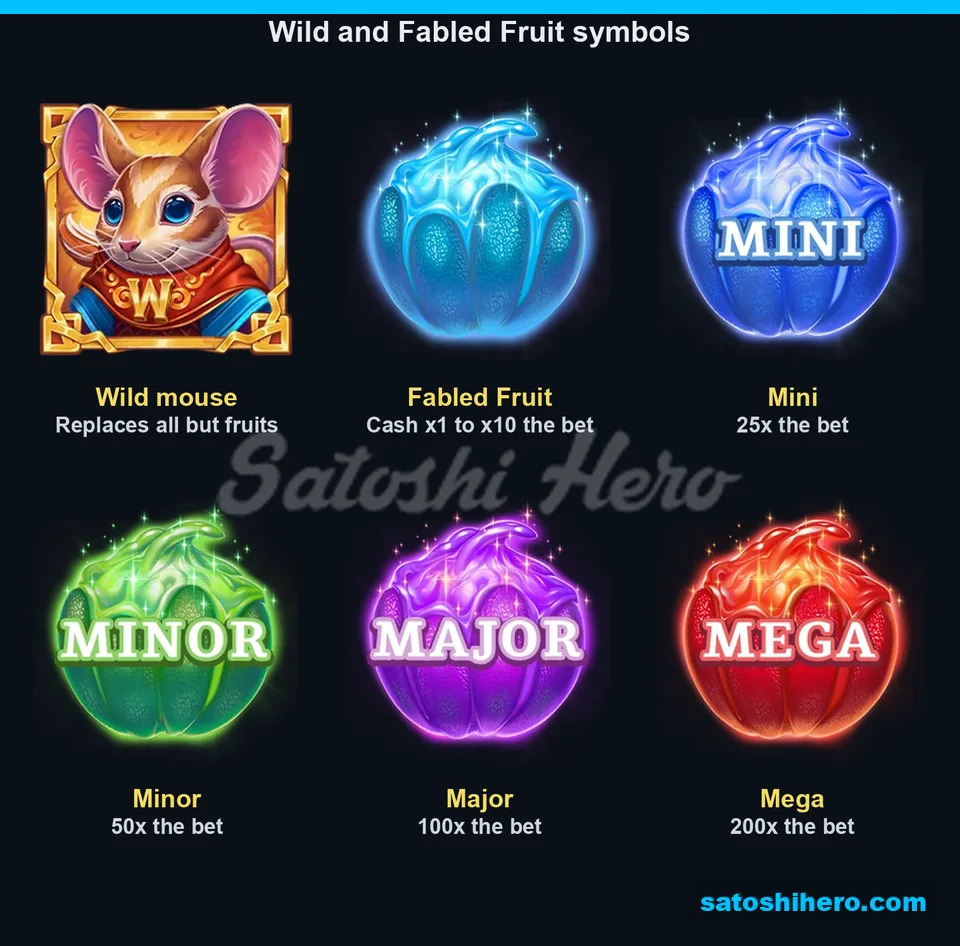
Filling all 15 positions adds the 1,000x Grand jackpot instead. At my tested $10.00 stake, the panels displayed Mini at $250.00, Minor at $500.00, Major at $1,000.00, Mega at $2,000.00, and Grand at $10,000.00. These are feature prizes rather than standard line awards. You should scale them against your own bet before deciding how meaningful each level feels.
Searches for tree of light fabled fruits codes appear to confuse visible fruit numbers with a redemption system. The numbers aren’t codes, and the game offers no code-entry feature in the tested interface. They simply show fruit values or jackpot amounts collected when Hold & Win ends. You won’t gain a special entry route by copying them elsewhere.
My single bonus included several small amounts and one $100.00 fruit, but that sample can’t establish a distribution. Outside the respin feature, fruits matter only as trigger symbols. Their narrow role remains easy for you to track.
Bonus Chance
Bonus Chance costs 1.80x the normal stake per spin and doubles the natural Hold & Win trigger probability. Its toggle sits left of the reels and adds more Fabled Fruits to the reel view. Payout calculations still use the normal base bet, not the increased spin charge. You get better trigger odds, but you don’t get larger multiplier values.
I kept Bonus Chance disabled throughout all 100 counted spins. That choice matters because my spin 39 Hold & Win arrived through ordinary base play rather than boosted odds. You can compare that natural trigger with the option’s higher expense, but one occurrence doesn’t prove either route more efficient. I prefer keeping those claims separate from what I actually observed.
A fixed spin plan becomes much more expensive after activating the toggle. For example, maintaining the same round count means paying 1.80 times the planned base cost while each feature remains chance-based. You should recalculate the budget before switching it on, rather than keeping an old spin target automatically. The added fruit visibility may feel encouraging, yet it can’t guarantee a bonus or a profitable result.

Alert: The 1.80x charge can drain your balance faster while Hold & Win remains random. Reduce your planned spin count before enabling it.
This is a pacing choice, not a strategy for beating the math. I didn’t test it, so I won’t rank it against natural play or buying the feature. You should judge whether extra trigger chances justify shorter play.
Bonus Buy
The Bonus Buy opens Hold & Win directly for 64x the total bet. A confirmation window displays the full charge before the game deducts it, giving you a final chance to cancel. I didn’t purchase the feature during my test. That leaves the verified discussion limited to its price and direct access function.
At a $10.00 base stake, one purchase costs $640.00, equal to 64 standard spins at that stake. Bonus Chance spreads its 1.80x premium across individual rounds, while the buy takes a much larger amount upfront. You should compare those spending patterns rather than assume one route offers stronger returns. The direct route saves waiting time, but it doesn’t remove payout variance.
Tree of Light Bonus Buy offers a relevant comparison when you’re deciding whether to pay upfront or wait for a natural trigger. The shared title makes that choice easy to recognize, though I won’t infer matching feature math or results. In this game, my only observed Hold & Win came naturally on spin 39. You may value immediate access, but my test gives no evidence that buying produces a better outcome.
Repeated purchases can move your balance sharply because every attempt starts with the same sizeable charge. I think 64x may look approachable, yet a short losing sequence could become costly. You should set a purchase limit because convenience never softens random results.
Hold & Win
Six or more Fabled Fruits anywhere on the grid trigger Hold & Win. You start with three respins, and each new fruit locks before resetting the counter. Empty spaces keep spinning while collected values stay fixed.
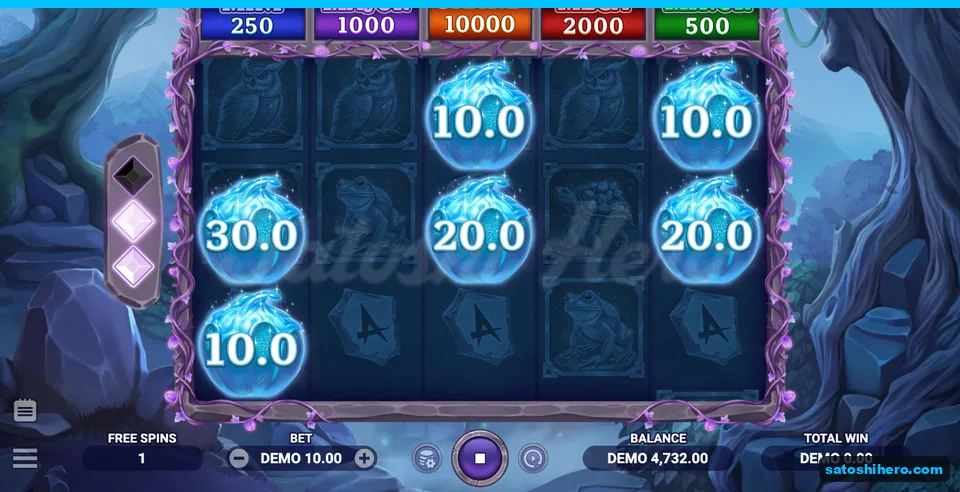
The full sequence works like this:
- The round starts with three respins.
- Every landed fruit locks in its position.
- Each new fruit resets the counter to three.
- Only fruits can land during the feature.
- The round ends when no respins remain or all 15 positions fill.
- The game adds every locked value and pays the combined amount.
- A full grid awards the 1,000x Grand jackpot.
My natural trigger arrived on spin 39 with a $4,732.00 balance. Eleven fruits locked at $10.00, $50.00, $10.00, $10.00, $30.00, $20.00, $20.00, $10.00, $10.00, $100.00, and $70.00. They paid $340.00, equal to 34x my $10.00 bet. You could feel the session change after many smaller returns.
The payout lifted my balance to its $5,062.00 session high. I enjoyed the lock-in tension, though 34x looked modest beside the jackpot panels. You shouldn’t treat this observed bonus as an average award.

Trivia: The Grand jackpot equals 1,000x the bet, while the overall game ceiling reaches 1,650x. Those limits describe different prize levels.
Hold & Win created my session’s only major upward movement. Eleven locked fruits occupied most of the board without reaching the full-grid prize. When you assess this slot, the feature deserves more attention than any base symbol.
Test Setup and Controls
My formal test covered exactly 100 base-game spins at $10.00 each from a fresh $5,000.00 balance. I enabled turbo mode, kept Bonus Chance off, and didn’t use Bonus Buy. Those controls isolated ordinary play and one naturally triggered feature. You can read every reported result against the same conditions.
The setup was:
- Starting balance: $5,000.00.
- Bet per counted spin: $10.00.
- Turbo mode: Enabled.
- Bonus Chance: Disabled.
- Bonus Buy: Not used.
- Counted sample: The first 100 spins.
Autoplay continued slightly beyond spin 100, but I excluded every surplus round. I also made later manual spins for a clean line-win image, and none entered the totals. You won’t see a favorable screenshot quietly improving the result. I think this separation prevents selective counting from flattering a short test.
The sample doesn’t cover stake limits, device behavior, or platform-specific controls. You should focus on the tested stake, starting balance, feature settings, and sample length. Every performance figure comes only from those 100 spins.
RTP, Volatility and Our Test
According to Evoplay, the slot’s official profile combines 96.2% RTP, medium-high volatility, and a 1,650x maximum win. RTP describes theoretical return, not the amount you should expect from a short session. In practice, my modest base payouts gave way to one much larger feature movement. I find the 1,650x cap fairly modest for this volatility level, though a less extreme ceiling may appeal to some readers.
The simulator and live test illustrate possible balance behavior rather than future outcomes. You can use them to understand spread, losing runs, and the influence of one feature. Neither method forecasts your next spin. That limit matters more than any neat-looking average.
Simulator Projection
The SatoshiHero Slot Simulator used a one-unit stake across 1,000 spins. Its median run finished 50x down, while the middle 90% ranged from 256.6x down to 235.8x up. About 21% of spins returned something. You can see from that wide interval how differently sessions may finish under the same profile.
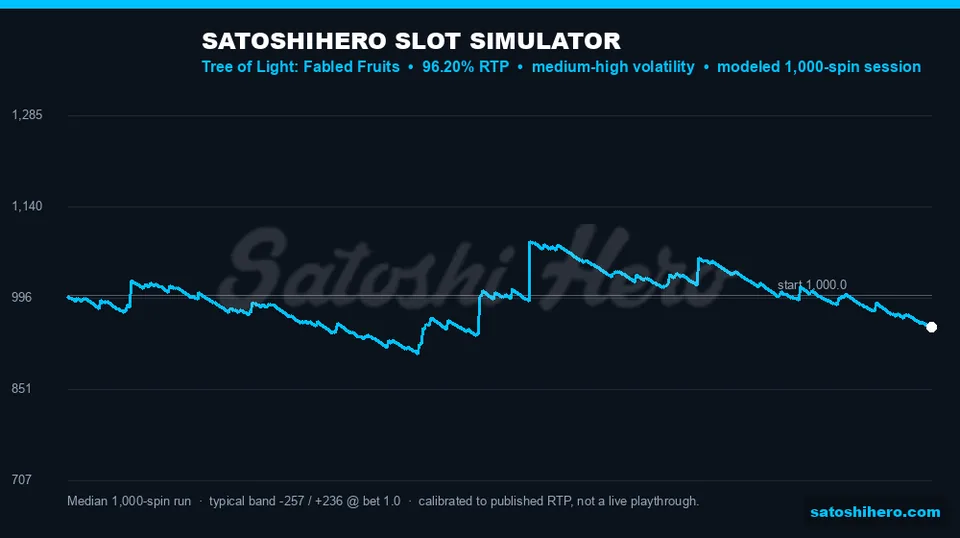
Other model estimates add context:
- Median result: 50x down.
- Middle 90% range: 256.6x down to 235.8x up.
- Paying-spin rate: Approximately 21%.
- Hold & Win frequency: Roughly once every 45 spins.
- Very large win frequency: Roughly once every 4,000 spins.
The projected feature rate doesn’t create a countdown. A feature may appear sooner or much later than 45 spins. The 4,000-spin large-win estimate tempers expectations around the jackpot display. You should read the model as a risk illustration, never a schedule.
Our 100-Spin Session
My balance fell from $5,000.00 to $4,724.00, creating a $276.00 loss equal to 27.6x my $10.00 stake. The run started with a slow decline, jumped above the opening balance after spin 39, then slid through the final 60 spins. That arc matched the game’s uneven profile better than a simple final number could. You would’ve seen one feature temporarily hide the weakness of the surrounding base play.
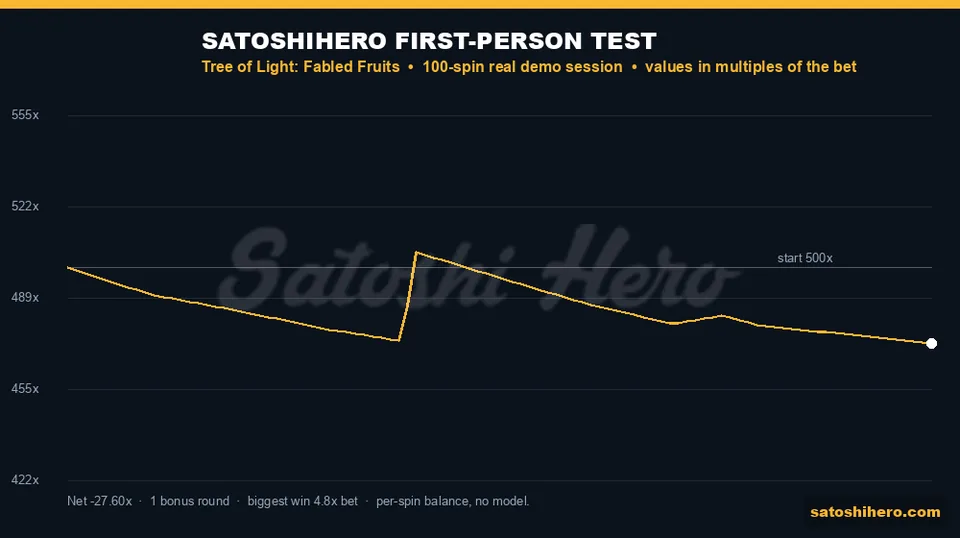
Key results were:
- Paying spins: 32 of 100.
- Longest non-winning run: 10 spins.
- Largest base-game win: $48.00, or 4.8x.
- Only feature: A 34x Hold & Win on spin 39.
- Session high: $5,062.00 after the feature settled.
The 32 paying spins exceeded the simulator’s approximate 21% paying-spin rate, yet most returns stayed small. My largest base hit merely matched 4.8x, leaving the $340.00 feature to carry the session. I didn’t notice the Wild mouse complete a winning line during the sample. You may encounter a very different mix because 100 rounds capture only a narrow slice of play.
My 27.6x loss was less negative than the simulator’s 50x median decline. A direct comparison would mislead because one sample spans 100 spins and the other summarizes 1,000-spin sessions. I take the live run as a useful story about path dependence, not proof of better performance. You should notice how quickly the balance moved from $5,062.00 to a losing close.
The theoretical RTP comes from the operator’s published figure, and one live session can’t confirm, disprove, or alter it. Simulator ranges model possible outcomes rather than promising them. If the interface shows a separate return for another feature setting, that value applies only to that configuration. This distinction keeps the math useful without pretending my result predicts yours.
Frequently Asked Questions
What is the top-paying symbol in Tree of Light: Fabled Fruits?
The fire bull is the top standard symbol, paying 15x for five, 4.8x for four, and 1.2x for three. Wins must connect on adjacent reels from left to right, beginning on reel one. Only the highest result pays on each line, so you won’t receive overlapping versions of the same combination.
How do you trigger Hold & Win in Tree of Light: Fabled Fruits?
Six or more Fabled Fruits anywhere on the grid start Hold & Win. You begin with three respins, each landed fruit locks, and every new fruit resets the counter to three. The round ends after the counter expires or all 15 spaces fill.
What do the jackpot fruits pay in Tree of Light: Fabled Fruits?
Mini pays 25x, Minor 50x, Major 100x, and Mega 200x the bet. Plain fruits carry 1x, 2x, 3x, 5x, 7x, or 10x values. Filling all 15 feature positions awards the 1,000x Grand jackpot.
How does the Wild work in Tree of Light: Fabled Fruits?
The Wild mouse can appear on any reel during base play and replaces every symbol except Fabled Fruits. Five Wilds on one payline pay 15x the bet. You won’t see it substitute for fruit triggers because those symbols follow separate rules.
What does Bonus Chance do in Tree of Light: Fabled Fruits?
Bonus Chance charges 1.80x the normal stake and doubles the natural Hold & Win trigger probability. It also places more Fabled Fruits in view, while all payouts still use the base bet. I kept it disabled during my counted test.
Does Tree of Light: Fabled Fruits have a Bonus Buy?
Yes, the Bonus Buy costs 64x the total bet and opens Hold & Win after a confirmation prompt. I didn’t purchase it during the test, so my results reflect ordinary base-game spins. The option offers speed, not a guaranteed outcome.
How did the Tree of Light: Fabled Fruits 100-spin test go?
I started with $5,000.00, staked $10.00 per spin, and finished at $4,724.00. That equals a $276.00 loss, or 27.6x my bet. My 34x feature payout caused the only large lift, while the best base-game spin paid 4.8x.
What does the Tree of Light: Fabled Fruits simulator show?
The 1,000-spin model produced a median finish of 50x down. Its middle 90% ranged from 256.6x down to 235.8x up, with about 21% paying spins. Hold & Win appeared roughly once every 45 spins in the model, but that rate can’t predict your next trigger.
What are the Tree of Light: Fabled Fruits RTP and maximum win?
The game has 96.2% RTP, medium-high volatility, and a 1,650x maximum win. Its traditional layout uses five reels, three rows, and 25 fixed paylines. Those lines pay matching symbols from left to right across adjacent reels.
Closing Thoughts
Tree of Light: Fabled Fruits puts its lock-and-respin bonus at the center. Fixed lines and clear fruit values work well, but the top prize feels restrained. You should expect base play to support the feature.

My Verdict
Choose this slot for clear paylines, visible cash values, and one focused bonus. Expect modest base returns with occasional Hold & Win swings. Optional feature routes add flexibility, though their extra cost deserves firm limits.
I liked how the spin 39 feature turned a steady decline into temporary profit. Watching the final 60 spins erase that recovery felt flat. The test showed how much work one bonus had to do.
Tree of Light: Fabled Fruits remains readable and easy to assess from a fixed budget. Details are checked regularly and updated periodically after verified changes.

Pros:
 Readable mechanics: Fixed paylines make every winning route easy to follow.
- Clear fruit values: Locked prizes show their dollar impact without guesswork.
- Natural bonus access: My feature triggered without paid enhancements or a direct purchase.
- Flexible entry routes: Bonus Chance and Bonus Buy offer different spending patterns.

Cons:
 Modest ceiling: The top prize feels restrained beside the volatility.
- Feature dependence: Small base wins left one bonus carrying the session.
- Costly shortcuts: Enhanced spins and direct purchases can accelerate losses.

Best For: Fixed-payline fans and lock-and-respin regulars will appreciate the clear structure. If you budget carefully, you can compare natural, boosted, or direct access. Huge-prize hunters may find the ceiling too conservative.































































Bets
All Bets
Game
Player
Date
Wager
Mult.Multiplier
Prize
 Fruit Cash: Hold 'N' Link NG
 Hidden
- 19:06:09
- 0.4×
- Galaxy Glitter
- Hidden
- 19:06:07
- 2.5×
- Katana Klash: Hold'n'Link
 nina87
- 19:06:07
- 0×
- Galaxy Glitter
- mike_721
- 19:06:05
- 0×
- Grand Koala: Hold ‘N’ Link
- mdp0fxo
- 19:06:04
- 0×
- Fruit Cash: Hold 'N' Link NG
- Hidden
- 19:06:02
- 0×
- Royal Fruits 9: Hold 'n' Link
- Hidden
- 19:06:01
- 0×
- Katana Klash: Hold'n'Link
- nina87
- 19:06:01
- 0×
- Galaxy Glitter
- mike_721
- 19:06:00
- 0×
- Galaxy Glitter
- Hidden
- 19:06:00
- 0×