
Dark Summoning
RTP94.34%
VolatilityMedium–high
Max winx10,666
Lines24
Hit rate29.56%
ThemeHorror

Dark Summoning slot: Crypt Cascades and Hellfire Wilds
Dark Summoning slot looks like a brutal Hacksaw Gaming bonus hunter, but my 500-spin test showed how cold the base game can feel before one feature finally lands.
Dark Summoning is a medium-high volatility slot from Hacksaw Gaming with 96.36% RTP and 10,666x max win potential. It uses a 5-reel, 6-row grid with 24 fixed paylines, Super Cascades, Wild multipliers, and two bonus paths. Aimed at dark-theme slot fans who like volatile feature hunts and bonus rounds with different risk profiles.
Key takeaways
I played the Dark Summoning slot demo on SatoshiHero at the $2.00 opening bet, then tested both direct bonus buys. The theme is strong and the feature design is clever, but the base game won’t suit you if you hate long, low-paying stretches.
- Best bonus: Rise to Salvation performed best, paying $370.80 from a $500.00 buy; Trial by Hellfire paid $70.80 from a $260.00 buy.
- RTP / volatility: Official RTP is 96.36%, volatility is medium-high, and bonus buy RTPs run from 96.33% to 96.42%.
- Max win: The maximum win is 10,666x the bet and can land in the base game or either bonus feature.
- Risk note: My 500-spin session finished down $553.80, with one organic bonus and many small cascade wins.
- Bankroll note: Trial by Hellfire costs 130x and Rise to Salvation costs 250x, so direct buys need strict limits.

Table of Contents
- How Dark Summoning Works
- Symbol values
- Line wins
- Theme & First Impressions
- Crypt atmosphere
- Blue versus red
- Super Cascade and Multipliers
- Full-grid removals
- Added multipliers
- Order and Unholy Triggers
- Order symbol
- Unholy counter
- Trial by Hellfire
- Hellfire marks
- Test result
- Rise to Salvation
- Lost Souls
- Global multiplier
- Bonus Buy Options
- Buy prices
- Tested returns
- How It Played Over 500 Spins
- Base-game pace
- Session finish
- RTP, Volatility & Our Test
- Simulator projection
- Our 500-spin session
- Frequently Asked Questions About Dark Summoning
- Final Verdict
How Dark Summoning Works
Dark Summoning slot uses a 5-reel, 6-row grid with 24 fixed paylines. Wins pay left to right from the leftmost reel, so you’re watching a traditional line slot rather than a cluster or pay-anywhere setup.
The game pays for 3, 4, or 5 matching symbols. You can read the board quickly because the fixed-payline grid stays clear on mobile and desktop layouts. I like that choice, since some 6-row slots become messy when features start firing.

Key Stat: The 24 figure is a true fixed-payline count here, not a pay-anywhere, ways-to-win, or cluster mechanic.
Symbol values
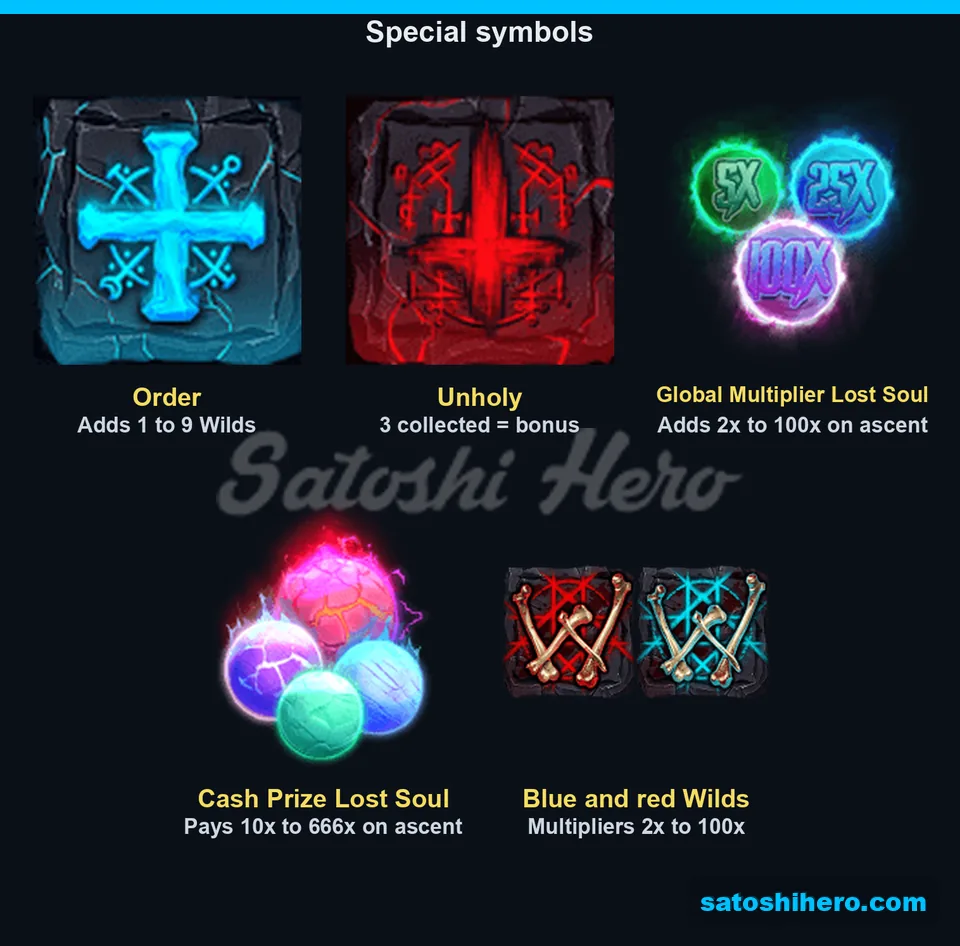
The crossed-bones Wild substitutes for every paying symbol. At a $2.00 bet, five Wilds pay $60.00, which makes them the strongest symbol on the grid.
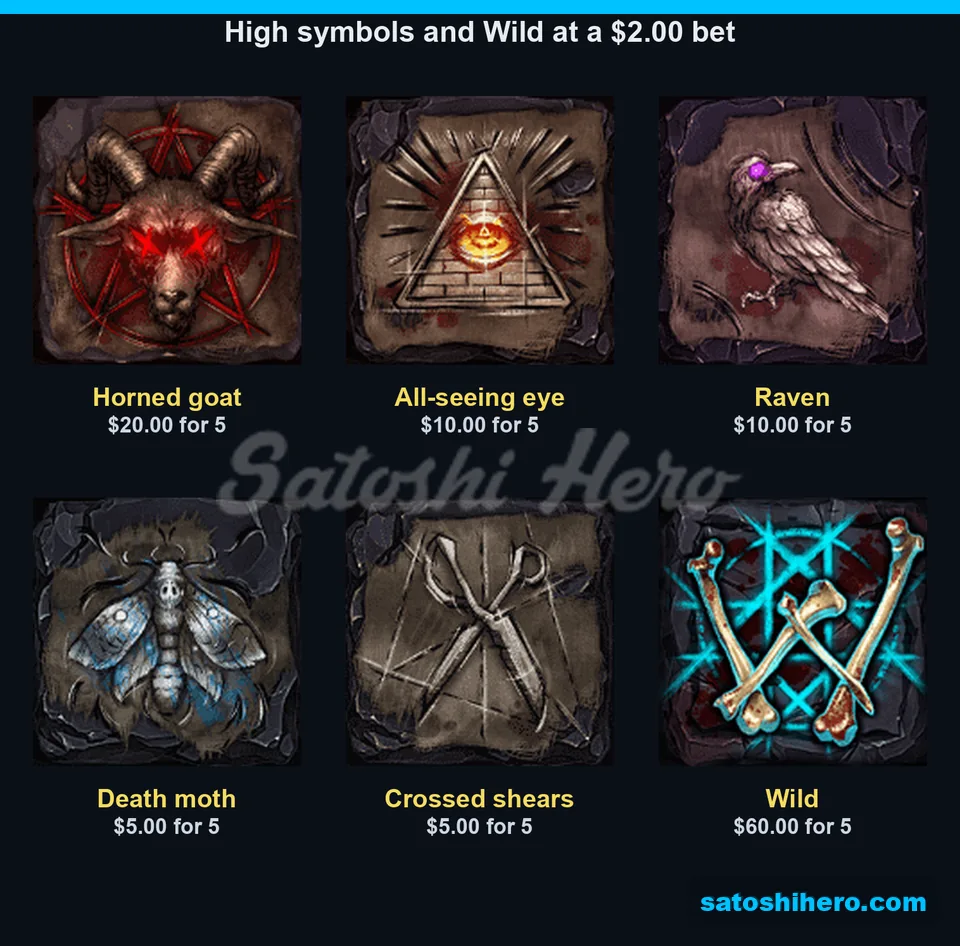
The horned goat in a pentagram leads the regular pay table. It pays $20.00 for five, $4.00 for four, and $2.00 for three at the same $2.00 stake. That top-symbol gap matters because low-rune cascades can look busier than they feel.
The all-seeing eye and raven each pay $10.00, $3.00, and $1.60. The death moth and crossed shears each pay $5.00, $2.00, and $1.00. You’ll notice these mid symbols when cascades connect, but they still need multiplier help to feel meaningful.
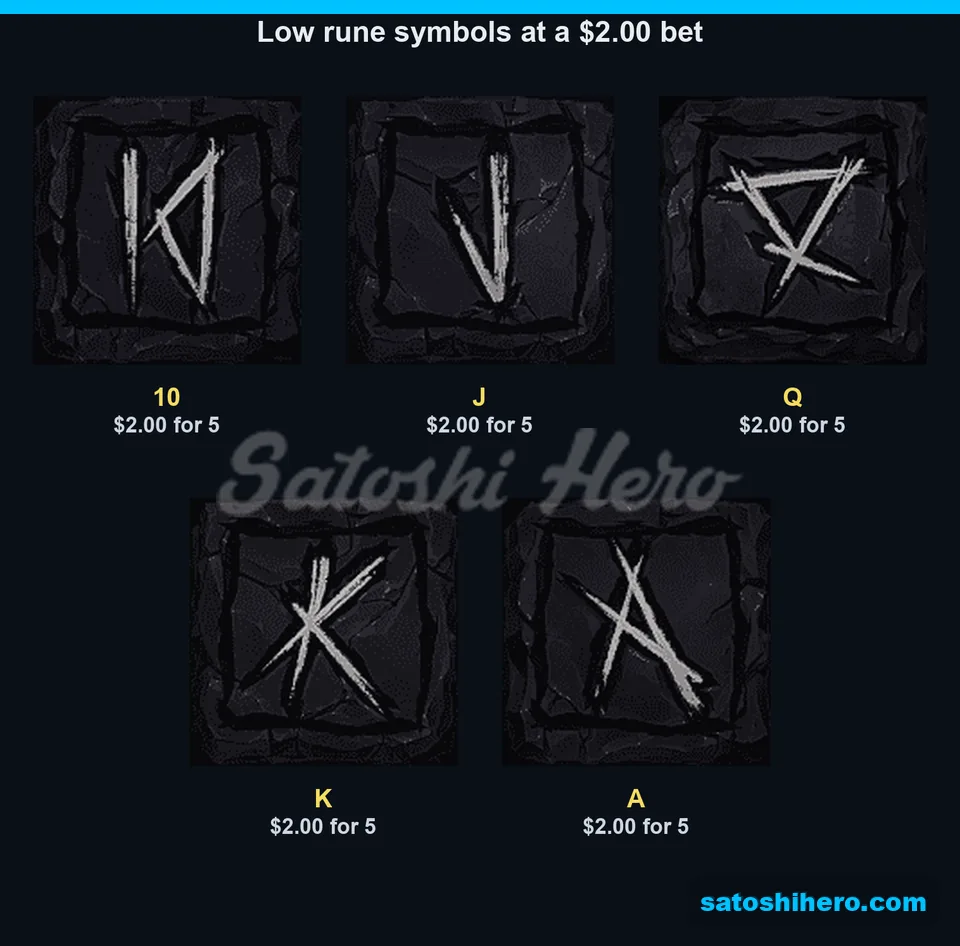
Low runes show 10, J, Q, K, and A. Each pays $2.00, $1.00, or $0.40 at a $2.00 bet. In my session, those runes appeared often during cascades, and they rarely changed the balance by much.
Line wins
The 24 paylines start from reel 1 and pay left to right. That means a matching group in the middle of the grid doesn’t count unless it connects through the correct line path.
You should watch the first reel closely. A strong symbol there can create a paying chain, while the same symbol starting on reel 2 may do nothing. The grid is simple, but the bonus systems add most of the complexity.
Theme & First Impressions
The slot uses a candlelit crypt, blue Order imagery, and red demonic imagery to make its two bonus paths easy to read. The horror theme feels familiar, but the colour language helps you follow what’s happening.
Crypt atmosphere
A hooded skeleton in blue robes stands on the left. A horned black demon stands on the right, staring over a crumbling stone gateway. The red, dripping logo sits above the reels and sells the grim tone without trying too hard.
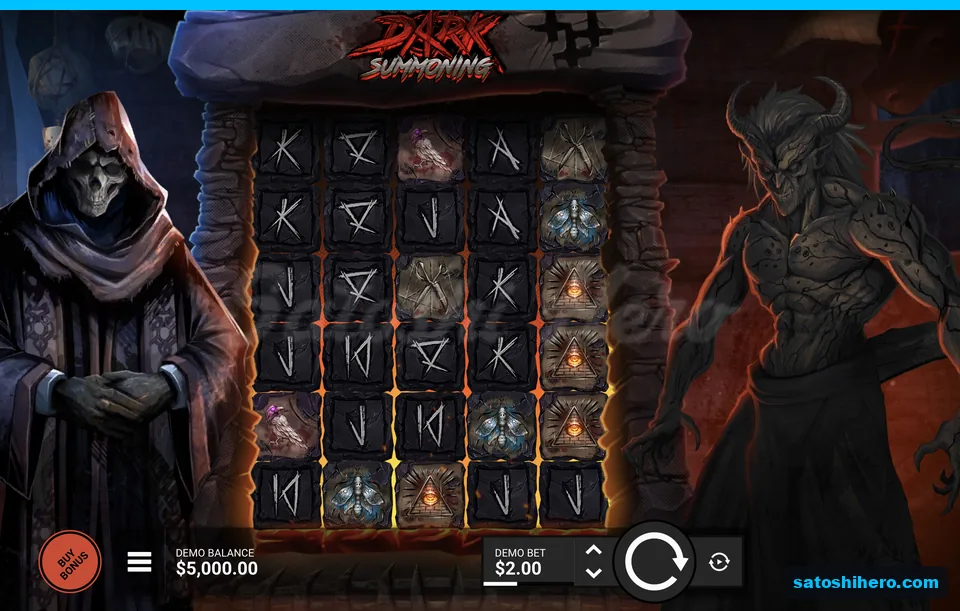
You get candles, rough stone, robes, bones, and ritual symbols. The look won’t win originality awards for horror slots, but it does its job. Fear The Dark may appeal if you like a similar grim mood, though this game explains its features more clearly through colour.
Blue versus red
Blue signals Order, while red signals the demon side. That split carries through Wilds, Trial by Hellfire, and Rise to Salvation, so you can tell which system controls the spin.
I like this more than vague horror decoration. You don’t need to guess whether the game has shifted into a different mode. The theme supports the mechanics, and that’s where the design earns its keep.
Super Cascade and Multipliers
Super Cascade removes every symbol of the winning type from the full grid, not just symbols on the payline. Wild multipliers matter most when they join a paying line, so you shouldn’t judge a spin by movement alone.
Full-grid removals
When a line wins, every matching symbol of that winning type gets marked. The game removes those symbols from the whole grid, then drops new symbols into the gaps.
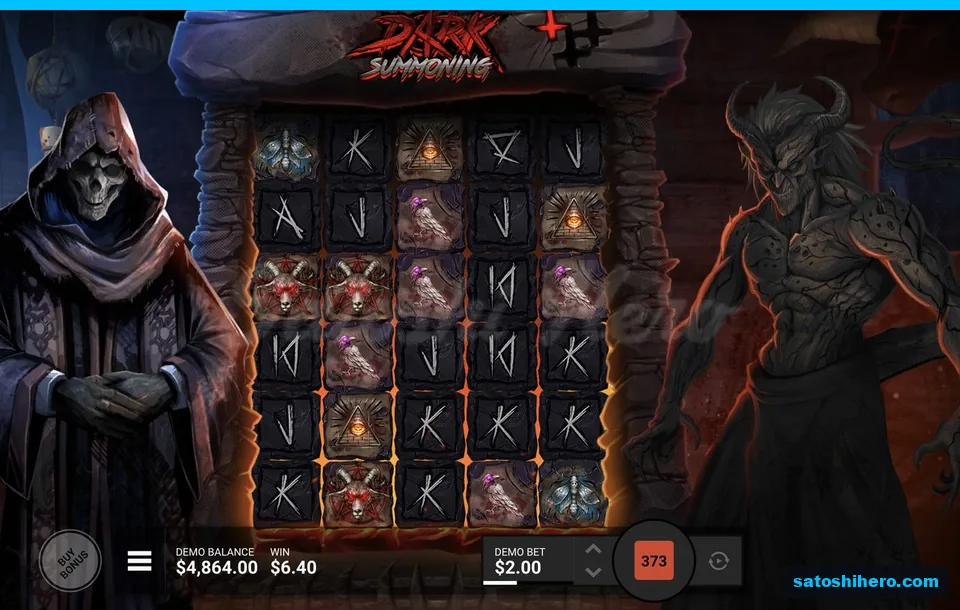
Cascades continue while new wins form. You’ll see plenty of board movement, but many chains still clear low runes for small returns. That was the main base-game rhythm in my test, and it got repetitive during colder stretches.
This system feels better than a basic tumble because one line win can clear more space than expected. But spectacle doesn’t equal profit. You need quality symbols or Wild support before the cascade starts to bite.

Strategy Insight: Don’t judge a cascade only by how many symbols disappear. The valuable moments come when Wild multipliers actually connect to a paying line.
Added multipliers
Wilds can land with 2x, 3x, 4x, 5x, 10x, 15x, 20x, 25x, 50x, or 100x multipliers. If several multipliers sit on the same winning line, the game adds them together before applying the total.
Blue Wilds appear in the base game and Rise to Salvation. Red Wilds appear in Trial by Hellfire. The important exception is simple: Wilds never carry multipliers in Rise to Salvation.
That rule matters because Rise to Salvation shifts value into the global multiplier instead. You’re not hunting the same Wild setup there. I like the separation because it stops the two bonuses feeling like colour-swapped copies.
Order and Unholy Triggers
Order and Unholy symbols control the two feature routes. Unholy symbols build the bonus counter, while an Order symbol can upgrade the path into Rise to Salvation.
Order symbol
The Order symbol is a blue cross. Will of the Order turns itself and 1 to 9 other symbols into Wilds, with or without multipliers.
Two Order symbols on one spin can fire the feature twice. That can create a stronger board, especially if a paying line already has room to connect. You should watch these blue crosses during cascades because they can change a dull spin fast.
I found this trigger more interesting than a simple random Wild drop. It gives the base game a little drama, even when the final payout stays small. Dark Spiral has a similar dark-feature tension if you like waiting for a dangerous trigger to develop.
Unholy counter
The Unholy scatter is a red inverted cross. It never lands on reels 1 or 2, which limits where the collection chase can start.
The game collects an Unholy symbol when it lands on a spin that also has a winning line. Three Unholy symbols landing together get collected straight away. The counter holds for the full round, including cascades, so you can build toward a bonus across one extended sequence.
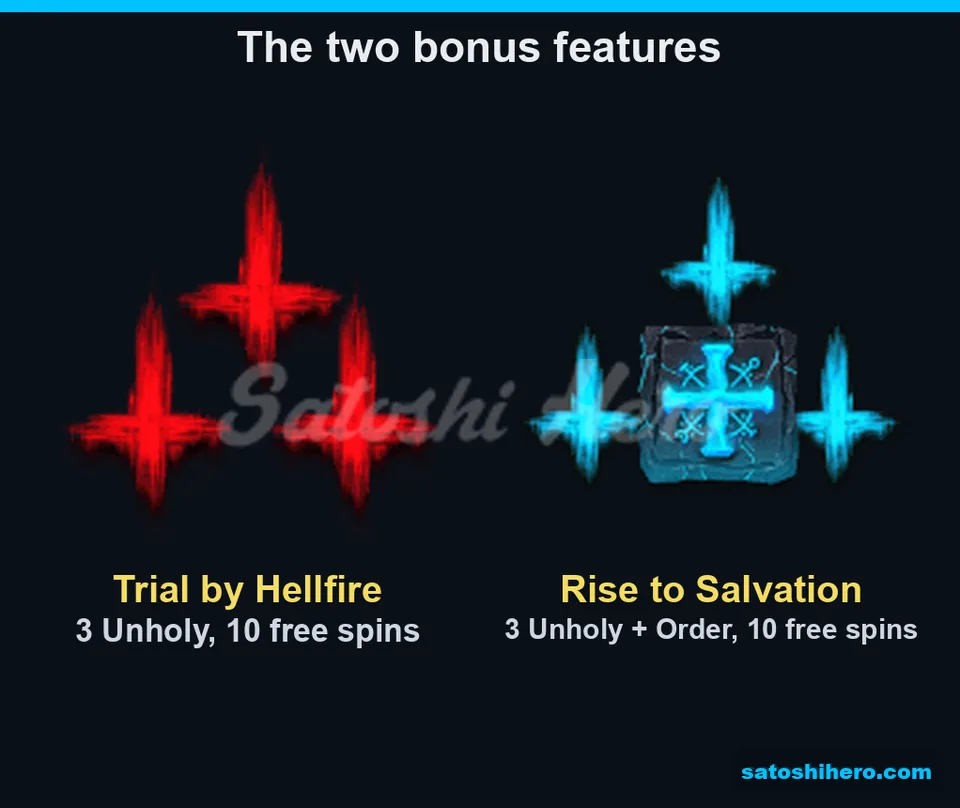
Three collected Unholy symbols start Trial by Hellfire. If an Order symbol sits on the grid when the third Unholy is collected, the round becomes Rise to Salvation instead. That routing is clear once you know what to watch.
Trial by Hellfire
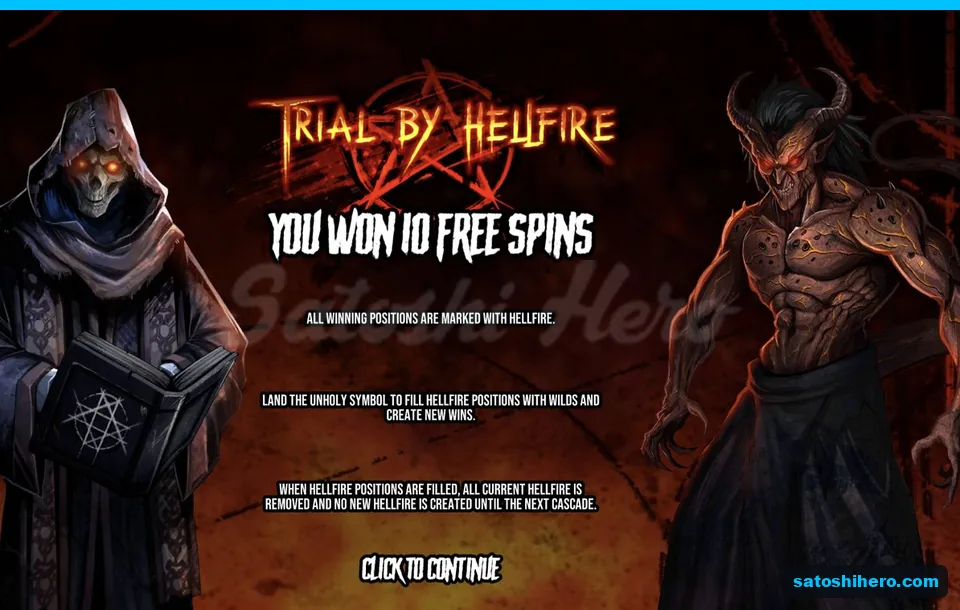
Trial by Hellfire starts from 3 collected Unholy symbols and gives 10 free spins with Hellfire-marked positions. In my 500-spin test, it triggered once organically and paid $85.00, or 42.5x at a $2.00 bet.
Hellfire marks
Every winning position gets marked with Hellfire during the feature. When an Unholy symbol lands, Fires of Hell triggers and turns that Unholy symbol plus every marked position into red Wilds.
Those red Wilds can appear with or without multipliers. After Fires of Hell resolves, the Hellfire marks clear. New wins don’t create Hellfire again until the next cascade, so timing matters more than a quick early trigger.
You want Unholy to arrive after the board has built a strong group of marked spaces. That’s the exciting version of this feature. The weaker version gives you marks that sit there unused, which happened during my bought round for most spins.
Test result
The organic trigger came around spin 300. Hellfire marks built into a block on the left reels, then Fires of Hell turned that block into red Wilds.
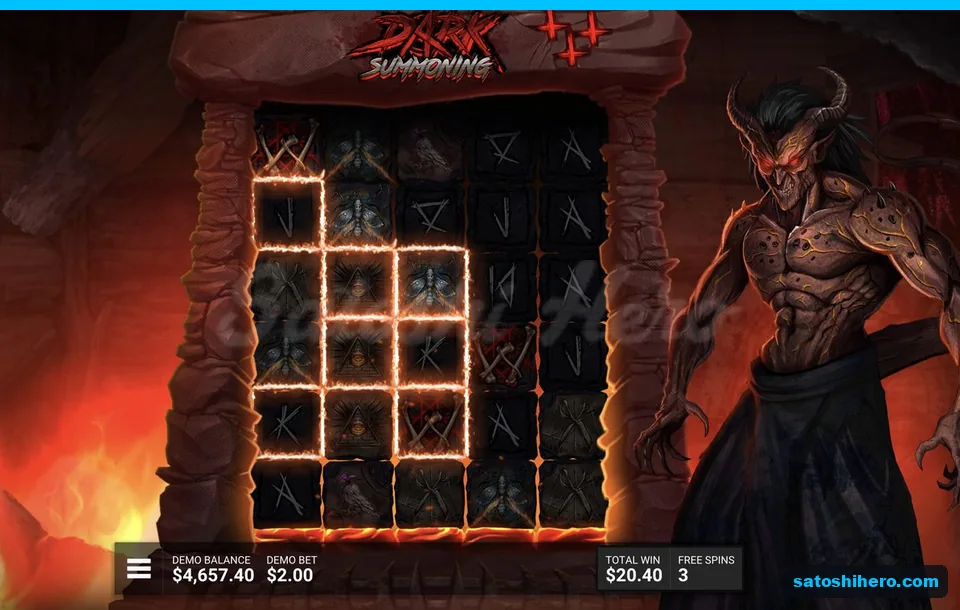
The 10 spins paid $85.00. It helped the session, but it didn’t save it. I’d call the result exciting in the moment and modest in the ledger.
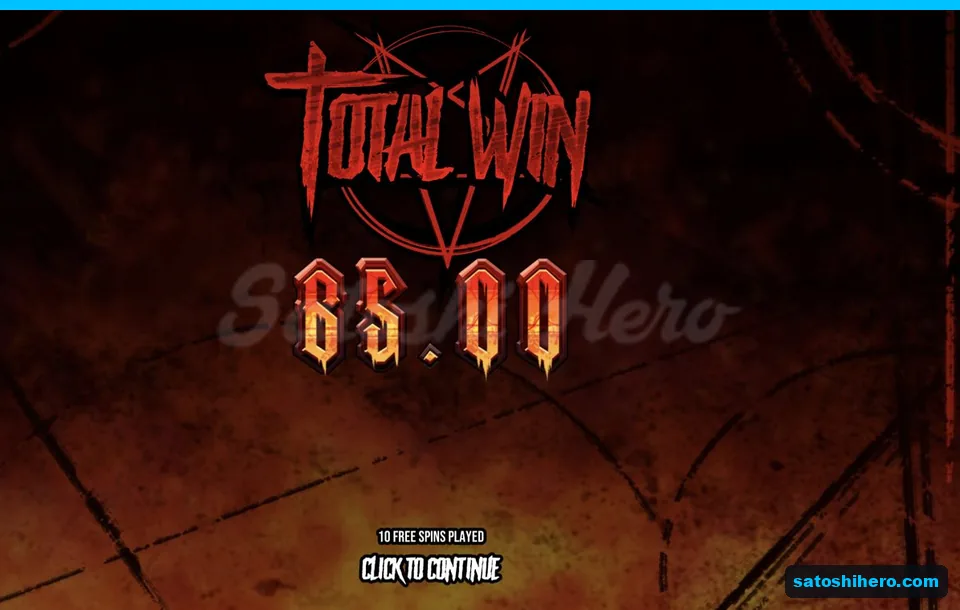
That round became the biggest single result of my 500-spin session. It also showed the feature’s problem clearly. You can get a dramatic board change and still walk away with a medium payout.
Rise to Salvation
Rise to Salvation felt stronger in my test because upward cascades, Lost Souls, and a global multiplier changed the rhythm. The bought round reached an 8x global multiplier and paid $370.80.
Lost Souls
Rise to Salvation starts when an Order symbol is on the grid as the third Unholy symbol gets collected. It begins with 10 free spins, but symbols drop and cascade upward instead of downward.
Lost Soul symbols stay on the grid until they climb to the top row and Ascend. A Global Multiplier Lost Soul adds 2x, 3x, 4x, 5x, 10x, 15x, 25x, 50x, or 100x to the global multiplier above the reels.
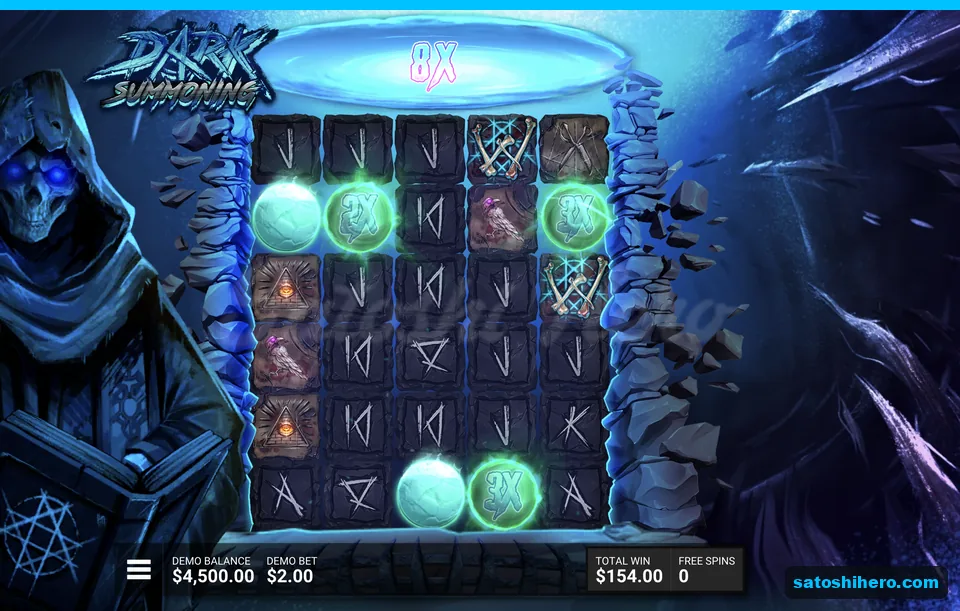
A Cash Prize Lost Soul pays 10x, 15x, 20x, 25x, 50x, 100x, or 666x the bet, multiplied by the global multiplier. After three losing spins in a row, 3 to 5 random paying symbols clear on the third spin. You can feel the feature nudging itself back into motion.

Insight: Rise to Salvation isn’t just a blue reskin of Trial by Hellfire. The upward cascades, Lost Souls, and global multiplier create a different rhythm and match the salvation theme.
Global multiplier
My bought Rise to Salvation round pushed the global multiplier to 8x. That number mattered because it applied pressure to every later win and cash-prize moment.
The final spin ran through a Big Win into Super Mega Win. One final sequence paid $216.80 by itself, and the whole round landed at $370.80, or 185.4x the bet.
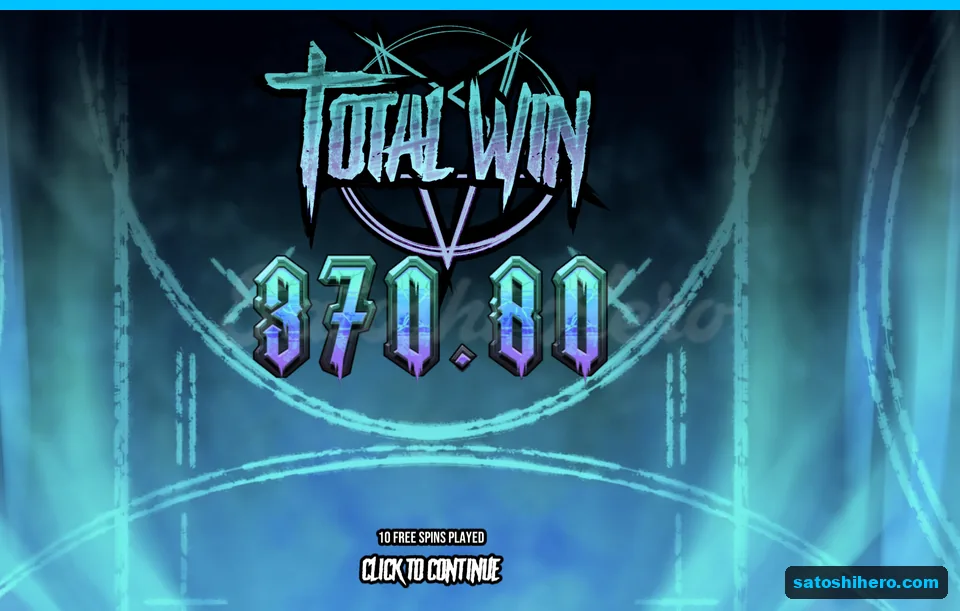
That was the best result in my test, but it still finished below the $500.00 buy price. Ze Zeus may appeal if multiplier-led bonus momentum is your main attraction, though this feature adds a darker and more structured climb. You should enjoy the rhythm, not treat the buy as a shortcut to profit.
Bonus Buy Options
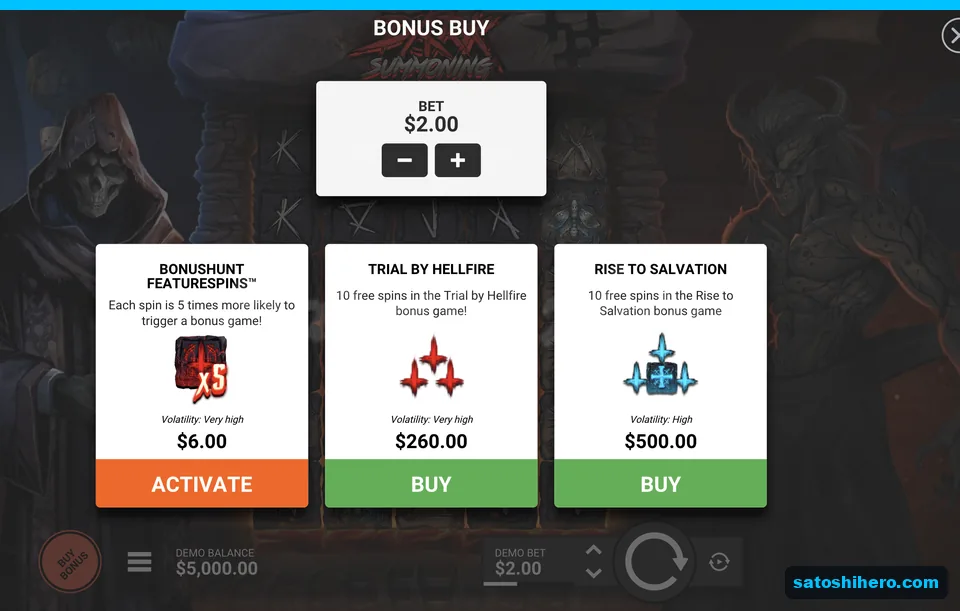
The bonus buy menu offers one FeatureSpins mode and two direct bonus buys. Both tested direct buys returned below cost, so the prices deserve more attention than the button animation.
Buy prices
At a $2.00 bet, Bonushunt FeatureSpins cost $6.00 per spin. The mode makes each spin five times more likely to trigger a bonus, carries very high volatility, runs at 96.33% RTP, and stays active until you disable it.
Trial by Hellfire costs $260.00. That equals 130x the bet, has very high volatility, runs at 96.36% RTP, and gives 10 free spins.
Rise to Salvation costs $500.00. That equals 250x the bet, has high volatility, runs at 96.42% RTP, and also gives 10 free spins. You can try the Dark Summoning slot demo flow on SatoshiHero before risking a direct buy.

Warning: Medium-high volatility plus 130x and 250x buy costs can hit hard. Both tested direct buys returned below cost, so set limits before you use them.
Tested returns
I pressed BUY BONUS, chose BUY on the selected card, confirmed the price with OK, and clicked through the intro card. The process is simple, which makes discipline more important.
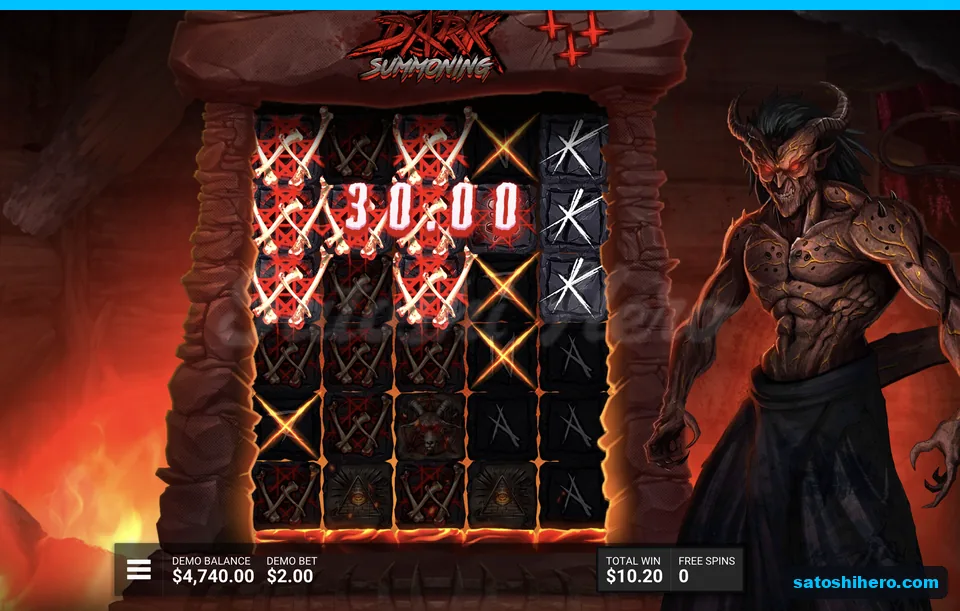
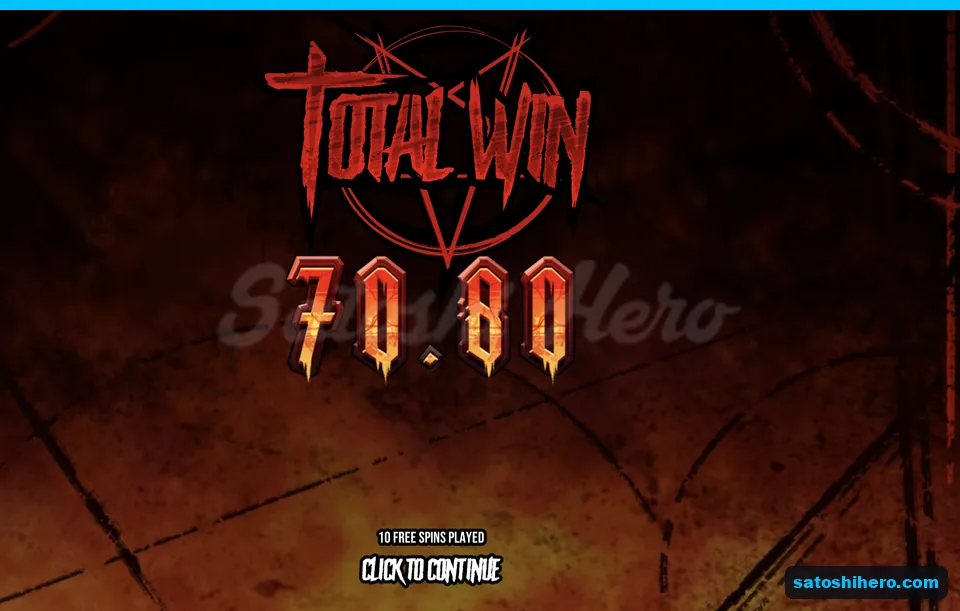
Trial by Hellfire cost $260.00 and paid $70.80. For most of the round, Hellfire marks sat unused and the total crept to $10.20. On the last spin, an Unholy symbol landed, Fires of Hell turned a wide block into red Wilds with a 3x, and one chain paid $30.00.
Rise to Salvation cost $500.00 and paid $370.80. Several Global Multiplier souls ascended, the multiplier reached 8x, and the last spin delivered the best sequence of my testing. I didn’t use Bonushunt FeatureSpins because it’s a per-spin mode, not a round.
How It Played Over 500 Spins
My 500-spin test lost $553.80 at $2.00 per spin, with one organic bonus and a steady base-game bleed. This is where the Dark Summoning slot looks harsher than its moving grid first suggests.
Base-game pace
I started with $5,000.00 and played 500 spins at $2.00. Super Cascades fired often, but most chains cleared low runes for $0.40 to $3.40.
Wild multipliers rarely landed on a winning line. That made many spins feel active on screen but weak in the balance. You’ll probably enjoy the engine more if you can accept movement without constant meaningful payout.
By spin 300, my balance sat around $4,658.00. Then the Unholy counter filled, and Trial by Hellfire finally started. The timing felt overdue, but that’s typical of medium-high volatility.
Session finish
The organic Trial by Hellfire paid $85.00. It became the only bonus of the session and the biggest single result.
The final 200 spins went straight back down. My best base pay after the bonus was only a few dollars, and I finished on $4,446.20. That left me down $553.80.
Numbers indicate the engine can create frequent movement without frequent strong hits. Limbo gives a cleaner contrast if you want faster, simpler risk instead of a traditional feature slot. I prefer the structure here, but the base game can feel punishing.
RTP, Volatility & Our Test
Dark Summoning has 96.36% theoretical RTP, medium-high volatility, and a 10,666x maximum win cap. The simulator and my live test show why a fair headline RTP can still feel rough in short sessions.
The 10,666x cap can land in the base game and both bonus features. The round ends as soon as the max win hits. Bonus buy RTPs sit close together: Bonushunt FeatureSpins runs at 96.33%, Trial by Hellfire at 96.36%, and Rise to Salvation at 96.42%.
Simulator projection
Our simulator modelled 1,000 spins at $2.00 with 96.36% RTP and the 10,666x cap. It used the high volatility band as the closest fit to the official medium-high rating.
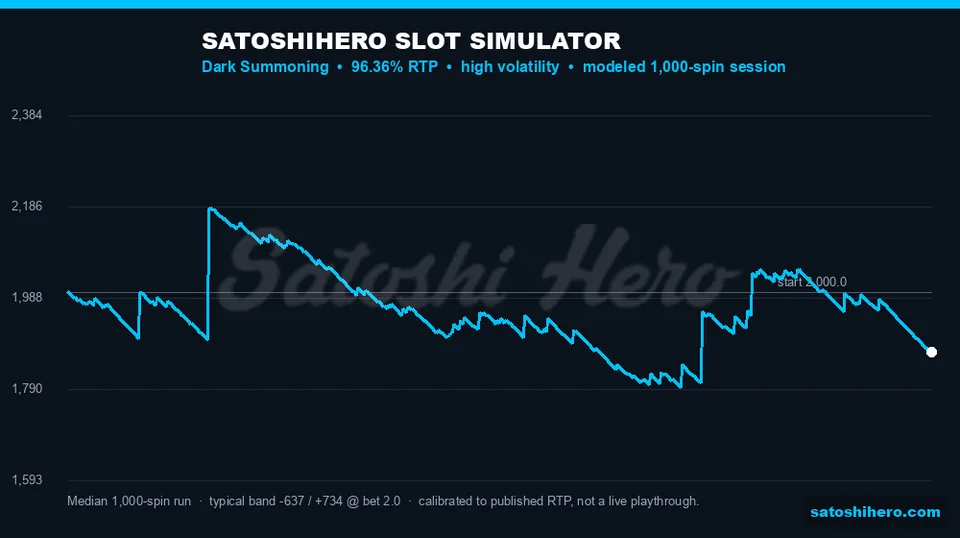
The median run finished $130.50 down. Most runs landed between $636.70 down and $733.90 up. That range explains why a slot can feel fair on paper and still punish one session badly.
The model put a feature-sized hit around once in 45 spins. It put a 100x or better win around once in 1,748 spins. You should treat those figures as session-range context, not as a schedule for your next spin.
Our 500-spin session
My 500-spin session finished down $553.80. That placed it near the bottom of the simulator range, which matched how the play felt.
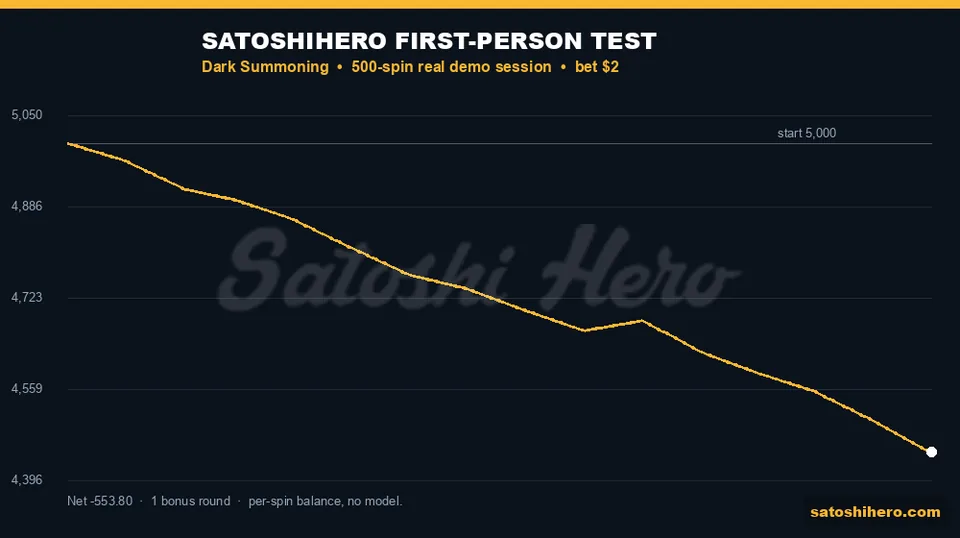
One organic Trial by Hellfire paid $85.00. That was the biggest result, yet it couldn’t offset the long base-game slide. The math suggests the slot needs better multiplier contact or a stronger bonus to turn a session.
I don’t mind cold slots when the upside feels sharp. Here, the 10,666x cap gives enough upside, but the tested path showed plenty of grind before any meaningful lift. The theoretical RTP is the operator-published figure. A single live session doesn’t change that figure, and bonus buy RTPs differ slightly from the base setup by design. The simulator uses the official RTP and cap to show a range of possible outcomes, not a guaranteed path.
Frequently Asked Questions About Dark Summoning
What happened in 500 real spins of Dark Summoning slot?
I played 500 spins at $2.00 from $5,000.00 and finished on $4,446.20, down $553.80. One organic Trial by Hellfire around spin 300 paid $85.00.
How does Trial by Hellfire work in Dark Summoning slot?
Three collected Unholy symbols give 10 free spins. Every winning position gets marked with Hellfire, and each new Unholy symbol turns itself and all marked positions into red Wilds, with or without multipliers.
What makes Rise to Salvation different in Dark Summoning slot?
It starts when an Order symbol sits on the grid as the third Unholy is collected. Symbols cascade upward, and Lost Souls that reach the top row add to a global multiplier or pay a cash prize from 10x to 666x.
How did the Dark Summoning slot bonus buys do?
The Trial by Hellfire buy returned $70.80 from a $260.00 price. Rise to Salvation cost $500.00 and paid $370.80 with the global multiplier at 8x.
What does the simulator predict for Dark Summoning slot?
Over 1,000 spins at $2.00, the median run ended $130.50 down. The main range stretched from $636.70 down to $733.90 up.
What are the RTP and max win of Dark Summoning slot?
The RTP is 96.36%, the buys run from 96.33% to 96.42%, and the maximum win is 10,666x the bet in every game mode.
Can I play the Dark Summoning slot demo on SatoshiHero?
Yes, the demo helps you learn the Super Cascade flow, Unholy counter, Order trigger, and bonus-buy menu before real play.
Final Verdict
Dark Summoning stands out through its split bonus design, readable colour coding, and detailed cascade system. Its main drawback is the cold base-game pace, which my 500-spin session exposed clearly.

My Take
Dark Summoning is a strong pick when you want a dark Hacksaw feature hunt with real structure behind the theme. Expect movement, tension, and some dry stretches. I’d rather play the base game patiently than rush straight into expensive buys.
I like Rise to Salvation best because the upward cascades and global multiplier gave my strongest tested result. I don’t like how often base-game cascades cleared low runes for tiny returns. The bought Trial by Hellfire round also showed how marks can sit unused until very late.
The Dark Summoning slot earns its place through clever feature routing, not easy returns. My specs and test notes are updated periodically.

Pros:
 Clear feature routes: Blue and red systems help you track every bonus path.
- Strong RTP: 96.36% gives the math a competitive baseline.
- Distinct bonuses: Trial and Salvation play differently, not like copied free spins.
- Readable grid: The 5-reel, 6-row layout stays clear during cascades.

Cons:
 Cold base game: Frequent small rune wins can drain your balance slowly.
- Expensive buys: 130x and 250x prices demand tight bankroll control.
- Modest tested hits: My biggest organic result paid only $85.00.

Best For: Dark-feature hunters, patient bankroll managers, and Hacksaw fans get the most from this slot. You’ll enjoy it more if you like watching bonus routes develop through symbols, counters, and multipliers. Quick-hit players may find the base game too slow.























Bets
All Bets
Game
Player
Date
Wager
Mult.Multiplier
Prize
 San Chong Baozha Blue: Bonus Combo
 mike_721
- 18:30:03
- 2.05×
- Luck of Panda: Bonus Combo
 Hidden
- 18:30:03
- 0×
- Sugar Rush Super Scatter
 Hidden
- 18:30:01
- 0×
- Luck of Panda: Bonus Combo
- Hidden
- 18:30:00
- 0×
- Luck of Panda: Bonus Combo
- josh1998
- 18:30:00
- 0.64×
- San Chong Baozha Blue: Bonus Combo
- mike_721
- 18:30:00
- 0×
- Sugar Rush Super Scatter
- Hidden
- 18:29:59
- 0.19×
- Galaxy Glitter
- mdp0fxo
- 18:29:59
- 0×
- Luck of Panda: Bonus Combo
- Hidden
- 18:29:57
- 0×
- San Chong Baozha Blue: Bonus Combo
- mike_721
- 18:29:57
- 0×