

Dungeon: Immortal Evil
By pressing play, you agree that you are above legal age in your jurisdiction and that your jurisdiction allows online gambling.

Fighting for Loot in the Halls of Immortal Evil
Dungeon: Immortal Evil replaces reels, matching symbols and paylines with monsters that can drop individual pieces of paying loot.
Dungeon: Immortal Evil is Evoplay’s dark-fantasy, medium-high volatility slot with 96.2% theoretical RTP and 6,316x maximum win potential. Its five-position, one-row layout targets action-RPG fans who prefer loot payouts over standard combinations. I began the play-money demo with $5,000 at $10 per spin, then finished 100 spins down 29.5x after 29 paying results and a 21x best hit. You can try the same demo or play for real on SatoshiHero.
Key Takeaways
- Best bonus: Find a portal during ordinary paid play, because the tested demo showed no bonus-buy control.
- RTP / volatility: The 96.2% theoretical RTP and medium-high volatility can produce uneven short sessions.
- Max win: The 6,316x cap exceeds the boss’s highest individual loot item, which pays 5,000x.
- Risk note: My test lost 29.5x despite an early 21x win, showing how quickly gains can fade.
- Bankroll note: I started with 500 bets in play money, but you should set your own fixed budget.

Table of Contents
- How Dungeon: Immortal Evil Works
- The single-row layout
- Calculating a win
- Theme and First Impressions
- Dungeon-crawler presentation
- First-spin impressions
- Monster and Loot Values
- Five loot tiers
- Monster pay ranges
- Random Events
- Four event types
- Mimic test result
- Dungeon Free Game Mode
- Seven-room progression
- Gear and survival
- Controls, Turbo and Bestiary
- Autoplay and turbo
- Reading the Bestiary
- How the Base Game Played
- Monster density
- Notable paid spins
- RTP, Volatility and Our Test
- Simulator projection
- Our 100-spin session
- Frequently Asked Questions About Dungeon: Immortal Evil
- Closing Thoughts
How Dungeon: Immortal Evil Works
Wins come from independent monster loot, not paylines, ways, or matching combinations. You can collect from one monster while every other position remains empty. I found this system easy once I stopped looking for traditional slot patterns.
The single-row layout
The play area holds five positions across one row. Each paid spin places between one and five monsters, while unused positions stay genuinely empty. You don’t need a left-to-right sequence or any minimum matching count.
This HTML5 layout works cleanly on mobile and desktop, preserving the same single-row action. That consistency matters because movement carries the experience more than the tiny grid.
Calculating a win
The loot-drop mechanic follows three direct steps:
- Each monster independently decides whether it drops loot.
- Every displayed loot coefficient multiplies your selected bet.
- The game adds all loot from that spin into one total.
I confirmed the calculation when a Gargoyle dropped a common item. The $30 reward from my $10 bet equalled 3x, with no matching enemy required. You read the defeated monsters and loot panel rather than searching for a conventional winning line.
The base-game image shows two defeated monsters beside the $30 loot total from my $10 bet. It’s strange initially, but soon becomes clearer than a busy payline display. Every ordinary win follows this calculation.
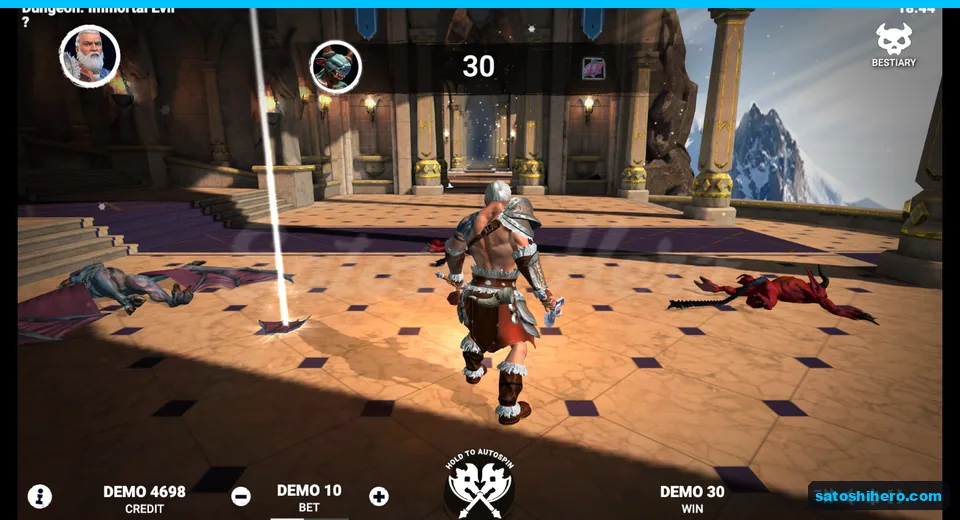

Fast Fact: A monster doesn’t have to match anything else. If it drops loot, that item pays its listed multiplier of your bet.
That direct rule controls every ordinary payout you’ll see.
Theme and First Impressions
This dark-fantasy slot presents a third-person 3D adventure, with a barbarian walking through changing dungeon rooms. You watch him advance, meet enemies, attack, and collect any loot left after combat. The setting isn’t subtle, but its movement gives the one-row game needed character.
Dungeon-crawler presentation
The hero wears fur and steel while exploring torch-lit stone halls framed by heavy fantasy architecture. A bell and occasional exterior details break up the corridors, including a snowy mountain view. You get a new room on each spin, followed by enemies, combat, and the final loot panel.
The theme image shows the hero inside a stone hall, with the bell and snow-covered landscape visible around him. It also records my $5,000 play balance and $10 bet. Those details matter because all monetary outcomes here come from the play-money demo, not a claimed cash session.
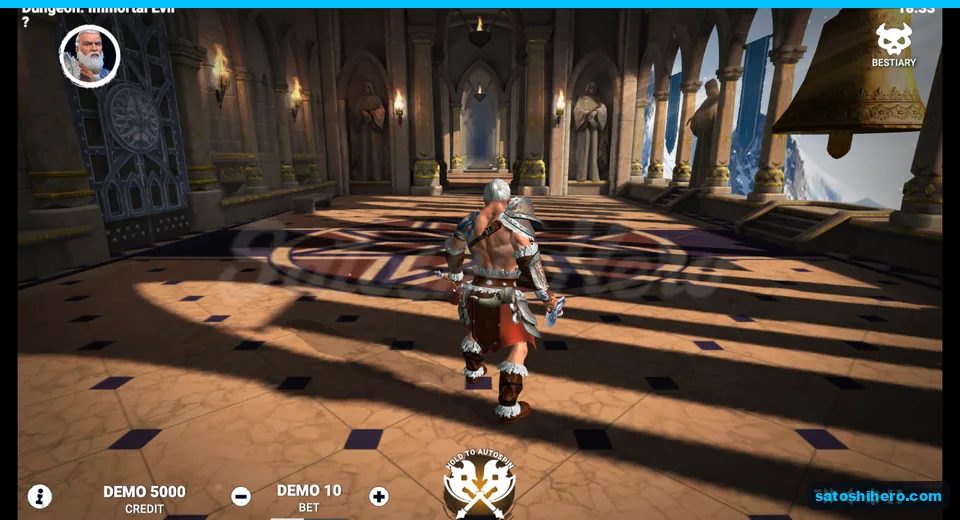
The fighting animations give Dungeon: Immortal Evil more identity than static fantasy reels. I’d still have liked more room variety during quieter stretches.
First-spin impressions
At first, the single-row layout looks almost too basic. Yet the hero’s movement makes every room feel larger than five positions suggest, and you can quickly see which monsters occupy them. Expressing my results as bet multiples also made the different loot values easier to compare.
You’ll notice that spectacle doesn’t change the underlying simplicity. One monster may appear, fall, and leave nothing, even after an energetic attack animation. For me, the presentation carries more personality than the structure, though repeated single-enemy rooms eventually lose some impact. Evoplay fans can compare its dark fantasy with Young Wolf Song and X-Demon, while Wonder Farm offers a brighter theme from the same studio.
Monster and Loot Values
Seven ordinary monsters can appear in the base game, while Immortal Evil only appears inside the Dungeon. Each enemy has five possible loot tiers, with stronger colours marking higher values for that specific monster. You must judge both the creature and the colour, not colour alone.
Five loot tiers
The five tiers use a clear colour ladder:
- Common: white
- Uncommon: blue
- Rare: yellow
- Epic: violet
- Legendary: orange
A monster can drop up to five loot types, but it can’t repeat the same tier. White always marks that enemy’s weakest item, rather than one shared value across the entire game. You’ll understand a drop faster after checking several creatures in the Bestiary.
The Skeleton gives the cleanest full example:
- Common: 0.2x
- Uncommon: 0.5x
- Rare: 1x
- Epic: 5x
- Legendary: 20x
That range shows why colour alone isn’t enough. A legendary Imp can pay less than common drops from stronger monsters. I like this hierarchy, although it demands more learning than a normal symbol table.
Monster pay ranges
| Monster | Loot range |
|---|---|
| Evil | 20x–5,000x |
| Gargoyle | 3x–150x |
| Spider | 2x–100x |
| Acolyte | 1x–75x |
| Succubus | 0.5x–50x |
| Inferno | 0.3x–30x |
| Skeleton | 0.2x–20x |
| Imp | 0.1x–10x |

The upper-value image groups Evil, Gargoyle, Spider, and Acolyte with their loot ladders. A second image covers Succubus, Inferno, Skeleton, Imp, and the chest-shaped Mimic. Together, they show why you should identify the enemy before getting excited by an orange item.

All items dropped during one spin combine into the final payout. Dungeon: Immortal Evil can therefore total several modest rewards rather than relying on one huge item. The boss’s top individual piece remains separate from the game-wide payout ceiling.

Trivia: The Evil boss’s legendary drop is worth 5,000x, while the official total win cap reaches 6,316x the bet.
Monster identity and loot colour jointly determine every item’s value. Once you grasp that pairing, the unusual pay system becomes much easier to read.
Random Events
Four random events can follow a main-game spin: Mimic, Chest, Big Game, and Bad Company. They create stronger loot opportunities, but none ensures that your return exceeds the stake. My enhanced encounter looked dramatic yet paid only 6.2x.
Four event types
- Mimic: A chest-shaped monster attacks when the hero approaches. Defeating it guarantees five random main-game loot types, with no other monsters present.
- Chest: This event gives five guaranteed random loot types without a monster fight.
- Big Game: All five positions fill, and one main monster becomes ten times more likely to drop loot.
- Bad Company: Five monsters appear, and each receives double its normal loot-drop chance.
Magic, rare, or epic notices can appear before combat. You should watch them because they identify unusual fights, although they don’t reveal the payout.
Mimic test result
My 100 spins produced two rare rooms and one epic room. The epic encounter became a Mimic, which paid $62 from my $10 bet, or 6.2x. I enjoyed the surprise, but the result proved that a grand entrance can lead to a fairly modest reward.

Tip: Watch the room announcement before each fight. It identifies unusual encounters, but my epic Mimic still returned only 6.2x.
The random events vary ordinary play without changing its core mathematics. You still total the coefficients attached to every awarded loot item. In my session, they added visual variety, but they didn’t rescue the balance from its downward path.
Dungeon Free Game Mode
The Dungeon is a seven-room free-game sequence that begins when the hero finds a portal. No portal appeared during my 100 spins, so the details below come from the game’s rules rather than a completed trigger. You should treat the mode as a survival sequence, not guaranteed access to the boss.
Seven-room progression
- Six rooms contain ordinary monsters.
- The seventh room contains Immortal Evil.
- Immortal Evil starts with 900 health.
- Every cleared room awards a chest.
- The sequence ends if the hero’s health reaches zero.
The hero becomes mortal here. If enemies defeat him before completion, you return to the main game. That danger adds tension, although you don’t control his attacks.
| Monster | Health | Damage |
|---|---|---|
| Imp | 60 | 20 |
| Skeleton | 80 | 40 |
| Acolyte | 130 | 30 |
| Gargoyle | 150 | 35 |
| Succubus | 150 | 25 |
| Spider | 180 | 60 |
| Inferno | 250 | 60 |
| Evil | 900 | 50 |
Attack frequency sets how often a monster retaliates. A value of three means it hits back after every three hero attacks, so health and damage don’t tell the whole story. You’ll need the rules panel to compare those combat rhythms fully.
Gear and survival
Room chests can improve the hero or restore him:
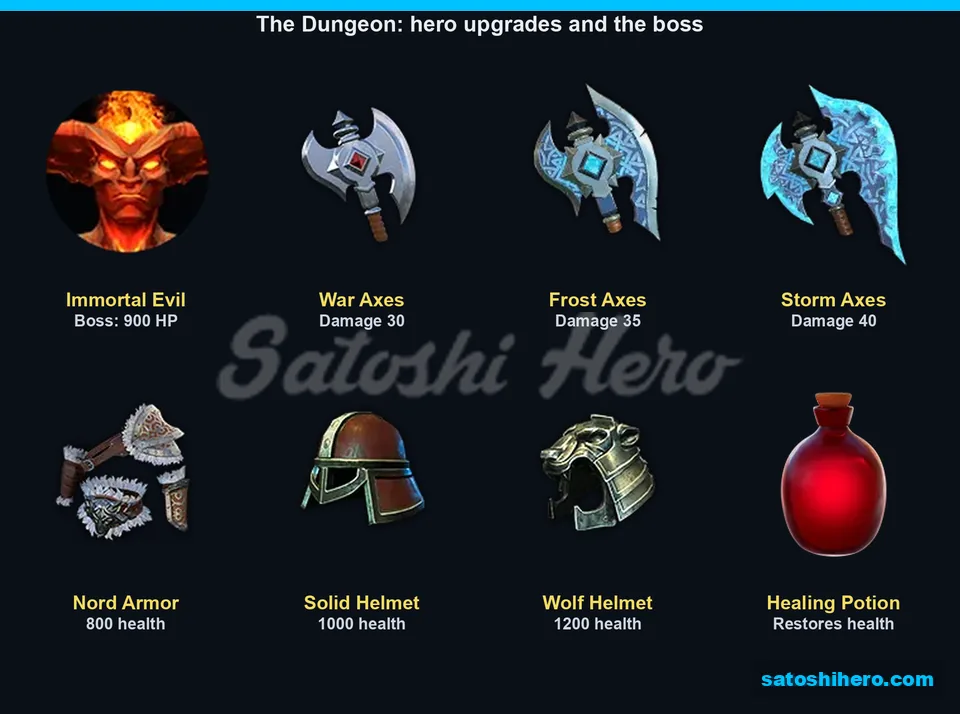
- Axes raise damage from 30 to 35, then 40.
- Armour sets total health at 800, 1,000, or 1,200.
- Finding the same equipment type twice raises it to level three.
- A healing potion restores the hero’s health completely.
The feature image displays Immortal Evil beside three axes, three armour pieces, and the potion. Check the hero portrait as you advance because it shows the equipment carried into later rooms. I like this visible progression, even though combat outcomes remain automatic.
Autoplay stops by default when the free-game mode triggers. That pause helps you notice the portal and inspect your equipment before the sequence continues.

Alert: Reaching the Dungeon doesn’t ensure completion. The hero can die before the boss, ending the feature and returning you to the base game.
Survival and equipment create the feature’s main tension. You can follow each upgrade, but you can’t steer the fight or force a safer outcome.
Controls, Turbo and Bestiary
The interface groups its main tools around the spin button, while holding that button opens autoplay. The Bestiary matters most because it replaces the standard symbol paytable you’d expect from reels. You’ll likely use it more than the settings menu while learning loot values.
Autoplay and turbo
Visible controls include:
- Turbo mode
- Autoplay with stop conditions
- Sound and settings
- Full-screen view
- Balance and bet controls
- Information button
- Hero equipment portrait
I used turbo mode for the 100-spin test, but I started and logged every paid spin individually. No bonus-buy control appeared in the demo, so finding a portal remained the practical route into the Dungeon. You can use the SatoshiHero demo to learn room notices, the loot panel, and each control before real play.
Holding the spin button opens autoplay without crowding the screen. I prefer single spins because room labels and loot pass quickly in turbo mode. Set autoplay limits before starting.
Reading the Bestiary
The Bestiary lists every monster alongside all possible loot values. When a colour appears, you should check the enemy too because identical tiers can pay very different coefficients. A common Gargoyle, for example, starts above several lower monsters’ common items.
This reference feels essential rather than optional. Without familiar reel symbols or a normal paytable, the game needs a fast way to explain each drop. The Bestiary remains the clearest route through this unusual payout system.
How the Base Game Played
Most of my 100 spins showed only one or two monsters, creating lively fights but frequent small balance declines. Just 29 spins returned money, and the longest non-winning run lasted 11 spins. You see action constantly, yet the loot panel can still remain empty.
Monster density
| Monsters shown | Spins |
|---|---|
| One | 49 |
| Two | 25 |
| Three | 15 |
| Four | 7 |
| Five | 4 |
Almost half the session contained one monster, while only four spins filled every position. More occupied spaces give you additional possible loot sources, but they don’t ensure any payout. This distinction matters because a crowded room can look far stronger than its final return.
The hero fought every spin, while my balance slipped through empty drops or returns below $10. Combat stayed watchable, though repeated one-monster rooms made the missing portal more noticeable.
Notable paid spins
- Spin 6: Five Gargoyles appeared, two dropped loot, and the result reached $210, or 21x.
- Spin 58: A smaller result returned $61, equal to 6.1x.
- Spin 63: The epic Mimic paid $62, which equalled 6.2x.
- Spin 72: A Skeleton and Succubus combined for $170, or 17x.
My balance peaked at $5,159 after the early Gargoyle hit. You might expect five matching-looking enemies to matter, but only the two actual loot drops created that payout. The later 17x result also showed how different monsters can combine without forming a conventional pattern.
I used the 500x-bet starting balance only as session context. It isn’t an amount you need, and it can’t guarantee a certain playing time. My honest assessment is mixed: the animations kept action visible, but single-monster rooms became repetitive while I waited for a portal that never appeared.
RTP, Volatility and Our Test
Dungeon: Immortal Evil has a 96.2% theoretical RTP, medium-high volatility, and a 6,316x maximum win. This profile can create uneven sessions, with gradual declines interrupted by occasional larger jumps. The cap looks substantial, but my ordinary play stayed dominated by smaller loot while I waited for a portal.
Simulator projection
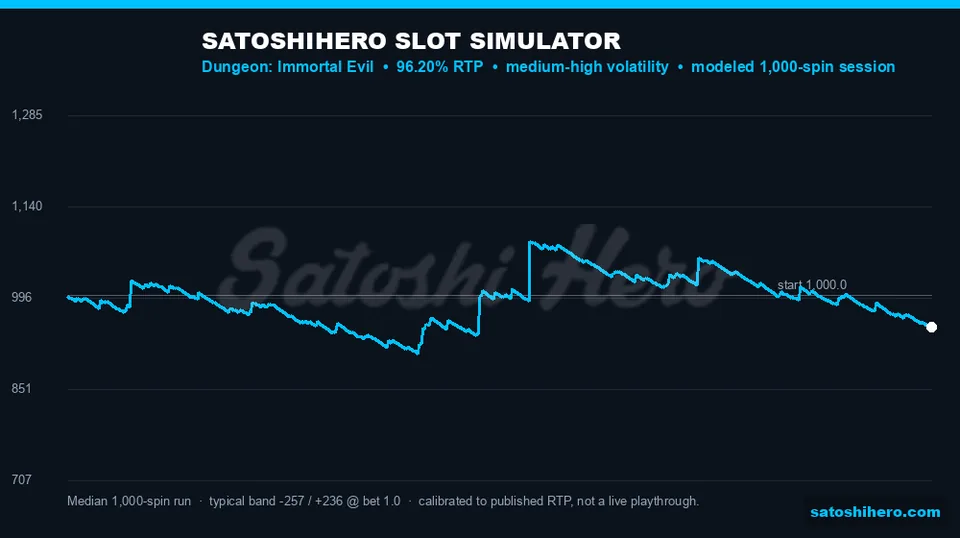
The SatoshiHero Slot Simulator modelled 1,000 spins at one bet unit:
- Median result: 50.0x the bet down
- Central 90% range: 256.6x down to 235.8x up
- Feature-sized win frequency: about once per 45 spins
- Very large win frequency: roughly once per 4,000 spins
Our model maps a range of possible outcomes. You shouldn’t treat these figures as a forecast or countdown, since rare results can fall anywhere.
The simulator image shows a blue line beginning at 1,000 bet units. It trends downward despite several sharp jumps, which captures the jagged path behind the median loss. In my view, that picture explains the risk more honestly than the median alone.
Our 100-spin session
- Starting balance: $5,000.00
- Bet: $10.00
- Ending balance: $4,705.00
- Net result: $295 lost, equal to 29.5x the bet
- Paying spins: 29 out of 100
- Biggest win: $210, equal to 21x, on spin 6
- Longest non-winning run: 11 spins
- Dungeon triggers: none
I initiated and logged every spin individually in turbo mode. The balance chart rises sharply after spin six, then shows smaller Mimic and 17x bumps before finishing lower. You can see how one strong opening hit failed to hold against many empty or low-paying rounds.
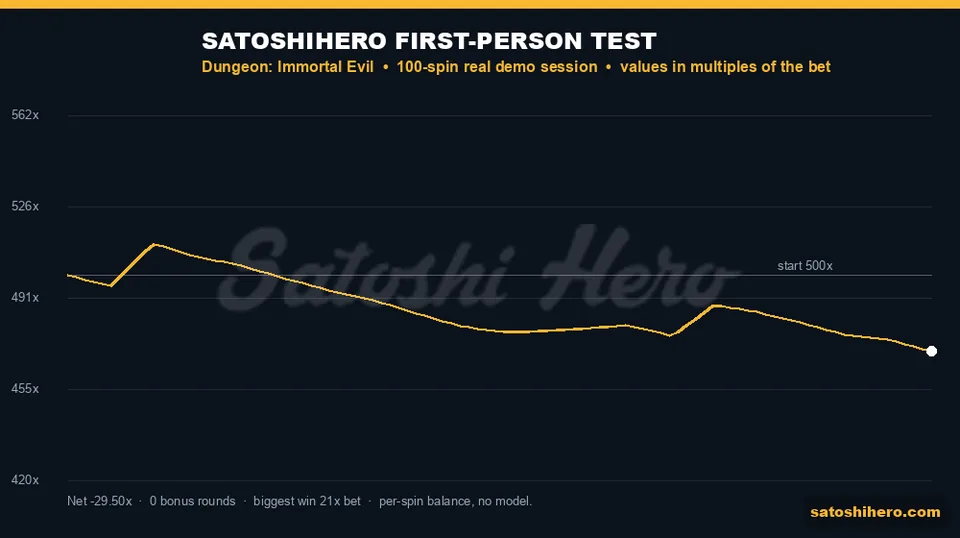
One short test describes my session, not yours. The early peak felt generous, yet the final $295 loss showed an uneven path. Visual action shouldn’t distract you from balance movement.
The 96.2% figure is the operator-published theoretical return, and one 100-spin session doesn’t alter it. The simulator maps possible outcomes rather than predicting an individual result; mode-specific percentages belong here only when exact verified figures exist.
Frequently Asked Questions About Dungeon: Immortal Evil
How do you win in Dungeon: Immortal Evil?
The game has no paylines or matching combinations. Each monster can independently drop loot, and that item’s coefficient multiplies your bet. Displayed values run from the Imp’s weakest 0.1x item to the boss’s 5,000x legendary loot.
What do the loot colours mean in Dungeon: Immortal Evil?
White means common, blue means uncommon, yellow means rare, violet means epic, and orange means legendary. Each colour marks a value tier for that particular monster. White always represents its lowest-paying item, so you also need to identify the enemy.
Which random events can happen in Dungeon: Immortal Evil?
Mimic and Chest each give five random loot types. Big Game fills every position and gives one main monster ten times its normal loot chance. Bad Company fills all positions while doubling the loot chance for each monster.
How does the Dungeon mode work?
A portal starts seven rooms, with six ordinary encounters followed by Immortal Evil. Cleared rooms provide gear or recovery items, but the feature ends if the hero dies. The portal didn’t appear during my 100-spin test.
Does Dungeon: Immortal Evil have a bonus buy?
No bonus-buy option appeared in the tested demo. I saw information, balance, bet, spin, turbo, sound, settings, and full-screen controls. Holding the spin button opened autoplay instead.
What does the Dungeon: Immortal Evil simulator show?
The 1,000-spin model produced a median result 50x the bet down. Its central range stretched from about 257x down to 236x up. That spread describes possible variation and can’t predict your own result.
What happened in the 100-spin test?
I started with $5,000 at a $10 bet and ended with $4,705. The session lost 29.5x the bet, while the biggest win reached 21x. Twenty-nine of the 100 spins paid something.
What are the Dungeon: Immortal Evil RTP and maximum win?
The theoretical RTP is 96.2%, the volatility is medium-high, and the maximum win reaches 6,316x the bet. Those figures describe the math profile, not a guaranteed session result.
Closing Thoughts
Dungeon: Immortal Evil stands out through its moving 3D hero, independent loot, and survival-style free-game rules. Its biggest drawback is repetition when single-monster rooms dominate and the portal stays hidden.

My Verdict
Action-RPG fans who accept uneven results should try the demo before risking a fixed budget. Expect frequent combat, many modest outcomes, and no promise that the Dungeon appears during a short session.
I like how the Gargoyle, Mimic, and mixed-monster wins made the loot system feel tangible. I don’t like that my 100 spins never reached the headline feature, while the balance slipped $295 after an early peak.
Dungeon: Immortal Evil offers a genuinely unusual alternative to standard reel combinations. This guide is updated periodically so its controls, presentation, and tested observations remain useful.

Pros:
 Distinct combat: Third-person fights give every spin visible action and personality.
- Readable loot: Colours and the Bestiary make enemy rewards easier to compare.
- Varied events: Four random encounters break up ordinary room sequences.
- Progressive feature: Dungeon gear adds clear survival tension across seven rooms.

Cons:
 Elusive portal: My test never reached the main free-game sequence.
- Repetitive rooms: Frequent single-monster spins made quieter stretches feel similar.
- Automatic combat: You can track upgrades but can’t influence battle decisions.

Best For: Dark-fantasy fans and patient bankroll managers get the strongest match here. You should enjoy RPG imagery, unusual payout logic, and uncertain feature access rather than conventional reel patterns.


































































Bets
All Bets
Game
Player
Date
Wager
Mult.Multiplier
Prize
 Luck of Panda: Bonus Combo
 Hidden
- 18:30:24
- 0×
- San Chong Baozha Blue: Bonus Combo
 mike_721
- 18:30:24
- 0×
- Luck of Panda: Bonus Combo
- josh1998
- 18:30:23
- 0×
- Egypt Fortunes: Bingo Bounty
- nina87
- 18:30:22
- 0×
- Sugar Rush Super Scatter
 Hidden
- 18:30:22
- 1.04×
- Luck of Panda: Bonus Combo
- Hidden
- 18:30:21
- 0×
- San Chong Baozha Blue: Bonus Combo
- mike_721
- 18:30:21
- 0×
- Luck of Panda: Bonus Combo
- Hidden
- 18:30:18
- 0×
- San Chong Baozha Blue: Bonus Combo
- mike_721
- 18:30:18
- 0×
- Almighty Diamonds: Hold 'N' Link
- Hidden
- 18:30:17
- 0×