

Arrow Slot
By pressing play, you agree that you are above legal age in your jurisdiction and that your jurisdiction allows online gambling.

Arrow Slot
RTP97.33%
VolatilityMedium
Max winx3,600
Lines3
Hit rate2.5%
ReleasedApr 2025
Live game stats
Real RTP71.74%
Spins336
Players1
Biggest win$1.92

Follow the Neon Arrow to Multiplied Line Wins
Follow Arrow Slot’s neon board upward as numbered centre values connect with multipliers across three fixed paylines.
Quick Summary: Arrow Slot is a synthwave, medium volatility slot from Bgaming with an unusual central-cell system. According to BGaming, its 97.33% theoretical RTP, 3,600x maximum win, and three fixed paylines combine on a 3-reel, 3-row arrow board. Frequent small returns, line multipliers, and occasional feature chances give patient players the clearest reason to try it.
Key Takeaways
- Tested setup: You can compare my results only with standard $1.00 play; I didn’t test either paid option.
- Return profile: Arrow Slot pairs a 97.33% theoretical RTP with medium volatility.
- Win ceiling: The official maximum win reaches 3,600x the bet.
- Paid-option risk: You pay 20% more with Chance x2, while Buy Bonus commits 50x immediately.
- Bankroll result: My balance lost 54.2x across 100 spins despite 41 paying results.

Table of Contents
- How Arrow Slot Works
- Central cell values
- Special pieces
- Theme and First Impressions
- Neon road setting
- Look and usability
- Chance x2 Spin Mode
- Extra spin cost
- What I tested
- Respin Feature
- Trigger and locks
- Test results
- Multipliers and Line Wins
- Line calculation
- Recorded example
- Wheel Bonus
- Central-cell trigger
- Wheel values
- Buy Bonus
- Purchase price
- Test limitations
- RTP, Volatility and Our Test
- Simulator projection
- Our 100-spin session
- Frequently Asked Questions About Arrow Slot
- Summing It Up
How Arrow Slot Works
Arrow Slot pays from a numbered central cell across three fixed lines. It isn’t a cluster, pay-anywhere, or Megaways game, so you read each line separately.
Central cell values
The 3-reel, 3-row board forms an arrow rather than a normal rectangle. Its large top diamond acts as the central cell and supplies the base pay instead of showing a usual reel symbol. At a $1.00 bet, the complete ladder reads:
- $0.20
- $0.40
- $0.60
- $0.80
- $1.00
- $1.20
- $1.60
- $2.00
- $3.00
Those amounts equal 0.2x through 3x your total bet. A plain central value pays its displayed amount when no relevant multiplier touches its line. I saw $0.20 to $0.80 values regularly, and each returned less than my $1.00 stake.
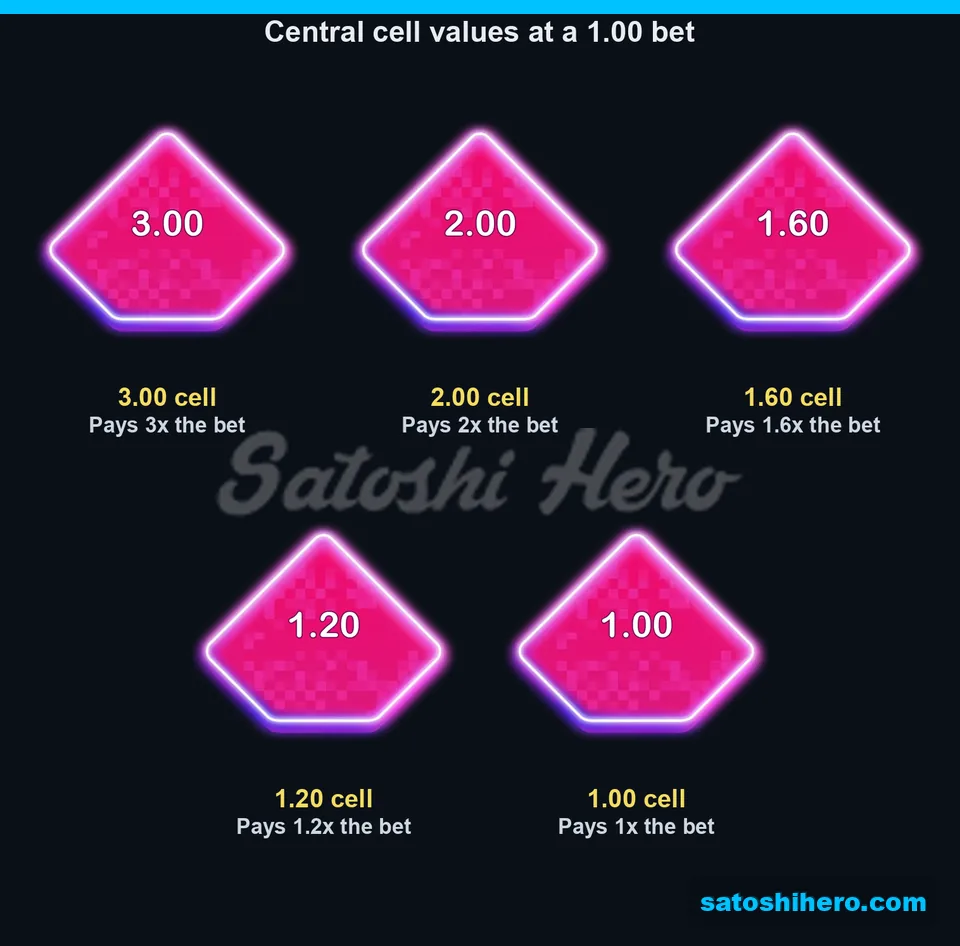
Unless I identify a cash balance or direct cost, session results express multiples of the total bet.
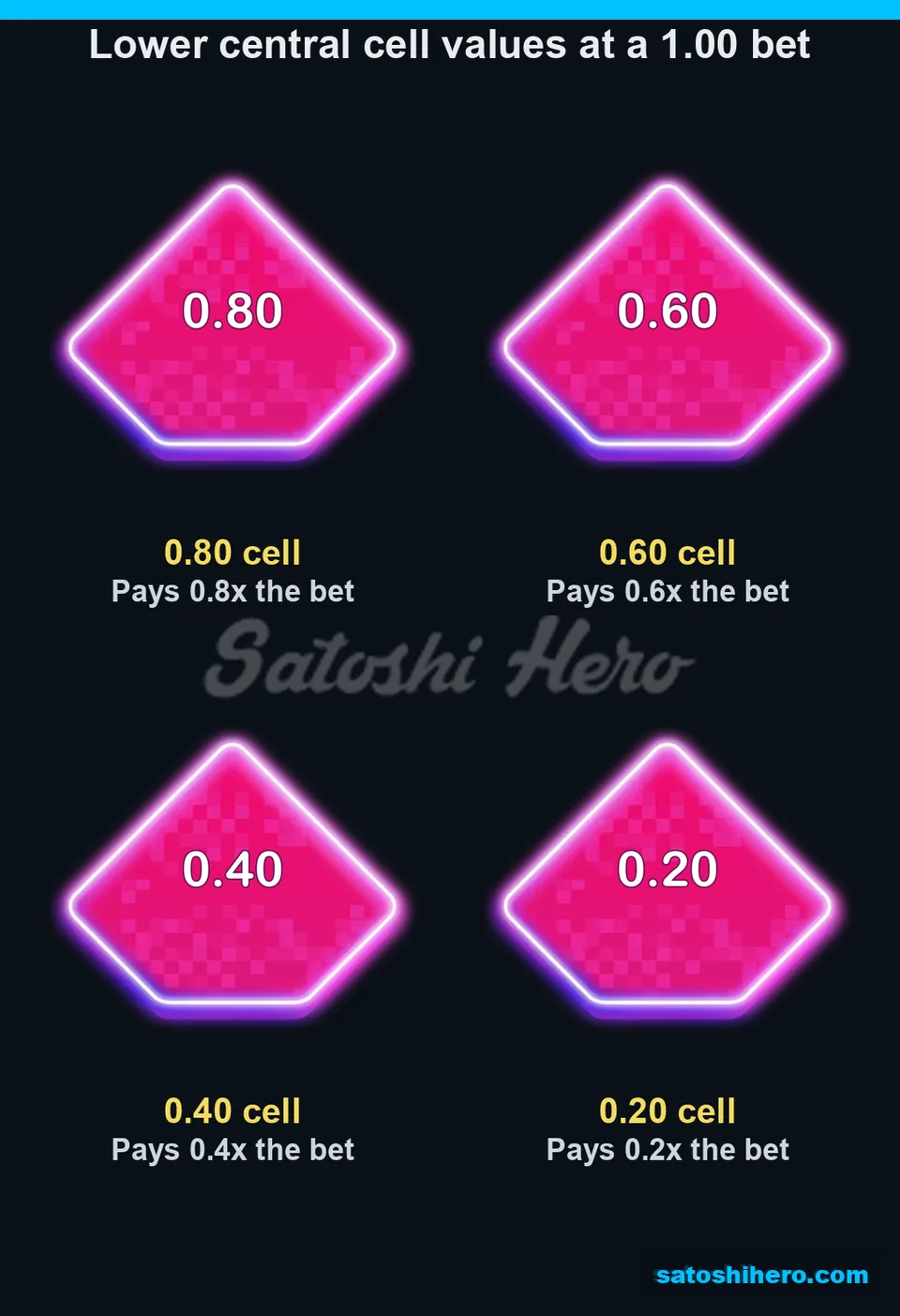
The compact board and visible controls remain the core interface on desktop and mobile. You don’t need a wide screen to identify the large centre diamond, although the unusual geometry takes several spins to learn.
Special pieces
You won’t find card ranks, fruit, gems, Wilds, or Scatters here. Multiplier cells, the Respin symbol, and the central Wheel Bonus symbol handle every special outcome. Compared with conventional Arrow Slot machines, the numbered design feels more like reading a compact calculation than matching pictures.
Slot Machine provides a useful reference point if you prefer familiar reels and symbol combinations. For two more BGaming alternatives on SatoshiHero, compare Train to Rio Grande and Winter Fishing Club. This game asks you to scan the central value first, then trace the three lines around it. The strange shape changes how you read a result, but it doesn’t alter the fixed-line foundation.

Highlight: The $3.00 central cell is the highest plain value at a $1.00 bet; larger returns need line multipliers or bonus mechanics.
Check the central amount first, then inspect each connected line independently.
Theme and First Impressions
The synthwave theme looks familiar, but the arrow-shaped play area gives the presentation a clear identity. You can understand the visual hierarchy quickly because the largest diamond always draws attention upward.
Neon road setting
A glowing sun hangs above a dark road lined with palm trees. Pink and purple diamond cells sit over that landscape, forming an arrow aimed at the sky. The large top diamond creates the arrowhead, while a stem and diagonal arms build the lower board.

That upward shape guides your eye toward the central payout cell without extra prompts. I found the composition useful rather than decorative, since the position carrying the base amount never gets lost among smaller cells. The scene has no characters or story, and I don’t think it needs them.
Look and usability
The interface shows your balance, total bet, spin control, Chance x2 arrow, and Buy Bonus arrow. Active cells remain visually separate from those controls, so you can follow a result without confusing a paid option for part of the board.
The synthwave setting won’t win originality awards, but the shaped board has more personality than another rectangular neon grid. Controls stayed clear during quick spin, while the centre value remained readable throughout my session. That’s the right priority for a game built around line calculations.

Notable Detail: The diamond cells form a complete upward-pointing arrow, with the largest top diamond doubling as the central payout cell.
The design serves the mechanic well because you can locate the base value immediately.
Chance x2 Spin Mode
Chance x2 is an optional mode that raises a $1.00 spin to $1.20. You pay an extra $0.20 each time it stays active, which increases the cost by 20%.
Extra spin cost
The surcharge repeats on every activated spin, unlike Buy Bonus and its one-off purchase. One hundred Chance x2 spins cost $120.00 instead of $100.00 at the same displayed base stake. That difference can remove another twenty standard spins from your planned budget.
No published figure here proves that the mode improves feature frequency, return, or overall value. You should treat the added amount as a known cost, not evidence of a better outcome. In my view, the small-looking toggle makes its budget impact too easy to overlook.
What I tested
I left Chance x2 off throughout all 100 spins. My 54.2x loss, 41 paying spins, and 10x best hit came solely from standard $1.00 play. Those results can’t show whether paying the surcharge would have changed the experience.
Standard play is the only setup backed by my session, though that doesn’t make it universally superior. The test opened with a $1,000.00 play-money balance, and the selectable bet range ran from $0.05 to $70.00. Both the free demo and real-play game are available here on SatoshiHero.

Expert Advice: Measure the extra $0.20 against your complete session budget. Across many spins, it becomes a meaningful cost rather than a minor toggle.
Decide your total spend before you activate this mode, not after several costly spins.
Respin Feature
A Respin symbol lands outside the central cell with a multiplier and locks existing multipliers for another filling attempt. You may see plenty of promising cells, yet only the final line result determines whether they pay.
Trigger and locks
The symbol can occupy any cell except the central one. It arrives carrying x2, x3, x4, x5, or x10, and that multiplier stays locked beside every multiplier already present. Empty positions then get another chance to fill.
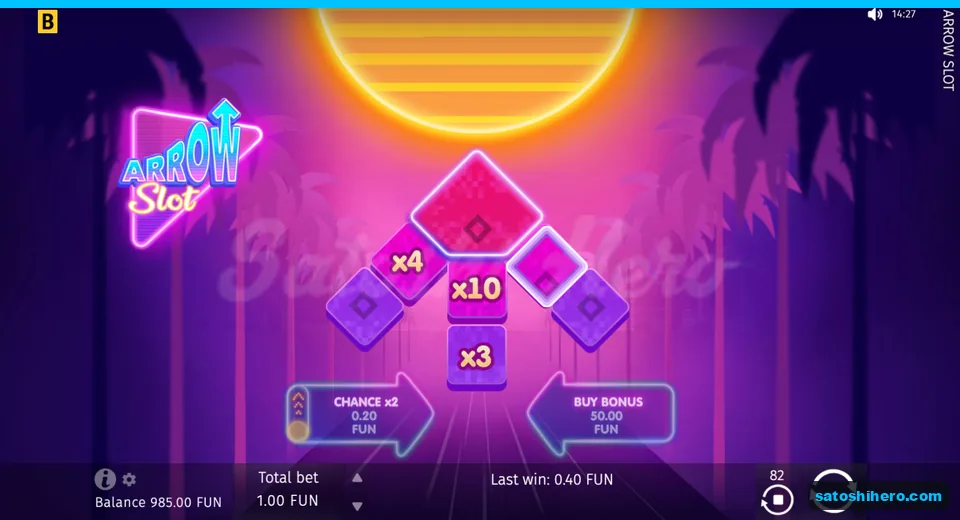
My first trigger paused until I pressed the spin button once. After that input, the remaining respins continued automatically, which felt slightly inconsistent but easy to follow. If you see x4, x10, and x3 cells together, each remains fixed while open spaces cycle.
Test results
I triggered two Respin sequences during 100 standard spins. The first lasted three respins, while the second stopped after one. Neither sequence created a payout, so their striking locked boards added $0.00 to my balance.
Several fixed multipliers look exciting because the screen appears to build toward a larger calculation. My tests showed the uncomfortable counterpoint: a strong-looking board can still produce nothing. Two triggers can’t establish a reliable frequency, and you shouldn’t read them as a promise about another session.
The feature added the most tension outside the wheel, but its two failures made the base game’s small returns more important. Judge the settled paylines, not the number or size of locked multiplier cells.
Multipliers and Line Wins
Each line multiplies the central amount only by adjacent multiplier cells assigned to that line. You mustn’t combine every visible multiplier, because the three paylines settle independently.
Line calculation
Multiplier cells carry x2, x3, x4, x5, or x10 values. Their position matters as much as their size, and a large cell on another line doesn’t help your active result. Read each outcome in this order:
- Find the central amount.
- Identify the active line.
- Apply only multipliers connected to that line.
- Check the displayed line payout.
This sequence makes the arrow board much easier to understand. You can ignore unused branches instead of trying to calculate the whole screen at once. I needed several spins to trust the line message, but the logic became clear once I stopped treating all cells as one chain.
Recorded example
My clearest example began with a $0.40 central value. The board displayed x2, x3, x2, and x4 multipliers, yet the final result reached $3.20. That payout equals eight times $0.40, and the interface stated that Line 1 paid.
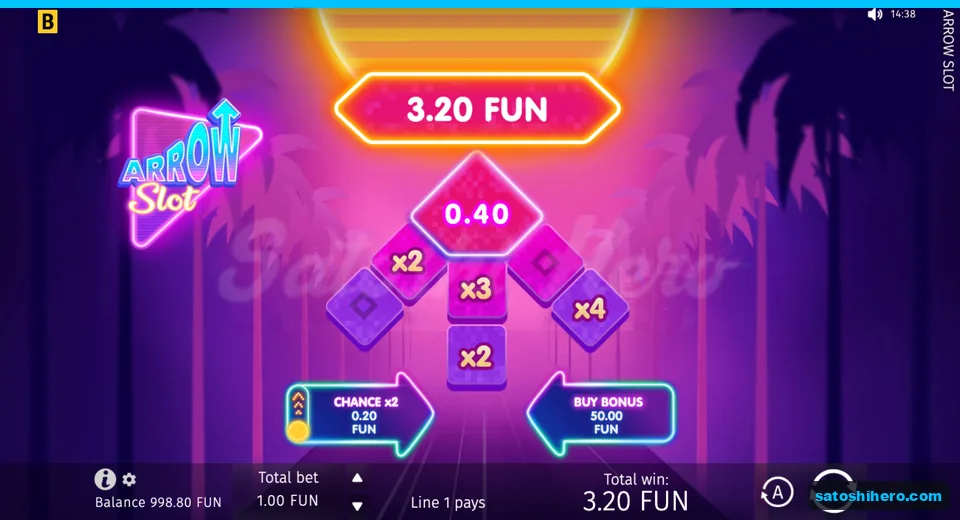
Unused multipliers explain why multiplying the entire board gives the wrong answer. Match the $0.40 centre to its connected cells and the $3.20 result, then disregard unrelated positions. The outcome was better than many sub-stake hits, although it still wasn’t my 10x session high.
Large multiplier numbers can dominate your attention, but geometry controls their usefulness. Follow the winning line before you estimate any return.
Wheel Bonus
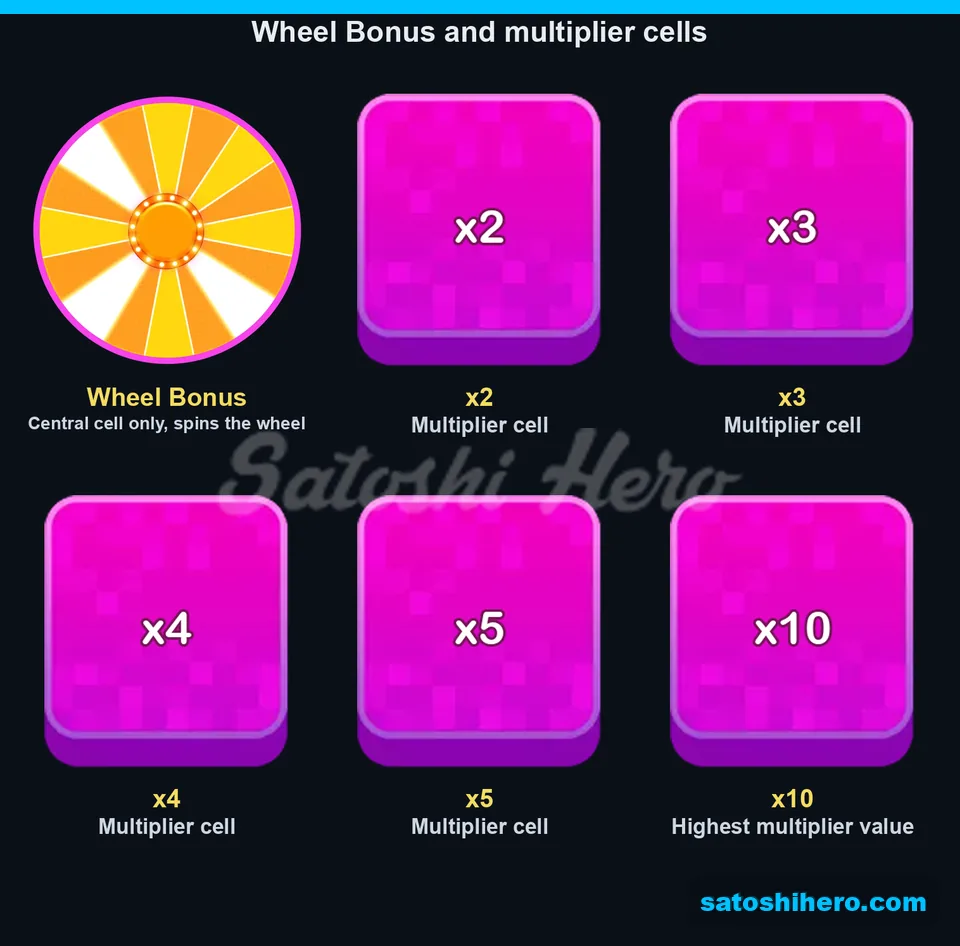
The Wheel Bonus starts only when the Bonus symbol appears in the central cell. You then receive the wheel’s stopping value as a base award, with applicable board multipliers able to increase it.
Central-cell trigger
The game opens a Wheel of Fortune above the board after the central trigger. Existing multipliers can affect the wheel value when they belong to the relevant line structure. You shouldn’t assume every visible multiplier applies automatically.
This feature uses the board’s most important position, making the trigger easy to recognize. I consider it the most visually interesting event because it temporarily expands the compact play area. Its central placement also prevents confusion with the Respin symbol, which can’t occupy that cell.
Wheel values
At a $1.00 stake, the wheel contains these ordinary cash-value segments:
- $0.20
- $0.30
- $0.50
- $1.00
- $1.50
- $2.00
- $2.50
- $5.00
- $10.00
- MAX WIN
MAX WIN appears as a named segment rather than another cash amount. No observed information establishes the chance of reaching any segment, so you can’t infer frequency from the wheel layout.
The Wheel Bonus never triggered during my 100 spins. I therefore have no first-hand wheel payout to report, and I won’t pretend the rules-panel values mirror a played result. Its absence left the base game and two unsuccessful Respins carrying the entire session.
Treat the wheel as a possible highlight, not an event that your budget can schedule.
Buy Bonus
Buy Bonus costs $50.00 at a $1.00 base bet, equal to 50x the stake. You commit the equivalent of 50 standard spins immediately for one concentrated feature result.
Purchase price
A single purchase would consume 5% of the tested $1,000.00 starting balance before its outcome. Chance x2 spreads smaller surcharges across spins, but this option makes one large deduction at once. That concentration changes the shape of your risk even when your nominal base bet remains $1.00.
The purchase doesn’t guarantee the largest prizes, and nothing here supports a claim of improved expected value. I find the 50x price substantial beside a base game that often returned only 0.2x to 0.8x. You need to assess the full deduction, not just the excitement of immediate feature access.
Test limitations
I made no bonus purchase during the session. Any purchased-round result, feature frequency, or separate return figure would therefore be invented, so my evidence applies only to standard spins. This option isn’t the proven best way to play.
The practical choice concerns risk concentration. One result replaces many separate base-game decisions, leaving fewer chances to stop, lower your bet, or preserve part of the balance. If you prefer gradual spending, the purchase works against that control.

Risk Note: A 50x purchase removes the equivalent of 50 standard spins from your balance immediately. I didn’t test it, so no first-hand result supports the extra risk.
Treat the full 50x charge as a complete session expense, not a small side bet.
RTP, Volatility and Our Test
The 97.33% theoretical RTP pairs with medium volatility, while my session delivered many small returns and still lost 54.2x. You can see a steady hit rhythm without receiving enough money to protect the balance.
The medium rating matched the short session’s relatively gentle pace, though one test can’t prove a mathematical volatility classification. Simulator outputs and played results answer different questions, so you shouldn’t merge them into one prediction.
Simulator projection
The SatoshiHero Slot Simulator modeled 1,000 spins at a fixed $1.00 stake using the stated game parameters. Its middle outcome finished 33.4x down, while the typical modeled band stretched from 207.3x down to 180.5x up. Roughly one-quarter of simulated spins returned something.
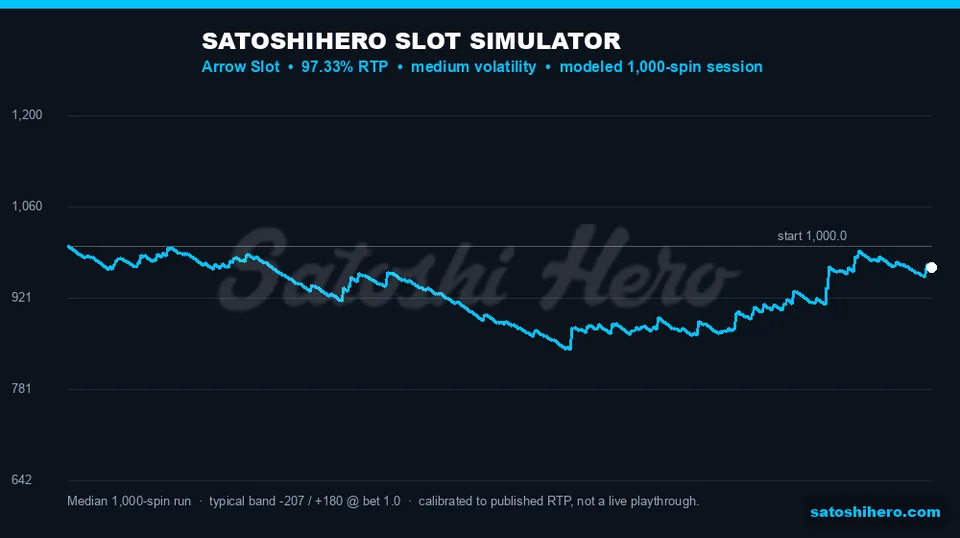
A modeled top-tier win appeared approximately once per 12,658 spins. That result illustrates how widely sessions can spread, not when a major hit should arrive. The simulator can’t predict your next spin or time a Wheel Bonus.
I find the broad range more useful than the middle figure alone. It shows why two equal budgets can finish far apart, even under identical assumptions. Use the projection to understand uncertainty rather than set a target return.
Our 100-spin session
My balance fell from $1,000.00 to $945.80, producing a 54.2x loss at a fixed $1.00 stake.
- Starting balance: $1,000.00.
- Ending balance: $945.80.
- Paying spins: 41 out of 100.
- Largest win: 10x.
- Respin triggers: two, both unsuccessful.
- Wheel Bonus triggers: none.
Most payments came from 0.2x to 0.8x central values without useful multipliers. My balance reached $946.80 by spin 85, then a 10x win on spin 88 lifted it to $954.60. The final 12 spins pushed it back to $945.80.
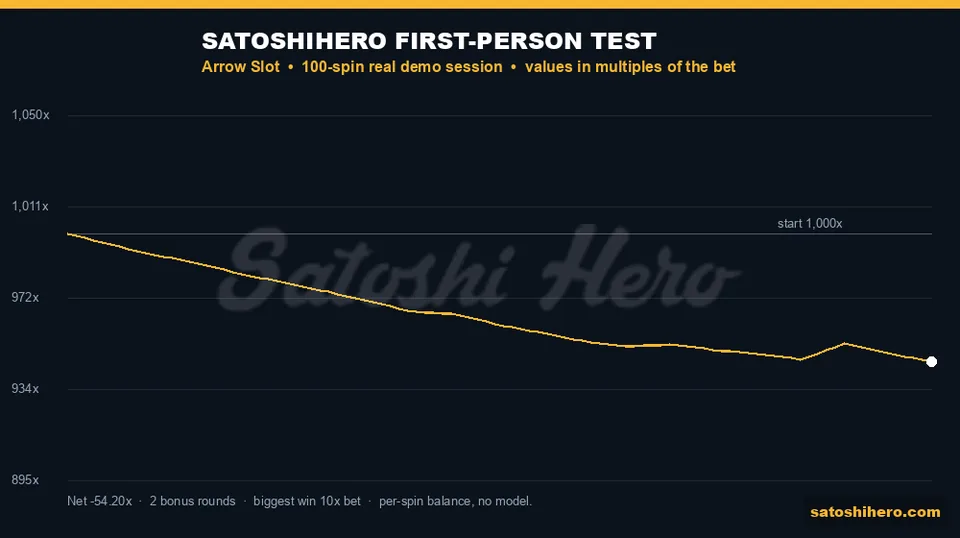
The session felt gentler than its ending because payments appeared often. Yet sub-stake returns steadily drained the balance, proving that hit count and profitability measure different things. You may feel busy while still losing ground.
That contrast shaped my strongest impression of the game. Forty-one paying outcomes sound healthy in isolation, but many merely returned part of the $1.00 cost. The late 10x hit improved the balance briefly without repairing the earlier decline. If you track only celebratory animations, this pace can look kinder than the account history shows. I’d track net movement beside hit count, especially when central values repeatedly stay below 1x.
Math and source note: The stated RTP is the operator’s published theoretical return. My 100-spin result doesn’t alter it, and simulator distributions illustrate possibilities rather than forecasts. Separate return figures shouldn’t be inferred for Chance x2 or Buy Bonus without published evidence.
The small-hit-heavy pace rewards patience more than expectations of frequent large features.
Frequently Asked Questions About Arrow Slot
How does Arrow Slot work?
A numbered central cell supplies the base amount on a 3-reel, 3-row arrow board. Plain values range from 0.2x to 3x, while surrounding x2 to x10 cells can multiply connected results. Three fixed paylines settle separately, so only multipliers assigned to the active line affect that line’s payout.
What are Arrow Slot’s RTP and volatility?
Arrow Slot has a 97.33% theoretical RTP and medium volatility. Its official maximum win reaches 3,600x the bet. Those figures describe the game’s mathematical profile, but they don’t promise any single session outcome or feature trigger.
What does the Respin symbol do in Arrow Slot?
The Respin symbol lands outside the central cell with an x2, x3, x4, x5, or x10 multiplier. Existing multiplier cells lock while empty positions respin. I triggered it twice, with one three-respin sequence and one single respin, but both rounds returned $0.00.
How does the Wheel Bonus trigger in Arrow Slot?
The Bonus symbol must occupy the central cell to open the wheel. Its stopping value supplies the base award before applicable multipliers, with ordinary segments from $0.20 to $10.00 plus MAX WIN at a $1.00 stake. It didn’t trigger during my 100-spin test.
What are Chance x2 and Buy Bonus?
Chance x2 adds $0.20 to a $1.00 spin, raising its cost by 20%. Buy Bonus charges 50x the base bet as one immediate purchase. I used neither paid option, so my session results apply only to standard $1.00 spins.
What does the 1,000-spin simulator project?
The model’s middle result finished 33.4x down. Its typical band ran from 207.3x down to 180.5x up, while a top-tier win appeared approximately once per 12,658 spins. These outputs illustrate a range of sessions and can’t forecast your next result.
How did the 100-spin Arrow Slot test go?
I started with $1,000.00 and ended at $945.80, losing 54.2x at a $1.00 stake. Forty-one spins paid, and my largest win reached 10x. Both Respin sequences returned nothing, while the Wheel Bonus never appeared.
What is the maximum win in Arrow Slot?
The official cap is 3,600x the bet. My strongest result reached only 10x during 100 spins, which shows how far a short test can finish below the ceiling. A limited session shouldn’t be expected to approach the largest possible outcome.
Summing It Up
Arrow Slot turns a simple base value into a readable three-line multiplier puzzle with an unmistakable board. Its main drawback is that frequent sub-stake hits can disguise a steadily shrinking balance.

My Call
Play standard spins first if you value evidence over feature promises. Expect many small results, occasional multiplier tension, and no assurance that the wheel appears within a modest session.
I like how quickly the centre-first calculation becomes readable. I don’t like that two lively-looking Respins paid nothing, while 41 paying spins still left my balance 54.2x lower.
Arrow Slot remains easy to understand once you trace each line separately, and the game facts and tested controls are checked regularly.

Pros:
 Strong theoretical return: According to BGaming, the theoretical return is 97.33%.
- Distinct board: The arrow shape makes the central value easy to locate.
- Readable multipliers: Separate line messages help you verify connected cells.
- Frequent activity: Forty-one paying spins kept my short session visually busy.

Cons:
 Weak small hits: Many 0.2x to 0.8x returns still reduce your balance.
- Unproductive Respins: Both tested sequences ended without any payout.
- Concentrated purchase risk: Buy Bonus removes 50x before one result resolves.

Best For: Patient players who enjoy compact line calculations, visible multiplier positions, and a steady rhythm of small returns. Budget-focused readers should start with standard play and treat both paid options cautiously.































































Bets
All Bets
Game
Player
Date
Wager
Mult.Multiplier
Prize
 4 Lucky Nuggets
 whodey39311
- 00:16:38
- 0×
- 3 Witches: Bonus Combo
 bjgrandy149
- 00:16:37
- 0×
- 3 Witches: Bonus Combo
- bjgrandy149
- 00:16:35
- 0.05×
- 3 Witches: Bonus Combo
- bjgrandy149
- 00:16:32
- 0×
- Book Of Nile: Magic Choice
 Hidden
- 00:16:32
- 11×
- 3 Witches: Bonus Combo
- bjgrandy149
- 00:16:30
- 0×
- Galaxy Glitter
 Hidden
- 00:16:30
- 0×
- 4 Lucky Nuggets
- whodey39311
- 00:16:28
- 0×
- Royal Fruits 9: Hold 'n' Link
- nina87
- 00:16:28
- 0×
- 3 Witches: Bonus Combo
- bjgrandy149
- 00:16:28
- 0×