

Wild Card Gang
By pressing play, you agree that you are above legal age in your jurisdiction and that your jurisdiction allows online gambling.

Wild Card Gang
RTP97.25%
VolatilityVery high
Max winx5,000
Hit rate3.04%
ReleasedFeb 2025
Live game stats
Real RTP53.08%
Spins205
Players1
Biggest win$189

Cards, Crime and Cluster Wins
Wild Card Gang turns card symbols into a gritty cluster chase, where every paid group can upgrade into something stronger.
Wild Card Gang is a very-high volatility slot from Bgaming with 97.25% RTP and 5,000x max win potential. It uses a 6×6 grid with cluster pays, Merge Up symbol upgrades and Joker scatters instead of paylines. Aimed at risk-aware cluster fans who like active base games and clear grid mechanics.
Key takeaways
You can try demo or real play here on SatoshiHero, with bets from $0.20 to $50.00.
- Cluster wins: You need 4 or more matching symbols touching horizontally or vertically, and diagonal contact doesn’t count.
- RTP / volatility: Wild Card Gang has 97.25% RTP, very-high volatility and a 5,000x maximum win.
- Best play: Merge Up drives the action because paid symbols can upgrade and create chained wins.
- Best bonus: Free spins need 4 or more Jokers, while Buy Bonus costs 100x the bet.
- Risk note: Chance x2 adds 25% to each spin cost, so you need a firm limit before using it.
- Bankroll note: My 100-spin test at $0.60 ended 17.4x down, with 34 paying spins.

Table of Contents
- How Wild Card Gang Works
- Cluster win rules
- Symbol pay ladder
- Theme & First Impressions
- Crime-slot styling
- Table presence
- Merge Up Feature
- Upgrade ladder
- Chain potential
- Joker Scatter
- Scatter creation
- Trigger target
- Free Spins Multipliers
- Marked cells
- Retrigger rules
- Buy Bonus and Chance x2
- Bonus buy cost
- Chance toggle
- How It Played Across 100 Spins
- Base-game rhythm
- Session result
- RTP, Volatility & Our Test
- Simulator projection
- Our 100-spin session
- Frequently Asked Questions About Wild Card Gang
- Summing It Up
How Wild Card Gang Works
Wild Card Gang pays through 4+ symbol clusters on a 6×6 grid, so you watch connected groups rather than lines. You need matching symbols to touch horizontally or vertically, and diagonal groups don’t count. The game has no fixed paylines, no wild symbol and one special symbol, the Joker scatter.
The Joker also sits at the top of the Merge Up ladder, which gives the slot its main push. I like this structure because you can read the whole board quickly, even when small wins chain together. The 6×6 grid and side panels stay easy to read on desktop, while quick spin keeps mobile play snappy.
Cluster win rules
Cluster wins form anywhere on the board if four or more identical symbols connect by side contact. You don’t follow left-to-right paths here, so scan the whole grid for touching groups. That matters because a corner cluster can pay just as clearly as a central one.
In my base-game screenshot run, a small cluster win paid $0.30 and then fed the merge list beside the grid. That running list helped me track how the spin reached its final total. The board can look busy, but the pay logic stays cleaner than many cluster slots.
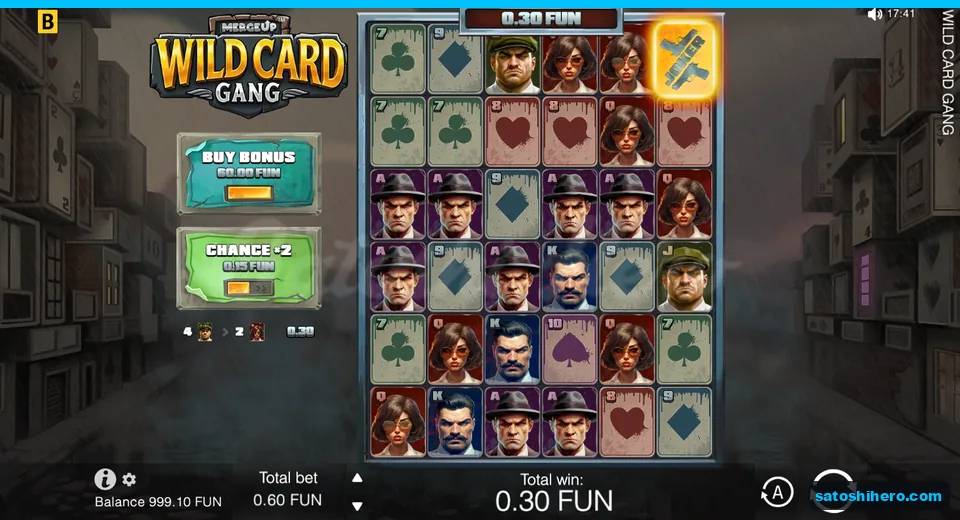

Highlight: Wild Card Gang has cluster pays, not paylines, so four matching symbols can pay anywhere on the 6×6 board if they touch horizontally or vertically.
Symbol pay ladder
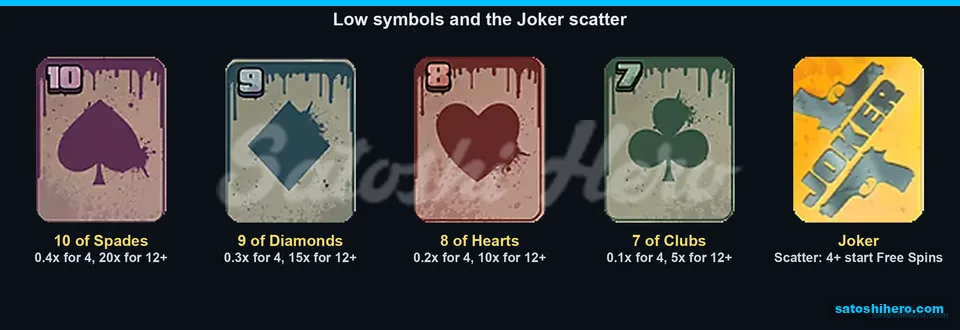
Ace is the highest regular symbol, and it pays 1x for four symbols or 50x for 12 or more. King, Queen and Jack sit below it, while battered suit cards make up the lower pays. You don’t need every table value memorised, but you should know that larger clusters scale sharply.
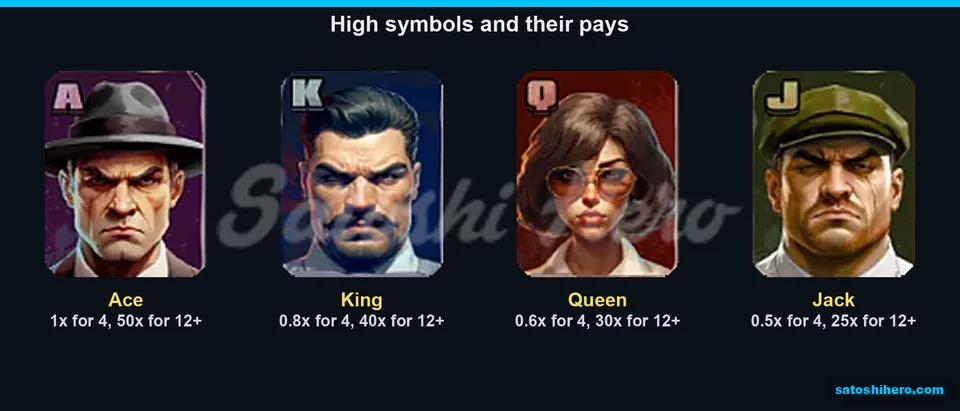
The Joker scatter sits above Ace in the ladder, though it doesn’t substitute for other symbols. I found that distinction important during play because a Joker feels valuable, yet it won’t complete a normal cluster. Merge Up matters because better symbols can appear through paid clusters, not only fresh drops.
Theme & First Impressions
The slot looks like a gritty comic-book crime card game, not a realistic gangster story. You get a steel-framed 6×6 card grid over a rainy city street, and the whole table has a grimy, low-lit feel. It isn’t subtle, but you can read the symbols without squinting.
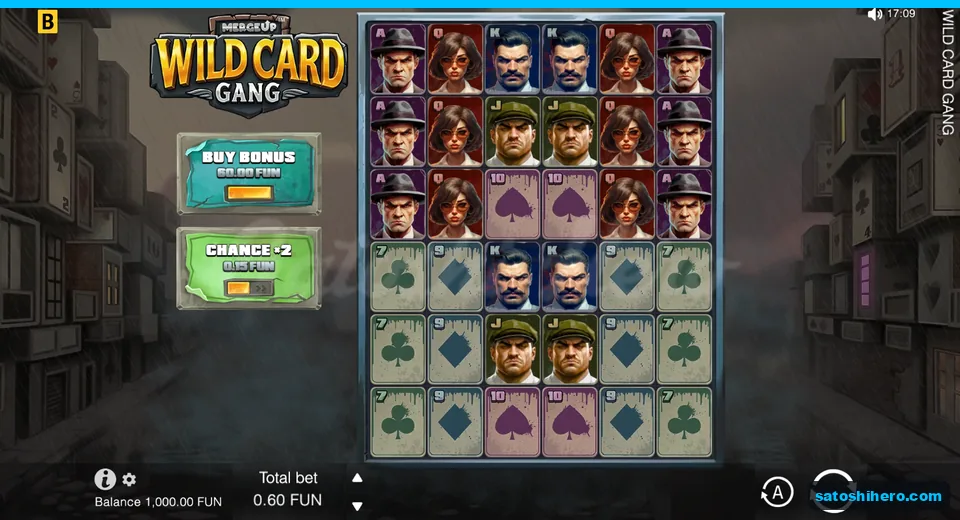
High symbols carry most of the personality: a fedora Ace, a mustached King, a Queen in sunglasses and a Jack in a green cap. The low cards look battered, with 10, 9, 8 and 7 suit cards filling the cheaper end. The Joker scatter shows two crossed pistols on a gold card, which makes it hard to miss.
Crime-slot styling
The theme leans more toward comic-book card gang than deep crime drama. That choice helps, because you need symbol clarity more than story in a fast cluster game. The artwork won’t win originality awards, but the symbol design makes the merge ladder easy to follow.
If you prefer animal-themed action over crime-card styling, Wild Tiger may feel closer to that mood. Here, the appeal comes from sharper card faces and a darker table. You can tell where each rank sits after only a few spins.

Notable Detail: The theme uses card ranks as mobster characters, which helps the symbol ladder feel readable during fast spins.
Table presence
The interface keeps the grid, balance, total bet and bonus buttons visible without clutter. Buy Bonus and Chance x2 sit on the left as grimy slabs, and they stay clear during base play. I liked that because you always know when paid options are off.
During my test, the merge list and bet values stayed readable at quick speed. That matters more than flashy background detail when chains start running. You can judge the table quickly, which keeps the game from feeling messy.
Merge Up Feature
Merge Up is the core mechanic because paid clusters leave upgraded symbols behind and can extend a spin. After a cluster pays, part of that cluster disappears, while the remaining symbols upgrade to the next symbol level. New symbols then drop into the gaps, so one spin can chain through several merge events.
This is where the slot feels more active than a plain cluster game. Small wins don’t always feel flat, because even a modest cluster can leave something better behind. You still shouldn’t treat every chain as value, since plenty of upgrades end quickly.
Upgrade ladder
The nine levels run in this order: 7 of Clubs, 8 of Hearts, 9 of Diamonds, 10 of Spades, Jack, Queen, King, Ace and Joker. That ladder gives you a simple route from low cards toward bonus pressure. You can feel the board improve when face cards start grouping.
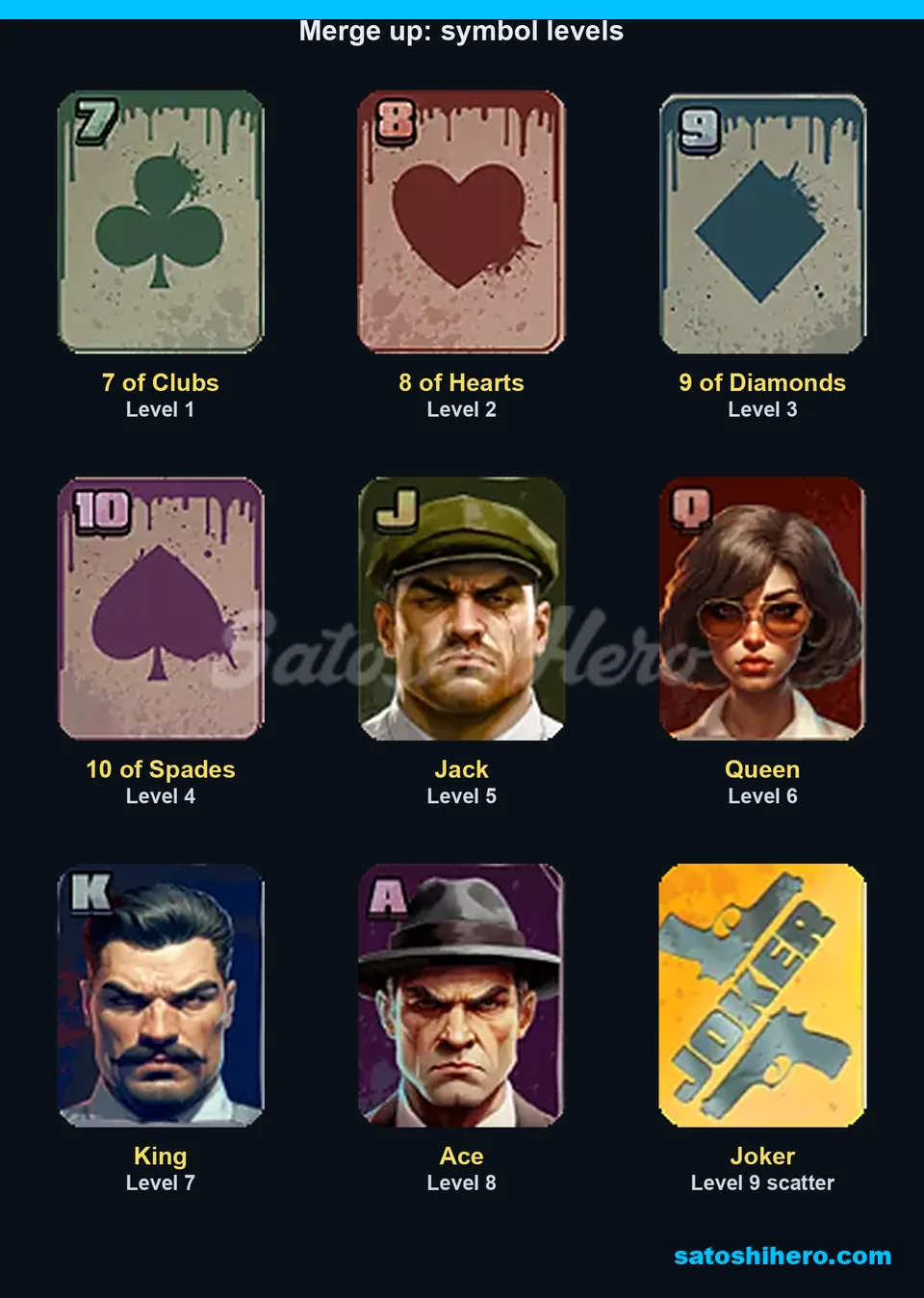
Cluster size controls how many upgraded symbols stay behind:
- 4 or 5 symbols leave 2 upgraded symbols.
- 6 or 7 symbols leave 3 upgraded symbols.
- 8 or 9 symbols leave 4 upgraded symbols.
- 10 or 11 symbols leave 5 upgraded symbols.
- 12 or more symbols leave 6 upgraded symbols.
That scaling gives larger clusters two jobs: they pay more and leave more upgraded material. I like that design because it rewards board shape, not just symbol value. You still need new drops to cooperate, which keeps the mechanic volatile.
Chain potential
In my spins, four Jacks turned into two Queens for a $0.30 win. That wasn’t a big result, but it showed the engine clearly. The game kept a running merge and pay list beside the reels, which helped me see where the total came from.
Long chains can take longer to play out because each merge gets its own animation. I pressed spin during some longer chains to skip ahead, and that made quick sessions smoother. You get more control over rhythm than the theme first suggests.

Expert Advice: Watch the merge list on the left if you want to understand where a total win came from; the final number can hide several small upgrades.
Joker Scatter
The Joker triggers free spins, but it isn’t a wild. It can land anywhere on the grid, acts as the scatter and also marks the final level of the Merge Up ladder. Four or more Jokers in view can trigger the free spins feature.
Wild Card Gang makes that distinction important because the Joker looks powerful. You may expect it to substitute, but it doesn’t help complete normal clusters. It matters for the bonus path, not for filling a paid group.
Scatter creation
Ace clusters can create Jokers through the merge ladder. When an Ace cluster pays, it can leave one Joker behind. That gives the bonus a build-up route rather than relying only on natural scatter drops.
I like this path because it gives high-symbol clusters extra tension. When Aces start linking, you pay closer attention to the next board state. Still, the mechanic doesn’t make the feature easy, and my test proved that clearly.
Trigger target
Joker buildup matters because it can move the board toward the free spins trigger. You should watch Ace upgrades closely, since they can turn a normal base-game hit into scatter progress. That makes the highest regular symbol feel meaningful beyond its pay table value.
The bonus still asks for 4 or more Jokers in one view. In my 100 spins, I didn’t land the needed set. That left the base game carrying the whole test, which makes the next section more rule-based than experience-based.
Free Spins Multipliers
Free spins use marked cells that can build x2, x4 and higher multipliers when winning clusters reuse them. Four Jokers award 15 free spins, five award 18, and six or more award 20. None of my 100 spins triggered the round, so this section explains the rules rather than a live bonus result.
Cluster fans often care more about board activity than line patterns, and Wild Clusters may appeal for that same reason. Here, the free spins add a cell-memory layer to the cluster system. You need repeated wins on the right cells, not just one lucky drop.
Marked cells
Every cell in a winning cluster becomes marked during free spins. If a marked cell joins another winning cluster, it gains a x2 multiplier. Each later win in that same cell doubles the multiplier again, up to x128.
A newly earned multiplier applies from the next winning combination involving that cell, not the same win that created it. Marked cells stay marked until the round ends, so early activity can matter. I like the idea, but you still need repeated cluster reuse before the bonus really heats up.
Notable Detail: A multiplier that has just been created doesn’t boost that same win; it starts helping from the next winning cluster involving that cell.
Retrigger rules
Retriggers follow the same Joker logic during the round. Four Jokers add 5 spins, five add 8 spins, and six or more add 10 spins. That gives the feature a second growth path beyond marked-cell multipliers.
You should notice two things if you hit the bonus: where wins land and whether Jokers appear together. The round can look simple at first, but the best tension comes from cells that keep joining clusters. Without that reuse, the multiplier ceiling stays mostly theoretical.
Buy Bonus and Chance x2
Buy Bonus gives direct free spins for 100x the bet, while Chance x2 raises the spin cost by 25% for a better trigger chance. At the default $0.60 bet, Buy Bonus costs $60.00 and sends you straight into free spins. Chance x2 adds $0.15 to a $0.60 spin.
I didn’t use either option in my test, and I left Chance x2 off. That choice kept the 100 spins clean and easier to judge. You may use those tools differently, but they change bankroll pressure fast.
Bonus buy cost
The 100x price is easy to understand and hard to ignore. If you buy at $0.60, one click removes $60.00 from the balance before the bonus even starts. That can reshape your session quickly.
I treat that price as a risk choice, not a shortcut. A bought feature can still miss its ceiling by a wide margin. You need to decide whether you want one expensive bonus attempt or many base-game spins.

Risk Note: Because Wild Card Gang is very-high volatility, buying the bonus or adding Chance x2 can burn through a balance faster than regular spins. Set a limit before using either option.
Chance toggle
Chance x2 increases the cost of every active spin. At $0.60, the extra $0.15 looks small, but it adds up over longer runs. The toggle raises the chance of triggering free spins, yet it doesn’t guarantee a bonus.
I prefer testing the base game first before adding cost. That gives you a feel for chain speed, dry patches and symbol flow. If you raise stake or activate Chance x2 too early, you may learn the volatility the expensive way.
How It Played Across 100 Spins
The 100-spin test ended slightly down, with steady small base-game wins but no feature spike. I played 100 spins at $0.60 per spin on quick spin, starting from $1,000.00 and finishing at $989.56. That left me $10.44 down, or 17.4x the bet.
Wild Card Gang paid something on 34 of those 100 spins. My biggest hit was $6.00, or 10x the bet, and it landed on spin 50. No free spins triggered, so the session showed base-game feel more than bonus potential.
Base-game rhythm
The base game felt active enough because small merge wins appeared often. Most pays sat around $0.30 to $0.60, which kept the board moving without changing the balance much. You see plenty of motion, but that doesn’t mean profit follows.
Long merge chains slowed the rhythm more than losing spins did. I skipped some animations by pressing spin, especially when the running list had several tiny upgrades. That helped, because the entertainment comes from board movement, not waiting through every small pay.
Session result
The balance dipped to about $992 by spin 20, then climbed after the spin 50 hit. The high point reached $1,002.40 right after that $6.00 win. From there, the balance bled back down to $989.56.
That arc felt contained rather than dramatic. If you want a softer mood after this kind of crime-card grind, Wild Heart may be worth comparing by theme and pace. My short test doesn’t show the full range, but it does show how modest the base game can feel without free spins.
RTP, Volatility & Our Test
Wild Card Gang has 97.25% RTP, very-high volatility and a 5,000x maximum win, so the math looks strong but short sessions can still swing. The RTP is attractive on paper, especially compared with many modern high-risk slots. The 5,000x cap feels controlled for this volatility level, though.
You shouldn’t read the headline RTP as protection for a small balance. Very-high volatility can still give you dry spells, bonus misses and long waits between meaningful hits. My own run stayed fairly calm, but the simulator spread shows why caution matters.
Simulator projection
I ran a 1000 spin projection using 97.25% RTP, very-high volatility, a 5,000x maximum win and one bet per spin. The median result came out 95x the bet down. The middle 90% of sessions ranged from 430.2x down to 692.3x up.
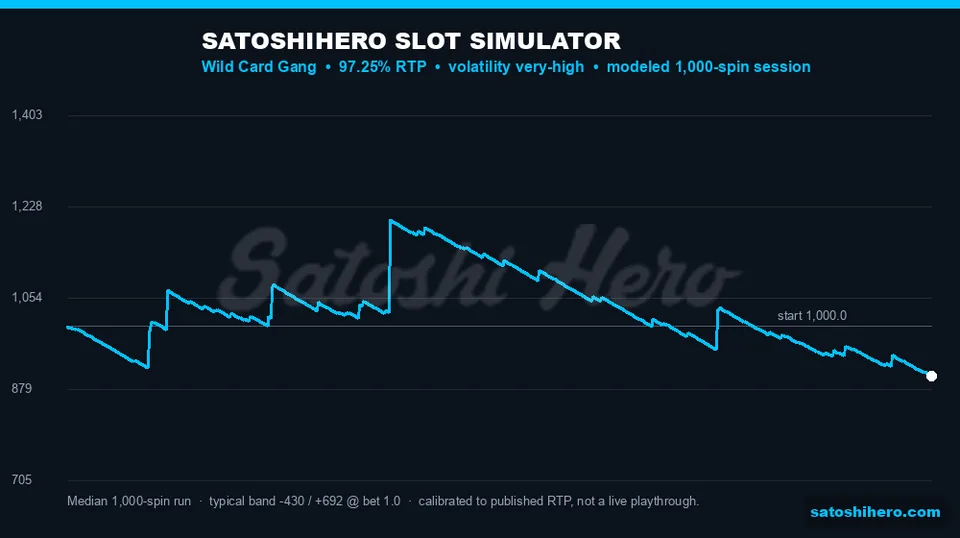
A free spins style feature appeared roughly once in 53 spins in the model. A 100x+ win appeared about once in 797 spins. That model doesn’t know the real random number generator, so treat it as spread mapping, not a personal forecast.
Risk Note: Very-high volatility with a 5,000x cap means the game can still deliver dry stretches even with a strong published RTP.
Our 100-spin session
My 100-spin session used the default $0.60 bet and quick spin. I finished 17.4x down, with 34 paying spins, a 10x biggest hit and no free spins. That sounds mild, but it also shows how a high-RTP slot can still drift down.
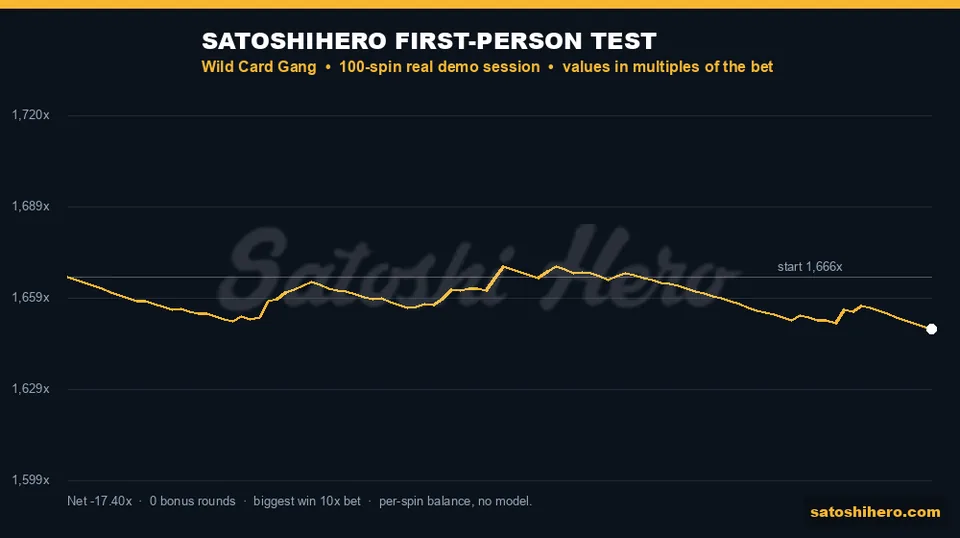
The run felt contained because the balance never moved far from the starting point. Small merge wins created activity, yet they didn’t offset the missing feature. You get a fair read on rhythm here, not a verdict on ceiling.
The 97.25% RTP is the operator-published theoretical return. A single 100-spin live session doesn’t prove or change that figure, and base spins, bonus buys and feature routes can have slightly different return profiles by design. The simulator shows possible session spread, not a prediction of what you may hit next.
Frequently Asked Questions About Wild Card Gang
What is the RTP and volatility of Wild Card Gang?
Wild Card Gang has 97.25% RTP, very-high volatility and a 5,000x maximum win. You get a strong headline RTP, but the risk level still demands patience.
How do wins work in Wild Card Gang?
Wins come from clusters of 4 or more matching symbols touching horizontally or vertically on the 6×6 grid. Diagonal contact doesn’t count, and the game doesn’t use fixed paylines.
What does the Merge Up feature do?
Merge Up pays a cluster, removes part of it and turns the remaining symbols into the next level. There are 9 levels, and cluster size controls how many upgraded symbols stay on the grid.
How do I trigger the free spins in Wild Card Gang?
Land 4 or more Joker scatters in one spin. Four Jokers award 15 free spins, five award 18, and six or more award 20.
How do the free spins multipliers work?
Winning cells become marked, and marked cells that win again gain a x2 multiplier. Each later win in that cell doubles the value up to x128.
Does Wild Card Gang have a wild symbol?
No. The Joker is a scatter, not a wild, and the other eight symbols are paying symbols in the merge ladder.
Can you buy the bonus in Wild Card Gang?
Yes. The Buy Bonus costs 100x the bet, shown as $60.00 at the $0.60 default bet. I didn’t buy it during my 100-spin test.
What did the 1000 spin simulation show?
The simulation put the median session at 95x the bet down. The middle 90% of sessions ranged between 430.2x down and 692.3x up.
How did the 100 spin test with Wild Card Gang go?
My test started at $1,000.00 and finished at $989.56, which was 17.4x down. 34 spins paid, the biggest hit was 10x, and no free spins triggered.
Summing It Up
Wild Card Gang stands out through readable cluster wins, a clear Merge Up ladder and a strong 97.25% RTP. Its main drawback is the risk profile, because very-high volatility can leave you waiting for the feature while the base game pays small.

My Call
Patient cluster-slot players should try the demo first and watch how Merge Up changes the board. Expect plenty of small base-game motion, but don’t expect the free spins to arrive on demand. The 5,000x cap feels fair, yet not huge for this volatility level.
I like the clarity of the merge list, the Joker route and the clean 6×6 board. I don’t like how quickly paid options can reshape a balance, especially with a 100x Buy Bonus. My 100-spin run felt honest and controlled, but it never showed the bonus round.
Wild Card Gang works best when you treat it as a volatile cluster test, not a quick feature hunt. I used first-hand session notes, simulator output and operator specs here, and the guide should be checked regularly.

Pros:
 Strong RTP: 97.25% gives the slot a competitive theoretical return.
- Clear Mechanics: Cluster wins and Merge Up stay easy to follow.
- Readable Theme: Mobster card ranks make the ladder simple during quick play.
- Active Base Game: Small merge wins keep the board moving between bonus attempts.

Cons:
 Very-High Volatility: Dry stretches can arrive despite the strong RTP.
- Controlled Ceiling: 5,000x feels modest for this risk level.
- Costly Options: Buy Bonus and Chance x2 can shrink balances quickly.

Best For: Risk-aware cluster fans get the most from this slot because the grid stays active and the upgrade ladder remains clear. You need patience for bonus chasing, and you need firm limits if you touch Buy Bonus or Chance x2.































































Bets
All Bets
Game
Player
Date
Wager
Mult.Multiplier
Prize
 Royal Fruits 9: Hold 'n' Link
 Hidden
- 00:20:42
- 0×
- Sweet Lotto
 whodey39311
- 00:20:41
- 0×
- Egypt Fortunes: Bingo Bounty
- mdp0fxo
- 00:20:41
- 0×
- Royal Fruits 9: Hold 'n' Link
 mike_721
- 00:20:39
- 0×
- Royal Fruits 9: Hold 'n' Link
- Hidden
- 00:20:39
- 0×
- Sweet Lotto
- whodey39311
- 00:20:38
- 0×
- Wild Buffalo Megaways: Hold N Link
 lakidd1987
- 00:20:37
- 4.2×
- Royal Fruits 9: Hold 'n' Link
- Hidden
- 00:20:36
- 0×
- Grand Koala: Hold ‘N’ Link
- nina87
- 00:20:36
- 5×
- Wild Buffalo Megaways: Hold N Link
- lakidd1987
- 00:20:34
- 0×