

Gemhalla
By pressing play, you agree that you are above legal age in your jurisdiction and that your jurisdiction allows online gambling.

Gemhalla
RTP97.1%
VolatilityHigh
Max winx5,000
Lines27
ThemeAncient civilizations
ReleasedJun 2023
Live game stats
Real RTP80.16%
Spins6,077
Players11
Biggest win$468

Norse Tumbles and Shield Hunts in the Gemhalla Hall
Gemhalla drops you into a Norse 6×5 grid where eight matching symbols can pay from anywhere, not just fixed lines. Gemhalla is a high volatility slot from BGaming with 97.1% RTP and 5,000x maximum win potential. The game uses pay-anywhere wins, tumbling symbols and Multiplier Shields. Patient feature-pressure players get a better match here than steady base-game grinders.
Key takeaways
I tested the Gemhalla demo on SatoshiHero, not just the paytable. Bets run from $0.20 to $50.00, the demo opens at 0.60, and the 1,000.00 FUN balance equals about 1,667x the default bet. According to BGaming, the game info lists 27 lines of play, but you should treat the player-facing mechanic as pay-anywhere groups.
The 97.1% RTP looks strong, but high volatility and a quiet base game still demand patience. That distinction matters because the screen can show paid activity while the balance keeps drifting down. My sample made that clear: the slot delivered several small connections, yet none had the multiplier support needed to change the session shape.
- Best play: Base game play costs less per decision, and my test used Chance x2 off with no bonus buy.
- Bonus access: Buy Bonus costs 100x the bet, while Chance x2 adds 25% to each spin and improves free-spin odds.
- Math profile: The slot has 97.1% RTP, high volatility and a 5,000x maximum win.
- Risk note: My 100-spin test finished 64x the bet down with no free spins and no Multiplier Shield.
- Bankroll note: Short sessions can feel dry because small rune hits may slow losses without changing the path.

Highlight: Gemhalla pays eight or more matching symbols anywhere on the 6×5 grid, so don’t read it like a standard left-to-right line slot.

Table of Contents
- How Gemhalla Works
- Win condition
- Tumbling wins
- Symbols and Payouts
- Premium pays
- Rune pays
- Norse Hall Theme & First Impressions
- Visual style
- Table feel
- Tumble and Multiplier Shields
- Shield values
- Test result
- Free Spins
- Trigger rules
- Accumulating shields
- Buy Bonus and Chance x2
- Bonus price
- Chance switch
- Base-Game Pace From 100 Spins
- Session setup
- What it felt like
- RTP, Volatility & Our Test
- Simulator projection
- Our 100-spin session
- Frequently Asked Questions About Gemhalla
- Summing It Up
How Gemhalla Works
Gemhalla works through pay-anywhere groups on a 6-reel, 5-row board. You need eight or more matching symbols anywhere on the grid, then tumbles can extend the same paid spin.
Win condition
The Gemhalla slot doesn’t ask you to trace fixed paylines across the screen. If enough matching symbols land anywhere, the group pays, and bigger groups move into higher payout tiers. That structure makes the game feel more open than classic line slots, even though the game info also lists 27 lines of play.
You should treat those 27 lines as a secondary technical note, not the main way to read wins. Wild West TRUEWAYS also moves away from classic paylines, so it gives a useful comparison if you like unusual slot structures. Here, the key question is simple: did eight or more matching symbols land?
Tumbling wins
Winning symbols vanish after a paid result, and new ones drop into the gaps. That refill can create another group, so one paid spin can chain several tumbles before it ends. In my base-game screenshot, a red rune group paid 0.15 FUN, equal to 0.25x on a 0.60 bet.
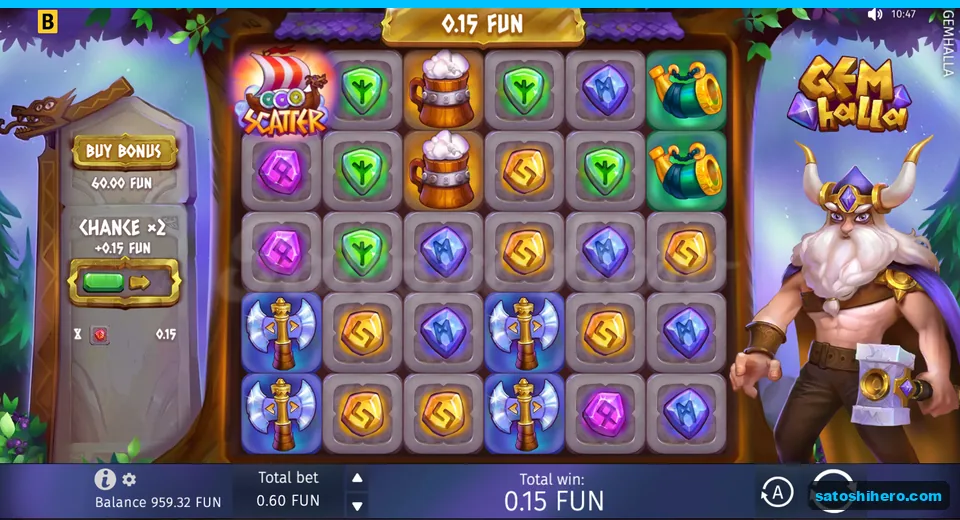
The Longship Scatter is the only special reel symbol, and I cover it in the free-spin section. The game also ran smoothly on desktop and mobile through SatoshiHero during my test, so you can focus on reading the grid rather than fighting the interface. I like the clarity, but the base game still needs shields or bonus access to feel alive.
Symbols and Payouts
The symbol ladder makes many base-game wins small, especially when lower rune stones form the paying group. You can land paid spins often enough to notice movement, but low tiers rarely change the balance by themselves.
Premium pays
Premium symbols carry the best regular paytable values. Larger groups unlock the upper tiers, so a small helmet connection isn’t the same as filling the board with helmets.
- Viking Helmet: 10x, 25x, 50x.
- Beer Mug: 2.5x, 10x, 25x.
- Horn and Coin Pouch: 2x, 5x, 15x.
- Battle Axe: 1.5x, 2x, 12x.
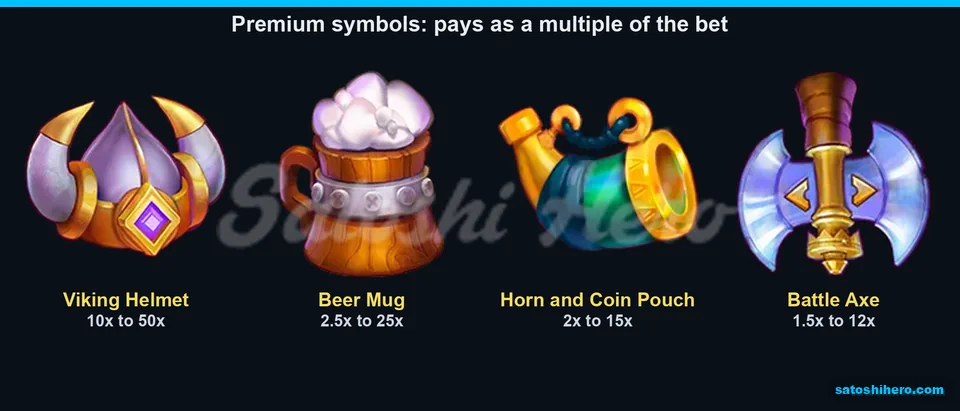
These symbols matter most when tumbles keep the spin open. A single premium hit can help, but you still want follow-up drops or a shield to turn it into a serious result. I don’t mind that structure, because it gives each paid spin a little suspense.
Rune pays
The rune stones form the low end of the ladder. They keep the screen busy, but you shouldn’t mistake every paid group for meaningful recovery.
- Violet rune: 1x, 1.5x, 10x.
- Yellow rune: 0.8x, 1.2x, 8x.
- Green rune: 0.5x, 1x, 5x.
- Blue rune: 0.4x, 0.9x, 4x.
- Red rune: 0.25x, 0.75x, 2x.
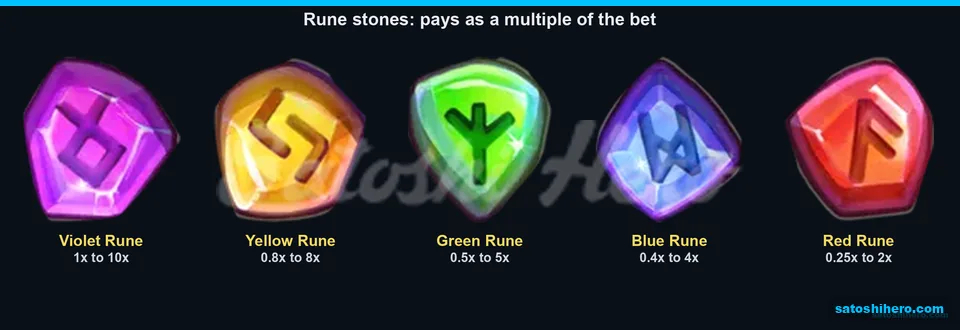
I checked the lowest red tier in my own play. A red group paid 0.25x on a 0.60 bet, which matched the paytable and showed why small wins can slow the slide without stopping it. That became a theme later, because 27 paid spins still left my 100-spin test clearly down. The low symbols also explain why a hit count can look healthier than the actual result. Without a premium group, repeated tumbles or a shield, a paid spin may only return a slice of the stake.

Expert Advice: Don’t judge a tumble by the first small rune hit. The useful part is whether follow-up tumbles or shields arrive before the spin ends.
Norse Hall Theme & First Impressions
The theme presents a readable Norse hall scene with familiar Viking symbols and a clear stone-board layout. Gemhalla BGaming doesn’t reinvent Norse fantasy, but the execution keeps every mechanic easy to follow.
Visual style
A bearded Viking with a hammer stands beside the grid, which sits in a tree trunk under purple leaves. Stone tiles frame the 6×5 board, while rune stones, a helmet, beer mug, horn pouch and battle axe fill the symbol set. The Longship Scatter sails in as the main feature cue.
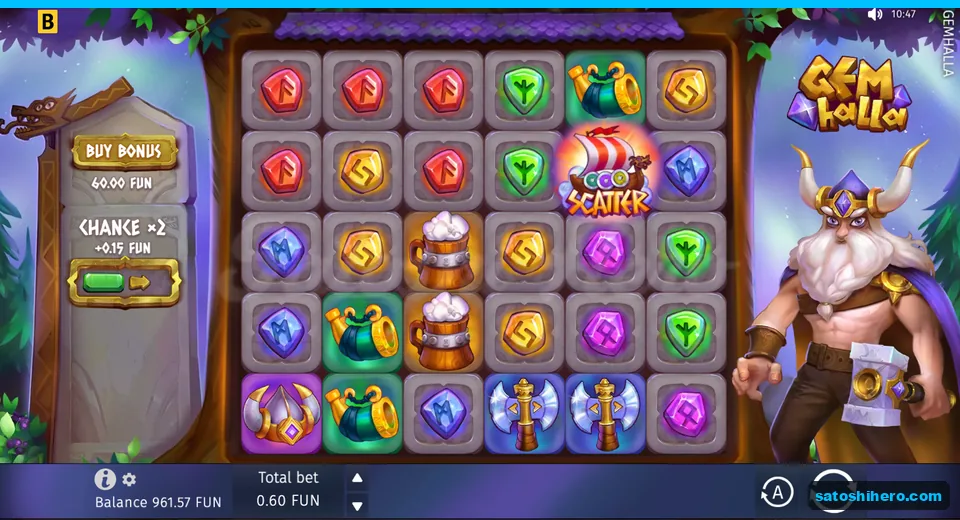
The layout helped during testing because I could read wins quickly. Wild Tiger offers a very different animal-led style, so this Norse setup gives you a cleaner fantasy alternative if you prefer runes, wood and shields. I wouldn’t call the art bold, but it does the job well.
Table feel
The demo uses play-money FUN, so I describe test results in bet multiples wherever the result matters. My settled board view showed the Buy Bonus button, Chance x2 switch, 0.60 bet and 961.57 FUN balance after the test had already drained.
You get a polished screen rather than a noisy one. That matters in a tumble game, because you need to see which group paid and what dropped next. The theme won’t win originality awards, but the stone-board layout keeps the mechanics clear.

Notable Detail: The Longship Scatter fits the Norse hall setting because it acts as the visual cue for the feature round. It feels more natural than a generic bonus badge.
Tumble and Multiplier Shields
Multiplier Shields are the mechanic that can turn a normal tumble into a serious result. None appeared in my 100-spin base-game test, and that absence shaped the whole session.
Shield values
After any win, winning symbols disappear and the symbols above fall down. If another group forms, the spin pays again, and that cycle continues until the grid stops connecting. Multiplier Shields can land in both the base game and free spins.
Each shield carries a random value based on colour:
- Wooden shield: x2 to x5.
- Green shield: x6 to x30.
- Violet shield: x31 to x100.
- Striped shield: x101 to x500.
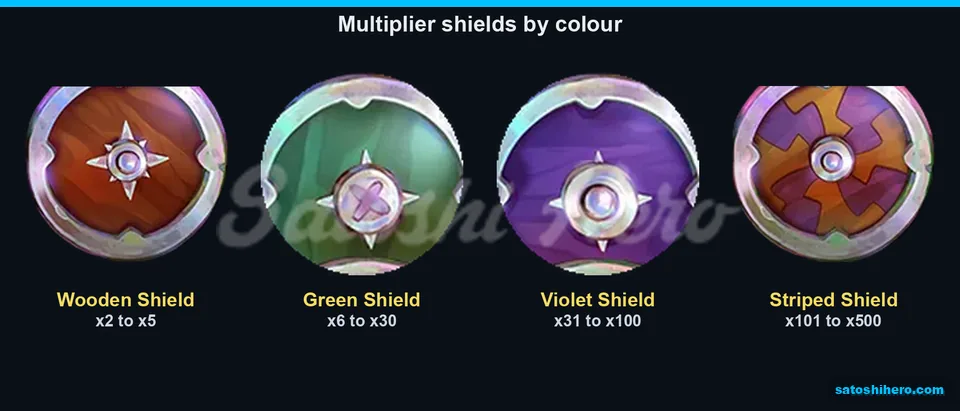
When tumbles end, the game adds every shield value on screen. The total spin win then gets multiplied by that combined shield sum. The striped shield can carry a huge number, but it still needs a meaningful win underneath it. That is the important practical catch: a large multiplier only helps if the paid symbols have already built enough value. In the base game, the feature can feel like the difference between a decorative tumble and a session-changing spin.
Test result
No multiplier showed up in my 100 spins. That matters more than it sounds, because 27 paid spins out of 100 still felt flat without a shield or free spins to break the pattern.
You can see the design tension here. Regular rune hits keep the game moving, but the real upside sits in rarer shield moments. I like that the shield math stays simple, yet the feature can feel invisible during a cold base-game sample.
Free Spins
Free spins are the main bonus and the clearest route toward the 5,000x maximum win. The feature matters because shield multipliers can build across winning spins instead of resetting each time.
Trigger rules
Four Longship Scatters anywhere on the grid start 10 free spins. Five scatters start 20, and six scatters start 30. The scatters also pay 3x the bet for four, 5x for five and 100x for six or more.
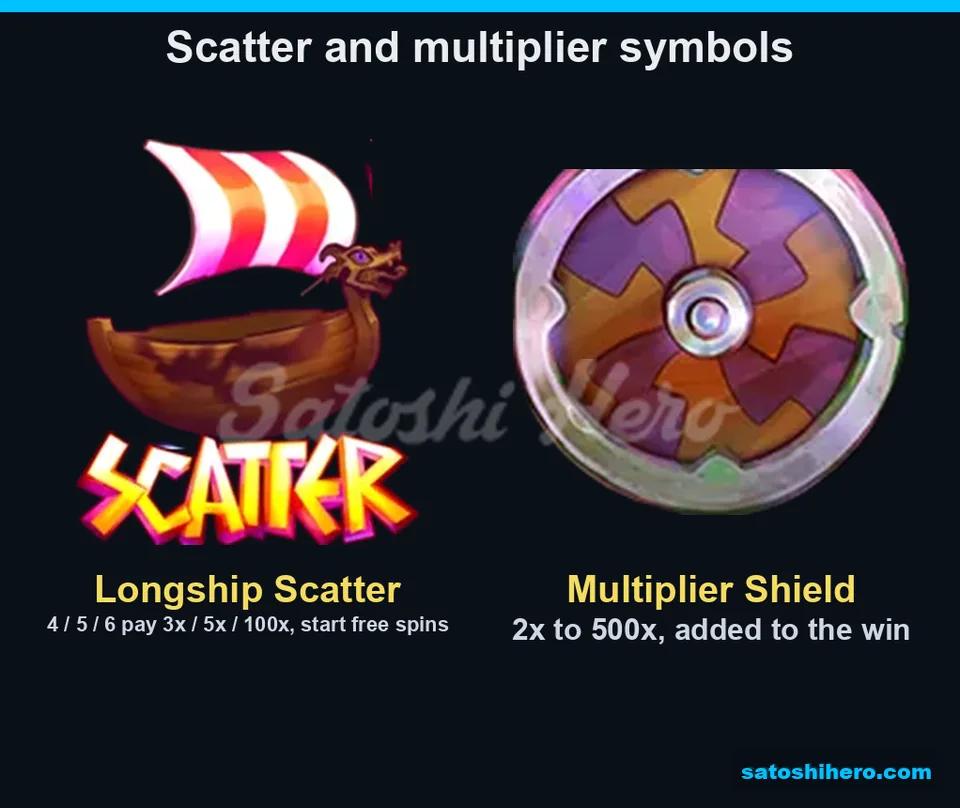
Three or more scatters during the round add 5 extra free spins. The tested session stayed in the base game, so I didn’t trigger this round in my 100 spins. That kept the test useful for base-game pace, but it left the main upside untested by live play.
Accumulating shields
Free spins use the same tumble rules as the base game, but the shields become more important. When a winning spin lands shields, those values join a running total, and later winning spins use the earlier total plus any new shields.
That running total explains why bonus-hunting players care about the feature round. Winter Fishing Club gives feature-led players another waiting-game comparison, especially if you like one bonus round carrying the session. My take is simple: the base game teases the mechanic, but free spins hold the real pressure point. According to BGaming, the same tumble logic carries into the round, so the difference is not a new board rule. The difference is persistence, because shield values can keep helping later winning spins once the bonus starts building.
Buy Bonus and Chance x2
Buy Bonus gives direct feature access for 100x the bet, while Chance x2 raises each spin cost by 25% for better free-spin odds. I used neither, so my test shows base-game behaviour only.
Bonus price
The Buy Bonus button sits left of the board. At the 0.60 default bet, the buy costs 60.00 FUN. That price gives you a fast route to the feature, but it also turns one click into a large bankroll decision.
Base-game play gives you a slower look at how the slot behaves without spending 100x upfront. Train to Rio Grande may appeal if you like comparing bonus-chasing pace, but this game’s buy option feels sharper because shields carry so much of the upside. I prefer testing the base rhythm first.
Chance switch
Chance x2 adds 0.15 FUN at the 0.60 default bet. That equals 25% extra on every spin, and the switch improves free-spin odds. You can test both the switch and buy button in Gemhalla demo mode before making bigger decisions.
I left Chance x2 off because I wanted a clean base-game sample. That choice made the dry spell easier to judge, but it also meant I didn’t pay extra for faster bonus access. The switch has a clear purpose, but it isn’t a harmless toggle.

Risk Note: A 100x bonus buy is a large single decision. If your bankroll is small, a few buys can replace hundreds of base-game spins very quickly.
Base-Game Pace From 100 Spins
My 100-spin base-game test felt slow and dry because small pays appeared, but no feature or shield changed the balance path. This was the kind of session where the hit counter looks okay, but the balance tells the truth.
Session setup
I played 100 spins on autoplay with quick spin at the 0.60 default bet. The start balance was 1,000.00 FUN, and the end balance was 961.57 FUN. That left me 64x the bet down.
The test used base-game spins only. I didn’t buy the bonus, and I left Chance x2 off. That matters because the result shouldn’t be read as a judgement on the free spins or the buy feature.
What it felt like
27 of 100 spins paid something, but the biggest logged win reached only 3.45x the bet. No free spins triggered, and no Multiplier Shield appeared. The balance fell roughly 4 to 5 FUN every ten spins, which gave the session a slow-drain feel.
You could watch the game pay small groups, then give much of it back. That isn’t unusual for high volatility, but it can feel frustrating when the feature never lands. I read this as a quiet-base-game sample, not a full verdict on the slot’s ceiling. The practical lesson is not that the base game cannot pay, but that most ordinary pays need help. In my run, the grid kept producing motion without producing a momentum shift.
RTP, Volatility & Our Test
Gemhalla has 97.1% theoretical RTP, high volatility and a 5,000x maximum win. My test and the SatoshiHero Slot Simulator both show why short sessions can swing hard despite that strong return figure.
Simulator projection
Our simulator modelled 1,000 spins at one bet unit. It used the 97.1% RTP, 5,000x cap and high-volatility band to create a practical range, not a prediction for your next session.
The median run finished 58.1x down. 90% of sessions landed between 313.1x down and 377.5x up. Roughly 18% of spins paid something, a feature-sized win appeared about once in 45 spins, and a very large win appeared about once in 1,718 spins.
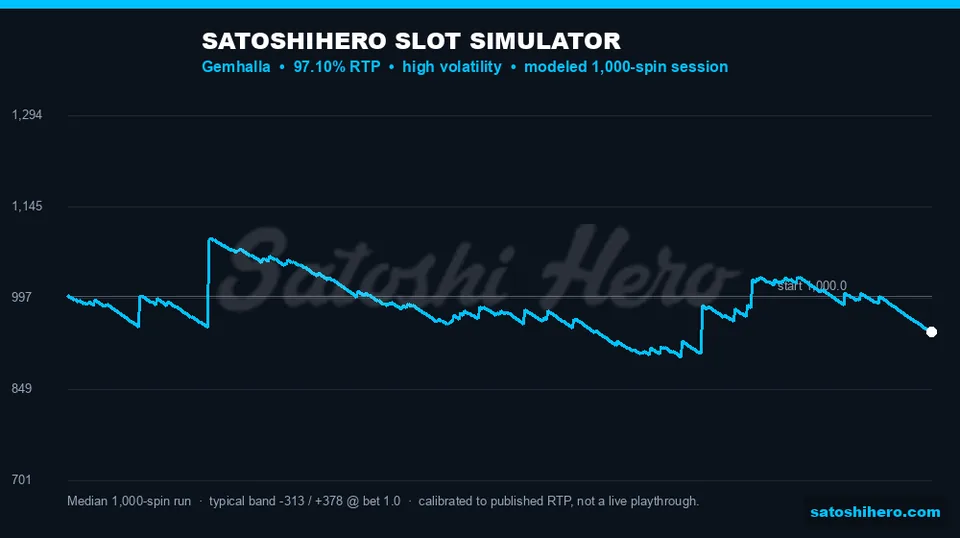
Those figures match the feel of a swingy game. You can get paid often enough to stay interested, but the big movement depends on feature-scale events. I like the RTP on paper, but the volatility still asks you to bring a patient bankroll. The simulator also helps separate return percentage from ride quality. A strong theoretical return does not make the path smooth, especially when the best movement depends on shields, scatters and tumble chains arriving together.
Our 100-spin session
My 100-spin session finished 64x the bet down. 27 spins paid something, the biggest win was 3.45x the bet, and no free spins or shield multiplier appeared. That lines up with the idea of a quiet base-game sample.
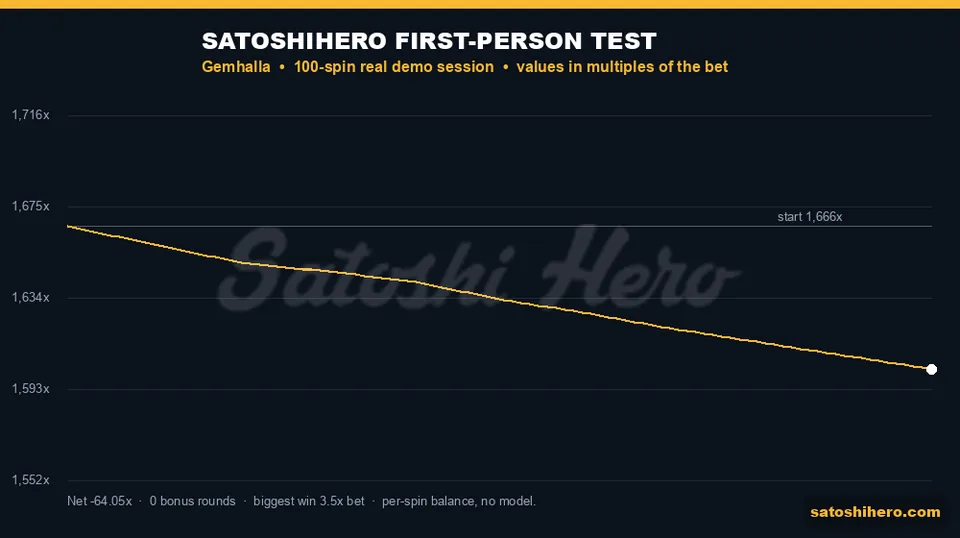
The result doesn’t predict the next session. It does show why small rune hits can’t carry the game alone. If you play without Chance x2 or bonus buys, you may spend a lot of time waiting for the Longship Scatter or a shield to alter the pace.
Highlight: The 97.1% RTP is player-friendly on paper, but high volatility means your short session can still look nothing like the theoretical figure.
The theoretical RTP is the operator’s published return figure. One live or demo session has no bearing on that return, and bonus-buy and base-game returns can sit slightly differently by design. The simulator is illustrative and based on RTP, maximum win and volatility assumptions.
Frequently Asked Questions About Gemhalla
How do wins work in Gemhalla?
Wins pay anywhere on the 6×5 grid when eight or more matching symbols land. Winning symbols vanish, new ones tumble in, and the spin keeps paying until nothing more connects.
How do Gemhalla free spins start?
Four Longship Scatters anywhere start 10 free spins, five start 20 and six start 30. Three or more scatters during the round add 5 more free spins.
What do the Multiplier Shields do?
Each shield carries a random value from x2 to x500, set by its colour. When tumbles end, values on screen are added and the spin win gets multiplied by the sum. In free spins, values accumulate across winning spins.
Can you buy the bonus in Gemhalla?
Yes. Buy Bonus costs 100x the bet, and Chance x2 adds 25% to the stake while improving free-spin odds. My base-game test used neither option.
What did the Gemhalla 1000-spin simulator show?
At one bet unit, the median 1,000-spin session ended 58.1x down. 90% of runs landed between 313.1x down and 377.5x up.
How did the 100-spin Gemhalla test go?
The session finished 64x the bet down. 27 of 100 spins paid something, the biggest logged win was 3.45x, and no free spins triggered.
What are the RTP and max win in Gemhalla?
RTP is 97.1%, volatility is high and the maximum win is 5,000x the bet.
Summing It Up
Gemhalla stands out through pay-anywhere tumbles, shield multipliers and a bonus round with real growth potential. The drawback is clear: the base game can feel flat when shields and scatters stay away.

My Call
Patient slot players get the best read on this one by starting in the base game, then deciding whether the buy feature fits their bankroll. Expect small rune hits, dry patches and sudden upside only when shields or free spins arrive. I wouldn’t treat the strong RTP as protection from short-session swings.
I like the clean grid, simple shield math and honest sense of escalation when a paid spin keeps tumbling. I don’t like how my 100-spin test produced 27 paid spins yet still finished 64x the bet down. That gap between activity and profit tells you exactly how high volatility feels here. According to BGaming’s game information, the slot gives you a clear mechanical target rather than a complicated set of side rules. The question is whether you can sit through the quiet stretches while waiting for the target to matter.
Gemhalla is worth checking if you want a Norse pay-anywhere slot with a stronger math profile than many rivals. We keep game details checked regularly on SatoshiHero so the playable data and guide stay aligned.

Pros:
 Strong RTP: 97.1% gives the game a sharp theoretical return.
- Clear Win System: Pay-anywhere groups make wins easy to read.
- Shield Upside: Multipliers can turn tumbles into much larger results.
- Bonus Control: Buy Bonus and Chance x2 give flexible feature access.

Cons:
 Dry Base Game: Small rune hits may not stop balance drift.
- High Volatility: Short sessions can miss the features that matter.
- Costly Buy: 100x bonus access can drain small bankrolls fast.

Best For: Patient bankroll managers and bonus hunters get the most from this slot’s structure. If you like tumbling grids, Norse visuals and multiplier-building free spins, this game gives you a clear target. If you need frequent strong base-game wins, the dry stretches may test you.




























































Bets
All Bets
Game
Player
Date
Wager
Mult.Multiplier
Prize
 Royal Fruits 9: Hold 'n' Link
 mike_721
- 04:14:13
- 0×
- Luck of Panda: Bonus Combo
 Hidden
- 04:14:10
- 0×
- Galaxy Glitter
- Hidden
- 04:14:08
- 0×
- Royal Fruits 9: Hold 'n' Link
- mdp0fxo
- 04:14:07
- 0×
- Royal Fruits 9: Hold 'n' Link
- mike_721
- 04:14:06
- 0×
- Luck of Panda: Bonus Combo
- Hidden
- 04:14:06
- 0×
- Royal Fruits 9: Hold 'n' Link
- nina87
- 04:14:05
- 0×
- Galaxy Glitter
- Hidden
- 04:14:03
- 0×
- Royal Fruits 9: Hold 'n' Link
- mike_721
- 04:14:00
- 0×
- Royal Fruits 9: Hold 'n' Link
- nina87
- 04:13:59
- 6×