

Money Cart
By pressing play, you agree that you are above legal age in your jurisdiction and that your jurisdiction allows online gambling.


Money Cart slot Guide: Wild West Re-Spins, Persistent Symbols and 500-Spin Test
Money Cart slot is Relax Gaming’s original Wild West re-spin game, and it plays very differently from a normal line slot.
Money Cart slot is a high volatility slot from Relax Gaming with 98% RTP and 2,000x max win potential. It has no paylines, no base-game paying symbols, and every win comes from re-spins on a 5 by 4 grid that can expand during bonus play. Trigger-chase slot fans get the clearest value here, because one strong feature can shape the whole session.
Key takeaways
- Best bonus: Chase 3 Bonus Symbols, because all payouts come from re-spins.
- RTP / volatility: The slot lists 98% RTP with high volatility.
- Max win: The cap is 2,000x the bet.
- Risk note: The tested demo has no bonus buy, so every feature must land naturally.
- Bankroll note: My $2.00 test ended $55.60 down despite one 92.8x hit.

Table of Contents
- Money Cart slot Theme & First Impressions
- Money Cart slot Game Info
- Money Cart slot Symbols and Payouts
- How Money Cart Works
- No line wins
- Re-Spin Feature
- Trigger and reset
- How rounds end
- Special Symbols
- Payer and Collector
- Widener symbol
- Persistent Symbols
- Persistent Payer
- Persistent Collector
- 500-Spin Test Results
- Best round
- Session result
- RTP, Volatility & Test Data
- Simulator projection
- Our 500 spins
- Frequently Asked Questions About Money Cart
- Final Verdict
Money Cart slot Theme & First Impressions
Money Cart slot uses a Wild West train-heist setup, with a red freight car framing the hay-bale grid. You get a clear dusk frontier scene, not a busy screen that hides the key numbers.
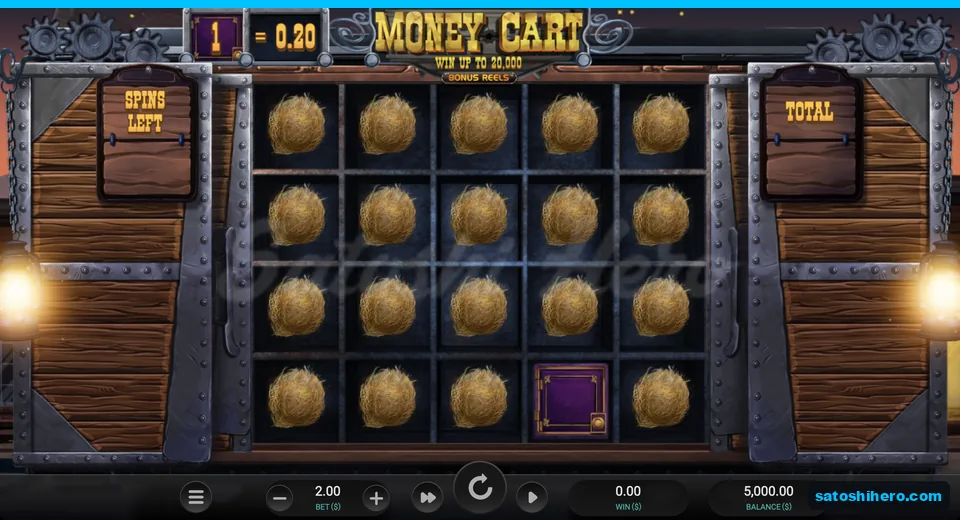
The town sits behind the train with oil lamps glowing in the windows. A windmill cuts the skyline, while steel doors slide open to show the stacked hay bales inside the car. You can read the feature state quickly because the Spins Left board, Total board, and grid all sit in obvious places.
The special symbols look like sepia wanted posters of masked outlaws. That choice fits the cash-collect tone, even if the theme won’t shock Western-slot fans. I like the freight-car setup because it turns the bonus into a moving heist rather than another flat grid.
Money Cart 2 keeps the same frontier-cash-collect family feel, so it makes sense after you understand the original’s visual rhythm. You won’t need a long learning curve if the red wagon and wanted posters already click for you.

Insight: Old train-heist stories work well in slot design because the screen naturally frames locked cargo, hidden values, and getaway tension.
The best part is clarity. You always know where to look, and that matters when the re-spin counter starts dropping.
Money Cart slot Game Info
Money Cart slot has a listed 98.00% return, high volatility, and a top prize of 2,000x the bet. At my $2.00 stake, that ceiling equals $4,000, and the round ends if values reach that cap.
Relax Gaming built this slots title around one main idea: trigger the feature, collect coin values, and hope modifiers land early. The tested demo opened at a $2.00 stake with a $5,000 balance. It had no bonus buy, so I had to earn every feature through base spins.
The 98% RTP looks generous beside many grid-style bonus games. But the 2,000x ceiling feels modest for high volatility, especially when the whole game leans on feature swings. You get strong theoretical return, yet you don’t get a huge top-end target.
That trade-off defines the game. You’re playing for frequent feature access and modifier tension, not a moonshot max win.
Money Cart slot Symbols and Payouts
Money Cart slot doesn’t pay through normal symbols. Every win comes from the re-spin feature, where landed symbols carry coin values that pay when the round ends.
The base setup uses 5 columns and 4 rows. Two more columns can open during feature play, which gives the grid room to grow. Hay bales fill empty spaces, so you don’t scan for card ranks, wilds, or normal matching symbols.
At a $2.00 bet, each value unit is worth $0.20. The purple safe acts as the Bonus Symbol and reveals $0.20 to $2.00 in value at that stake when it lands. Those numbers feel small at first, but they matter more when Payers, Collectors, or Persistent symbols start acting on the board.

The layout stays easy to follow on desktop and mobile because the grid, total, and spins-left counter remain central. You don’t need to pinch the screen or hunt for side panels. I found the coin math simple during quick spin, which helps when several values change at once.

Key Stat: No paylines and no base-game symbol payouts means you’re trying to trigger the re-spin feature, not match symbols across a line.
This section matters because it stops the biggest mistake. You shouldn’t expect small line wins here, because the whole payout model waits for the feature.
How Money Cart Works
Money Cart works as a re-spin trigger game, not a normal left-to-right line slot. You don’t win from paylines, ways, or base-game symbols, because every payout comes from collected coin values.
No line wins
This slot has no paylines. It also has no ways to win and no paying symbols in the base game. Base spins matter only because they can land the Bonus Symbols that start re-spins.
That design creates a quiet base game. If you prefer regular small line hits, this one may feel slow between features. I don’t mind that structure, but you need to accept that most action happens in short bonus bursts.
Game details and test notes should be checked regularly because displays and demo options can change. That doesn’t change my test result, but it matters when you compare site screens with written guides.
The upside is clean decision-making. You track trigger symbols, spin count, and total value rather than several paytable layers. You’ll either like that focus, or you’ll miss the steady feedback of a standard slot.
Re-Spin Feature
The re-spin feature is the whole game because it produces every payout. Land 3 or more Bonus Symbols anywhere, and the round starts with 3 re-spins.
Trigger and reset
The triggering symbols reveal their coin values immediately. Every new symbol resets the counter to 3, so even a small coin can extend the round and keep the board alive. You should care about timing as much as value.
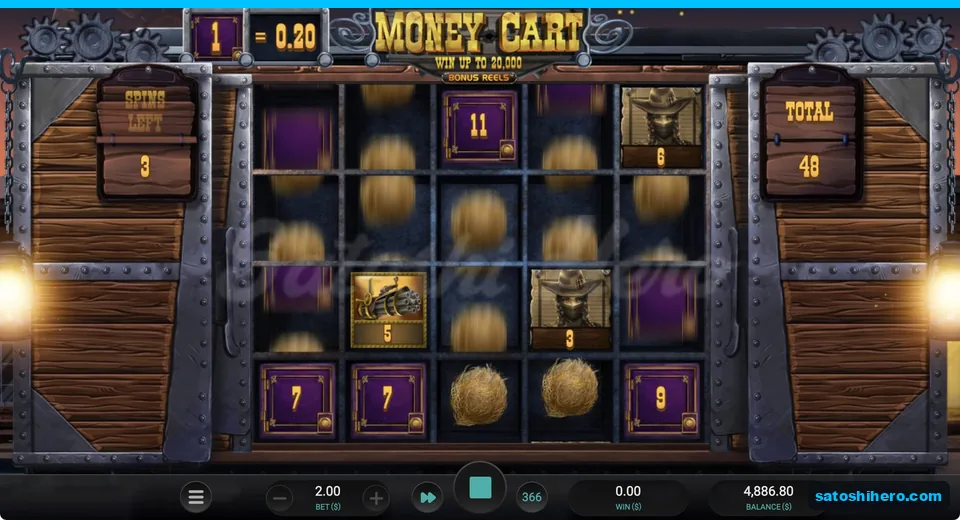
In my session, frequent small rounds made up most of the feature traffic. Many triggers ended before the board filled, and several paid only enough to slow the balance drop. That felt fair for the game’s structure, though not always exciting.

Strategy Insight: Early new symbols matter because each one resets the counter to 3 and gives the feature more chances to add Payers, Collectors, or Wideners.
How rounds end
The feature can expand when Wideners open extra columns. If both extra columns open and every position holds a symbol, the round ends right there. If spins run out first, the game adds every visible value and pays the total.
This mechanic looks simple until the final spins start landing. One new symbol can buy three more chances, while one dead spin can drain the tension fast. You’ll feel the feature’s pace most when two spins remain and the board needs a fresh hit.
The re-spin system works because it gives every symbol a job. Small coins can extend the round, and special symbols can turn a plain board into something worth watching.
Special Symbols
Special Symbols modify the board after revealing their own coin value. Payer, Collector, and Widener can all change the feature’s outcome, especially when the grid already holds several coins.
Payer and Collector
Every special reveals a coin value before it acts. The Payer adds its value to every other visible symbol, while the Collector gathers every visible value and adds that total to its own. Numbers indicate why timing matters more than the first value you see.
A Payer or Collector can matter more when the board already holds several coins. If one lands too early, it may have little to work with. If it lands after the grid has built some density, the same symbol can push the total much higher.
I like these symbols because they give the feature a second layer without adding clutter. You aren’t just counting symbols. You’re watching whether the next special lands before the counter expires.
Widener symbol
The Widener opens an extra column, and it’s the only way the original game grows. The grid can move from 5 columns to 7, adding more positions for coins and specials. Extra space raises the round’s ceiling, though it also leaves more empty spots to fill.
Money Cart 3 builds on the same idea of symbols modifying the board, so the original helps you understand where the series went next. You can see the design logic here in its cleanest form.
The Widener doesn’t create an instant payout spike like a Collector can. Still, I paid close attention to it because more space gives Persistent symbols and later specials more room to work.
Persistent Symbols
Persistent Symbols matter most because they keep acting after they land. In my test, an early Persistent Payer created the best feature and carried the whole session.
Persistent Payer
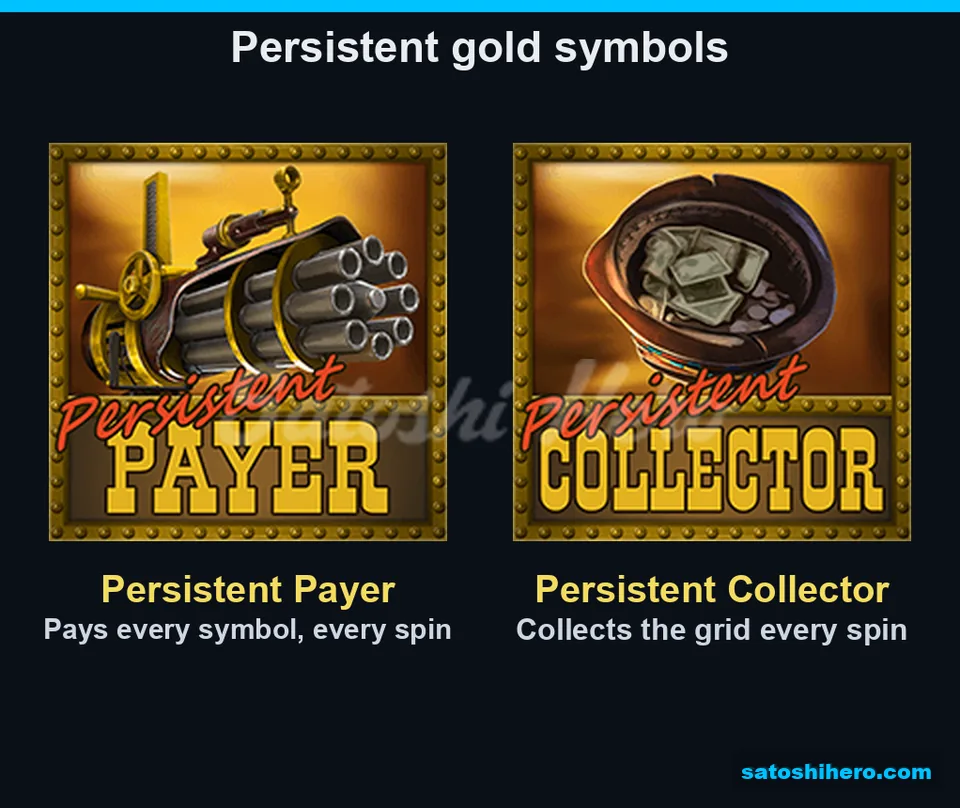
The gold Persistent Payer adds its value to every other visible symbol at the end of that spin and every spin after. It doesn’t pay itself, so its position and timing can matter more than the number printed on it.
My best round showed that perfectly. A Persistent Payer landed in the top-left corner, then kept adding value as fresh symbols arrived. Several values moved past 100, which changed the feature from a decent bonus into the clear highlight of the test.
You should watch early Persistent Payers carefully. A modest value can still become powerful when it fires across multiple remaining spins. That’s the symbol that made me sit up during the run.
Persistent Collector
The gold Persistent Collector collects every visible value at the end of that spin and every spin after it. It doesn’t collect its own value, so it gets stronger when more values already sit on the grid.
This symbol rewards board density. You shouldn’t judge it only by the coin amount it reveals. Remaining spins, open positions, and current total all decide whether it feels useful or late.
Persistent symbols give this game its best moments. Without them, many rounds would feel like small coin totals waiting to expire.
500-Spin Test Results
My 500-spin test finished $55.60 down, even though one Persistent Payer round paid $185.60. That result matched the high volatility feel: many small features, one standout hit, then a slow slide back.
Best round
I played 500 spins at $2.00 in one autoplay run with quick spin on. The starting balance was $5,000, and re-spins landed about 60 times. Most features stayed small, which made the bigger round stand out.
For the first 280 spins, my balance stayed near $4,860 to $5,000. Two better early rounds near spin 134 and spin 239 paid roughly $70 to $80 each. They helped, but neither changed the session in a major way.
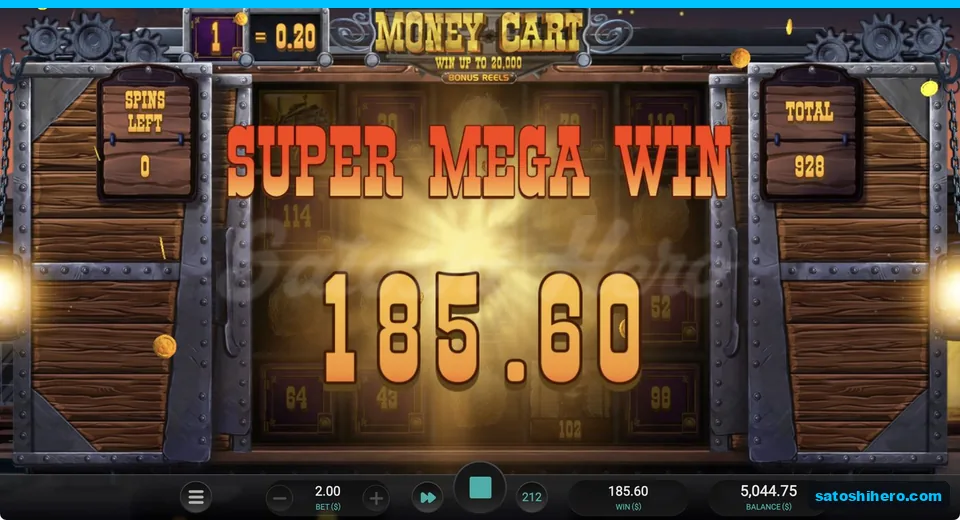
The best round came near spin 288. A Persistent Payer landed in the top-left corner and added its value to every coin on every spin. Values climbed past 100 each, and the total moved from 249 to 411, then 618, then 774.
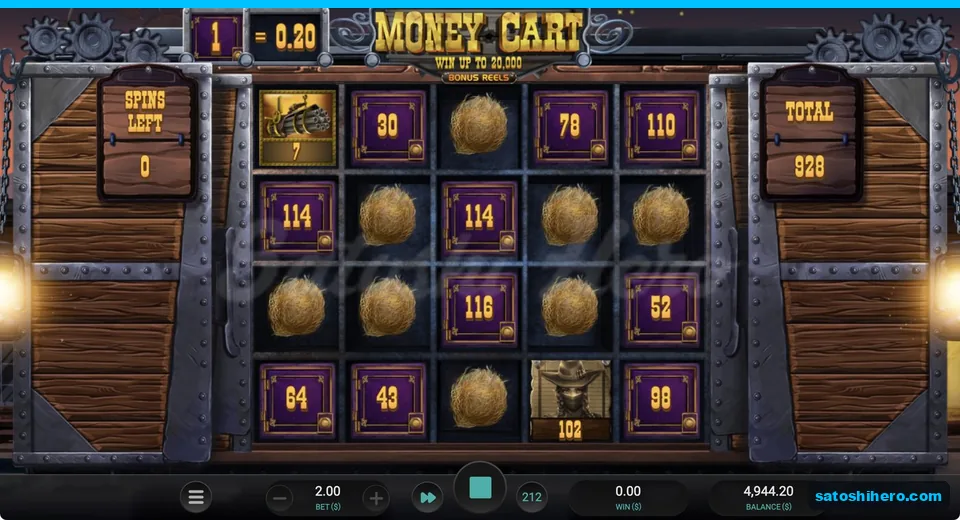
The round closed on a 928 total. At a $2.00 stake, that paid $185.60, equal to 92.8x the bet. The game labeled it Super Mega Win, and I agree with that label inside this slot’s tighter 2,000x ceiling.
Session result
That hit lifted my balance to about $5,141. The last 200 spins slowly gave most of it back, and I ended at $4,944.40. Net result: $55.60 down.
The session felt typical for this game. Small re-spins arrived often, one Persistent symbol did the heavy lifting, and a near break-even run still ended negative. That’s high volatility in practical terms, even with a generous RTP figure.
There was no bonus buy in the tested demo. Every feature came from natural triggers, which made the pacing feel honest but sometimes cold. If you chase control through buys, this version won’t give you that option.
Money Cart 4 adds more layers for players comparing the series, and the Money Cart 4 demo makes sense after you learn the original’s simpler rhythm. The first game gives you the clean baseline.
RTP, Volatility & Test Data
Money Cart has 98% RTP, high volatility, and a 2,000x max win. The return looks generous, but my test and the simulator both show that short sessions can still swing hard.
Simulator projection
The SatoshiHero Slot Simulator ran 1,000 spins at a $2.00 stake. The model used 98% return, high volatility, and the 2,000x ceiling. Its median session finished $98.70 down.
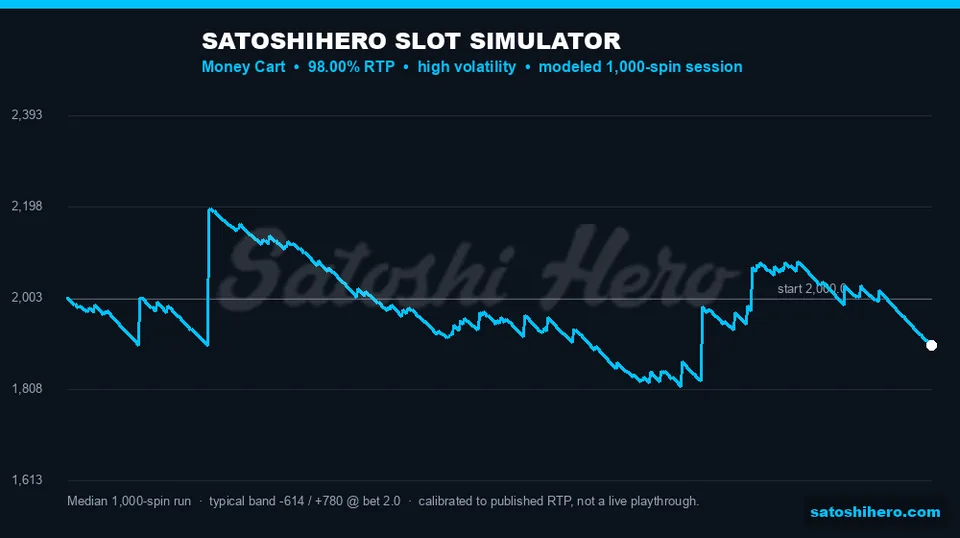
The middle 90% of runs landed between $613.50 down and $780.40 up. About 18% of spins returned something, while a feature-sized hit came roughly once every 44 spins. A 100x win appeared about once every 1,669 spins.
Those numbers show spread, not a prediction for your next session. Data shows a wide short-run range, and that range fits the game’s bonus-first structure. You can have frequent re-spins and still lose ground if modifiers don’t connect.

Warning: High volatility still matters. Even with a 98% RTP, the simulator’s median 1,000-spin session at $2.00 was down $98.70.
Money Train offers another cash-collect style comparison where volatility and feature timing shape the whole session. Money Sleigh gives the same broad value-collection audience a colder seasonal alternative, while the main lesson carries across all three games: the feature quality matters more than simple trigger count.
Our 500 spins
My 500-spin run finished $55.60 down. One 92.8x hit defined the result, while frequent small rounds didn’t remove the high volatility feel. Meaningful profit depended on a strong Persistent symbol round.
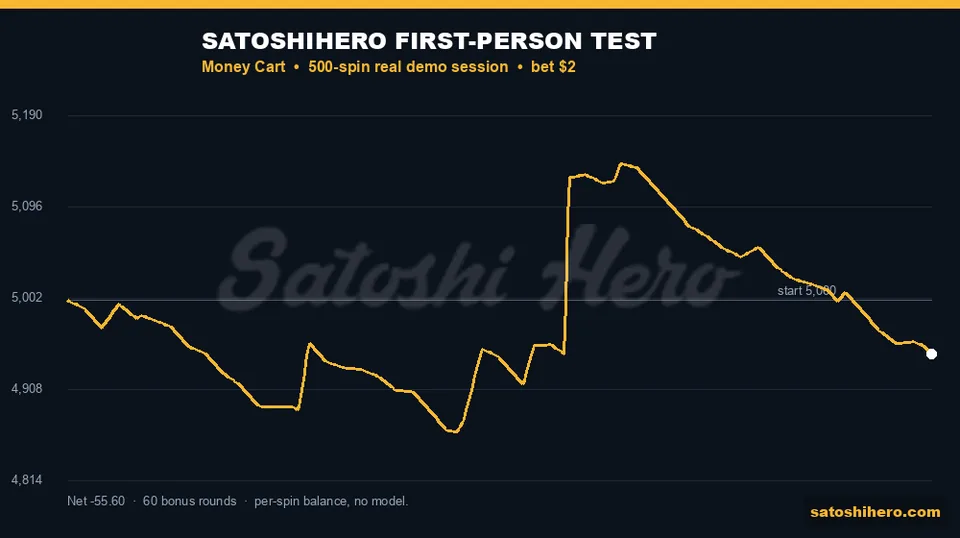
Numbers indicate the session sat inside the simulator’s expected swing zone. I didn’t get crushed, but I also didn’t hold the profit after the best round. The last 200 spins showed how quickly a good peak can fade.
The 2,000x max win feels modest for high volatility. That opinion comes from the way the game depends on feature swings. You need a strong board to get paid, yet the official cap stays lower than many modern bonus-heavy slots.
The 98% RTP is the published theoretical return for the game. A single 500-spin live session doesn’t prove or disprove that figure. Simulator results show possible session spread, and any feature behavior from one run should be treated as experience data rather than a pattern you can rely on.
The practical bankroll lesson is simple: a flat-looking first half can still hide most of the session’s result in one board. My biggest feature created the peak, but it did not protect the finish because later triggers stayed too small to hold that lead. That is why I read the game through feature quality first and trigger count second.
Frequently Asked Questions About Money Cart
How does Money Cart slot pay?
Money Cart has no paylines or paying base-game symbols. Wins come only from the re-spin feature, where each symbol on the grid holds a coin value that pays when the re-spins end.
How do you trigger the Money Cart slot re-spins?
Land 3 Bonus Symbols anywhere on the 5 by 4 grid. The round starts with 3 re-spins, and every new symbol resets the count to 3.
What does the Widener do in Money Cart slot?
The Widener reveals a coin value and opens an extra column. It grows the grid from 5 columns toward 7 during the re-spin feature.
Can you buy the bonus in Money Cart slot?
No. The tested demo has no bonus buy, so you can trigger the re-spin feature only by landing Bonus Symbols.
What did the 1000 spin simulator show for Money Cart?
At $2.00 per spin, the median 1,000-spin session ended $98.70 down. The middle 90% of runs landed between $613.50 down and $780.40 up.
How did your 500-spin test of Money Cart go?
I finished $55.60 down. My best round came near spin 288, when a Persistent Payer helped the feature reach a 928 total and pay $185.60, or 92.8x the bet.
What are the RTP and max win of Money Cart?
Money Cart has a listed RTP of 98.00% and a maximum win equal to 2,000x the bet.
Final Verdict
Money Cart stands out because it strips the slot down to one clean re-spin chase. Money Cart gives you strong RTP, clear mechanics, and tense Persistent symbol moments, but the 2,000x cap limits the dream result.

My Take
I’d play this when I want a focused bonus-chase slot with no line-win noise. Expect quiet base spins, many small features, and rare rounds where one Persistent symbol changes everything.
I like how easy the game makes every value and reset to read. I don’t like how a high volatility session can still feel capped by the 2,000x ceiling. My 500-spin test proved both points, because one strong round still left me $55.60 down.
Money Cart slot deserves a place on SatoshiHero for measured-risk bonus chasers and visible-math fans, not mystery mechanics. My test notes and game details should be checked regularly as demo settings and site screens can change.

Pros:
 Clear Re-Spin Focus: Every payout route stays easy to track during quick play.
- Strong RTP: The 98% return gives the math a generous base.
- Readable Feature State: Counters and totals stay visible when values move fast.
- Persistent Symbol Tension: Early gold symbols can reshape an entire feature.

Cons:
 No Line Wins: Base spins can feel quiet between triggers.
- Modest Top Prize: The 2,000x cap feels tight for high volatility.
- No Bonus Buy: You must wait for natural triggers in the tested demo.

Best For: Patient bankroll managers and bonus-chase players get the most from this slot. You need to enjoy re-spin tension, visible coin math, and sessions where one feature can define the result.












Other Relax Gaming Games






















































Bets
All Bets
Game
Player
Date
Wager
Mult.Multiplier
Prize
 Rich Piggies: Bonus Combo
 josh1998
- 04:18:43
- 0×
- Galaxy Glitter
 mike_721
- 04:18:42
- 0×
- Heat Hit
- Hidden
- 04:18:42
- 0×
- Wild Buffalo Megaways: Hold N Link
- nina87
- 04:18:39
- 0×
- Heat Hit
- Hidden
- 04:18:37
- 0×
- Royal Fruits 9: Hold 'n' Link
- Hidden
- 04:18:35
- 0×
- Merry Cash Splash: Hold 'N' Link
- Hidden
- 04:18:35
- 0.29×
- Rich Piggies: Bonus Combo
- josh1998
- 04:18:34
- 0×
- Heat Hit
- Hidden
- 04:18:33
- 0×
- Galaxy Glitter
- mdp0fxo
- 04:18:31
- 1.5×