

Fish 'n' Nudge
By pressing play, you agree that you are above legal age in your jurisdiction and that your jurisdiction allows online gambling.


Fish ‘n’ Nudge: Nets, Nudges and a Fisherman on the Hunt
Fish ‘n’ Nudge is a Push Gaming fishing slot built on a 5×4 grid with 20 paylines, medium volatility and an RTP of 96.4%. Its defining mechanic is a Net overlay that nudges down the reels and catches Fish carrying Instant Prizes. I played 100 counted spins in the demo, tracked every result and tested the Free Spins separately. The slot mixes modest line wins with occasional collections, so the session can change sharply when several valuable Fish enter a Net.
Key takeaways
- Fish ‘n’ Nudge uses 20 fixed paylines across a 5×4 reel grid.
- Net overlays remain active across spins as they nudge down one position at a time.
- Fish caught inside Nets pay their attached Instant Prizes without needing a payline win.
- The Fisherman works as the Wild and collects every visible Fish prize when he lands inside a Net.
- My 100-spin test returned 96.6x from 100x staked, leaving the session 3.4x down.
What does Fish ‘n’ Nudge look and sound like?
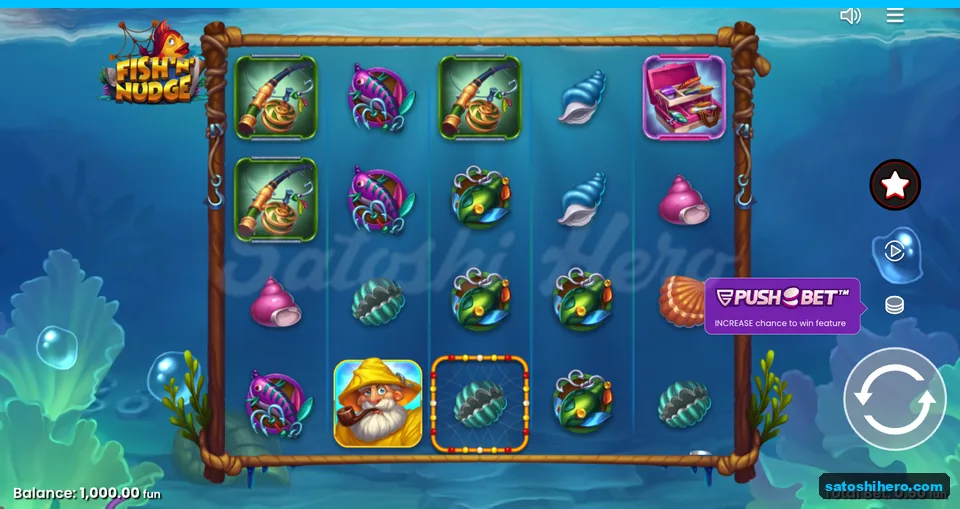
The answer is a light underwater fishing scene with a weathered wooden reel frame, a blue seabed and a bearded Fisherman in a yellow raincoat. The visual identity is readable rather than elaborate. Shells, lures, rods, tackle boxes and bright red-and-gold Fish separate cleanly from the background, while dotted gold Net frames sit over reel positions without hiding the symbols underneath.
The base game keeps the sea blue, with rocks, plants and bubbles adding depth behind the grid. During Free Spins, the seabed changes to purple, making the feature state immediately distinct from ordinary play. That color change matters because the underlying reels retain many of the same symbols, and the different background makes it easier to recognize when the multiplier-driven round is active.
The Fisherman is the visual focal point. His beard, pipe and yellow coat make him easy to identify when several symbols settle at once, which is useful because he serves two jobs: he is the highest-paying regular symbol and the Wild. His collection function also depends on whether he occupies a Net, so quick recognition helps when checking why a result paid.
The presentation supports the mechanics without crowding the screen. The bottom bar displays the play-money balance, total bet and settled win, while the Push Bet star sits on the right side of the grid. Prize values printed on Fish remain legible inside Net overlays, and the interface gives enough space to see which reel position contains each active frame.
How does the base game play?
Fish ‘n’ Nudge evaluates wins from the leftmost reel across adjacent reels, with at least three matching symbols required. The game uses 20 fixed paylines, and the five reels each display four positions. That conventional line structure makes ordinary symbol wins easy to understand, while the Net overlay introduces outcomes that don’t depend on a completed payline.
I used a $0.50 total bet for every counted spin. The demo started with a $1,000.00 play-money balance, and I left the Push Bet option off throughout the test. Every result in this guide is therefore expressed as a multiple of the total wager, which keeps the session data useful when a different stake is selected.
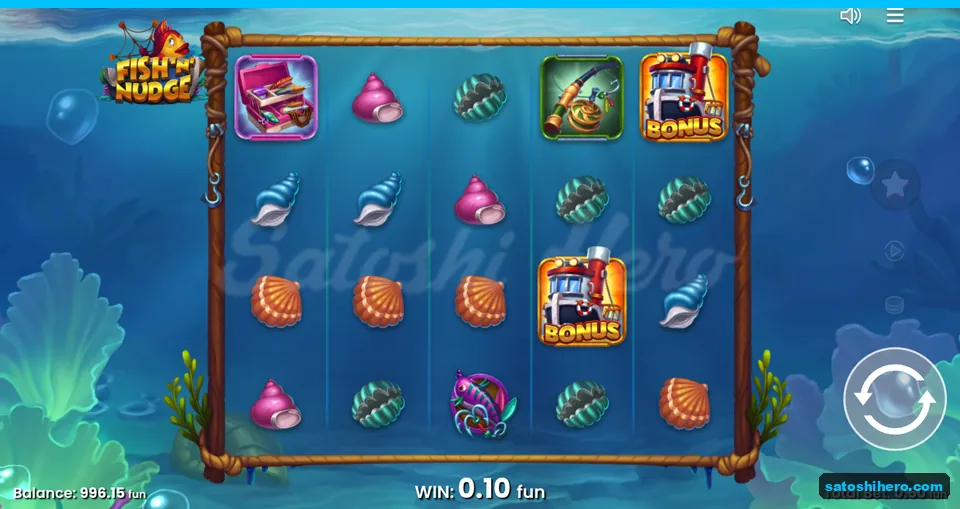
The smallest result I recorded came on spin 4 and paid $0.10, equal to 0.2x the bet. That result matched the three-of-a-kind value shown for the lowest shell symbols at my selected wager. It also provided a straightforward check that the displayed paytable amounts could be converted consistently into bet multiples.
Base-game spins can resolve in two layers. The game first evaluates ordinary line wins, including any substitution made by the Fisherman Wild. It then checks whether Fish or Fisherman symbols occupy active Net positions, allowing an Instant Prize or collection to contribute even when the symbol arrangement doesn’t make a line.
The separation between line evaluation and Net prizes is central to understanding the result meter. A small line win can appear alongside a larger Net-based payment, while a Fish that contributes no line win can still pay its printed value. Watching both the symbol paths and the framed positions made the settled totals easier to follow during the test.
Which symbols pay the most?
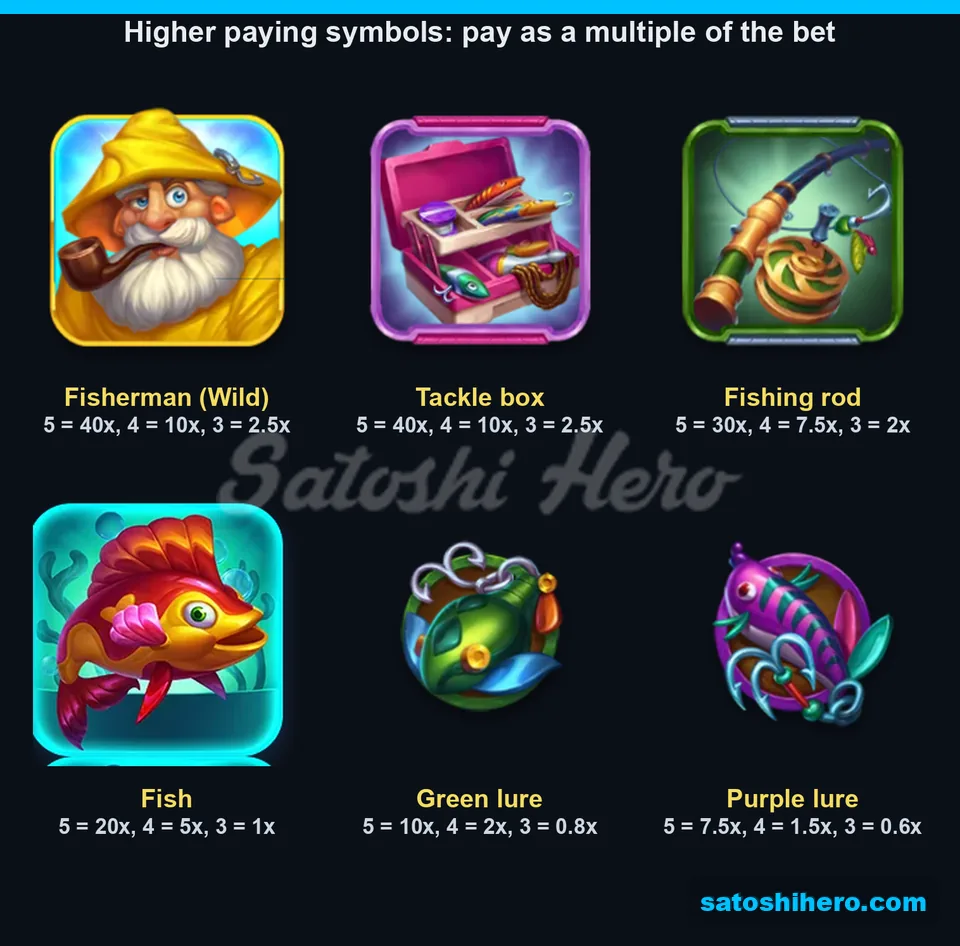
The Fisherman and tackle box are the strongest regular pay symbols. Each pays 40x for five of a kind, 10x for four and 2.5x for three. The fishing rod follows at 30x, 7.5x and 2x, while the red-and-gold Fish pays 20x, 5x and 1x for the same matching lengths.
The two lures form the middle of the paytable. The green lure pays 10x for five, 2x for four and 0.8x for three. The purple lure returns 7.5x, 1.5x and 0.6x, so both can produce useful line contributions without matching the potential of the Fisherman, tackle box or rod.
The Fisherman substitutes for every paying symbol except the Bonus tugboat and the Net overlay. His substitution role can complete or extend a line, but his special collection function only activates when he lands within a Net. Those two jobs can occur in the same result, though they are evaluated under different parts of the feature rules.
The Bonus symbol is a red tugboat rather than a paying regular symbol. Three or more tugboats in the base game start Free Spins, with the number of trigger symbols setting the initial prize multiplier. Net symbols also sit outside the normal paytable because they modify occupied reel positions instead of forming their own line wins.
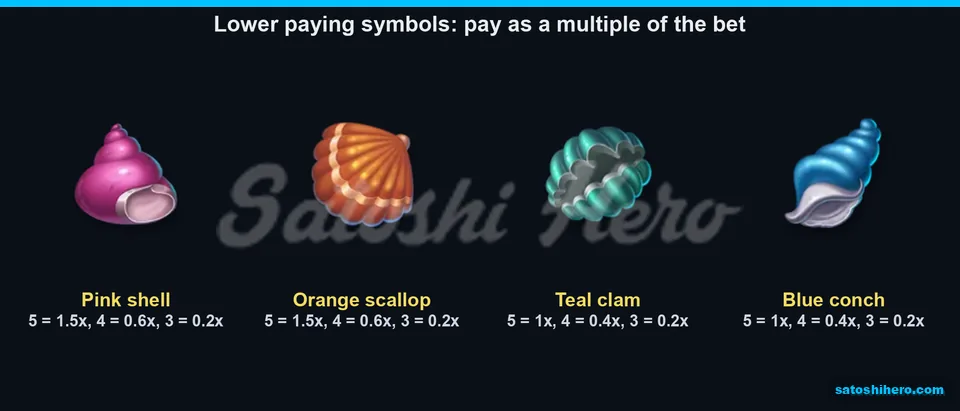
Four shells occupy the lower end. The pink shell and orange scallop each pay 1.5x, 0.6x and 0.2x for five, four and three matches. The teal clam and blue conch each pay 1x, 0.4x and 0.2x, which explains why some settled spins return less than the original wager even when they contain a valid line.
How do Net symbols change later spins?
Net symbols are persistent overlays that land in stacks covering four reel positions. They can appear anywhere in the base game or Free Spins, and they remain over the underlying symbols while the result is evaluated. Their purpose is to catch prize-bearing Fish or activate the Fisherman’s collection ability, not to create a separate line combination.
After the game evaluates all wins, pressing spin again moves each active Net down by one position while the reels turn. The same process repeats on following spins until every part of the Net has moved beyond the visible grid. A single stack can therefore influence several consecutive outcomes without staying over the same row.
This movement gives the base game a short sequence-based rhythm. Once a Net appears near the top, I could see which positions it would cover on the next nudge, although the new reel symbols remained random. The visible path helps explain the mechanic, but it doesn’t predict whether a Fish, Fisherman or ordinary symbol occupies the framed position after the reels settle.
The stack format also creates more than one active catching position at once. Several Fish may land within the frames, or the Fisherman may appear in one while other Fish remain visible elsewhere. Because each nudge shifts the entire stack, the relevant reel rows change together rather than moving as independent single-position modifiers.
Nets don’t need a payline connection and don’t pay by themselves. Their value comes entirely from the symbols they frame. An empty Net position adds nothing, an enclosed Fish pays its printed Instant Prize, and an enclosed Fisherman gathers the prizes attached to all Fish visible on the grid.
What do Fish prizes and the Fisherman collect?
A Fish inside a Net pays its attached Instant Prize whether or not that Fish belongs to a winning line. Fish symbols still retain their normal paytable role, so one symbol can contribute to a left-to-right combination while also paying the value printed on it. The two payment routes are independent and are combined in the settled result.
The Fisherman turns the same setup into a wider collection. When he lands inside a Net, he gathers the Instant Prize values from every Fish in view, not only Fish occupying nearby or connected positions. This makes the whole grid relevant whenever a framed Fisherman appears, since prize-bearing Fish on distant reels can contribute to the collection.
My largest result demonstrated the mechanic directly. Three Fish inside Nets on the first reel carried values of $12.50, $2.50 and $2.50 at the $0.50 bet. Together with the complete result, they produced a $17.50 payout, equal to 35x the wager, and reversed a substantial session deficit in a single spin.
The important distinction is that Fish prizes are not scatter payments. A Fish outside a Net keeps only its ordinary line-paying function unless a framed Fisherman collects it. A Fish inside a Net can pay independently, while a Fisherman inside a Net can gather visible Fish values even when those Fish aren’t framed themselves.
That distinction prevents a common reading error. Seeing several printed prize values across the grid doesn’t mean every value is paid automatically. The result needs either a Fish occupying a Net or a Fisherman occupying one, and the settled animation shows which of those conditions activated before the total appears.

How do the Free Spins work?
Three or more Bonus tugboats in the base game trigger Free Spins. Three Bonus symbols begin the round with a x1 multiplier, four start it at x10 and five start it at x25. The multiplier applies only to Fish Instant Prize wins, so it doesn’t increase ordinary line payouts made by shells, lures or other regular symbols.
The round starts with reels 2 and 4 filled with Net symbols. On every spin, those Nets nudge downward by one position, and each nudge increases the multiplier by one. The feature ends only after no Net symbols remain visible, which means its duration follows the overlay movement rather than a fixed award of identical spins.
That structure links the number of remaining Net positions to the multiplier’s growth. Early feature results have more framed spaces available, while later results use a larger multiplier on any qualifying Fish prizes. The trade-off is visible on the grid: Nets gradually leave the screen as the multiplier badge climbs.
No Free Spins triggered during my 100 counted spins. I continued only to collect feature screenshots, and three Bonus symbols landed on an extra spin outside the measured session.
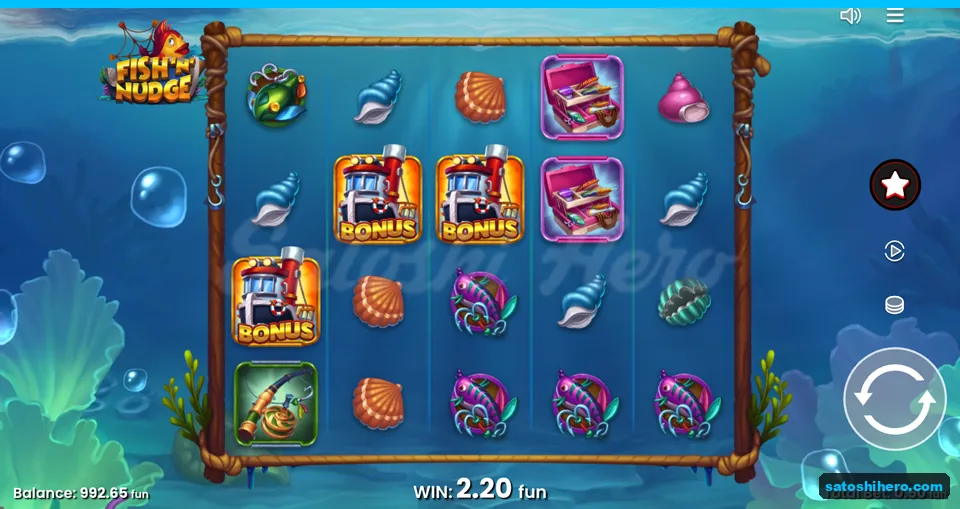
The saved frames showed the multiplier at x3 in one stage and x6 at a later point. Those images confirm that the badge rises while the Nets advance. They don’t imply a fixed feature result, since the Fish positions and printed prizes depend on the symbols produced during that specific round.
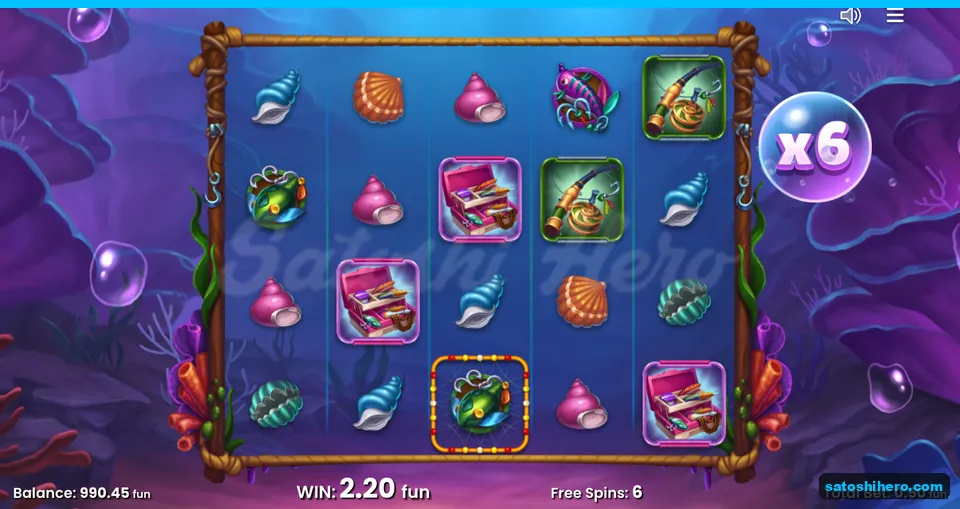
The resulting round paid $2.20, equal to 4.4x the $0.50 wager, so that outcome is documented separately and isn’t included in the 100-spin return.

What does the Push Bet button do?
Push Bet is an optional control intended to increase the chance of reaching the feature. A star-shaped button appears on the right side of the grid, and its on-screen tip says it can increase the chance to win the feature. I kept it switched off for every spin used in the tracked session.
Leaving it off kept the test on the standard $0.50 total bet displayed beneath the reels. That choice is important when interpreting the data because the session return, hit count and balance graph all come from the same base configuration. None of the recorded results used an altered feature-chance setting.
Push Bet shouldn’t be confused with a bonus buy. I didn’t find a control that allowed direct purchase of Free Spins in the demo. The star changes the betting configuration around feature access, while the ordinary trigger still depends on landing at least three Bonus tugboats in the base game.
The option may be useful when feature access matters more than maintaining the standard wager structure, but its label doesn’t promise that any individual spin produces a trigger. In my test, keeping it off meant the 100-spin sample measured the regular configuration without an added feature-chance setting.
What are the main game specifications?
According to Push Gaming, the game combines a 5×4 grid, 20 paylines and Net-driven Instant Prizes. The volatility is medium, and the maximum win is 10,000x the base bet. A game round is capped at that same amount, so line wins, Fish prizes and multiplier effects remain subject to the stated ceiling.
Medium volatility doesn’t mean the balance moves in a smooth line. My test contained many returns below the wager, a dry stretch lasting several spins and one 35x result that changed the session from a deep deficit to a profit. The label describes the intended risk profile, not a promise about any short sample.
The theoretical return shouldn’t be treated as a guaranteed result for one session. My measured return happened to sit close to the stated percentage, but the route included large swings and a late decline. Another sequence can distribute line wins, Net prizes and feature triggers differently even when the rules and betting settings remain unchanged.
The guide is checked regularly and updated periodically when verified rules, interface details or playable mechanics change. The screenshots remain direct evidence from the demo, while the numerical session block reports only the counted spins described here. No extra feature-hunting spins are folded into the measured return.
Session returns use total payouts divided by total stakes, with every result converted to a multiple of the selected bet. Simulator figures are modelled context rather than observations from the game’s random number generator, and the first-person test remains a finite sample rather than a forecast.
What did the 1000-spin simulator indicate?
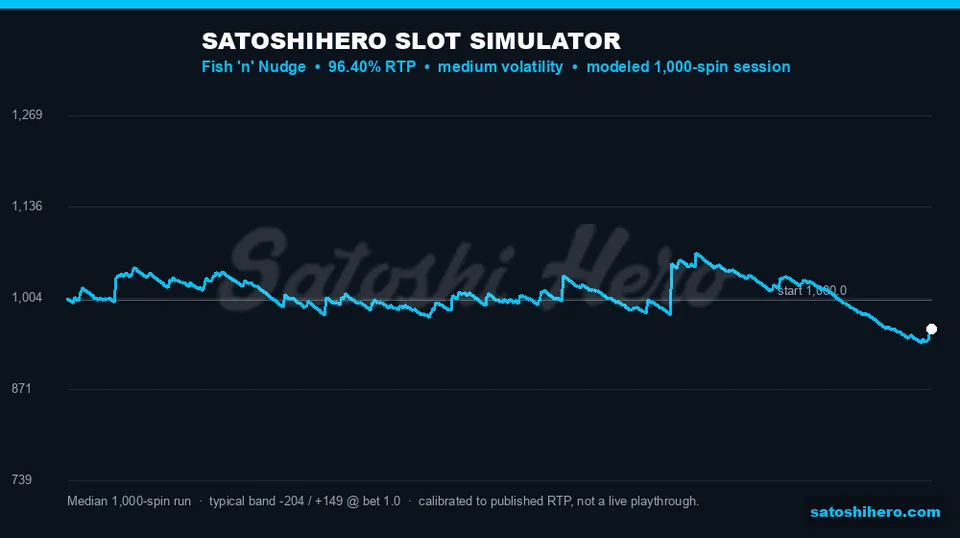
The simulator indicated a wide range of plausible session endings despite the medium-volatility setting. I configured it with the game’s stated return, risk level and win cap, then modelled repeated 1000-spin sessions at a wager of 1. The model treats each session as a probability exercise and doesn’t reproduce the game’s internal random number generator.
Within the model, 25% of spins return something. A result of at least 10x appears about once in 50 spins, while a result of at least 100x appears about once in 11,494 spins. Those rates describe the simulator assumptions and shouldn’t be read as fixed intervals between qualifying outcomes.
The median modelled session ended 42.2x below its starting point. At the lower edge of the central range, the 5th percentile finished 204.0x down, while the 95th percentile ended 148.7x up. That spread shows why two equal-length sessions can finish far apart even when they share the same setup.
The median loss also illustrates the effect of skewed payouts. Many modelled sessions can finish below the start while a smaller set of stronger runs lifts the broader return distribution. The maximum-win ceiling belongs far beyond an ordinary sample, so the model doesn’t rely on every session approaching the largest possible result.
This projection is most useful as context for bankroll movement, not as a timetable. It suggests that frequent small payments can coexist with substantial session-level variance, especially when uncommon larger outcomes carry meaningful weight. It cannot identify when a Net collection, Free Spins trigger or high-paying line appears in actual play.
How did my 100-spin Fish ‘n’ Nudge test go?
What did the return and hit breakdown show?
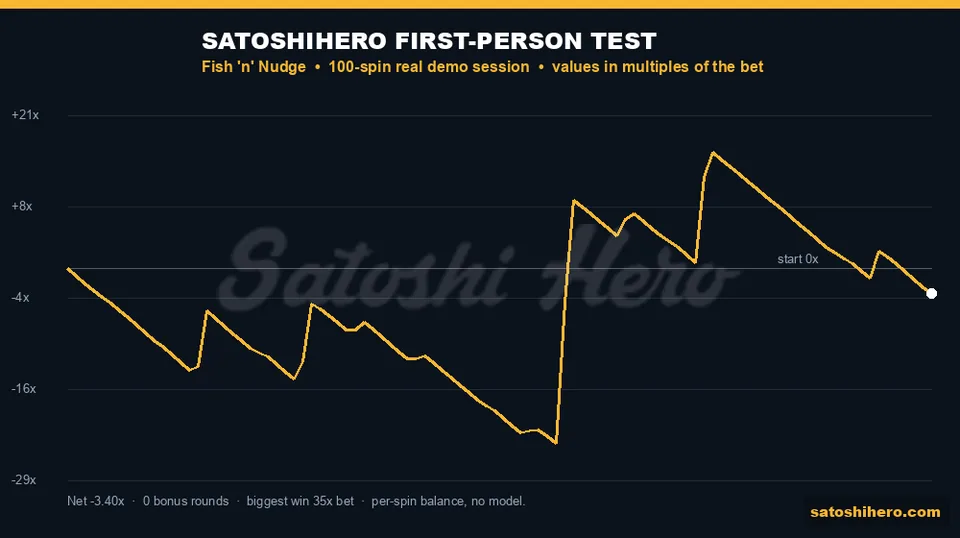
The session finished 3.4x the bet below its starting point. I wagered $0.50 on each of 100 spins, staking 100x in total, and the game paid back 96.6x. Twenty-four spins returned something, leaving 76 spins without a payment.
Fifteen paying spins returned less than the wager, three paid between 1x and 5x, and six paid at least 5x. That breakdown explains why the hit count alone doesn’t describe the session. Most paying results didn’t recover the cost of their own spin, so the larger Net and line outcomes carried much of the return.
When did the balance turn around?
The biggest win arrived on spin 58 and paid 35x, or $17.50. Three Fish caught in Nets on the first reel displayed prizes of $12.50, $2.50 and $2.50. The result moved my tracked balance from 24.1x below the start to 9.9x above it, creating the sharpest change on the graph.
The next-largest results were 17x on spin 74, 12x on spin 28 and 10x on spin 16. My highest balance came after spin 74, when I stood 16.6x above the starting point. Those stronger outcomes were separated by many small or empty spins, so the overall line remained uneven.
I was below the starting balance after every spin from 1 through 57. The lowest point came after spin 57 at 24.1x down, immediately before the largest result reversed the position. The balance stayed above the start from spin 58 through spin 91, then returned above it briefly on spins 94 through 96.
The longest dry stretch lasted 10 consecutive spins, covering spins 6 through 15. At the first quarter mark I was 13.8x down, and after 50 spins the deficit had widened to 19.8x. The balance then improved sharply, reaching 15.6x above the start after 75 spins before declining across the final quarter.
How did the reload affect the tracked balance?
An error screen appeared after spin 59, so I reloaded the game. The demo reopened with the full $1,000.00 play-money balance rather than the result of the earlier sequence. I played the remaining 41 spins in the new session and carried forward the tracked position from spin 59, which had been 8.9x above the original start.
The graph joins the two segments at that point instead of treating the reload as a balance gain. This preserves the economic result of all 100 wagers while acknowledging the interface interruption. The error didn’t alter the recorded outcomes before the reload, and no substitute spins were inserted.
What did the full session feel like?
No Free Spins appeared during the counted sample. After spin 100, I played nine extra spins to obtain screenshots, and none of those results contributes to the hit count, payout total or balance curve. The separate Free Spins payment is likewise excluded from the 96.6x return.
The session felt quieter than the final return percentage might suggest. Small line payments and empty Nets allowed the deficit to deepen for more than half the test, while one caught-Fish result changed the shape of the entire run. The final loss was modest, but the path included both a 24.1x deficit and a 16.6x profit.
Frequently Asked Questions
Final Take

My Take
Fish ‘n’ Nudge succeeds when the moving Nets are treated as the main event rather than a background modifier. The fixed paylines keep ordinary wins understandable, while caught Fish and Fisherman collections can alter a result without requiring another line. My test finished slightly down, yet it also showed how one strong Net outcome can reverse a long deficit.

Pros:

Cons:

Best for
Patient feature trackers get the clearest value from watching Net stacks descend across the reels. Fixed-line slot fans can read the base payouts without decoding a large ways system, while collector-feature fans receive a second result layer through caught Fish and the framed Fisherman. Bonus-buy hunters have less flexibility because I found no direct purchase option in the demo.
The balanced verdict is that the game has a coherent feature, clear proof of how its prizes are collected and enough session movement to stay engaging without disguising the risk. The 100-spin result was close to break-even, but its large internal swings matter more than the small final deficit. Try the demo on SatoshiHero, keep the Net conditions in view and judge Fish ‘n’ Nudge by its full reel flow rather than one isolated win.












Other Push Gaming Games























































Bets
All Bets
Game
Player
Date
Wager
Mult.Multiplier
Prize
 Galaxy Glitter
 Hidden
- 00:18:07
- 0×
- Galaxy Glitter
- Hidden
- 00:18:06
- 3.59×
- Royal Fruits 9: Hold 'n' Link
 Hidden
- 00:18:06
- 0×
- Royal Fruits 9: Hold 'n' Link
- Hidden
- 00:18:04
- 0×
- Galaxy Glitter
- Hidden
- 00:18:03
- 0×
- Galaxy Glitter
- Hidden
- 00:18:02
- 0×
- Galaxy Glitter
- Hidden
- 00:18:02
- 0×
- Royal Fruits 9: Hold 'n' Link
- Hidden
- 00:18:01
- 5.99×
- Galaxy Glitter
- Hidden
- 00:18:01
- 0×
- Royal Fruits 9: Hold 'n' Link
- Hidden
- 00:18:00
- 0×