

Catfish Hunters
By pressing play, you agree that you are above legal age in your jurisdiction and that your jurisdiction allows online gambling.


Reeling in Trouble Below the Waterline
Catfish Hunters throws you into a very-high-volatility Nolimit City slot where small symbol wins barely matter until Fish, Electrical Frames and the global multiplier connect.
Catfish Hunters is a very-high volatility slot from Nolimit City with 96.03% RTP and 20,000x max win potential. The game features a 5 reels by 3 rows layout with 14 symbols and Fish-and-Frame wins. Brutal dry stretches target patient players chasing big chains, as my test showed a $70 Dark Water buy returning $770.90 while a $600 Overcharged buy returned $55.50.
Key takeaways
- Best bonus: Dark Water Spins gave my strongest tested result, returning $770.90 from a $70 cost.
- RTP / volatility: The official math lists 96.03% RTP, very-high volatility and 20,000x max win.
- Max win: Final Discharge stops a round at 20,000x when compounding Fish wins pass the cap.
- Risk note: Overcharged Spins cost $600 in my test and returned only $55.50.
- Bankroll note: Base-game wins often landed between $0.25 and $1.00, so balance drift felt harsh.

Warning: Very-high volatility means even the premium round can miss badly when Electrical Frames land on low Fish values. You need room for cold stretches before one clean connection changes the session.

Table of Contents
- How Catfish Hunters Works
- Symbol pay values
- Fish and Frames
- Theme & First Impressions
- Mississippi setting
- Screen readability
- Dark Water, Deep Water and Overcharged Spins
- Trigger requirements
- Upgrade ladder
- Nolimit Booster Modes
- Spin toggles
- Multiplier starts
- Bonus Buy Results
- Dark Water buy
- Overcharged buy
- Extra Spin Decisions
- Offer rules
- When to decline
- Final Discharge and the 20,000x Cap
- Maximum payout
- Why it matters
- RTP, Volatility & Our Catfish Hunters Test
- Simulator projection
- Our 500-spin session
- Frequently Asked Questions About Catfish Hunters
- Final Verdict
How Catfish Hunters Works
Catfish Hunters works like a standard 5 reels by 3 rows slot only on the surface. The real money sits in Fish values, Electrical Frames and the global multiplier.
Regular wins pay left to right on adjacent reels, so don’t call this a fixed-payline game. The Wild substitutes for every symbol except Bonus, but a full Wild screen doesn’t pay. The Catfish Hunters slot also ran cleanly on desktop and mobile screens because Fish values and the multiplier barrel stayed easy to read.
Duck Hunters may create a similar naming expectation, but this game leans harder into position-based Fish hits. You aren’t just waiting for matching symbols. You need the right Fish under the right Frame, at the right multiplier.
Symbol pay values
At my $1.00 stake, the five tackle premiums paid modestly. Fishing Rod paid $5.00, $2.50 and $1.00, while Landing Net paid $3.00, $1.20 and $0.60. Worm Can paid $2.50, $1.00 and $0.50, Fly Lure paid $2.00, $0.80 and $0.40, and Beefy Brew paid $1.50, $0.60 and $0.30.

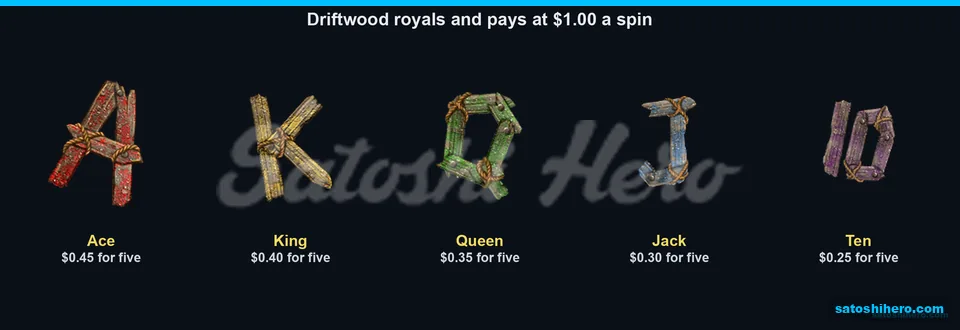
Low symbols felt even thinner at $1.00. Five Aces paid $0.45, Kings paid $0.40, Queens paid $0.35, Jacks paid $0.30 and Tens paid $0.25. Numbers suggest the paytable only keeps the reels alive between Fish moments.
Fish and Frames
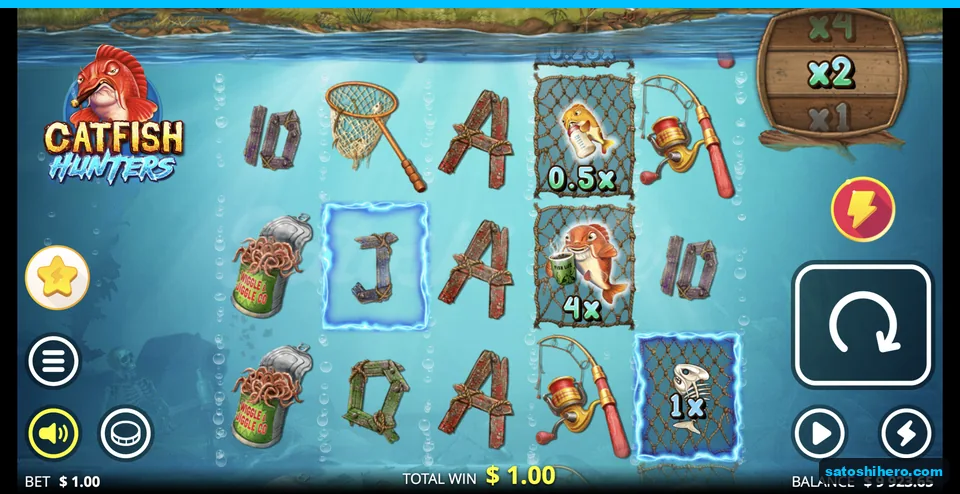
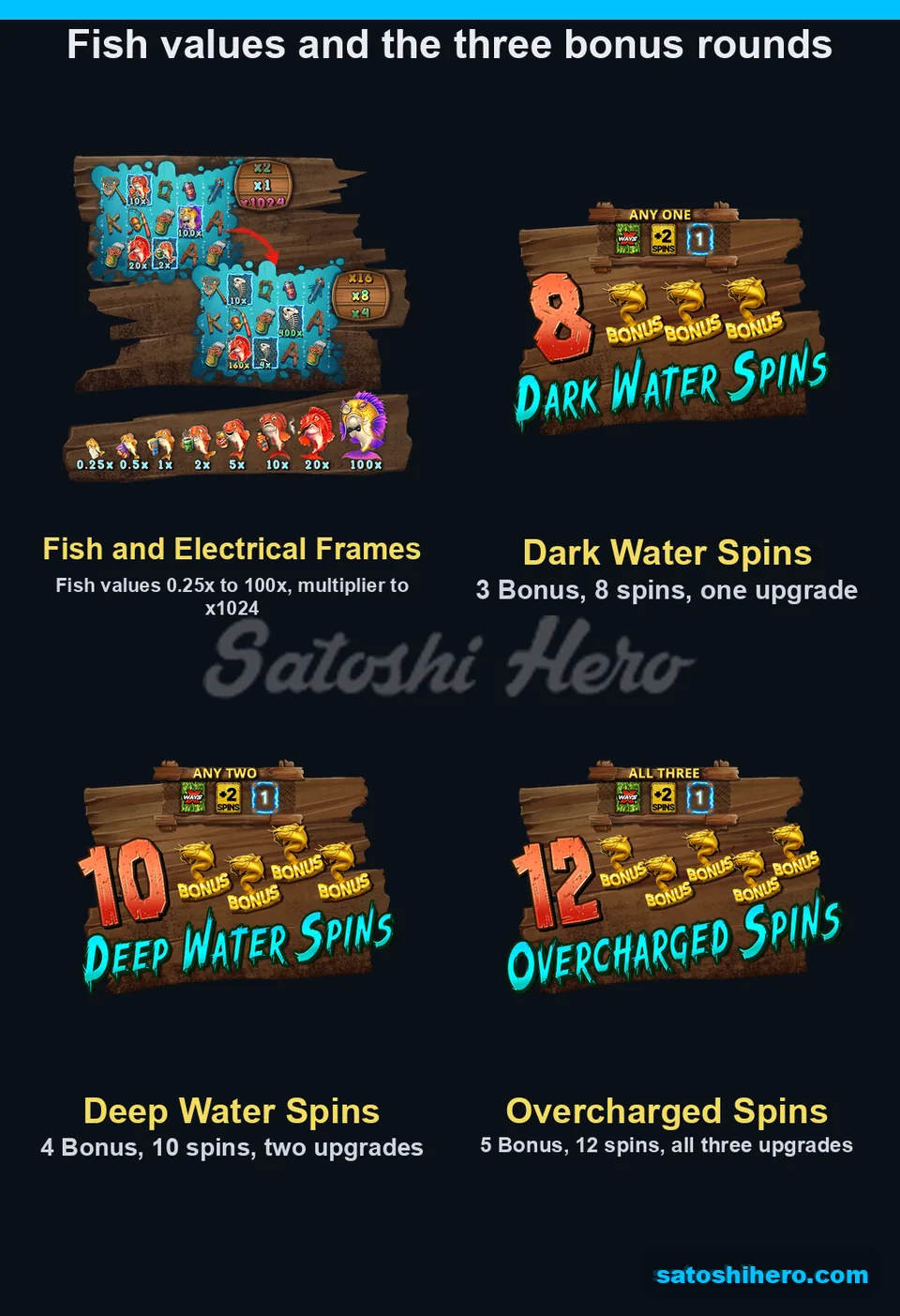
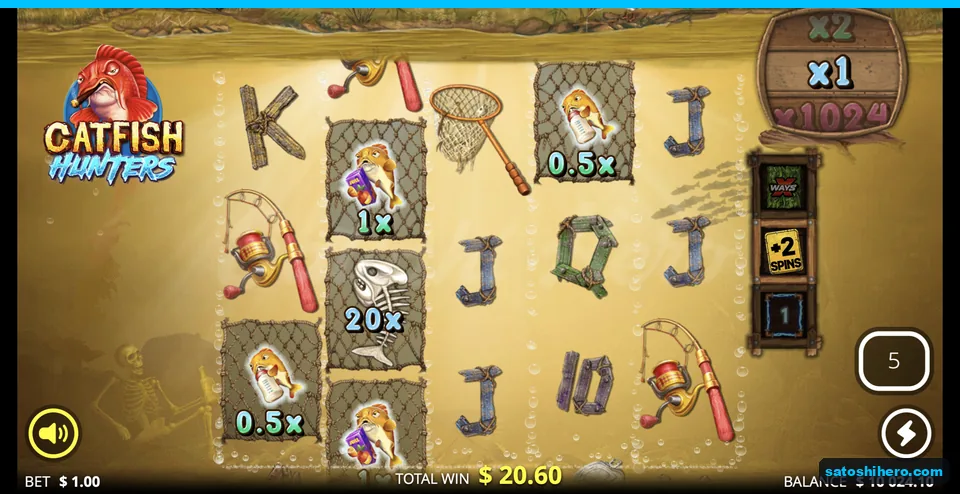
Electrical Frames appear in random positions at the start of every spin. Fish can carry 0.25x, 0.5x, 1x, 2x, 5x, 10x, 20x or 100x. A Fish pays only when an Electrical Frame lands on the same position.
The Fish value gets multiplied by the global Fish multiplier, then by your bet. That multiplier starts at x1 and can climb to x1024. Every Fish win doubles the global multiplier and doubles all remaining Fish values on screen, which is where the slot gets dangerous. That order matters because the board can look strong before it is actually paying, and one missed Frame can leave the best values untouched.
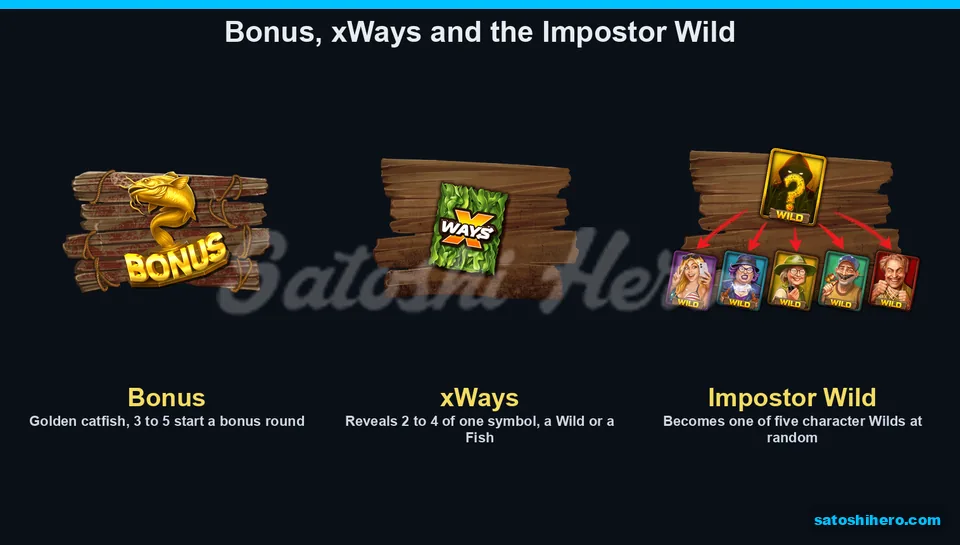
xWays transforms into one symbol type. It can reveal regular symbols in sizes of 2 to 4, or a Wild or Fish at size 1. The Impostor Wild then adds real chaos, because its five character versions can boost multipliers, add Frames or turn regular symbols into Fish. The paytable matters less than whether Frames hit valuable Fish.
Theme & First Impressions
The theme works because the underwater Mississippi layout makes the main mechanic easy to follow. You can track Fish values, Frames and the barrel without fighting the artwork.
Mississippi setting
The reels sit below the waterline, with the riverbank and a duck visible above. A sunken skeleton rests on the bottom, which gives the fishing comedy a sharper edge. Gator Hunters has a swampier animal mood, while this slot feels more like a riverbed ambush.
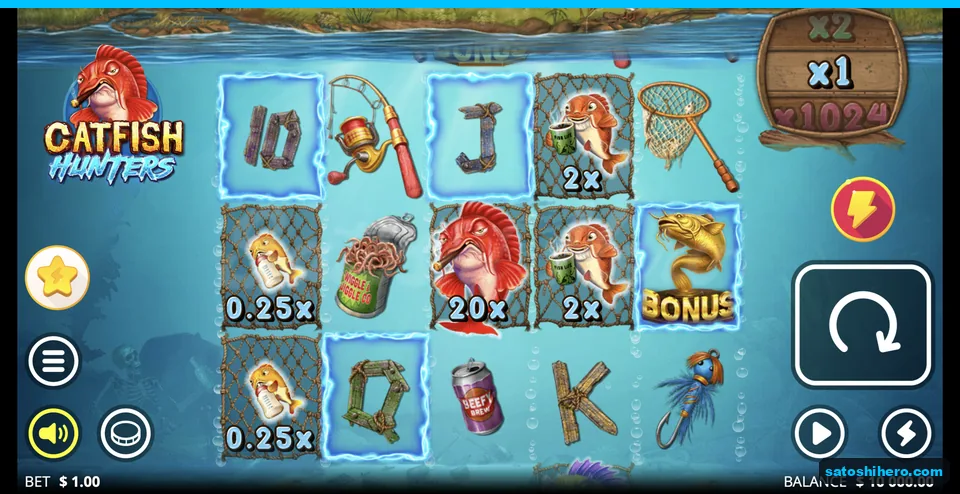
Fishing tackle, driftwood letters and Fish values form the visual language. I like that the game doesn’t pretend ordinary symbols matter much. The scene tells you what to watch, and that honesty helps.

Insight: The reels sit below the Mississippi waterline, while the riverbank scene above keeps the slot from feeling like a generic fishing game.
Screen readability
The wooden barrel on the right shows the global Fish multiplier from x1 toward x1024. That placement matters, because you check it constantly when Frames start hitting. Casino Win Spin offers a simpler spin rhythm, but this game asks you to read the board.
The theme won’t win originality awards, and I don’t think it needs to. The underwater layout supports the mechanic rather than distracting from it.
Dark Water, Deep Water and Overcharged Spins
The bonus ladder adds more spins and upgrades as more Bonus symbols land. Yet each round still needs Electrical Frames to hit the right Fish.
Trigger requirements
Three Bonus symbols trigger 8 Dark Water Spins. Four give 10 Deep Water Spins, while five give 12 Overcharged Spins. Each extra Bonus symbol adds one spin, so extended rounds can build if the symbols keep appearing.
The global Fish multiplier carries into the round from the base game. It then halves on each new spin down to x1. That rule keeps hot starts alive, but it also cools them quickly when the board misses.
Upgrade ladder
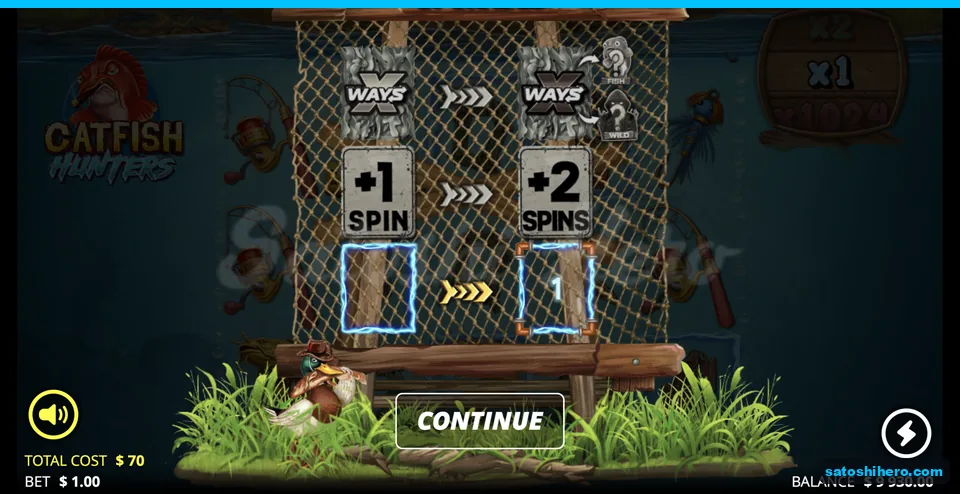
Dark Water gets one random upgrade, Deep Water gets two and Overcharged gets all three. The upgrades make xWays always reveal a Fish or Impostor Wild, add a sticky Electrical Frame in the middle position, and make each extra Bonus award two spins instead of one.
One organic Dark Water Spins round landed inside my first 50 spins. That early hit briefly pushed the session into profit and made the base game feel less punishing. Overcharged gives the strongest setup on paper, but it doesn’t guarantee a strong payout. The upgrade ladder mainly improves how many chances the board gets to create a payable position. It cannot solve the central problem by itself, because the game still checks exact symbol locations.
Nolimit Booster Modes
Nolimit Booster modes change the cost and setup of each spin. They don’t remove the core Fish-and-Frame risk.
Spin toggles
These are spin-mode toggles rather than one-off purchases, so each active mode changes every spin price. Bonus Booster guarantees a Bonus symbol on reel two and returns 96.08%. Grand Catch guarantees at least one Impostor Wild at 96.04%, while Legend Catch guarantees at least two at 96.05%.
That math sits close to the 96.03% base return. Numbers indicate these modes reshape variance more than value. You may see more feature ingredients, but you still need position hits.

Key Stat: Most booster returns sit close to the base 96.03%, but boosters reshape spin cost and volatility. You aren’t buying safety, you’re buying a different risk curve.
Multiplier starts
Fishy Spins starts the global Fish multiplier at x8 and returns 96.08%. Fishier Spins starts at x128 and returns 96.05%, while Fishiest Spins starts at x1024 and returns 96.08%. Two more modes restrict Fish values, with one allowing only 10x, 20x and 100x and another allowing only 100x.
These modes sound explosive, and they can be. Still, high starting multipliers mean little when Frames avoid the best Fish. Boosters can make the game feel faster without making it safer.
Bonus Buy Results
The bonus-buy test split sharply. The cheaper Dark Water buy crushed its cost, while the premium Overcharged buy missed almost everything that mattered.
Buying works as arm then spin. I picked a card in the Nolimit Bonus menu, confirmed on the panel, then the spin button carried a price badge before charging the balance. A banner named the round, and an upgrades screen appeared before play started.
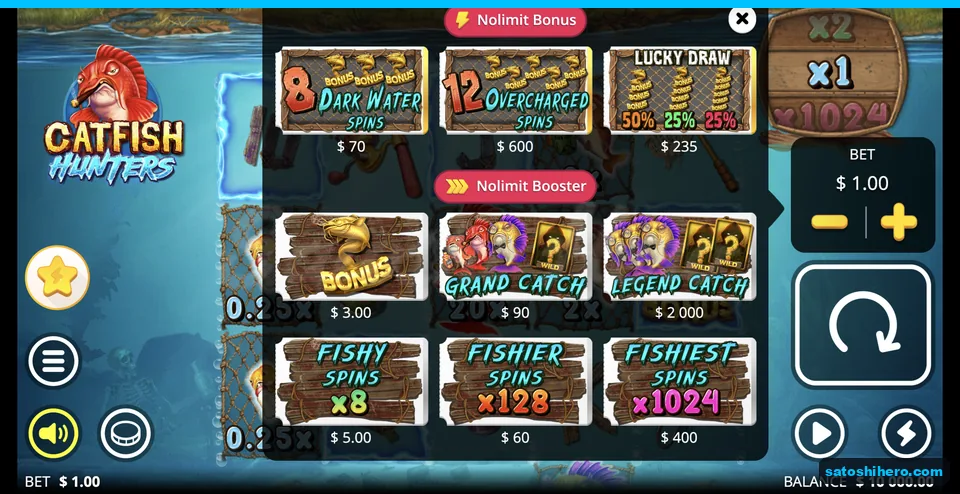
Lucky Draw cost $235 and returned 96.06%. It buys a weighted entry, with 50% into one round and 25% into each of the others. I skipped it because it gambles on which round you receive instead of giving a fixed feature.
Dark Water buy
Dark Water Spins cost $70, or 70x my $1.00 bet. It returned $770.90, which made it the best tested play by a huge margin. The round received the sticky Electrical Frame upgrade, and that middle Frame gave the board a clear anchor.
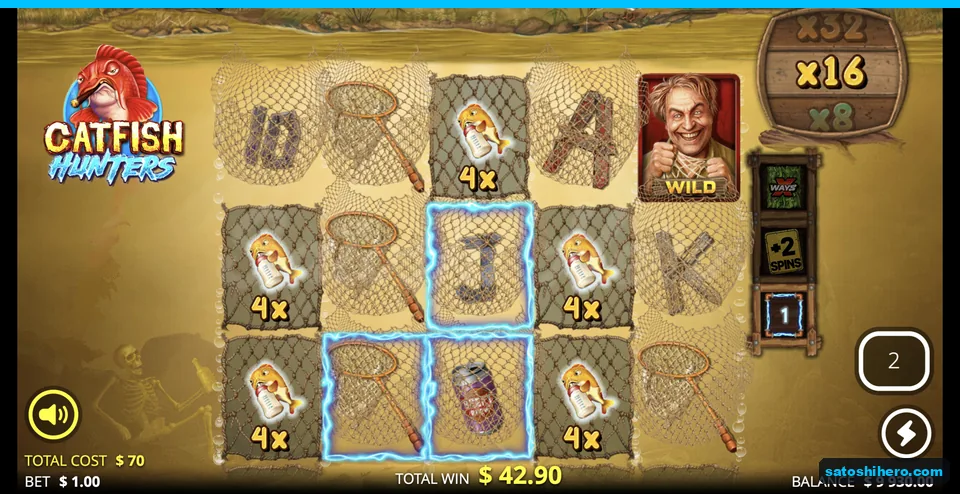
By the closing spins, Fish values had doubled up to 4x each. The global multiplier reached x16, and a character Wild sat on the reels. The reveal climbed through $100.05, $253.63, $500.00 and $570.42 before settling at $770.90.
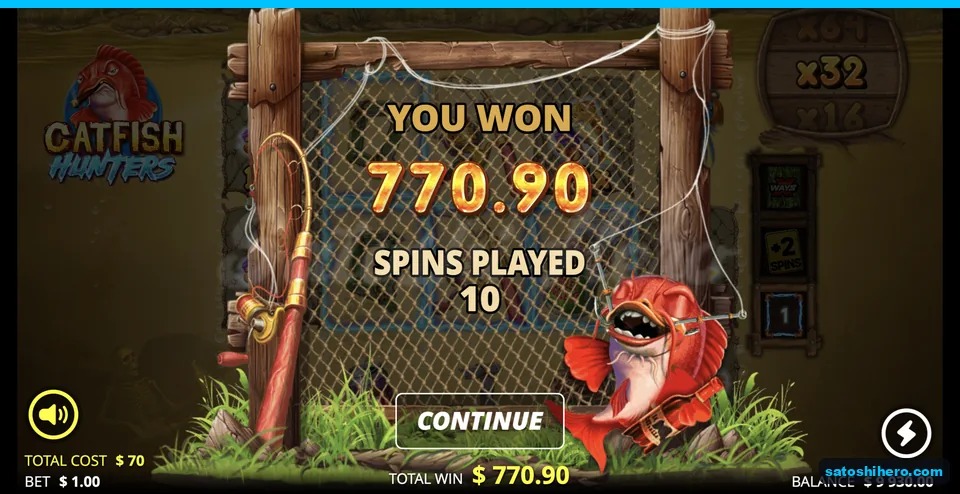

Strategy Insight: Judge a bonus board by where Electrical Frames can land, not by how large the Fish values look. Big values don’t matter until the game frames them.
Overcharged buy
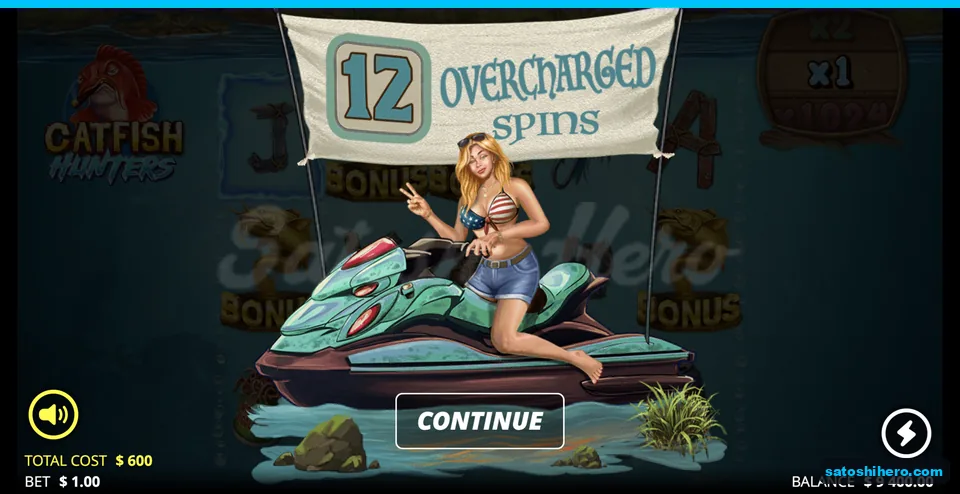
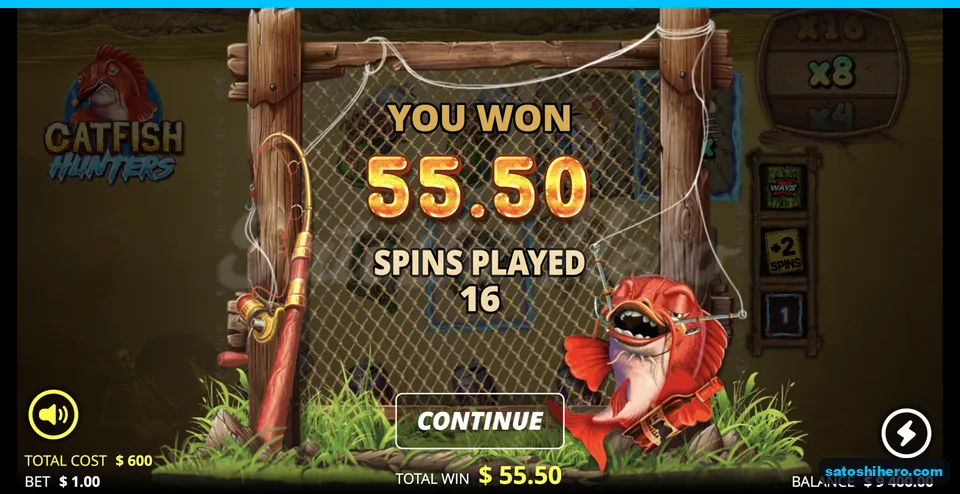
Overcharged Spins cost $600, or 600x the bet, and returned $55.50. Bounty Hunters fans may accept that kind of violent feature swing, but this result still stung. The round received all three upgrades and played 16 spins.
The board looked huge at one point. I had a 160x Fish, three separate 40x Fish, plus 8x, 4x and 2x values, with the global multiplier at x8. The problem was brutal: three Electrical Frames landed on 0.5x, 1x and 2x Fish instead.
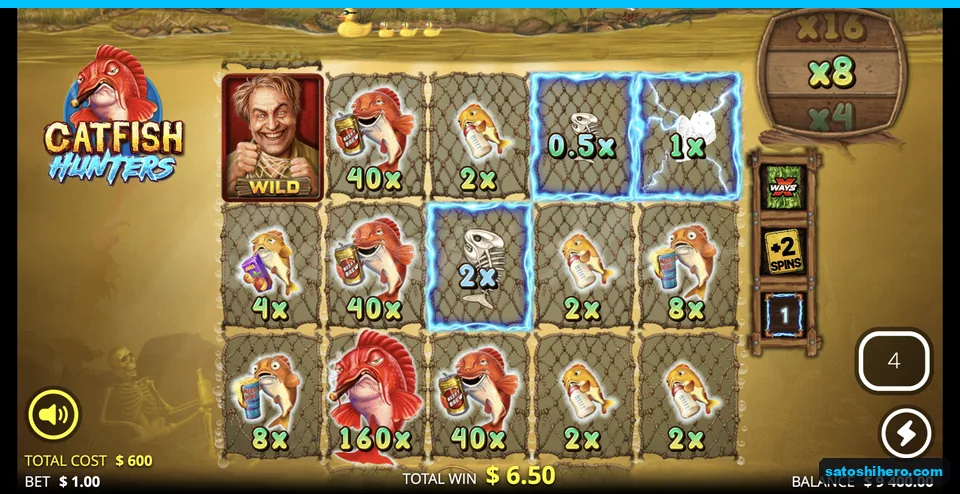
That spin paid $6.50, and the round closed at $55.50. Nine to Five gives a steadier session rhythm by comparison, if you don’t want premium-buy swings this sharp. The Overcharged result gives the strongest warning in the whole test. I kept that result instead of rebuying because it showed the slot at its most honest: premium setup, full upgrades and still no rescue when the positions failed.
Extra Spin Decisions
Extra Spin is a paid follow-up gamble, not a free extension. You should judge it like a separate bet.
Offer rules
When a round ends, the game may sell one extra spin. That spin keeps the Electrical Frames and global Fish multiplier from the previous spin. The offer only appears when its cost is no higher than the total win.
Bonus symbols can’t land during Extra Spin. New Electrical Frames can only come from Karen or Granny Wilds during it. That restriction matters because you can’t turn the purchase into another bonus round.
When to decline
My test showed an offer at $19.00 with the barrel at x16. I declined it. The kept multiplier looked tempting, but the spin still needed Frames to land on valuable Fish.
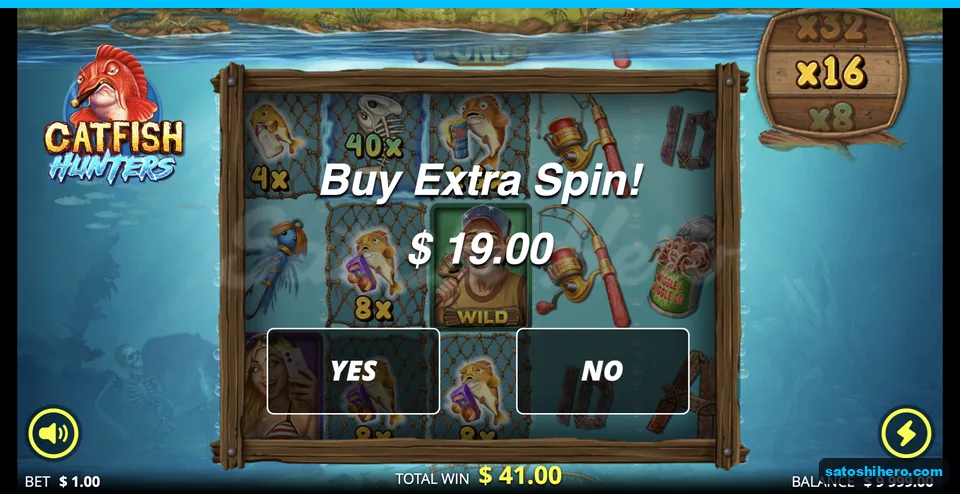
Data shows why that restraint matters. A strong multiplier without Frame placement can burn money fast. Extra Spin fits only players comfortable buying one more high-risk roll.
Final Discharge and the 20,000x Cap
Final Discharge is the hard stop that pays the official 20,000x max win when a round passes that cap. The game awards 20,000x and ends the round.
Maximum payout
The official maximum win is 20,000x. Don’t inflate that number, because the engine already has enough ceiling. The cap matters because x1024 multiplier growth and doubled Fish values can escalate very quickly.
Why it matters
The route to the cap needs several parts to align. You need Fish values, Electrical Frame placement, character Wild effects and multiplier growth. My test showed how often one missing piece kills the whole setup.
The 20,000x ceiling makes sense for this engine. I still think the slot makes you work brutally hard before it feels dangerous. The max win looks chaseable in theory, but Fish, Frames and multiplier growth all need to connect.
RTP, Volatility & Our Catfish Hunters Test
Catfish Hunters has 96.03% RTP, very-high volatility and 20,000x max win. My test data showed a slot that can leak slowly before one feature changes everything.
The Catfish Hunters slot carries a sharper risk profile than its headline return suggests. The test and simulator are checked regularly, but one live or demo session doesn’t prove the return. It only shows how the math can feel at $1.00 per spin.
Simulator projection
Our simulator ran 1,000 spins at $1.00 using 96.03% RTP, very-high volatility and the 20,000x ceiling. The median session finished about $106.40 down. The middle range ran from roughly $437.40 down to $671.10 up.
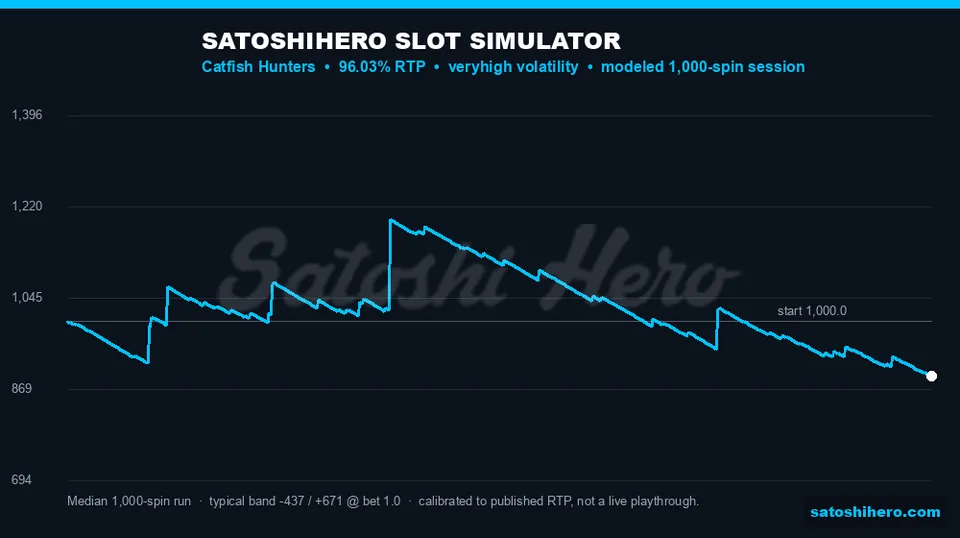
That spread sits more than $1,100 around the median loss. Hit frequency came out at 14% in the model, a feature-tier result landed about once in 54 spins, and a 100x or better win appeared about once in 814 spins. The model describes a range, not your next result.
Insight: The simulator projected 14% hit frequency, but 100x+ wins appeared only around once per 814 spins in the model.
Our 500-spin session
I played 500 spins at $1.00 on a fresh $10,000 demo balance. I finished at $9,928.40, down $71.60. One organic Dark Water Spins round landed inside the first 50 spins and pushed the balance to $10,024.10.
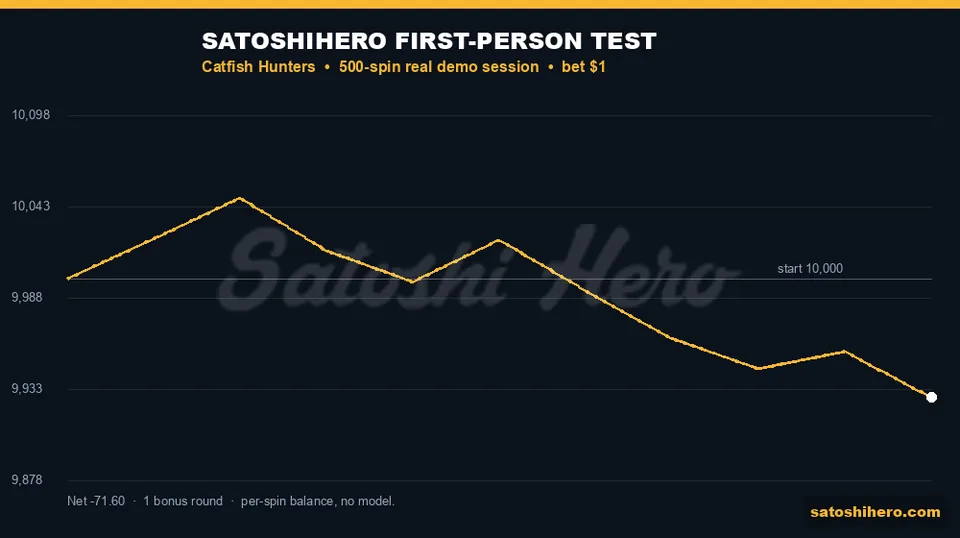
The balance reached $10,048.80 by spin 100. It still sat at $10,023.50 at spin 250, then drifted down through the back half. Base-game wins felt tiny, mostly between $0.25 and $1.00. That arc made the early bonus look more important in hindsight, because ordinary reel hits did not protect the lead once the Fish-and-Frame connections dried up.
My clearest base hit paid $1.00 from a 1x Fish under an Electrical Frame with the global multiplier at x2. That result tells the story well. The base game leaks unless Fish and Frames connect, so careful bet sizing beats bonus chasing.
Theoretical RTP is the operator-published return, and a single live or demo session doesn’t prove or change that figure. Bonus-buy and booster returns can sit slightly above or below the base RTP by design.
Frequently Asked Questions About Catfish Hunters
How do the Fish symbols and Electrical Frames work in Catfish Hunters?
Electrical Frames appear randomly at the start of every spin. Fish can carry 0.25x, 0.5x, 1x, 2x, 5x, 10x, 20x or 100x. A Fish pays only when a Frame lands on its position, then the Fish value multiplies by the global Fish multiplier and your bet. Wins evaluate top to bottom and left to right.
How high can the global Fish multiplier go in Catfish Hunters?
The global Fish multiplier starts at x1 and can climb to x1024. It doubles every time a Fish win gets awarded. Each Fish win also doubles remaining Fish values on screen, so the double compounding creates most of the upside.
What is the Impostor Wild in Catfish Hunters?
The Impostor Wild can land on any reel and transform into one of five character Wilds. One can multiply the global Fish multiplier by 2, 4 or 8. Others add Electrical Frames, add Frames to the full reel area, or turn regular symbols into Fish.
What is the difference between Dark Water, Deep Water and Overcharged Spins?
Three Bonus symbols give 8 Dark Water Spins, four give 10 Deep Water Spins and five give 12 Overcharged Spins. Dark Water gets one random upgrade, Deep Water gets two and Overcharged gets all three. The extra upgrades improve the setup, but they don’t guarantee a strong payout.
Should I take the Extra Spin offer in Catfish Hunters?
Treat Extra Spin as a purchase, not a free spin. It keeps Electrical Frames and the global Fish multiplier, and it only appears when the cost is no higher than the total win. Bonus symbols can’t land during it, and I declined my $19.00 offer.
What did the 1,000-spin simulator project for Catfish Hunters?
Our simulator used 1,000 spins at $1.00 with 96.03% RTP, very-high volatility and 20,000x max win. The median session finished about $106.40 down, while the middle range ran from roughly $437.40 down to $671.10 up. Hit frequency came at 14% in the model, with a feature-tier result about once in 54 spins and a 100x+ result about once in 814 spins.
Final Verdict
Catfish Hunters stands out because its Fish-and-Frame engine makes every meaningful hit feel earned. The drawback is just as clear: you can stare at huge Fish values and still win almost nothing if the Frames miss.

My Take
High-volatility hunters and bonus-buy fans get the sharpest version of this game. Expect long dry spells, small base hits and sudden feature spikes. If you can’t shrug off a $600 premium buy returning $55.50, keep the stake low.
I like the way my $70 Dark Water buy built from real board movement into a $770.90 result. I don’t like how helpless Overcharged felt when Frames hit low Fish beside much larger values. That contrast makes the game honest, harsh and memorable.
Catfish Hunters is best treated as a measured volatility test, not a steady grinder. This guide is updated periodically as the SatoshiHero test data changes and new session notes become useful.

Pros:
 Clear Core Mechanic: Fish and Frames make every meaningful win easy to understand.
- Strong Upside: The 20,000x cap gives compounding wins real room.
- Memorable Theme: The underwater Mississippi layout supports the feature logic well.
- Useful Buy Data: Real $70 and $600 tests show the risk clearly.

Cons:
 Harsh Base Game: Small $0.25 to $1.00 wins can drain balance slowly.
- Premium Buy Risk: Overcharged cost $600 and returned only $55.50 in my test.
- Position Dependence: Big Fish values mean nothing when Frames miss them.

Best For: Patient bankroll managers, bonus-buy testers and Nolimit City fans get the most from this slot. The theme helps you follow the math, but the very-high volatility demands discipline. You can test it on SatoshiHero in demo or real play before risking real money.

































































Bets
All Bets
Game
Player
Date
Wager
Mult.Multiplier
Prize
 Royal Fruits 9: Hold 'n' Link
 Hidden
- 16:46:19
- 0×
- Aztec Magic Megaways
 Hidden
- 16:46:13
- 0.39×
- Royal Fruits 9: Hold 'n' Link
- Hidden
- 16:46:11
- 0×
- Royal Fruits 9: Hold 'n' Link
- Hidden
- 16:46:11
- 0×
- Aztec Magic Megaways
- Hidden
- 16:46:10
- 0×
- Aztec Magic Megaways
- Hidden
- 16:46:06
- 0×
- Royal Fruits 9: Hold 'n' Link
- mdp0fxo
- 16:46:04
- 0×
- Royal Fruits 9: Hold 'n' Link
 Hidden
- 16:46:03
- 0×
- Royal Fruits 9: Hold 'n' Link
- Hidden
- 16:46:03
- 0×
- Aztec Magic Megaways
- Hidden
- 16:46:02
- 0×