

Fire Hopper
By pressing play, you agree that you are above legal age in your jurisdiction and that your jurisdiction allows online gambling.


Chasing a Multiplier Frog Across the Lotus Pond
Follow the multiplier-carrying frog as it leaps across Fire Hopper’s 7×7 pond grid. Fire Hopper is a Push Gaming slot with 96.3% theoretical RTP, high volatility, and 50,000x maximum win potential. Five matching lotus symbols must connect horizontally or vertically, with no fixed paylines.
This cluster game targets risk-tolerant players chasing frog multipliers and seven free games. My 100-spin test ended 73.2x down, peaked at 5.4x, and triggered no free games. SatoshiHero offers free demo and real play, while this evidence-led guide separates observed results from modeled outcomes.
Key takeaways
- Best bonus: The base game was my tested mode; the 124x Free Games buy remained unused.
- RTP / volatility: The math combines a 96.3% theoretical return with high volatility.
- Max win: One game round can reach 50,000x through an exceptional sequence.
- Risk note: My test lost 73.2x, and its largest result reached only 5.4x.
- Bankroll note: The session included 11 consecutive losing spins, while one bonus purchase costs 124 stakes.

Table of Contents
- How Fire Hopper Works
- Cluster Wins and Collapses
- Wild and Prize Symbols
- Leaping Frog Feature
- Trigger and Leap Sequence
- Multiplier Growth
- Theme and First Impressions
- Pond Setting
- First Visual Impression
- Lotus Payouts and Special Symbols
- High-Value Lotus Pays
- Lower-Value Lotus Pays
- Free Games Feature
- Trigger and Timing
- Persistent Frog Multipliers
- Buying the Free Games Bonus
- Cost and Access
- What I Didn’t Test
- RTP, Volatility and Our Test
- Simulator projection
- Our 100-spin session
- How It Played Over 100 Spins
- Pacing and Dry Spells
- Session Reliability Notes
- Frequently Asked Questions About Fire Hopper
- Final Verdict
How Fire Hopper Works
Wins in the Fire Hopper slot come from connected lotus clusters on a 7×7 grid, not paylines. You need five matching flowers touching horizontally or vertically before the game removes them. Symbols above each gap then fall, and new symbols enter from the top. You can gain another cluster from that collapse without placing another stake.
One symbol can contribute to more than one connected group. Diagonal contact alone doesn’t count, which makes some crowded boards look better than they are. I find the rule simple after a few spins, but you should check each group’s side-to-side or vertical links. SatoshiHero supports the game through its desktop and mobile experience.
Cluster Wins and Collapses
Every valid cluster starts with five matching lotus symbols. The game clears that group, drops the remaining flowers, and fills gaps from above. Another group can then pay from the same spin. Watch for fresh flowers joining symbols below.
You shouldn’t count diagonal chains. One flower can support two valid groups, and I find those collapses easy to follow. Cluster size and direct contact determine your result.
Wild and Prize Symbols
The Frog and Gold Frog substitute for lotus flowers, but neither replaces a Firefly or Bonus Firefly. Fireflies and Bonus Fireflies don’t pay alone, while Instant Prize symbols show values from 1x to 1000x. You need a Frog beside an eligible target on the same board before a leap sequence starts. A visible target without that Frog changes nothing.
My settled 5.4x base-game result showed exactly that distinction. A Firefly remained visible, but no Frog appeared, so I got no leap. You should separate ordinary cluster activity from an active feature, especially when several special symbols crowd the pond. I think that visual lesson matters more than memorizing every icon immediately.
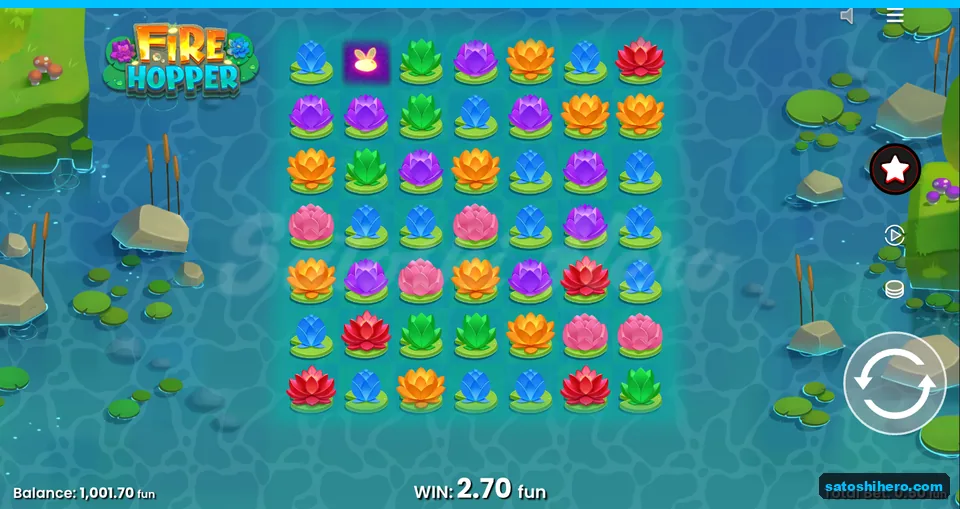

Key Stat: Fire Hopper doesn’t use paylines. Five matching symbols must touch horizontally or vertically before they pay.
You should read the finished board rather than assume every busy layout contains a feature.
Leaping Frog Feature
The Leaping Frog Feature starts when a Frog shares the grid with a Firefly, Instant Prize, or Bonus Firefly. You don’t choose the route, target, or final destination. Random symbol placement controls the sequence, while the animation shows how the resulting multiplier develops. I like that clarity because each leap has a visible purpose.
Trigger and Leap Sequence
Eligible targets include Fireflies, Instant Prizes, and Bonus Fireflies. The Frog jumps to one, leaving a Gold Frog at its prior position. Further eligible targets can extend the movement, while collapses can expose additional opportunities within the same sequence. You can follow the active Frog to see whether another target remains.
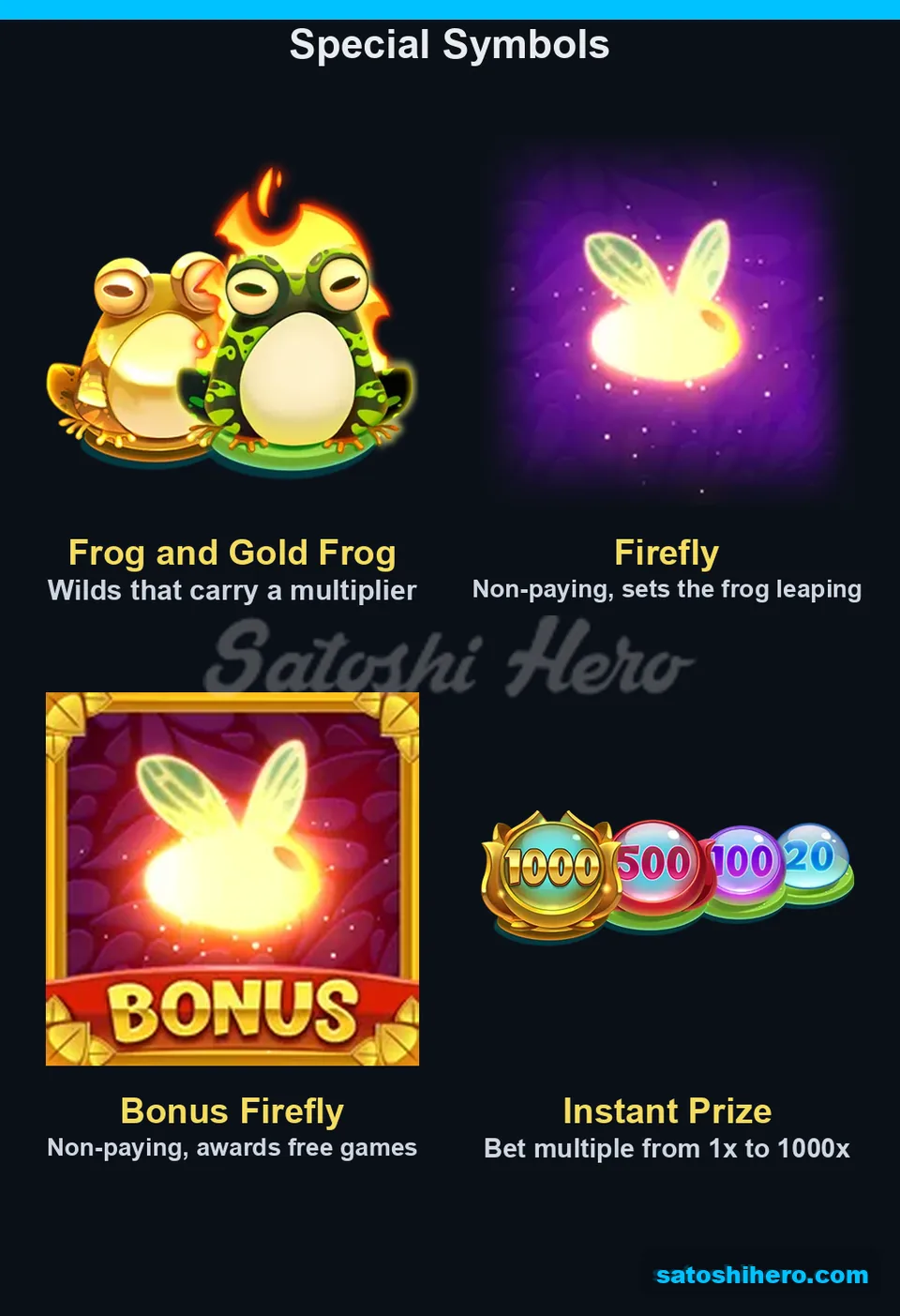
A lone Frog can’t leap without a target, and a lone Firefly can’t activate itself. You should treat the route as an outcome display, not a skill choice.
Multiplier Growth
Every Frog begins at 1x, and each completed leap raises its multiplier by one. A deposited Gold Frog keeps the value held when the active Frog created it. If the Frog reaches an Instant Prize, the game applies the active multiplier and pays that result immediately. The printed 1x to 1000x value isn’t necessarily the final payment.
The growing multiplier can matter more than the prize’s printed number. You should track the active Frog and each Gold Frog because their values explain the payment.

Strategy Insight: Follow the multiplier on the active Frog and every deposited Gold Frog, not only the printed prize. This helps you read results but doesn’t change the odds.
Multiplier tracking explains what happened after the symbols land. It can’t influence which targets appear, so you should never mistake close attention for control.
Theme and First Impressions
A calm lotus pond gives the cluster system a clear visual frame. Floating flowers form the entire 7×7 field, while the Frog moves between them during its feature. You can read direct connections quickly because the grid avoids heavy frames or ornate reel dividers. I found the peaceful look deceptively gentle beside the game’s severe risk profile.
Pond Setting
Six lotus colors fill the pond: red, orange, pink, purple, green, and blue. Their rounded shapes keep adjacent groups easy to trace, especially when a collapse creates a larger vertical chain. You can watch the Frog cross those flowers without losing sight of the remaining clusters. The setting isn’t original, but I think it supports the mechanism better than a busier fantasy scene would.

Insight: Frogs often use floating leaves and pond plants as resting points, making a lotus field a natural thematic fit.
Fireflies act as destinations, the Frog jumps, and Gold Frogs mark past positions. You won’t need a story to understand that visual logic.
First Visual Impression
My tested layout showed a clean board, calm colors, a visible balance, and a $0.50 total bet. The bonus-buy star sat on the right rail, separate from the main spin controls. You can follow collapses without visual clutter, even when multiple colors drop together. I liked the interface, though its soft presentation hides how sharply the balance can fall.
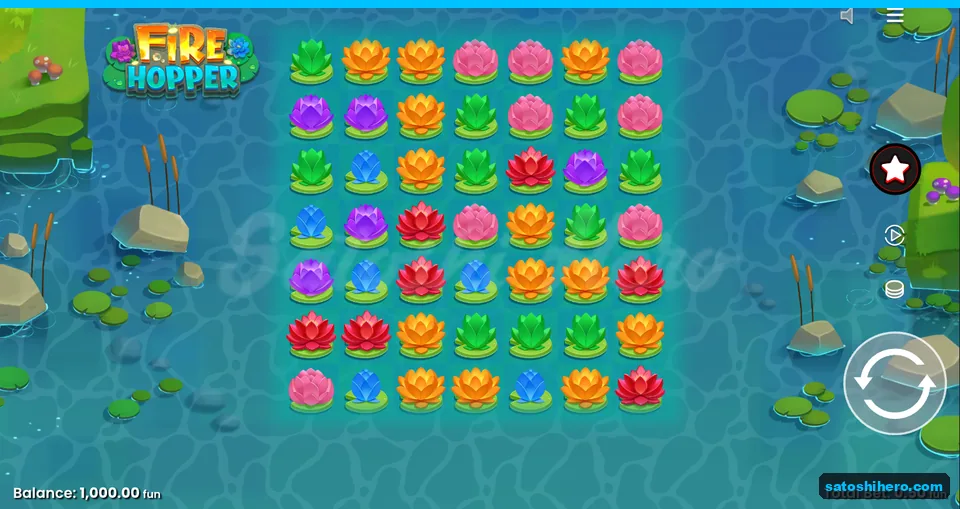
Large flower symbols preserve their color differences, and the Frog remains easy to locate. You should slow down around special symbols because a Firefly alone doesn’t activate anything.
Lotus Payouts and Special Symbols
Larger connected groups pay sharply more than five-symbol clusters, with red flowers offering the strongest scale. The displayed table came from my $0.50 setup, so bet multiples give you the cleanest comparison. Cash values change when you select another stake, while these multipliers remain useful. I think cluster quality matters far more than the simple sight of a winning group.
High-Value Lotus Pays
Red lotus clusters pay:
- 20 or more: 200x
- 16 to 19: 100x
- 13 to 15: 50x
- 11 or 12: 20x
- 10: 12x
- Nine: 8x
- Eight: 6x
- Seven: 4x
- Six: 3x
- Five: 2x
Orange lotus clusters pay 100x, 50x, 25x, 10x, 6x, 4x, 3x, 2x, 1.5x, and 1x across those same size bands. Pink clusters pay 50x, 25x, 12.5x, 5x, 3x, 2x, 1.5x, 1x, 0.8x, and 0.5x. You can see how aggressively red gains value once a group expands beyond ten symbols. I consider that steep curve the table’s most meaningful feature.
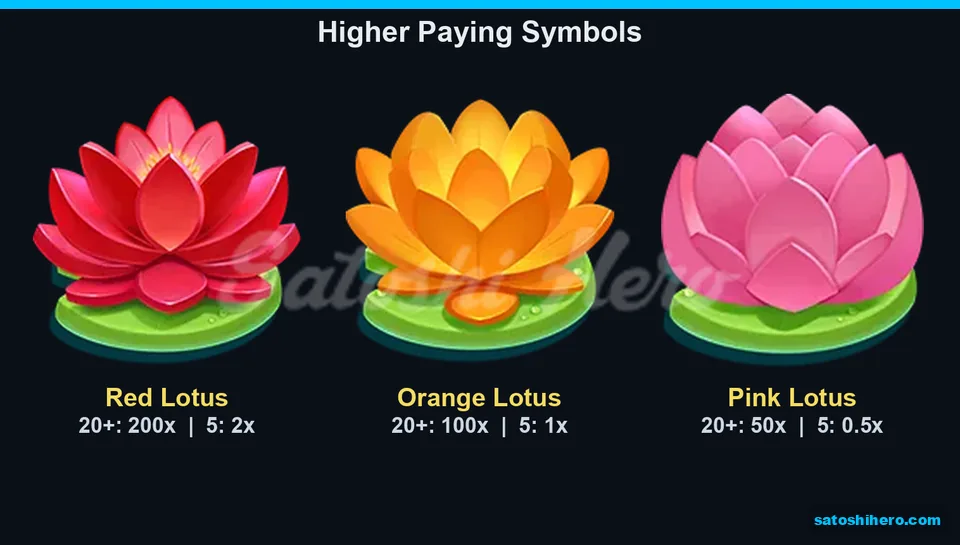
At 20 symbols, red reaches 200x while pink stops at 50x. You should inspect color and size together before judging a collapse.
Lower-Value Lotus Pays
Purple, green, and blue share one table:
- 20 or more: 25x
- 16 to 19: 12.5x
- 13 to 15: 6x
- 11 or 12: 2.5x
- 10: 1.5x
- Nine: 1x
- Eight: 0.7x
- Seven: 0.5x
- Six: 0.3x
- Five: 0.2x
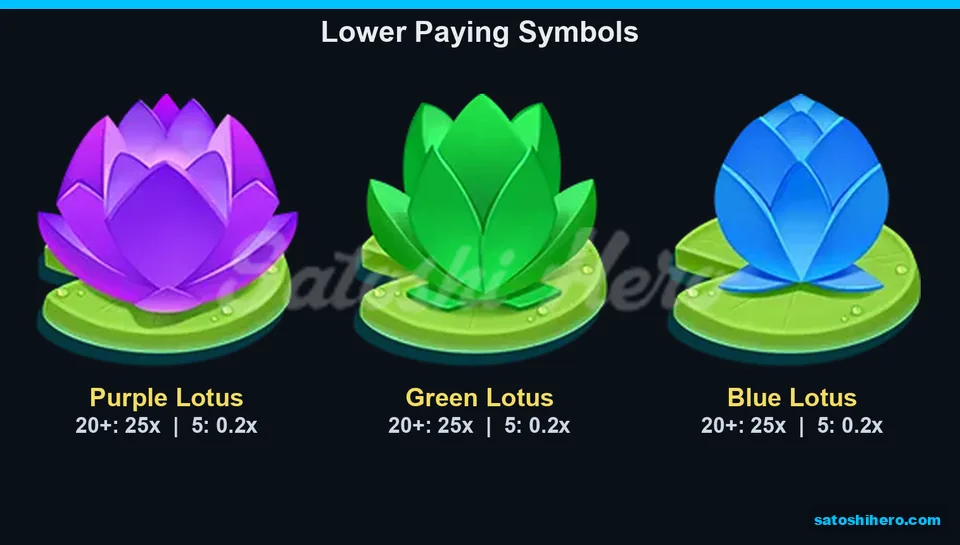
The 0.2x minimum appeared on eight spins during my session. Those rounds counted as wins, yet each still reduced my balance after the 1x stake. You shouldn’t equate a paying spin with a profitable spin. In my test, that difference made the apparent activity feel much less rewarding.
Wilds support lotus connections, while Fireflies and Bonus Fireflies carry no standalone payout. You should judge lotus color, cluster size, and feature context together.
Free Games Feature
The Frog must collect a Bonus Firefly to award seven free games. A Bonus Firefly landing alone doesn’t trigger the round, and play begins only after existing wins and cascades finish. You should watch the Frog’s route rather than the target symbol by itself. My 100-spin session never reached this feature, so I can’t claim a firsthand bonus result.
Trigger and Timing
When collected, the Bonus Firefly moves into the bonus display and grants the seven-game round. The game settles every active cluster and collapse before switching modes. That order prevents the feature from interrupting a live base-game chain. I find the trigger easy to understand, although its two-symbol dependency can leave obvious near-misses.
No free games appeared in my recorded test. I won’t invent trigger odds, feature frequency, or an expected bonus payment from that absence. You can only confirm activation after the active Frog reaches the Bonus Firefly. A visible bonus symbol isn’t enough, which remains the key practical distinction.
Persistent Frog Multipliers
Each Frog leap adds one to its multiplier during free games. Deposited Gold Frogs preserve the value used when they appeared, and a collapse keeps the active Frog in place. At the start of each new free game, Gold Frogs cascade away from the board. You therefore carry the active multiplier’s growth, not a permanent field full of old wilds.
Later leaps can use a larger persistent value, but seven games don’t guarantee enough targets. You should treat that growth as potential, not promised momentum. I like the design, though my session never tested it directly.
Poorly connected boards can consume the limited games without meaningful progress. You can’t force extra leaps by changing speed or stake.
Buying the Free Games Bonus
The star icon opens a Free Games Feature purchase costing 124x the base bet. That price equals 124 ordinary stakes committed to one feature result, so you should treat it as a separate bankroll decision. I saw the option during testing but didn’t buy it. Calling it the stronger mode would exceed the evidence.
Cost and Access
The right-rail star opens the same seven-game mode triggered through Bonus Firefly collection. At a $0.50 base stake, the 124x cost equals $62. You can remain in the base game for lower exposure per action.
One purchase costs more than my entire 100-spin test wagered. You shouldn’t assume the buy changes prize values, Frog behavior, or multiplier rules.
What I Didn’t Test
I didn’t purchase the bonus during the recorded session, so my firsthand evidence covers only base play. No observed return, hit rate, or average payout supports a recommendation for the buy. You should not treat access as proof of better value. The option saves waiting time, but it places 124 stakes into one uncertain outcome.
A purchase compresses exposure into one seven-game sequence, where limited leaps can still produce a weak finish. Set your limit before opening the menu.

Warning: High volatility already creates wide swings, and the 124x buy concentrates substantially more bankroll into one feature. Set a separate purchase limit rather than treating it like one spin.
The buy isn’t a shortcut to the top outcome. If losing 124 stakes would disrupt your plan, you should skip it.
RTP, Volatility and Our Test
The official math describes expected game behavior, while the projection and my short test show different possible session paths. You shouldn’t combine modeled percentiles with observed spins as though they came from one source. I find the contrast useful because both sets show how widely results can spread. Neither tells you what the next spin produces.
Simulator projection
The SatoshiHero Slot Simulator modeled 1,000 spins at 1x per round. Its median finished 68.2x down, while the 5th percentile ended 317.5x down. The 95th percentile closed 344.9x up. You should use that spread for risk context, not a target.
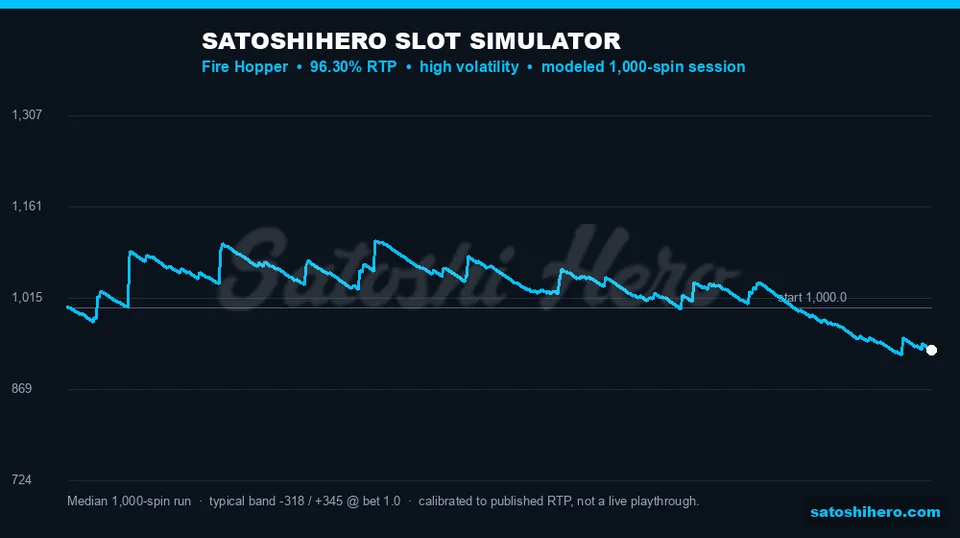
About 18% of simulated spins paid. A modeled result of at least 100x appeared roughly once per 1,623 spins, which is rarer than one event in the modeled session length. That frequency isn’t a countdown, and you shouldn’t expect a large result after any fixed number of misses. I think the percentile range communicates risk better than the median alone.
The model doesn’t reproduce Push Gaming’s random-number generator or predict outcomes. You should use it only to judge whether your bankroll can tolerate a long negative path.
Our 100-spin session
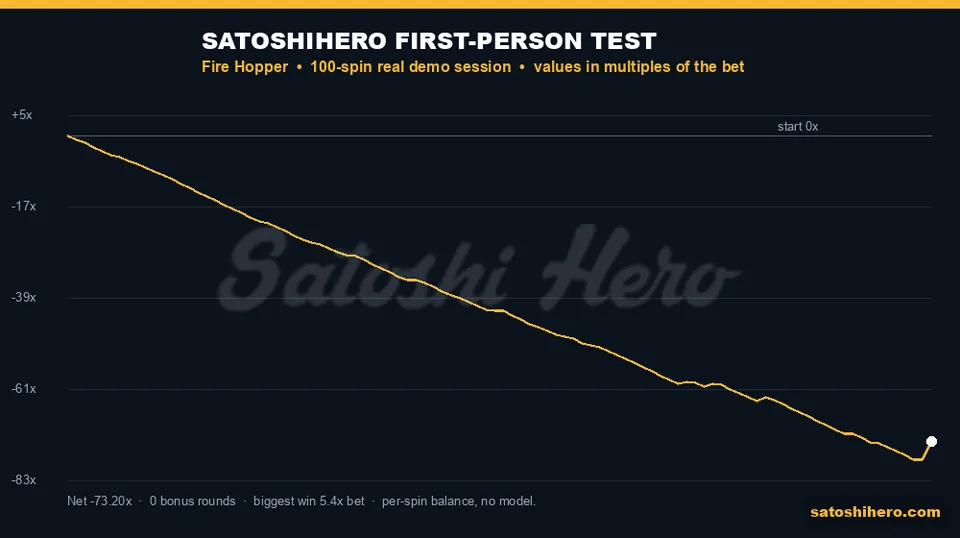
I played 100 spins at the default $0.50 stake, equivalent to $50 wagered across the test. The play-money display showed no currency sign, so I recorded outcomes as bet multiples. My final position was 73.2x down, equal to a $36.60 test loss at that stake. You should read those figures as one observed trace, not an expected result.
Twenty-eight spins paid, but 17 returned less than the original stake. Only 11 paying rounds reached at least 1x, which explains why the balance kept falling despite a 28% observed hit count. My largest result was 5.4x on spin 100. The next four reached 2.5x, 2.3x, 2.2x, and 1.8x.
My low point reached 77.6x down after spins 98 and 99. An 11-spin empty stretch ran from spin 12 through spin 22, and no free games appeared. You can see why I found the run harsher than its hit count suggests.
The theoretical return is the operator’s published expectation across a very large sample of rounds. One live session can’t confirm, disprove, or change it, and individual bonus modes can use slightly different returns by design. No separate bonus-buy return was supplied, so I haven’t assigned one. Treat my test as one real session rather than a universal result.
How It Played Over 100 Spins
The balance never returned to its starting point after spin one, when it sat 0.8x down. You shouldn’t mistake small clusters for stability. I found the steady decline frustrating because weak returns kept suggesting activity.
Pacing and Dry Spells
Twenty-eight spins paid, yet 17 returned less than the stake. Those results still pushed my balance backward. You can see a win animation and remain worse off after that round. Hit count alone can’t describe session quality.
No free games or substantial base win interrupted the decline. You shouldn’t read low clusters as evidence that a stronger result is approaching. I think a bankroll must absorb both blanks and under-stake returns.
Spin 100 delivered the 5.4x high point, though it barely changed the overall loss. You can post a late session best without rescuing the balance.
Session Reliability Notes
The demo produced server errors after spins four and 97. I reloaded after each interruption, continued in fresh sessions, and carried the running balance forward. The chart therefore combines three segments into one stitched 100-spin trace. You should know that context before interpreting its smooth numerical sequence.
I didn’t remove, replace, or replay any completed spin. The errors affected continuity, not the order of settled outcomes. In my view, disclosing those breaks matters because a clean-looking chart can hide technical interruptions. The stitched method preserves every observed result while making the test conditions transparent.
I kept technical reliability separate from performance. You can judge the trace knowing exactly how I assembled it.
Frequently Asked Questions About Fire Hopper
How does the Leaping Frog Feature work in Fire Hopper?
It activates when a Frog appears with a Firefly, Instant Prize, or Bonus Firefly. The Frog jumps to the target, leaves a Gold Frog behind, and raises its multiplier by one. An Instant Prize pays immediately after the active multiplier applies. You don’t control the destination or route.
What triggers free games in Fire Hopper?
The Frog must collect a Bonus Firefly, which moves into the bonus display and awards seven free games. The round starts after all active wins and cascades finish. Each Frog leap can raise the multiplier during the feature. My 100-spin test didn’t trigger it.
What did the 1,000-spin Fire Hopper simulation show?
The median result finished 68.2x down. Its 5th percentile ended 317.5x down, while the 95th percentile reached 344.9x up. About 18% of modeled spins paid, and 100x results appeared roughly once per 1,623 spins. The simulation doesn’t predict future play or reproduce the game’s random-number generator.
How did my 100-spin Fire Hopper test finish?
I lost 73.2x, recorded 28 paying spins, and reached a 5.4x largest result. The low point was 77.6x down, while the longest dry period lasted 11 spins. No free games triggered. Two server errors split play into three stitched segments without removing completed spins.
What are the RTP, volatility, and maximum win in Fire Hopper?
The game uses a 96.3% theoretical RTP, high volatility, and a 50,000x cap for one round. When that maximum is due, a Golden Frog sequence plays and clears every symbol except the Frog. Those figures describe the design, not a promised session result.
Can you buy the Free Games Feature in Fire Hopper?
Yes. The star icon on the right rail opens the seven-game feature for 124x the base bet. I didn’t purchase it during my 100-spin test, so my observed outcomes cover base play only. The price concentrates 124 ordinary stakes into one result.
Final Verdict
Fire Hopper stands out through readable cluster mechanics and a Frog multiplier that records each leap clearly. Other fire-themed slots on SatoshiHero include Fire Strike, Fire Portals, Fire Archer, and Fire 88. Its huge ceiling creates appeal, but my short test showed how little upside ordinary base play can reveal. You need patience for weak clusters, dry spells, and a bonus that might never appear.

My Take
Risk-tolerant cluster fans can appreciate the transparent feature logic and steep red-lotus table. Expect small returns to outnumber memorable hits in many short sessions, and keep the 124x purchase separate from normal base play.
I like how the active Frog, Gold Frogs, and Instant Prizes explain each outcome. I don’t like how 28 paying spins hid a 73.2x loss, while the missing free games left the main attraction untested. My 5.4x best hit offered too little relief to soften that result.
Fire Hopper rewards careful reading more than casual glances, and this guide remains updated periodically. You should use the test as evidence of possible pressure, while your own result can differ completely.

Pros:
 Readable clusters: Clear flower colors make horizontal and vertical connections easy to trace.
- Visible multipliers: Frog values explain how leaps and Gold Frogs affect each result.
- Strong ceiling: The top payout leaves room for exceptional sequences.
- Meaningful paytable: Red clusters scale sharply as their connected size increases.

Cons:
 Harsh short play: My test lost heavily despite 28 paying rounds.
- Weak small wins: Many valid clusters returned less than the original stake.
- Costly access: The feature buy concentrates 124 stakes into one uncertain round.

Best For: Experienced cluster-slot players who accept sharp swings and enjoy tracking evolving multipliers. You should prefer transparent mechanics over constant bonus action and keep enough bankroll for prolonged weak patches.












Other Push Gaming Games























































Bets
All Bets
Game
Player
Date
Wager
Mult.Multiplier
Prize
 Royal Fruits 9: Hold 'n' Link
 zelencov2309
- 10:18:07
- 0×
- Pelican's Bay: Rapid Link
 Hidden
- 10:18:06
- 0.79×
- Mighty Stars
 nina87
- 10:18:06
- 0×
- Royal Fruits 9: Hold 'n' Link
- zelencov2309
- 10:18:05
- 0×
- Galaxy Glitter
 blazecraft
- 10:18:04
- 0×
- Mardi Gras Queen
- mdp0fxo
- 10:18:04
- 0×
- Almighty Diamonds: Hold 'N' Link
- novaone948
- 10:18:04
- 0×
- Royal Fruits 9: Hold 'n' Link
- zelencov2309
- 10:18:03
- 1.49×
- Mighty Stars
- nina87
- 10:18:03
- 0×
- Royal Fruits 9: Hold 'n' Link
- zelencov2309
- 10:18:01
- 1.99×