

Fire Portals
By pressing play, you agree that you are above legal age in your jurisdiction and that your jurisdiction allows online gambling.
Pragmatic Play

Fire Portals
Title:
Fire Portals
Payout:
96.06
Volatility:
very-high
Max multiplier:
10000x
Release:
March 21, 2024
Game Provider:
Pragmatic Play
Bitcoin Slots
- Provably Fair
- Instant Crypto Payouts
- Thousands of Games

Written byMarcusUpdated
Cracking Open the Volcano Grid
Fire Portals throws you into a 7×7 cluster slot where roaming wilds can turn one stubborn cascade into the whole story.
The game is a very-high volatility slot from Pragmatic Play with 96.06% RTP and 10,000x max win potential. It uses a 7×7 cluster-pay grid, not paylines, and the strongest moments come when roaming fire portal wilds survive long enough to build huge multipliers. High-risk feature hunters get the clearest match here, especially if you prefer bonus pressure over steady base-game grinding.
Key takeaways
- Best bonus: The free spins round gives fire portal wilds the most time to stay, roam and build multipliers.
- RTP / volatility: Fire Portals has 96.06% RTP and very-high volatility, so cold base-game stretches can run long.
- Max win: The cap sits at 10,000x stake, and the round ends once that ceiling gets reached.
- Risk note: My 500-spin test at $2 stakes lost $534.10 after one weak natural bonus.
- Bankroll note: The $200 feature buy returned $416.20 in my test, not a promotional bonus result; casino bonus funds are subject to the displayed T&Cs and wagering requirements.

Table of Contents
- How Fire Portals Works
- Cluster pay rules
- Symbol value ladder
- Tumbling Wins and Chain Reactions
- Cascade sequence
- Why chains matter
- Fire Portal Wilds
- Sticky roaming wilds
- Multiplier merging
- Free Spins Feature
- Scatter triggers
- Persistent wilds
- Fire Portals Bonus Buy Tested
- Buy cost
- Test result
- Theme and First Impressions
- Volcanic setting
- Sound and pacing
- RTP, Volatility and Our Test
- Simulator projection
- Our 500-spin session
- Bankroll Lessons From the Cold Run
- Base-game pressure
- Safer stake sizing
- Frequently Asked Questions About Fire Portals
- Final Thoughts
How Fire Portals Works
Fire Portals works on a 7×7 cluster-pay grid, so you need connected symbol groups instead of fixed paylines. A win needs at least five matching symbols touching horizontally or vertically. You don’t trace lines from the left side. You watch the grid for blocks that can grow.
Cluster pay rules
The Fire Portals slot pays after a matching cluster forms anywhere on the grid. Bigger clusters matter because the payout jumps sharply as more symbols connect. I think this makes every drop feel more readable than a line slot, though you still need patience when the grid refuses to group.
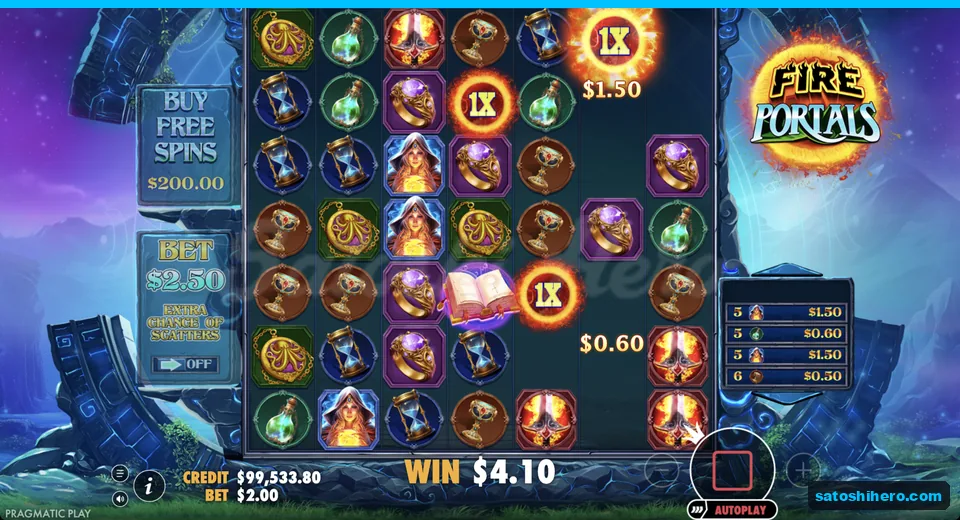
The book scatter can land anywhere and doesn’t need a cluster. Desktop and mobile play use the same 7×7 grid and core controls, so you won’t relearn the format when you switch screens. If you like fire-themed games but want a simpler win structure, Fire Strike feels easier to read than this cluster engine. Here, you need to track shape and size.
Symbol value ladder
At my $2 stake, the sorceress paid $300 for a block of 15 or more. The fire blade paid $200, the amethyst ring paid $180, and the green amulet paid $160. Those top symbols gave the grid its real bite.
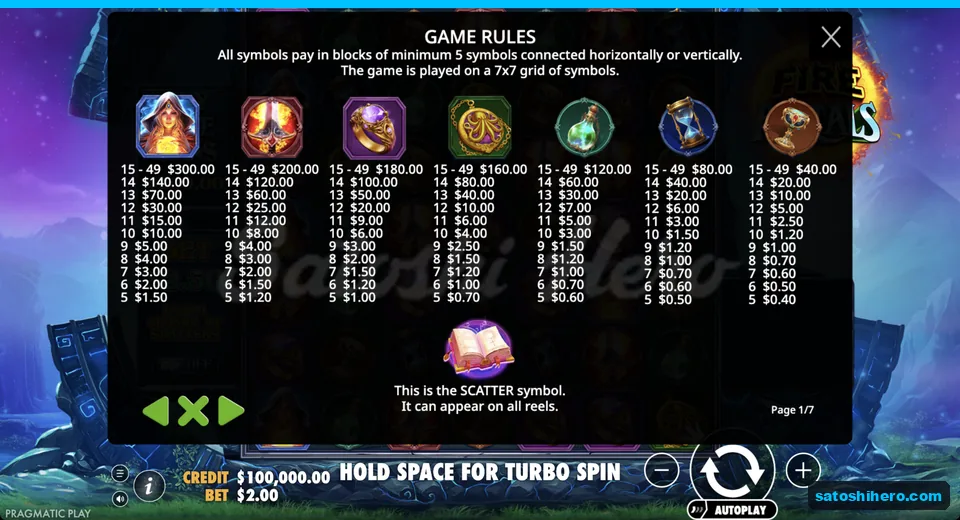
Lower symbols still mattered during tumbles. The green potion paid $120 for 15 or more, the blue hourglass paid $80, and the bronze chalice paid $40. I don’t treat these as throwaway icons because a large low-value block can still feed a bigger chain. With Fire Portals pragmatic play design, cluster size can matter as much as symbol rank.
Tumbling Wins and Chain Reactions
Tumbling wins make one paid cluster explode, refill and possibly chain into more wins on the same spin. The mechanic keeps the grid alive after the first hit. You see symbols drop down, then fresh ones land from the top. I like the pace, but I wouldn’t call every tumble dramatic.
Cascade sequence
A winning cluster pays first, then disappears from the grid. Symbols above fall into the open spaces, and new symbols drop from the top. If another cluster forms, the process repeats again.
There isn’t a fixed limit on those tumbles. The spin only stops when a drop creates no new winning cluster. That matters because each extra cascade gives the portal system more chances to appear and move. You can get a dead-feeling start, then watch one cluster open the door.

Quick Fact: Tumbles don’t have a set cap; the spin ends only when a drop produces no new cluster.
Why chains matter
Tumbles drive the feature economy. More chain reactions mean more chances for fire portal wilds to spawn, stick, roam and build. You should watch how long the chain survives, not just the first payout.
That is the core Fire Portals strategy I kept coming back to during testing. A small early cluster didn’t excite me unless it created space for another drop. Many chains still stayed small when wild multipliers didn’t connect, which kept the base game blunt. The tumble engine sets the table for the wilds.
Fire Portal Wilds
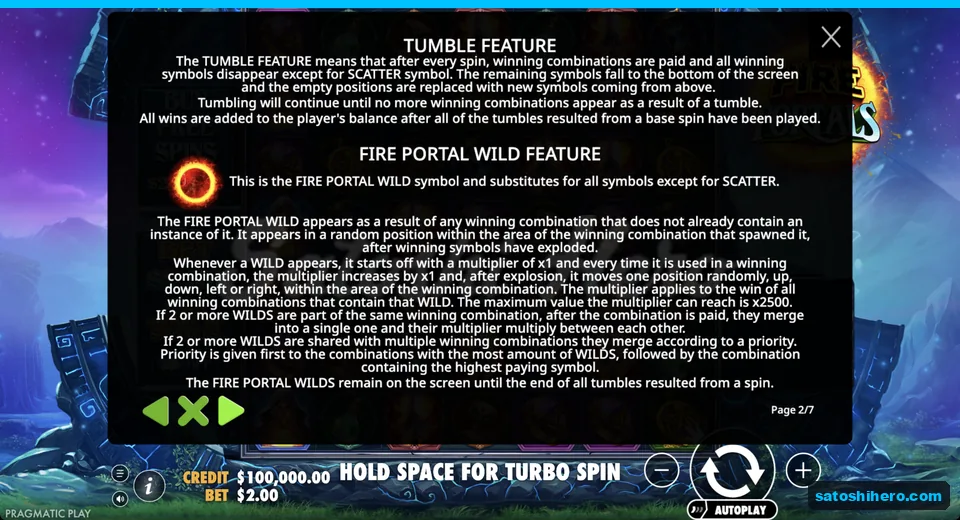
Fire portal wilds are the main feature because they stick, roam and grow their multiplier whenever they join wins. A wild can spawn inside any winning cluster that doesn’t already contain one. It substitutes for every regular symbol, but not the scatter. This is where the slot stops feeling ordinary.
Sticky roaming wilds
After a fire portal wild joins play, it doesn’t vanish with the cluster. It survives the cascade, then roams one square in a random direction after the win sequence. That movement can feel cruel when it drifts away from strong symbols.
You need the wild to keep touching future clusters. Every win it joins adds one to its multiplier, and that multiplier can climb to 2,500x. I think the idea works because you can see the potential building on screen. Still, potential doesn’t pay unless the grid keeps feeding it.

Pro Tip: Don’t judge the feature by the first wild spawn. The real value comes when a wild survives long enough to keep joining clusters.
Multiplier merging
The biggest moments need repeated contact, enough movement and a grid that keeps making clusters near the wild. If two wilds join the same winning cluster, their multipliers multiply together. That can turn a plain hit into something nasty.
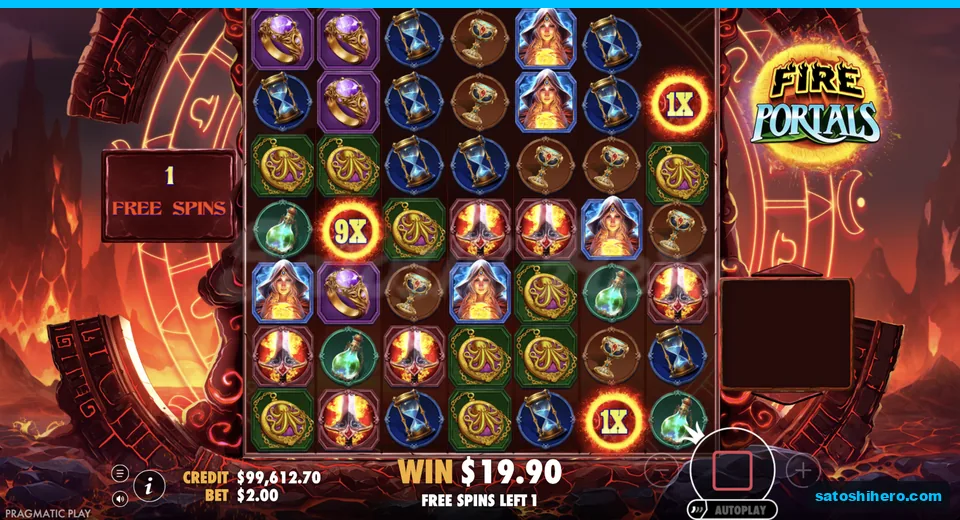
During my base session, those setups rarely had time to mature. The wilds appeared, moved, and then lost touch before the grid gave them real support. I don’t mind that harshness because it fits the slot design, but you should know what you’re chasing. Free spins give this mechanic more room to work.
Free Spins Feature
Free spins are the main bonus because fire portal wilds stay on the grid until the round ends. That single rule changes the whole feel. In the base game, a wild can drift out of relevance fast. In the bonus, it gets more time to build.
Scatter triggers
You trigger the round with book scatters. The award scales with how many land:
- 3 scatters: 10 free spins
- 4 scatters: 12 free spins
- 5 scatters: 14 free spins
- 6 scatters: 16 free spins
- 7 scatters: 18 free spins
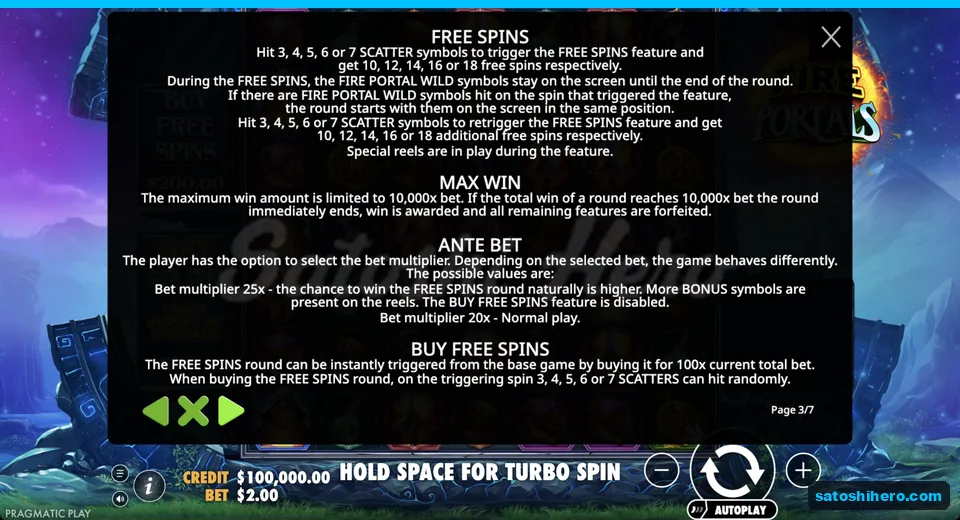
Landing three or more scatters again can retrigger the round. I like that structure because it keeps the bonus open without adding extra side games. You always know the target: keep wilds alive and close to clusters.
Persistent wilds
During free spins, fire portal wilds stay on the grid until the feature ends. Their multipliers can keep building spin after spin. This gives the mechanic the space it lacks during many base-game tumbles.
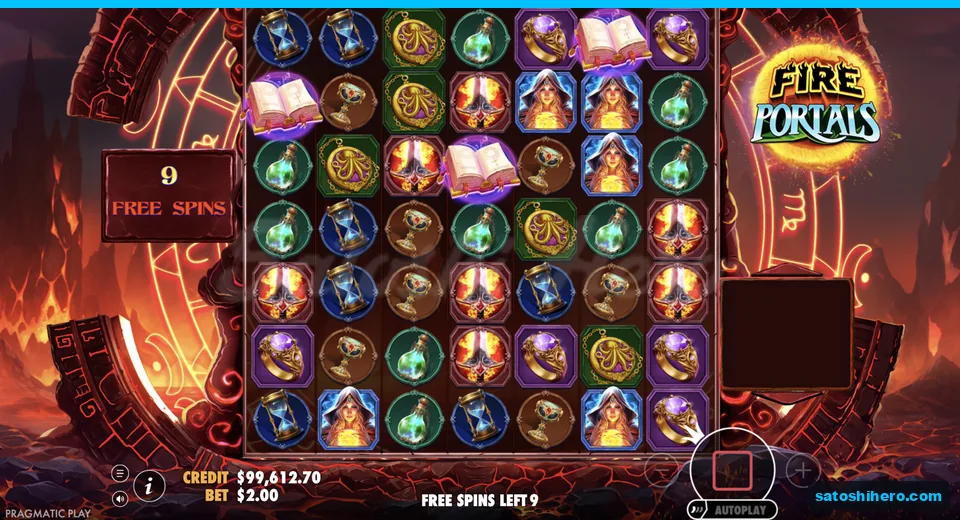
My natural free spins round arrived late in the 500-spin test and paid about $20. That result felt flat, but it also proved an important point. The round still needs connections to matter. If you want to learn the rhythm without using real balance, the Fire Portals demo and the slot demo on SatoshiHero are useful practice tools.
Fire Archer has a different fire-led bonus rhythm, so it may appeal if you prefer a less grid-heavy pace. This game asks you to watch persistent wild movement more closely. The bonus can feel brilliant when one wild keeps landing near clusters. It can also pass quietly.
Fire Portals Bonus Buy Tested
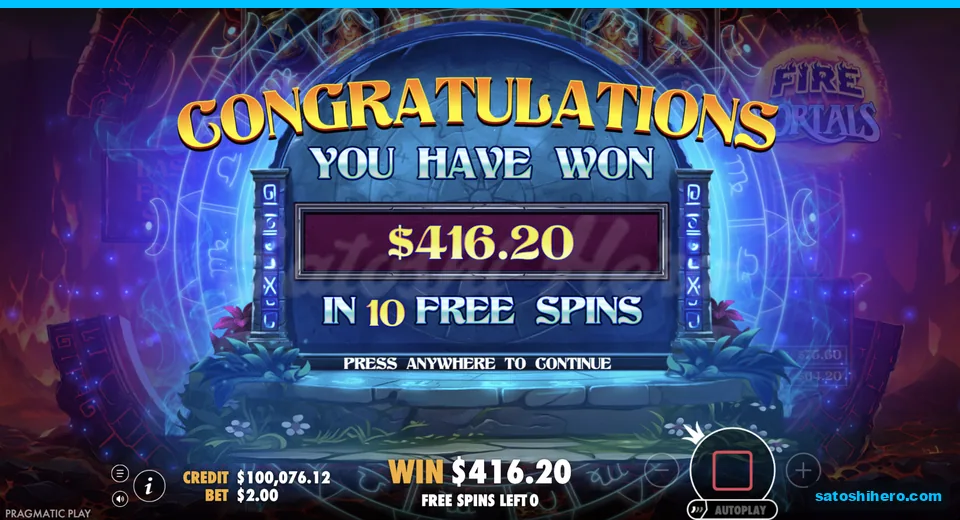
The Fire Portals bonus buy cost $200 at my $2 stake and returned $416.20 in the test. That buy equals 100x stake and opens the free spins directly. This was a feature-buy test result, not a promotional bonus, and any casino bonus funds depend on the displayed T&Cs and wagering requirements. I don’t treat that as a small decision. It compresses a lot of risk into one click.
Buy cost
At $2 stakes, the buy menu asked for $200. The ante route cost $2.50 at the same stake level, but it disabled the buy while raising the natural free spins chance. Those two options create a clear split.
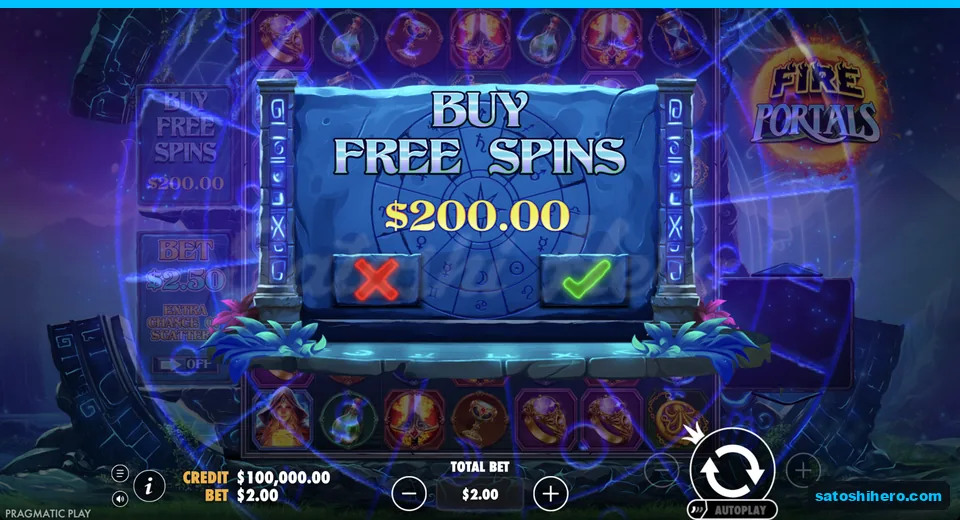
You either hunt the feature through the base game, or you pay 100x stake to enter it. I think the buy has appeal only if you already accept sharp swings. It isn’t a shortcut around volatility. It just moves the pressure into one round.

Caution: A 100x buy can look tempting after this result, but very-high volatility can also burn through balance quickly when wilds don’t connect.
Test result
My bought round ran for 10 spins. One roaming fire portal wild kept catching clusters until it reached 104x. That wild turned a small cluster into a $72 hit, which changed the whole round.
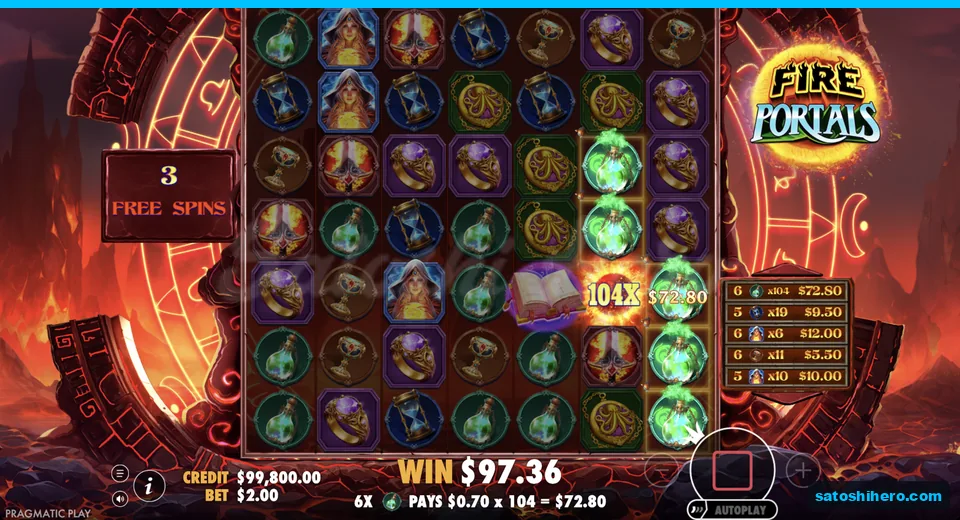
The total return landed at $416.20. That was about 208x stake and more than double the buy cost. It was the strongest part of my test, and it showed exactly how the multiplier wilds should work. Still, one wild did most of the work.
A Fire Portals strategy built around bonus buys needs a hard stop. The same 100x decision can miss badly when wilds wander away or clusters don’t form near them. Pragmatic Play made the feature exciting, not gentle. One strong buy doesn’t remove variance.
Theme and First Impressions
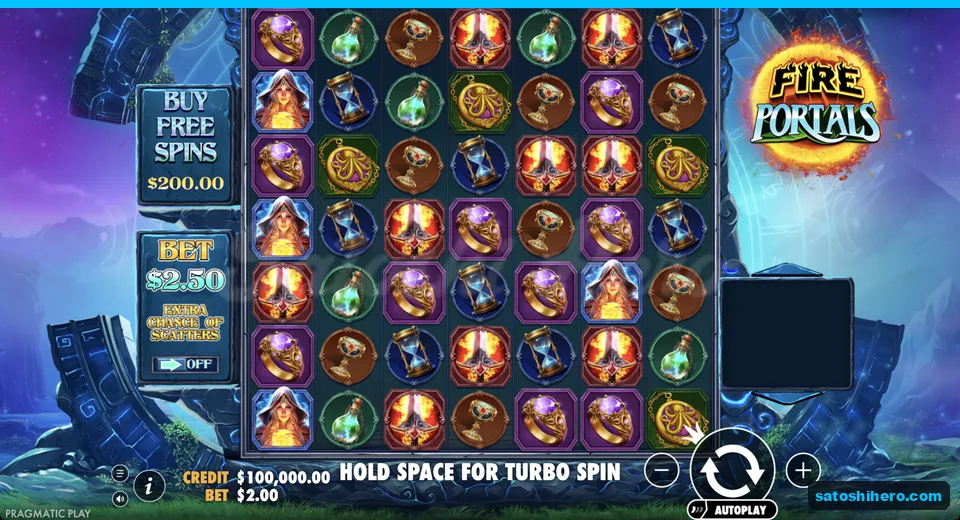
The theme is a dark volcanic fantasy setup with glowing portals, magical artifacts and aggressive audio pacing. Fire Portals drops its 7×7 grid into a cracked wasteland of magma, rock and neon heat. The setting isn’t subtle. It wants every cascade to feel unstable.
Volcanic setting
Glowing portals sit across a grid packed with artifacts like potions, rings, blades and hourglasses. Dark rock backgrounds make the bright symbol effects stand out clearly. I think the art helps you read the grid during fast tumbling sequences.
The theme won’t win originality awards. Fire, magic and portals are familiar slot territory. But the execution fits the volatile cluster engine well, and that matters more than novelty here. Fire 88 has a simpler classic feel if fire-led visuals attract you but the cluster pressure feels too intense.

Did You Know? The portal-and-magma art style supports the theme by making every cascade feel like the grid is cracking open.
Sound and pacing
The electronic soundtrack ramps up when scatters and portals fire. Larger cascades get extra energy from the audio, which makes near-miss chains feel sharper. You can tell the game wants tension, not calm.
I found the sound useful rather than decorative. It signaled when the grid started to wake up, especially during wild movement. The aggressive pacing matches the risk profile, though it may feel tiring if you prefer quiet base-game sessions. The presentation backs the math: this is a pressure slot.
RTP, Volatility and Our Test
Fire Portals has 96.06% RTP, very-high volatility and 10,000x max win potential, and my testing matched that risk profile. The base RTP is 96.06%, while the ante sits at 96.00% and the buy sits at 96.01%. Bets run from $0.20 to $300. I tested at the $2 default stake.
Simulator projection
The SatoshiHero Slot Simulator modelled 1,000 spins at $2 using 96.06% RTP, very-high volatility and the 10,000x cap. The median result sat about $212.10 down. That already tells you the average-feeling session can still hurt.
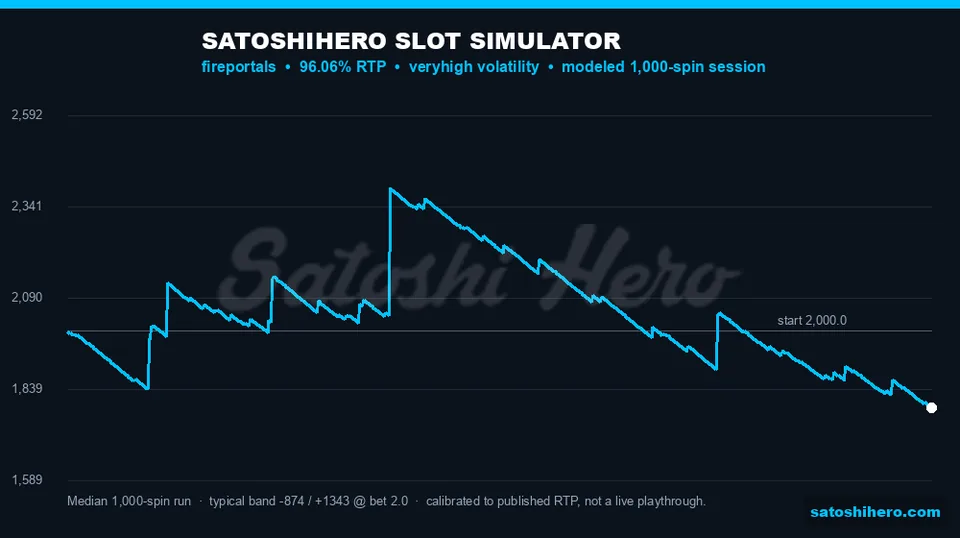
The 5th percentile landed around $874.30 down, while the 95th percentile reached about $1,343.30 up. Around 14% of spins paid. Free spins landed around once in 54 spins, and a 100x or bigger win appeared around once in 814 spins. Those numbers frame risk, not your own result.
Quick Fact: The model’s median result was negative even at 96.06% RTP because very-high-volatility slots push much of their return into rarer feature outcomes.
Our 500-spin session
I ran 500 spins at $2 from a fresh $100,000 balance. The base game bled steadily with small cluster wins that didn’t offset the cold stretch. Only one natural free spins round landed late, and it paid about $20.
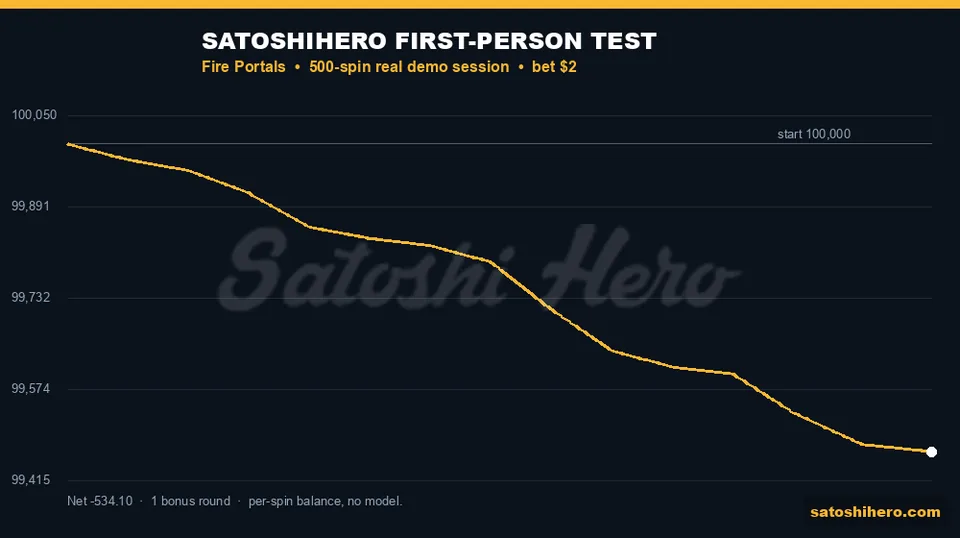
My session finished at $99,465.90. That made the net loss $534.10. The roaming wilds never had enough time to build meaningful multipliers in the base game, which made the cold run feel blunt. I didn’t feel cheated, but I felt the volatility.
The $2.50 ante can raise the natural free spins chance at this stake level, but it also disables the buy. That trade-off won’t suit every bankroll style. I think the base game makes the most sense when you accept long waits and focus on survival. If you want frequent small hits, this one fights you.
Theoretical RTP is the operator-published figure, while one live session doesn’t change or prove theoretical return. The ante and buy RTPs differ slightly from the base by design, so compare the option you actually plan to use.
Bankroll Lessons From the Cold Run
The cold test showed that this slot can drain balance fast when roaming wilds don’t build. Small clusters kept landing, but they didn’t cover the dead space between stronger features. You can feel the grid trying to wake up. It just doesn’t always get there.
Base-game pressure
My 500-spin run lost $534.10 at $2 stakes. That damage didn’t come from one brutal miss. It came from steady base-game pressure and a natural bonus that paid only about $20.
You should expect stretches where the grid pays just enough to keep you watching. I don’t hate that rhythm, but it asks for discipline. The max win is strong at 10,000x, yet the road there feels unforgiving. The slot needs repeated wild connections before it truly wakes up.
Slots like Fire Portals reward a feature-hunting mindset rather than a grinder’s approach. If you keep raising stake after dry spins, the math can punish you quickly. I prefer sizing the bet so a cold 200-spin patch doesn’t force a rushed decision. That gives the bonus system time to appear.
Safer stake sizing
Demo mode helps you learn the pace before real balance enters the picture. The Fire Portals demo lets you watch how often chains fade, how wilds move, and how free spins can vary. That practice matters because the mechanics look simple until the volatility shows up.
Smaller stakes make more sense if your goal is to survive long enough to see the feature develop. I wouldn’t chase the 100x buy after a poor base run unless the bankroll already allows it. The Fire Portals slot demo also helps you decide whether the tempo feels fun or stressful. This is a feature-hunting slot, not a steady grinder.
Frequently Asked Questions About Fire Portals
How do the fire portal wilds work in Fire Portals?
A fire portal wild spawns inside a winning cluster, then sticks and roams one square each cascade. Every win it joins adds one to its multiplier, up to 2,500x, and two wilds in one cluster multiply together.
How do you trigger free spins in Fire Portals?
Land 3, 4, 5, 6 or 7 scatters to win 10, 12, 14, 16 or 18 free spins. During the round, fire portal wilds stay on the grid until the feature ends.
What is the RTP and volatility of Fire Portals?
The base RTP is 96.06%, the ante RTP is 96.00%, and the buy RTP is 96.01%. Volatility is very-high, so long cold streaks can happen before the feature connects.
What is the maximum win in Fire Portals?
The max win is 10,000x stake. If a round reaches the cap, the game ends the round immediately and pays the capped result.
Is the Fire Portals bonus buy worth it?
The buy costs 100x your stake. In my test, it returned about 208x thanks to a roaming wild that reached 104x, but very-high variance means another buy can return far less.
What did the 500-spin Fire Portals test return?
From a fresh $100,000 balance at $2 a spin, the session ended at $99,465.90. That was a net loss of $534.10, with one small free spins round in a cold session.
Final Thoughts
Fire Portals stands out because the roaming wilds create real tension across the 7×7 grid. The main drawback is just as clear: the base game can run cold for a long time before the feature pays properly.

My Verdict
High-volatility bonus hunters can enjoy this slot if they accept sharp swings and long dry patches. I wouldn’t play it for steady base-game returns. Expect the best moments to come from sticky wilds that get time to grow.
I like how the bought bonus showed the whole mechanic in one clean example. That 104x wild made the $416.20 return feel earned, not random. I don’t like how my natural 500-spin run gave the wilds so little room to develop.
Fire Portals is checked regularly for spec, screenshot and test-note changes, especially where RTP options and feature behavior matter to bankroll planning.

Pros:
 Strong Wild System: Sticky roaming wilds create tense, visible multiplier growth.
- Clear Cluster Rules: The 7×7 grid makes wins easy to understand.
- Big Feature Upside: Free spins give wild multipliers time to build.
- Useful Demo Pace: Practice play reveals the risk before real balance.

Cons:
 Harsh Cold Runs: Base-game stretches can drain balance without strong wild contact.
- Risky Buy Cost: The 100x buy can miss when wilds don’t connect.
- Low Hit Feel: Small clusters often fail to soften the volatility.

Best For: Patient feature hunters get the most from this slot’s roaming wild system. Dark fantasy fans who enjoy explosive clusters may like the mood, but cautious bankroll players should stay at smaller stakes. The game rewards calm limits more than chasing.


























































Bets
All Bets
Game
Player
Date
Wager
Mult.Multiplier
Prize
 Gemhalla Xtreme
 tomstacey1993
- 00:04:19
- 0×
- Elephant's Gold: Bonus Combo
 Hidden
- 00:04:17
- 0×
- Fortune Skulls: Bonus Buy
- Hidden
- 00:04:17
- 0×
- Gorilla: Rapid Link
- mike_721
- 00:04:15
- 0×
- Aztec Gems
- Kiss_My_Ace
- 00:04:14
- 0×
- Gemhalla Xtreme
- tomstacey1993
- 00:04:14
- 0.99×
- Aztec Gems
- Kiss_My_Ace
- 00:04:11
- 0×
- Aztec Gems
- Kiss_My_Ace
- 00:04:08
- 0×
- Gemhalla Xtreme
- tomstacey1993
- 00:04:07
- 0×
- Elephant's Gold: Bonus Combo
- nina87
- 00:04:06
- 0×