

Sugar Rush 1000
By pressing play, you agree that you are above legal age in your jurisdiction and that your jurisdiction allows online gambling.

Sugar Rush 1000
RTP96.53%
VolatilityVery high
Max winx25,000
ThemeSweets
ReleasedMar 2024
Live game stats
Real RTP75.20%
Spins7,148
Players15
Biggest win$63.02

Candy Grids With a Bitter Bite
I tested Sugar Rush 1000 at $2 a spin on SatoshiHero to see whether Pragmatic Play’s upgraded candy slot has the punch its top cap suggests. The session used demo funds, real feature buys, and the simulator snapshot, so the guide focuses on how the grid actually behaved: small tumbles, rare bonus access, sticky multipliers, and a sharper bankroll feel than the sweet theme implies.
Key takeaways
Sugar Rush 1000 is a very-high volatility slot from Pragmatic Play with 96.53% RTP and 25,000x max win potential. It uses a seven-by-seven candy grid, cluster pays, tumbles, persistent multiplier spots in free spins, and two bonus buys. High-variance players with patience get the clearest match here, not anyone chasing steady base-game returns. The key tension is simple: the board moves often, but the balance needs clustered symbols and multiplier repeats before the session feels alive.
- Best bonus: The standard Free Spins buy has the stronger paper return at 96.52%, while Super Free Spins drops to 96.44%.
- RTP / volatility: Sugar Rush 1000 has 96.53% RTP, very-high volatility, and no fixed paylines.
- Max win: The ceiling is 25000x the bet, driven by sticky multiplier spots in free spins.
- Risk note: My 500-spin SatoshiHero demo test lost about $464 at $2 a spin, with one natural feature.
- Bankroll note: You need room for cold stretches because the biggest boards need locked spots to build.

Caution: Very-high volatility means the demo can feel quiet for long stretches, even when the 96.53 published RTP looks competitive.

Table of Contents
- How Sugar Rush 1000 Works
- Cluster wins
- Symbol values
- Theme & First Impressions
- Candy-shop look
- First spin feel
- Tumble Feature
- Chain reactions
- Base-game pace
- Multiplier Spots
- Growing spots
- Added multipliers
- Free Spins
- Scatter triggers
- Sticky multipliers
- Buy Free Spins and Super Free Spins
- Standard buy
- Super buy
- RTP, Volatility & Our Test
- Simulator projection
- Our 500-spin session
- How It Played at $2
- Session rhythm
- Bankroll feel
- Frequently Asked Questions About Sugar Rush 1000
- Final Thoughts
How Sugar Rush 1000 Works
Sugar Rush 1000 pays through clusters on a seven-by-seven grid, not fixed paylines. You need five or more matching symbols connected up, down, left, or right.
Cluster wins
The Sugar Rush 1000 slot gives you a full candy board instead of reels with lines. Winning symbols pop, symbols above drop into the gaps, and fresh candy falls from the top. That tumble cycle keeps going until no new paying cluster lands. The mechanic makes each paid spin feel like a short board sequence rather than a single stop.
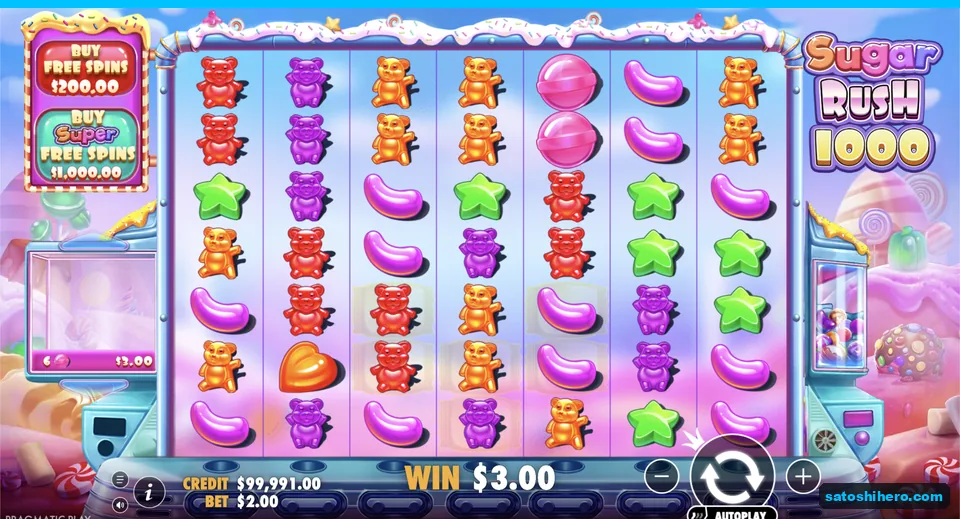
I like this setup because you can read each win quickly. You aren’t checking line paths or guessing where a payout came from. The same seven-by-seven layout and buy buttons stay easy to read on desktop and mobile, though the grid feels clearer on a larger screen.
Sugar Rush has the same familiar candy-grid DNA, but this version pushes the math harder with a 25000x cap and stronger multiplier-spot pressure.
Symbol values
At the $2 stake, the pink lollipop tops the paytable. It pays $300 for a cluster of 15 or more and $2 for the minimum five-symbol cluster. That wide gap matters because small clusters can keep the animation busy while still adding little to the total.
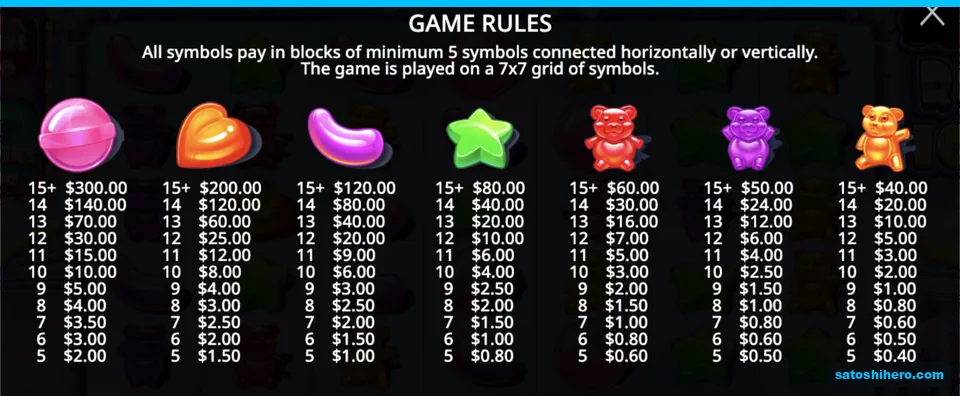
The orange heart pays up to $200, the pink jelly bean reaches $120, and the green star climbs to $80. Lower symbols pay less, with the red bear up to $60, the purple bear up to $50, and the orange bear up to $40. The pay ladder rewards board coverage, so a larger cluster of a lower candy can still feel better than a small premium hit.
The gumball machine scatter matters most. It lands across the grid and opens free spins, so you notice it fast when you’re chasing the bonus. I feel the paytable looks friendly, but the hit quality tells the real story.

Theme & First Impressions
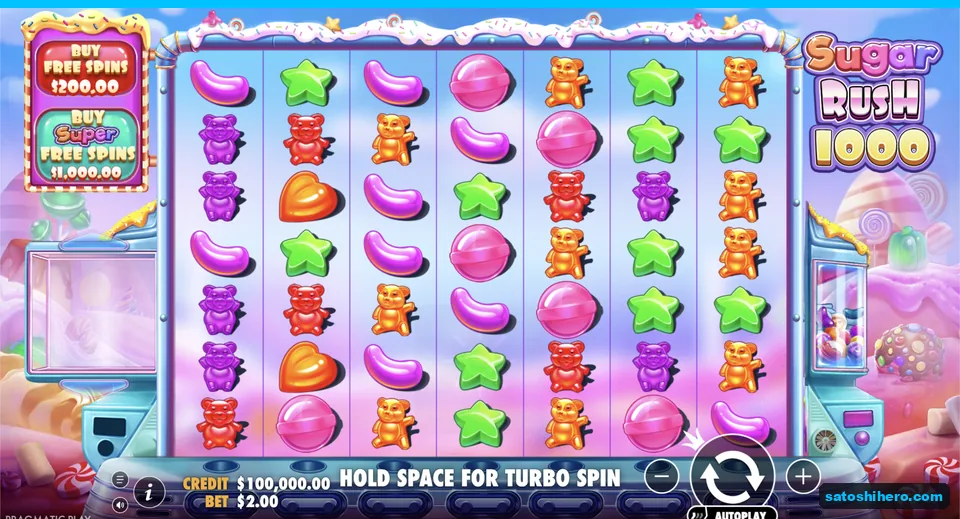
The game looks sweet and simple, but the math gives it a sharper edge than the candy visuals suggest. You get gummy bears, jelly beans, lollipops, stars, and a bright sweet-shop sky. The clean art helps because the important information sits on the grid, not in side animations.
Candy-shop look
The theme won’t win originality awards, but it stays clean. That matters when clusters start popping and fresh symbols drop fast.
I found the Sugar Rush 1000 demo easy to follow because the visuals never hide the cluster action. The colors stay soft, the board stays readable, and the wins don’t vanish under flashy effects. Sugar Rush Xmas makes sense if you like this candy mood with a seasonal twist, while Sugar Rush Dice moves the brand into a different format.
First spin feel
My first few spins felt busier than the balance suggested. Small clusters kept the board moving, but the money side stayed tight.
That contrast defines the whole experience. You see candy moving often, yet meaningful recovery needs bigger clusters or a feature. Sugar Rush 1000 free play gives you a safe way to learn that rhythm before risking a real balance. The demo also shows how quickly turbo mode compresses quiet spins into one long dry spell.
I think the theme does its job. It keeps you comfortable while the volatility does something much harsher underneath.
Tumble Feature
Every paying spin tumbles until no new winning cluster lands. You get one paid spin, then the game keeps checking the refreshed grid for more clusters.
Chain reactions
Winning candy pops off the board, symbols above fall down, and new candy enters from the top. The sequence can keep going with no cap until a drop pays nothing.
One paid spin can quietly become three or four drops. That sounds exciting, but the size of each cluster still matters. Tiny chains can look lively without moving your balance much. The best base-game moments need repeated drops in useful places, not just one extra low-symbol connection.

Quick Fact: A paid spin can keep tumbling until no new cluster lands. The full tumble run then adds to your balance after the chain ends.
Base-game pace
During my session, small tumbles kept the base game visually active. They didn’t stop the grind.
You may feel like something is always close because the board keeps moving. I’d treat that feeling with care. Movement isn’t the same as value, and this slot proves it fast.
The base game has rhythm, but it doesn’t hand you easy momentum. I think that’s the first lesson every player should learn here.
Multiplier Spots
Multiplier spots are the main engine behind the 25000x max win because they grow when winning symbols keep popping on the same grid positions. The base game teases this power, but free spins give it time.
Growing spots
Whenever a winning symbol pops, it marks that grid position. The second pop on that same position adds a 2x multiplier.
Further pops double the spot again, climbing up to 1024x. That number looks huge, but you shouldn’t expect it often. You need repeat wins on the same square, and the base game clears those spots once the tumble sequence ends. A marked square can look promising, then disappear before it gets another hit.
Sugar Rush Super Scatter offers another angle on scatter-driven bonus access, but this game’s tension comes from watching fixed grid positions heat up.
Added multipliers
If one winning cluster covers several marked spots, the game adds those multipliers together. That can turn one cluster into the kind of hit you remember.

Did You Know? If one cluster covers several multiplier spots, the game adds those multipliers together instead of choosing only the biggest one.
I like this mechanic because it gives the board a memory. You start watching certain positions instead of only watching symbols. In base play, that memory disappears too quickly, so the bonus remains the real stage.
Free Spins
Free spins are where the slot’s multiplier spots matter most because they stay locked and keep growing through the round. You need scatters to enter, and the board can change fast once spots survive.
Scatter triggers
Three scatters award 10 free spins, four award 12, five award 15, six award 20, and seven award 30. Extra scatters during the feature add more spins on that same scale.
You should watch the gumball machines closely. They’re the only symbol that opens the bonus, and they can turn a cold stretch into a real chance. My 500-spin test only produced one natural free-spins round, so don’t treat the trigger as routine.
Sticky multipliers
During free spins, multiplier spots no longer reset after each spin. Every built spot stays locked and keeps doubling when wins land on it again.
That makes the back half of the feature more important than the first few spins. A slow start can still become a loaded board if enough marked positions connect later. My natural feature paid $40.50 at $2, which felt underwhelming but honest for this volatility level. The round showed the problem clearly: sticky spots help only when fresh clusters keep landing through them.

Pro Tip: In Sugar Rush 1000 free play, watch how many multiplier spots survive into the back half of the feature. That tells you more than the first couple of spins.
Buy Free Spins and Super Free Spins
The standard Free Spins buy has the better published return, while the Super Free Spins buy costs far more and still carries harsh variance. Neither buy should feel like a shortcut. These prices are in-game feature-buy costs, not a promotional cash bonus or cash offer; normal game rules, account terms, and wagering conditions apply to play on SatoshiHero.
Standard buy
Buy Free Spins costs 100x the bet. At my $2 stake, that meant a $200 feature buy.
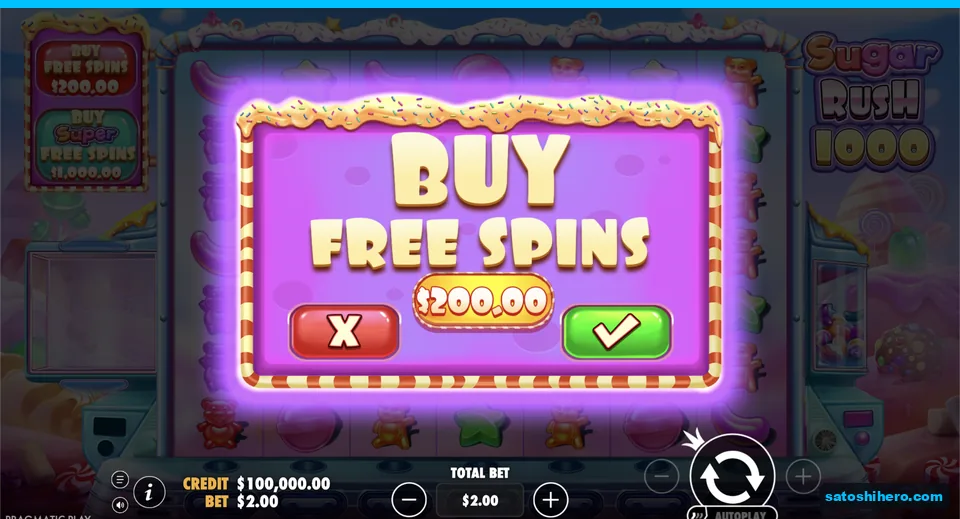
It starts a standard free-spins round with a 96.52% published return. That sits just under the 96.53 base-game figure, so the base game still has the stronger headline number. My $200 buy returned $70.30, which felt flat but not surprising.
I’d use the standard buy only in demo first. You need to feel how quickly a feature can drain value when spots don’t connect. The buy removes the wait for scatters, but it does not remove the need for multipliers to build in the right places.
Super buy
Buy Super Free Spins costs 500x the bet, so my $2 test price was $1,000. It starts with a 2x multiplier already sitting on every grid spot.
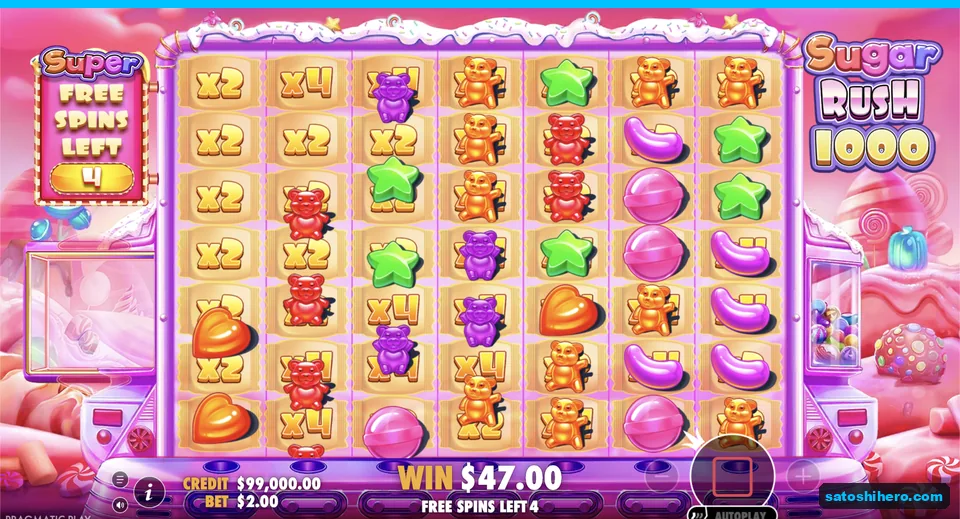
That setup looks dramatic. The return sits at 96.44%, which is below both the base game and the standard buy. My $1,000 Super Free Spins buy returned $163.00, so the loaded board still failed hard in that run.

Mining Rush may appeal if you like high-risk bonus hunting with a different theme, but the same bankroll caution applies. I think the super buy has spectacle, not comfort.
RTP, Volatility & Our Test
Sugar Rush 1000 has 96.53% RTP, very-high volatility, and a 25000x max win, so short sessions can swing hard. Stakes run from $0.20 to $240, and I kept the test at $2.
Simulator projection
The SatoshiHero Slot Simulator ran 1,000 spins at $2 using 96.53% RTP, very-high volatility, and the 25000x ceiling. The median session finished about $282 down.
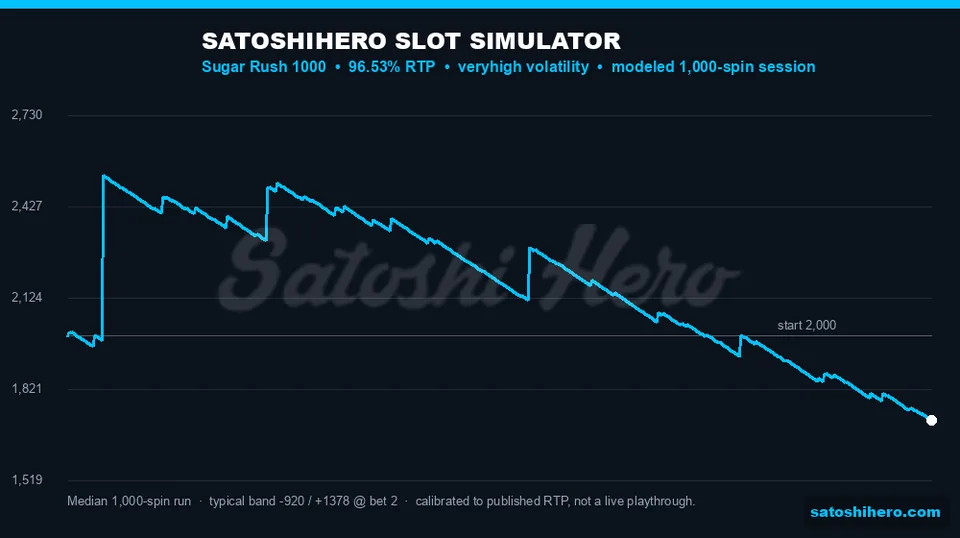
The p5 to p95 band stretched from roughly $920 down to $1,378 up. That spread tells you how wide the result range can feel. The model showed a feature about once every 55 spins and a 100x or larger win about once every 812 spins.
I wouldn’t read those numbers as a promise. They model variance, not destiny. The Sugar Rush 1000 RTP looks competitive, but the distribution can still punish short play. A median loss in the model also matches the feel of a slot that saves much of its return for rarer feature boards.
Our 500-spin session
My live run started from a fresh $100,000 SatoshiHero demo balance. I played 500 spins at $2 on turbo.
The base game leaned on tiny tumbles. Only one natural free-spins round triggered, and it paid $40.50. My final balance landed at $99,535.60, which left me about $464 down.
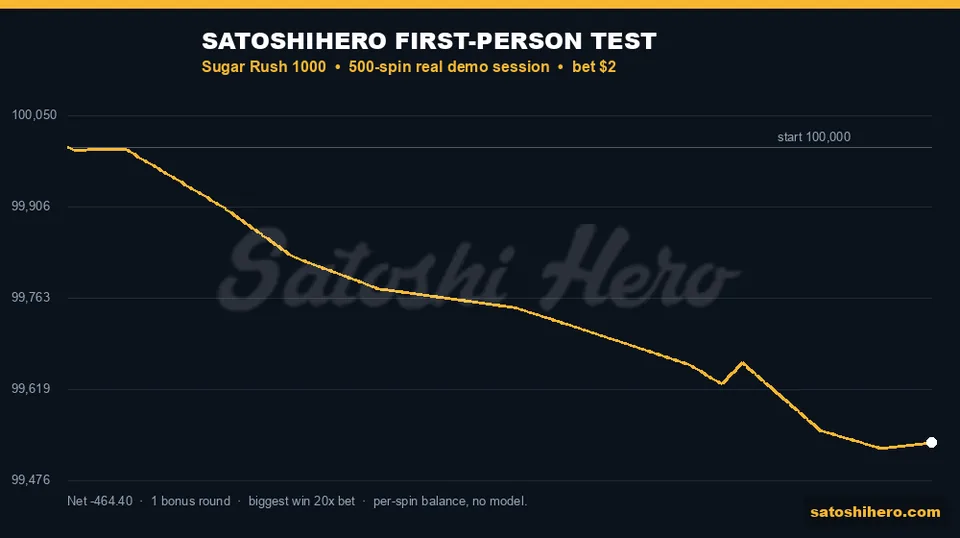
Then I tested both buys from clean balances. The $200 Free Spins buy returned $70.30, and the $1,000 Super Free Spins buy returned $163.00. Those results made the volatility feel real, not theoretical.
Caution: A very-high volatility slot can match its published RTP and still punish a short session. Don’t judge this one on 50 or 100 spins.
The 96.53% RTP is the operator’s published theoretical return, and one live 500-spin demo session has no bearing on that figure. Bonus-buy returns differ by design, with 96.52% for standard Free Spins and 96.44% for Super Free Spins.
How It Played at $2
At $2 a spin, the session felt grindy because visual activity didn’t turn into meaningful balance recovery. The candy kept moving, but my balance kept slipping.
Session rhythm
Turbo mode made the dry stretch feel sharper. You see the grid refill fast, then another tiny tumble lands, then the balance barely moves.
That rhythm can trick you into thinking the next drop has to matter. It doesn’t. The only natural free-spins round paid $40.50, and both buys lost badly against their costs.
The Sugar Rush 1000 demo pace helps you test that feeling without pressure. I think that matters more here than in many softer slots. It also shows whether the bonus-chase cycle feels exciting or draining before you use real funds.
Bankroll feel
The max win looks huge, but the average $2 session can feel harsher than the candy theme suggests. You need patience, and you need a budget that can absorb dead space.
The Sugar Rush 1000 demo and Sugar Rush 1000 free play mode help you feel the pacing before you use a real balance. Try 100 spins, then ask whether the rhythm fits you. If you need frequent meaningful base-game hits, this one may feel too sharp. A smaller stake can stretch the same test longer, but it won’t change the underlying volatility profile.
I like the feature potential. I don’t like how quickly a quiet board can eat through a mid-sized session.
Frequently Asked Questions About Sugar Rush 1000
How do wins work in Sugar Rush 1000?
Wins work through clusters of five or more matching symbols on the seven-by-seven grid. The symbols must connect up, down, left, or right. Winning clusters clear, fresh candy drops in, and tumbles continue until no new cluster lands.
What are the multiplier spots in Sugar Rush 1000?
Multiplier spots are marked grid positions created when winning symbols pop. The second pop on the same spot adds 2x, and further pops can double the value up to 1024x. Multiple spots inside one cluster add together, base-game spots reset after tumbles, and free-spins spots stay locked.
How do you trigger and play the free spins?
You trigger free spins by landing three to seven scatters. They award 10, 12, 15, 20, or 30 spins. Extra scatters can top up the round, and locked multiplier spots create the biggest boards.
What is the difference between Buy Free Spins and Buy Super Free Spins?
Buy Free Spins costs 100x the bet, which was $200 at my $2 stake. Buy Super Free Spins costs 500x the bet, or $1,000 at $2, and starts with 2x on every grid spot. Their published returns are 96.52% and 96.44%. These are in-game feature-buy costs, not promotional bonus amounts.
What did the SatoshiHero simulator project for Sugar Rush 1000?
The simulator projected a median result about $282 down across 1,000 spins at $2. Its p5 to p95 band ran from roughly $920 down to $1,378 up. It also modelled a feature about once every 55 spins and a 100x plus win about once every 812 spins.
What happened in your real 500-spin test?
My real 500-spin test started from a $100,000 demo balance at $2 a spin. I triggered one natural free-spins round, which paid $40.50. The balance ended at $99,535.60, about $464 down, and the two buys returned $70.30 and $163.00.
What are the RTP and maximum win of Sugar Rush 1000?
The RTP is 96.53%, the volatility is very-high, and the maximum win is 25000x the bet. The biggest results depend on locked multiplier spots building during free spins. That setup can create high peaks, but it also creates long dry patches.
Is Sugar Rush 1000 worth playing?
It’s worth trying in demo or free play if you like cluster slots with very-high volatility and persistent multipliers. It’s a poor match if you want steady base-game returns. My test showed plenty of movement, but not much balance recovery.
What is the difference between Sugar Rush and Sugar Rush 1000?
Sugar Rush 1000 keeps the candy-cluster formula but pushes the potential harder. The 25000x cap and stronger multiplier-spot focus make it feel sharper. The original feels more familiar, while this version asks for more bankroll patience.
Where can I play Sugar Rush 1000?
You can play Sugar Rush 1000 on SatoshiHero in demo, free play, and real-play modes where available. The demo is useful because it shows the tumble pace, bonus rhythm, and buy-feature risk without using a real balance.
Final Thoughts
Sugar Rush 1000 stands out because its sweet look hides a brutal math profile. The main draw is the sticky multiplier board, while the main drawback is how little the base game can give back during cold runs.

My Verdict
High-volatility hunters and bonus-buy testers get the most value from this slot. Expect long quiet spells, small tumbles, and the occasional feature that needs time to build. If you want steady base-game comfort, I’d look elsewhere.
I like the clear grid, the readable tumbles, and the way multiplier spots give every bonus round a visible story. I don’t like how both buys performed in my test, especially the $1,000 super buy returning only $163.00. The single natural feature also reminded me how harsh the gap between potential and reality can feel.
Sugar Rush 1000 is a sharp candy slot with real upside, but I’d treat it as a bankroll test first. We keep the published figures and bonus-return details checked regularly, because small return differences matter when buy costs get this high.

Pros:
 Clear grid: Cluster wins stay easy to follow during fast tumbles.
- Strong ceiling: The 25000x cap gives bonus rounds serious upside.
- Sticky spots: Free spins let multipliers grow across the full feature.
- Useful demo: Free play shows the harsh rhythm before real betting.

Cons:
 Cold base game: Tiny tumbles can drain balance without meaningful recovery.
- Costly super buy: The $1,000 test buy returned only $163.00.
- Harsh variance: Very-high volatility demands patience and a deeper budget.

Best For: Patient bankroll managers, cluster-slot fans, and bonus hunters get the clearest match here. The candy theme feels light, but the volatility doesn’t. Try the demo first if you want to feel the pacing before staking real money.
Similar Games

























































Bets
All Bets
Game
Player
Date
Wager
Mult.Multiplier
Prize
 Royal Fruits 9: Hold 'n' Link
 Hidden
- 22:19:36
- 0×
- Big Banker Bonanza
 mdp0fxo
- 22:19:35
- 0×
- Galaxy Glitter
- mike_721
- 22:19:30
- 7×
- Big Banker Bonanza
- mdp0fxo
- 22:19:30
- 0×
- 6 Jokers
 kotakota9180
- 22:19:29
- 0×
- 6 Jokers
- kotakota9180
- 22:19:28
- 0×
- 6 Jokers
- kotakota9180
- 22:19:26
- 0×
- 6 Jokers
- kotakota9180
- 22:19:24
- 0×
- Galaxy Glitter
- mike_721
- 22:19:23
- 0.46×
- Elephant's Gold: Bonus Combo
- Hidden
- 22:19:23
- 0×