

Moleionaire
By pressing play, you agree that you are above legal age in your jurisdiction and that your jurisdiction allows online gambling.

Moleionaire
RTP96.08%
VolatilityVery high
Max winx5,000
Lines20
ThemeFantasy
ReleasedNov 2024

Digging for Riches in a Ruthless Garden
Moleionaire plants a cheerful Pragmatic Play garden over a very-high risk engine with 96.08% RTP, 5,000x max win potential, a 7×7 cluster grid, no fixed paylines, and bets from $0.20 to $240.00.
Moleionaire is a very-high volatility slot from Pragmatic Play with 96.08% RTP and 5,000x max win potential. It pays through connected clusters, and my 500-spin test at $2.00 from $100,000.00 finished $362.00 down. Aimed at patient bonus hunters who can handle sharp swings, slow balance bleed, and rounds ending at the 5,000x cap.
Key takeaways
- Best bonus: Free spins carry the strongest upside because Cluster Reaction adds at least two wilds in the same spot during the round.
- RTP / volatility: Moleionaire uses 96.08% RTP with very-high volatility, so you need patience and a steady stake plan.
- Max win: The cap sits at 5,000x, and a capped round ends immediately with remaining free spins forfeited.
- Risk note: Wins come from connected blocks of five or more symbols on a 7×7 grid, not fixed paylines.
- Bankroll note: My 500-spin test lost $362.00 at $2.00 per spin despite frequent small base-game wins.

Caution: Very-high volatility means the grid can feel active while your balance still grinds down. You need room for long dry stretches.

Table of Contents
- How Moleionaire Works
- Cluster pays
- Symbol values
- Cluster Reaction
- Chosen symbol pair
- Wild stack impact
- Theme & First Impressions
- Garden setup
- Table presence
- Tumbles and Chain Wins
- Falling symbols
- Chain totals
- Free Spins
- Trigger symbols
- Stronger reactions
- Bonus Buy
- Buy cost
- Same RTP
- Bought Free Spins Test
- Test result
- Buy risk
- RTP, Volatility & Our Test
- Simulator projection
- Our 500-spin session
- Frequently Asked Questions About Moleionaire
- Final Thoughts
How Moleionaire Works
Moleionaire pays through connected symbol clusters, so you don’t need to track paylines. Five or more matching symbols must touch horizontally or vertically on the 7×7 garden grid. You watch the board for connected patches, not left-to-right lines. I like that clarity, because you can read each spin quickly.
Mobile and desktop play use the same grid and feature flow. The layout adapts to screen size without changing how you play, so you still follow clusters, tumbles, and wild reactions in the same order. That matters on a busy board. If you miss the chosen symbol pair, you can misread why a weak patch suddenly turns useful.
Cluster pays
Cluster pays trigger when at least five matching symbols connect horizontally or vertically. Diagonal touches don’t count, which keeps the rules simple once you stop looking for lines. Winning blocks vanish after they pay, then new symbols tumble into the gaps.
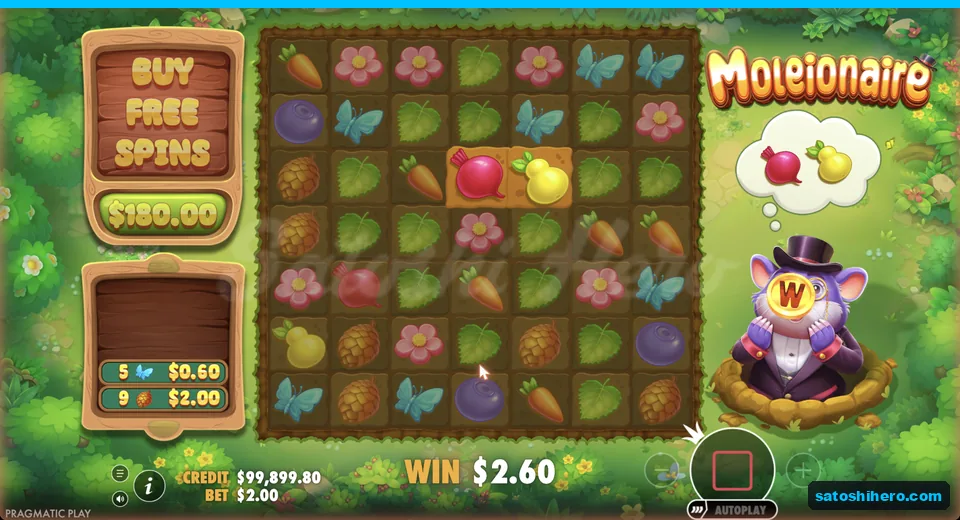
In my base-game screenshot, a $2.60 connected block landed with a golden wild in the middle. That kind of hit looks lively, yet it doesn’t move the balance much at a $2.00 stake. You need bigger linked patches before the grid starts doing real work.
Symbol values
At my $2.00 stake, the blueberry pays $2.00 for five and $500.00 for twenty or more. Beetroot tops out at $300.00, pear at $200.00, and carrot at $100.00. Butterfly and flower can reach $40.00, while pinecone and leaf top out at $20.00.
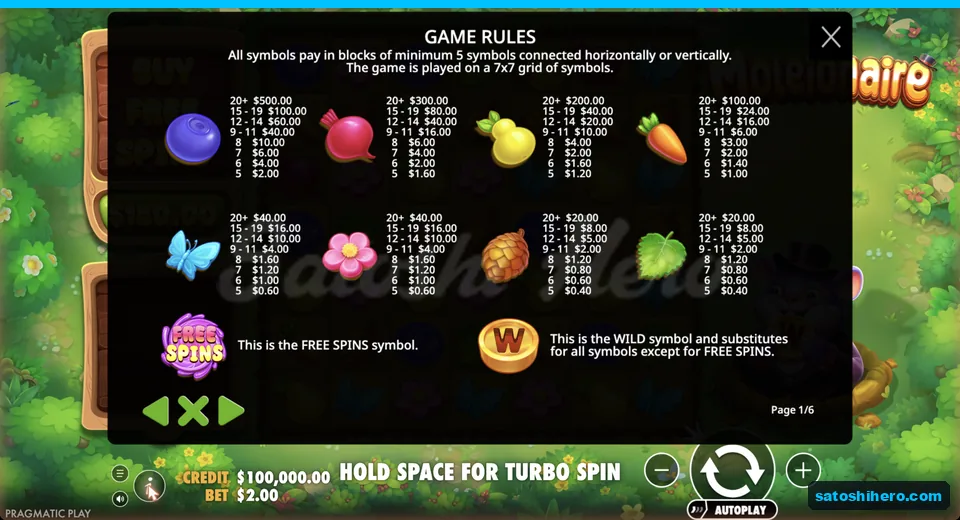
The golden W coin acts as the wild and substitutes for everything except the free spins symbol. I think the wild looks clear enough, which helps when the board floods with produce. The purple free spins symbol matters most, because four or more can open the bonus round.
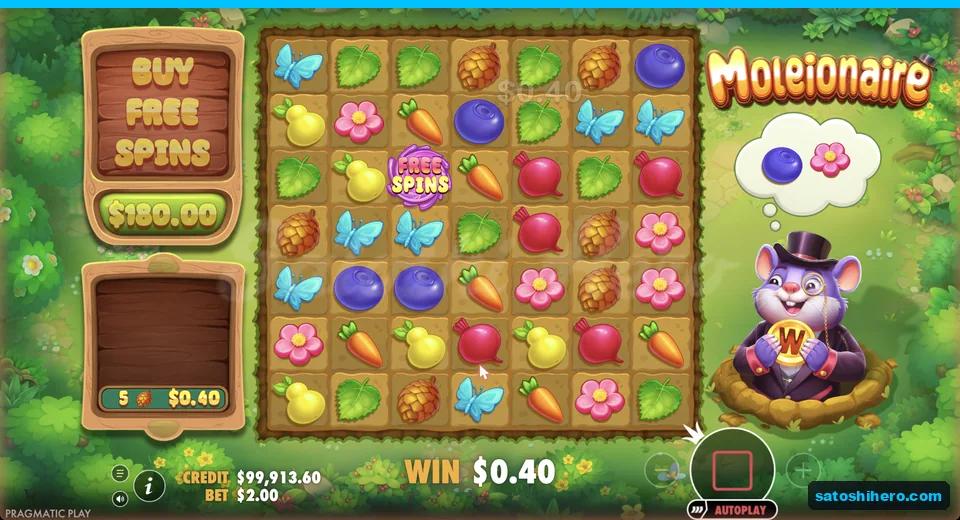
This slot asks you to read the whole grid. A line paytable mindset won’t help here.
Cluster Reaction
Cluster Reaction gives the game its personality, because the mole can turn a chosen adjacent symbol pair into stacked wilds before the spin pays. Before each spin resolves, he picks two paying symbols and shows them in a thought bubble. If those symbols land next to each other anywhere on the grid, they transform into wilds. You get a neat moment of suspense before the result settles.
The reaction can place one, two, three, four, or five wilds in the same spot. Those wilds add to the count of any connected block they help form. In my session, reactions fired often enough to keep the base game busy. They rarely built clusters large enough to change the session result.
Chosen symbol pair
The thought bubble tells you exactly which pair to watch. You aren’t guessing at a hidden mechanic, which I appreciate on a 7×7 grid. If the two chosen symbols touch after the drop, the board can change before the payout lands.
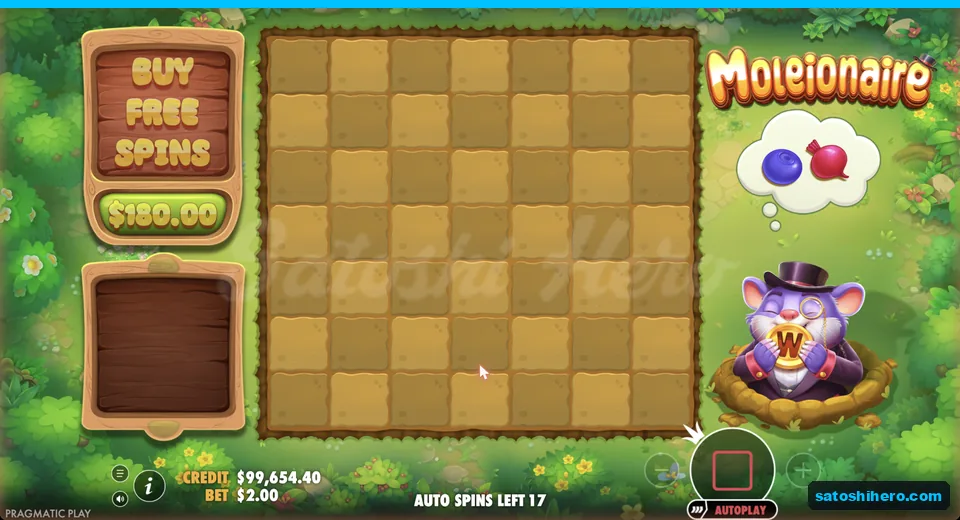
That setup adds personality without slowing the spin too much. I found myself checking the bubble first, then scanning the garden for the pair. It gives you a reason to stay engaged, even when the first symbol layout looks weak.
Wild stack impact
Stacked wilds can turn a dead-looking board into a real cluster. A five-wild stack adds heavy symbol count support, especially when it connects a premium block. The feature doesn’t promise a big result, though. In my test, it created plenty of motion without building the kind of huge patches that rescue a cold balance.
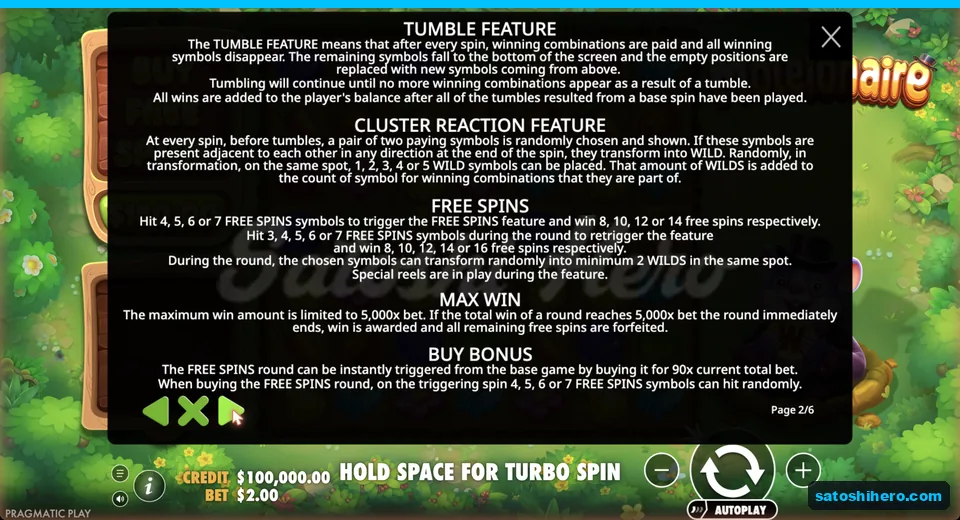

Quick Fact: A reaction can stack up to five wilds in one position. That’s why a weak grid can suddenly create a stronger cluster.
This gives the slot personality, but it doesn’t soften the risk as much as the animations suggest. Cluster Reaction keeps the base game lively, yet the best outcomes still need rare board shapes.
Theme & First Impressions
The theme is a bright cartoon garden, and it looks friendly even though the slot plays with harsh risk. A top-hatted, monocled mole sits in his burrow beside the board, watching the produce-heavy grid. Berries, vegetables, flowers, leaves, pinecones, butterflies, and small garden details fill the screen. I think the theme works because the board stays readable.
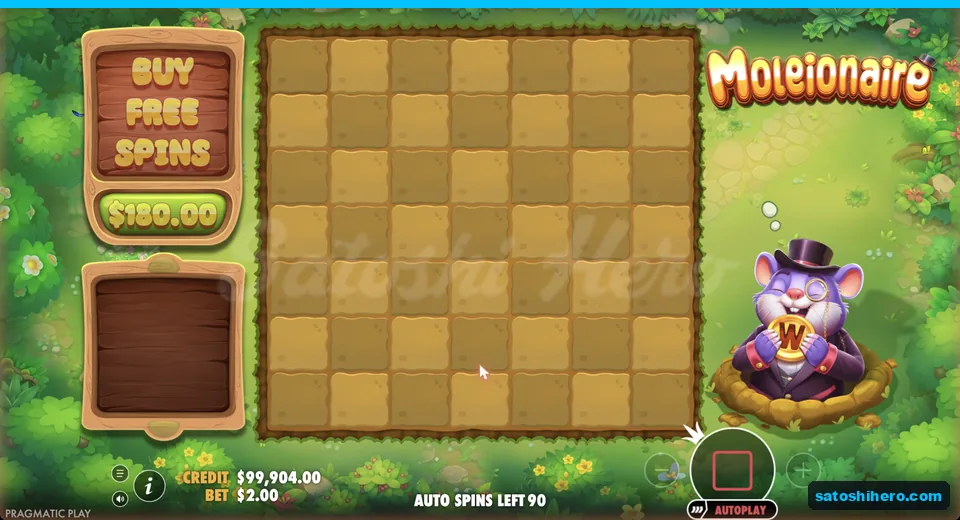
The 7×7 layout feels more like a puzzle board than a classic reel strip. That choice fits the cluster system well, because you scan shape and connection rather than line direction. The theme is light, but the volatility isn’t. If you like a bolder adventure mood, Journey to the West offers a very different style from this bright garden.
Garden setup
The garden setup uses cheerful colors and simple symbol shapes. Produce symbols stand apart well enough, even when the board gets crowded. That helps you spot clusters fast, and it also makes the wild reactions easier to follow.
I don’t think the setting wins originality awards. Plenty of slots use cute animals and bright backdrops. Still, the mole gives the board enough character, especially when the thought bubble appears before a reaction.
Table presence
The buy sign, stake display, and mole position frame the board clearly. They don’t clutter the action, which matters when you track forty-nine symbol spaces. I like practical design more than flashy decoration here.

Did You Know? The mole theme works because the character sits beside the grid like he’s watching the garden. The symbol set itself stays familiar and easy to read.
Visual details and specs are checked regularly to keep this guide accurate. The style fits readers who prefer clean cartoon slots over dark or dramatic themes.
Tumbles and Chain Wins
Tumbles keep each winning spin alive by clearing paid clusters and dropping new symbols into the gaps. After a winning cluster pays, it disappears from the grid. Symbols above fall down, and new symbols drop from the top. The chain continues until no new paying block forms.
The entire tumble sequence pays as one win total. That makes a spin feel more active than a single-stop reel result. In my 500-spin session, tumbles created lots of movement. Most base-game blocks paid around $0.40 to $2.60 at the $2.00 stake.
Falling symbols
Falling symbols give every winning patch another chance to connect. You want repeat clusters, not just one small paying block. A single blueberry patch can clear space, then fresh produce may drop into a stronger shape.
I like the pace, but it can trick you. A busy grid doesn’t mean a profitable grid. When the symbol count stays low, the total often remains tiny despite all the motion.
Chain totals
Chain totals combine every paid cluster from the tumble sequence. You see one final amount, which makes the outcome easy to track. During my test, many chains looked busier than their payouts felt.

Pro Tip: Don’t judge this slot by how often the grid pays. Watch whether tumbles combine with stacked wilds into twenty-symbol-plus blocks.
Frequent paying didn’t stop the balance decline. Tumbles add pace, but the real value comes from rare chains that grow beyond tiny clusters.
Free Spins
Free spins are the main upside feature because Cluster Reaction becomes stronger during the round. Four purple free spins symbols award 8 free spins, five award 10, six award 12, and seven award 14. Landing three or more during the round can retrigger another 8 to 16 spins. You want this mode because the reaction mechanic hits harder here.
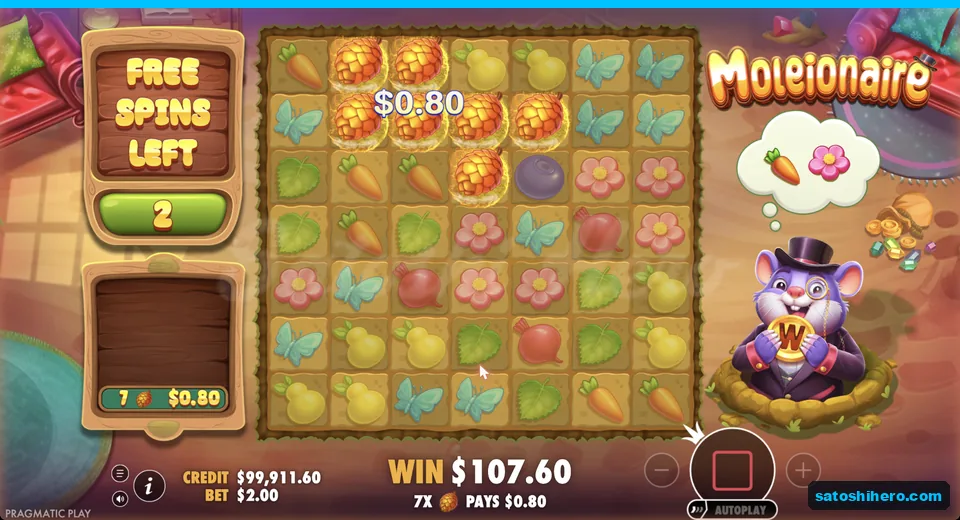
During free spins, chosen symbols always transform into at least two wilds in the same spot. That extra wild count gives each reaction more weight. I triggered one natural free spins round early during my 500-spin run. It paid $95.00 at my $2.00 stake.
Trigger symbols
The purple free spins symbols stand out from the garden produce. Four of them open the bonus with 8 spins, while more symbols add extra starting spins. Retriggers can extend the round, which gives the grid more chances to build.
I like that the trigger ladder stays simple. You don’t need to remember side meters or hidden levels. You just need enough purple symbols to land, which can take patience.
Stronger reactions
Free spins improve the reaction mechanic by guaranteeing at least two wilds in the same spot. That makes each chosen pair more dangerous when it connects. The round carries more upside than the base game because stacked wilds can push clusters toward premium counts.
Hot to Burn – 7 Deadly Free Spins gives free-spin fans a more direct bonus focus, while this garden slot ties its bonus power to cluster reactions. I prefer the extra board-reading tension here, though the result can still disappoint. One decent feature won’t always repair a long base-game slide.
Bonus Buy
The bonus buy jumps straight to free spins for 90x the total bet, but it doesn’t improve the 96.08% RTP. You can buy the round directly from the base game. At my $2.00 stake, the price was $180.00. That cost changes how you should think about risk.
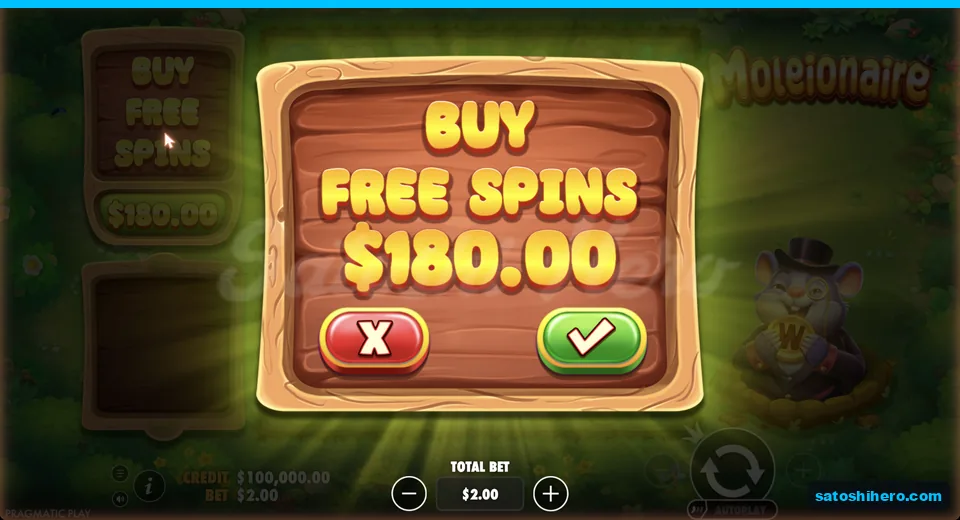
Buying skips the wait for the feature. It doesn’t make the round safer, and it doesn’t make the theoretical return higher. I think that matters because the cheerful presentation can make the buy feel less severe than it is. A weak bonus can return well below the purchase price.
Buy cost
The 90x price means one bought round costs as much as ninety base spins at the same stake. At $2.00, that becomes a $180.00 decision. You should think in buy attempts, not single spins.
That framing changes bankroll pressure fast. Two poor buys can create a bigger dent than a long base-game stretch. I wouldn’t click the buy casually unless I had already set a strict stop.
Same RTP
The official buy RTP is 96.08%, matching the base game. The buy changes pace, not theoretical return. You trade waiting time for concentrated variance.
Caution: The buy costs 90x your stake, so one weak round can hurt more than dozens of ordinary dead spins.
This feature makes sense for controlled testing. It feels too sharp for casual default play.
Bought Free Spins Test
My bought free spins test returned $99.60 from a $180.00 purchase, so it paid just over half the buy price. I bought once on a fresh $100,000.00 balance at my $2.00 stake. The round landed the minimum 8 spins. It returned 49.8x my stake, which sounds better than it felt.
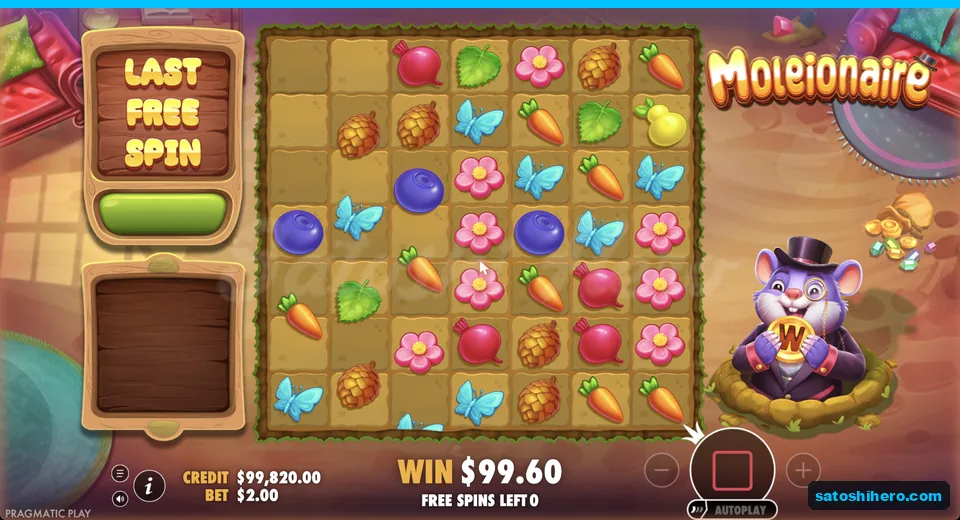
Wilds arrived on every spin as promised. The round made respectable blocks, yet nothing chained into the board needed to make the buy pay properly. I wouldn’t treat the buy as the default way to play unless your bankroll is built for repeated misses. The downside showed up faster than the ceiling.
Test result
The $180.00 cost set a high bar before the first free spin landed. A $99.60 return still meant an $80.40 shortfall. You can feel that gap because the round looks active while the buy price sits in your head.
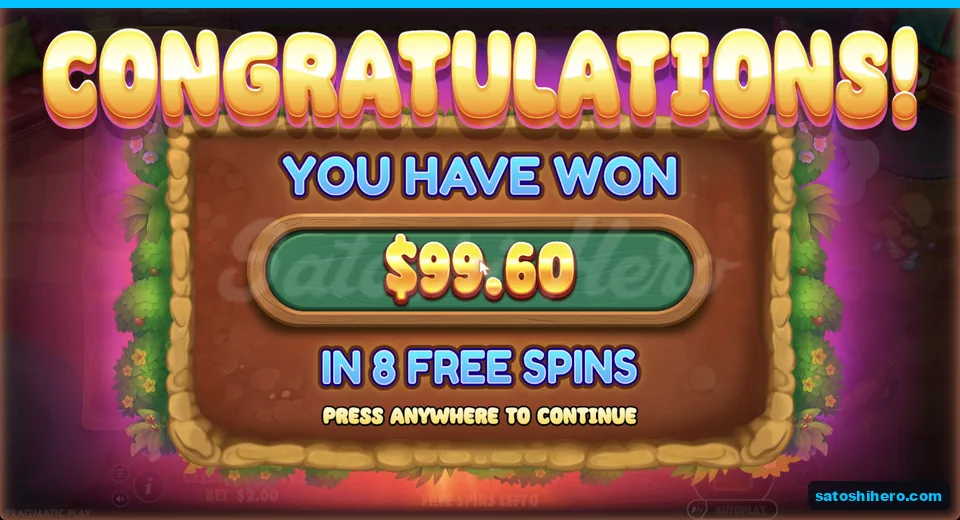
Eight spins gave the feature room to show its stronger reactions. It just didn’t chain into a large premium block. I wouldn’t call the result awful, but it clearly failed to justify the 90x entry price.
Buy risk
Buy risk comes from price pressure. Every bought round needs stacked wilds plus strong tumble chains to beat the cost. Small and medium clusters may look respectable, but they don’t always cover a $180.00 buy.
Hot To Burn Multiplier may appeal if you prefer visible multiplier-led upside over cluster-wild reactions. This game asks you to trust board shape and wild stacks instead. My buy showed the downside more clearly than the ceiling.
RTP, Volatility & Our Test
Moleionaire has 96.08% RTP, very-high volatility, and 5,000x max win, and my testing matched that high-risk profile. Pragmatic Play built a slot where small cluster pays can appear often while meaningful upside stays locked behind rare feature chains. The max win feels modest for this volatility, because 5,000x is real upside but not a giant ceiling. You can test the swing profile in demo mode on SatoshiHero before using real funds.
Official RTP and volatility don’t come from my sample. They describe the game model, while my session shows one real path through it. I think the risk profile came through clearly in both the simulator and my live play. You need cautious stake sizing here more than hope.
Simulator projection
The SatoshiHero Slot Simulator ran one thousand spins at $2.00. It returned a median net of $211.80 down, with the fifth percentile at $874.10 down and the ninety-fifth percentile at $1,344.00 up. That spread tells the story fast. Most sessions bleed, while rare sessions run far ahead.
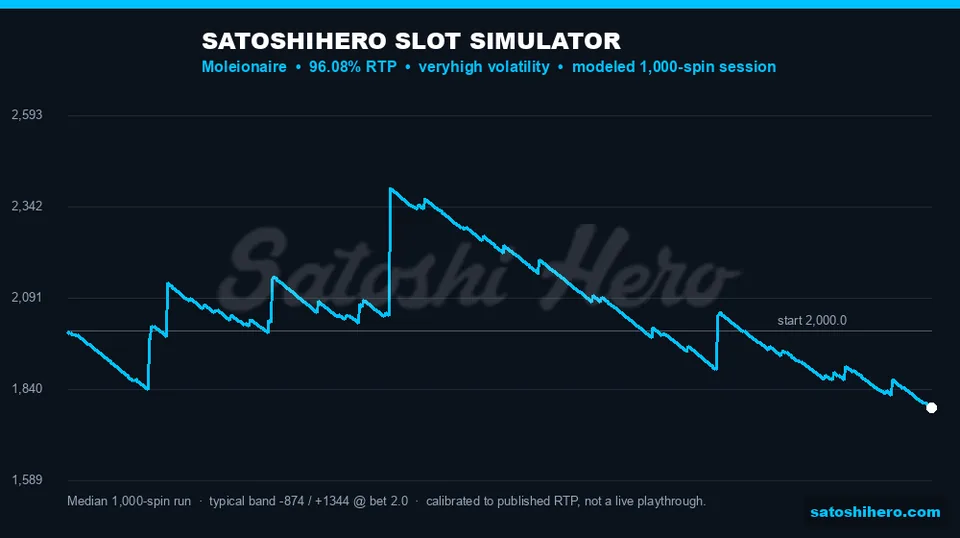
The gap between the median and upside shows the volatility better than a label alone. You can hit many paying clusters and still trail badly. I see this as a bankroll test first, not a casual spin-and-relax slot. If you raise stake too quickly, the cold side can punish you.
Our 500-spin session
I played 500 spins at $2.00 from a fresh $100,000.00 balance. I finished at $99,638.00, which put me $362.00 down. One organic free spins round paid $95.00 early in the run. After that, the balance drifted down for around four hundred spins.
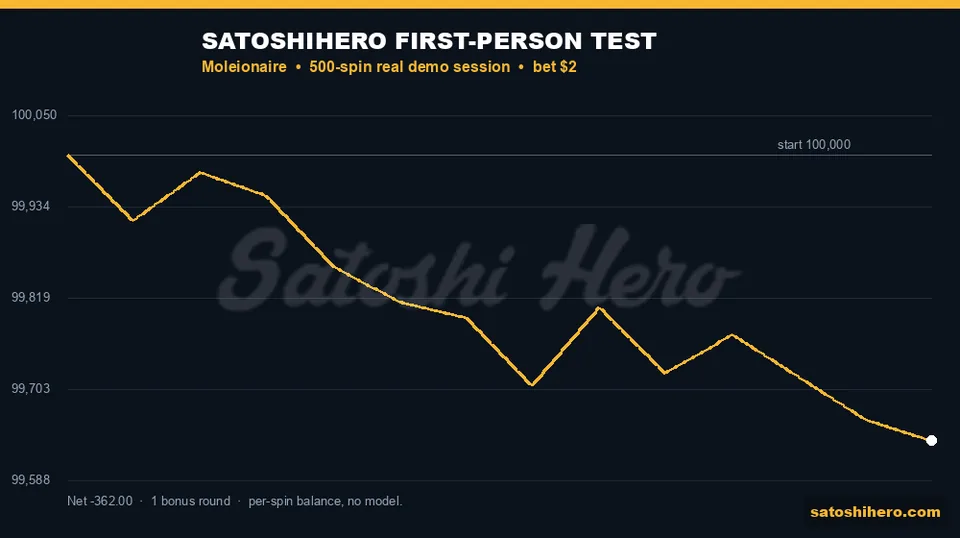
The base game paid often, but most wins stayed tiny. I saw many blocks around $0.40 to $2.60, and Cluster Reaction kept the grid moving. None of that built a strong enough board. The session felt busy, then quietly expensive.
Quick Fact: A slot can pay small wins often and still finish deep in the red. Here, the real upside sits in rare feature chains.
The 96.08% RTP is the operator-published theoretical return. One 500-spin session doesn’t prove or disprove that RTP. The bonus-buy RTP is officially 96.08%, the same as the base game. This test shows session shape, not a recalculated return.
Cautious stake sizing matters more here than chasing the next busy-looking board. If you play too large, even active clusters can drain you.
Frequently Asked Questions About Moleionaire
What is the Moleionaire win system?
Symbols pay in blocks of at least five connected horizontally or vertically on a 7×7 grid. There are no fixed win lines. Winning blocks vanish, new symbols tumble in, and more wins can form on the same spin.
How does the Moleionaire cluster reaction feature work?
Before each spin resolves, the mole chooses two paying symbols and shows them in a thought bubble. If those two symbols land adjacent anywhere on the grid, they transform into wilds. Between one and five wilds can land in the same spot.
How do you trigger Moleionaire free spins?
Four, five, six, or seven free spins symbols award 8, 10, 12, or 14 free spins. Three or more free spins symbols during the round can retrigger it for another 8 to 16 spins. In free spins, chosen symbols always transform into at least two wilds in the same spot.
Can you buy the Moleionaire free spins?
Yes, the free spins buy costs 90x the total bet. At my $2.00 test stake, the buy cost $180.00. The tested buy returned $99.60 from eight spins, and the buy RTP is 96.08%.
What happened in the 500-spin Moleionaire test?
The 500-spin test at $2.00 finished $362.00 down from a fresh $100,000.00 balance. One natural free spins round paid $95.00. The base game paid often in small amounts, but the balance drifted down overall.
Which RTP and maximum win does Moleionaire use?
The RTP is 96.08%, and the maximum win is 5,000x. Volatility is very-high, so long losing stretches can happen even when the grid keeps paying small clusters.
Is this a paylines slot?
No, it uses cluster pays on a 7×7 grid. Connected groups of five or more matching symbols pay. You watch symbol blocks rather than fixed left-to-right lines.
Is the bonus buy worth it?
It can be exciting because it jumps straight to the highest-upside mode, but it costs 90x the bet. In my test, the $180.00 buy returned $99.60. It needs a strong chain to justify the price.
Where can you play Moleionaire in demo mode?
You can test the game in demo mode on SatoshiHero before playing for real. Demo play helps you understand the cluster system, free spins, and very-high volatility without risking a bankroll.
Does Moleionaire have a wild symbol?
Yes, the golden W coin acts as the wild. It substitutes for every symbol except the free spins symbol. Cluster Reaction can create stacked wilds when the chosen symbol pair lands adjacent.
Final Thoughts
Moleionaire stands out because it wraps a tough cluster engine in a bright, readable garden. The main drawback is simple: very-high volatility can grind your balance down even when the grid keeps paying.

My Verdict
Patient cluster fans can get good tension from this slot, especially if they like watching reactions build wild stacks. Expect busy base-game motion, long cold patches, and feature rounds that need serious chain growth. I’d keep stakes modest and treat the bonus buy as a controlled test, not a habit.
I like the thought-bubble mechanic because it gives every spin a small read before the result lands. I don’t like how often my session looked active while the balance still slid downward. The $180.00 bought round returning $99.60 summed up the risk neatly.
Moleionaire is checked regularly, and I’d return to it for the cluster reactions rather than the theme alone. If you want soft swings, this garden digs too deep.

Pros:
 Clear Cluster Pays: The 7×7 grid makes wins easy to read.
- Lively Reactions: Thought-bubble pairs give each spin extra tension.
- Stronger Free Spins: Bonus reactions add at least two wilds in one spot.
- Readable Design: Bright symbols help you track busy tumble chains.

Cons:
 Harsh Volatility: Long losing stretches can hit despite frequent small pays.
- Costly Buy: The 90x price puts heavy pressure on each bonus.
- Modest Ceiling: The 5,000x cap feels restrained for this risk level.

Best For: Bonus hunters, cluster-slot fans, and careful bankroll managers get the most from this game. You need patience for long slides and discipline around the 90x buy. If you prefer low-risk sessions, this one may feel too sharp.








































Bets
All Bets
Game
Player
Date
Wager
Mult.Multiplier
Prize
 Fu Yin Yang: Hold 'n' Link
 mcanteup1
- 00:22:51
- 0×
- Luck of Tiger: Bonus Combo
 nina87
- 00:22:51
- 0.04×
- Mayan Fortunes
 josh1998
- 00:22:50
- 0×
- Galaxy Glitter
- mike_721
- 00:22:49
- 0×
- Fu Yin Yang: Hold 'n' Link
- mcanteup1
- 00:22:49
- 0×
- Luck of Tiger: Bonus Combo
- nina87
- 00:22:48
- 0×
- Fu Yin Yang: Hold 'n' Link
- mcanteup1
- 00:22:47
- 0×
- Luck of Tiger: Bonus Combo
- nina87
- 00:22:45
- 0×
- Fu Yin Yang: Hold 'n' Link
- mcanteup1
- 00:22:44
- 0×
- Luck of Tiger: Bonus Combo
- nina87
- 00:22:42
- 0×