

Jewel Rush
By pressing play, you agree that you are above legal age in your jurisdiction and that your jurisdiction allows online gambling.


Gem Chains and Multiplier Sparks in Jewel Rush
I tested Jewel Rush at $2.00 a spin to see whether Pragmatic Play’s gem-grid multiplier slot has enough punch to justify its high volatility.
Jewel Rush is a high volatility Pragmatic Play slot with 96.47% RTP and 5,000x max win potential. It uses a 7×7 cluster-pay grid, not paylines, with wins formed by 5 or more matching jewels connected horizontally or vertically. Swing hunters get fast tumble chains, random multipliers and sharp bankroll swings instead of steady small wins.
Key takeaways
- Best play: Jewel Rush pays on a 7×7 cluster grid, where 5 or more connected matching jewels form wins.
- RTP / volatility: The slot has 96.47% RTP, high volatility and a swingy multiplier-led rhythm.
- Max win: The cap sits at 5,000x your bet, solid but not huge for this risk level.
- Risk note: Random multipliers can rescue dull spins, yet long cold stretches still happen.
- Bankroll note: Regular spinning tested better than my $200.00 buy, which paid only $24.40.

Table of Contents
- How Jewel Rush Works
- Cluster pay basics
- Grid readability
- Theme & First Impressions
- Visual style
- Game pace
- Symbols and Payouts
- Top jewel payouts
- Scatter symbol
- Tumbles and Random Multipliers
- Tumble chains
- Multiplier stacking
- Free Spins Feature
- Trigger rules
- Retrigger potential
- Bonus Buy Test
- Buy cost
- Test result
- How It Played at $2 a Spin
- Cold stretch
- Feature recovery
- RTP, Volatility & Our Test
- Simulator projection
- Our 500-spin session
- Frequently Asked Questions About Jewel Rush
- Final Thoughts
How Jewel Rush Works
Jewel Rush pays through connected jewel clusters on a 7×7 grid, not through fixed paylines. You need 5 or more matching jewels touching horizontally or vertically before the game pays anything. I like that clarity, because you can read a winning shape quickly even when the screen tumbles fast.
Cluster pay basics
Pragmatic Play builds this Slots game around simple cluster logic. Bigger connected blocks pay much more than minimum clusters, so you’re not just hoping for any match. You want larger jewel groups, then you want those groups to catch random multipliers when the tumble chain starts moving.
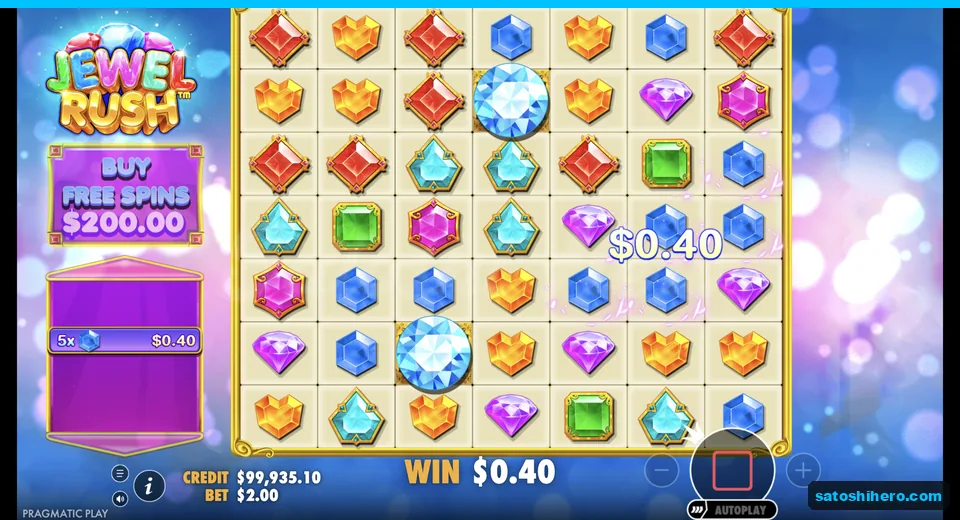
Blue diamond Scatters appear across the grid and open free spins. You can test the demo on SatoshiHero before risking a real balance, which helps because the rules feel simple but the variance bites hard. Sugar Rush shares that quick “Rush” energy, yet this game uses connected clusters on a jewel grid rather than its candy-style setup.
Grid readability
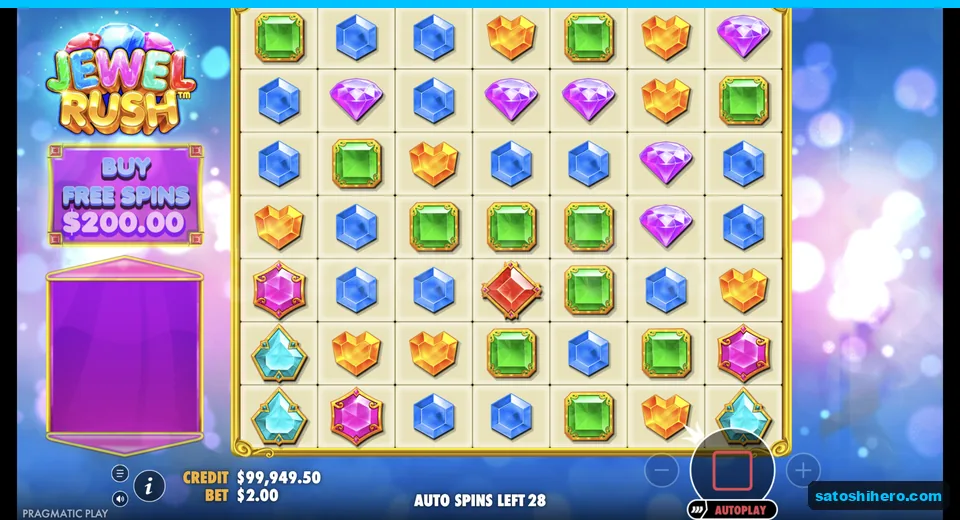
The 7 rows by 7 columns stay readable on desktop and mobile because the symbols use bold colours and clean shapes. You won’t need to hunt for tiny line paths or check a payline map after every spin. That makes the game easier to follow than many busy grid slots.
Still, readable doesn’t mean gentle. You can understand every result and still watch the balance slide while weak clusters miss multipliers. I think the design helps you track the action, but it doesn’t soften the risk.
Theme & First Impressions
The theme is a clean gem-grid setup built for fast multiplier chasing, not a deep story. Jewel Rush drops glittering jewels onto a sparkling background and keeps almost everything focused on the grid. You get a gem-mining feel, but the game doesn’t spend time on characters or side scenes.
Visual style
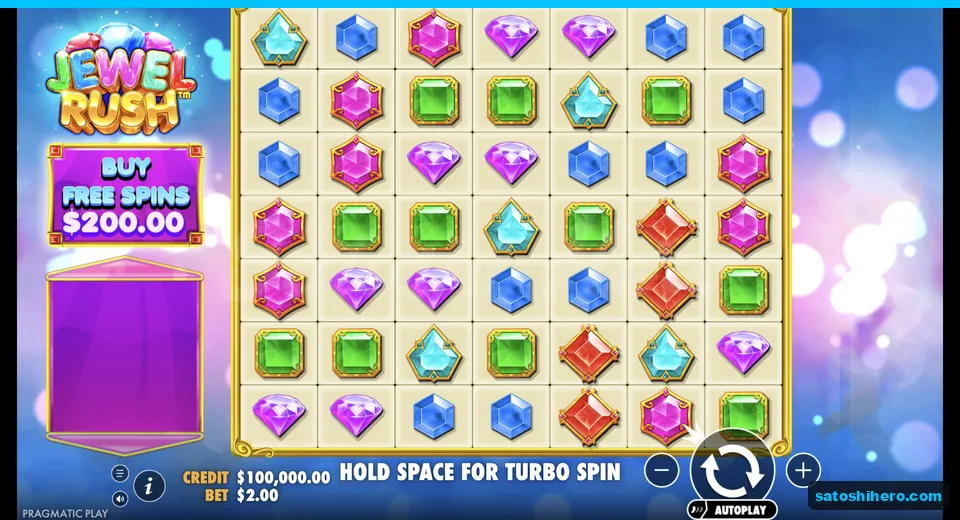
The jewels look bright, sharp and easy to separate at a glance. Pink pentagons, red diamonds, green squares and blue hexagons give the screen enough contrast for fast cluster reading. I think the theme won’t win originality awards, but the clean layout helps when you’re watching tumbles stack.

Did You Know? The stripped-back gem theme keeps the screen clear, which matters when tumble chains and multipliers start stacking.
Game pace
The pace feels quick because wins vanish, new jewels drop and fresh clusters can form instantly. You don’t sit through long animations before the next result becomes clear. That speed works if you like seeing many outcomes quickly, but it can also make cold stretches feel harsher.
If you want story-heavy slots, this may feel plain after a few spins. If you want readable action, it does the job well. I’d take this clean setup over a cluttered bonus screen when multipliers start landing.
Seasonal Rush fans can compare the clearer gem grid with Sugar Rush Xmas, while Sugar Rush Dice gives the same family a dice-led twist.
Symbols and Payouts
All listed payouts come from connected jewel blocks, and the top blocks pay sharply more than small clusters. You need at least 5 matching jewels connected horizontally or vertically, and the game pays bigger prizes when that block grows. That makes every extra connected symbol matter.
Top jewel payouts
At my $2.00 stake, the pink pentagon sat at the top of the paytable and paid $300.00 for a block of 15 or more. The red diamond paid $200.00, the cyan pentagon paid $180.00 and the green square paid $160.00. Those numbers give the best symbols real weight when a larger block appears.
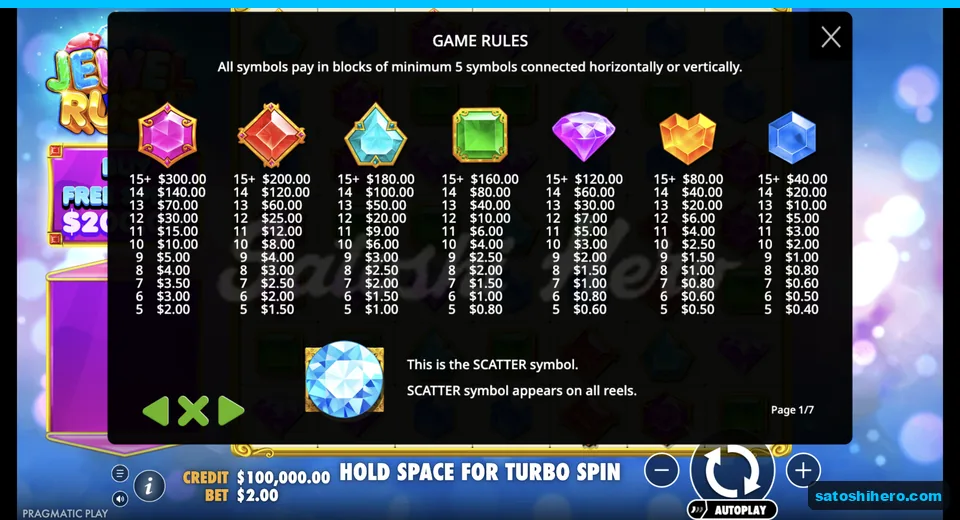
The lower listed jewels still matter because multipliers can turn modest blocks into serious hits. Purple diamonds paid $120.00 for 15 or more, orange hearts paid $80.00 and blue hexagons paid $40.00. You should treat those as connected-block payouts, not line hits, because the game has no fixed line path to follow.
That spread also explains why I cared more about block growth than single-symbol value during play. A top jewel block looks great, but a lower jewel with a stacked multiplier can still steal the spotlight. You need to watch shape, symbol and multiplier position together.
Scatter symbol
The blue diamond Scatter appears across the grid and opens the free spins feature. You need it because the bonus carries stronger multiplier potential than the base game. I don’t mind simple Scatter rules here, since the main tension already comes from cluster shape and multiplier timing.
The paytable feels easy to learn after a short demo run. You still need cluster size and multiplier luck before the slot really moves. Small blocks keep the screen active, but the real money waits for connected jewels and stacked boosts.
Tumbles and Random Multipliers
The biggest wins come when tumbles connect with random multipliers, not from cluster size alone. Winning blocks pay, vanish and let new jewels fall into empty spaces. You want those falling jewels to create another cluster, because every extra tumble gives the game another chance to build pressure.
Tumble chains
Tumbles continue while new winning clusters keep forming. A weak chain can finish after one tiny payout, which feels flat at $2.00 a spin. A stronger chain can keep feeding the grid and make you watch every falling jewel with more interest.
I felt the base game drag when tumbles stopped too quickly. That’s the trade-off here, because the mechanic looks exciting but often needs several lucky steps. You can get movement on the screen without getting much movement in your balance.
That rhythm also makes the first few tumbles important. If the opening cluster pays low and the next drop misses, the spin ends before any tension builds. When two or three drops connect, you start watching for multiplier jewels instead of just counting matching shapes.

Quick Fact: The biggest hits usually come when a decent cluster catches stacked multipliers, not when one huge block lands alone.
Multiplier stacking
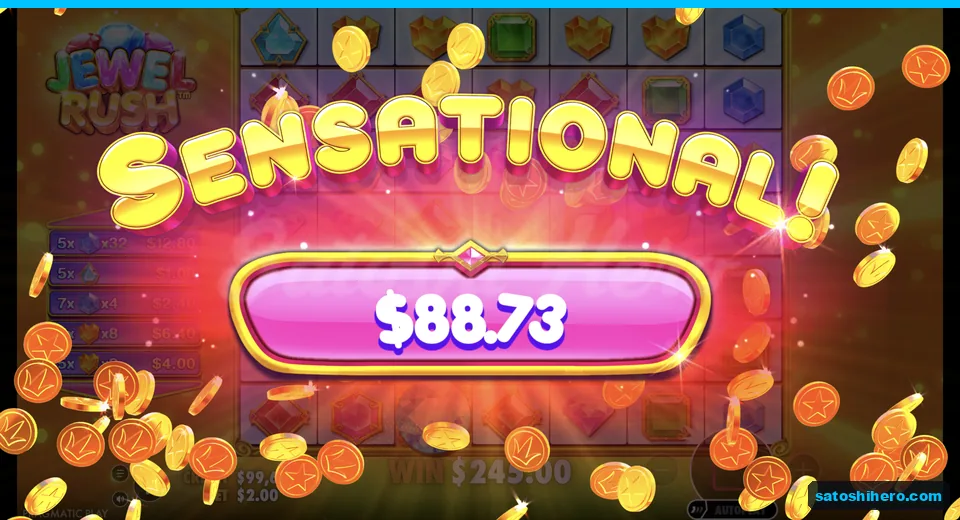
In the base game, any jewel in a winning block can carry a random 2x multiplier. If several multipliers sit inside the same paying block, the game multiplies them together. The product can climb as high as 256x, and that’s where the slot shows its teeth.
My clearest highlight came when a x32 multiplier turned a modest block into a $245.00 single-spin win. That result felt much bigger than the cluster shape suggested at first glance. You need connected jewels first, but multiplier luck decides whether a win feels minor or memorable.
Dead tumbles can look tiny and slightly frustrating. One stacked chain can change the whole session, though you shouldn’t count on it arriving neatly. I think this feature gives the game its real identity.
Free Spins Feature
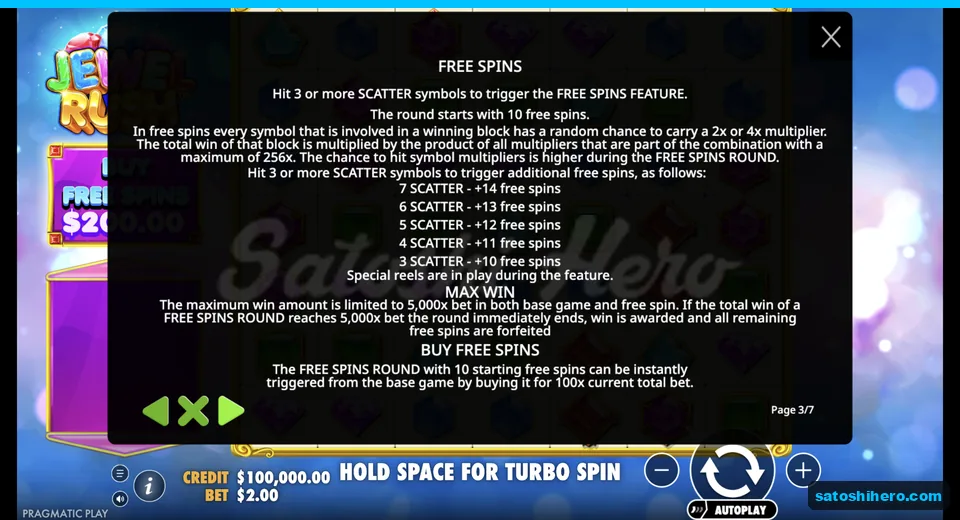
Free spins raise the multiplier threat because the game adds 2x and 4x multipliers with a higher hit chance. Three or more Scatters award 10 free spins. You immediately feel the round’s extra danger because more winning jewels can carry bigger boosts.
Trigger rules
During free spins, every jewel inside a winning block can carry a 2x or 4x random multiplier. The chance to hit multipliers rises compared with the base game, so ordinary-looking clusters can become much more interesting. I like the rule because it improves the same core mechanic instead of adding a detached mini-game.
Sugar Rush 1000 may attract multiplier fans with a bigger headline feel, but this slot keeps its action focused through cluster chains and stacked random multipliers. The 5,000x cap still limits the ceiling. You’re chasing impact, not endless potential.
Retrigger potential
Landing 3 or more Scatters again can retrigger the round. Retriggers add 10 to 14 more spins depending on the Scatter count, which gives the feature a second life when the grid cooperates. That matters because a short bonus can die before multipliers connect with valuable blocks.
This is where the slot feels most dangerous in a good and bad way. You can rescue a session with one strong chain, but you can also watch 10 spins pass with too little connection. Free spins can save a balance, but they still need a proper tumble run.
Bonus Buy Test
The bonus buy cost 100x the bet and paid poorly in my test, so I treat it as a high-risk shortcut. At my $2.00 stake, buying free spins cost $200.00. That price gives you instant access to 10 free spins, but it doesn’t make the feature safer.
Buy cost
The buy button skips the base-game wait and puts the higher multiplier chance into play. That convenience feels tempting when the base game runs cold. You should size your stake around the full buy cost first, because a $2.00 spin turns into a $200.00 decision fast.
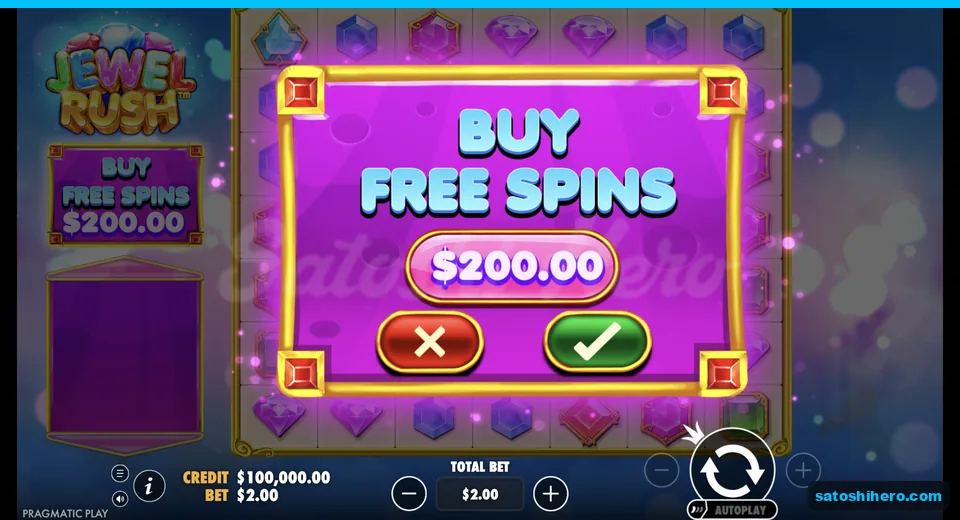

Pro Tip: If you use the buy feature, size your stake around the 100x cost first, not the base spin price.
Test result
I bought the feature once on a clean $100,000 balance. The round gave me 10 free spins, but the jewels refused to link properly and the multipliers stayed small. It paid $24.40, about 12x my stake, which landed far under the $200.00 cost.
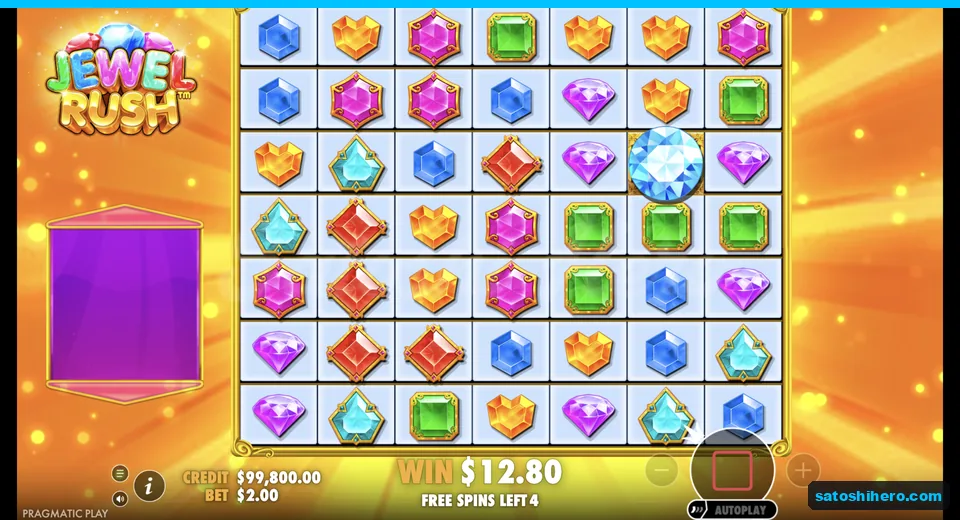
That buy felt brutally cold. I don’t view it as a value shortcut just because it skips dead base spins. It still needs one meaningful multiplier chain, and the tested round never found it.
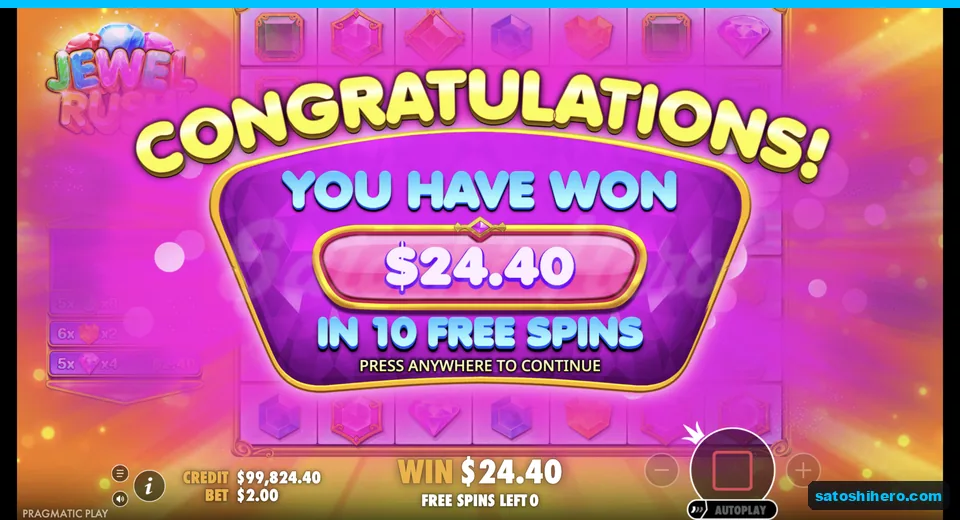
The pain came from the gap between stake size and buy cost. A normal $2.00 spin feels controlled, but the buy instantly risks 100 of those spins. You need to think in full feature cost, not the smaller number shown beside the spin button.
If the buy cost feels large, your stake is already too high. You can enjoy the feature, but you need to accept that one poor buy can erase many base-game spins. I’d rather use it sparingly than treat it as the main way to play.
How It Played at $2 a Spin
The $2.00 test finished only $58.90 down after 500 spins, but one feature did most of the repair work. I started from a fresh $100,000 balance and kept every spin at the same stake. That steady setup made the session easy to judge.
Cold stretch
The base game dragged for a long stretch and chipped away slowly. Tumbles appeared, but too many stopped before multipliers turned them into anything useful. I felt the grind clearly, because the grid kept moving without delivering enough meaningful hits.
That part of the session tested my patience more than the rules. A few small clusters kept the balance from collapsing, but they didn’t create real momentum. You need to be comfortable with that slow bleed, because the slot can look active while still paying light.
That rhythm reminded me why Mining Rush can appeal to patient theme fans who accept slow feature chasing. This gem-grid slot asks for the same patience, although its payoff depends more on multiplier chains than mining-style reveals. You need a bankroll that can sit through dull patches without forcing a stake jump.
Feature recovery
A Free Spins round late in the run paid $317.00 and changed the mood quickly. The best moment came from the x32 multiplier spin worth $245.00. Without that single hit, my session would have looked much rougher.
Finishing $58.90 down after 500 spins felt tidy for a high-volatility grid game. I wouldn’t call that typical, and you shouldn’t read it as comfort. The test shows how one feature can nearly undo a long grind, but a missed bonus would have left a very different result.
That’s why I judge this slot by damage control, not by one headline hit. The best spin paid $245.00, yet the final loss still sat at $58.90. You can get a great moment and still need discipline afterward.
RTP, Volatility & Our Test
Jewel Rush has 96.47% RTP, high volatility and a 5,000x max win, so the math points toward swingy sessions. The theoretical return looks fair for a modern cluster-pay slot, but the risk profile pushes pressure onto your bankroll. I think the win cap feels respectable, though not extreme for a multiplier chaser.
Simulator projection
Our simulator modelled 1,000 spins at $2.00 using the 96.47% RTP and high volatility setting. The median session finished about $128.40 down, which fits the cold base-game feel I saw. The fifth percentile landed roughly $635.10 down, while the ninety-fifth percentile finished about $737.00 up.
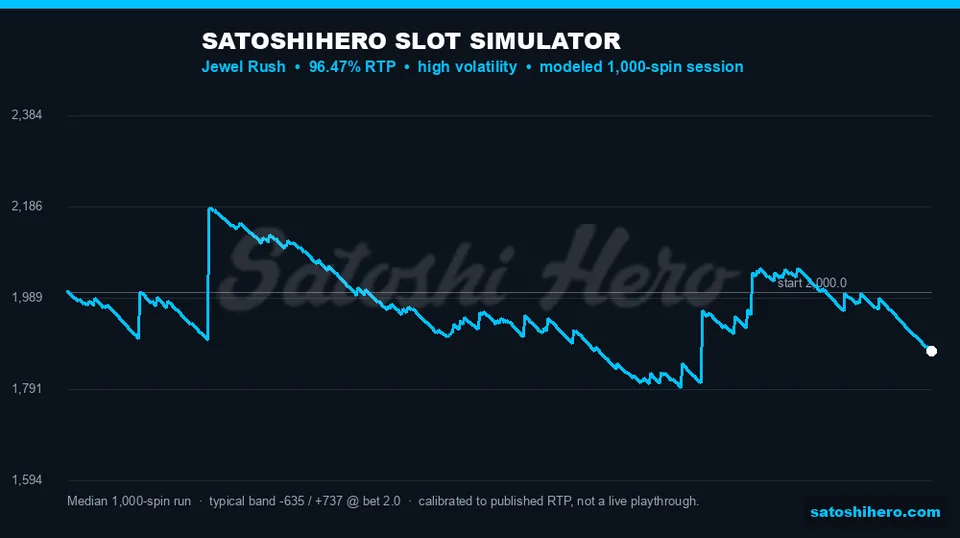
The model expects a feature roughly once every 45 spins. It also places a 100x win about once in 1,742 spins. You should treat those figures as session-shape guidance, not prediction certainty, because the next 100 spins can still run badly.
I find the fifth-percentile figure more useful than the top-end result when choosing a stake. A rough $635.10 downswing at $2.00 tells you how quickly the grid can punish weak timing. The upside exists, but the downside arrives first in plenty of sessions.

Caution: Don’t read a near-break-even 500-spin result as safety. This is still a high-volatility slot where a missed feature or dead buy can cut into your balance quickly.
Our 500-spin session
I played 500 spins at $2.00 and finished $58.90 down. The Free Spins round paid $317.00 during the run, and the $245.00 single spin came from a x32 multiplier. That result matched the simulator’s swingy shape better than a smooth return curve.
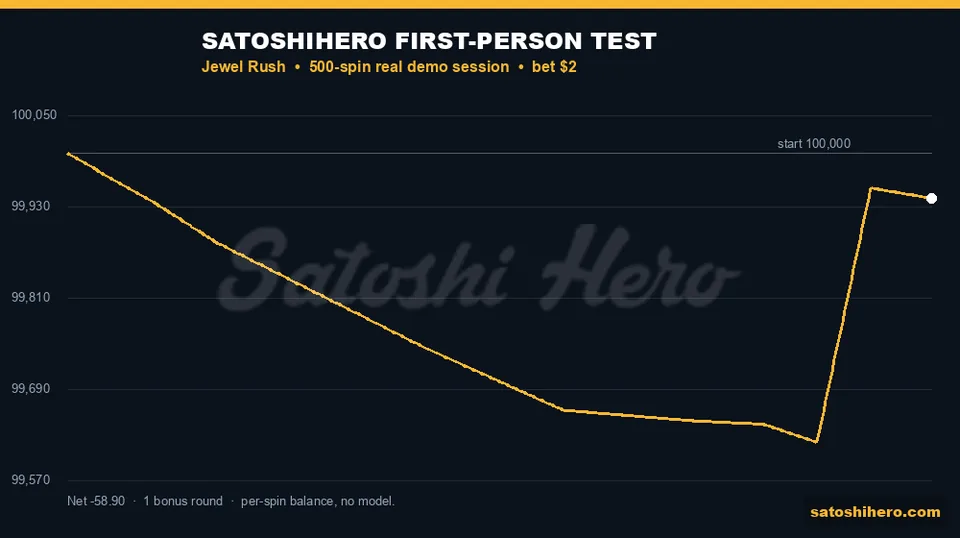
The figures are tracked against the live game data. The 96.47% RTP is the theoretical return figure used for the game. One live 500-spin session doesn’t prove or change that return, and bonus-buy returns can differ slightly from base-game returns by design.
Size your stakes for cold runs, not for the strongest feature outcome. You’ll enjoy the slot more if one missed bonus doesn’t force a reset. That’s the practical lesson from both the model and my live test.
Frequently Asked Questions About Jewel Rush
How do the free spins work in Jewel Rush?
Three or more Scatters award 10 free spins in Jewel Rush. During the round, every jewel in a winning block can carry a 2x or 4x random multiplier, and the multiplier chance rises above the base game. Landing 3 or more Scatters again can retrigger the round with 10 to 14 more spins.
What is the multiplier feature in Jewel Rush?
Any jewel in a winning block can carry a random multiplier. Base-game multipliers are 2x, while free spins use 2x and 4x multipliers. The block win gets multiplied by the product of all multipliers in that block, up to 256x.
Can you buy the bonus in Jewel Rush, and what did it pay?
Yes, free spins cost 100x the bet in Jewel Rush. At my $2.00 stake, the buy cost $200.00 and paid $24.40. That was about 12x my stake and well below the cost, which shows how much the buy relies on a strong multiplier chain.
How did the 500-spin session go?
I played 500 spins at $2.00 and finished $58.90 down. The base game stayed cold for a long stretch, but a Free Spins round paid $317.00. The strongest single spin paid $245.00 from a x32 multiplier.
What are the RTP, volatility and max win of Jewel Rush?
Jewel Rush has 96.47% RTP, high volatility and a maximum win of 5,000x the bet. It is a cluster-pay multiplier slot where cold spells can break when a strong tumble chain catches stacked multipliers.
Final Thoughts
Jewel Rush stands out because its simple 7×7 grid makes multiplier chains easy to follow. The main drawback is the sharp risk, especially when a bonus buy lands flat. You get a clean slot, but you don’t get a gentle one.

My Verdict
Patient high-volatility hunters can enjoy this game, especially if they like seeing one multiplier chain reshape a session. Expect long dry patches, quick tumbles and feature rounds that can either rescue or disappoint you. I’d play it with a clear stop point.
I like the way the x32 spin turned a modest cluster into $245.00 during my test. I don’t like how cold the $200.00 buy felt when it returned only $24.40. That contrast tells you almost everything about the game’s appeal and danger.
Jewel Rush is checked regularly on SatoshiHero, where the demo and real play sit in the same game library. Keep the stake modest if you’re testing it, because the best moments need time and bankroll room.

Pros:
 Clear grid: The 7×7 layout makes clusters easy to follow during fast tumbles.
- Strong multipliers: Stacked boosts can turn modest blocks into memorable hits.
- Fair headline RTP: The 96.47% figure gives the math a solid base.
- Simple bonus rules: Free spins improve the main mechanic without adding clutter.

Cons:
 Cold base game: Weak tumbles can drain balance before the feature arrives.
- Risky buy: The 100x cost can punish one flat bonus round.
- Limited theme depth: The gem setup looks clean but doesn’t offer much story.

Best For: High-volatility grid fans, cluster-pay regulars and bonus-buy users get the clearest value here. You’ll need patience, because the game can feel quiet until multipliers combine inside a decent block. If you prefer frequent small returns, this slot may feel too swingy.






























































Bets
All Bets
Game
Player
Date
Wager
Mult.Multiplier
Prize
 Fu Yin Yang: Hold 'n' Link
 bjgrandy149
- 21:42:40
- 0×
- Fu Yin Yang: Hold 'n' Link
- bjgrandy149
- 21:42:38
- 0×
- Wild Buffalo Megaways: Hold N Link
 nina87
- 21:42:37
- 0.09×
- Big Banker Bonanza
 mdp0fxo
- 21:42:35
- 0×
- Fu Yin Yang: Hold 'n' Link
- bjgrandy149
- 21:42:35
- 0×
- Elephant's Gold: Bonus Combo
- Hidden
- 21:42:34
- 0×
- Royal Fruits 9: Hold 'n' Link
- Hidden
- 21:42:34
- 0×
- Fu Yin Yang: Hold 'n' Link
- bjgrandy149
- 21:42:33
- 0×
- Elephant's Gold: Bonus Combo
- josh1998
- 21:42:33
- 0×
- Galaxy Glitter
- mike_721
- 21:42:31
- 0×