

Slotcade
By pressing play, you agree that you are above legal age in your jurisdiction and that your jurisdiction allows online gambling.


Five Lines of Pixel Fruit and No Detours
Spin Slotcade’s five fixed paylines and you get a classic fruit machine rebuilt with chunky arcade pixels.
Slotcade is a medium volatility slot from Platipus with 95% RTP and 1,200x max win potential. Its 5×3 grid, fixed lines, and stacked-fruit jackpots favor you when you prefer direct base-game results over layered bonus rounds. There are no wilds, free spins, or bonus-buy options.
Key takeaways
- Best play: Every wager uses the five-line base game because there’s no bonus buy or alternate mode.
- RTP / volatility: The theoretical RTP is 95%, paired with medium volatility.
- Max win: The overall cap is 1,200x, while the Grand Jackpot pays 1,000x.
- Risk note: My 100-spin test lost $25, and its biggest award reached only 12x.
- Bankroll note: The $1 minimum makes 100 spins cost $100 before returns. Set your limit first, because you can’t control results.

Table of Contents
- How Slotcade Works
- Reading the lines
- Bet conversion
- Pixel-Art Fruit Machine Theme
- Visual direction
- Symbol Values and Paytable Priorities
- Highest line pays
- Fruits and Scatter
- RTP, Volatility and Our Test
- Simulator projection
- Our 100-spin session
- How It Played Across 100 Spins
- Session rhythm
- Bankroll lesson
- Three-Tier Jackpot Feature
- Trigger pattern
- Award levels
- Playing Slotcade Free on SatoshiHero
- What to check
- Demo limits
- Frequently Asked Questions About Slotcade
- Bottom Line
How Slotcade Works
Slotcade runs on a 5×3 grid with five permanently active paylines. You can’t reduce that line count, so every selected stake covers all five patterns. A regular win must start on reel 1 and continue across adjacent reels from left to right. Only the highest result on each line pays, while awards from different lines add together.
The star Scatter ignores those line rules and pays anywhere. Three, four, or five stars create an award without beginning on reel 1. No wild can replace a missing symbol, so later-reel matches alone don’t form a standard win. Plain and simple, you need to read line symbols and Scatters as separate systems.
Reading the lines
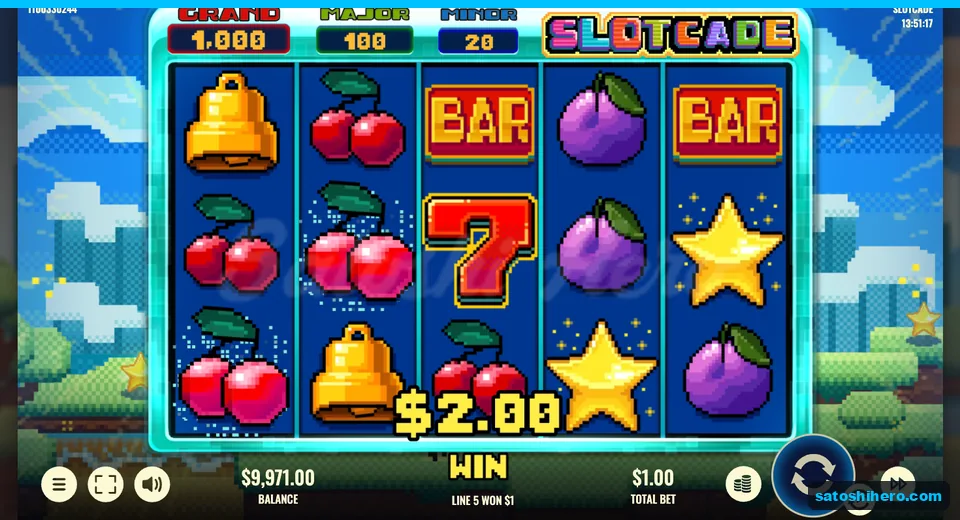
Picture cherries landing on reels 1 and 2 along line 5. That pattern qualifies because it starts at the left edge and follows one active line. Two cherries sitting only on reels 3 and 4 pay nothing as a regular match. The star works differently because its position across the grid doesn’t matter.
My verified cherry result made the distinction clear. Two cherries on line 5 paid $1 at a $1 total stake. A later illustrative spin showed a $2 settled total, highlighted cherries, and the message “Line 5 won $1.” Its visible balance came from outside the counted test, so I didn’t include it in my session figures.
Bet conversion
The stake selector shows your total wager across five lines, not the amount on one line. At a $1 total bet, divide by five to get a $0.20 line bet. The paytable lists five line bets for two cherries, producing $1 in that example. This conversion is simple, but the display makes it easy to overstate multipliers.

Data Point: All five paylines stay active, so a $1 total stake equals $0.20 per line.
Available total stakes are $1.00, $2.50, $5.00, $10.00, $25.00, $50.00 and $100.00. Those amounts create line bets from $0.20 through $20.00. Raising your wager changes cash awards, not the underlying rules or mathematical profile. The browser controls handle spin, stake, paytable, and autoplay without forcing you through extra menus.
Autoplay offers 25, 50, 75, 500, or 1,000 spins. You can also set single-win and loss limits with sliders before starting a sequence. I like those clear boundaries, although they don’t affect random outcomes. Understanding total bet versus line bet prevents the paytable’s most likely reading error.
Pixel-Art Fruit Machine Theme
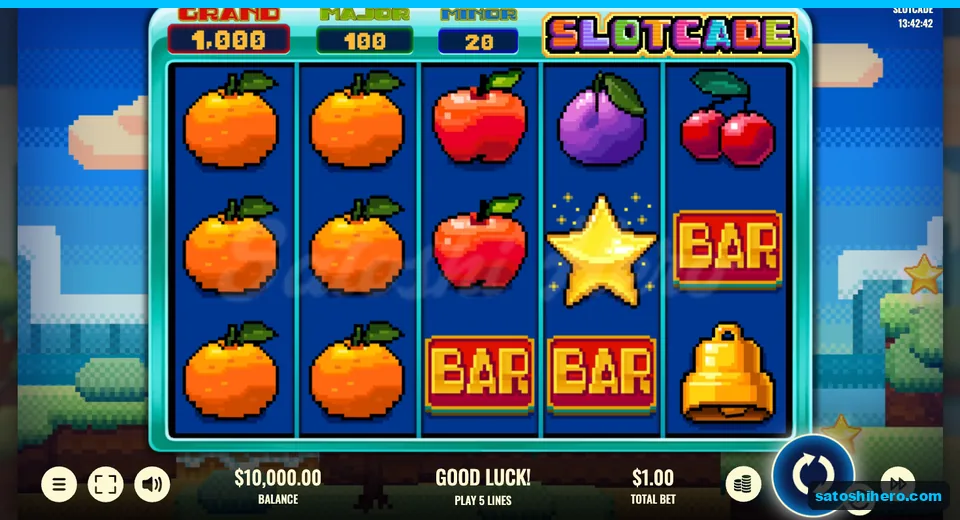
The design turns a traditional fruit machine into a bright retro arcade screen. Chunky symbols sit inside a teal frame, with pixel clouds, hills, and trees behind the reels. Above them, Grand, Major, and Minor signs keep the only named feature in constant view. You’ll notice those tier signs before any small background detail.
The resting screen shows the 5×3 grid, fruit, BAR, golden bell, red seven, and Scatter star clearly. My test setup also displayed a $10,000 balance and $1 total bet, which made the session orientation easy to follow. You can scan this small symbol set quickly because every shape has a strong outline. That clarity matters more than decorative depth here.
Visual direction
The landscape borrows the broad forms and bright colors associated with side-scrolling arcade scenes. Cabinet-style framing keeps the reels separate from the hills behind them. Meanwhile, the suspended jackpot signs create the main visual target and scale with your selected wager. I find that focus useful because the game has little mechanical clutter.

Fun Fact: The pixel landscape echoes early side-scrolling arcade art while retaining familiar fruit-machine symbols.
No sugarcoating, the fruit concept won’t win originality awards. Consistent pixel treatment still gives it more character than a plain mechanical cabinet. You might appreciate the clean presentation if visual noise bothers you, but theme-first players could find it thin. The art supports quick, simple play even though the subject remains conventional.
Symbol Values and Paytable Priorities
The red seven leads the regular symbols, while the star Scatter pays anywhere. There are eight symbols and no wild. I converted every listed line-bet value into total-bet multiples, then checked that method against the two-cherry win. You should focus first on the seven, BAR, and Scatter because they define the paytable’s largest gaps.
Highest line pays
| Symbol | Three | Four | Five |
|---|---|---|---|
| Red seven | 20x | 200x | 1,000x |
| BAR | 10x | 80x | 200x |
| Golden bell | 1x | 4x | 20x |
Five red sevens produce the standout regular-line award at 1,000x the total bet. Four fall sharply to 200x, and three return 20x. BAR ranks second among standard line symbols, while the bell sits much lower. The jump to five sevens looks dramatic, but it doesn’t raise the overall game cap.
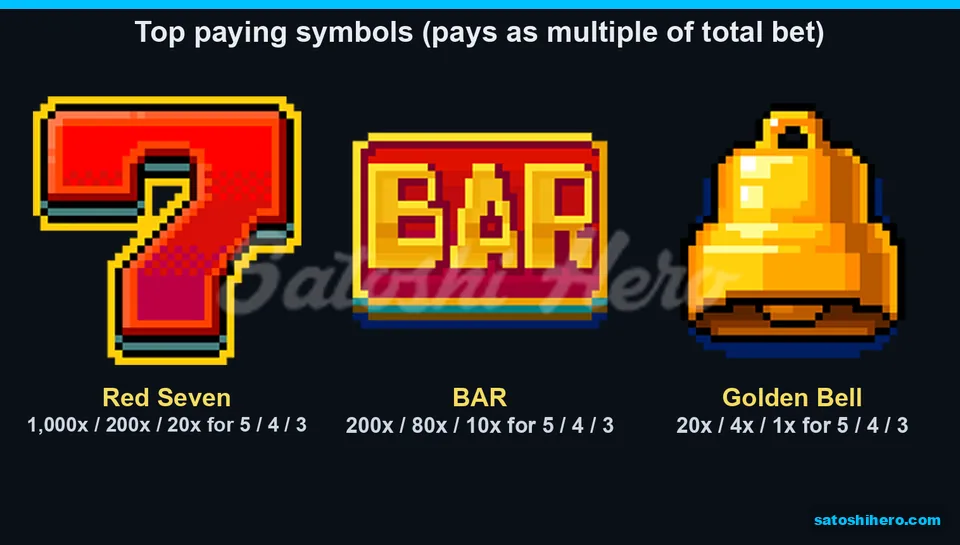
At a $1 total stake, five red sevens pay $1,000, four pay $200, and three pay $20. Those figures already account for the five-line conversion. You shouldn’t multiply them by five again. In my view, the huge distance between the top line and everyday bell results makes careful paytable reading essential.
Fruits and Scatter
| Symbol group | Three | Four | Five |
|---|---|---|---|
| Plum, apple, orange | 4x | 10x | 40x |
| Cherry | 4x | 10x | 40x |
| Scatter star | 2x | 10x | 50x |
Plum, apple, orange, and cherry share the same awards for three through five matching symbols. Cherry adds the lone two-symbol exception, paying 1x when two start a valid line. That’s why my two-cherry result returned the full $1 stake. Most fruit combinations sit far below the headline seven award.
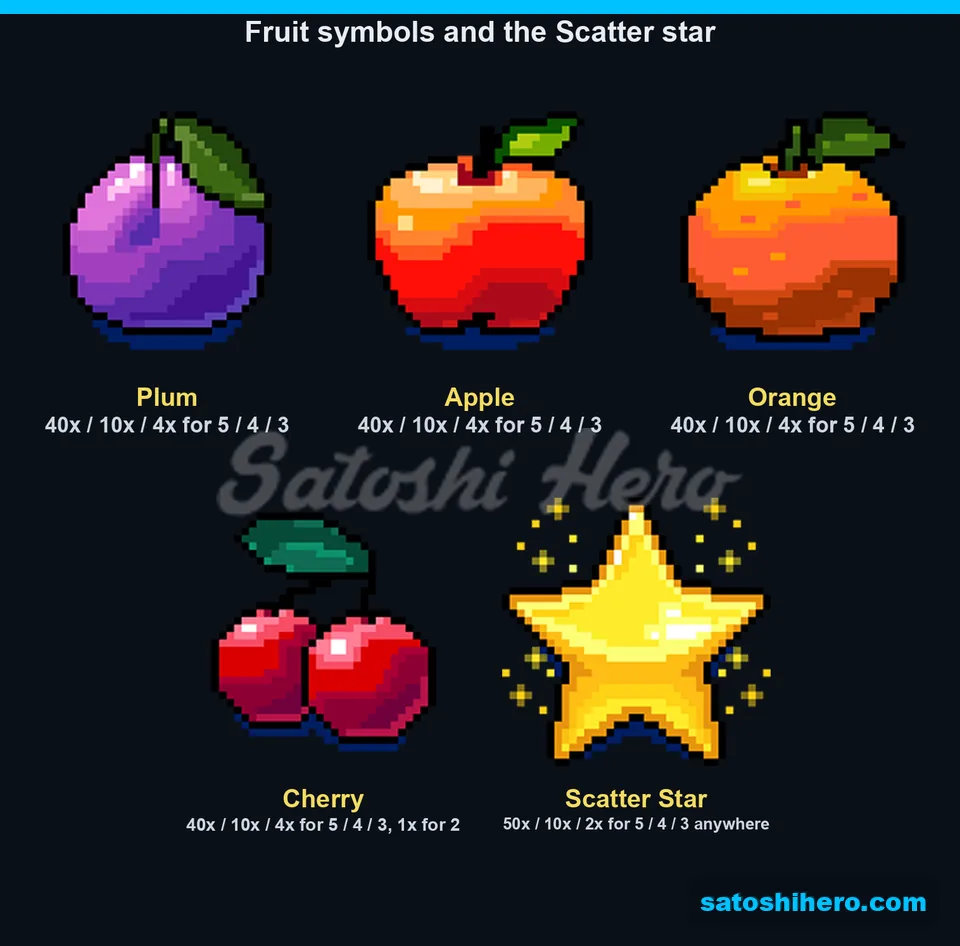
The Scatter star pays 2x for three, 10x for four, and 50x for five anywhere. It doesn’t open a second round or act as a bonus trigger. Scatter awards add to qualifying line wins from the same spin. You get a very readable hierarchy, but the lack of substitution keeps near-misses unforgiving.
RTP, Volatility and Our Test
The theoretical return is 95%, volatility is medium, and the top possible award is 1,200x the total bet. That profile doesn’t keep a short session near its starting point. You can still see a steady decline without any dramatic feature purchase. I’d treat the maximum as a rules limit, never a session target.
Modeled outcomes and my demo record answer different questions. The simulator maps a possible spread using mathematical inputs, while my 100 spins document one actual short run. Neither dataset predicts your next result. The medium rating still allowed meaningful movement over a relatively small sample.
Simulator projection
The SatoshiHero Slot Simulator modeled 1,000 spins at a $1 stake. Its median session ended $60.30 down, while the 5th percentile finished $216.60 down. The 95th percentile ended $148.50 up. These projected paths show a wide band rather than one likely personal result.
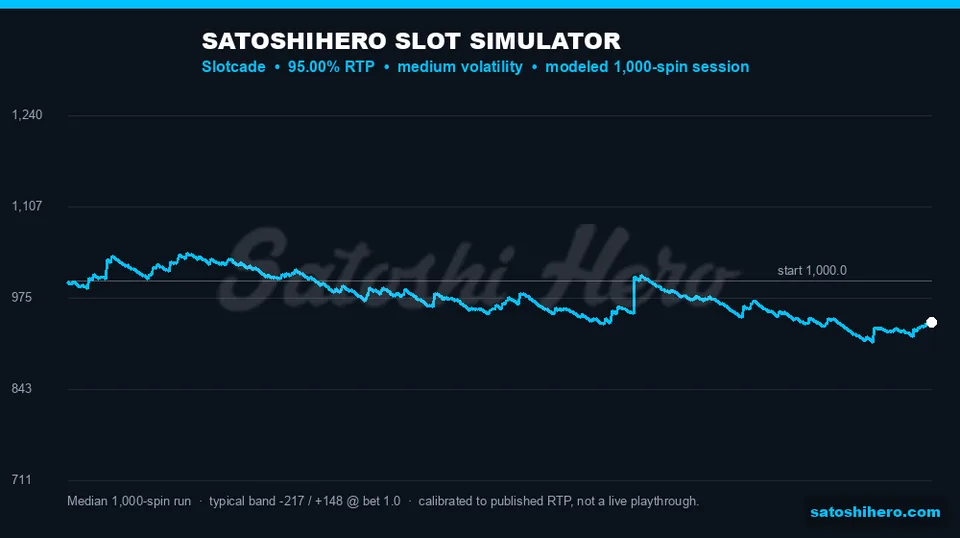
About 25% of modeled spins returned something. A result worth 10x or more appeared roughly once per 51 modeled spins, while a 100x-plus outcome appeared around once per 12,987 spins. Those frequencies aren’t countdowns. You shouldn’t expect a large result because a certain number of spins have passed.
The model used the stated return, risk level, and prize ceiling as inputs. It can’t reproduce the live random number generator or tell you what happens next. I find the percentile spread useful because it exposes downside and upside paths. Even then, it remains a projection rather than played evidence.
Our 100-spin session
I started with $10,000 in demo funds at a $1 stake and finished with $9,975, losing $25. My balance peaked at $10,008 after spin 7, then reached $9,966 on spin 77. Late awards improved the finish without erasing the loss. That arc felt gradual rather than explosive.
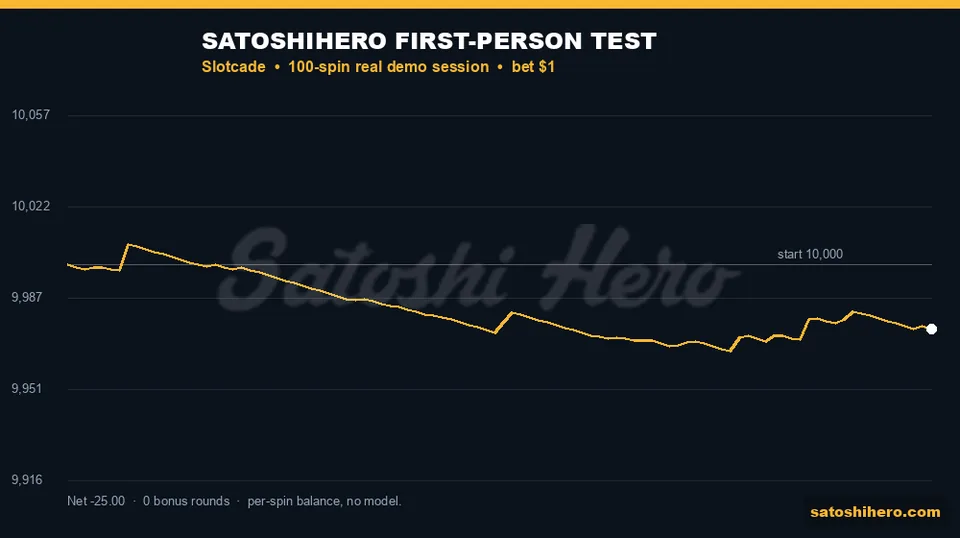
Across 100 spins, 22 paid and 78 returned nothing. My largest award was $12, or 12x, on spin 7. I also recorded $10 on spins 51 and 86, plus $8 on spin 78. Most other returns ranged from $1 to $4, and no jackpot appeared.

Watch Out: A 95% theoretical return doesn’t mean you receive $95 from each $100 session. My test lost $25, while another short run could finish very differently.
Every award came from standard lines or the Scatter because there’s no secondary round. I don’t treat the observed 22% paying-spin share as an official hit rate. You shouldn’t either, since one run can’t establish how often future spins pay. The result shows short-session variation, not a fixed pattern.
Platipus publishes the theoretical return used here, and one live or demo session doesn’t change that figure. The simulator models possible variation rather than recreating live results. There are no separate bonus-mode returns because no buy or alternate mode exists. Key details receive periodic verification.
How It Played Across 100 Spins
One early 12x award created the session’s only meaningful rise above its starting balance. After that peak, most returns landed between 1x and 4x. Small wins often refunded one $1 stake or recovered only part of earlier losses. You could see the balance grind down through short steps rather than feature-driven swings.
Session rhythm
The run began with enough movement to push the balance $8 above its starting point. That high arrived on spin 7 and didn’t return. From there, frequent small awards interrupted the decline without changing its direction. I found the pattern easy to follow, though not especially exciting.
The $10 hits on spins 51 and 86 provided the strongest later relief. An $8 return on spin 78 also pulled the balance away from its spin-77 low. None created a lasting recovery. You might like this uninterrupted flow when direct reel outcomes matter more than feature anticipation.
A bonus-focused player could find the same rhythm sparse. There’s no free-spin build-up, expanding mechanic, or selectable mode to break the sequence. The simplicity feels coherent, but I found it repetitive across 100 spins. This format made more sense as a short session than a long feature hunt.
Bankroll lesson
The $1 minimum gives you a clear planning base. One hundred spins create $100 in turnover before returns, so choose a spin count and acceptable loss first. Never build that limit around expecting a jackpot. Random outcomes don’t respond to stake changes, timing, or previous misses.

Suggestion: Decide how many spins you can afford at the $1 minimum before starting. Autoplay’s loss limit can help you hold that boundary.
Autoplay can run 25 through 1,000 spins, but the larger presets can create substantial turnover. Its loss-limit slider helps stop a sequence at your chosen boundary. You should still watch the total stake because every spin covers all five lines. No betting pattern creates a winning system or influences the random result.
My strongest lesson came from the late partial recovery. A few larger base-game hits improved the ending, yet they didn’t reverse the overall loss. Chasing that recovery would have changed a controlled test into an open-ended session. The observed pace favors short, simple play over long feature seeking.
Three-Tier Jackpot Feature
Matching fruit stacks across consecutive full reels award the Minor, Major, or Grand jackpot. This is the only named feature. Eligible symbols are plum, apple, orange, and cherry, and each qualifying reel must show one fruit in all three positions. You need complete stacks from reel 1, not scattered fruit or partial columns.
Trigger pattern
A valid Minor pattern fills reels 1 through 3 with the same fruit. Extending that exact arrangement through reel 4 reaches Major, while all five full reels reach Grand. Ordinary fruit matches elsewhere don’t activate a tier. I like the visual rule because you can understand it without studying a complex feature screen.
The target remains unmistakable during play. Three isolated apples can form a line award, but they don’t count as full-reel stacks. You can’t buy, select, or improve the trigger. My 100-spin run produced none of the three jackpots.
Award levels
| Tier | Required full reels | Total-bet multiple | At a $1 stake |
|---|---|---|---|
| Minor | Reels 1 to 3 | 20x | $20 |
| Major | Reels 1 to 4 | 100x | $100 |
| Grand | Reels 1 to 5 | 1,000x | $1,000 |
A qualifying jackpot adds to ordinary paytable awards from that spin instead of replacing them. The signs above the grid show $20, $100, and $1,000 at the $1 total stake, then scale with your wager. This additive rule explains how the 1,000x Grand remains separate from the higher overall ceiling.
The feature is easy to understand, but I wouldn’t treat it as a practical session goal. My test never came close to a full five-reel fruit screen. You should regard the signs as potential outcomes, not progress meters. That distinction keeps a simple mechanic from encouraging false expectations.
Playing Slotcade Free on SatoshiHero
You can try Slotcade free in demo mode on SatoshiHero before moving to real play. Both modes sit on this site, so you can learn the same five-line structure without searching elsewhere. Demo play helps you inspect controls and rules. It doesn’t forecast what a funded balance does.
What to check
Start by following each line from reel 1 across adjacent reels. Then confirm that a $1 total stake becomes $0.20 per line and that two cherries return $1 on a valid pattern. Watch how the Scatter ignores lines. You should also change the stake and note how the three jackpot signs scale.
Open the paytable and compare its line-bet entries with total-bet examples. This step prevents fivefold errors when reading the red seven or fruit values. Next, test the autoplay presets and set both single-win and loss limits. I consider these checks more useful than spinning aimlessly in demo mode.
Demo limits
My recorded run used a fresh $10,000 demo balance and a $1 total stake. It ended $25 down after 100 spins. That result teaches you about one session’s pace, not what another balance should do. Demo outcomes also don’t make a modeled frequency more likely on later spins.
A free test can still reveal whether the stripped-back format holds your attention. If you need bonus choices or changing reel mechanics, you’ll notice their absence quickly. If clear lines and immediate settlements matter more, the interface makes that preference easy to test. Demo play is most useful for learning stake conversion, fixed lines, and jackpot structure.
For different Platipus formats, compare Xmas Avalanche and WondeReels, then check Wizard of the Wild and Wild Spin Deluxe for feature sets beyond this stripped-back fruit machine.
Frequently Asked Questions About Slotcade
How many paylines does Slotcade have?
Slotcade has five fixed paylines on a 5×3 grid, and every line remains active. Standard wins start on reel 1 and continue left to right across adjacent reels. Your displayed stake covers all five lines, so a $1 total bet places $0.20 on each.
Does Slotcade have a wild, free spins, or a bonus buy?
No, there’s no wild symbol, free spins, or bonus buy. The stacked-fruit jackpots and anywhere-paying Scatter are the only extras. You remain in the base game on every wager.
How do the Slotcade jackpots work?
Minor pays 20x, Major pays 100x, and Grand pays 1,000x the total bet. They require the same fruit to fill reels 1 through 3, 1 through 4, or all five reels. A jackpot can combine with ordinary wins from that spin.
What are Slotcade’s RTP, volatility, and maximum win?
The game has 95% theoretical RTP, medium volatility, and a 1,200x maximum win. The maximum uses the total bet as its base. These figures don’t promise a particular short-session result.
What does the red seven pay in Slotcade?
At a $1 total stake, five red sevens pay $1,000, four pay $200, and three pay $20. These amounts convert the paytable’s line-bet entries into total-bet terms. Don’t multiply them by five again.
What did the 1,000-spin simulation show?
The projected median finished $60.30 down at a $1 stake. Its 5th percentile ended $216.60 down, while the 95th percentile ended $148.50 up. About 25% of modeled spins returned something, and a 100x-plus result appeared roughly once per 12,987 simulated spins. This model isn’t a live result or prediction.
What happened in my 100-spin Slotcade test?
My $1 demo session moved from $10,000 to $9,975, producing a $25 loss. Twenty-two spins paid, the largest result was $12 or 12x, and no jackpot appeared. You should read that as one short first-person record, not an expected outcome.
Bottom Line
Slotcade stands out through clear fixed lines, readable pixel art, and a jackpot rule anyone can grasp quickly. Its main drawback is equally clear: no secondary round breaks the base-game repetition. You get an honest, narrow experience rather than a feature stack.

My Verdict
Choose it when five-line play and immediate settlements matter more than bonus spectacle. Expect many modest base-game results, with no wilds or free spins to change the rhythm. Skip it if you need layered modes to stay engaged.
I like how the $1 cherry result verified the paytable conversion without guesswork. I don’t like how repetitive the 100-spin run felt after the early 12x peak. The late $10 and $8 returns improved the finish, but they never created a real comeback.
Slotcade delivers coherent simplicity, though its limited variety and modest ceiling narrow the audience. You can trust that the key mechanics and playable version are checked regularly.

Pros:
 Clear paylines: Five fixed patterns make every regular result easy to trace.
- Verified conversion: The cherry win confirmed how line-bet values become total-bet awards.
- Readable design: Strong pixel shapes keep fruits, sevens, and Scatters distinct.
- Simple jackpots: Full matching reels define every tier without extra menus.

Cons:
 No bonus round: Every spin stays in the same base-game loop.
- Limited variety: Missing wilds and selectable modes make longer sessions repetitive.
- Modest ceiling: The top award trails many feature-heavy alternatives.

Best For: Fixed-line traditionalists who value clean paytables and quick settlements should feel comfortable here. Medium-risk play keeps the profile approachable, but you still need a firm loss limit. Bonus hunters and feature buyers should choose something with more moving parts.


































































Bets
All Bets
Game
Player
Date
Wager
Mult.Multiplier
Prize
 Luck of Panda: Bonus Combo
 mdp0fxo
- 16:21:18
- 0×
- Reel Rider: Rapid Link
 Hidden
- 16:21:17
- 0.75×
- Fu Yin Yang: Hold 'n' Link
- bjgrandy149
- 16:21:17
- 0.4×
- Luck of Panda: Bonus Combo
- mdp0fxo
- 16:21:15
- 0×
- Fu Yin Yang: Hold 'n' Link
- bjgrandy149
- 16:21:14
- 0×
- Reel Rider: Rapid Link
- Hidden
- 16:21:14
- 0×
- Area 69
- jdelfino102
- 16:21:13
- 0×
- Luck of Panda: Bonus Combo
- Hidden
- 16:21:12
- 0×
- Luck of Panda: Bonus Combo
- mdp0fxo
- 16:21:12
- 0×
- Area 69
- jdelfino102
- 16:21:11
- 0×