

Richy Witchy
By pressing play, you agree that you are above legal age in your jurisdiction and that your jurisdiction allows online gambling.

Richy Witchy
RTP94%
VolatilityHigh
Max winx850
Lines40
ThemeFantasy
Live game stats
Real RTP66.25%
Spins382
Players3
Biggest win$76.38

Brewing Trouble Across Forty Lines
A red-haired witch stirs a bubbling cauldron while stacked symbols tumble across Richy Witchy’s 5×4 grid.
According to Platipus, Richy Witchy is a high volatility slot with 94% RTP, 40 fixed paylines, and 850x max win potential. Three cauldron Scatters unlock seven Free Spins and a random Extra Wild, but that cap feels restrained beside the risk. Built for patient line-slot fans, this SatoshiHero guide separates documented rules, projections, and my test across free demo and real play.
Key takeaways
- Best bonus: You can reach Free Spins only through normal spins because there’s no bonus buy.
- RTP / volatility: Richy Witchy combines 94% RTP with high volatility, creating sharp balance swings.
- Max win: The 850x cap feels modest when you consider the game’s risk profile.
- Risk note: My 100-spin test lost $38.50 at $0.80 without triggering the feature.
- Bankroll note: You need a budget that can absorb dry spells, not faith in modeled averages.

Table of Contents
- How Richy Witchy Works
- Theme and First Impressions
- Symbol Values at the Tested Stake
- Free Spins
- Extra Wild
- Wild and Scatter Rules
- RTP, Volatility and Our Test
- Simulator Projection Results
- Our 100-Spin Session
- What the Short Session Felt Like
- Richy Witchy FAQ
- Bottom Line
How Richy Witchy Works
Richy Witchy uses a 5×4 grid with 40 fixed paylines. This is a traditional line-paying slot, not a cluster, pay-anywhere, or ways-to-win game. Wins run left to right across adjacent reels, and only the highest award on each active line pays. You should read each highlighted route as a separate line result.
Ordinary combinations use the line bet rather than your total bet. A $0.02 line bet across all 40 lines creates the $0.80 total stake I tested. Three 10 symbols pay 5x that $0.02 line bet, producing a $0.10 win. That simple calculation tells you far more than the large multipliers alone.
The witch-and-Wild result shown during play awarded $0.80 because one fixed line formed a valid combination. It wasn’t a ways win across every matching position. Stacked symbols can fill large parts of the grid and make a screen look loaded. Plain and simple, those stacks don’t alter the line rules or multiply the number of paylines.
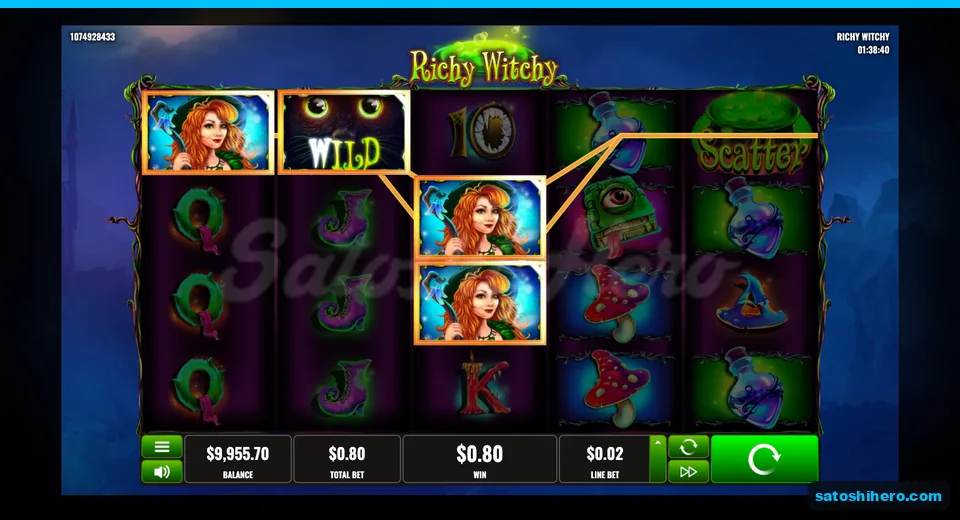
The line bet ranges from $0.02 to $2.00, giving a total bet range of $0.80 to $80.00. You can speed ordinary spins with Turbo, while autoplay includes loss and single-win limits. There’s no ante bet or feature buy.
The controls and grid remain readable on mobile and desktop, though smaller screens compress the payline highlights. When you inspect a win, follow the marked line and multiply its award by your selected line stake. The clearest approach is to treat every base result as line math first.

Data Point: A $0.80 total stake places $0.02 on each of the 40 fixed paylines.
Theme and First Impressions
The purple-and-blue forest gives the game a clear witchcraft setting from the first spin. Vines frame the reels, and a bright cauldron sits among expressive stacked symbols. You get a coherent board rather than a cluttered effects show. I think that restraint helps you read combinations quickly.
Five illustrated symbols carry most of the visual character: a red-haired witch, a green spell book, a potion, a spotted mushroom, and a wizard hat. The book sticks out because it has an eye and a tongue. Lower symbols keep the same theme through a candle-shaped K, thorny green Q, witch’s boot J, and fanged 10. You can identify each value tier without studying tiny labels.
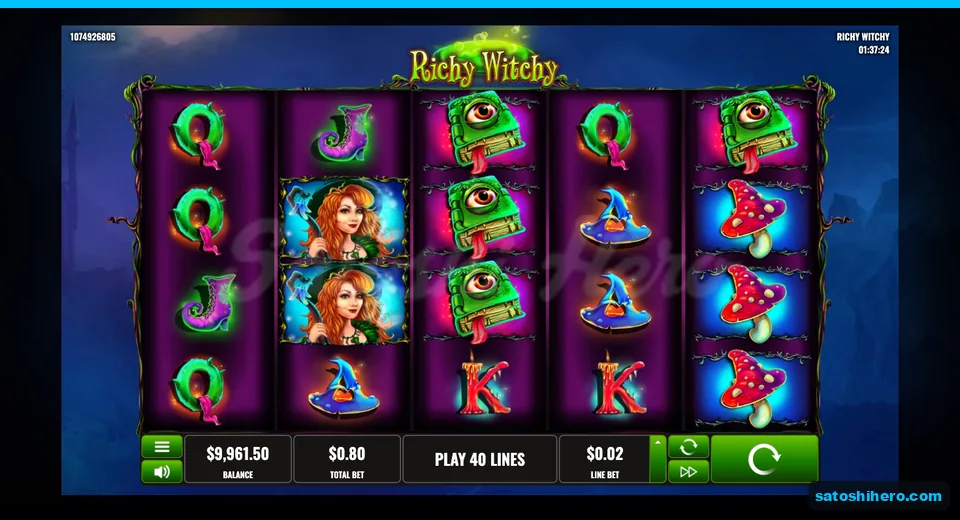
A black cat with green eyes serves as the Wild, while the bubbling cauldron acts as the Scatter. Their silhouettes differ enough that you won’t confuse them during Turbo play. The stacked artwork often creates suspense because several matching faces can cover a reel. In my session, those crowded screens looked more promising than their final awards.
The witch theme won’t win originality awards, but the artwork commits to one visual language. Wizard of the Wild offers another magic-heavy setting if you prefer a broader wizard focus. Xmas Avalanche and WondeReels provide two more Platipus comparisons, though their presentations differ from this witch theme. Here, the red-haired lead and mischievous book give the board a lighter personality. You should expect clear character art, saturated colors, and familiar fantasy props during ordinary spins.
The visual and rules details are checked regularly so you can compare the screen with the mechanics described here. I’d choose this presentation over a busier fantasy slot because the symbols remain distinct at speed. The familiar theme lands best when you value readable character art more than novelty.
Symbol Values at the Tested Stake
Ordinary symbol multipliers use the line bet, not your total stake. That distinction changes every cash conversion in the paytable. At my $0.02 line stake, you multiply the listed figure by $0.02. Don’t treat a four-digit symbol value as a four-digit multiple of the full spin cost.
The five-, four-, and three-symbol awards are:
- Witch: 1,000x, 400x, and 50x the line bet.
- Spell Book: 300x, 200x, and 40x the line bet.
- Potion: 200x, 100x, and 20x the line bet.
- Mushroom: 200x, 100x, and 20x the line bet.
- Wizard Hat: 150x, 40x, and 5x the line bet.
- K: 150x, 40x, and 5x the line bet.
- Q, J, and 10: 100x, 25x, and 5x the line bet.
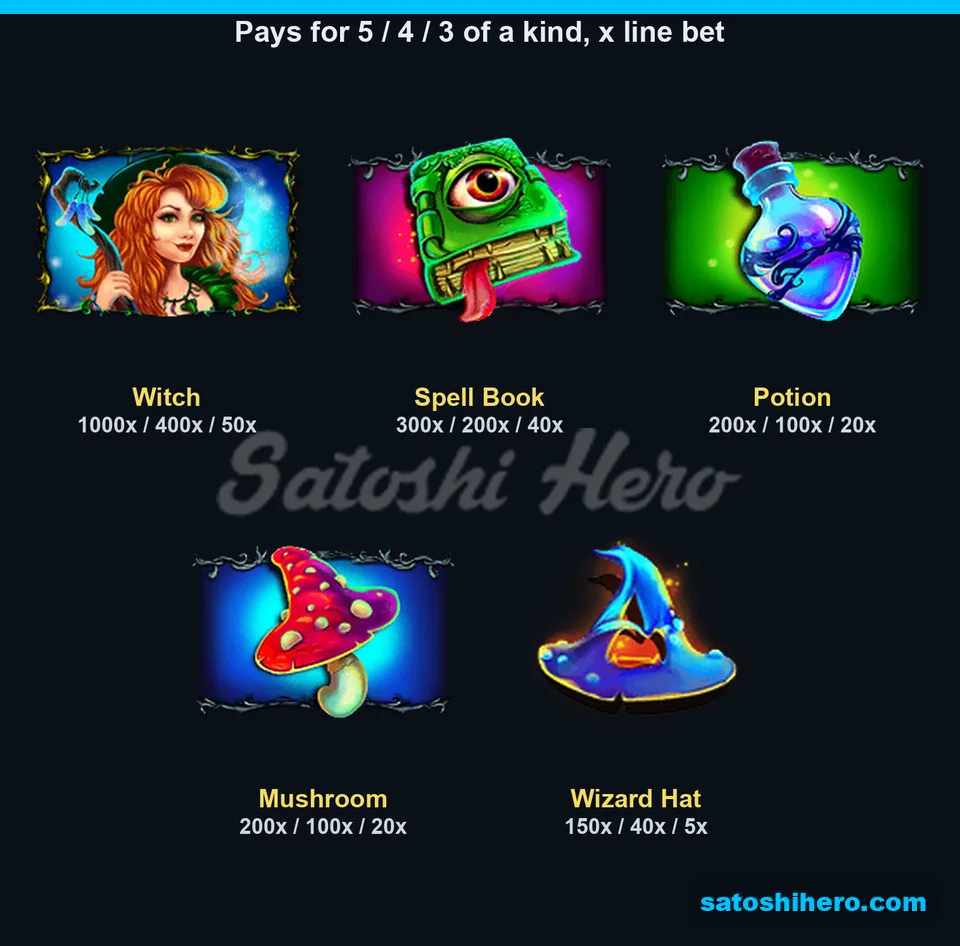
The Witch provides the clearest cash example at my tested stake. Five Witches convert to $20, four convert to $8, and three convert to $1. Those amounts come from multiplying 1,000x, 400x, or 50x by $0.02. You can apply that same method to every regular symbol listed above.
I checked the unit against an observed three-10 result. The paytable assigns 5x the line bet, so 5x multiplied by $0.02 produced the displayed $0.10 award. This tiny hit confirmed that the game wasn’t multiplying the symbol value by my $0.80 total bet. In my view, the paytable should make this distinction more prominent.

Suggestion: Check whether a paytable uses the line bet or total bet before converting any multiplier. Ordinary symbol awards here use the line bet.
A screen of five Witches can look like a 1,000x total-bet hit, but it isn’t. The listed multiplier only becomes useful after you apply your selected line stake. Keep that unit in view before judging any highlighted award.
Free Spins
Three or more cauldron Scatters anywhere on the grid award seven Free Spins. The triggering Scatter also pays alongside any valid line combinations from that spin. Three Scatters pay 2x the total bet, four pay 20x, and five pay 200x. You should separate those total-bet awards from ordinary line-bet prizes.
At the tested $0.80 stake, three Scatters produce $1.60, four produce $16, and five produce $160. The feature keeps the triggering stake and the same 40 fixed paylines. Landing at least three Scatters during the round adds seven more spins. The rules set no retrigger limit, though that doesn’t make another trigger predictable.
Normal play provides the only route into Free Spins because there’s no feature buy or ante bet. You can’t pay extra to shorten the wait or improve the trigger chance. That restriction keeps the game simple, but it also makes quiet base-game stretches more noticeable. I prefer having the choice, so the missing buy limits flexibility.
My 100 counted spins never produced three cauldrons. I didn’t enter Free Spins, and I won’t pretend that I observed how the round paid. The documented trigger and retrigger rules still explain what you should watch for. Seven starting spins make the Extra Wild selection especially important because the initial sample is short.
A retrigger can extend the round, but you must land the required Scatters naturally. In a brief session, access can feel slow even when stacked symbols keep teasing fuller screens. Budget for the base game rather than assuming the feature must arrive.
Extra Wild
Before Free Spins begin, the game randomly selects one eligible paytable symbol as an Extra Wild. The cauldron Scatter can’t receive that role. Your selected symbol then substitutes for everything except the Scatter throughout the feature. It also receives the black cat Wild’s payout value in winning combinations.
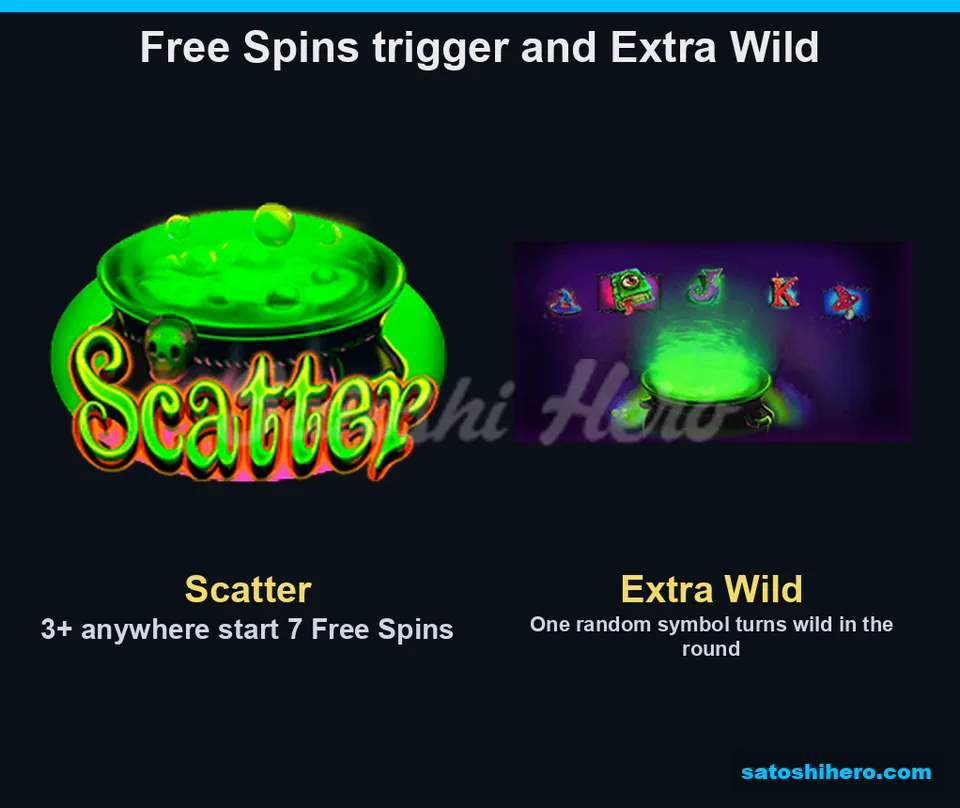
That payout treatment matters because the selection can land on a premium Witch or a low-paying 10. Either choice changes the symbol mix across the following seven spins. You can’t choose, reroll, or influence the result. No selection guarantees a better round because the reels still need to form valid fixed-line combinations.
The feature didn’t trigger in my test, so I never saw the selection screen or Extra Wild substitutions in action. I can confirm only the documented behavior, not an observed feature return. When your round starts, check which image gains the Wild role before the first free spin. That tells you which ordinary symbol now carries substitute power and the Wild’s value.

Fun Fact: The selected Extra Wild receives the black cat Wild’s payout value instead of retaining its ordinary symbol value.
I like the concept because a single random pick changes the round’s setup without adding a complicated meter. Yet its value remains tied to where the chosen image lands across fixed paylines. You should treat the pick as a setup change, never a promise of a strong feature.
Wild and Scatter Rules
The black cat Wild supports fixed-line wins, while the cauldron Scatter triggers Free Spins and pays against the total bet. Keeping those jobs separate prevents most payout confusion. You should identify the symbol type before converting any displayed multiplier. I find the split logical once the paytable units are clear.
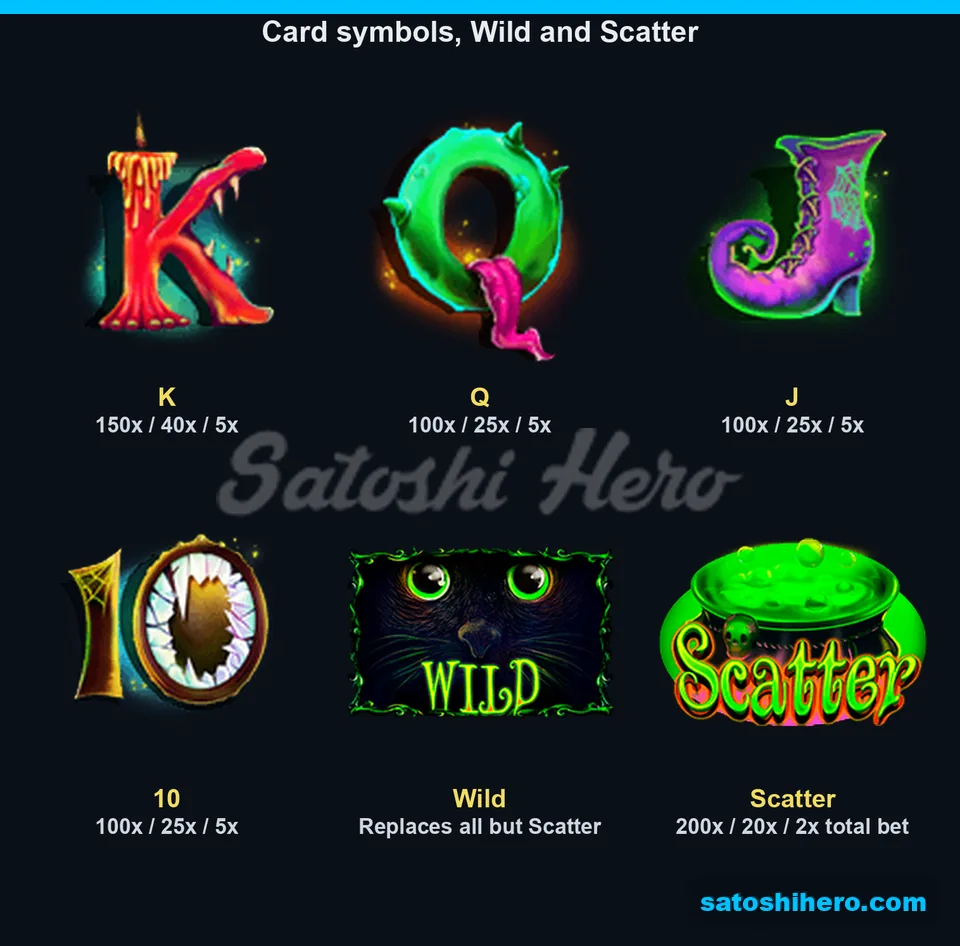
The Wild appears only on reels two, three, and four. It replaces every symbol except the Scatter, helping regular combinations continue across adjacent reels. Five Wilds pay 1,000x the line bet. A qualifying mixed combination needs at least one regular symbol unless the result forms a complete line of Wilds.
That reel restriction means the cat can’t begin a line from reel one or finish it on reel five. It works as a bridge through the middle positions instead. When you inspect a highlighted result, follow the regular symbol from the first reel and watch where cats complete the route. This is conventional line-slot behavior, and I think it remains easy to follow.
The cauldron can appear on any reel. Its three-, four-, and five-symbol awards use the total bet, and those prizes stack with qualifying line wins. At least three also activate the feature described above. You don’t need the cauldrons to follow an active payline because their count applies anywhere on the grid.
Regular symbols and Wild combinations thus use the line bet, while Scatter awards use the total stake. This distinction explains why two identical-looking multipliers can convert into very different dollar values. Check the symbol class first, and the remaining arithmetic stays straightforward.
RTP, Volatility and Our Test
Richy Witchy has a 94% theoretical RTP, high volatility, and an 850x maximum win. Those figures describe the game’s mathematics, not a guaranteed session return. The lean return and restrained cap form a tough pairing beside the stated risk. You should compare the model and live test as separate evidence classes.
Simulator Projection Results
The 1,000-spin projection at $0.80 produced a median loss of $76.40. Its outcome band ran from $265.90 down at the fifth percentile to $223.10 up at the ninety-fifth percentile. Roughly 18% of modeled spins returned a payout. You can see a wide range around one negative midpoint.
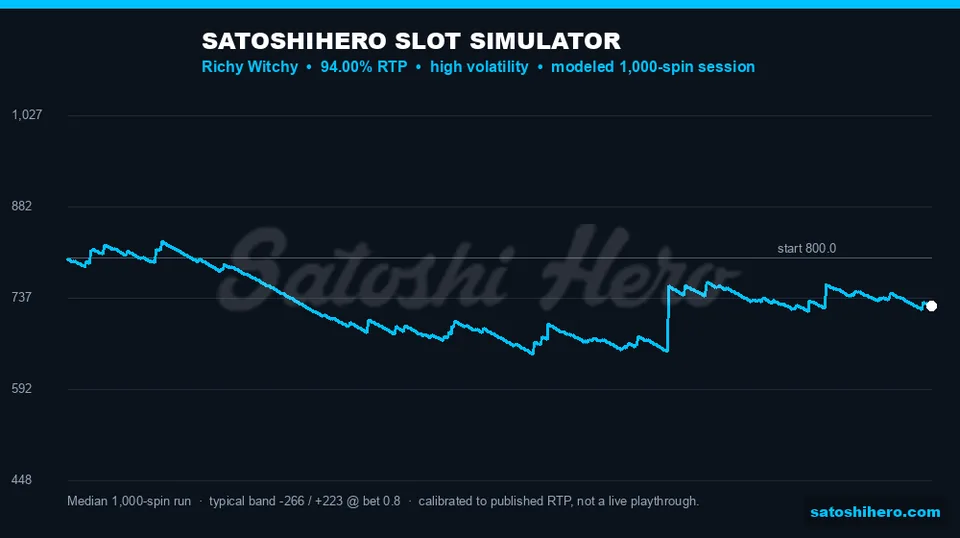
A feature-tier event appeared about once per 47 modeled spins, while a 100x-or-better result appeared around once per 1,712 spins. Neither frequency acts as a timer. Counting 47 losing attempts doesn’t make the next spin more likely to trigger anything. No sugarcoating, modeled averages become dangerous when you treat them like appointments.
The projection illustrates how these settings can spread outcomes across many runs. It doesn’t record events from my live session, and it can’t tell you what your next balance path looks like. Every real spin remains independent. Use the blue modeled path to understand range, not to schedule your bankroll.
Our 100-Spin Session
I played 100 spins at a $0.80 total bet from a fresh $10,000 demo balance. Turbo stayed active, while autoplay handled batches of 75 and 25 spins. Total wagering reached $80, and my final balance was $9,961.50. That left me $38.50 down after all recorded returns.
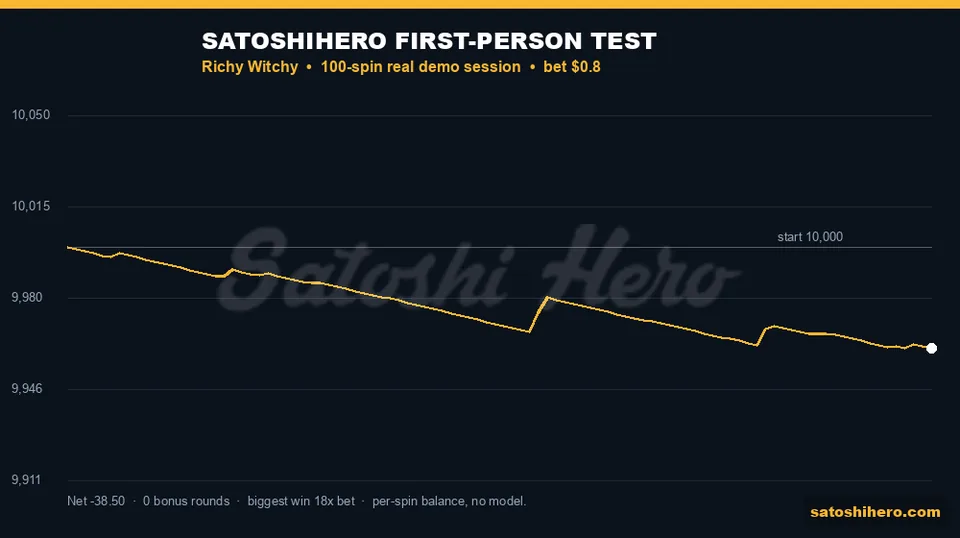
Eighteen spins paid something, producing $41.50 in total returns. My best hit reached $14.40, equal to 18x the bet, and the next best paid $8.80. Everything else ranged from a $0.10 line win to a few dollars. You can see why one decent base hit didn’t repair the session.
The balance declined in small steps through the first 50 spins. A $14.40 result on spin 54 lifted it to $9,981.20, then the total drifted toward the $9,961.50 finish. Free Spins never triggered, so I didn’t observe the Extra Wild. I bought no bonus because no feature-buy option exists.

Watch Out: High volatility can create long stretches of tiny or absent returns. My minimum-stake test lost $38.50 across 100 spins without reaching Free Spins, so set a firm budget and don’t treat trigger averages as a countdown.
The 94% figure is the operator’s published theoretical RTP, while one 100-spin test neither changes nor validates it. The simulator projects results from the stated settings, and the gold graph records my actual play. Feature returns can differ slightly from base-game returns by design, and every real spin remains independent.
Both graphs help you understand how widely outcomes can spread. Neither graph predicts what your next session does, so you should size your stake around loss tolerance instead.
What the Short Session Felt Like
The session felt subdued because most payouts stayed small and Free Spins never appeared. My $14.40 result briefly interrupted the decline, but that 18x hit couldn’t recover the run. The base game carried all 100 spins. You should expect the same possibility whenever feature access depends on natural Scatters.
Most winning spins returned between $0.10 and a few dollars. Stacked symbols repeatedly created busy, promising boards without delivering large awards. That visual tension kept the reels readable, yet the repeated near-miss feeling became tiring. I’d have enjoyed the pace more if one feature round had broken up the base play.
Patient fans of conventional Scatter triggers can accept this rhythm. Anyone seeking frequent bonus access can find it slow, while direct feature-buy fans get no alternative route. You need to enjoy line reading and stacked-symbol suspense on their own merits. The Free Spins can’t carry a session when they never arrive.
At $0.80 per spin, 100 spins require $80 in wagers before recycled returns. Choose the stake from a fixed session budget, not from frustration after a dry run. You shouldn’t raise the bet because the cauldrons haven’t landed. That reaction increases exposure without changing what the next independent spin can do.
One quiet session can coexist with the simulator’s much wider outcome band. My result captured one path near the losing side, not a forecast for another 100 spins. Judge this slot by your comfort with waiting and uneven returns, not by one missing bonus.
Frequently Asked Questions
How does Richy Witchy work?
Richy Witchy uses a 5×4 grid and 40 fixed paylines, with wins running left to right across adjacent reels. Only the highest win on each line pays. The black cat substitutes for regular symbols, while three cauldron Scatters activate seven Free Spins. You should calculate ordinary prizes from the line bet.
What does the Extra Wild do in Richy Witchy?
Before Free Spins, Richy Witchy randomly selects any paytable symbol except the Scatter. That choice becomes another Wild, substitutes for all non-Scatter symbols, and receives the Wild’s payout value. A premium or low-paying regular image can gain the role. You can’t influence the selection.
How many Free Spins does Richy Witchy award?
Three or more Scatters award seven Free Spins. Three, four, or five Scatters also pay 2x, 20x, or 200x the total bet. Another three or more during the round add seven spins. You retain the triggering bet and all 40 fixed paylines.
Does Richy Witchy have a bonus buy?
No, Richy Witchy has no feature buy and no ante bet. Normal spins provide the only route into Free Spins through at least three Scatters. I didn’t buy a bonus during my test because that option doesn’t exist. You must wait for a natural trigger.
What did the simulator projection show?
The 1,000-spin model at $0.80 produced a $76.40 median loss, with outcomes ranging from $265.90 down to $223.10 up across the stated band. About 18% of modeled spins paid, and feature-tier events appeared roughly once per 47 spins. You shouldn’t read those averages as predictions.
How did my 100-spin Richy Witchy test go?
I started with $10,000 and played 100 spins at $0.80. My final balance reached $9,961.50, leaving a $38.50 loss. The best hit paid $14.40, and Free Spins never triggered. You should treat that outcome as one short session.
What are the Richy Witchy RTP and maximum win?
The theoretical RTP is 94%, volatility is high, and the maximum win is 850x the bet. Richy Witchy runs on 40 fixed paylines. Those figures define the game’s published setup, while your individual result can vary sharply. My short test finished below its starting balance.
Bottom Line
Richy Witchy delivers clear fixed-line play, characterful stacked art, and a Free Spins modifier with genuine setup variety. Its main drawback is blunt: the lean return and modest prize ceiling don’t look generous beside the risk. You also get no shortcut into the feature.

My Verdict
Patient line-slot fans can enjoy the readable paytable and random Extra Wild concept. Expect uneven base play, natural Scatter hunting, and the chance that a short session ends without Free Spins.
I like how easily the grid, Wild routes, and line-bet awards can be checked. I don’t like that my 100 spins lost $38.50 without showing the feature that gives the game its main twist. The $14.40 best hit offered only brief relief.
Richy Witchy earns consideration when you prefer classic payline math and can accept a slow bonus chase. This guide’s mechanics and test settings are updated periodically.

Pros:
 Clear line math: Highlighted paylines make qualifying combinations easy to verify.
- Distinct symbol art: Strong silhouettes keep stacked reels readable during Turbo play.
- Useful Extra Wild: The random choice changes each Free Spins setup.
- Scatter value clarity: Total-bet awards remain separate from ordinary line prizes.

Cons:
 Lean return: The theoretical rate leaves little room beside high volatility.
- Restrained ceiling: The top prize feels modest for the stated risk.
- No feature shortcut: Natural Scatters provide the only path into Free Spins.

Best For: Classic slot fans who enjoy fixed paylines, stacked fantasy symbols, and natural bonus triggers fit this game’s rhythm. You’ll need patience, a firm session budget, and no expectation of frequent feature access.

































































Bets
All Bets
Game
Player
Date
Wager
Mult.Multiplier
Prize
 Luck of Panda: Bonus Combo
 mdp0fxo
- 16:20:54
- 0×
- Elephant's Gold: Bonus Combo
 nina87
- 16:20:51
- 0.78×
- Luck of Panda: Bonus Combo
- mdp0fxo
- 16:20:51
- 0×
- Reel Rider: Rapid Link
 Hidden
- 16:20:50
- 3.9×
- Galaxy Glitter
- Hidden
- 16:20:48
- 0×
- Luck of Panda: Bonus Combo
- mdp0fxo
- 16:20:48
- 9.95×
- Reel Rider: Rapid Link
- Hidden
- 16:20:47
- 0×
- Luck of Panda: Bonus Combo
- Hidden
- 16:20:46
- 0×
- Luck of Panda: Bonus Combo
- mdp0fxo
- 16:20:45
- 0×
- Reel Rider: Rapid Link
- Hidden
- 16:20:44
- 0×