

Roaming Wild Buffalo
By pressing play, you agree that you are above legal age in your jurisdiction and that your jurisdiction allows online gambling.

Roaming Wild Buffalo
RTP96%
VolatilityLow
Max winx5,000
Lines20
Hit rate25.9%
ThemeWild West
ReleasedMar 2025
Live game stats
Real RTP57.90%
Spins1,338
Players2
Biggest win$9.02

Chasing Purple Buffalo Across the Desert
The Roaming Wild Buffalo slot is an Octoplay 5×4 line slot built around moving buffalo Wilds, respins and multiplier-based Free Spins. This low-volatility frontier game has a 96% RTP, a 5,000x maximum win and 20 traditional paylines. Wins connect left to right from reel one, giving you a steadier structure with layered Wild features instead of constant large swings.
I tested 100 SatoshiHero demo spins at $1; stakes run from $0.10 to $200. Roaming Wild Buffalo free play and real play are available here. Its lively rules contrast with my quiet result.
Key takeaways
- Best bonus: I tested regular $1 spins without Buy Feature or Double Chance, so neither option earns a higher ranking.
- RTP / volatility: You get 96% RTP, low volatility and 20 fixed paylines.
- Max win: The ceiling is 5,000x the bet, and reaching it ends active Free Spins.
- Risk note: My 100 spins lost $58.50, with 28 paying spins and an $8 top hit.
- Bankroll note: You can see frequent small pays yet lose 58.5 stakes without triggering Free Spins.
That evidence gives you a useful baseline, but one short test can’t define your next session.

Table of Contents
- Roaming Wild Buffalo slot Mechanics
- Lines and payouts
- Extra respin chances
- Wild Buffalo Respin
- Trigger rules
- Moving wilds
- Theme and First Impressions
- Free Spins and Buffalo Multiplier
- Trigger and sticky wilds
- Multiplier and extensions
- Super Free Spins
- Upgrade trigger
- Faster multiplier growth
- Buy Feature and Double Chance
- Direct feature access
- Higher trigger chance
- How the Base Game Played
- Win pattern
- Largest hit
- RTP, Volatility and Our Test
- Simulator projection
- Our 100-spin session
- Frequently Asked Questions About Roaming Wild Buffalo
- Final Take
Roaming Wild Buffalo slot Mechanics
The Roaming Wild Buffalo slot uses a 5×4 grid with 20 fixed paylines. Every winning combination starts on the leftmost reel and links matching symbols across adjacent reels. All listed pay-table values use your total bet, which makes the amounts easy to scale. I prefer this clarity over vague ways mechanics because you can trace every result along a defined line.
Lines and payouts
Five tens or jacks pay 2.00x, while five queens or kings pay 3.00x. An ace combination returns 3.50x for five, followed by the cougar at 4.00x. The wolf pays 5.00x, the eagle 6.00x and the bear 10.00x. Five Wild Buffalo symbols top the regular hierarchy at 15.00x.

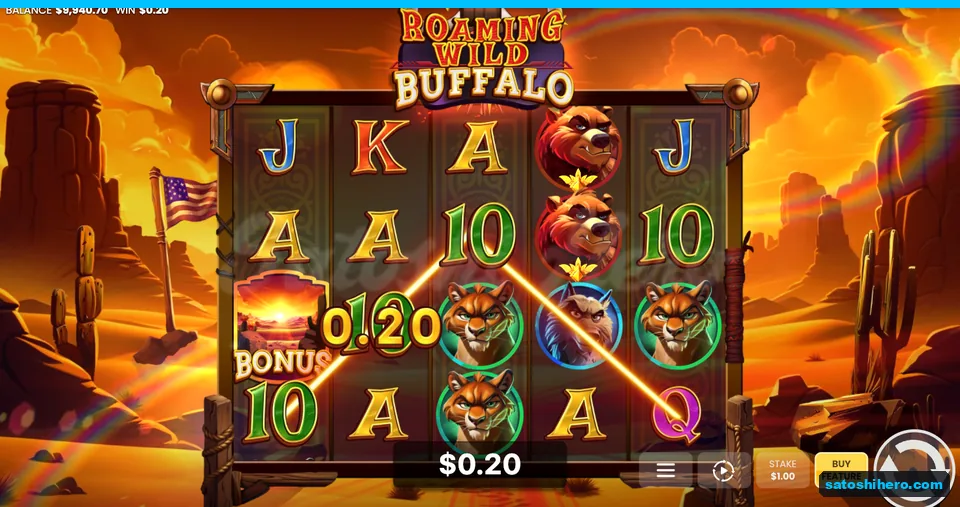
Four-symbol combinations span 0.50x to 7.50x, while three-symbol combinations run from 0.20x to 2.50x. The Wild substitutes for every paying symbol except Bonus and Super Bonus. My $1 logs matched those rules: three wolves paid $1, four wolves paid $2.50, and three bears returned $2. You should still inspect each highlighted line because several small combinations can settle together.

What stands out is how modest many individual line returns look beside the feature rules. The interface keeps those connections clear in a modern desktop or mobile browser, even when you use fast play. Smooth presentation matters here because the roaming symbols demand more attention than the card ranks.
Extra respin chances
Two Bonus symbols can give the final reel a Bonus Respin, creating another chance to complete the trigger. A losing spin can instead receive a Lucky Respin, which guarantees a win worth at least 8x your stake. Neither event appeared during my 100 spins, so I won’t pretend they softened the actual loss.

Factoid: The 20 figure is a genuine payline count, not a ways-to-win label. Combinations pay left to right from reel one.
Read every result as a fixed-line combination, and you won’t confuse this traditional format with a ways slot.
Wild Buffalo Respin
Three or more Wild Buffalo symbols on one Roaming Wild Buffalo slot base-game spin trigger the Wild Buffalo Respin. My 100-spin test never reached it, so you should treat the following details as verified rules rather than observed frequency. I find that distinction important because a vivid feature description can otherwise make an absent bonus sound common.
Trigger rules
The Wilds stay active when the first respin begins. Each respin then shuffles those symbols into fresh positions instead of locking them in place. Another arriving Wild continues the sequence, while a respin with no new Wild ends it. The action also stops when eight Wilds occupy the reels.
Persistence doesn’t mean positional certainty during this roaming sequence. You keep the accumulated buffalo, but their locations can change after every shuffle. That difference matters because your promising connection on one payline can disappear while another line opens elsewhere. You need the full result before deciding whether a particular movement helped.
Moving wilds
The changing locations separate this mechanic from a standard locked-Wild respin. A locked layout steadily protects the same covered spaces, while these buffalo redraw potential connections on every step. The surprise here is the tension between accumulation and motion: more Wilds improve coverage, but you can’t rely on one exact line remaining covered.

Tactic: Watch the complete payline result after every shuffle instead of judging the feature from the Wilds’ starting positions.
No trigger arrived in my session, and that absence kept the base game noticeably plain. If you reach the sequence, you gain shifting line coverage rather than a steadily expanding locked-Wild layout.
Theme and First Impressions
Roaming Wild Buffalo by Octoplay uses a bright frontier scene framed by red desert mesas. A flagpole, rainbow and rope-bound wooden border surround the 5×4 grid. You can identify the setting immediately, although I wouldn’t call the concept adventurous. Its strongest visual choice is simple readability rather than surprise.
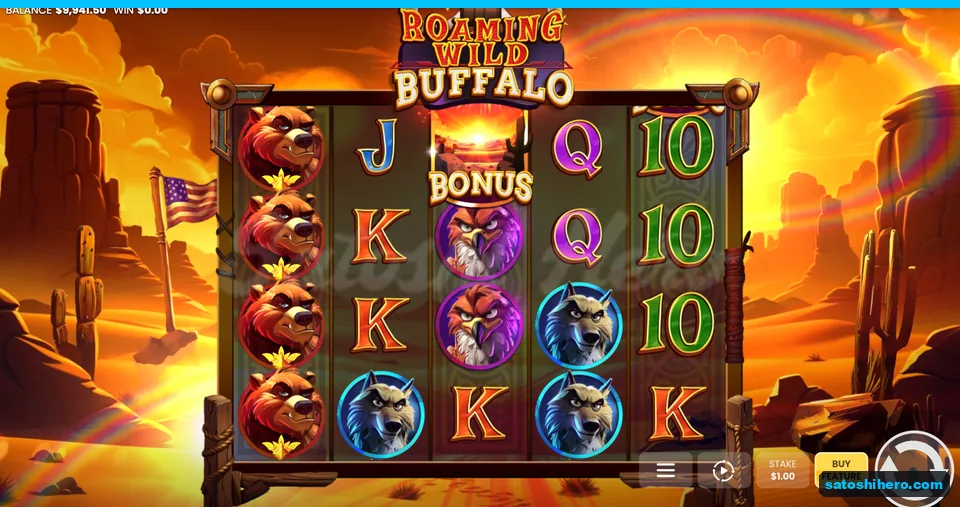
Painted cougars, wolves, eagles and bears fill the higher-paying positions. Chunky card ranks sit below them, while a purple buffalo marks the regular Wild. Golden buffalo imagery signals the multiplier-building version, so you can separate the two roles without studying small labels. That visual contrast helps when retained symbols move quickly.
The buffalo-frontier theme won’t win originality awards, but the clean animal art makes the grid easy to read at fast-play speed. Savannah Gold: Coin of the Wild offers another broad wildlife look if you enjoy animal-led artwork, though this desert presentation feels brighter. Wish for a Cash Star and Wilfred’s Wheel give you two more Octoplay titles to compare with this game’s presentation. I like the rainbow and purple Wild because they lift a familiar palette without cluttering your view.

Discovery: North American buffalo imagery often anchors frontier-themed slots. This title uses purple and gold treatments to separate mechanical roles.
My final balance of $9,941.50 looked stark against the cheerful resting screen. The familiar theme succeeds mainly because you can read every symbol quickly.
Free Spins and Buffalo Multiplier
In the Roaming Wild Buffalo slot, Bonus symbols on reels 1, 3 and 5 award 6, 7, 8, 10, 12 or 15 Free Spins. My 100-spin test didn’t trigger the round, so you are reading verified mechanics rather than a witnessed bonus result. I like the layered design on paper, but I can’t claim it improved my session.

Trigger and sticky wilds
Every Wild Buffalo that lands during Free Spins remains active until the round ends. Retained buffalo move to a different position on each new spin, preserving their presence without fixing their reel location. If the feature begins without a Wild, the first spin guarantees one. The paylines also expand, though you shouldn’t assume a line count beyond the verified rules.
This movement keeps the screen fluid as the collection grows. You can carry useful symbols forward, yet each spin reshapes where they support a connection. That setup feels more lively than ordinary sticky Wilds because coverage keeps changing. Still, persistence doesn’t promise a payout on every turn.
Multiplier and extensions
The Buffalo Multiplier starts at x1 and rises by one whenever a Golden Wild Buffalo lands. It applies to every win during the feature, making Golden arrivals the main growth engine. When the buffalo move, two to six can stack on one position. Each qualifying stack adds two spins, and that extension can happen up to five times.
Worth noting, stacked buffalo and Golden buffalo serve related but distinct purposes. One expands the remaining spin count, while the other raises the multiplier attached to wins. You need both effects to align for the round’s most compelling build. Reaching the 5,000x cap ends the feature immediately.
The rules create a clear arc from retained buffalo, changing coverage and multiplier growth. Since I never entered the round, I won’t turn that potential into a performance claim. You get the feature’s main growth path by collecting buffalo and lifting the multiplier.
Super Free Spins
A Super Bonus symbol in the triggering combination upgrades the standard round to Super Free Spins. The underlying Free Spins rules remain unchanged, but every new buffalo arrives as Golden. You get a more direct route to multiplier growth. I still see this as the stronger ruleset only on paper because my test reached neither mode.
Upgrade trigger
The Super Bonus must participate in the trigger; merely seeing it elsewhere doesn’t qualify. Persistent buffalo still move on every spin, stacks can add extra spins, and expanded paylines remain active. You should expect the same moving-symbol structure with a stronger Golden Wild condition, not a separate style of bonus.
My base-game test gave me no first-hand payout comparison between the two rounds. That matters because a stronger rule doesn’t guarantee a stronger result in one attempt. Random symbol placement and line connections still decide whether a growing multiplier has worthwhile wins to enhance.
Faster multiplier growth
Every buffalo that lands in Super Free Spins raises the Buffalo Multiplier because each one is Golden. Standard Free Spins only increase that meter when the Golden version appears. This upgrade removes that distinction and can build the multiplier faster. The 5,000x ceiling still ends the feature immediately when reached.
What stands out is the cleaner growth logic. You don’t need to wait for a special buffalo type once the upgraded round begins. However, no test evidence supports claims about its typical return, trigger rate or likely final multiplier. You receive a faster multiplier-building path, but not a proven performance advantage.
Buy Feature and Double Chance
Buy Feature provides direct access to standard Free Spins, while Double Chance raises your total bet for a higher feature-trigger chance. I used neither option during the 100-spin test. You shouldn’t read my base-game loss as evidence for or against either choice. Frankly, ranking untested modes would offer false confidence.
Direct feature access
A purchase concentrates more bankroll into one outcome instead of spreading it across ordinary spins. It changes your immediate exposure, but it doesn’t give you control over buffalo positions, multipliers or resulting paylines. The interface determines the exact amount before confirmation, and I won’t invent a price or expected return.
Base-game play deducts only the displayed stake on each spin. That slower exposure gave me 100 separate outcomes at $1, including 28 paying spins. Buying the bonus changes the shape of the risk, not your influence over the random result. You should compare its shown cost with the amount you planned to spend.
Higher trigger chance
Double Chance costs more per spin and improves the chance of reaching a feature. It doesn’t support an assumed payout boost, and no verified probability justifies attaching a number here. I left it off, so my feature-free session came entirely from standard base-game settings.

Proceed Carefully: A low-volatility label doesn’t make a feature purchase low-risk. The buy places a larger amount into one result, and my test doesn’t show that buying is preferable.
Optional-mode settings can change, so assess the displayed cost before each decision. Judge either option by its immediate impact on your bankroll, not by an imagined advantage.
How the Base Game Played
My 100-spin Roaming Wild Buffalo slot session finished $58.50 down and produced no bonus feature. I ran 100 autoplay spins at $1 with fast play active, starting from $10,000 and ending at $9,941.50. You can call the rhythm steady, but you can’t call the outcome gentle. The loss reached 58.5 stakes despite regular small returns.
Win pattern
Twenty-eight spins paid something, and most wins sat between $0.20 and $2. Those small results appeared often enough to break up the misses without reversing the overall decline. I noticed a restrained pulse rather than dramatic swings: a few dollars returned, then several losing outcomes removed the gain. You should expect small hits to matter less when they don’t cover the intervening stakes.
No Free Spins, Bonus Respin or Lucky Respin appeared. That absence made the richer rules feel distant from the actual 100-spin experience. I don’t dislike a quiet base game by default, but this stretch lacked a meaningful change of pace. One short run can’t prove how your next session behaves.
Largest hit
The biggest result arrived on spin 41 and paid $8. Five wolf line wins landed within that single spin, so the amount came from combined line evaluations rather than a feature. It stood well above my usual $0.20 to $2 returns, yet it recovered only eight $1 stakes.
That distinction keeps the result in perspective. The hit wasn’t evidence of the game’s upper range, and it didn’t signal that a bonus was close. You can enjoy several line wins together while the session remains far below its starting balance. Frequent small pays can still accompany a meaningful short-session loss.
RTP, Volatility and Our Test
The official decision profile combines 96% theoretical RTP, low volatility and a 5,000x maximum win. Low volatility points toward a smoother intended payout pattern than highly volatile wild buffalo slots. It doesn’t promise profit, regular bonuses or shelter from a poor run. My result makes that limit clear, and you should never treat the rating as short-session insurance.
Simulator projection
The SatoshiHero Slot Simulator used a $1 stake across 1,000 spins with the published settings. Its median modeled session ended $45 below the starting balance. The fifth percentile finished $143.90 down, while the ninety-fifth percentile ended $67 up. Roughly 34 spins per 100 paid, and a feature appeared about once per 123 spins.
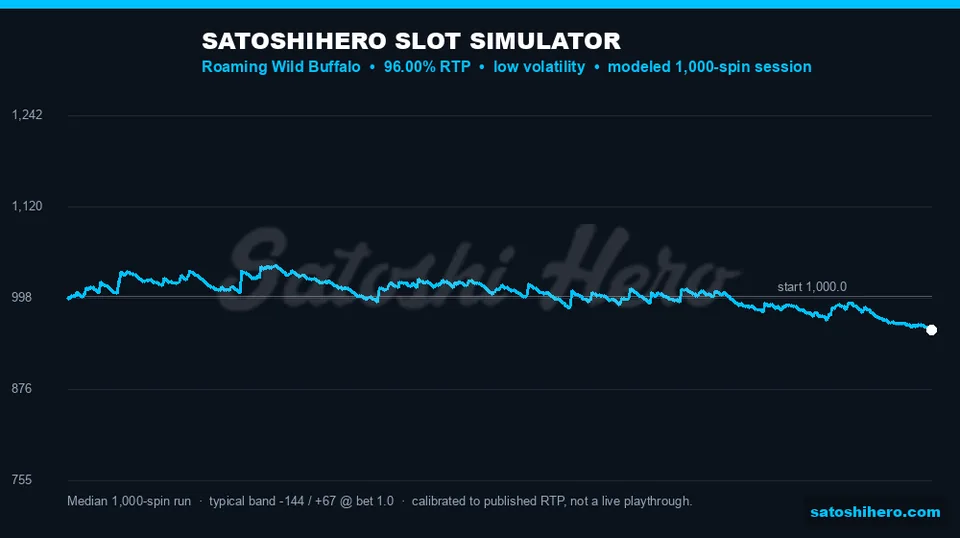
That spread matters more than the midpoint alone. It shows how simulated sessions can finish well apart despite using identical inputs. The model can’t predict your next result, and it doesn’t access the demo game’s random-number stream. I see it as a range tool, not a forecast.
A feature interval near 123 spins is an average across modeled runs. It isn’t a countdown, deadline or promise that a bonus follows after a certain number of misses. You can finish 100 spins without one, just as my live test did. That timing gap doesn’t contradict the model’s average interval.
Our 100-spin session
My $58.50 loss finished below the modeled median but remained inside its wider projected range. The live session produced 28 paying spins, six fewer than the model’s rough 34-per-100 figure. You can see partial alignment in the overall loss while still finding clear differences in hit count. I consider that a useful reminder that averages don’t script individual sessions.

The balance graph would show a subdued decline interrupted by small returns and the $8 result on spin 41. No single win reversed the direction for long. My feature-free outcome also fits comfortably beside an average interval longer than the test itself. Nothing in that average required a trigger before spin 100.
The 96% RTP is the operator-published theoretical return for the game’s underlying mathematics. One live session doesn’t alter that figure, and simulator projections don’t come from the game’s RNG. Any separate feature-mode value must appear directly in the interface rather than come from inference.
This test showed a quiet short session inside a much wider set of possible outcomes. Use the model to understand spread, not to predict what your next spin can do.
Frequently Asked Questions About Roaming Wild Buffalo
What happens when three Wild Buffalo symbols land in the Roaming Wild Buffalo slot?
Three or more Wild Buffalo symbols on one base-game spin trigger respins. The Wilds remain active but shuffle to new positions after each step. Respins stop when no new Wild arrives or eight Wilds occupy the reels. You gain changing line coverage, so you shouldn’t expect them to stay locked.
How do Free Spins work in the Roaming Wild Buffalo slot?
Bonus symbols on reels 1, 3 and 5 award 6, 7, 8, 10, 12 or 15 spins. Persistent buffalo move each spin, while Golden versions lift the multiplier from x1. Qualifying buffalo stacks can add two extra spins each. You should track both the shifting paylines and growing meter.
What separates Free Spins from Super Free Spins?
A Super Bonus in the trigger upgrades the normal round. Every new buffalo then arrives Golden, which builds the multiplier faster under otherwise matching rules. You still face random outcomes, and you can’t infer a typical result from the upgrade alone.
Did the simulator match the Roaming Wild Buffalo slot test?
Partly, because both outcomes showed a loss inside the modeled range. The model’s median showed a $45 loss, while my 100 spins lost $58.50 within the wider range. You shouldn’t treat either figure as a prediction. My result reflects one run, while the simulator summarizes many modeled paths.
How did the 100-spin Roaming Wild Buffalo slot test finish?
I started with $10,000 and finished with $9,941.50. The run logged 28 paying spins, an $8 largest hit and no Free Spins. You can see a steady surface rhythm here, but you also see a substantial 58.5-stake loss.
What are the RTP and maximum win of the Roaming Wild Buffalo slot?
The game has 96% RTP, low volatility and a 5,000x maximum win. Reaching that cap ends an active Free Spins round immediately. You should view each figure as part of the mathematical profile, not a promise for your session.
How do buffalo slots work?
Buffalo slot mechanics differ greatly across individual titles and providers. Here, 20 fixed paylines pay left to right from reel one, while buffalo Wilds power moving respins and multiplier-based Free Spins. You follow defined lines rather than ways wins, and you evaluate every shuffle afresh.
Final Take
Roaming Wild Buffalo turns a familiar frontier theme into a neat moving-Wild system. Its best ideas sit inside bonuses, while my feature-free test exposed a plain base game.

My Read
Patient line-slot fans can appreciate the readable grid and layered buffalo mechanics. Expect small pays to interrupt misses, but don’t mistake that rhythm for protection against a sharp short-session loss.
I like how the purple and Golden buffalo show their roles at speed. My main complaint is that no respin or headline feature appeared across my 100 spins.
The Roaming Wild Buffalo slot works for readers who value traditional paylines and moving Wilds. Optional-mode values are checked regularly, so you can assess their visible cost first.

Pros:
 Clear paylines: Defined left-to-right lines make every result easy to trace.
- Distinct Wilds: Purple and Golden buffalo communicate separate roles instantly.
- Layered Free Spins: Persistent movement, stacks and multipliers create meaningful growth paths.
- Broad stakes: The $0.10 to $200 range supports varied bankroll sizes.

Cons:
 Quiet test: No headline feature appeared across my 100 spins.
- Small base wins: Most returns couldn’t offset nearby losing spins.
- Concentrated buys: Direct feature access places more bankroll into one outcome.

Best For: Traditional slot fans who value fixed paylines and moving Wilds have plenty to examine. You need patience for feature-free stretches and a budget tied to the displayed stake.
Similar Games



































































Bets
All Bets
Game
Player
Date
Wager
Mult.Multiplier
Prize
 Royal Fruits 9: Hold 'n' Link
 Hidden
- 00:21:09
- 0×
- Galaxy Glitter
 nina87
- 00:21:08
- 4.2×
- Wild Buffalo: Megaways
- mike_721
- 00:21:08
- 0×
- Royal Fruits 9: Hold 'n' Link
- Hidden
- 00:21:08
- 0×
- Galaxy Glitter
- josh1998
- 00:21:07
- 0×
- Royal Fruits 9: Hold 'n' Link
- Hidden
- 00:21:05
- 0×
- Galaxy Glitter
- nina87
- 00:21:03
- 0×
- Elephant's Gold: Bonus Combo
- Hidden
- 00:21:02
- 0.49×
- Royal Fruits 9: Hold 'n' Link
- Hidden
- 00:21:02
- 0×
- Royal Fruits 9: Hold 'n' Link
- Hidden
- 00:20:59
- 0×