

Wilfred's Wheel
By pressing play, you agree that you are above legal age in your jurisdiction and that your jurisdiction allows online gambling.

Wilfred's Wheel
RTP95.78%
VolatilityMedium
Max winx10,000
Lines20
Hit rate24.5%
ThemeLuxury life
ReleasedJan 2024

Chasing the Crown Around Wilfred’s Golden Wheel
The Wilfred’s Wheel slot spins through a royal court where every base-game result can bring the persistent-prize wheel closer.
Wilfred’s Wheel is a medium volatility slot from Octoplay with 95.78% RTP and 10,000x max win potential. This royal-court game uses a 5×4 grid and 20 fixed paylines. It best fits players preferring simple line wins and a stop-or-continue wheel feature instead of free spins.
Key takeaways
- Best bonus: Regular $1.00 spins provide the only tested approach because I didn’t test the Buy Feature.
- RTP / volatility: The official profile combines 95.78% RTP with medium volatility.
- Max win: The reward ceiling reaches 10,000x the stake.
- Risk note: Two empty wheel sectors can stop the bonus before its reward pool grows far.
- Bankroll note: My 100-spin test lost $25.50, while the simulator’s median 1,000-spin result lost $48.70.
The accumulating Wheel bonus provides the main draw, while the base game stays easy to follow. I tested $1.00 spins from a fresh $10,000 balance, and you can try free demo or real play here on SatoshiHero. A Buy Feature button appeared, though I didn’t test, rank, or recommend it.
My counted 100 spins finished $25.50 down without a Wheel trigger. Extra, uncounted play later produced an 11x Wheel payout, which only illustrates how the feature works. The royal theme won’t win originality awards, but clear paylines and visible values help you track the curtains, wheel, and mathematical profile.

Table of Contents
- How Wilfred’s Wheel Works
- Premium symbols
- Card-rank values
- Winning Lines and Payout Rules
- Reading a win
- Theme and First Impressions
- Courtroom presentation
- The Royal Curtain Trigger
- Five-reel trigger
- Inside the Wheel Bonus
- Building the pool
- King Wilfred effect
- How the 100 Spins Played
- Session highlights
- Practical bankroll view
- RTP, Volatility and Our Test
- Simulator projection
- Our 100-spin session
- Frequently Asked Questions About Wilfred’s Wheel
- Final Take
How Wilfred’s Wheel Works
The Wilfred’s Wheel slot uses a 5×4 grid, 20 fixed paylines, and eight paying symbols. You won’t find a Wild or Scatter, so every payout depends on natural matches. Wins use multiples of your total stake, making the paytable easy to read at $1.00.
At my tested stake, a 5x value appeared as $5.00. That direct relationship let me check line amounts quickly. The browser screen preserved the core reels and controls, so you can focus on the paytable.
Premium symbols
Three royal objects form the premium group, with the crown leading regular-symbol payouts:
- Crown: 4x for three, 10x for four, and 40x for five.
- Orb: 2x for three, 5x for four, and 20x for five.
- Scepter: 1x for three, 2.5x for four, and 10x for five.
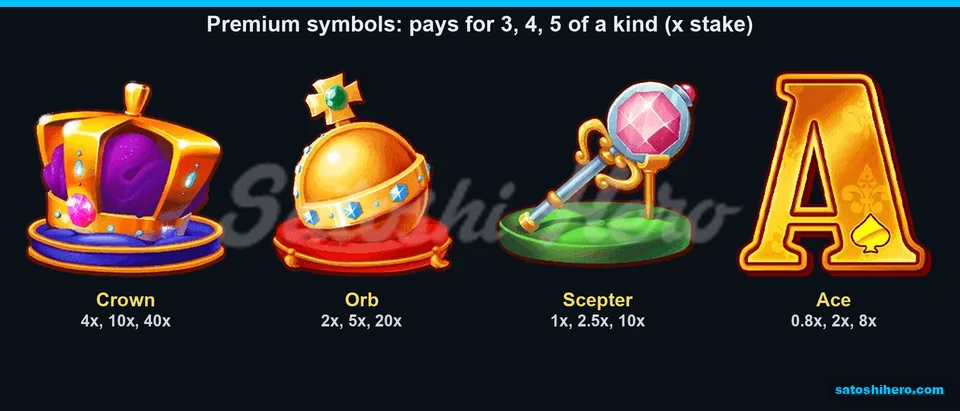
I verified those values during actual play. Five orbs across one line paid $20.00, while four orbs on another line paid $5.00. You can compare both outcomes directly against the orb row, which makes the Wilfred’s Wheel slot feel transparent despite its decorative royal frame.
Card-rank values
The five lower symbols follow a familiar order, yet their decimal values create several small returns:
- Ace: 0.8x, 2x, and 8x for three, four, and five.
- King: 0.6x, 1.5x, and 6x.
- Queen: 0.5x, 1.2x, and 4.8x.
- Jack: 0.4x, 1x, and 4x.
- Ten: 0.3x, 0.7x, and 2.8x.
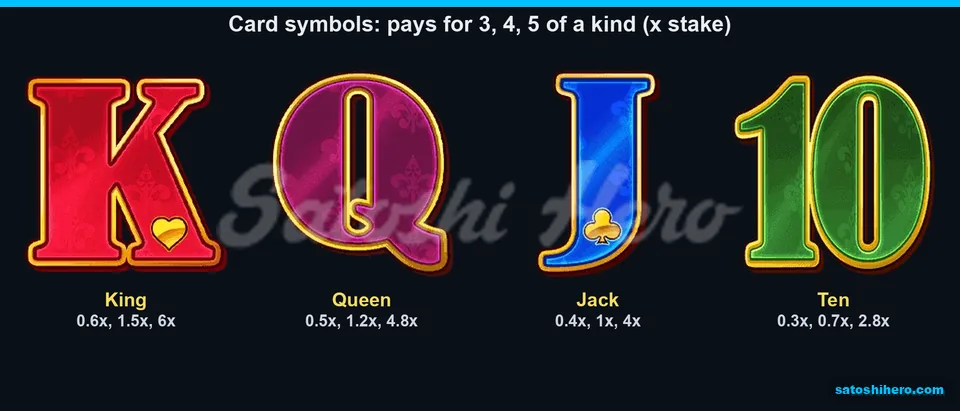
Those low values explain why a paying spin doesn’t always protect your balance. A three-ten line returns 0.3x, so you can hit while losing most of that stake. I found the hierarchy clear, but low matches felt like partial refunds.

Factoid: Five crowns produce the highest regular-symbol prize at 40x. No Wild or Scatter can substitute for symbols or start free spins.
Once you understand these multipliers, every $1.00 test result becomes straightforward to check. That clarity is one of the Wilfred’s Wheel slot’s strongest qualities, even though the symbol set itself feels conventional.
Winning Lines and Payout Rules
Wins form across 20 traditional fixed paylines, not clusters or a pay-anywhere system. Matching symbols must connect on adjacent reels from left to right, beginning on reel one. You need to follow the active route because identical symbols elsewhere don’t count unless they occupy that line.
The game adds simultaneous line wins, while paying only the highest winning combination per symbol. On spin 5, three orb lines returned $5.00, $5.00, and $20.00. Together they produced my $30.00 session high, showing how several modest routes can build a larger total without changing any paytable value.
Separate line amounts made that result easy to read. You can see why the total rose instead of treating $30.00 as a mystery. I prefer clear accounting to oversized effects that hide the calculation.
Reading a win
The highlighted overlay traces each contributing symbol and reel after a payout. During a $0.50 example, the headline amount alone didn’t explain which path had connected. Checking the route revealed more useful information, and you can apply that same habit whenever several paylines light together.
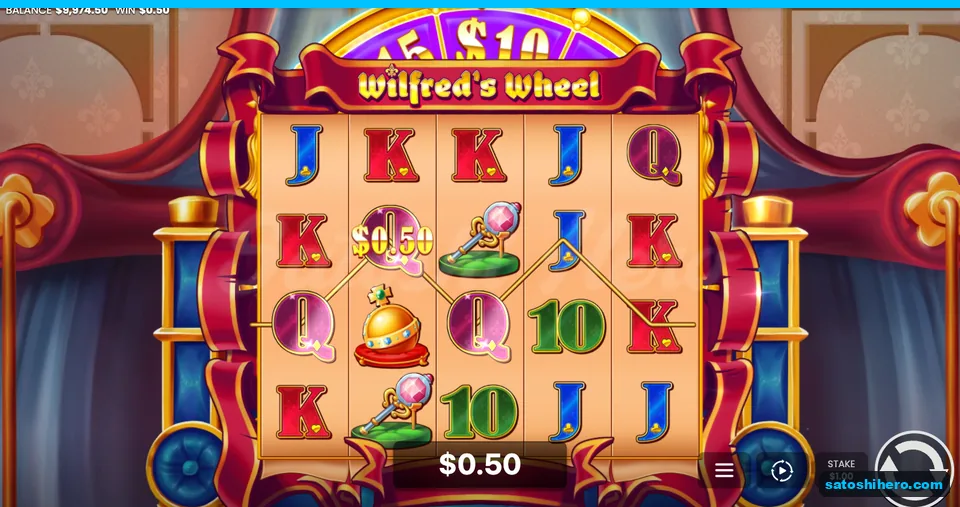

Tactic: Check the highlighted route and its separate line amounts whenever several wins combine. You’ll understand the total faster and avoid mistaking one strong line for multiple weak ones.
The overlay separates near-misses from valid matches. Symbols can look close while sitting outside the active route or missing reel one. The Wilfred’s Wheel slot lets you verify payouts through its paytable and line display.
That level of transparency matters during fast play, when small totals disappear quickly. I still slowed down for combined wins because the route mattered more than the celebration. If you care about understanding each result, the fixed-line structure makes solid sense.
Theme and First Impressions
The game presents a clear royal court with red velvet curtains, King Wilfred, and a golden wheel above the reels. Crowns, orbs, and scepters support the setting, while card ranks keep the layout familiar. You can identify valuable symbols quickly without memorizing unusual characters.
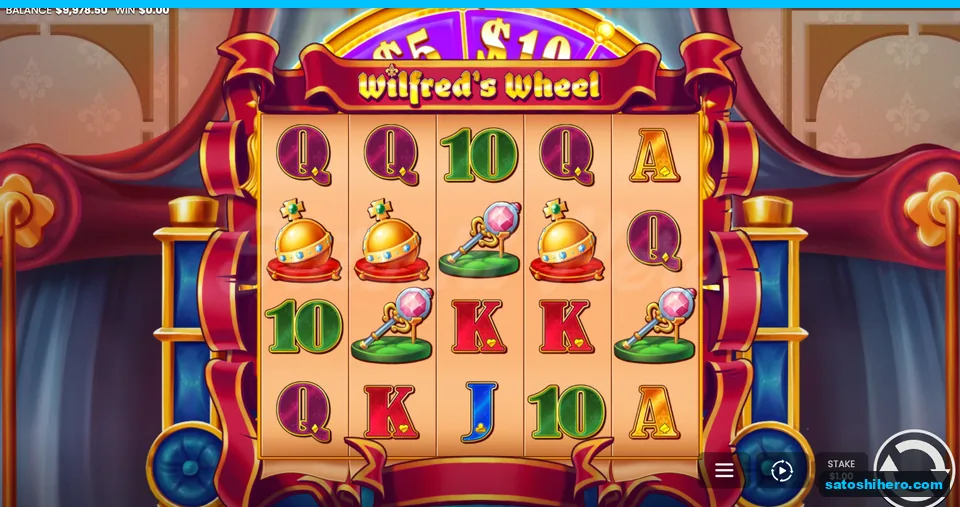
King Wilfred peers over the frame as if guarding his treasury. The theme won’t surprise palace-slot fans, but it gives the feature a face. I liked how the bold palette kept important elements visible.
Fast play and autoplay sped up presentation during my test without changing odds or payout rules. The hierarchy remained easy to scan at that pace, and you can still pause to inspect highlighted paylines. The sound and motion support the reels rather than turning every low return into a noisy event.
Courtroom presentation
The curtains do more than frame the grid because they also signal progress toward the Wheel trigger. Their deep red panels contrast cleanly with the symbols, so you can spot coverage across individual reels. King Wilfred and the gold wheel remain visible before the bonus begins, keeping the main attraction in view.
Wheel O’Gold offers another wheel-led presentation if a visible prize wheel draws your attention, though its mechanics aren’t identical. Blitz Super Wheel and Wheel of Happiness provide further wheel-led comparisons. Here, the permanent wheel makes each curtain appearance feel connected to a clear destination. I think that visual link works better than hiding the bonus behind an unrelated Scatter symbol.

Discovery: King Wilfred starts as a decorative court figure above the reels. Inside the feature, his own wheel segment becomes the power that doubles displayed cash prizes.
The theme isn’t inventive, but its clean layout serves the mechanics. You can follow wins and curtains without clutter, giving the Wilfred’s Wheel slot a practical identity.
The Royal Curtain Trigger
The Wheel bonus starts only when curtains drop behind all five reels during one paid spin. A curtain can appear behind symbols on each reel at any bet, but partial coverage doesn’t activate anything. You need all five reels covered together before the wheel takes over.
Curtain appearances show trigger progress without becoming separate prizes. Four covered reels can look promising, yet they remain non-winning fragments. I found the rule simple, though repeated incomplete coverage tested my patience.
Five-reel trigger
My counted 100 spins never produced complete curtain coverage. The five-reel trigger appeared only during extra spins afterward, so I kept that feature result outside the official session totals. You should make the same distinction between a counted test and later illustrative play.
Our simulator modeled a feature roughly once per 50 spins. That’s context, not a countdown, so you shouldn’t assume the bonus is due after misses. Random outcomes can bunch together or stay absent longer.
The surprise here is how little partial coverage tells you about the next spin. Curtains don’t accumulate across paid spins, and an almost complete display creates no stored progress. You start each new result with the same five-reel condition.
I view the Royal Curtain as a trigger rule, not a separate prize round. It creates anticipation, but only the completed pattern moves the Wilfred’s Wheel slot into its wheel feature. That distinction helps you judge near-misses without giving them extra value.
Inside the Wheel Bonus
The Wheel bonus keeps collecting cash prizes until an empty sector ends the round and pays the accumulated pool. Its ten segments include seven cash prizes, two empty spaces, and one King Wilfred symbol. You can see the risk on every spin because one fifth of the displayed sectors end the sequence.
A cash stop adds its amount to the reward pool, then the wheel spins again. Landing on an empty sector closes the feature and releases the accumulated total. Reaching the 10,000x maximum also ends the round, although my observed feature finished much earlier.
This stop-or-continue format creates the clearest tension. Each cash result grows your pool before another risky spin. I like that rhythm, but empty segments can end it before bigger prizes matter.
Building the pool
Repeated cash stops increase the reward pool, and the running amount stays visible throughout the sequence. During my extra, uncounted feature, the pool moved from $5.00 to $8.00 and then $11.00. The following wheel spin hit an empty sector, ending the round with an $11.00 payout.
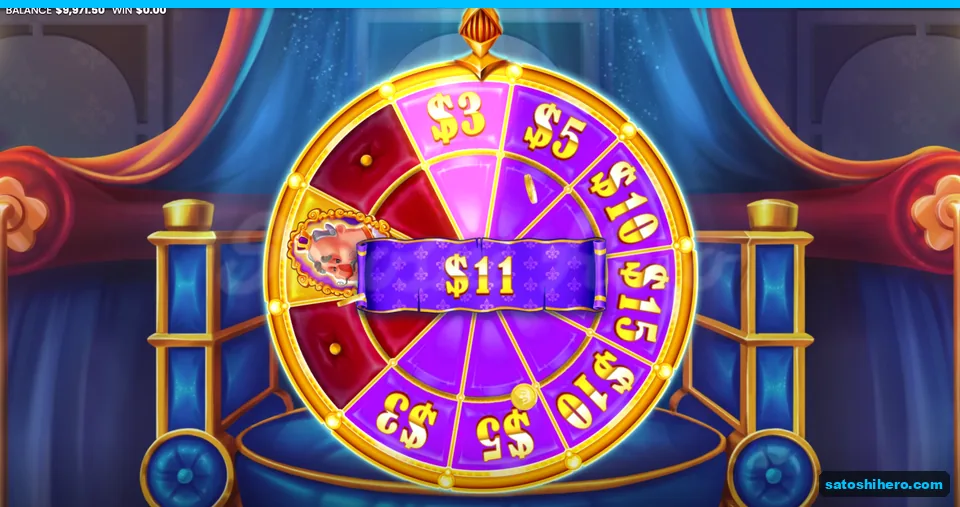
That return equaled 11x my $1.00 stake. It showed the mechanic clearly without producing a large win. You could watch each cash stop contribute before the empty sector paid the pool.
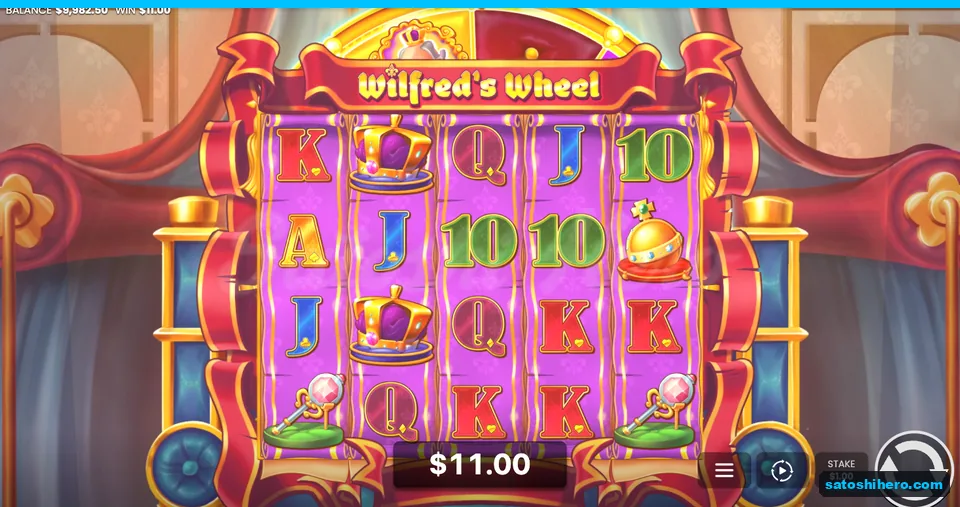
This round occurred after the official 100-spin session and doesn’t belong in its balance totals. I include it only because it demonstrates the feature with a real result. Keeping those records separate prevents the Wilfred’s Wheel slot test from looking stronger than it actually finished.
King Wilfred effect
Landing on King Wilfred doubles every cash value still displayed on the wheel. He doesn’t simply double the reward pool you’ve already collected, so the timing changes future segment values instead. Individual cash segments can rise to 500x through this effect.
My observed feature never stopped on King Wilfred. I can’t claim how dramatic repeated doubles feel from firsthand play, though the rule gives later cash stops more potential. You should read him as a wheel modifier rather than an instant multiplier applied to the pool.
Visible growth creates suspense, but an empty stop can close the sequence anytime. Even improved segments never become guaranteed rewards. I find the bonus tense and clear, yet my 11x result showed how modest it can finish.
How the 100 Spins Played
My 100-spin session returned something on 36 spins but still finished $25.50 down. I played $1.00 per spin from a fresh $10,000 demo balance, using fast play and autoplay. You would’ve seen plenty of small hits, yet too few meaningful returns to stop the balance decline.
The run created $100 in turnover, while $25.50 was the balance loss. You need both figures because total stakes and net cost answer different bankroll questions.
Session highlights
Spin 5 delivered the session high of $30.00 through three orb paylines. Those routes paid $5.00, $5.00, and $20.00, giving the balance an early lift. I didn’t find another result close to it during the remaining spins.
Spin 32 returned $6.00, while spin 51 paid $4.60. After that, the balance continued sliding until it reached $9,974.50. The Wheel bonus never triggered during these counted spins, leaving the base game responsible for every return you see in the record.
The early $30.00 hit carried much of the session. Although 36 spins paid, most returns couldn’t halt the decline. I found the pace lively on the surface but subdued underneath.
Practical bankroll view
A 36% observed hit count doesn’t mean the Wilfred’s Wheel slot returned 36% of my stakes. Many paying results came in below the $1.00 wager, so the balance could fall even while wins appeared often. You should judge hit count and return size as different measures.
The $100 turnover also doesn’t mean I lost $100. My final balance shows a $25.50 net loss after all wins flowed back into the session. This distinction matters because repeated staking can exceed your final loss.
One short session can’t forecast your next 100 spins. My test simply records one path through the game’s random outcomes, including an early high point and a featureless finish. I thought the small returns kept play moving, but the missing wheel left everything dependent on that single orb result.
RTP, Volatility and Our Test
The Wilfred’s Wheel slot has a 95.78% theoretical RTP, medium volatility, and a 10,000x maximum win. Medium volatility describes an intended balance between hit frequency and win size, not a promise of gentle pacing. You can still face a sustained decline, as my counted run demonstrated.
That profile sits between steadier games and harsher high-variance releases. I found my session restrained because its best result arrived early and the feature stayed absent. Your experience can differ sharply.
Simulator projection
The SatoshiHero Slot Simulator used a $1.00 stake, the stated mathematical settings, and the maximum-win cap. Its 1,000-spin projection produced a wide set of modeled outcomes:
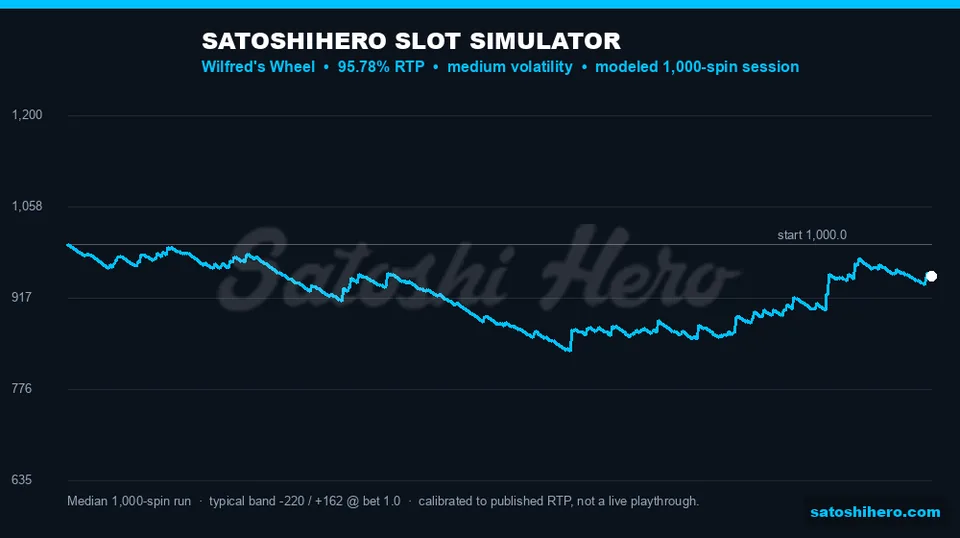
- Median result: $48.70 down.
- Fifth percentile: $219.90 down.
- Ninety-fifth percentile: $161.70 up.
- Paying frequency: About one in four simulated spins returned something.
- Feature frequency: A feature appeared roughly once per 50 simulated spins.
- Big-win frequency: A big win appeared roughly once per 13,514 simulated spins.
These figures describe projections, not live results, trigger schedules, or guaranteed limits. The spread shows why you shouldn’t treat the median as a prediction. I find the range useful because it exposes short-run uncertainty.
Our 100-spin session
My counted play remained separate from the model and produced these observed results:
- Starting balance: $10,000.00.
- Ending balance: $9,974.50.
- Net result: $25.50 down.
- Paying spins: 36.
- Largest win: $30.00 on spin 5.
- Wheel triggers: Zero.
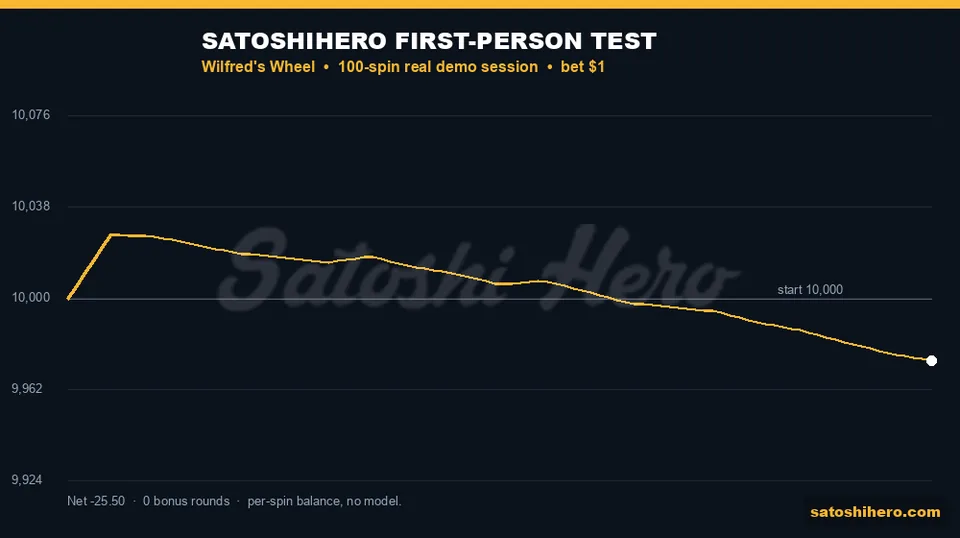
The real run paid more often than the model’s broad rate, yet it lost money. Hit frequency alone can’t describe value. You can receive many partial returns while stronger outcomes decide the balance.

Proceed Carefully: Medium volatility doesn’t prevent sustained declines. The model’s lower-tail result lost $219.90 across 1,000 $1.00 spins, while my test lost money despite 36 paying spins.
The theoretical RTP comes from Octoplay’s published figure, and one 100-spin session doesn’t alter it. Our simulator offers a projection rather than a record of live spins, while mode-specific settings can carry slightly different returns by design. Use the profile for context and my test as one honest example of short-session variance.
Frequently Asked Questions About Wilfred’s Wheel
How do wins work in Wilfred’s Wheel slot?
The Wilfred’s Wheel slot pays across 20 fixed paylines on adjacent reels from left to right, starting on reel one. Regular-symbol awards range from 0.3x for three tens to 40x for five crowns. Several line wins can combine into one total, and you can inspect each highlighted route.
What is the best-paying symbol in Wilfred’s Wheel slot?
The crown pays the most among regular symbols, returning 4x for three, 10x for four, and 40x for five. The orb ranks next at 2x, 5x, and 20x. You won’t find a Wild that substitutes for either symbol.
How is the Wheel bonus triggered in Wilfred’s Wheel slot?
Curtains must drop behind all five reels during the same paid spin. Partial coverage doesn’t trigger the feature or carry progress into your next result. My counted 100-spin test never completed the five-reel pattern.
How does the Wheel bonus pay in Wilfred’s Wheel slot?
Seven cash sectors add values to the reward pool, while two empty sectors end the feature and pay that pool. The King Wilfred sector doubles cash values still displayed on the wheel. In my extra play, three cash stops built $11.00 before an empty sector ended the round.
What did the 1,000-spin simulator show?
The model produced a median loss of $48.70 at a $1.00 stake. Its fifth percentile lost $219.90, while the ninety-fifth percentile gained $161.70. These are projection points, not a guaranteed range for your session.
What happened in the 100-spin Wilfred’s Wheel slot test?
I lost $25.50 across 100 spins at $1.00 each. The run included 36 paying spins, a $30.00 largest win on spin 5, and zero Wheel triggers. You shouldn’t treat that single result as a forecast.
What are the RTP and maximum win of Wilfred’s Wheel slot?
The game has a 95.78% theoretical RTP, medium volatility, and a 10,000x maximum win. Those figures describe its official mathematical profile rather than a promised session return. The wheel and fixed paylines remain random on every paid spin.
Final Take
Wilfred’s Wheel turns a simple fixed-line base game into a tense chase for an accumulating wheel pool. Its clear payout accounting stands out, while the two empty sectors and absent bonus in my test expose the drawback. You get readable mechanics, though not constant feature action.

My Read
Choose it when you value transparent paylines and a wheel that can continue building until an empty stop. Expect many modest base-game returns, and don’t assume medium volatility guarantees an even session.
I like how the line overlay explained my $30.00 orb result and how the extra wheel round displayed each pool increase. I don’t like how little partial curtain coverage means, especially after the counted session ended without a full trigger. You can feel close without gaining stored progress.
The Wilfred’s Wheel slot guide and its testing notes are checked regularly. You should still treat the recorded session as a firsthand example, not a script for your own results.

Pros:
 Clear line accounting: Separate route values explain exactly how combined payouts form.
- Visible bonus risk: Cash and empty sectors make each wheel decision easy to understand.
- Readable symbols: Strong color contrast keeps premiums distinct during faster spins.
- Simple feature flow: Cash stops build the pool until an empty sector ends it.

Cons:
 No substitute symbols: Natural line matches carry the entire base game.
- Curtains don’t persist: Partial coverage creates anticipation without storing any progress.
- Bonus can end modestly: Two empty sectors can stop the pool before strong growth.

Best For: Fixed-payline fans who enjoy checking each route and watching a visible prize pool develop. The medium-volatility profile and simple royal presentation reward patient, detail-focused play more than feature-heavy spectacle.


































































Bets
All Bets
Game
Player
Date
Wager
Mult.Multiplier
Prize
 Mardi Gras Queen
 nina87
- 04:22:54
- 0×
- Mardi Gras Queen
- nina87
- 04:22:51
- 2×
- Big Banker Bonanza
- Hidden
- 04:22:50
- 0×
- Luck of Panda: Bonus Combo
 mdp0fxo
- 04:22:49
- 3.65×
- Mardi Gras Queen
- nina87
- 04:22:48
- 0.03×
- Mardi Gras Queen
- nina87
- 04:22:45
- 0×
- Phoenix HIT Hotfire Hold & Win Buy Bonus
 Hidden
- 04:22:44
- 0×
- Phoenix HIT Hotfire Hold & Win Buy Bonus
- Hidden
- 04:22:42
- 0×
- Bow of Artemis
 Hidden
- 04:22:42
- 0×
- Bow of Artemis
- Hidden
- 04:22:40
- 0×