

Space Donkey
By pressing play, you agree that you are above legal age in your jurisdiction and that your jurisdiction allows online gambling.


Arcade War in Deep Donkey Space
Space Donkey slot throws you into Nolimit City’s arcade sci-fi war, where a gun-toting monkey, UFO wilds, choppers and aliens fight across a 6×6 grid.
Space Donkey is a high volatility Nolimit City slot with a cartoon sci-fi theme, 96.07% RTP and 14,649x maximum win potential. The setup uses a 6×6 grid, 46,656 ways to win and avalanche drops, so feature hunters get more value than calm line-slot fans. At my $1.00 stake, Hide N Seek cost $79.00, Seek N Destroy cost $272.00 and the weighted draw ticket cost $143.00.
Key takeaways
- Best bonus: Hide N Seek is the cheaper 79x route, while Seek N Destroy costs 272x and gave me a 149x return from the bought round.
- RTP / volatility: The official RTP is 96.07%, volatility is high and the action can grind between feature spikes.
- Max win: The top win is 14,649x the bet, and both tested bonuses landed well below that ceiling.
- Risk note: The 1,000-spin model at $1.00 showed a median session about $68.10 down, with wide bonus-driven swings.
- Bankroll note: My 500-spin test lost $52.45 at $1.00 stakes despite one natural Hide N Seek trigger.

Warning: High volatility means short sessions can swing hard even with 96.07% RTP. You need enough bankroll room to survive quiet base-game patches.

Table of Contents
- How Space Donkey slot Works
- Grid and ways
- Symbol pay values
- Theme & First Impressions
- Pixel war setting
- First table feel
- Avalanche and Abduction Wild
- Dropping symbols
- UFO multiplier
- Hellfire Multipliers
- Chopper symbols
- Firing directions
- Hide N Seek Bonus
- Trigger and buy
- Chest collection
- Seek N Destroy Bonus
- Weapons and aliens
- Bought result
- Bonus Buy Testing
- Buy menu
- Tested returns
- RTP, Volatility & Our Test
- Simulator projection
- Our 500-spin session
- Frequently Asked Questions About Space Donkey
- Final Verdict
How Space Donkey slot Works
Space Donkey slot works through a 6×6 ways system, not fixed lines, so wins form across 46,656 possible symbol routes. Winning symbols disappear, new ones drop into place, and one paid spin can create several connected hits.
Grid and ways
You’re playing across six columns and six rows, with matching symbols paying through the ways engine. The game runs smoothly on desktop and mobile, so you can test the grid without losing the busy visual detail. I like the motion here, though the smaller drops can feel noisy when no feature connects.
Each avalanche can reset part of the board after a win. That means you shouldn’t judge the spin by the first payout alone. A weak first hit can still lead into better symbol positions, but most base-game chains need wilds or multipliers to matter. xWays Hoarder xSplit offers a sharper example of Nolimit-style ways chaos, while this game keeps the layout easier to read.
Symbol pay values
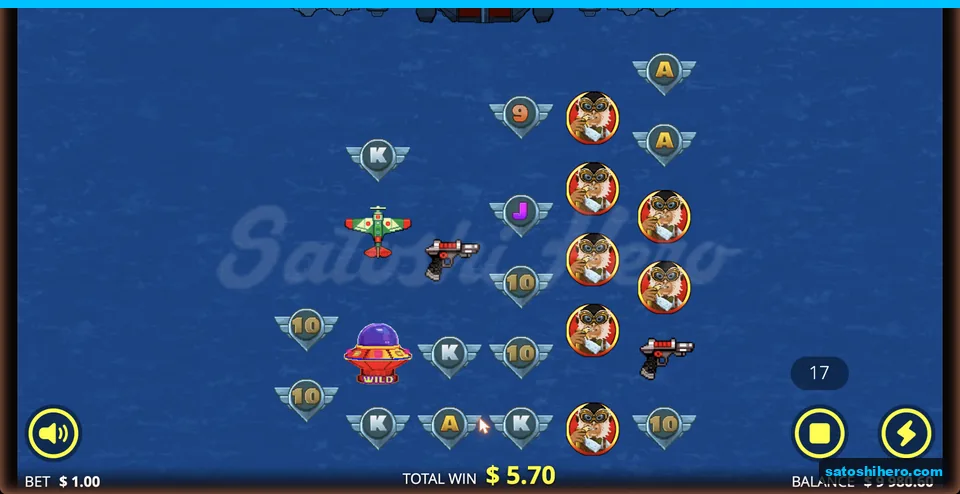
The high symbols pay clearly at a $1.00 stake. Six monkeys pay $4.00, six fighter planes pay $1.75, six aliens pay $1.40, six laser guns pay $1.25 and six bullets pay $1.00. Those numbers give the monkey a real lead, but you still need repeated drops to build a memorable spin.
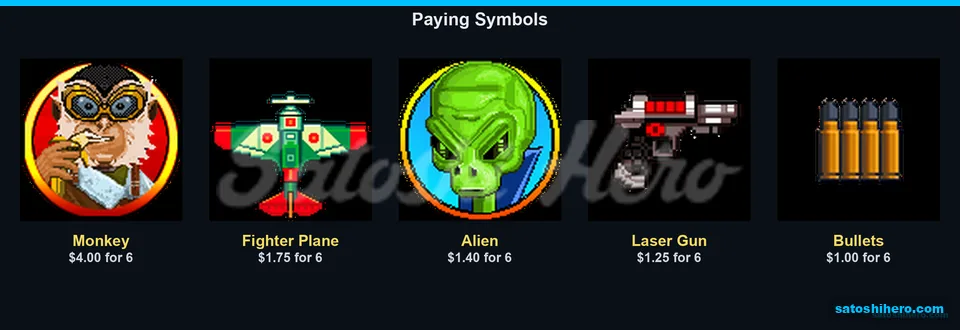
Low symbols use winged royals and numbers. Six A symbols pay $0.75, K pays $0.70, Q pays $0.50, J pays $0.45, 10 pays $0.40 and 9 pays $0.25. Space Donkey slot stays readable because the symbol ladder makes sense, though xWays Hoarder 2 feels denser if you prefer heavier grid math. The grid creates plenty of motion, but bigger upside needs features or multipliers.
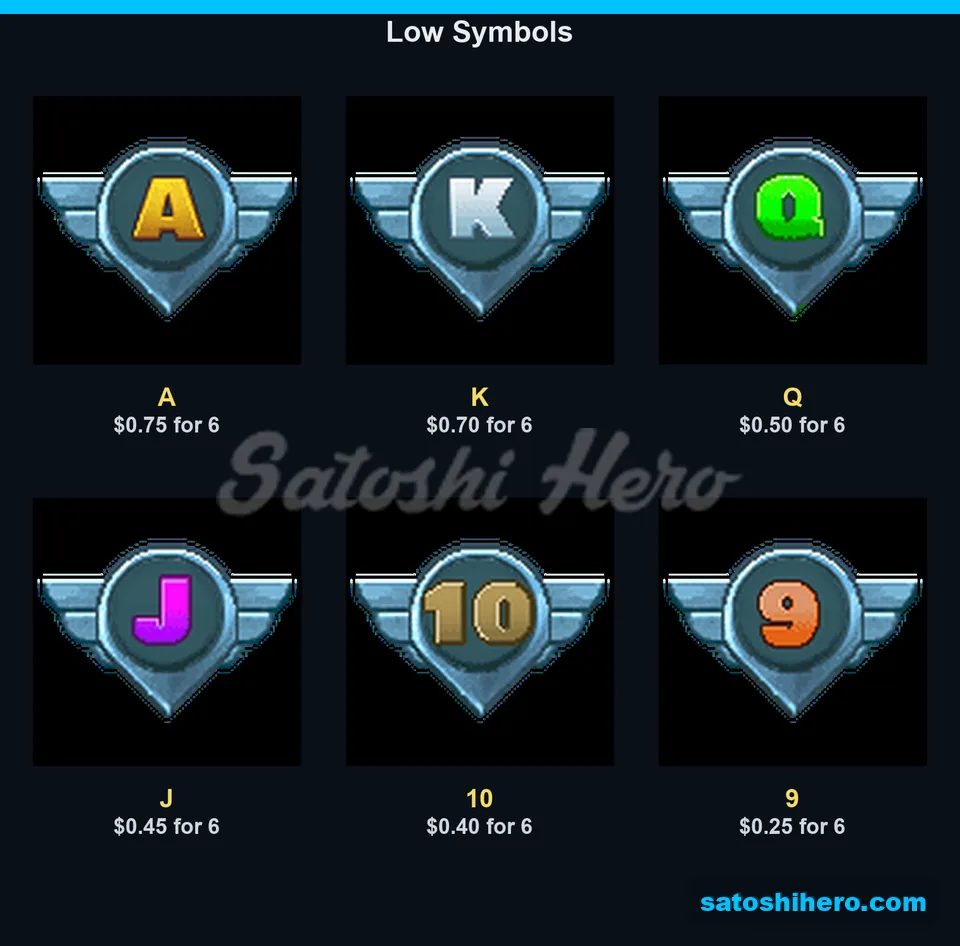

Strategy Insight: Start small until you understand how the avalanche rhythm affects your balance. The grid moves often, but the strongest gains need a premium chain.
Theme & First Impressions
The theme is cartoon sci-fi warfare, and its loud pixel style makes the game feel more memorable than a plain space slot. Nolimit City leans into a silly warship mood, with a space monkey, fighter planes and aliens blasting above an ocean planet.
Pixel war setting
The backdrop looks like pixel art dropped onto a distant sea-world battlefield. UFOs, lasers, bullets and choppers aren’t just decoration, because they connect directly to the wild and multiplier systems. You get a clear sense that every moving part has a role.
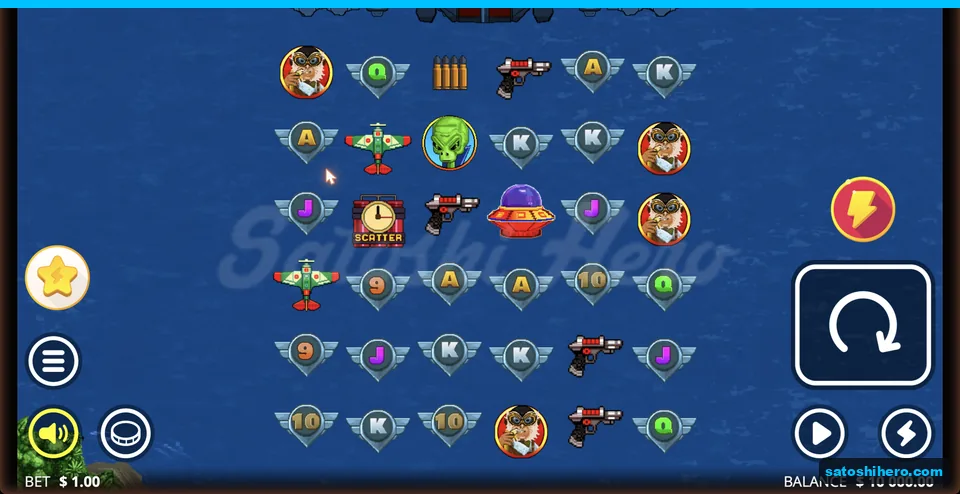
The donkey space wording sounds absurd, but that’s part of the charm. This theme won’t win subtlety points, and I mean that as praise. Highway To Hell gives you darker chaos, while this game pushes cartoon sci-fi energy with brighter, stranger confidence.
First table feel
My first table impression was simple: the screen looks ridiculous in a good way. Space Donkey slot gives you explosions, weapons and pixel characters without pretending to be serious. The visual style also makes the two bonus modes easier to remember.
Land of the Free aims for bigger cinematic weight, while this slot works through arcade noise and character movement. You’ll know quickly if that tone clicks with you. The silly theme helps Hide N Seek and Seek N Destroy stand apart from basic free-spin rounds.

Insight: Pixel art often works best when every symbol reads fast. Here, the bold shapes help you track UFOs, choppers and weapons during busy drops.
Avalanche and Abduction Wild
The Avalanche and Abduction Wild create the best base-game upside because a surviving UFO can move down the grid and build a multiplier. Space Donkey slot feels most dangerous when that purple UFO joins a win, stays alive and keeps pulling symbols away.
Dropping symbols
Every win removes paying symbols, then new symbols fall into the empty spaces. This can create several hits from one paid spin, though many drops stay small without a strong follow-up. You should watch the shape of the grid after each clear, not just the first cash amount.
My 500-spin session stayed active with small monkey and alien wins. Still, it didn’t land a major avalanche chain, which helped keep the result near break-even rather than explosive. The mechanic gives you motion, but motion alone doesn’t mean profit.
UFO multiplier
The Abduction Wild is a purple UFO that appears only on reels 2 to 6. When it joins a win, it stays for the next drop, moves down one row and abducts normal paying symbols it passes. Each abducted symbol adds +1 to the wild multiplier.
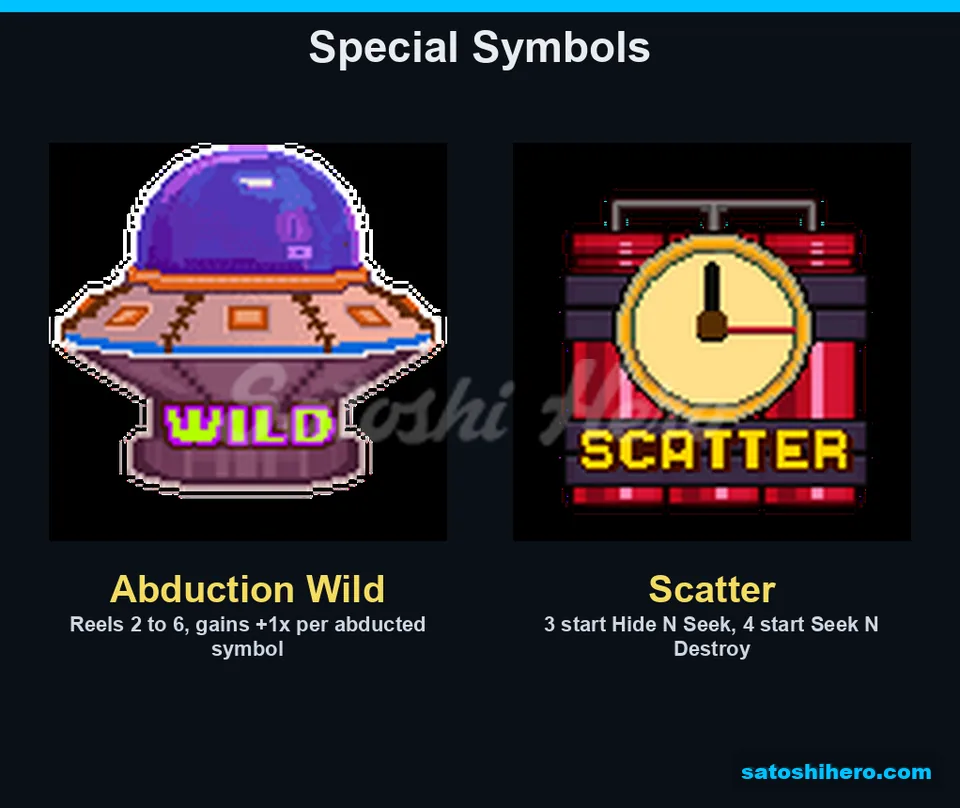
That rule makes survival more important than the first UFO landing. A one-drop wild can help, but a multi-drop UFO can change the whole spin. In my test, no major Abduction Wild chain arrived, so the feature showed more promise than payout. The UFO matters more when it survives than when it appears once.
Hellfire Multipliers
Hellfire turns Chopper symbols into directional multiplier shots, but it needs three or more Choppers before the feature starts. The mechanic can make the board feel dangerous fast, though it still needs the right symbol layout.
Chopper symbols
Choppers land on reels 2 to 5 and carry multipliers from 2x to 10x. Three or more Choppers trigger Hellfire, where each one fires its multiplier along set directions. Those shots add value to wilds and paying symbols in their line.
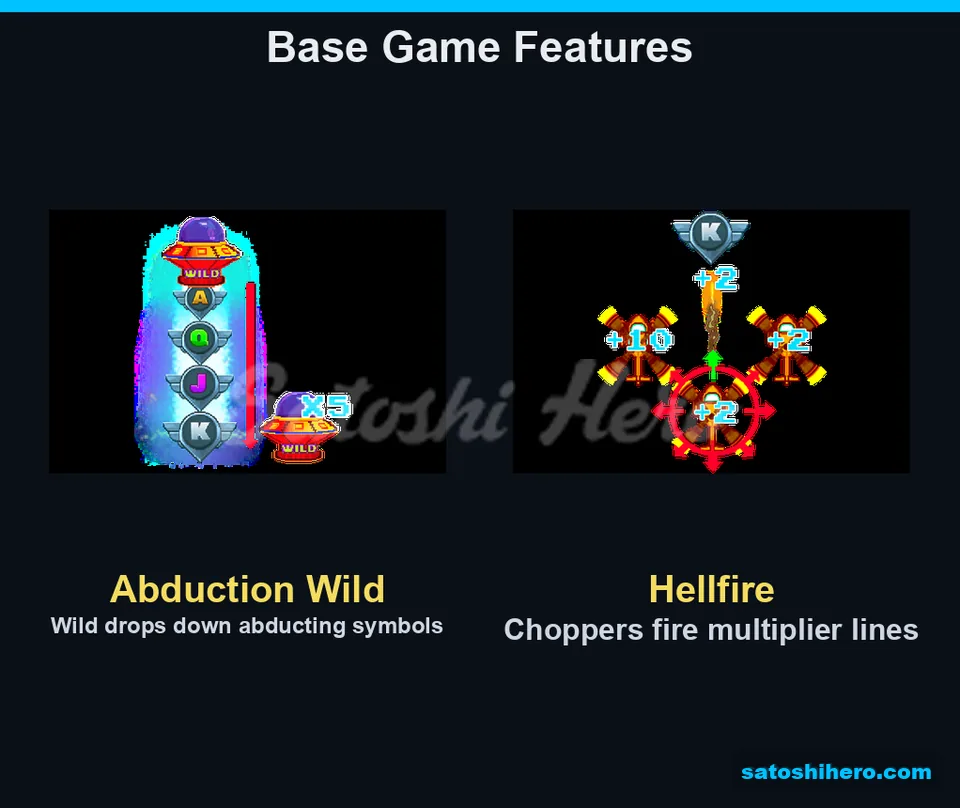
Numbers indicate why this feature can look better than it pays. A 10x Chopper sounds strong, yet it needs useful targets in its firing path. Nine to Five offers steadier pacing by comparison, while Space Donkey slot asks you to accept sharper multiplier bursts. I prefer the drama here, but it can tease hard.
Firing directions
The first Chopper fires in one direction, the second fires in two directions, and the pattern expands from there. More Choppers can cover more of the grid, so the best moments need both quantity and placement. You want the shots to cross paying symbols or wilds, not empty value.
My session didn’t hit a major Hellfire chain. The feature showed potential, but the profit never matched the noise on screen. That’s a fair snapshot of the base game: exciting tools, cold math, and a lot of waiting. Hellfire looks dangerous, but it pays strongly only when Choppers and symbols line up well.
Hide N Seek Bonus
Hide N Seek is the cheaper bonus mode, and it plays like a grid-walk chest hunt rather than standard free spins. Three Scatter clocks trigger it, or you can buy it for 79x the bet, which cost $79.00 at my $1.00 stake.
Trigger and buy
The bonus uses a 6×6 wraparound area, and Scatters become traps. The monkey receives a direction and number of steps each turn, then walks the grid to collect chest values. You get three lives at the start, and the round ends when they run out.
That format gives the mode a board-game feel. You can follow the monkey’s path, count the danger squares and understand why a round ends. I like this much more than plain free spins, because the movement gives each turn a visible reason.
Chest collection
Grey chests can award an extra life, a multiplier, an upgrade or nothing. Golden chests award a multiplier, while the Magician, King, Princess and Stone Monster can boost or collect chest values. The round has enough moving parts to feel interactive without becoming unreadable.
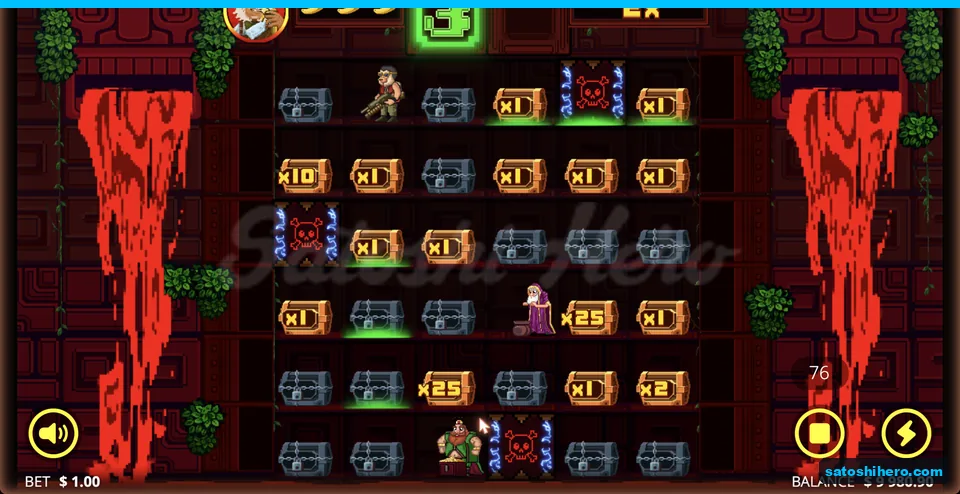
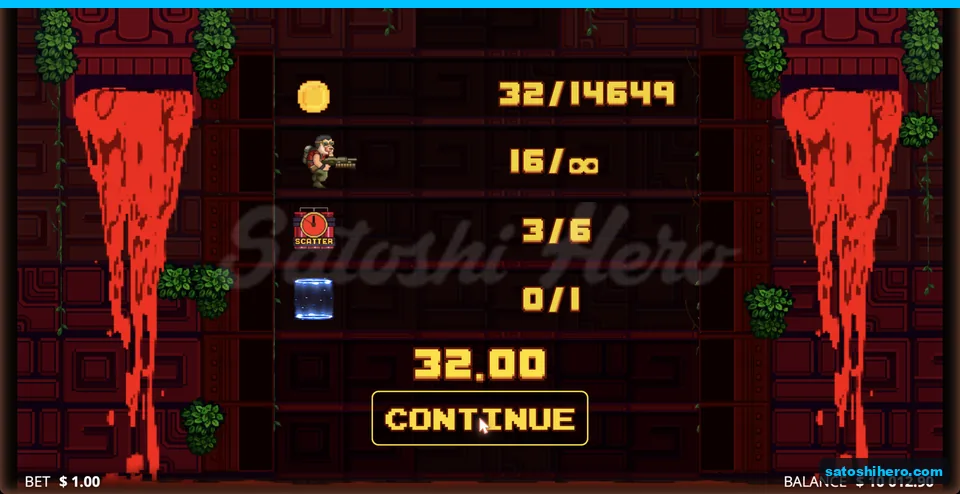
My natural Hide N Seek trigger arrived around spin 190 and paid $32.00, or 32x the $1.00 bet. That result felt modest, but the format kept me interested because each move had a clear purpose. The Space Donkey demo on SatoshiHero helps you learn this movement-and-chest format before using a real balance. Hide N Seek is the more bankroll-friendly interactive bonus.
Seek N Destroy Bonus
Seek N Destroy is the bigger, flashier bonus, but the 272x buy cost makes it much riskier than Hide N Seek. Four Scatter clocks trigger it, and extra Scatters add monkey shields.
Weapons and aliens
The mode runs on a 5-row, 6-column shooter grid. The monkey jumps to a random row each turn and fires the Link Gun, Laser Gun, Nuke or Rail Gun. Aliens carry multipliers, and killed alien value gets multiplied by its column multiplier.
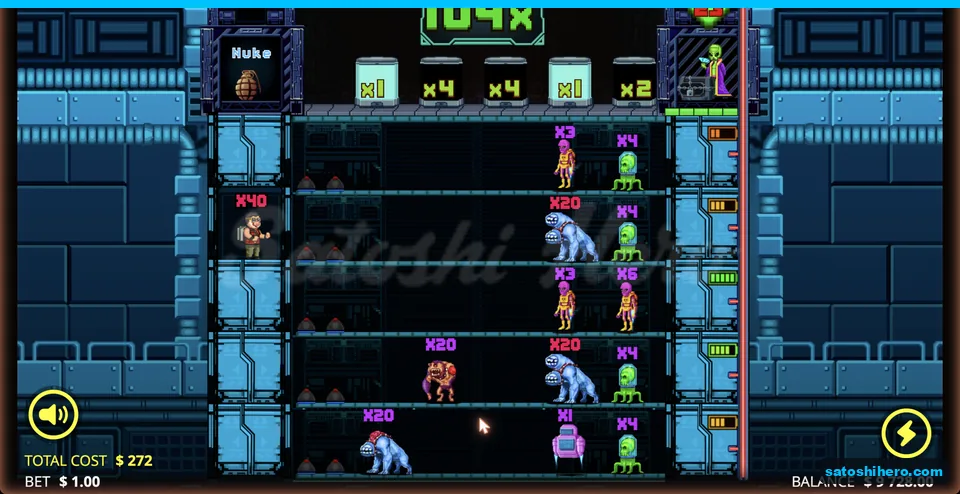
Destroying a launcher tube pays 100x the bet. That target gives the mode a clear focal point, which I like. You can see why each shot matters, and the weapons give the bonus more personality than a passive pick round. The trade-off comes from the entry cost, because one weak round can hurt fast.

Key Stat: Destroying a launcher tube pays 100x the bet, making launcher hits one of the clearest targets in the mode.
Bought result
I bought Seek N Destroy for $272.00 on a fresh $10,000.00 balance. It returned $149.00, or 149x, across 13 alien kills with column multipliers up to x4. The round had action, but the result still finished below the buy price.
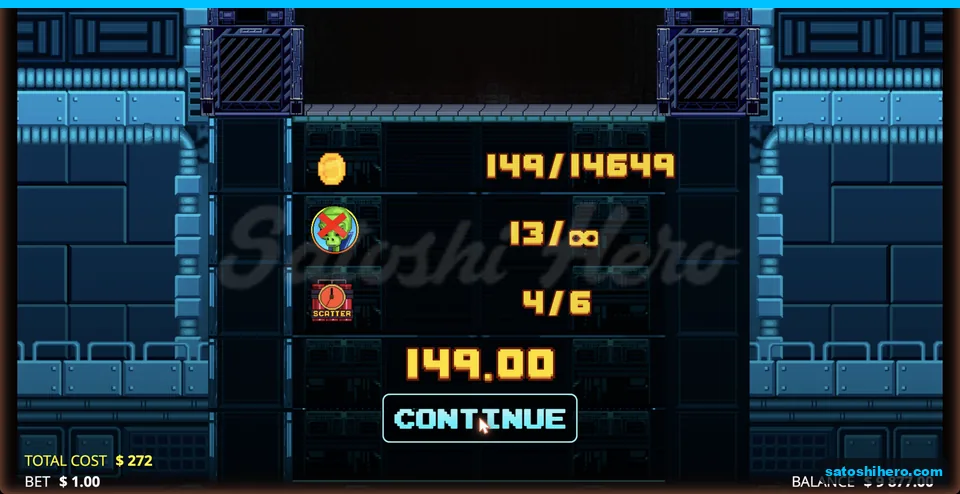
That outcome captures the mode well. Seek N Destroy feels more explosive than Hide N Seek, yet it doesn’t give you a safer path. You’re paying for a bigger swing and a stronger spectacle, not a smoother balance curve. Space Donkey slot puts the larger punch here, but not the calmer route.
Bonus Buy Testing
The bonus-buy menu gives you three routes into the features, but my tested results show why you should treat them as high-risk shortcuts. You can buy Hide N Seek for 79x, Seek N Destroy for 272x or a weighted draw ticket for 143x.
Buy menu
At my $1.00 stake, those prices were $79.00, $272.00 and $143.00. The weighted draw ticket randomly picks one of the two modes, which adds variety but removes your direct choice. I’d only use it if you genuinely accept either outcome.
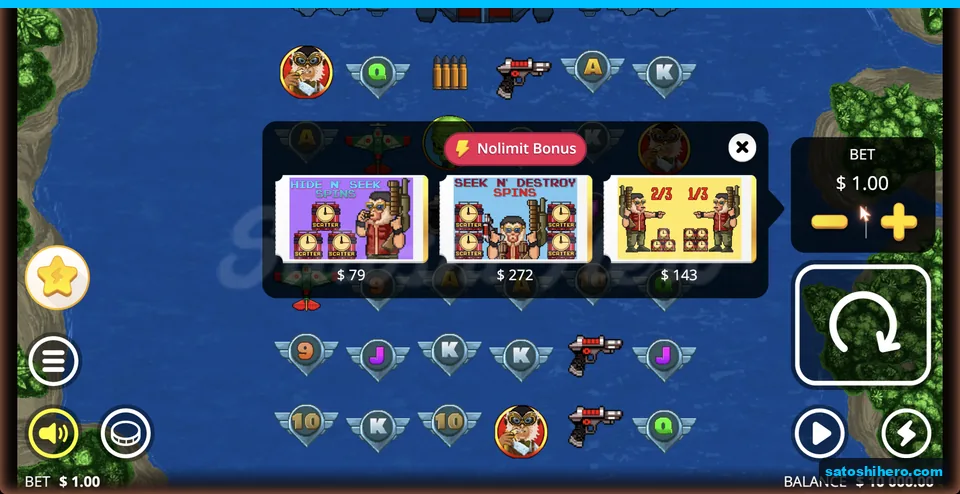
The menu adds control over feature access, yet it doesn’t soften the volatility. You skip the wait, but you still face the same uneven bonus outcomes. That’s an important difference, because buying a feature can feel decisive while the math stays brutal.
Tested returns
The natural Hide N Seek bonus paid $32.00, or 32x. The bought Seek N Destroy paid $149.00, or 149x, from a $272.00 buy. Both results landed well under the 14,649x ceiling.
Numbers indicate a simple split. Hide N Seek asks less from your bankroll, while Seek N Destroy demands a bigger upfront hit for a more explosive shooter-style round. I won’t call either route better value from one test. The buys add control, but they don’t remove volatility.
Warning: The tested 272x Seek N Destroy buy returned 149x, so bonus buys need a bigger bankroll buffer. You can lose ground quickly even after reaching the feature.
RTP, Volatility & Our Test
Space Donkey slot has 96.07% RTP, high volatility and a 14,649x maximum win, so short sessions can finish far above or below expectation. The base game stays active through avalanches, but the bigger results depend on bonus spikes and multiplier chains.
Simulator projection
Our simulator ran a 1,000-spin model at $1.00 using the published math profile. The median session finished about $68.10 down, with a middle 90% band from about $320.40 down to $362.80 up. A feature landed about once every 45 spins, while a 100x+ win appeared about once every 1,757 spins.
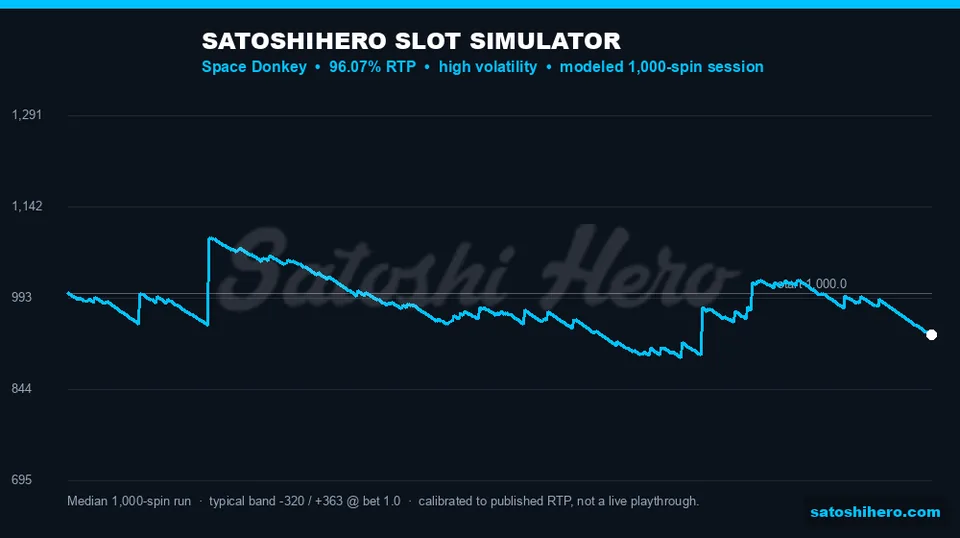
That spread tells you more than the headline RTP alone. The game can keep you engaged with frequent drops, yet the meaningful lifts cluster around rarer events. I don’t mind that style, but you need patience and a firm stop point. Space Donkey slot can grind between rare bonus spikes.
Our 500-spin session
I played 500 spins at $1.00 from a fresh $10,000.00 balance. My ending balance was $9,947.55, which left a net result of -$52.45. A natural Hide N Seek triggered around spin 190 and paid $32.00.
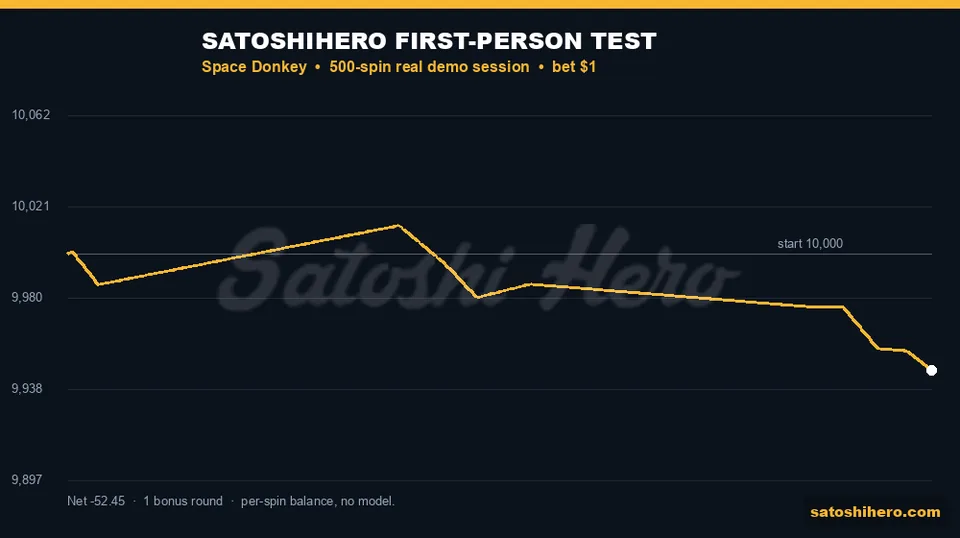
The run felt steady rather than wild. Small monkey and alien wins kept the base game moving, but no major Abduction Wild or Hellfire chain arrived. The max win fits the volatility profile, though my test showed how long the game can grind without a premium chain. My tested figures and availability details are checked regularly.
The 96.07% RTP is the operator-published theoretical return figure. A single 500-spin session doesn’t prove or disprove that return. Bonus-buy returns and individual feature results can sit above or below the base game in the short term by design.
Frequently Asked Questions About Space Donkey
How does the avalanche work in Space Donkey slot?
Space Donkey slot pays through 46,656 ways across a 6×6 grid. Winning symbols disappear, new symbols drop in, and a single spin can pay several times. The Abduction Wild also moves down after a winning drop and gains +1 for each abducted symbol.
How do you trigger the bonuses in Space Donkey slot?
Three Scatter clocks trigger Hide N Seek, which turns the grid into a chest-collecting walk. Four Scatter clocks trigger Seek N Destroy, where the monkey shoots aliens carrying multipliers. Extra Scatters add monkey shields in Seek N Destroy.
Can you buy the bonuses in Space Donkey slot?
Yes, the bonus-buy menu offers three options. Hide N Seek costs 79x the bet, Seek N Destroy costs 272x and the weighted draw ticket costs 143x. At my $1.00 stake, those prices were $79.00, $272.00 and $143.00.
What is the RTP and top win of Space Donkey slot?
The RTP is 96.07%, and the maximum win is 14,649x your bet. The volatility rating is high, so the base avalanche can grind while the bonuses carry the larger pays. You should expect uneven sessions.
What happened in your 500-spin test of Space Donkey?
I started with $10,000.00 and finished at $9,947.55. That left a net loss of $52.45 over 500 spins at $1.00. One natural Hide N Seek trigger paid $32.00, but no premium wild or Hellfire chain followed.
What did the Seek N Destroy bonus pay in Space Donkey?
The bought Seek N Destroy round cost $272.00 and returned $149.00, or 149x the bet. It produced 13 alien kills with column multipliers up to x4. The result felt lively, but it still finished under cost.
Is there a Space Donkey demo on SatoshiHero?
Yes, you can try the Space Donkey demo on SatoshiHero before real play. That helps because Hide N Seek and Seek N Destroy use unusual movement and shooter mechanics. A few demo rounds make the bonus logic easier to follow.
Is Space Donkey slot a high-volatility slot?
Yes, the official volatility is high. The simulator and my live test both showed a game that can grind before bonus spikes. You get plenty of movement, but the stronger results need feature or multiplier support.
Final Verdict
Space Donkey stands out because it turns Nolimit City grid math into a loud arcade fight. The main drawback is clear: the game can look busy while your balance barely moves. Space Donkey rewards patience more than casual short sessions.

My Take
I’d play this when I want interactive bonus modes and don’t mind a rougher balance curve. Expect small avalanche movement, then wait for UFO, Chopper or bonus pressure to matter. Keep stakes modest unless you’re prepared for a cold run.
I like the Hide N Seek format because it gives every move a visible purpose. I don’t like how easily the $272.00 Seek N Destroy buy can return less than cost. My 500-spin session felt fair, but it never found the premium chain needed to break away.
Space Donkey slot is strongest as a tested feature game, not as a calm base-game grinder. The checked regularly note matters here because bonus costs, demo access and real-play availability need to stay accurate.

Pros:
 Distinct bonus design: Hide N Seek and Seek N Destroy feel genuinely interactive.
- Clear ways system: The 6×6 grid keeps wins easy to follow.
- Strong theme fit: Pixel warfare matches the wilds, weapons and aliens well.
- Useful test data: Real $ results show how uneven sessions can feel.

Cons:
 High variance: Cold stretches can drain small bankrolls before features help.
- Costly shooter buy: Seek N Destroy needs a large upfront spend.
- Modest test returns: Both tested bonus results finished below major-win territory.

Best For: Bonus hunters, Nolimit City fans and patient grid-slot players get the most from this game. You’ll enjoy it more if you like interactive features, volatile swings and cartoon sci-fi chaos. If you want steady line-style pacing, this one may feel too spiky.






















































Bets
All Bets
Game
Player
Date
Wager
Mult.Multiplier
Prize
 Luck of Panda: Bonus Combo
 Hidden
- 18:33:57
- 0×
- San Chong Baozha Blue: Bonus Combo
 mike_721
- 18:33:57
- 0×
- Luck of Panda: Bonus Combo
- Hidden
- 18:33:54
- 0×
- San Chong Baozha Blue: Bonus Combo
- mike_721
- 18:33:54
- 0×
- Luck of Panda: Bonus Combo
- josh1998
- 18:33:53
- 0×
- Galaxy Glitter
- mdp0fxo
- 18:33:52
- 0×
- Blazing Stallion
 whodey39311
- 18:33:51
- 0×
- Luck of Panda: Bonus Combo
- Hidden
- 18:33:51
- 17.5×
- San Chong Baozha Blue: Bonus Combo
- mike_721
- 18:33:51
- 0×
- Blazing Stallion
- whodey39311
- 18:33:49
- 0×