

Reapers
By pressing play, you agree that you are above legal age in your jurisdiction and that your jurisdiction allows online gambling.


Robot Collectors Chasing a Brutal Grid Payday
Reapers slot throws robotic collectors onto a hostile grid, clearing critters, charging barriers, and chasing a 20,000x max win. Reapers is a high volatility slot from Print Studios with 96.47% RTP and 20,000x max win potential. The game uses an 8×8 cluster-pay grid with no fixed paylines, plus Energy Cells, Charges, barriers, and a demanding Bonus Game. Patient grid-slot fans get the most value here if they can handle long quiet stretches.
Key takeaways
- Best bonus: The main goal is to collect Energy Cells, earn Charges, clear 15 barriers, and reach the Bonus Game.
- RTP / volatility: Reapers is an 8×8 cluster-pay slot from Print Studios with 96.47% RTP and high volatility.
- Max win: The maximum win is 20,000x, and the route there runs through a tough barrier system.
- Risk note: In my 100-spin test, one $86.28 round rescued a long leak and left me $39.76 up.
- Bankroll note: High volatility plus slow barrier progress means small cluster wins often won’t cover spin cost.

Snapshot: Reapers uses cluster pays on an 8×8 grid, so you shouldn’t describe it as a paylines slot.

Table of Contents
- How Reapers slot Works
- Cluster pay basics
- Symbol values
- Barriers and Charges
- Barrier groups
- Charge costs
- Reapers and Collecting
- Energy Cells
- Charge building
- Special Abilities
- Power Core triggers
- Ability effects
- Bonus Game
- Juggernaut Reaper
- Level unlocks
- Feature Buy
- Buy range
- Test limits
- Theme and First Impressions
- Sci-fi setting
- First spin feel
- Reapers slot RTP, Volatility & Our Test
- Simulator projection
- Our 100-spin session
- Frequently Asked Questions About Reapers
- Where I Land
How Reapers slot Works
Reapers slot works through cluster pays on an 8×8 grid, not fixed paylines. You need groups of 5 or more matching critters to trigger standard wins, then collectors can add extra value by gathering nearby matching symbols.
Cluster pay basics
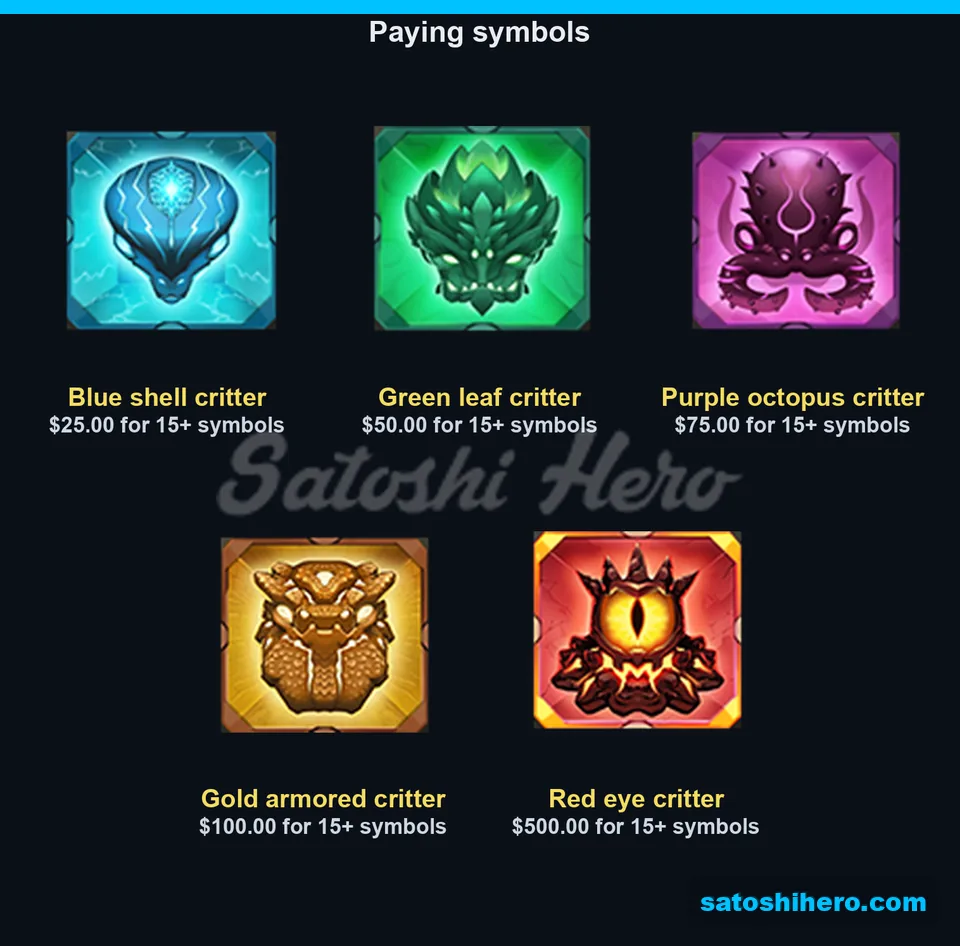
The board has 64 positions, and every spin builds wins from connected critter tiles. The five paying critters are blue shell, green leaf, purple octopus, gold armoured critter, and red eye. A cluster of 5 or more always pays, while smaller groups of 1 to 4 only pay when a matching collector grabs them. That rule matters, because you can’t judge this grid slot like a simple lines game.
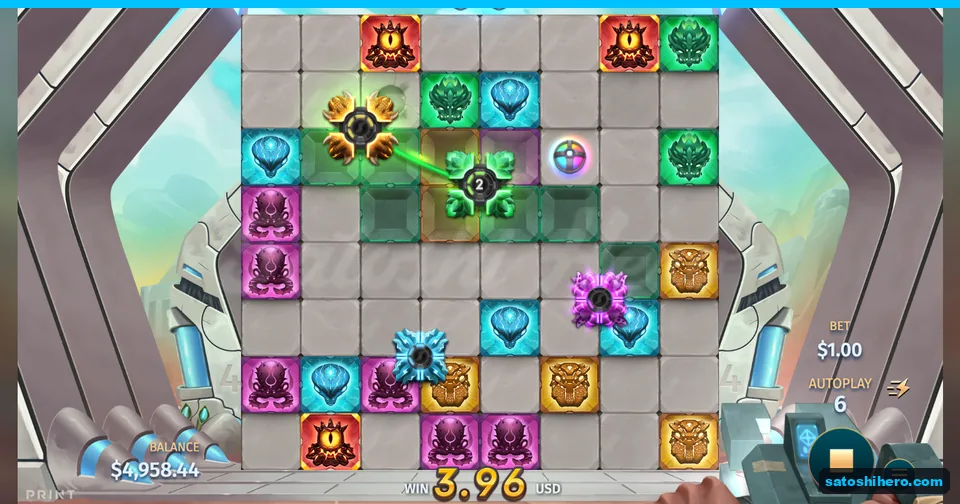
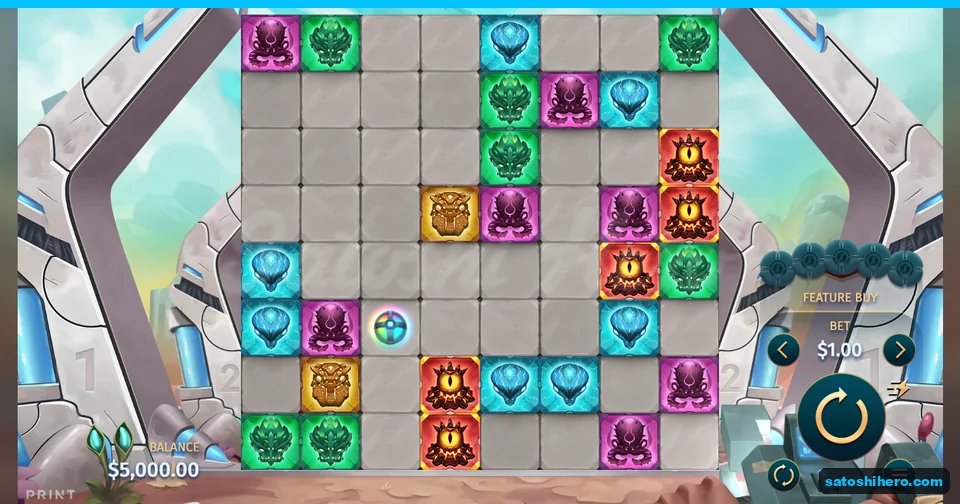
You should watch the collector position as much as the cluster itself. When a Power Core appears, it shows as a round rainbow disc, and a collector that grabs it gains a power-up. The grid layout stays readable on desktop and mobile, though the barrier and collector details need closer attention on small screens. I like the system, but it asks more focus than a plain spin-and-wait slot.
Symbol values
At a $1.00 bet, a 15+ cluster pays $25.00 for blue, $50.00 for green, $75.00 for purple, $100.00 for gold, and $500.00 for red. A 10 to 11 cluster pays $5.00, $6.00, $10.00, $20.00, and $50.00 in the same order. A 5-symbol cluster pays $0.20, $0.40, $0.60, $0.80, and $1.00. Those low-end wins explain why many paid spins can still feel flat.
Smaller collected groups pay $0.04 to $0.16 per symbol, which helps only when the collector chain grows. You may enjoy this if Royal Potato 2 appeals to you through layered grid action and feature-heavy decisions. The bottom line is simple: cluster wins start the action, but collectors decide whether a spin has real movement.
Barriers and Charges
Barriers are the real progression system in this game. You need Charges to shut down 15 stacked grids before the Bonus Game can start, and that’s why the bonus doesn’t arrive quickly.
Barrier groups
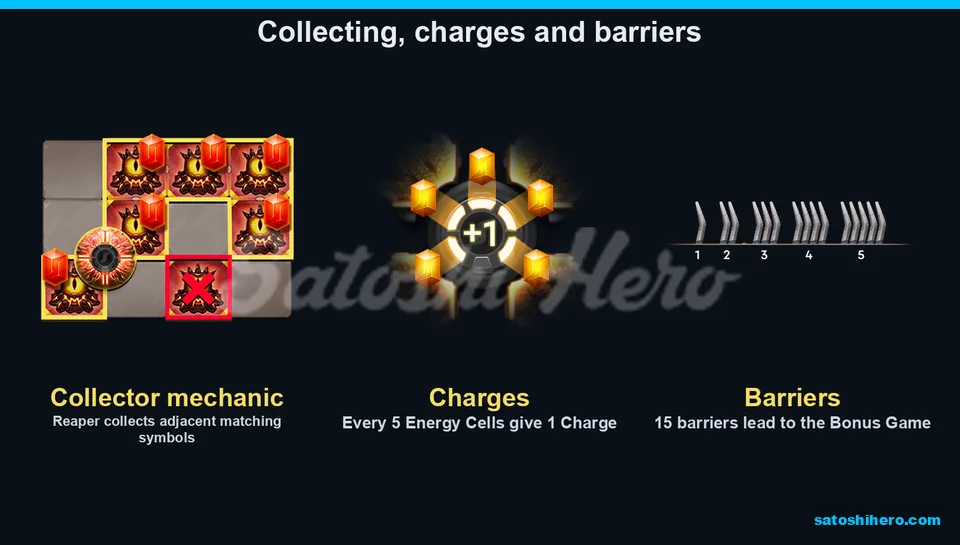
The base game uses 15 barriers grouped as 1, 2, 3, 4, and 5. Each barrier holds its own symbol grid, stacked in front of the next one. When you remove one grid, the next barrier becomes active. Practically speaking, you’re not just looking for a win, you’re trying to cut deeper into the stack.
That structure gives the game a strong sense of progress, but it can also test your patience. A few small wins don’t mean you’ve made serious headway. In my session, I often saw minor pays without feeling close to the destination. You need to track the barrier stack, not just the last payout.
Charge costs
Shutting down barriers costs Charges by group. Groups 1 and 2 need 1 Charge, group 3 needs 2 Charges, group 4 needs 3 Charges, and group 5 needs 6 Charges. Clearing all 15 barriers triggers the Bonus Game. The later groups explain why a good early run can still stall before the main feature.

Pointer: Watch Charge progress more than individual tiny wins. Charges are what move you toward the Bonus Game, while small pays may only soften the cost.
If you’re asking why the bonus isn’t showing quickly, the answer sits in those rising Charge costs. The structure feels demanding, not unfair, because it makes each deep round matter. I prefer that to random scatter fishing, though it won’t please impatient players. Charges connect directly to collectors, so the next layer matters even more.
Reapers and Collecting
The collectors turn cluster wins into progress. When a cluster of 5 or more appears, the matching-colour collector lands beside it and collects adjacent matching symbols.
Energy Cells
Collected symbols become Energy Cells, and those Energy Cells pay right away. A matching collector can grab adjacent matching symbols and matching clusters, so position matters on every grid. If the board gives you useful neighbours, a small cluster can grow into a stronger collecting round. If it doesn’t, the spin can end with very little bite.
I played at $1.00, and small cluster wins often didn’t cover the spin cost. That wasn’t surprising for a high volatility grid slot, but it did make cold patches feel slow. The best moments came when collectors stayed useful across multiple grids. That’s where the game feels smarter than most basic cluster slots.
Charge building
Every 5 Energy Cells enables 1 Charge. A collector stays in play until the round ends or the Bonus Game starts, which gives longer chains real value. The collection system feels more interesting than most grid slots, but it can feel stingy when the board gives you short chains. You need repeat action, not just one neat cluster.
Shinobi Spirit offers a useful comparison if you like repeated feature actions and chain-style progress. This game feels more mechanical and less flashy, but both reward patience during building phases. What matters here is how often the collectors create Charges from the board. Power Cores then decide whether the chain has another gear.
Special Abilities
Special abilities start when a collector grabs a Power Core. The boost lasts until the round ends, so timing matters more than the name of the power.
Power Core triggers
A Power Core is the round rainbow disc on the grid. When a collector gathers it, that collector gains its special ability for the rest of the round. You don’t get a guarantee of deep progress from a Power Core, but it can improve the shape of a collecting chain. I like that restraint, because the feature feels meaningful without pretending every trigger is huge.
The most useful boosts depend on board shape. A flashy multiplier may look better, but collection range and linking can matter more when barriers still stand. You should judge each power by how it helps Charges, not by how dramatic it sounds. That’s the practical way to read this feature.
Ability effects
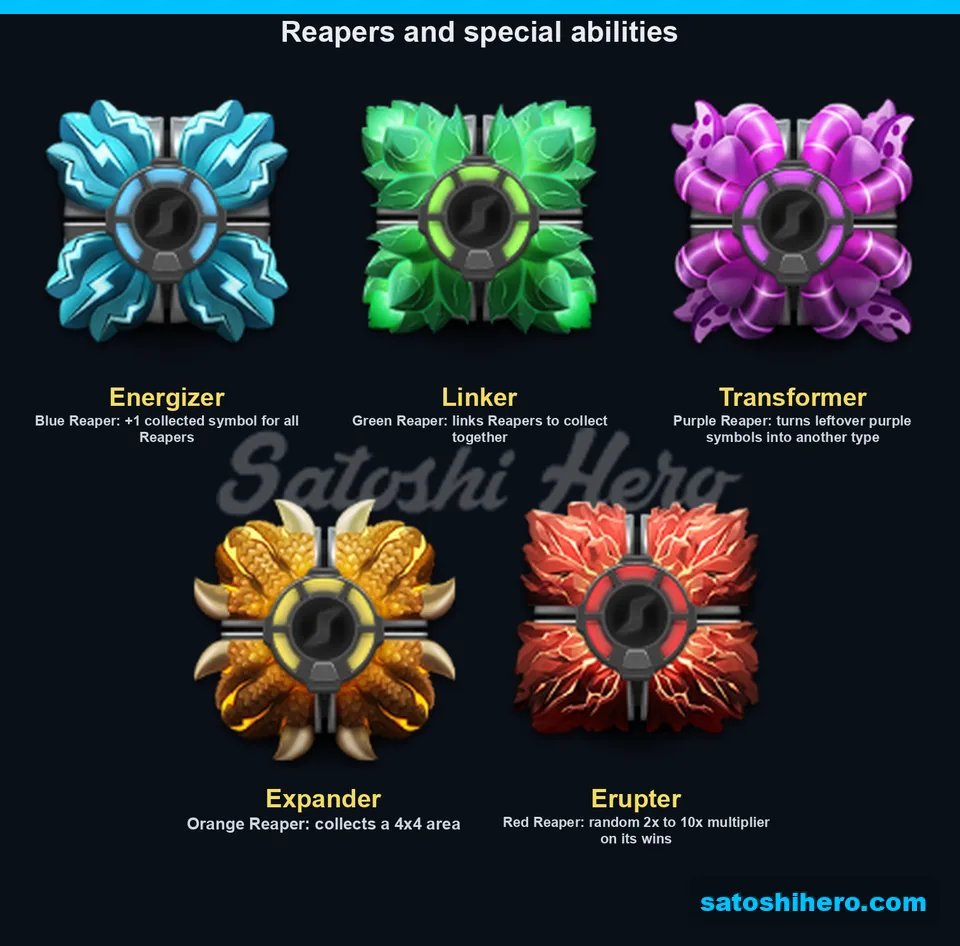
The blue Energizer makes every collector generate one extra Energy Cell, once per grid. The green Linker connects collectors so they collect from each other. The purple Transformer changes remaining purple symbols into another symbol type after it finishes collecting. The orange Expander widens its collection area to 4×4.
The red Erupter applies a random 2x to 10x multiplier to all its wins, with the multiplier refreshed at the start of each grid. Erupter looks flashiest on paper, but Linker and Expander may feel more useful when you want longer collection chains. I don’t treat these as shortcut buttons. They matter most when they help build Charges and keep the round alive.
Bonus Game
The Bonus Game starts only after all 15 barriers are cleared. It then processes 5 levels of automatic symbol grids around the Juggernaut Reaper, which makes it the main destination feature.
Juggernaut Reaper
The Juggernaut Reaper collects every symbol and cluster in or touching a 4×4 centre area. Clusters of 5 or more always count, and the grids process automatically. Each level contains 75 symbol grids, so the feature has a clear machine-like rhythm. That fits the industrial theme better than a manual pick bonus would.
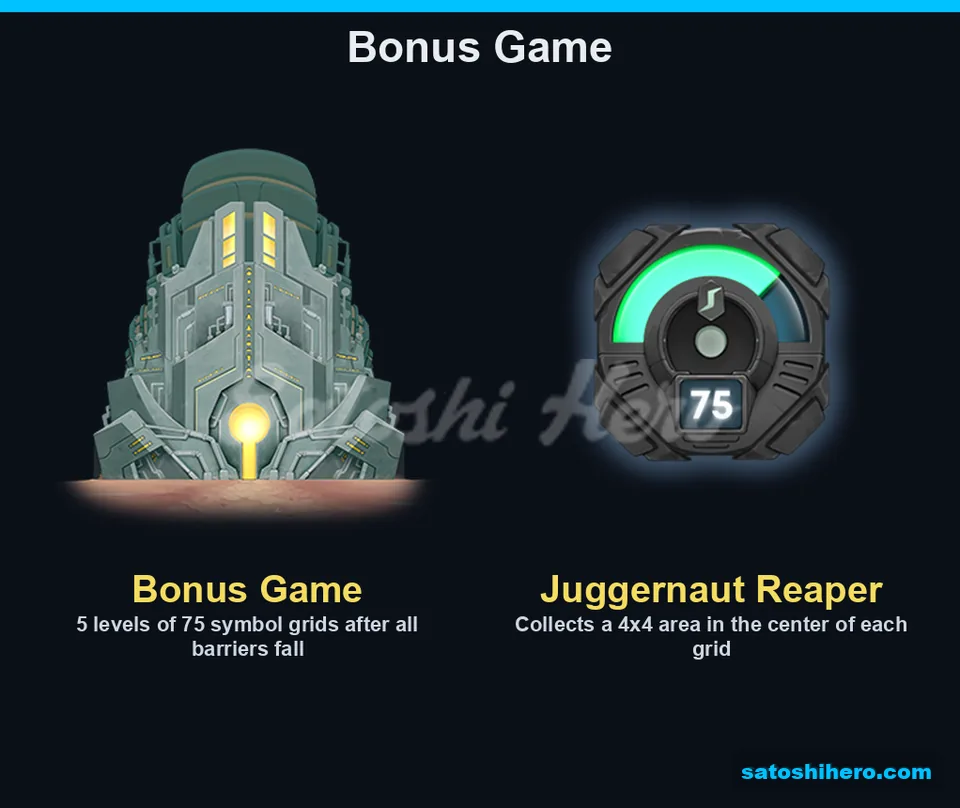

Background: The Bonus Game processes 75 grids per level automatically, so the theme feels like a facility sweep rather than a pick-and-click bonus.
I didn’t trigger the Bonus Game in my 100-spin session. That result fits the high volatility profile and the barrier structure. You can see the feature goal from the start, but reaching it takes real grid movement. I prefer that transparency, even if the wait can feel harsh.
Level unlocks
The Bonus Game can run through 5 levels, and each new level needs enough collected symbols. Level 2 needs 430 collected symbols, level 3 needs 520, level 4 needs 590, and level 5 needs 790. One critter gets removed with each new level, which should make later grids cleaner. The structure gives the feature a strong escalation path.
You play the base game mostly to build toward this feature, but you may not see it quickly. That’s the core trade-off. The bonus has scale, yet the entrance gate is strict. If you’re playing short sessions, you need to accept that the best-looking feature may stay out of reach.
Feature Buy
The Feature Buy lets you pay for a stronger first grid, but it wasn’t part of my hands-on test. That matters because my observed results came from normal $1.00 spins.
Buy range
The Feature Buy tab guarantees between 1 and 5 Collectors on the first grid. The cost range runs from 3.40x to 425.00x the bet. That’s a wide spread, and the top end demands a serious bankroll. I wouldn’t treat the buy as a casual shortcut.
Base-game wait skippers may find it useful. Still, it doesn’t remove volatility or promise a profitable outcome. You’re paying for a stronger starting state, not a guaranteed deep run. That distinction matters when the top option costs so much.
Test limits
I didn’t use the Feature Buy during my first-person session. My results came from normal spins at a $1.00 stake, with no buy used and no Bonus Game triggered. That keeps the test clean, because it shows the base game without paid acceleration. I won’t invent buy outcomes from a mode I didn’t play.

Heads Up: Because Reapers slot is high volatility, buying into a stronger start doesn’t remove the risk of a poor return. Treat the 425.00x option as a serious bankroll decision.
If you use the buy, set the stake before you look at the higher prices. A small base stake can turn into a large single decision fast. The feature has a clear purpose, but the price range changes the risk profile. Next, the theme explains why all this barrier clearing fits the game.
Theme and First Impressions
The theme puts you on a distant planet where an extraction facility has been overrun by critters. You control robotic clean-up collectors, which fits the barrier-clearing mechanics well.
Sci-fi setting
Print Studios’ sci-fi slot uses a stone-and-metal look, with stacked barriers giving the grid depth. Each spin starts on a barrier stack, and you work down toward the facility. The robotic collectors act like a clean-up crew, removing critters and harvesting Energy Cells. That setup ties the theme to the mechanics better than I expected.
The theme won’t win points for warmth or character charm. It feels cold, mechanical, and a little grim. That tone works because the game is about clearing layers, not telling a friendly adventure story. Tarasque may appeal more if you prefer darker creature-led themes with a less mechanical frame.
First spin feel
The first spins feel busy because you’re watching clusters, collectors, barriers, and Charge progress. You need a few rounds before the grid language clicks. Once it does, the design becomes easier to read, though the small symbols still need attention on mobile. I’d call the presentation functional rather than beautiful.
What matters here is how the art supports the game loop. The stone barriers show progress clearly, and the collectors make the grid feel active. I don’t love every visual choice, but the industrial sci-fi execution fits the math and feature structure. The next section shows how that structure behaved in testing.
Reapers slot RTP, Volatility & Our Test
The official RTP is 96.47%, volatility is high, and the maximum win is 20,000x. The test showed that risk clearly: a long leak turned positive only after one stronger late round.
Simulator projection
The SatoshiHero Slot Simulator ran 1000 spins at a $1.00 stake using 96.47% RTP, high volatility, and a 20,000x cap. The median session ended $64.20 down. The p5 to p95 band ran from $317.60 down to $368.50 up. That spread says more about session risk than any slogan could.
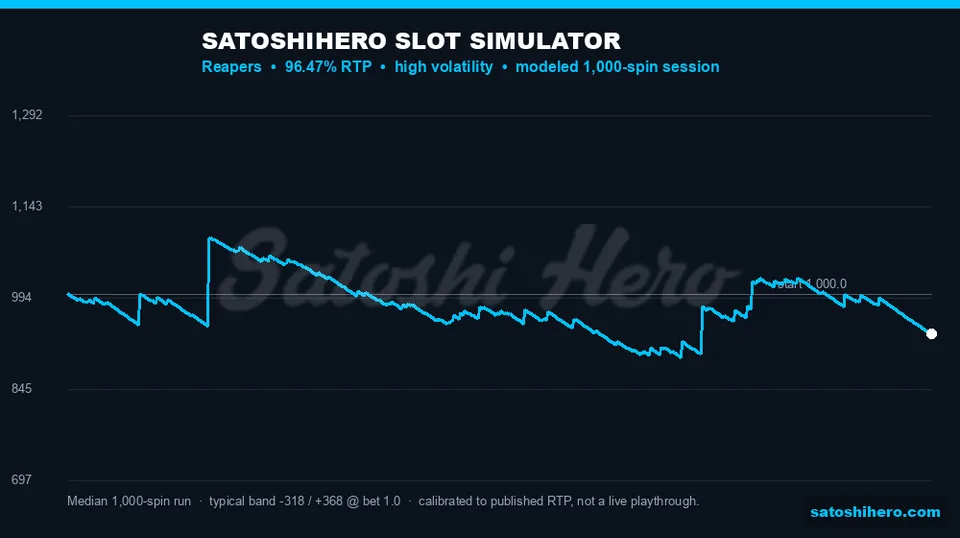
About 18 in 100 spins pay in the projection. A feature-tier win appears roughly once in 45 spins, while a big win appears about once in 1742 spins. The simulator can’t predict real RNG or your next session. It helps frame the shape of variance before you risk money.
Win-O-Mart gives a lighter session feel if you’d rather avoid a tougher sci-fi barrier grind. Here, the route to the top result feels ambitious rather than easy to chase. A round ends when the 20,000x cap is reached, but reaching that type of outcome asks a lot from the grid. I respect the upside, yet I wouldn’t call it friendly.
Our 100-spin session
I played 100 spins at $1.00 with turbo on, starting from a $5,000.00 demo balance. I finished at $5,039.76, which made the session a $39.76 gain. For about 90 spins, my balance leaked down toward $4,954. Then one deeper round through the group 5 barriers paid $86.28 and flipped the result.
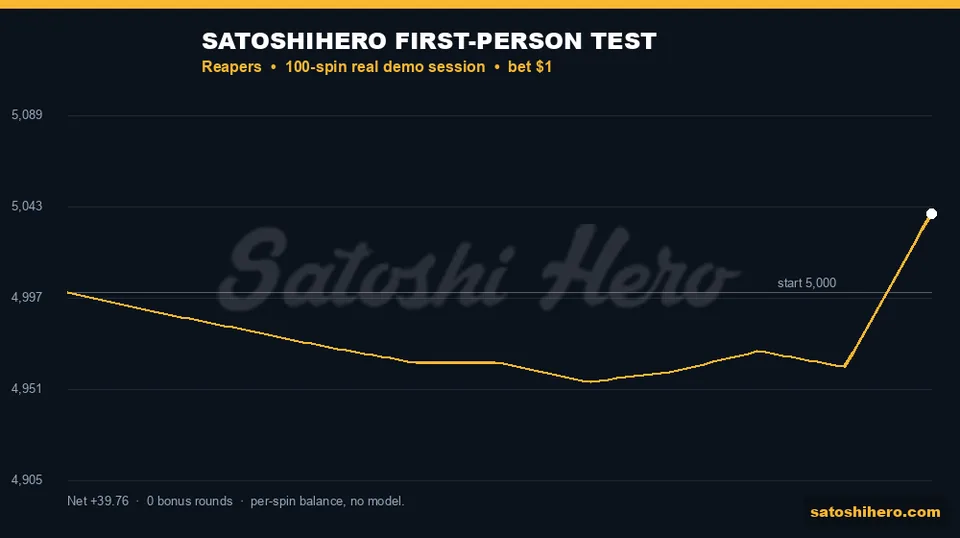
That single hit carried the session. Small cluster wins rarely covered the $1.00 spin cost, so the early stretch felt like slow bleed. No Bonus Game appeared in 100 spins, which matched the number of barriers required. The max win is large, but the route through the barrier stack feels demanding.
The game uses an 8×8 cluster-pay grid with no fixed paylines. You need to judge it by collections, Energy Cells, and Charges, not by line-hit rhythm. The theoretical RTP is the operator’s published return figure, while one live test session doesn’t change that number. Simulator output is a model, not a prediction, and bonus or buy configurations can differ by design.
Frequently Asked Questions About Reapers
How does the Reapers slot work?
Reapers slot works on an 8×8 cluster-pay grid. Clusters of 5 or more always pay, and a matching collector then gathers adjacent matching symbols. Every 5 collected symbols give a Charge, and Charges shut down barriers on the way to the Bonus Game.
What is the RTP and volatility of Reapers slot?
The RTP is 96.47%, and volatility is high. The maximum win is 20,000x, and the game uses cluster pays instead of fixed paylines.
What do the Reapers slot special abilities do?
Each collector powers up when it collects a Power Core. Energizer adds Energy Cells, Linker connects collectors, Transformer changes leftover purple symbols, Expander collects a 4×4 area, and Erupter applies a random 2x to 10x multiplier to its wins.
How do you reach the Bonus Game in Reapers slot?
You shut down all 15 barriers. The barrier groups need 1, 1, 2, 3, and 6 Charges, and a Charge comes from every 5 symbols collected. The Bonus Game then plays up to 5 levels of 75 grids.
What did the 1000-spin simulator show for Reapers?
At a $1.00 stake, the median session ended $64.20 down. The p5 to p95 band ran from $317.60 down to $368.50 up, and the model can’t predict real play.
How did my 100-spin Reapers slot test go?
I played 100 spins at $1.00 and finished at $5,039.76 from a $5,000.00 start. That gave me a $39.76 gain, with one $86.28 round carrying the result and no Bonus Game trigger.
Where I Land
Reapers stands out because its collectors, barriers, and Charges create a real progression puzzle. The main drawback is obvious: the Bonus Game takes work to reach, and short sessions can feel dry.

My Take
Patient bankroll managers get the most from this grid slot. Expect long flat patches, small cluster pays, and occasional rounds where the collector system finally shows its teeth.
I like how the collectors give every good cluster a second job. I don’t like how many early paid spins failed to cover the $1.00 cost. My best hit came late, and without that $86.28 round, the session would have looked much harsher.
Testing notes and game details are checked regularly and updated periodically when the playable version changes. If you try Reapers slot on SatoshiHero, treat it as a high volatility grid grind rather than a quick bonus chase.

Pros:
 Clever collector system: Energy Cells make cluster wins feel more active.
- Clear progression: Barriers show exactly how far you’ve pushed.
- Strong upside: The 20,000x cap gives risk hunters a large target.
- Theme fit: Robotic clean-up links neatly with the grid-clearing loop.

Cons:
 Slow bonus access: Fifteen barriers can keep the main feature distant.
- Small pays sting: Many early wins may not cover a $1.00 spin.
- Costly buy ceiling: The 425.00x option can pressure weak bankrolls fast.

Best For: High-volatility hunters and grid-mechanic fans get the clearest value here. You’ll enjoy it more if you track Charges, accept dry stretches, and don’t need the Bonus Game to appear quickly.




















































Bets
All Bets
Game
Player
Date
Wager
Mult.Multiplier
Prize
 Luck of Panda: Bonus Combo
 Hidden
- 18:33:21
- 0.19×
- San Chong Baozha Blue: Bonus Combo
 mike_721
- 18:33:21
- 0×
- Galaxy Glitter
- mdp0fxo
- 18:33:19
- 18.5×
- Luck of Panda: Bonus Combo
- Hidden
- 18:33:18
- 0×
- San Chong Baozha Blue: Bonus Combo
- mike_721
- 18:33:18
- 0×
- Luck of Panda: Bonus Combo
- Hidden
- 18:33:15
- 7.1×
- San Chong Baozha Blue: Bonus Combo
- mike_721
- 18:33:15
- 0×
- Egypt Fortunes: Bingo Bounty
- nina87
- 18:33:14
- 0×
- Luck of Panda: Bonus Combo
- josh1998
- 18:33:13
- 0×
- 81 Super Expand: Classic$$erieS
 whodey39311
- 18:33:13
- 0.99×