

Space Gems Rockblocks
By pressing play, you agree that you are above legal age in your jurisdiction and that your jurisdiction allows online gambling.

Space Gems Rockblocks
RTP94.9%
VolatilityLow
Max winx750
Hit rate28.2%
ReleasedDec 2024
Live game stats
Real RTP81.98%
Spins416
Players2
Biggest win$5.05

Mining Bright Clusters on an Alien World
Space Gems Rockblocks is a low-volatility cluster slot from Mascot Gaming, built around repeat Rockfall drops rather than paylines or a conventional bonus round.
Quick Summary: This cheerful sci-fi game uses a 6×6 grid, 94.9% RTP, low volatility, and a 750x maximum win. Frequent small results, linked Rockfall drops, and occasional UFO multipliers drive the pace instead of traditional bonus rounds. The 750x ceiling feels modest, though it matches the gentler math profile.
Space Gems Rockblocks at a Glance
According to Mascot Gaming, Space Gems Rockblocks is a cluster-pays slot with simple rules and a compact feature set. You get steady-looking grid action rather than a hunt for free spins, while the limited prize ceiling keeps expectations grounded.
- Provider: Mascot Gaming, shortened to Mascot below
- Game type: 6×6 cluster-pays slot
- Winning connection: Five or more matching symbols touching along their sides
- Starting demo balance: $10,000.00
- Default demo bet: $1.00
- Features: Rockfall, UFO multipliers, Astronaut coin wins, and the optional Risk Wheel
- Missing traditional elements: No fixed paylines, wild, scatter, free spins, or bonus buy
Every paytable amount and test result uses a multiple of the total bet. You can try the free demo or real-play version directly on SatoshiHero, so the same core rules remain easy to inspect before staking money.
I based this guide on my documented 100-spin session and a separate 1,000-spin model. Those records serve different jobs: my session shows what I experienced, while the model maps a range of possible results. Honestly, the smaller win ceiling matters because you shouldn’t expect a giant jackpot to rescue a weak run.
You can expect a clean cluster game that keeps the board moving without many side modes. I think it makes most sense when steady-looking action matters more to you than a huge prize target.
Key Takeaways
- Best play: Standard spins open every feature; collecting a win is less aggressive than using the Risk Wheel.
- RTP / volatility: The theoretical return is 94.9%, and the volatility is low.
- Max win: The exact cap is 750x the total bet.
- Risk note: The optional Risk Wheel can erase a result you already hold.
- Bankroll note: My balance fell about 16.6x before recovering, so gentle math can’t prevent dips.
These points tell you exactly where the excitement and limits sit. In my view, the collect option deserves more respect than the flashy wheel.

Table of Contents
- Space Gems Rockblocks at a Glance
- How Space Gems Rockblocks Works
- Cluster Rules and Grid
- Symbol Values and Pays
- UFO Multiplier
- Theme and First Impressions
- Rockfall Feature
- Astronaut Coin Wins
- RTP, Volatility and Our Test
- The Simulator Projection
- Our 100-Spin Session
- Risk Wheel
- Frequently Asked Questions About Space Gems Rockblocks
- Wrap-Up
How Space Gems Rockblocks Works
Space Gems Rockblocks pays clusters of side-touching symbols, not fixed paylines. Watch the entire board after every result because one paid spin can launch several Rockfall drops without charging you again.
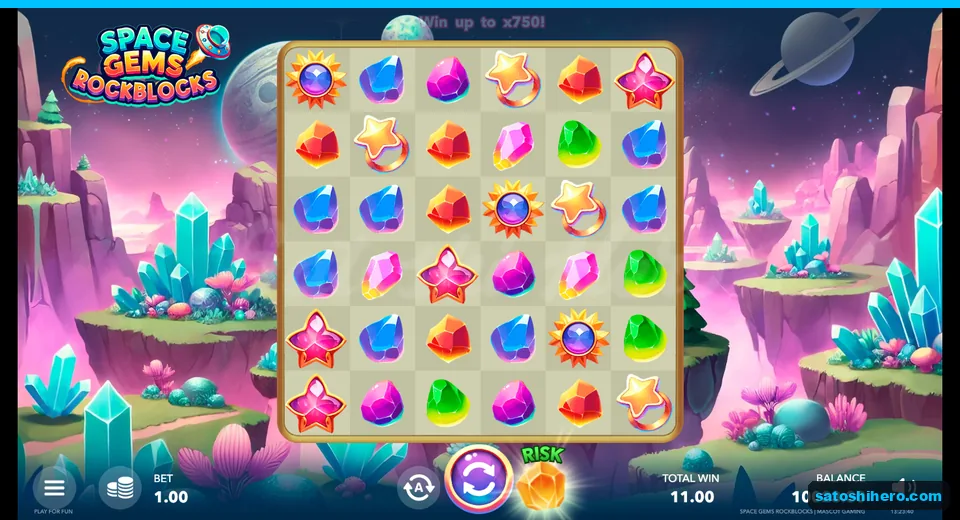
Cluster Rules and Grid
The game places symbols on a 6×6 grid. Matching icons must touch horizontally or vertically, while diagonal contact alone doesn’t build a cluster. You need at least five matching symbols before a regular payout begins.
The paytable increases at six clear cluster sizes:
- 5 symbols
- 7 symbols
- 9 symbols
- 12 symbols
- 15 symbols
- 20 symbols
Every result uses your total bet as its base, regardless of the cluster’s location. Nothing needs to start on the left, and you won’t find a wild or scatter helping connections. I like that clarity because you can inspect every winning shape without tracing awkward lines.
Supported desktop and mobile browsers display the same cluster rules through SatoshiHero. A larger screen makes the full grid easier to scan, but you won’t lose mechanical detail on a smaller screen.
Symbol Values and Pays
| Symbol | 5 | 7 | 9 |
|---|---|---|---|
| Sun | 2x | 3.75x | 5x |
| Pink Star | 1x | 2.75x | 4x |
| Star Ring | 0.8x | 1.75x | 3x |
| Pink Gem | 0.5x | 1.25x | 2x |
| Orange Gem | 0.4x | 0.5x | 0.75x |
| Green Gem | 0.2x | 0.35x | 0.5x |
| Blue Gem | 0.1x | 0.2x | 0.3x |
| Violet Gem | 0.1x | 0.2x | 0.3x |
| Symbol | 12 | 15 | 20 |
|---|---|---|---|
| Sun | 25x | 125x | 250x |
| Pink Star | 15x | 37.5x | 75x |
| Star Ring | 6.25x | 12.5x | 25x |
| Pink Gem | 4.5x | 7.5x | 15x |
| Orange Gem | 1.25x | 3x | 6.25x |
| Green Gem | 0.75x | 2.5x | 5x |
| Blue Gem | 0.6x | 1.5x | 3.75x |
| Violet Gem | 0.6x | 1.5x | 3.75x |
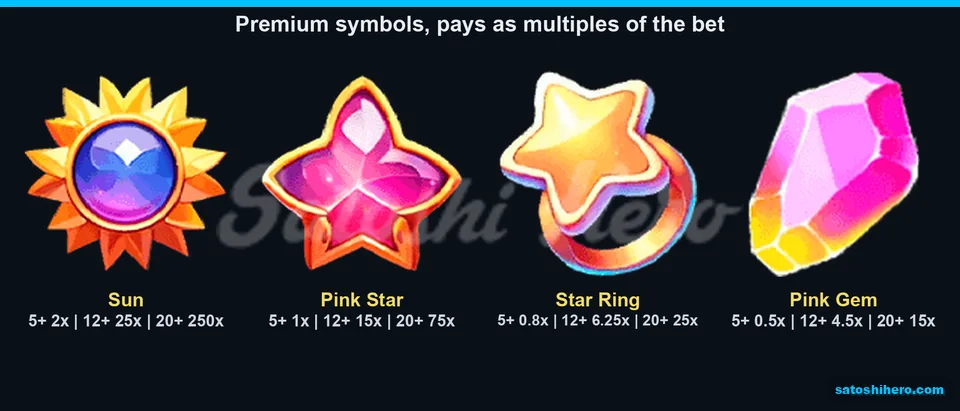
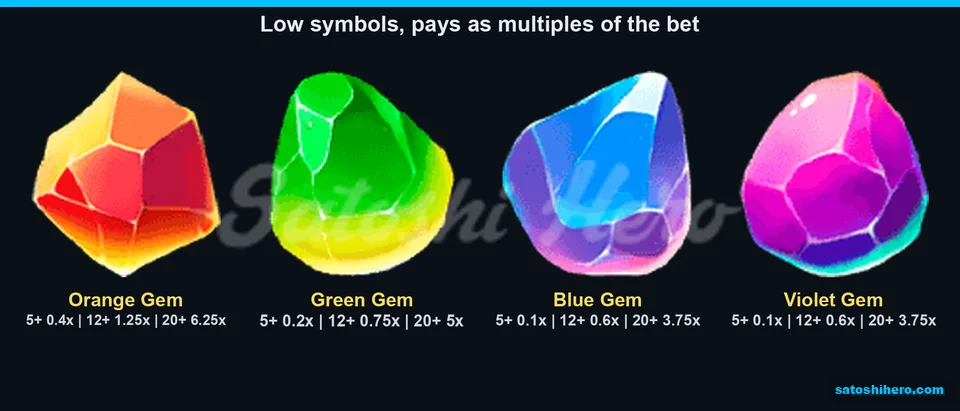
The Sun leads the regular symbols, while Blue and Violet Gems share the lowest values. My smallest logged return was 0.10x, matching a five-symbol cluster of either low gem. That tiny result shows why a paying spin doesn’t always recover your full stake.
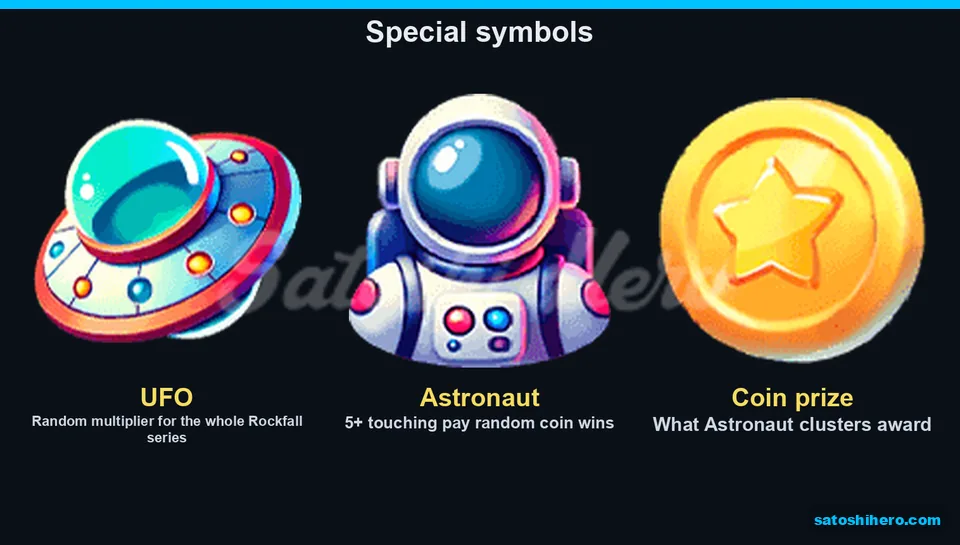
UFO and Astronaut symbols ignore this normal table and use separate mechanics. You should identify them before spinning, since their value depends on multipliers or coin awards rather than cluster tiers.

Stat Check: This game has no paylines. Wins begin with five matching symbols connected along their sides.
Cluster size matters far more than position here. Scan every connected group across the whole board, and don’t mistake a diagonal pattern for a valid win.
UFO Multiplier
Every UFO carries a random multiplier, and all visible UFO values combine into one accumulated multiplier. A UFO can start Rockfall even when the opening board contains no regular winning cluster, which gives a quiet screen some extra suspense.
My session log didn’t record individual UFO appearances, so I won’t invent a hit rate or claim one appeared at a specific moment. Let me be real, a large-looking UFO value can feel exciting, but dead surrounding drops make it useless.
The combined multiplier applies to the complete Rockfall series total, not one individual drop. If every linked board misses, the collected value expires without paying anything. You need a payout somewhere in that chain before the multiplier gains real value.
This mechanic stays distinct from regular cluster pays and Astronaut coin awards.

Player Hint: Watch the full Rockfall chain before judging a UFO. Its accumulated multiplier affects the series total only when that series produces a payout.
You should judge the final chain rather than celebrate the first special symbol. UFOs can improve a paying sequence, but they can’t manufacture value when every linked board fails.
Theme and First Impressions
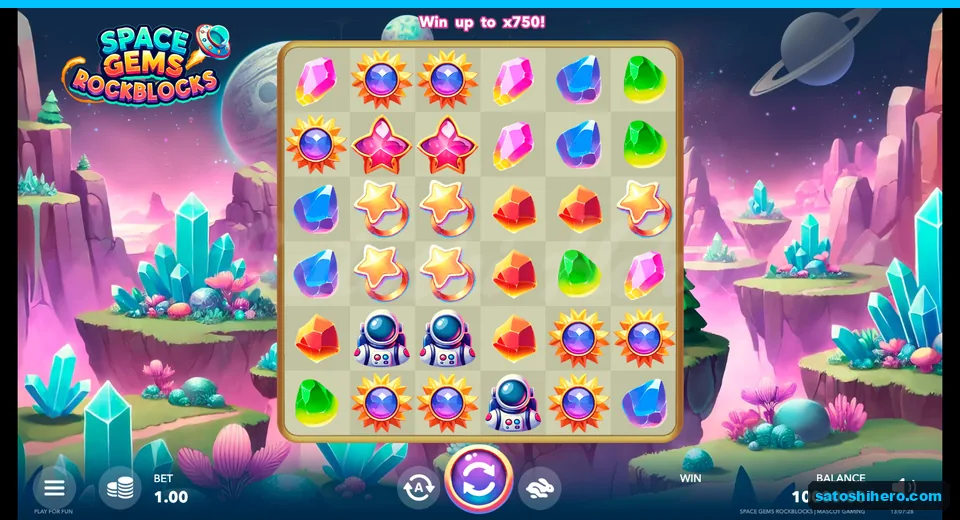
The game sets its 6×6 board on a bright pink alien planet. Crystal spires, floating rock shelves, and a ringed world frame the action while keeping every cluster easy to read.
Gems, star rings, sunbursts, and small cartoon astronauts fill the grid. Soft animations give each drop enough movement without burying your result beneath effects. I think the theme lacks originality, yet its cheerful execution fits the relaxed pace and keeps visual noise under control.
A “Win up to x750!” banner signals the prize ceiling from the first frame. You will probably notice the vivid background first, then the sharp symbol colors guide your eye back to connected groups. That practical contrast matters when several replacements fall quickly.

Fun Detail: Ringed planets, floating shelves, and crystal formations turn a familiar gem theme into a playful alien mining scene.
The resting board also shows the $10,000.00 demo balance and $1.00 bet clearly. You can track both without opening extra menus, which I prefer during a measured test. The presentation supports the cluster mechanics instead of fighting for attention.
Rockfall Feature
Every winning cluster disappears, then new symbols drop into its empty spaces. If those replacements make another winning cluster, Rockfall removes them and continues until a fresh board pays nothing.
During my test, I tracked each spin’s balance rather than every individual drop. That means I can confirm the final outcomes, but I can’t honestly assign a specific Rockfall count to the 21.60x best result. This evidence limit matters because long-looking animations don’t always equal large profit.
All linked results join the same paid-spin total, and you don’t pay another stake for each drop. This repeating sequence forms the game’s central engine rather than a separate bonus round. A plain opening hit can grow through several replacements, although many chains still stop after small returns.
What should you watch? Follow the empty spaces and see whether replacement symbols connect with matching icons already left behind. I find that process more engaging than fixed-line wins because the board visibly rebuilds around each paid cluster.
Spicy Candies Rockblocks offers a useful thematic comparison if you enjoy the recurring cluster-and-drop rhythm. It presents that broad Rockblocks style through candy visuals, while this game keeps you on a cartoon alien world. The shared appeal comes from repeat drops, not from a conventional free-spins chase. Other Mascot alternatives include the mythic-themed Zeus the Thunderer and Zeus the Invincible.
Rockfall supplies the momentum and gives every winning cluster another chance to extend your paid spin. In my opinion, it is easily the strongest part of the feature set.
Astronaut Coin Wins
A connected cluster of five or more Astronauts awards random coin values. The game adds those individual values together, then includes the combined coin award in the same spin total.
My session record tracked balances and final outcomes, but it didn’t record individual symbol appearances. I can’t give you an observed Astronaut frequency or attach one to my best spin. Honestly, claiming more would make the test sound stronger than the notes support.
Astronauts have no entry in the regular paytable. Their award adds an extra layer inside the cluster action, not a detached bonus round. You remain on the 6×6 board while the symbol handles its one special job.
The Astronaut graphic shows a small cartoon space explorer beside coin imagery. By contrast, the UFO displays a multiplier value, so you can separate both specials at a glance. That visual distinction keeps the two mechanics from feeling muddled during quick drops.
You should treat Astronaut awards as occasional additions rather than a feature you can target. I like their simplicity, though deeper bonus fans could find the mechanic too slight. Astronaut clusters add an extra award while keeping every event on the same board.
RTP, Volatility and Our Test
The slot combines a 94.9% theoretical RTP with low volatility and a 750x maximum win. This profile points toward smaller, frequent-looking outcomes, but it can’t promise you a smooth or profitable session.
I kept the projection and my live play separate throughout the test. The model describes possible distributions, while my 100 spins record one short run. Mixing them would turn useful context into a misleading claim.
The Simulator Projection
The SatoshiHero Slot Simulator modeled 1,000 spins at a $1.00 stake. Its middle projected outcome was a 54.9x loss, with the central band stretching from 156.2x down to 57.8x up.
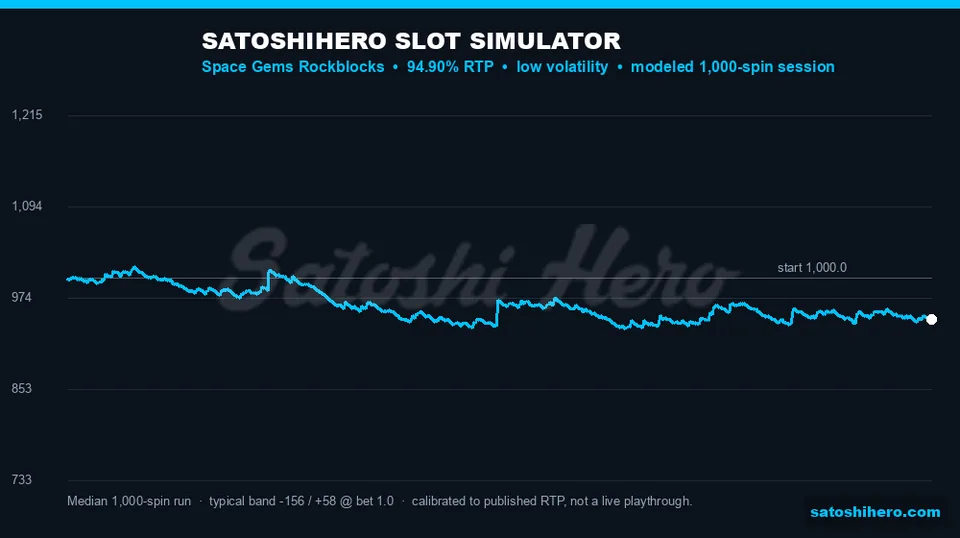
- Middle projected outcome: 54.9x loss
- 5th-to-95th-percentile band: 156.2x down to 57.8x up
- Modeled paying-spin rate: About 34%
- Modeled bigger-hit tier: Roughly once per 128 spins
- Modeled 100x-or-better result: Around once per 1,000,000 spins
That broad band matters more than the single middle result. You can see how identical inputs still allow a deep loss or a modest gain across the same spin count. I think the enormous rarity assigned to 100x hits also puts the modest prize ceiling into useful perspective.
The model uses the published math inputs, not the casino’s random number generator. It can’t forecast your next session, identify a lucky time, or provide a playing tip. Any graph from this projection shows a modeled balance path rather than observed casino play.
Our 100-Spin Session
I played 100 spins at a $1.00 bet, starting with $10,000.00. My final balance reached $10,016.25, leaving me 16.25x ahead after the last spin.
The balance declined early and hit its low near 16.6x down around spin 38. It then moved mostly sideways through the middle before climbing across the final 30 spins. That late recovery made the finish look comfortable, but most of the session didn’t feel profitable.
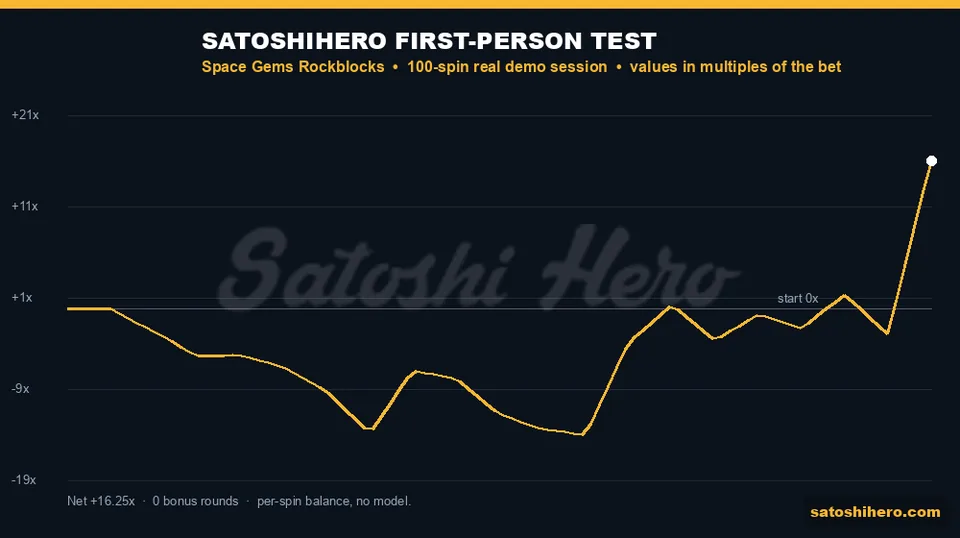
- Paying spins: 64 of 100
- Returns of at least 1x: 28 spins
- Returns of at least 5x: Five spins
- Best result: 21.60x on spin 98
- Second-best result: 11.50x
Those 64 paying spins didn’t equal 64 profitable spins because many returned less than my $1.00 stake. You need to separate any return from a result that actually grows the balance. This one surprised me: the high paying-spin count sounded strong, yet the recovery depended heavily on the closing stretch.
I logged every balance but not UFO or Astronaut appearances, so I can’t calculate feature frequencies. No bonus round or bonus buy existed to trigger, and skipping the Risk Wheel didn’t leave a separate feature unopened.
Session note: My test finished 16.25x ahead after sitting roughly 16.6x below its starting balance. That swing records one session, not the theoretical return.
The theoretical RTP is the operator’s published figure, and one live session has no bearing on that return. The simulator figures model the published math profile rather than live results; separate feature returns can differ slightly by design.
Low volatility softened the pace of my swings, but it didn’t remove the losing stretch. You should plan for dips even when the overall profile sounds gentle.
Risk Wheel
The Risk Wheel appears after a win and lets you gamble the amount already held. It remains optional, so you can collect whenever the wheel isn’t spinning instead of putting a secured result at risk.
I skipped it throughout my 100-spin test. Collecting felt more sensible for the gentle base profile, especially because one empty sector can erase a result I had already earned. In my view, frequent wheel use clashes with the main game’s lower-risk character.
Its layout contains three sector types:
- Multiplier sectors: Increase the held result
- Empty sectors: Remove the held result
- Advancement sectors: Move play to a higher wheel level
Higher levels can offer larger rewards while preserving the game’s 750x cap. Timing, judgment, and button choice can’t improve the underlying odds, so you shouldn’t treat the wheel like a skill challenge.

Beware: The Risk Wheel can wipe out a win you already hold. Choose a collect point before using it instead of chasing the 750x ceiling after every payout.
The wheel changes the risk attached to an existing win, not the way you unlock other features. You can ignore it and still access Rockfall, UFO multipliers, and Astronaut coin wins. It adds optional tension, but it isn’t required for the complete base experience.
Frequently Asked Questions About Space Gems Rockblocks
How do cluster pays work in Space Gems Rockblocks?
Five or more identical symbols must connect horizontally or vertically. Payout tiers rise at 5, 7, 9, 12, 15, and 20 symbols, while diagonal contact alone doesn’t count. The game uses no fixed paylines, so you should scan the entire grid.
What does the Rockfall feature do in Space Gems Rockblocks?
Each winning cluster disappears, and new symbols fall into the open spaces. Further winning clusters repeat that process, with every linked result joining one spin total. You don’t pay another stake for each replacement drop.
How does the UFO multiplier work in Space Gems Rockblocks?
All visible UFO multipliers combine and apply to the complete Rockfall series total. A UFO can start the sequence without an opening cluster, but its value expires if the entire series produces no payout.
What do Astronaut symbols do in Space Gems Rockblocks?
A side-connected group of five or more Astronauts awards random coin values. Those values join the spin total, and Astronauts don’t use the normal symbol paytable.
Does Space Gems Rockblocks have free spins or a bonus buy?
No. Rockfall, UFO multipliers, Astronaut coin wins, and the optional Risk Wheel form the complete feature set. You access them through standard play rather than buying a bonus.
What are the RTP, volatility, and maximum win?
Space Gems Rockblocks has a 94.9% theoretical RTP, low volatility, and a 750x maximum win. These specifications describe its math profile, not a guaranteed result for your session.
What did the 1,000-spin simulator project?
The model produced a middle loss of 54.9x and a band from 156.2x down to 57.8x up. About 34% of modeled spins paid something. It describes possible outcomes rather than predicting your next session.
How did my 100-spin Space Gems Rockblocks test end?
I finished 16.25x ahead after 100 spins at $1.00. My best result reached 21.60x on spin 98, and 64 spins returned something. Many of those returns stayed below the stake.
What is the Space Gems Rockblocks Risk Wheel, and should you use it?
The wheel contains multiplier, losing, and advancement sectors, with rewards capped at 750x. You can collect between spins. I skipped it because an empty sector can erase a secured win, and I prefer collecting within this gentler game.
Wrap-Up
Space Gems Rockblocks stands out with readable clusters and linked Rockfalls. Its modest prize ceiling limits the upside when the board gets lively.

My Verdict
Choose it when frequent-looking returns and board changes matter more than a bonus hunt. Expect small outcomes, linked chains, and an optional wheel that sharply increases risk.
I liked watching the balance recover during my final 30 spins, especially when the 21.60x result arrived near the end. I didn’t like how 64 paying spins sounded far stronger than the actual balance path, and I had no interest in risking secured wins.
Space Gems Rockblocks is updated periodically so its mechanics, figures, and firsthand test context remain useful. You should still treat the documented session as one experience rather than a promise.

Pros:
 Clear clusters: Side-touching connections make wins easy to read across the grid.
- Repeat drops: Rockfall extends paid spins without charging another stake.
- Simple specials: UFO and Astronaut symbols add variety without clutter.
- Optional risk: You can collect wins and ignore the wheel completely.

Cons:
 Modest ceiling: The 750x cap limits the game’s biggest possible result.
- No bonus round: Free-spins fans won’t find a separate feature chase.
- Tiny returns: Many paying spins can still return less than your stake.

Best For: Relaxed cluster fans who enjoy visible drops, frequent small returns, and simple special symbols should feel comfortable here. Big-jackpot hunters and bonus-round chasers will probably find the ceiling and compact feature set too restrained.


































































Bets
All Bets
Game
Player
Date
Wager
Mult.Multiplier
Prize
 Galaxy Glitter
 josh1998
- 06:21:34
- 0×
- Triple 5's: Megacharged
 Hidden
- 06:21:33
- 0×
- Wild Cash x9990
 nymphetamine1231
- 06:21:32
- 0×
- San Chong Baozha Blue: Bonus Combo
 mdp0fxo
- 06:21:31
- 0×
- Triple 5's: Megacharged
- Hidden
- 06:21:30
- 0×
- Wild Cash x9990
- nymphetamine1231
- 06:21:30
- 0×
- Wild Cash x9990
- nymphetamine1231
- 06:21:27
- 0×
- Triple 5's: Megacharged
- Hidden
- 06:21:26
- 0×
- Galaxy Glitter
- josh1998
- 06:21:26
- 0×
- 5 Power Joker
 Gkc818
- 06:21:24
- 0×