

Spicy Candies Rockblocks
By pressing play, you agree that you are above legal age in your jurisdiction and that your jurisdiction allows online gambling.

Spicy Candies Rockblocks
RTP95.13%
VolatilityLow
Max winx3,500
Hit rate34.6%
ReleasedDec 2024

Candy Clusters Crash Into Rockfall Action
Spicy Candies Rockblocks drops bright symbols across a 6×6 grid, where winning clusters launch multiplier-building Rockfall chains.
Spicy Candies Rockblocks is a low volatility slot from Mascot Gaming with 95.13% RTP and 3,500x max win potential. Five side-connected symbols can pay anywhere, while steady base-game action replaces free spins. You can play the free demo or real game on SatoshiHero from $0.20 to $50.00; my $1.00 test lost 6.0x despite a late 24.65x chain.
Key Takeaways
- Best play: Base-game Rockfall chains provide the main attraction because there’s no bonus buy or free-spin round.
- RTP / volatility: The theoretical RTP is 95.13%, paired with low volatility and frequent small-return potential.
- Max win: The overall payout ceiling reaches 3,500x the total bet.
- Risk note: The optional Risk Wheel can erase your staked win, so collecting keeps the secured result.
- Bankroll note: My $1.00 stake equaled 0.01% of the $10,000.00 demo balance; size your bet for your bankroll.

Table of Contents
- How Spicy Candies Rockblocks Works
- Cluster win rules
- Coins and special symbols
- Theme and First Impressions
- Rockfall Feature and Multiplier Ladder
- How chains continue
- Longest tested chain
- Symbol Values and Scatter Payouts
- Premium cluster values
- Scatter pay tiers
- How the 100 Spins Played
- Hit rate in context
- Balance turning point
- Risk Wheel Choices
- Wheel levels
- Collect or continue
- A Base-Game-Only Structure
- No free spins
- No bonus purchase
- RTP, Volatility and Test Results
- Simulator projection
- Our 100-spin session
- Frequently Asked Questions
- Wrap-Up
How Spicy Candies Rockblocks Works
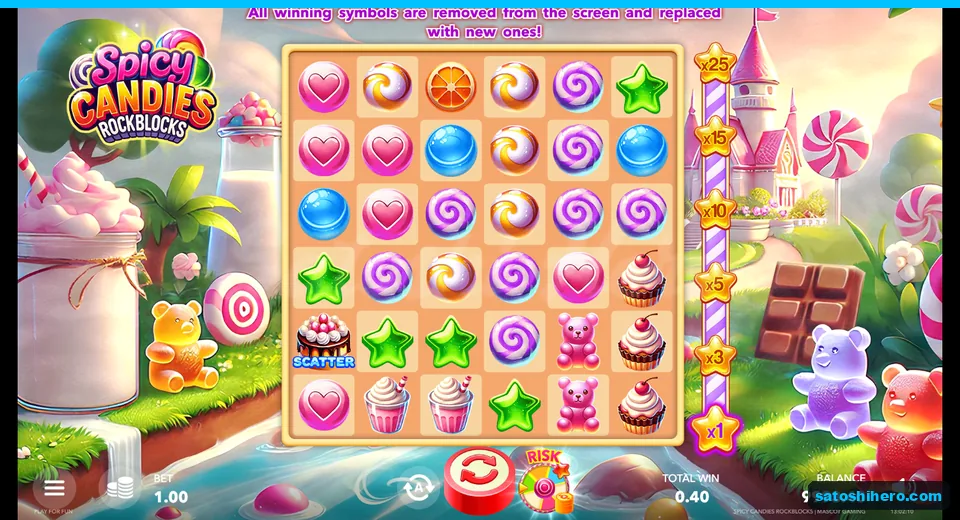
Spicy Candies Rockblocks uses cluster pays on a 6×6 grid, without fixed paylines or a left-to-right rule. You need five identical symbols touching along horizontal or vertical sides. Diagonal neighbors don’t count unless another side connection joins them. Honestly, that’s clearer than tracing busy paylines.
Cluster win rules
Winning groups can form anywhere on the board, and their locations don’t change the calculation. Cluster size and symbol type control the payout, with every paytable figure shown as a multiple of your total bet. You move through six size bands:
- 5–6 symbols
- 7–8 symbols
- 9–11 symbols
- 12–14 symbols
- 15–19 symbols
- 20 or more symbols
Larger groups usually reach stronger tiers, although premium symbols still beat low candies at equal size. You can follow the same rule on SatoshiHero’s mobile and desktop layouts. I find it easy to read because reel position becomes irrelevant.
Coins and special symbols
Five or more Coin symbols award their displayed random coin values. The game sums those values, then adds the amount to that spin’s total win. My log tracked each final result but not symbol positions, so I can’t identify which paying spins contained Coins. That evidence limit matters when you judge feature frequency.
There isn’t a Wild symbol. A cherry-crowned Scatter also follows separate rules and pays wherever it lands, with its exact tiers covered later. I like that these special symbols remain distinct, although the lack of a Wild removes one familiar route to joining clusters. You should focus on side-connected group size first, then check any special award.

Stat Check: There are no paylines. Five matching symbols connected on their sides can win anywhere on the board.
Side-connected cluster size, not reel order, controls ordinary wins. You can read each result quickly.
Theme and First Impressions
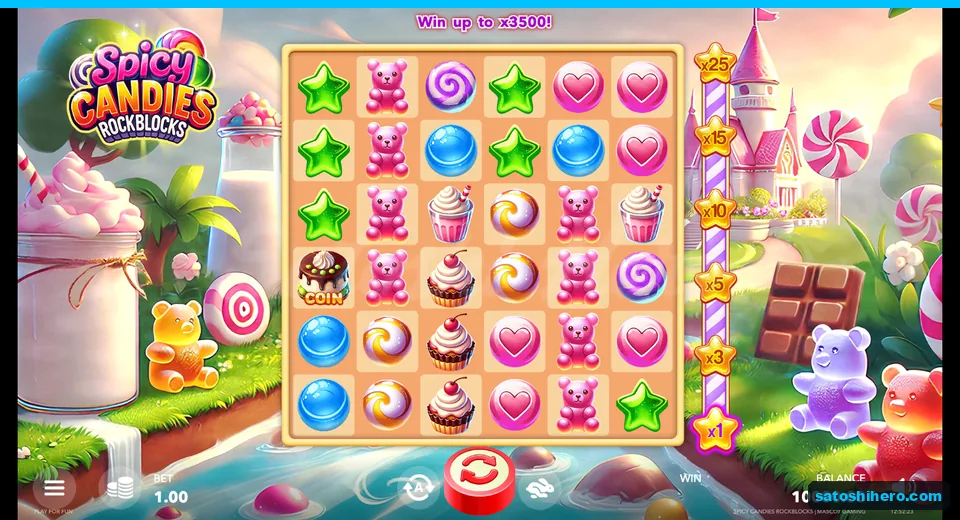
The game presents a bright candy kingdom around a clean, readable 6×6 board. A pink castle, lollipops, and giant gummy bears fill the background while the grid stays visually separate. You see glossy sweets, a milkshake, a cupcake, and a Pink Bear inside a warm orange frame. The playful scenery feels familiar, but I could track every drop without squinting.
My test screen showed the candy board beside a $1.00 stake and a $10,000.00 starting balance. A striped candy pole displayed the Rockfall ladder from x1 through x25. That practical meter contrasts with the softer fantasy background. You can watch it climb without losing sight of the symbols.
The pace stayed steady, and most chains ended quickly. Let me be real, the theme won’t win originality awards. Its uncluttered execution still supports playability.
The clean presentation helps you follow clusters and multiplier movement without visual clutter. If readability matters to you, the simple board does its job well.
Rockfall Feature and Multiplier Ladder
Every winning cluster starts Rockfall, removing those symbols and dropping replacements into the gaps. Fresh symbols enter from the top. Another qualifying group starts a new round, giving every paid cluster immediate movement.
How chains continue
The multiplier ladder advances through x1, x3, x5, x10, x15, and x25. A chain ends as soon as one drop creates no fresh win. Later multipliers can strengthen a new cluster, but the ladder alone doesn’t guarantee a large payout. I learned quickly that an impressive multiplier can still act on a tiny candy value.
Judge the new group’s base value and multiplier together. Watching only the ladder can make a modest return look stronger than it is. You should remember that the sequence resets after the chain ends. I think that reset limits slow-building momentum.
Longest tested chain
Every paying spin in my counted test produced at least one Rockfall. The longest sequence lasted six drops and created my best result, a 24.65x return on spin 88. This one surprised me because it arrived directly after the session low. It was my largest observed hit, not proof that six-drop chains usually pay that amount.
Most paying spins returned less than my $1.00 stake despite frequent Rockfall activity. Many cascades only softened a losing spin. A separate hand-played screenshot showed a settled $0.40 result, and I kept it outside the counted totals. You shouldn’t mix a demonstration frame with the recorded session.

Player Hint: Watch the multiplier ladder, but judge the whole cluster value too. A late multiplier can still boost a very small symbol win.
Rockfall creates the momentum, while the cluster value decides whether each chain feels worthwhile. You can’t assume every long sequence becomes a big hit.
Symbol Values and Scatter Payouts
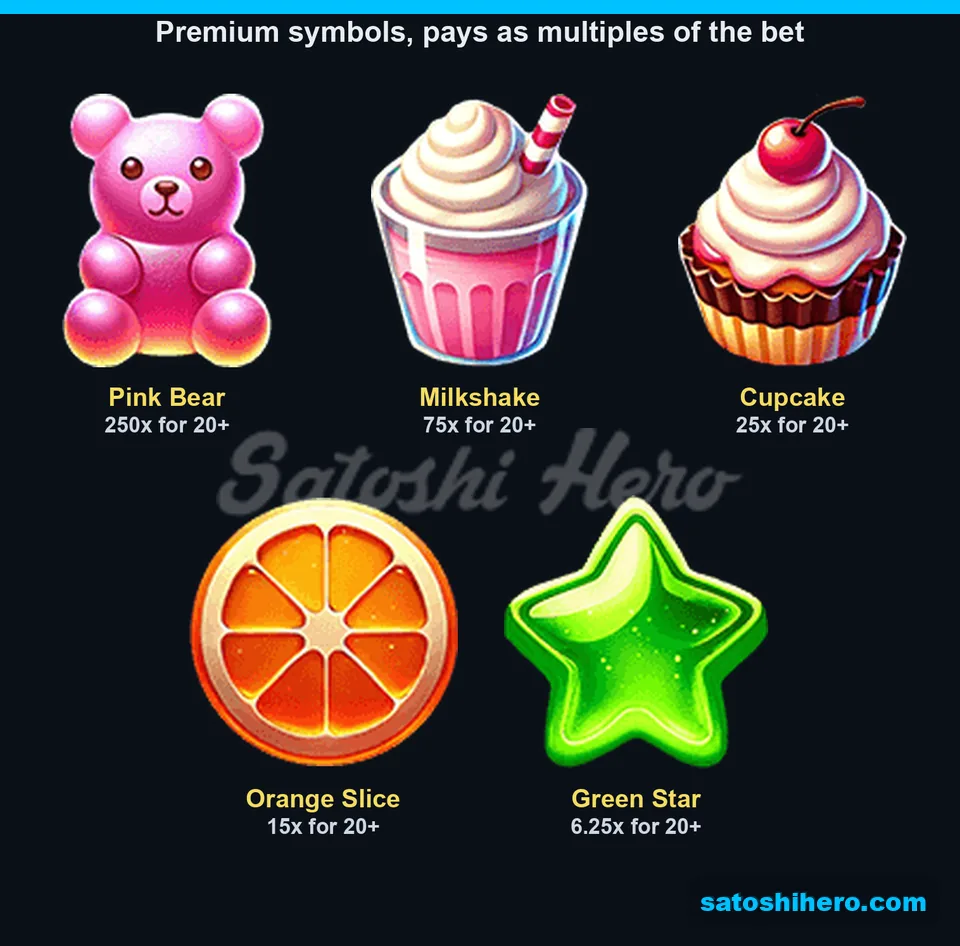
Symbol value and cluster size work together, with the Pink Bear offering the strongest ordinary cluster pay. You get the sharpest jumps from large premium groups, while low candies need size and multiplier help. I checked the paytable at a $1.00 stake, where a 20+ Pink Bear group displayed $250.00. That matched the stated 250x value exactly.
Scatter pay tiers
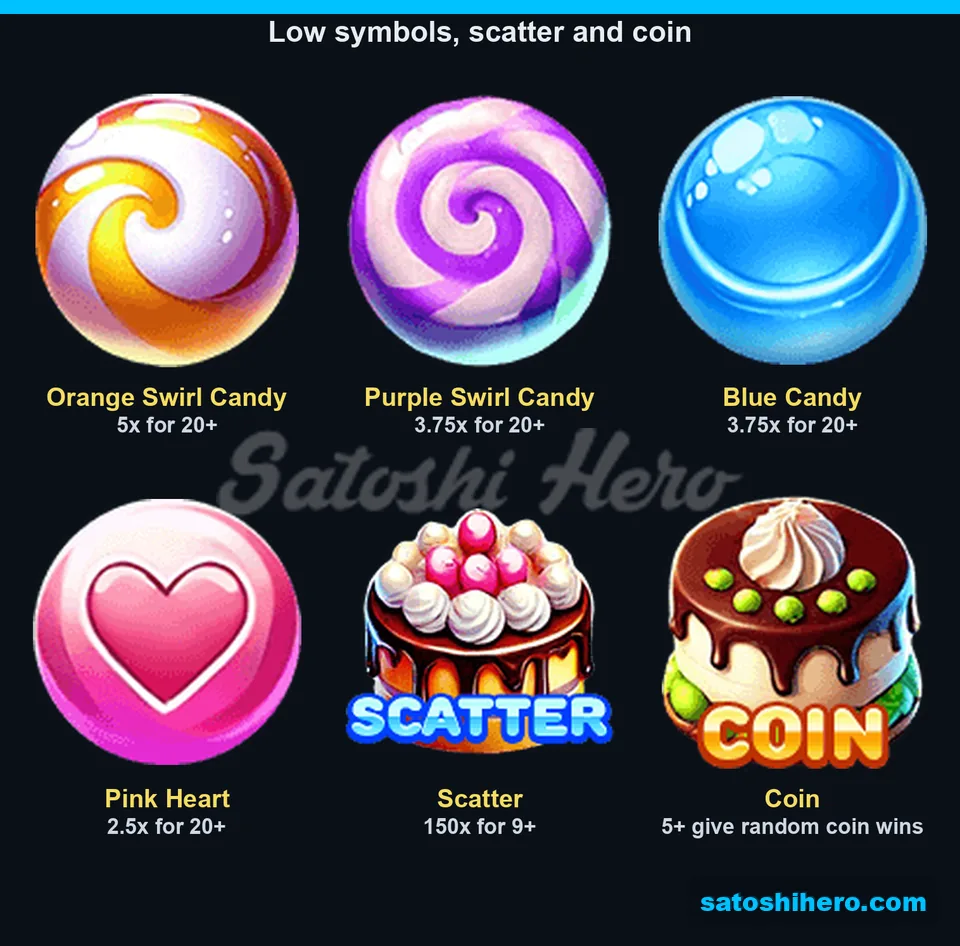
The cherry-crowned cake Scatter pays anywhere on the grid. Five or six pay 10x, seven or eight pay 50x, and nine or more pay 150x. It doesn’t open free spins. That direct award feels clean but anticlimactic.
Five or more Coin symbols award summed random displayed values. Low symbols use normal cluster tiers, while Scatter and Coin follow separate conditions. There is no Wild to bridge gaps. You need matching symbols or the stated special-symbol count.

Fun Detail: A cluster of 20 or more Pink Bears pays 250x the total bet before any applicable Rockfall multiplier enters the calculation.
Premium clusters offer the clearest payout jumps, while Scatter and Coin symbols use separate award rules. When you read the board, identify the symbol type before estimating its value.
How the 100 Spins Played
My 100-spin session finished 6.0x down after frequent small returns and one late 24.65x recovery. I started with $10,000.00, used a $1.00 stake, and ended on $9,994.00. Sixty spins paid something, producing a 60% observed hit rate. That headline sounded generous, but the balance curve told a weaker story.
Hit rate in context
Only 24 results returned at least the full $1.00 stake. The remaining paying spins gave partial returns, so they slowed losses without reversing them. You can record many paid spins while your balance keeps sliding. Honestly, the run felt steadier than bonus-chasing play, but the 60% figure looked kinder than my actual result.
Most returns arrived in small steps, matching the gentle rhythm. I found the activity engaging, although repeated sub-stake wins felt cosmetic. If you track only hit frequency, you’ll miss the difference between receiving something and making progress.
Balance turning point
My lowest point arrived after spin 87 at $9,968.65, a 31.35x drawdown from the starting balance. Spin 88 then delivered the six-drop Rockfall chain worth 24.65x. That result lifted the balance to $9,992.30 in one move. You can see how one stronger chain repaired much of a slow decline without creating profit.
The next-largest results reached 6.3x, 6.2x, and 5.6x. None approached the late recovery, so that chain drove the near-flat finish. I kept later hand-played screenshot spins outside these totals. That boundary gives you a cleaner picture.
A high number of paying spins doesn’t automatically mean your bankroll rises. You need to compare each return with the stake and follow the balance, not just count animations.
Risk Wheel Choices
After a win, you can collect it or stake it on the optional Risk Wheel. Pressing the Risk button opens a separate wheel with multiplier sectors, empty losing sectors, and special level-up sectors. Those special spaces move play to a higher wheel with larger potential rewards. I didn’t use it, so my comments here stay within the documented rules.
Wheel levels
The best wheel prize reaches 1000x the total bet. That figure belongs to the Risk Wheel and remains separate from the slot’s 3,500x overall maximum win. Empty sectors can erase the win placed into the feature, while multiplier sectors change its value. You shouldn’t confuse a visible top sector with a likely result.
Level-up sectors add suspense because they move the decision onto another wheel. Yet my session can’t support claims about sector frequency or practical odds. I prefer keeping that evidence line clear, so you get mechanics rather than an invented outcome.
Collect or continue
You can collect whenever the wheel isn’t spinning. Choosing that button locks the secured win, while another spin turns it into an uncertain event. Collecting is the lower-risk decision, not a method for beating the slot. Let me be real, the extra tension clashes with the otherwise gentle base-game pace.
A secured 5x return and a risked 5x return don’t carry the same bankroll value. The second remains exposed to an empty sector. You should decide whether that excitement justifies losing everything before pressing Risk.

Beware: The wheel stakes the win you’ve already earned. An empty sector can remove it, so don’t treat the 1000x top prize as a likely result.
Choose between certainty and extra risk before touching the wheel. Your decision should reflect the value already secured.
A Base-Game-Only Structure
The game has no free spins and no bonus buy, so all core play stays in the base game. Rockfalls, Coins, Scatters, and the Risk Wheel provide variation. You won’t wait for a separate round. I find that focus refreshing but narrow.
No free spins
There isn’t a separate free-spin round to trigger. The Scatter pays immediately at 10x for five or six, 50x for seven or eight, and 150x for nine or more. It never opens another mode. You receive the award within the same base-game flow.
Every paid cluster accesses Rockfall without a trigger hunt. Coin combinations add random displayed values, while the wheel remains optional. I like having the main mechanic available immediately. You could find the loop limited if you expect modifiers or a distinct feature stage.
No bonus purchase
There isn’t a purchasable feature round. Every paid spin begins through the normal base-game wager, so you can’t skip directly to another mode. That keeps stake decisions simple and avoids a high-priced shortcut. In my view, simplicity helps the low-volatility pacing but reduces strategic variety.
Free-spin modifiers and selectable feature menus require another slot style. Here, you judge clusters, watch Rockfall, and decide whether to risk a win. You can try that loop in the SatoshiHero demo before using real funds.
This base-game-only format fits readers drawn to continuous cluster action rather than separate feature rounds. You always know where the next result begins.
RTP, Volatility and Test Results
Spicy Candies Rockblocks has a 95.13% theoretical RTP, low volatility, and a 3,500x maximum win. Low volatility describes the intended general distribution, but your short run can still finish far from the headline percentage. You should expect many modest returns rather than treat the label as a promise. I thought the small-win rhythm matched it reasonably well.
Simulator projection
The SatoshiHero Slot Simulator modeled 1,000 spins in bet multiples. Its typical result finished 51.1x down, while the fifth-to-95th-percentile band ran from 154.9x down to 58.2x up. Roughly 34 spins in every 100 paid. That spread shows how widely modeled sessions can separate.
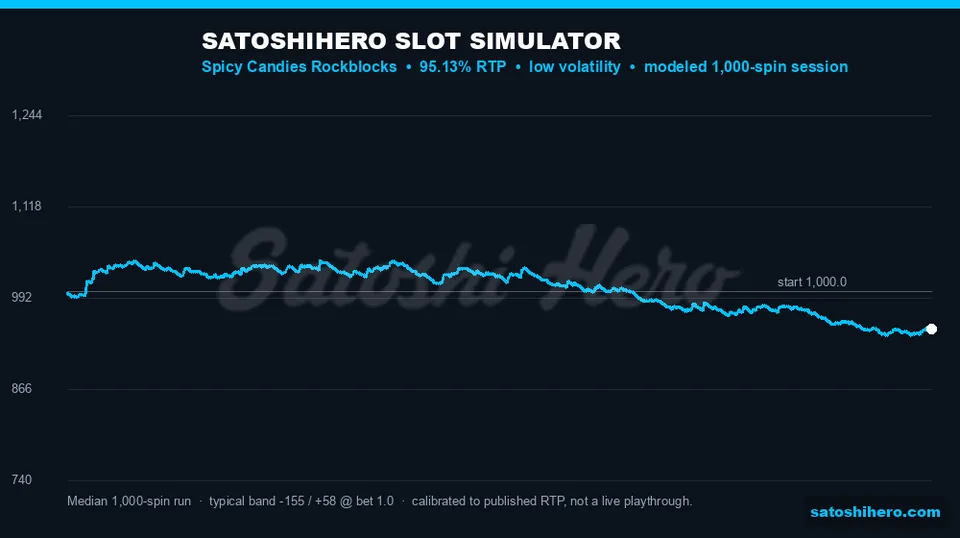
A feature-sized result appeared about once per 127 modeled spins. No 100x result appeared in the model’s one-million-spin sample. Those observations aren’t countdowns. The simulator doesn’t reproduce the game’s random number generator, so you shouldn’t read its blue curve as a forecast.
The projection used a 1.0 modeled stake alongside the stated RTP and volatility. I find the wide band useful because it makes uncertainty visible. A model can’t reconstruct your next session, so treat its frequencies as illustrative.
Our 100-spin session
My live run lost 6.0x, with 60 paying spins and 24 stake-or-better results. The largest win reached 24.65x after six Rockfall drops. Compared with the model’s roughly 34% paid-spin rate, my observed 60% rate looked unusually active. You still shouldn’t convert that small sample into a new hit-rate claim.
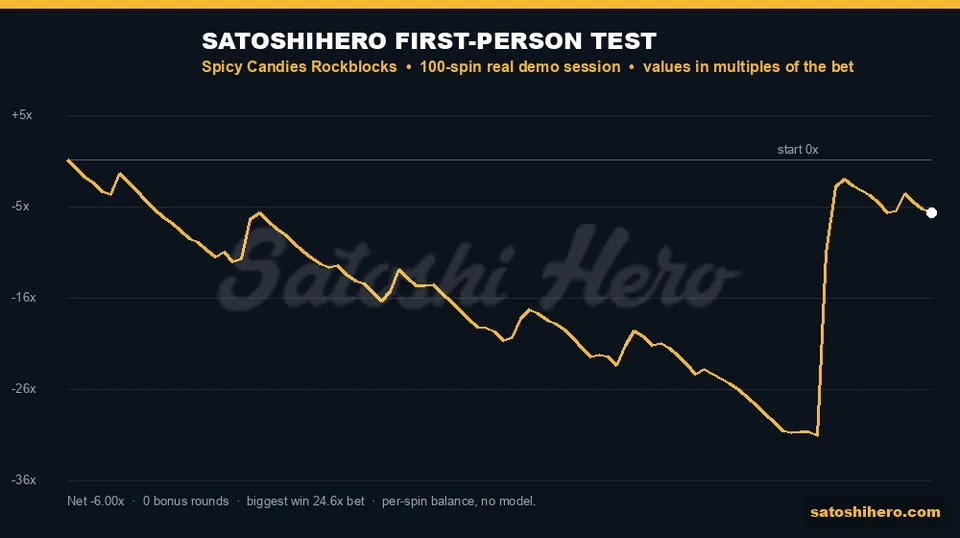
Many tiny returns supported the low-volatility description, while the swing after spin 87 showed how sharply a short balance path can change. My result also landed well inside the simulator’s broad projection band, but that doesn’t validate the next outcome. This one surprised me by looking busy while ending negative. You need both hit size and net movement to interpret the run.
Math and source note: 95.13% is Mascot Gaming’s published theoretical return, and one 100-spin session can’t alter it. The simulator illustrates variation rather than forecasting or reconstructing the slot’s RNG. Per-feature returns can differ slightly from the base by design.
Other Mascot Gaming options on SatoshiHero include Zeus the Thunderer, Zeus the Invincible, Yukon Fever, Wood luck, and Wildlife Riches if you want to compare different themes and feature structures from the same provider.
Frequently Asked Questions
How do wins work in Spicy Candies Rockblocks?
Wins need five or more identical symbols connected along horizontal or vertical sides on the 6×6 grid. Groups can sit anywhere, and six size tiers raise payouts as clusters grow. Diagonal contact alone doesn’t count, so you should trace each matching edge.
What are the RTP and volatility of Spicy Candies Rockblocks?
Spicy Candies Rockblocks has a 95.13% theoretical RTP, low volatility, and a 3,500x maximum win. My 100-spin test lost 6.0x, which provides firsthand context rather than a substitute return figure. Your session can differ from both the specification and my result.
How does the Rockfall feature work in Spicy Candies Rockblocks?
Winning symbols disappear, then replacements drop into their positions. Fresh wins advance the multiplier through x1, x3, x5, x10, x15, and x25. The chain stops when a drop creates no new win, so you need another cluster to continue.
What do Coin symbols do in Spicy Candies Rockblocks?
Five or more Coin symbols award their random displayed coin values. The game sums those values and adds the amount to the spin’s total win. My log didn’t preserve symbol positions, so I can’t identify Coin hits within the recorded results.
What do the symbols pay in Spicy Candies Rockblocks?
For 20+ symbols, Pink Bear pays 250x, Milkshake 75x, Cupcake 25x, Orange Slice 15x, and Green Star 6.25x. Smaller groups use lower tiers, and exact payouts depend on both symbol type and cluster size. You should check both before estimating a win.
Does Spicy Candies Rockblocks have free spins or a bonus buy?
No, it has neither free spins nor a bonus buy. The Scatter pays directly at 10x for five or six, 50x for seven or eight, and 150x for nine or more. Rockfall supplies the main recurring feature instead.
What is the Risk Wheel?
The optional Risk Wheel contains multiplier, empty losing, and level-up sectors. You can collect whenever it isn’t spinning, while an empty sector removes the staked win. Its top prize reaches 1000x the total bet, but I didn’t test wheel outcomes.
Which win was biggest in the 100-spin test?
My biggest win reached 24.65x on spin 88 after six Rockfall drops. Most other paying results returned less than the $1.00 stake. That late chain repaired much of the earlier drawdown without producing a profitable finish.
Wrap-Up
Spicy Candies Rockblocks stands out through accessible clusters and multiplier-building Rockfalls. Its narrow base-game structure remains the main drawback if you expect free spins. The cheerful design can’t hide a theoretical return that feels less inviting than the visuals.

My Verdict
Choose this slot for grid activity, clear mechanics, and no bonus waiting. Expect small returns, short chains, and balance-saving sequences rather than constant large hits.
I liked how easily I could follow every drop, and the six-stage ladder made the late 24.65x chain exciting. I didn’t like how 60 paying spins still left my balance 6.0x down. The Risk Wheel adds tension, but I preferred keeping recorded wins secure.
Spicy Candies Rockblocks receives a final mechanics and mathematics check whenever this guide is updated periodically.

Pros:
 Readable clusters: Side-connected groups remain easy to identify across the uncluttered grid.
- Frequent movement: Every paid cluster starts Rockfall and refreshes the board.
- Clear multiplier: The x1-to-x25 ladder makes chain progress visible immediately.
- Simple betting: A broad stake range supports careful bankroll sizing.

Cons:
 No free spins: Base-game action never develops into a separate feature round.
- Partial returns: Many paying spins can still leave your balance falling.
- Risk exposure: Empty wheel sectors can erase a win you’ve already secured.

Best For: Cluster-slot fans who value steady base-game movement and easy-to-read cascades should feel comfortable here. Bonus hunters and wheel-risk skeptics could find the structure too narrow, so test the normal loop before committing funds.
































































Bets
All Bets
Game
Player
Date
Wager
Mult.Multiplier
Prize
 Galaxy Glitter
 josh1998
- 06:21:34
- 0×
- Triple 5's: Megacharged
 Hidden
- 06:21:33
- 0×
- Wild Cash x9990
 nymphetamine1231
- 06:21:32
- 0×
- San Chong Baozha Blue: Bonus Combo
 mdp0fxo
- 06:21:31
- 0×
- Triple 5's: Megacharged
- Hidden
- 06:21:30
- 0×
- Wild Cash x9990
- nymphetamine1231
- 06:21:30
- 0×
- Wild Cash x9990
- nymphetamine1231
- 06:21:27
- 0×
- Triple 5's: Megacharged
- Hidden
- 06:21:26
- 0×
- Galaxy Glitter
- josh1998
- 06:21:26
- 0×
- 5 Power Joker
 Gkc818
- 06:21:24
- 0×