


Snacks, Skulls and Row Multipliers After Dark
Vending Machine slot looks relaxed, but the row multipliers can make diagonal lines surprisingly important. Vending Machine is a medium volatility slot from Hacksaw Gaming with 96.28% RTP and 5,000x maximum win potential. The game uses 5 reels, 5 rows, 35 fixed left-to-right paylines and row multipliers, aimed at calm-theme fans of bonuses that build slowly.
Key takeaways
My demo test opened with $5,000.00 at a $2.00 bet, and the demo plus real play sit here on SatoshiHero. The lo-fi art feels charming rather than groundbreaking, but the multiplier panel gives this soft-looking slot more bite than you’d expect.
- Best bonus: Spin and Chill looked stronger because all five rows start lit, but my $400.00 buy returned $224.40.
- RTP / volatility: Vending Machine slot has 96.28% RTP with medium volatility across the main game.
- Max win: The cap sits at 5,000x the bet, and both bonus modes can reach it.
- Risk note: My 500 base spins produced no bonus, so the base game can still feel dry.
- Bankroll note: At a $2.00 stake, Lo-Fi Spins costs $200.00 and Spin and Chill costs $400.00.

Key Stat: Both bonus modes can reach the 5,000x cap, but the paid returns sit slightly below the base RTP.

Table of Contents
- How Vending Machine Works
- Line pays
- Second-chance drops
- Theme & First Impressions
- Lo-fi street style
- Shelf-reel layout
- Multiplier Lights
- Switching rows on
- Stacking row values
- Spin and Chill
- Five rows active
- Ending the round
- Bonus Buy and FeatureSpins
- Buy menu prices
- FeatureSpins option
- Lo-Fi Spins
- Three active rows
- Cheaper bonus route
- Bought Spin and Chill Test
- Buying the round
- Final payout
- RTP, Volatility & Our Test
- Simulator projection
- Our 500-spin session
- Frequently Asked Questions About Vending Machine
- Final Verdict
How Vending Machine Works
Vending Machine slot uses a 5-reel, 5-row layout with 35 fixed paylines that pay left to right. You’re looking at a slot vending machine with five shelves as reels, not a pay-anywhere or cluster setup.
Line pays
Every paying symbol pays for 3, 4 or 5 on a line. At my $2.00 stake, toast, wrapped candy, chewing gum and lollipop pay $0.20, $1.00 and $4.00. Ice pop and energy drink pay $1.00, $4.00 and $12.00.
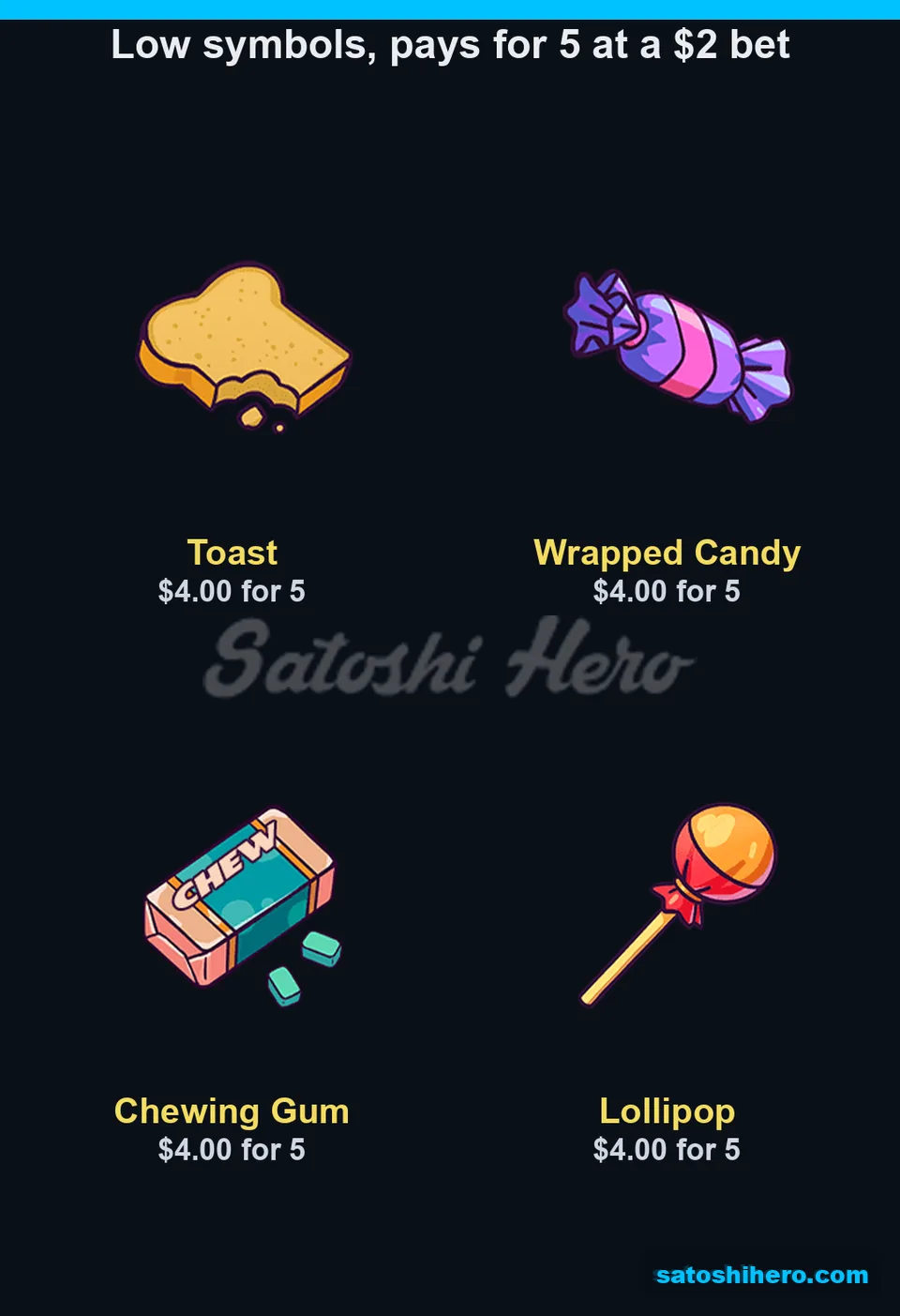
The juice carton pays $2.00, $6.00 and $20.00. Bubble tea tops the regular symbols at $4.00, $12.00 and $40.00 for five. Popcorn Wild substitutes for every paying symbol and also pays $40.00 for five.
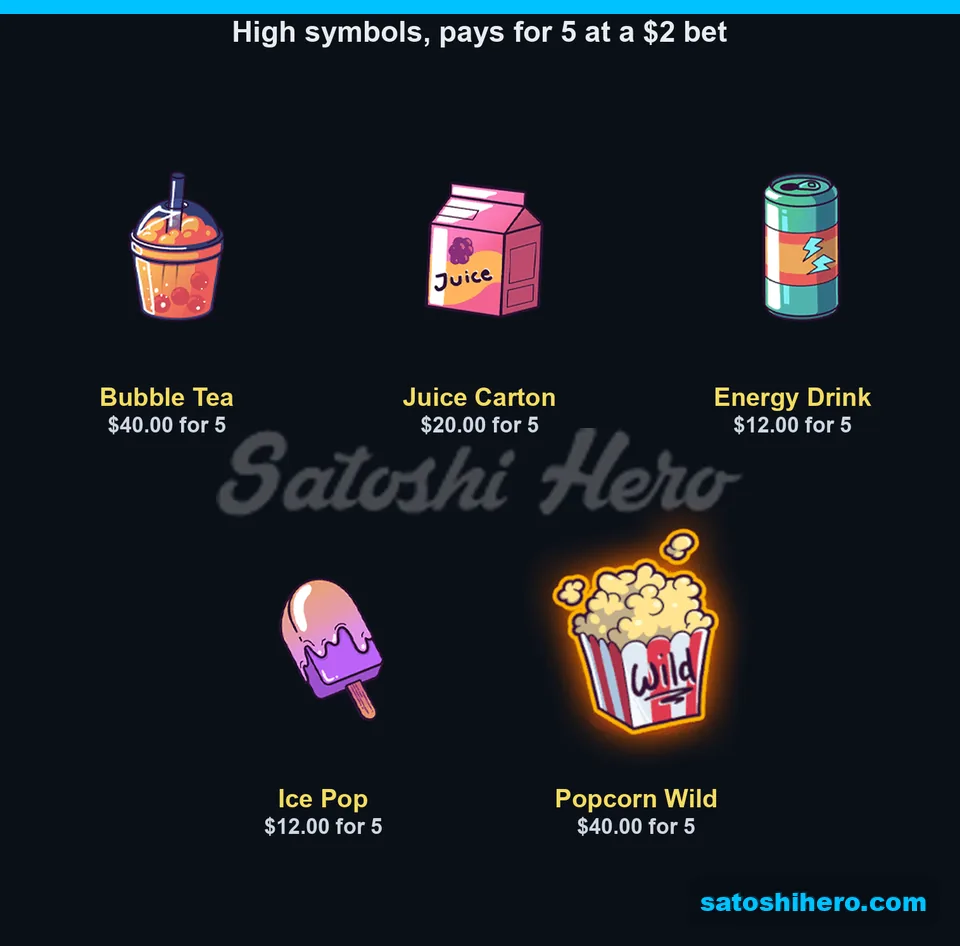
You need the FS scatter for bonus access. The paytable feels clear, and I like that the top symbol can still matter when it crosses active rows. You shouldn’t expect constant large base hits, though, because many spins in my test landed low or blank.
Second-chance drops
When no more wins show, the game can remove all low-paying snacks and drop fresh symbols. That gives one more chance for a line to connect, and it fits the snack-machine theme without slowing the spin too much.
The five-shelf layout stays easy to read on desktop and mobile because the row multipliers sit beside the glass. I’d still watch row position more than symbol value here. A lower snack on several active rows can beat a cleaner-looking hit.

Strategy Insight: Diagonal paylines matter more here than in many fixed-line slots because they can cross several lit multiplier rows.
Numbers indicate this mechanic rewards attention. You’re not just checking whether a line pays, you’re checking where that line travels. That makes Vending Machine slot more tactical than its cozy theme suggests.
Theme & First Impressions
The theme is a quiet lo-fi city scene built around a glowing snack machine and soft nighttime details. Hacksaw Gaming sets Vending Machine slot on a moonlit street where the reels feel like five snack shelves behind glass.
Lo-fi street style
A girl in an orange sweater scrolls her phone beside the machine. A cat watches from a balcony railing, which adds a nice lived-in touch. The mood feels softer than Ze Zeus, where louder mythological energy drives the screen.
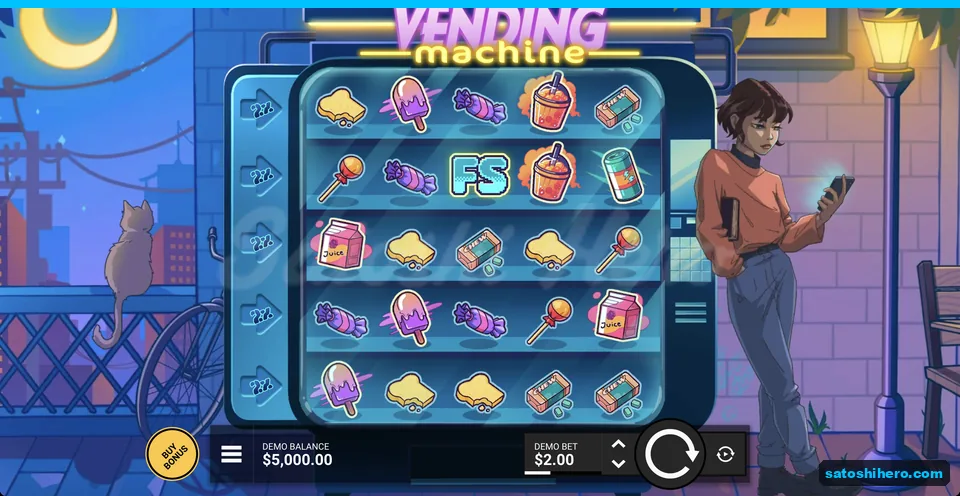
The vending machine coin slot is just visual flavour, not a separate mechanic. That matters because you shouldn’t expect a coin-collect feature or money-symbol side game. The real pressure comes from the multiplier panel.
Shelf-reel layout
The reels appear as five shelves inside the machine. A lit multiplier panel runs down the left side of the glass, and that panel changes how you read every line.
I don’t think the theme wins originality awards. Still, the cozy execution fits the stop-start multiplier lights well. You get a calm visual shell with a sharper scoring system hiding underneath.
The five shelves help the game stay readable. You can track rows quickly, even when skulls and bolts start changing values. That clarity matters when you’re trying to spot why a small line paid more than expected.
Multiplier Lights
The multiplier lights decide how much extra value a winning line can collect from active rows. Vending Machine slot starts every base spin with each row drawing an inactive value from 2x to 10x.
Switching rows on
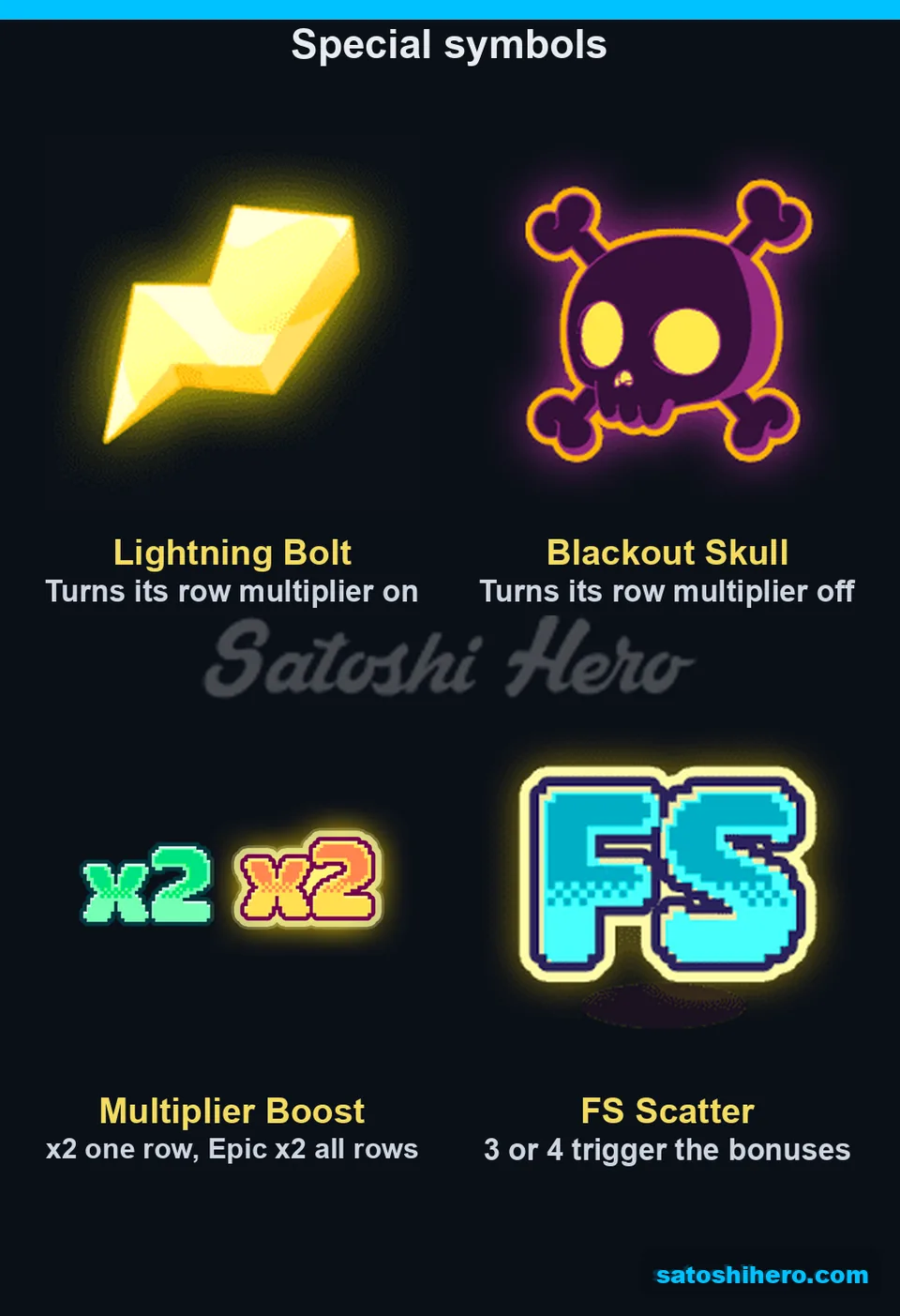
Each of the five rows has its own multiplier on the left. A Lightning Bolt scatter switches a row on, and a Blackout Skull scatter switches a row off again. You feel the row state change fast when both symbols appear close together.
The vending machine money slot visual is theme dressing. The real action sits in the row multiplier panel, not in a payment slot. That distinction helps you read the screen without chasing fake mechanics.
Stacking row values
Every winning symbol on a row adds 1 to that row’s multiplier. A Multiplier Boost doubles its own row, while an Epic Multiplier Boost doubles every row. If a win touches an active row, that row’s multiplier applies.
Lines that cross multiple active rows add those row multipliers together first. That’s why diagonal lines matter so much here. One diagonal can collect three or four lit rows, and that can lift a modest symbol hit quickly.
I like this system because it gives you a reason to follow every row. It doesn’t feel like pure decoration. You can see the numbers build, fade, and sometimes line up at the right moment.
The practical lesson is simple. Watch active rows before you judge a win by symbol alone. In my test, the best base hit came from lit rows working together, not from a rare symbol landing in isolation.
Spin and Chill
Spin and Chill is the stronger-looking bonus because all five multiplier rows start switched on. Four FS scatters trigger it, and the round runs without a fixed spin count.
Five rows active
All five rows begin active, so every early line has a chance to collect extra value. More active rows also give winning symbols more room to raise multipliers before the round ends.
The feature has the same growth appeal you might enjoy in Xpander, but this game uses row lights rather than expanding reels. That makes the tension more about placement than screen size. You’re watching which rows stay alive, not waiting for a reel set to stretch.
I prefer this bonus over the cheaper route on paper. It gives the mechanic its fullest shape from the first spin. The trade-off is obvious, though: buying it costs much more.
Ending the round
Blackout Skulls shut rows off one by one. The round keeps going until every row goes dark, so the ending can feel gradual rather than sudden. You can have a good-looking setup fade quickly if skulls arrive in the wrong order.
This mode feels built around patience. You want early wins to push row values up before too many skulls appear. When that happens, even ordinary line hits can look far better.
The name sounds mellow, and the visuals stay soft. Still, the feature can swing hard because every active row changes the math of a line. That’s why the bought test matters more than the feature label.
Bonus Buy and FeatureSpins
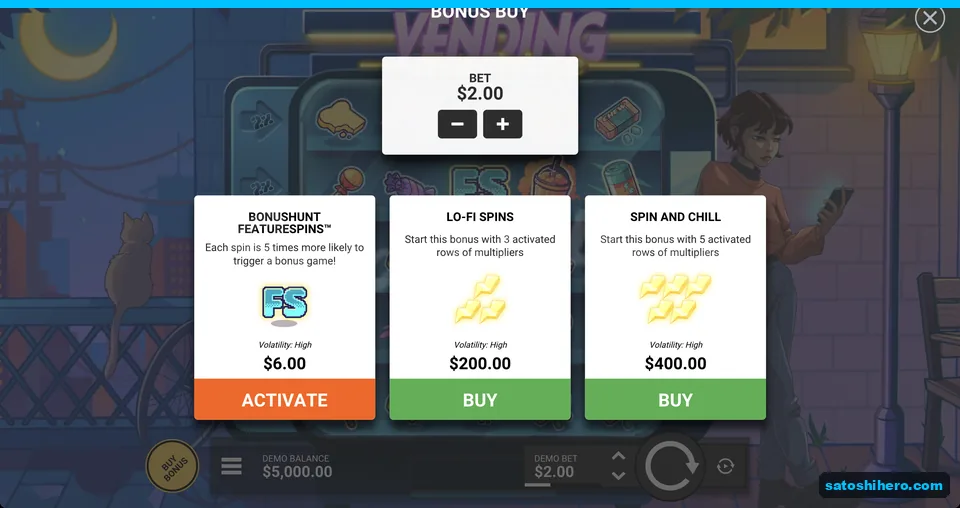
The buy menu gives direct access to both bonuses, but the prices make bankroll size matter. At a $2.00 base stake, Lo-Fi Spins costs $200.00, while Spin and Chill costs $400.00.
Buy menu prices
Lo-Fi Spins costs 100x the base bet and lists a 96.18% return. Spin and Chill costs 200x and lists a 96.25% return. Both paid bonus options carry a high volatility label in the buy menu.
The official overall game volatility remains medium. That split matters because the main slot can feel steadier than the paid feature paths. You shouldn’t treat the bonus menu as a shortcut to safer play.
Buying Spin and Chill at $2.00 is a serious step. It equals 200 regular spins at that stake, so one poor feature can erase a lot of base-game time. My $400.00 buy proves that point clearly.

Warning: The game’s overall volatility is medium, but the paid bonus options are marked high volatility, so don’t treat a buy as a guaranteed shortcut.
FeatureSpins option
Bonushunt FeatureSpins cost $6.00 per spin at a $2.00 base stake. They make a bonus 5x more likely and list a 96.22% return. FeatureSpins stay on until you disable them, so you need to watch the setting.
I like FeatureSpins as a middle path more than a full buy. You still pay a premium, but you don’t commit $400.00 in one click. That said, the higher spin cost can drain a balance faster than regular play.
Judge every paid route by cost, not just by excitement. A feature screen can feel great and still fall short against the purchase price. Vending Machine slot makes that lesson hard to miss.
Lo-Fi Spins
Lo-Fi Spins is the cheaper bonus route, starting with three active multiplier rows instead of five. Three FS scatters trigger it, and the round has no fixed spin count.
Three active rows
The feature starts with three multiplier rows switched on. That gives you less coverage than Spin and Chill, but it still opens with active row value in play. You need wins to land where the lit rows can help.
Blackout Skulls keep working in this mode. The round continues until every row has switched off, so a bad skull sequence can shorten the feature. You get the core mechanic, just with fewer rows active at the start.
I see this as the more measured bonus. It doesn’t offer the same opening power as Spin and Chill, but it also doesn’t ask for the 200x buy price. That difference matters if you’re managing a smaller session balance.
Cheaper bonus route
At a $2.00 stake, buying Lo-Fi Spins costs $200.00. That’s still a big step compared with regular spins. Cheaper does not mean low-risk, especially when the buy menu marks it high volatility.
Limbo may appeal to quick, stripped-back risk takers. This slot leans the other way, giving you structured bonus play with row multipliers and changing states. You need more patience here.
The best use case for Lo-Fi Spins is clear. It lets you sample the bonus system without paying $400.00 for the bigger mode. Just don’t confuse a lower entry price with a safer expected result.
Bought Spin and Chill Test
My bought Spin and Chill test paid $224.40 from a $400.00 buy, so it lost $175.60 against the purchase price. I started fresh with $5,000.00 and bought the feature at a $2.00 stake.
Buying the round
I opened BUY BONUS, pressed BUY on the Spin and Chill card, confirmed with OK, and clicked the intro card. The round began with all five rows lit, which immediately made the screen feel livelier than the base session.
Row values climbed into double figures as wins added to them. One early spin triggered a Mega Win of about $108, and that gave the feature real momentum. You can feel why this mode costs 200x when the rows start firing.
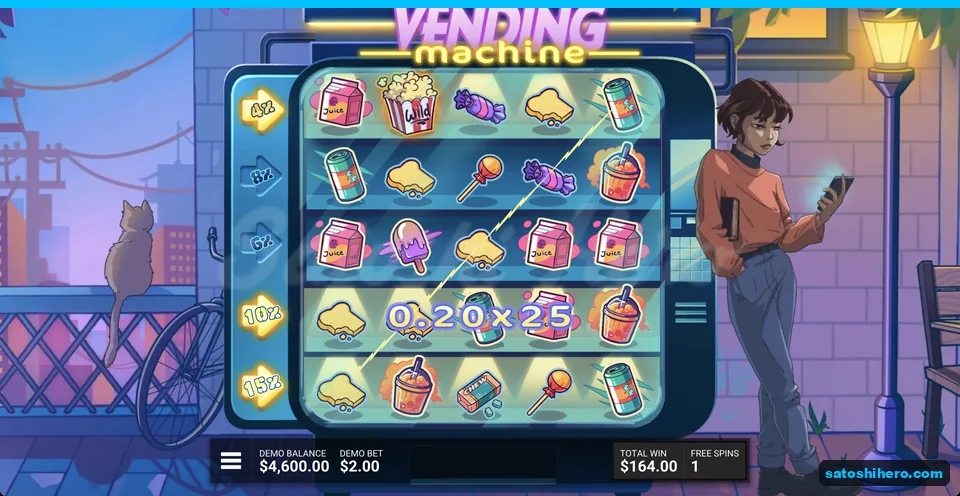
A later diagonal line crossed several lit rows and added more. That moment showed the mechanic at its best. The pay wasn’t huge, but the path across active rows made it more exciting than a straight line.
Final payout
Blackout Skulls gradually switched rows off. The round ended after 16 spins on $224.40, equal to 112.2x the bet. That returned a little over half the $400.00 buy price.
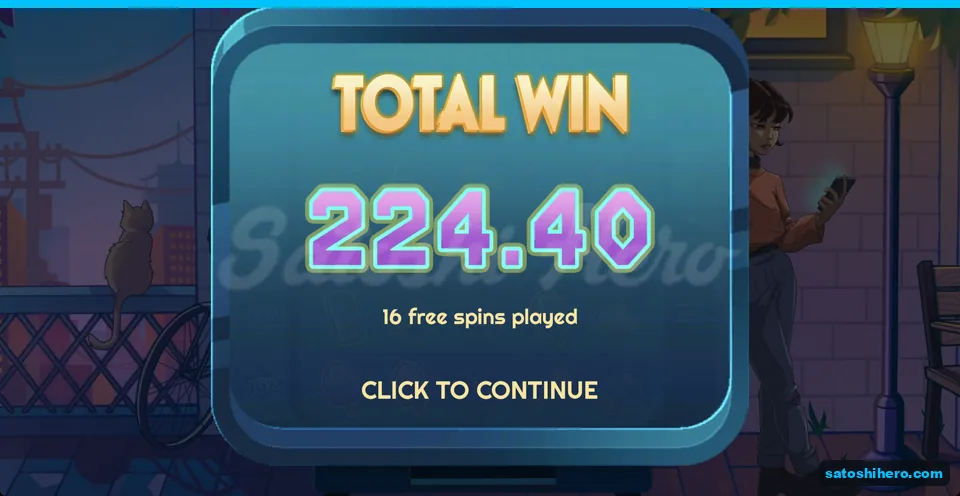
I enjoyed the feature more than the base-game grind. Still, the result lost money against the buy, and that matters more than the animation. A $224.40 win screen looks good until you compare it with the entry cost.
The lesson is practical. Feature excitement and value aren’t the same thing. You need to judge bonus buys by purchase price first, then decide whether the ride justifies the risk.
RTP, Volatility & Our Test
Vending Machine slot has 96.28% theoretical RTP, medium volatility and a 5,000x maximum win, but my 500-spin test missed the bonus completely. The game data is checked regularly against operator-published figures, so this guide uses the right numbers.
Official values stay simple: 96.28% RTP, medium volatility and 5,000x maximum win. That cap applies to both bonus modes. Numbers indicate a balanced slot on paper, but my test showed how dry the base game can feel.
Simulator projection
I ran 1,000 spins through the SatoshiHero Slot Simulator at $2.00. The model used 96.28% RTP, medium volatility and the 5,000x cap. The median run finished $87.60 down.
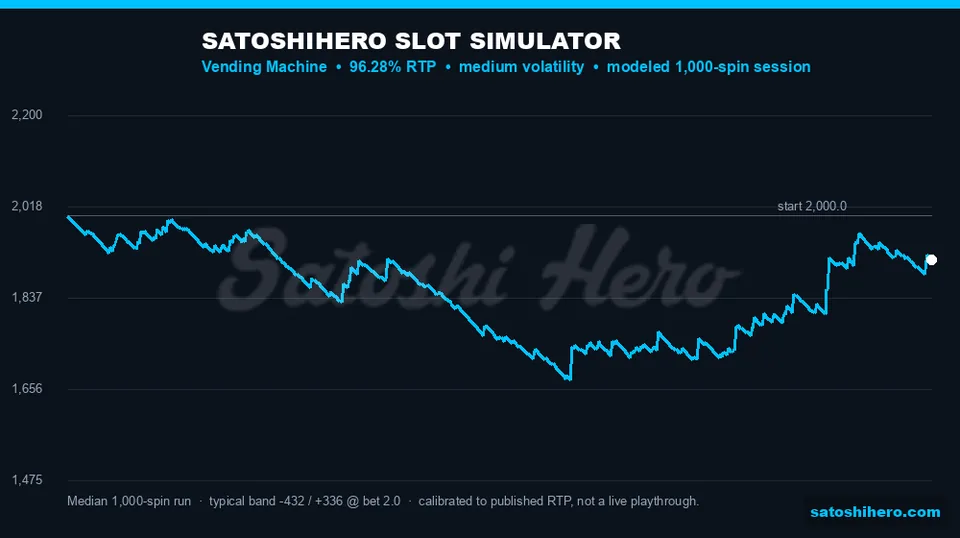
The middle 90% of runs landed between $431.60 down and $335.50 up. A bonus-sized hit appeared about once every 50 spins in the projection. A 100x hit looked rare, about once every 13,333 spins.
That spread gives you a useful shape, not a promise. You can sit inside the middle range and still feel a cold session. The max win looks attractive, but the data says big spikes need patience.
Our 500-spin session
I played 500 spins at $2.00 from $5,000.00 and finished on $4,586.20. That left me down $413.80. The demo server dropped after 149 spins because of a wallet connection error, so I played the remaining 351 spins in a new session.
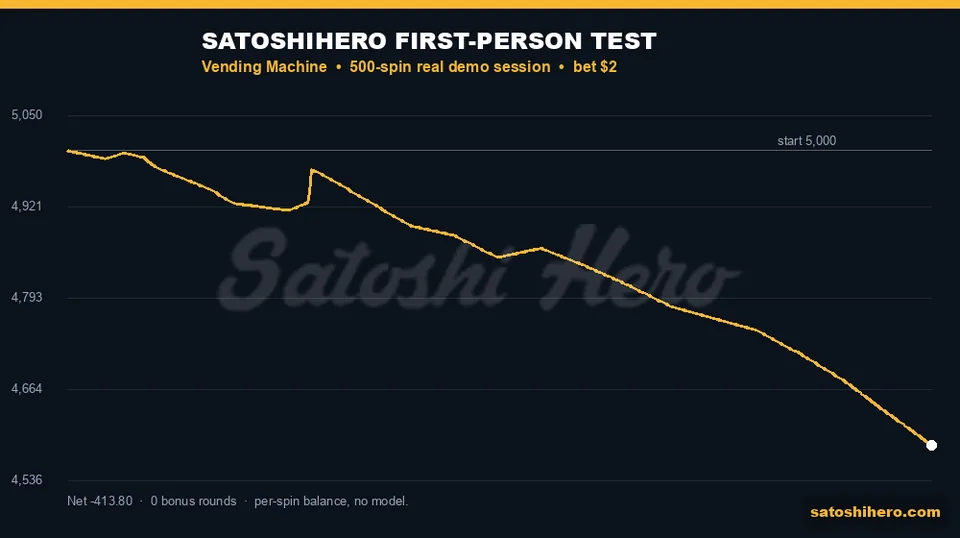
I carried the first result over, and the combined graph covers all 500 spins. No bonus landed. Most spins returned nothing to a couple of dollars, and the balance drifted down steadily.
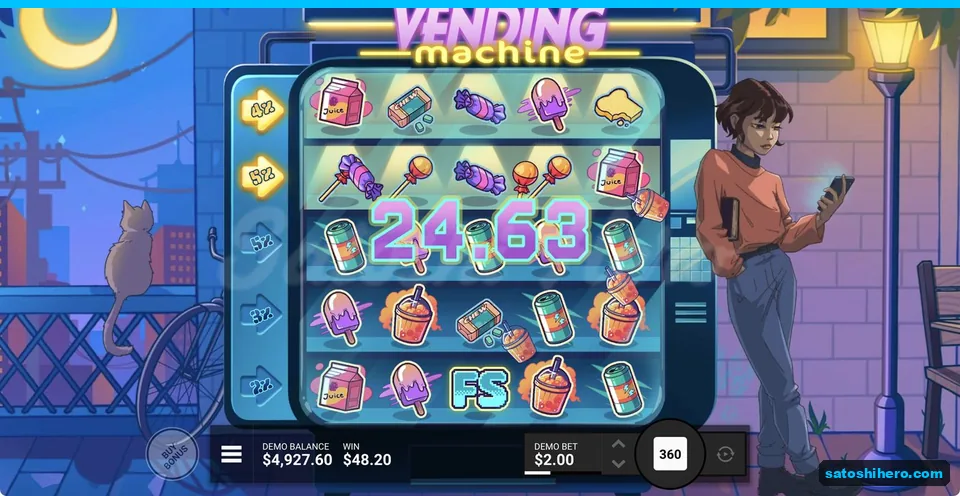
My best moment came around spin 140. The 4x and 5x rows were lit, and a win through those rows paid $48.20. That hit showed how row multipliers can rescue an otherwise modest line.
Finishing about $330 below the simulator median fits a no-bonus session. I don’t see that as a contradiction. The simulator showed the expected range, while my play showed one real path through the lower side of it.
Key Stat: Medium volatility doesn’t mean every 500-spin session is smooth; my test missed the bonus entirely and still landed well below the simulator median.
Theoretical RTP is the operator’s published figure. A single 500-spin session doesn’t change that return. Bonus-buy and FeatureSpins returns sit slightly different from the base return by design, and my test numbers are first-person session results, not predictions.
The balanced read is simple. Vending Machine slot can feel calm visually while still producing long dry base-game stretches. You need a bankroll plan before chasing the lit-row moments.
Frequently Asked Questions About Vending Machine
What happened in 500 real spins of Vending Machine slot?
I played 500 spins at $2.00 from $5,000.00 and finished on $4,586.20, down $413.80. No bonus landed, and the best hit was $48.20 through two lit multiplier rows.
How do the multiplier lights work in Vending Machine slot?
Each row has its own multiplier. Lightning Bolts switch a row on, Blackout Skulls switch it off, and every winning symbol on a row adds 1 to its value. Wins that cross several lit rows add those multipliers together.
What is the difference between Lo-Fi Spins and Spin and Chill in Vending Machine slot?
Lo-Fi Spins start with three multiplier rows switched on and Spin and Chill starts with all five. Both keep going until Blackout Skulls have switched every row off.
Is buying Spin and Chill worth it in Vending Machine slot?
In my test, I paid $400.00 and the round ran for 16 spins, finishing on $224.40. That returned a little over half the price, so this buy was exciting but still a losing one.
What did the 1,000-spin simulator predict for Vending Machine?
At $2.00, the median simulated session finished $87.60 down, with the middle 90% of runs between $431.60 down and $335.50 up.
What are the RTP and max win of Vending Machine slot?
Vending Machine has 96.28% RTP, medium volatility and a maximum win of 5,000x the bet. Both bonus modes can reach the 5,000x cap.
Which slot machine is most likely to win?
No slot is most likely to win in a guaranteed way. For Vending Machine, the useful figures are 96.28% RTP, medium volatility and the tested hit pattern from our session.
Final Verdict
Vending Machine stands out because it turns a quiet snack-machine theme into a row-position game. The main drawback is the dry base-game stretch, since my 500 spins missed the bonus completely.

My Take
I’d play this with a steady stake and a clear stop point. Expect calm visuals, medium volatility, and sudden interest when diagonal lines cross lit rows. Don’t buy Spin and Chill unless the $400.00 cost fits your session plan.
I like the row multipliers because they made even small lines worth checking. I don’t like how flat the base session felt without a bonus. My bought feature had better energy, but $224.40 still lost against the $400.00 buy.
Vending Machine slot earns a place with readable mechanics and real positional tension. This page is updated periodically so the main figures stay aligned with published game data.

Pros:
 Clear row system: Active multipliers make every line position easy to judge.
- Strong theme fit: Five shelves make the reels feel natural behind glass.
- Fair headline RTP: 96.28% gives the base game a solid published return.
- Two bonus routes: Lo-Fi Spins and Spin and Chill offer different cost levels.

Cons:
 Dry base stretches: My 500 spins missed the bonus and drifted down.
- Costly top buy: Spin and Chill costs $400.00 at a $2.00 stake.
- Paid volatility jump: Bonus buys carry high volatility despite the medium main game.

Best For: Patient slot players get the most from this game when they enjoy tracking row states and line paths. The best match is a calm-theme player with enough bankroll discipline to ride dry stretches without forcing bonus buys.

































































Bets
All Bets
Game
Player
Date
Wager
Mult.Multiplier
Prize
 Halloween Harvest: Rapid Link
 Hidden
- 00:20:52
- 0×
- Halloween Harvest: Rapid Link
- Hidden
- 00:20:51
- 0×
- Royal Fruits 9: Hold 'n' Link
- nina87
- 00:20:50
- 0×
- Halloween Harvest: Rapid Link
- Hidden
- 00:20:50
- 0.89×
- Big Banker Bonanza
 josh1998
- 00:20:49
- 0.8×
- Aztec Magic Deluxe
 RicoSoul
- 00:20:49
- 0×
- 4 Lucky Nuggets
 whodey39311
- 00:20:49
- 0×
- Aztec Magic Deluxe
- RicoSoul
- 00:20:47
- 0×
- 4 Lucky Nuggets
- whodey39311
- 00:20:46
- 0×
- 4 Lucky Nuggets
- whodey39311
- 00:20:44
- 0×