

Buffalo Stack'n'Sync
RTP94.38%
VolatilityMedium–high
Max winx10,000
Lines10
Hit rate20.18%
ThemeWild West
ReleasedMay 2022

Dust, Buffalo, and a Brutal Stack Chase
Buffalo Stack’n’Sync slot starts as a clean desert line slot, then turns every Stack’n’Sync respin into a fight for full reels. I played 500 base spins at $2.00, bought both main bonuses separately, and tested Hacksaw Gaming’s medium-high volatility math against the real balance swings.
Buffalo Stack’n’Sync slot is a medium-high volatility slot from Hacksaw Gaming with 96.36% RTP and 10,000x max win potential. The game uses 5 reels, 4 rows, 10 fixed paylines, and Stack’n’Sync respins. Aimed at patient line-slot players who like visible reel-building tension and risky bonus-buy choices.
Key takeaways
- Best bonus: Free Spins cost $200.00 and returned $94.80, while Stampede Spins cost $500.00 and returned $46.00.
- RTP / volatility: The official RTP is 96.36%, volatility is medium-high, and the buy RTPs sit slightly higher.
- Max win: The cap is 10,000x the bet, tied to rare buffalo stacks and strong multipliers.
- Risk note: My 500 spins at $2.00 finished $342.40 down after one organic bonus.
- Bankroll note: Repeated $0.20 and $0.40 wins can drip your balance down while you wait.

Table of Contents
- How Buffalo Stack’n’Sync slot works
- Grid and paylines
- Symbols and pays
- Buffalo Stack’n’Sync slot theme & first impressions
- Desert presentation
- Table feel
- Stack’n’Sync mechanic
- Stacks and respins
- Synced reels
- Stampede reels and multipliers
- Buffalo reels
- Added multipliers
- Free Spins
- Trigger and rules
- Bought result
- Stampede Spins
- Stripped reels
- Bought result
- FeatureSpins mode
- How it works
- When to skip
- RTP, volatility and my test
- Simulator projection
- Our 500-spin session
- Frequently Asked Questions About Buffalo Stack’n’Sync
- Final Verdict
How Buffalo Stack’n’Sync slot works
Buffalo Stack’n’Sync slot is a traditional 5×4 line slot with 10 fixed paylines. You don’t get a 7×7 grid here, even though stacked reels can make the screen look busier than a normal line game.
Grid and paylines
Wins pay left to right from the leftmost reel across the 10 fixed lines. Three, four and five matching symbols can pay when they sit on a valid line. That structure matters because you need line alignment, not cluster contact or pay-anywhere symbol counts.
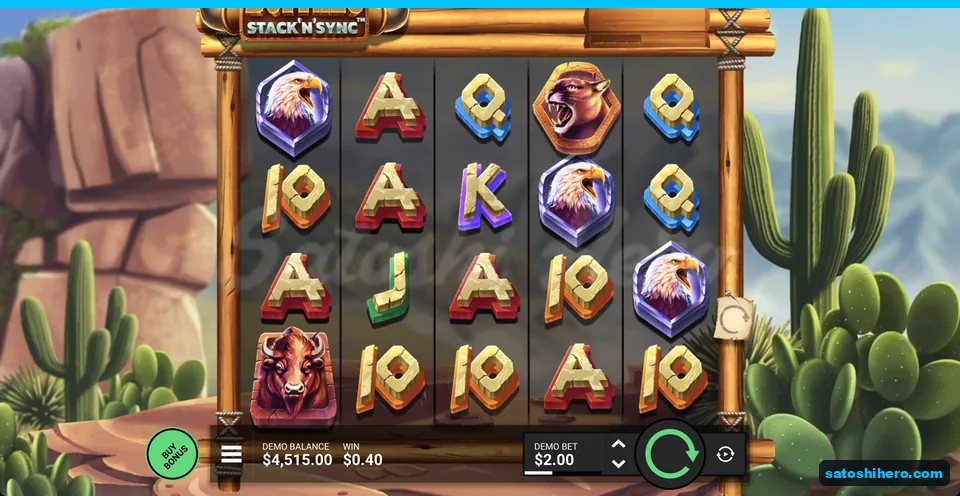
The in-game rules page for buffalo stack n sync hacksaw gaming gives the real setup: 5 reels, 4 rows and 10 fixed paylines. I trust that more than loose 7×7 descriptions elsewhere, because the rules page also explains why the stacks create the visual confusion.
You can try Buffalo Stack’n’Sync slot in demo or real play on SatoshiHero. The demo opened for me with a $5,000.00 balance at a $2.00 stake, which made the bankroll movement easy to track.
Symbols and pays
At $2.00, the carved 10 and J pay $4.00 for five. Q and K pay $6.00, while A pays $8.00. Those low wins landed often in my session, but they rarely changed the balance trend.
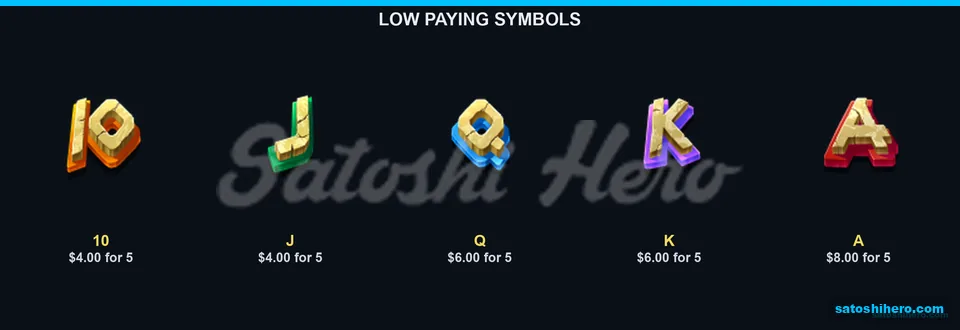
The animal symbols carry the better paytable weight. Horse and cougar pay $20.00 for five, wolf pays $24.00, eagle pays $30.00, and buffalo pays $40.00. The cactus wild substitutes for paying symbols and also pays $40.00 for five on its own.

Special symbols do the actual heavy lifting. Flaming hooves trigger bonuses, Stack’n’Sync symbols create the named respins, Stack symbols appear in Stampede Spins, and white buffalo skulls act as dead filler. The interface stayed readable on desktop and mobile-style play because the reel frame is simple and the buy button stays clear.
Buffalo Stack’n’Sync slot theme & first impressions
Buffalo Stack’n’Sync slot gives Hacksaw’s bright, naturalistic take on a familiar buffalo format. The theme won’t win originality awards, but the warm palette does more work than expected.
Desert presentation
The reels sit inside a rough wooden frame against a sun-bleached desert. Red rock buttes sit to one side, saguaro cactus sits to the other, and the whole scene feels calmer than many darker Hacksaw games.
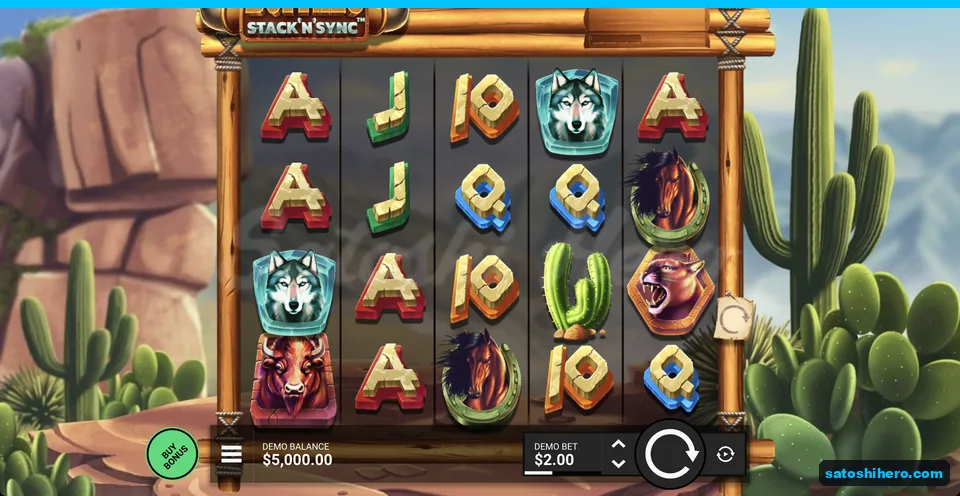
Bonus rounds shift the light into a dusty sunset. That small change helps, because you can feel the feature state without needing a loud visual reset. I like that choice, since the base game can already feel busy during stacked respins.
Xmas Drop makes more sense if you want a brighter seasonal look instead of dusty natural realism. This buffalo game leans warmer and slower, which matches its bankroll grind better than a louder theme would.
Table feel
Numbers indicate the theme has to carry plenty of low-pay spins. In my base session, $0.20 and $0.40 returns kept landing, so the relaxed art mattered more than I expected. You spend time waiting here, and harsh visuals would’ve made that wait feel worse.
Hacksaw keeps the sound and motion fairly clean. You can follow the stacks without fighting clutter, and that helps when several reels begin copying each other. The look doesn’t rescue weak payouts, but it does make long sessions less grating.
SatoshiHero checks slot rules and displayed game info regularly so specs stay aligned with the playable version. That matters here because grid claims around this game often get messy.
Stack’n’Sync mechanic
Stack’n’Sync is the core respin mechanic and the main reason to play. It fills reels with stacked symbols, then can sync later reels to copy the same symbol and stop position.
Stacks and respins
The first Stack’n’Sync symbols in a round fill their reels with 15, 30, 45 or 60 symbols of one kind. A 60-symbol stack fills that reel completely. Only one Stack’n’Sync symbol can land per reel in a round, so you watch positions closely.
Each Stack’n’Sync symbol awards one respin. If another one lands during the respin, the new reel copies an already stacked reel and stops in the same position. You want high-paying animals here, because low symbols can still sync without doing enough damage.

Key Stat: A 60-symbol stack can fill an entire reel, but the paying grid stays 5×4. That distinction explains why the game can look larger than its actual line setup.
Synced reels
My base session saw enough respins to stay interesting. They landed often in the first 80 spins and helped push the balance up to $5,128.20 by spin 83. After that, the same mechanic kept teasing without paying enough.
The strongest shape comes when several reels sync with the same high-paying animal. Buffalo stacks matter most because they can turn into Stampede Reels, but even A or eagle stacks can wake up the paytable. You shouldn’t treat every stack as progress, though.
I liked the tension more than the results. The mechanic gives you something to watch, yet my balance still ground down across the final 400 spins. Synced reels create the sweat, but the symbol quality decides whether the spin matters.
Stampede reels and multipliers
Full buffalo reels become Stampede Reels with multipliers. This is the route toward the 10,000x max win, not ordinary $0.20 and $0.40 base-game hits.
Buffalo reels
A full reel of buffalo symbols upgrades into a Stampede Reel. The multiplier applies to any winning payline that runs through that reel and contains buffalo symbols. You need both the reel state and the payline hit, so the setup has more friction than it first appears.

The possible multipliers are 1x, 2x, 3x, 4x, 5x, 6x, 7x, 8x, 9x, 10x, 15x, 20x, 25x, 50x, 75x and 100x. If a winning line passes through more than one Stampede Reel, the game adds those multipliers before applying them. That additive rule can make several full reels much stronger than one.
Added multipliers

Strategy Insight: Don’t judge a Stack’n’Sync respin only by how many reels stack. The stacked symbol matters just as much as the number of reels.
The math suggests full buffalo reels carry the real swing factor. A low-symbol sync can look exciting, then return very little because the paytable starts too low. Buffalo Stack’n’Sync slot needs premium symbols and clean line coverage before the multiplier system wakes up.
I don’t like calling this a simple max-win chaser. The 10,000x cap exists, but the route needs rare alignment plus strong multiplier conditions. Ordinary line hits keep the meter moving, while buffalo stacks create the only serious upside.
Free Spins
Free Spins is the cheaper bonus buy and the better tested bonus in my session. It still lost money, so “better” only means less punishing than Stampede Spins.
Trigger and rules
Three bonus symbols trigger Free Spins, which awards 10 spins. The rules resemble the base game, but the weighting changes in your favor. Stack’n’Sync symbols land more often, and high-paying animals are more likely to become the stacked symbol.

That shift matters because full buffalo reels can lead to Stampede Reel multipliers. You still need the right symbols to line up, but the round gives the named mechanic more room. I prefer this feature shape because it keeps the base game’s logic intact.
Wishbringer is a useful comparison when you judge whether a buy price matches a feature’s likely shape. Here, $200.00 buys more Stack’n’Sync action, not a direct promise of strong return.
Bought result
I bought Free Spins at $200.00 on a $2.00 stake. That equals 100x the bet. A Stack’n’Sync symbol landed on reel two, then two reels synced with A symbols on a 30 stack.
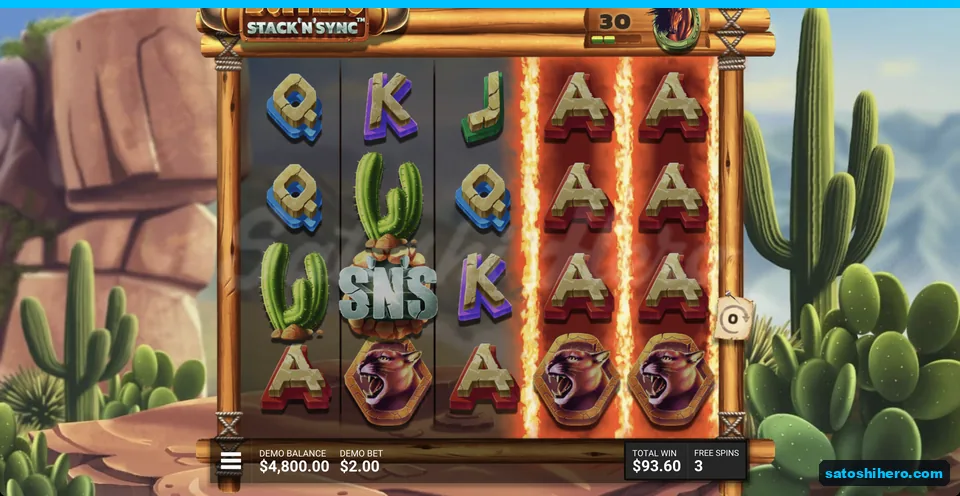
One spin paid $88.40, which carried most of the feature. The round closed on $94.80, equal to 47.4x my bet and a little under half the purchase price. You can see why I call it the better buy, but it still failed the basic cost test.

The feature felt playable because it produced one clear hit and several real teases. I don’t mind losing a buy when the round shows its shape, but the price still bit hard. Free Spins looked stronger than Stampede Spins in this test, yet it didn’t turn profitable.
Stampede Spins
Stampede Spins is the more expensive bonus, and it produced the weaker tested result. The feature looks promising because the reels strip down to buffalo symbols, skulls and Stack symbols.
Stripped reels
Four bonus symbols trigger Stampede Spins and award 10 free spins. Only buffalo symbols, non-paying skulls and Stack symbols appear. Every Stack symbol adds 5 to 60 buffalo symbols to its reel and gives one extra free spin.
That setup creates a simple race. You want the reels to fill with buffalos before the spin count runs out. The concept sounds aggressive, and visually it feels like every spin could connect.

Warning: A higher bonus-buy price doesn’t mean a better short-term result. My $500.00 buy returned less than the $200.00 Free Spins buy.
Bought result
I paid $500.00 for Stampede Spins at the same $2.00 stake. That equals 250x the bet. The round extended to 11 spins after one extra spin landed, but the final return was only $46.00.
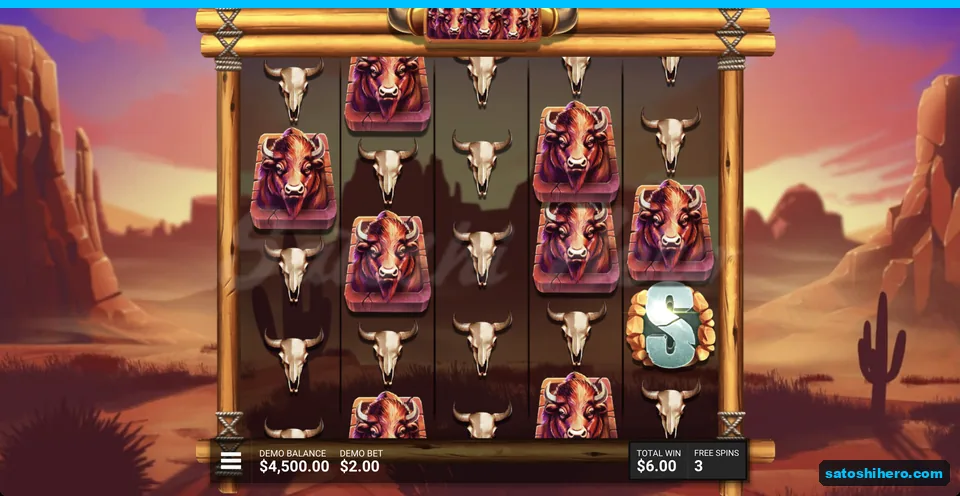
That result equals 23x the bet. The board looked close several times, but the Stack symbols didn’t add enough buffalos to build a meaningful payout. I found that more frustrating than the Free Spins loss because the visual promise felt stronger.

This buy taught the clearest risk lesson in the guide. Stampede Spins buys a different round shape, not a better expected short-term result. If you take it, you need to accept that the higher price can still give you a flat ending.
FeatureSpins mode
FeatureSpins is a paid spin mode, not a direct bonus purchase. At my $2.00 base stake, it cost $30.00 per spin and guaranteed at least one Stack’n’Sync symbol plus one respin.
How it works
FeatureSpins costs 15x the base stake and stays active until you switch it off. It doesn’t buy Free Spins or Stampede Spins. Instead, every paid spin gives you the central mechanic more often.
The official FeatureSpins RTP is 96.4%. That sits near the base 96.36% RTP, but the session rhythm changes fast because each spin costs far more. You get more action, yet your bankroll absorbs a much heavier price per decision.
Xpander offers a useful comparison for players who like paying into a central expanding or stacking-style mechanic. Buffalo Stack’n’Sync slot uses that idea through guaranteed Stack’n’Sync access rather than a separate expanding-reel format.
When to skip
I left FeatureSpins off during the 500-spin base test. That kept the session clean at $2.00 per spin, which made the base game easier to judge. If you want a slower bankroll burn, you should skip this mode.
You should also skip it when you want to measure base-game bonus frequency. FeatureSpins changes the whole texture of play by forcing the core mechanic into every spin. I see it as an action boost, not a profit shortcut.
The price feels concrete once you compare it with normal spins. Ten FeatureSpins cost $300.00 at my stake, while 10 normal spins cost $20.00. That difference changes your session rhythm fast.
RTP, volatility and my test
The official RTP is 96.36%, volatility is medium-high, and my test felt swingier than that label first suggests. The maximum win is 10,000x the bet, but the path depends on rare stacked buffalo outcomes.
Simulator projection
Our simulator modelled 1,000 spins at $2.00 using the confirmed 96.36% return. The median session finished $130.50 down. The 5th to 95th percentile band ran from $636.70 down to $733.90 up.
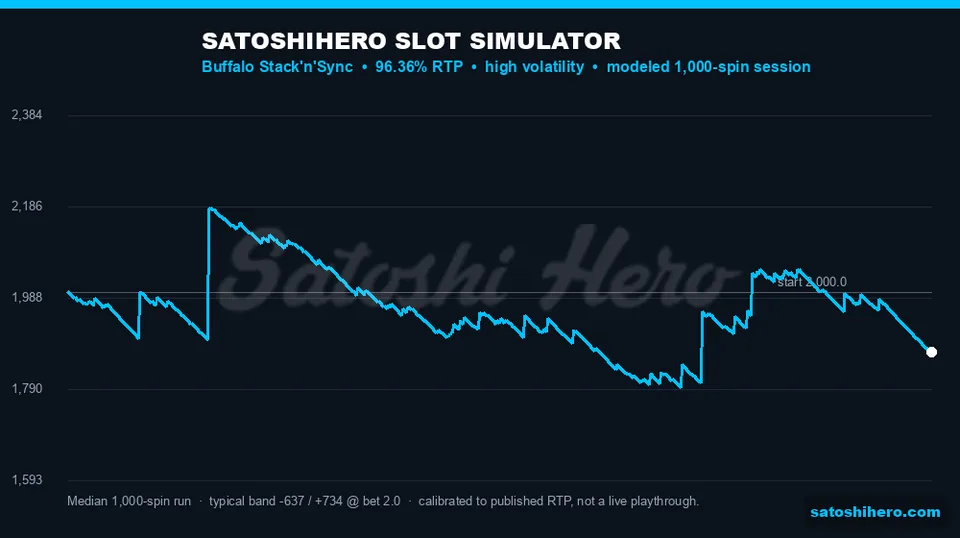
Around 18% of spins returned something. A bonus-tier round appeared about once every 45 spins, and a 100x bet win or better appeared about once every 1,748 spins. The model used a high-volatility band because no separate medium-high setting was available, so the spread may sit slightly wider than the game rating implies.
The buy RTPs sit close to the base figure. Free Spins shows 96.46%, Stampede Spins shows 96.5%, and FeatureSpins shows 96.4%. The buy cards add more risk context, with Free Spins labelled very high volatility and Stampede Spins labelled high.

Insight: The model expected a bonus-tier round roughly every 45 spins, but my 500-spin test produced only one organic bonus. That gap explains most of the pain.
Our 500-spin session
I played 500 spins at $2.00, starting at $5,000.00 and finishing at $4,657.60. That left me $342.40 down. The Buffalo Stack’n’Sync slot felt sticky at the start, then turned into a long bankroll grind.
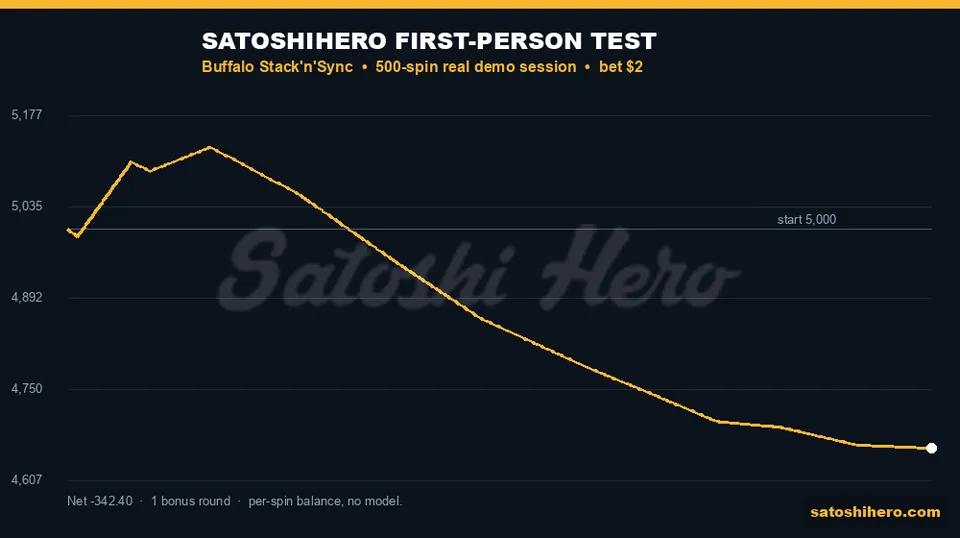
The best point came at spin 83, when the balance reached $5,128.20. Stack’n’Sync symbols had landed often enough to flatter the game early. From there, the balance fell almost without interruption.
Only one organic Free Spins round triggered, and it paid $11.60 over 10 spins. Base play kept feeding me $0.20 and $0.40 wins, but larger hits almost never followed. Numbers indicate the RTP is fair on paper, yet dry bonus frequency can punish you hard.
Limbo gives a simpler risk and reward curve if you prefer direct control over each wager. Ze Zeus may feel livelier if you want higher-energy slot pacing instead of this slower stacking grind. This game asks for patience, and my session didn’t reward much of it.
The 96.36% RTP is the operator-published theoretical return from the game rules. A single 500-spin session shows how the game can feel, not what it returns every time. Per-bonus RTPs differ slightly by design, because each mode changes the symbol mix and cost.
Frequently Asked Questions About Buffalo Stack’n’Sync
What grid does Buffalo Stack’n’Sync slot actually use?
Buffalo Stack’n’Sync slot uses a 5×4 grid with 10 fixed paylines. Three, four and five of a kind pay from the leftmost reel. Descriptions of a 7×7 grid are wrong, although 60-symbol stacks can fill a reel and make the board look larger.
How does the Stack’n’Sync mechanic work in Buffalo Stack’n’Sync slot?
The first Stack’n’Sync symbols create stacks of 15, 30, 45 or 60 symbols on their reels. Each one awards a respin. Later Stack’n’Sync symbols can sync to already stacked reels, copying their symbols and stop position.
What is a Stampede Reel worth in Buffalo Stack’n’Sync slot?
A full buffalo reel becomes a Stampede Reel with a multiplier. Values include 1x, 2x, 3x, 4x, 5x, 6x, 7x, 8x, 9x, 10x, 15x, 20x, 25x, 50x, 75x and 100x. Multipliers add together when one winning line passes through more than one Stampede Reel.
What is the difference between the two bonus rounds in Buffalo Stack’n’Sync slot?
Three bonus symbols trigger Free Spins, while four bonus symbols trigger Stampede Spins. Free Spins improves Stack’n’Sync and high-symbol weighting. Stampede Spins uses only buffalos, skulls and Stack symbols, so it feels more direct but costs more to buy.
What is the RTP of Buffalo Stack’n’Sync slot?
Buffalo Stack’n’Sync slot has 96.36% RTP, calculated over ten billion simulated rounds. Free Spins has 96.46% RTP, Stampede Spins has 96.5%, and FeatureSpins has 96.4%. Lower figures elsewhere may point to a different return build.
How did the real 500-spin Buffalo Stack’n’Sync slot session go?
I started with $5,000.00 at $2.00 per spin and finished with $4,657.60. That was a $342.40 loss. My best balance was $5,128.20 at spin 83, and the only organic bonus paid $11.60.
Are the Buffalo Stack’n’Sync slot bonus buys worth it?
Neither buy covered its cost in my test. Free Spins cost $200.00 and returned $94.80, while Stampede Spins cost $500.00 and returned $46.00 over 11 spins. The higher price bought a different feature shape, not a better short-term result.
Final Verdict
Buffalo Stack’n’Sync stands out because its central respin mechanic feels clear, visible and tense. Its main drawback is the grind between meaningful hits, especially when the bonus frequency runs cold.

My Take
Patient slot players can enjoy the Stack’n’Sync chase, but they shouldn’t expect soft volatility. My typical session felt like small wins holding the door open while the balance still slipped away.
I like the clean layout, honest rules page and strong feature identity. I don’t like how quickly the $500.00 Stampede Spins buy can fall flat. My 500-spin base test and both bonus buys left me respecting the design more than the payout experience.
Buffalo Stack’n’Sync slot is checked regularly on SatoshiHero against the displayed game rules and playable version. That matters because the exact 5×4, 10-payline setup is easy to misstate.

Pros:
 Clear core mechanic: Stack’n’Sync respins give every feature tease an obvious purpose.
- Strong rule clarity: The 5×4 grid and 10 paylines remove guesswork.
- Fair headline RTP: The 96.36% RTP sits in a solid range.
- Clean presentation: The calm desert style helps longer sessions feel less harsh.

Cons:
 Cold bonus frequency: My 500 spins produced only one organic bonus.
- Harsh buy pricing: Stampede Spins cost $500.00 and returned just $46.00.
- Small base wins: Frequent $0.20 and $0.40 hits rarely changed momentum.

Best For: This game fits patient line-slot players who like watching reels build toward a visible payoff. Bonus-buy fans get clear choices, but the test results show why bankroll control matters. If you prefer fast, direct risk with fewer moving parts, this one may feel too grindy.


































































Bets
All Bets
Game
Player
Date
Wager
Mult.Multiplier
Prize
 Royal Fruits 9: Hold 'n' Link
 nina87
- 00:17:02
- 0×
- 3 Witches: Bonus Combo
 bjgrandy149
- 00:17:02
- 9×
- 3 Witches: Bonus Combo
- bjgrandy149
- 00:16:59
- 0×
- Halloween Harvest: Rapid Link
- Hidden
- 00:16:57
- 0×
- 3 Witches: Bonus Combo
- bjgrandy149
- 00:16:55
- 0×
- 4 Lucky Nuggets
 whodey39311
- 00:16:54
- 0.33×
- Royal Fruits 9: Hold 'n' Link
- mike_721
- 00:16:54
- 0×
- Royal Fruits 9: Hold 'n' Link
 mdp0fxo
- 00:16:52
- 0×
- 3 Witches: Bonus Combo
- bjgrandy149
- 00:16:52
- 0×
- Galaxy Glitter
- Hidden
- 00:16:50
- 0×