

Epic Gladiators
By pressing play, you agree that you are above legal age in your jurisdiction and that your jurisdiction allows online gambling.


Tiny Gladiators, Exploding Clusters, and Skeleton Battles
Epic Gladiators slot drops you into Evoplay’s cartoon arena, where cluster wins fuel battles between tiny gladiators and skeleton enemies.
According to Evoplay, Epic Gladiators is a medium-high volatility slot with 95% RTP and 1,328x max win potential. Five symbols connect horizontally or vertically on a 7×7 board without fixed paylines. My 100-spin test ended 124.4x ahead after five features, but that unusual run doesn’t predict yours. You can play Epic Gladiators online at SatoshiHero in demo or real mode; this guide covers the mechanics and three gladiators.
Key takeaways
- Best bonus: You can’t buy free spins, so Kilevilus must defeat an enemy during one uninterrupted drop chain.
- RTP / volatility: The 95% theoretical return accompanies medium-high volatility and noticeably uneven play.
- Max win: The 1,328x cap feels modest beside the game’s risk level.
- Risk note: My five features and 124.4x profit form a favourable snapshot, not a forecast.
- Bankroll note: Size your stake for swings rather than expecting my frequent triggers to repeat.

Table of Contents
- How the Epic Gladiators slot Works
- Cluster Win Rules
- Drops and Wilds
- Theme and First Impressions
- Gladiator Attack
- Damage and Healing
- Defeating Enemies
- RTP, Volatility and Our Test
- Simulator Projection
- Our 100-Spin Session
- Free Spins
- Maximus Multiplier
- Growing Multiplier
- Tested Result
- Wild Crixus
- Random Wild Conversions
- Tested Result
- Spintacus Swaps
- Symbol Repositioning
- Three Test Results
- Extra Bonus Card Pick
- Possible Card Prizes
- Test Observation
- Frequently Asked Questions About Epic Gladiators
- Closing Thoughts
How the Epic Gladiators slot Works
You win by forming groups of at least five matching symbols on a 7×7 cluster-pays board. Epic Gladiators slot has no fixed paylines, and diagonal contact alone doesn’t complete a cluster. You should scan side-to-side and vertical connections instead. I find this system easier to read than a crowded web of paylines.
Cluster Win Rules
Matching icons must touch horizontally or vertically to form one paid group. Only the highest applicable payout for that group counts, then its paytable value multiplies your total bet. Bigger connected groups matter far more than scattered matches, even when those scattered icons look promising.
| Symbol | Five symbols | Fifteen or more |
|---|---|---|
| Skull coin | 2x | 800x |
| Sword | 1.2x | 700x |
| Green shield | 1x | 500x |
| Roman helmet | 0.8x | 300x |
| Flame | 0.7x | 250x |
| Cloud | 0.4x | 150x |
| Water drop | 0.3x | 120x |
| Rock | 0.2x | 100x |
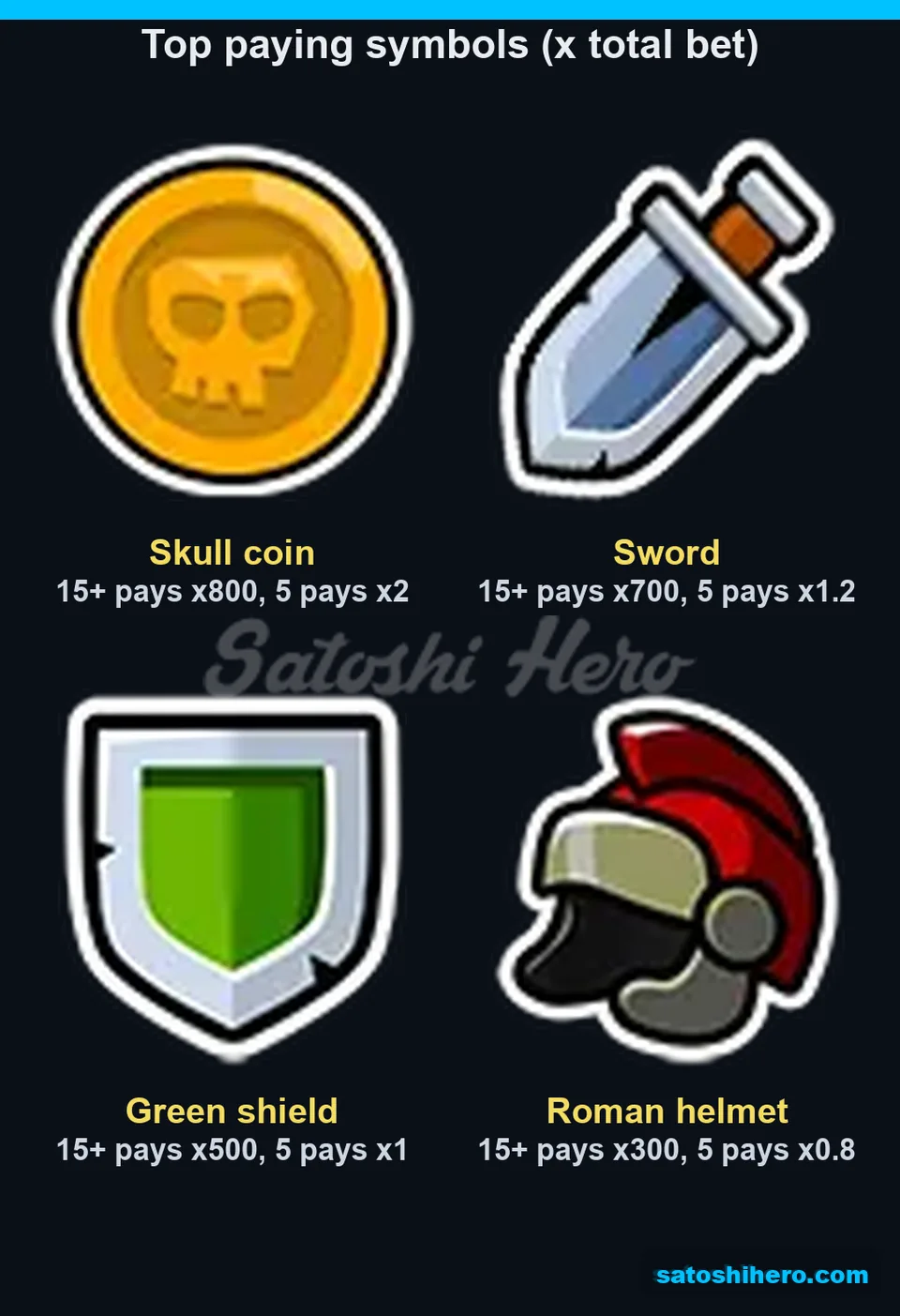
The skull coin leads the table, while rocks occupy the bottom. I checked the units when eight rocks returned $60 from a $10 stake, exactly 6x the bet. That direct check matched the displayed paytable and made later results easier to compare.
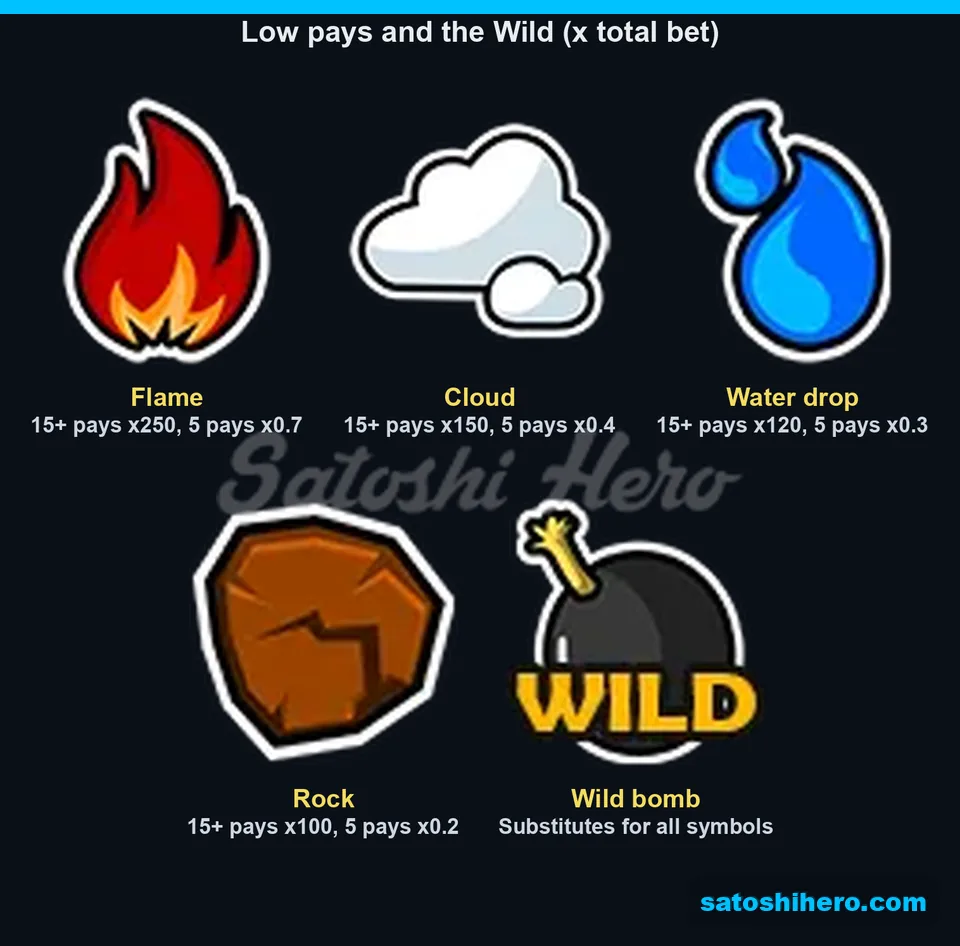

Fast Fact: Connected groups replace left-to-right paylines, so diagonal contact alone doesn’t form a winning cluster.
Drops and Wilds
Every winning group explodes, symbols fall into its gaps, and fresh icons enter from above. Another qualifying cluster continues the same paid spin. The meter combines every payout until no new group forms, so you see the complete round rather than separate spins.
Wild bombs substitute for every regular symbol and can support several groups simultaneously. During my base play, multiple clusters settled at a combined $70, or 7x my $10 stake. You might see a small first hit become useful once the bomb bridges nearby icons.
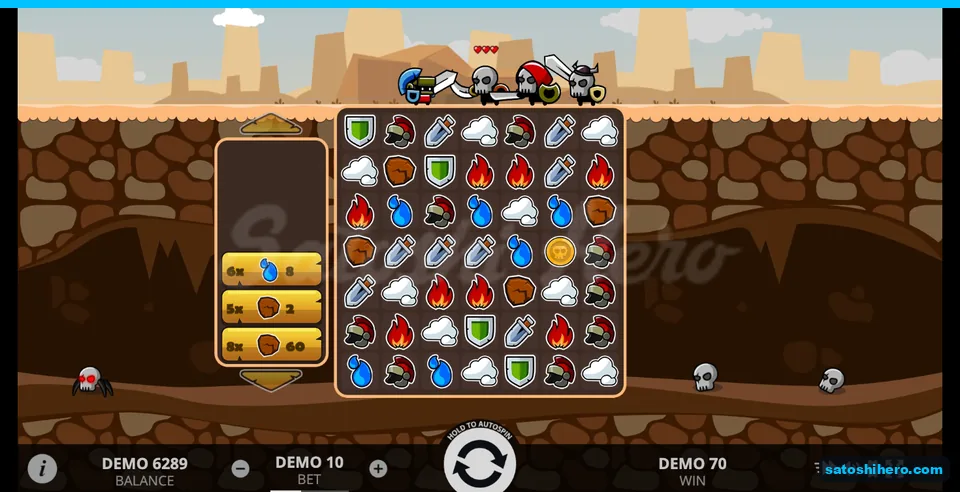
Longer chains matter twice because they build payouts and drive the battle above the board. Watch the complete drop sequence, not just its opening cluster, when judging a round.
Theme and First Impressions
Cartoon combat gives every cluster a clear purpose, although the gladiator setting won’t win originality awards. Tiny armoured fighters face skeletons above the board while chunky, outlined icons fill the playing area. You see a desert canyon during base play, which keeps the bright board easy to follow.
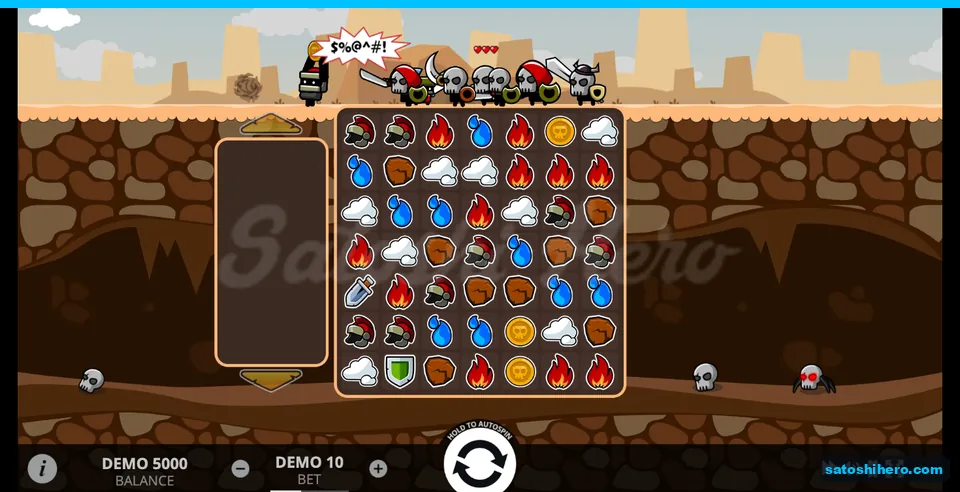
Free spins move the action into a darker stone dungeon. You might find that shift simple, yet it gives the bonus a stronger mood without hiding the symbols. Character reactions after wins also connect the theme to each explosion instead of leaving the fighters as idle decoration.
The play-money balance and prizes carry demo labels on screen. I liked that clarity because it kept the test separate from real wagering while preserving the same visual flow. The arena remains familiar, but the combat animation gives it more personality than the scenery alone. You can compare Evoplay’s other visual and mechanical approaches in Epic Legends, Roll to Luck, and Trip to the Future.

Trivia: The armoured fighters and skeleton enemies turn gladiatorial combat into playful fantasy rather than a serious historical scene.
Epic Gladiators slot uses movement well: each hit, fall, and reaction explains what just happened. You won’t find a subtle presentation here, but you should understand the board and battle quickly. In my view, the animated fight adds more value than the familiar setting.
Gladiator Attack
Every completed explosion-and-drop step deals one damage to the active skeleton enemy. Kilevilus fights three opponents above the board, turning continued cluster wins into visible progress. You can follow the attack without opening a help screen, which makes this feature particularly readable.
Damage and Healing
The first enemy had three hearts in my test, while the next two carried one heart each. A continued drop removes another heart after each winning step. Yet the enemy heals to full when the chain ends, so damage never carries into your next paid spin.
One opening cluster can cause damage without reaching free spins. Replacement symbols must create another cluster to keep Kilevilus attacking. You may therefore get more feature progress from several modest groups than from one expensive hit that ends immediately.

Tip: Watch the uninterrupted drop count instead of only the first cluster’s value. Consecutive drops preserve the attack and give Kilevilus time to finish an enemy.
Defeating Enemies
Enemy defeats provide the only route into free spins because Epic Gladiators slot has no Bonus Buy. One long sequence can remove several opponents, but you can’t control the incoming symbols. The feature rewards continuation while keeping every decisive drop random.
This design made near-misses easy to understand during my test. I could see when Kilevilus needed one more hit, then watch the fresh symbols fail to connect. You may find that tension entertaining, though repeated healing can feel harsh during quieter stretches.
A smaller opening win followed by several drops may prove more useful than one valuable, isolated cluster. For feature hunting, chain length tells you more than the first payout alone.
RTP, Volatility and Our Test
Epic Gladiators slot pairs 95% RTP and medium-high volatility with a restrained 1,328x ceiling. The risk profile can produce active bursts and long stretches where scattered returns fail to recover your stake. You should treat my strong test as one possible path, not a normal outcome.
Simulator Projection
The SatoshiHero Slot Simulator modelled 1,000 spins at one bet unit. Its median ending result finished 61.9x down, while the central 90% range ran from 265.8x down to 220.4x up. That broad spread captures how differently two equal-length sessions can unfold.
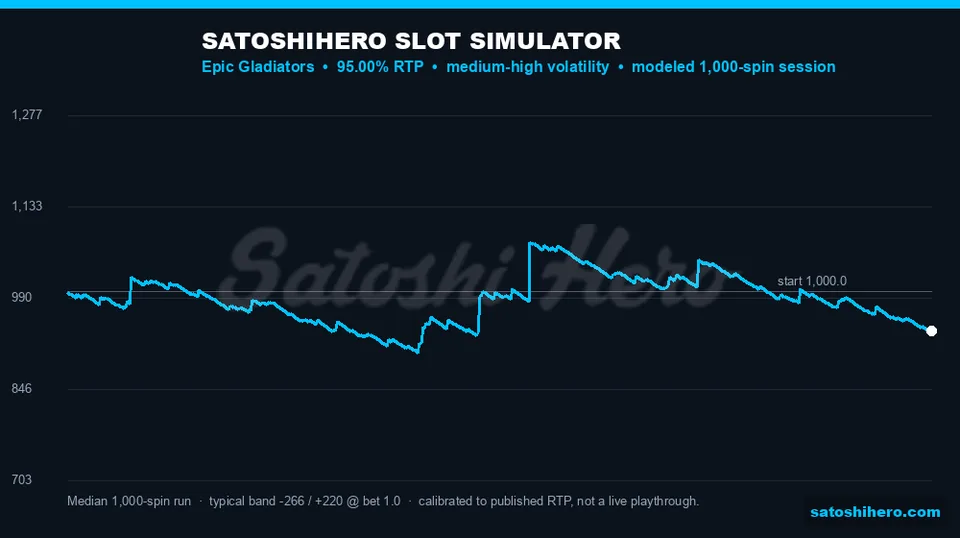
- About 21% of modelled spins returned something.
- A feature-sized win appeared approximately once per 45 spins.
- Very large wins appeared approximately once per 4,115 spins.
The model maps possible sessions rather than calling your next result. A 21% hit rate also counts every paying spin, including returns below the stake. You could see frequent small clusters while your balance still trends downward, which is why hit rate alone offers limited comfort.
Wide outcomes make sensible stake sizing important. If you start too high, an ordinary dry patch can cut your planned session short. I think the maximum payout looks modest beside this degree of variation, even though the feature mechanics remain engaging.
Our 100-Spin Session
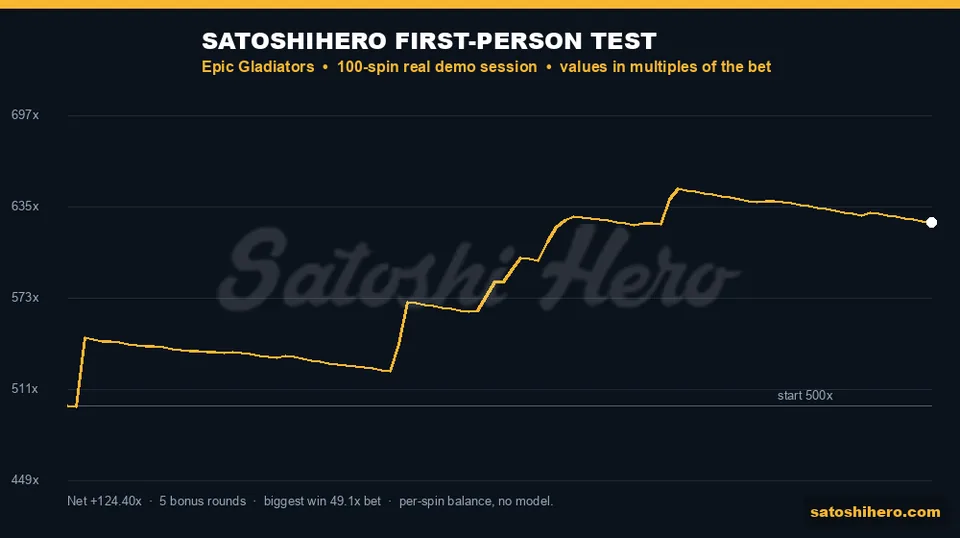
My 100-spin test ended 124.4x ahead, helped by five naturally triggered features. I started with $5,000, staked $10 per spin, and finished at $6,244. Thirty-six spins paid something, so you can see how concentrated bonus returns drove the profit.
The free spins began on spins 2, 39, 49, 52, and 70. Their returns measured 46.1x, 32.8x, 13.5x, 15.3x, and 16.9x. My biggest complete round reached 49.1x on spin 39, including the triggering spin, while spin 56 delivered my best base-only result at 25x.
After the first spin, my balance bottomed at $4,990. It reached $5,840 after spin 50, then climbed to $6,429 after spin 75 before giving some profit back. That path felt unusually comfortable for this risk band because I spent almost no time below my starting balance.

Alert: Medium-high volatility can produce a very different session. Set a fixed budget, and never raise your stake to chase a feature.
You shouldn’t expect five features across every 100 base spins. My sample landed several bonuses close together, including three consecutive Spintacus appearances, which created an exceptional run. The result shows what happened in my session, not what the Epic Gladiators slot owes the next player.
Theoretical RTP describes the game’s expected mathematical return, and one live session doesn’t alter it. Our simulator uses that return, the volatility band, and win cap rather than replaying live spins. Mode-specific returns can differ by design, and the figures receive routine verification.
Free Spins
Defeating one, two, or three enemies during one drop sequence awards 10, 15, or 20 free spins. The feature keeps the triggering stake and selects one gladiator to modify the board. You must press Start before play begins, then press it again on the Total Win card to collect.
I triggered five rounds naturally across 100 base spins. Maximus appeared once, Spintacus appeared three times, and Wild Crixus appeared once. No purchase shortcut influenced that mix because the Epic Gladiators slot doesn’t offer one.
- Maximus returned 46.1x in my first feature.
- Spintacus returned 32.8x, 13.5x, and 15.3x.
- Wild Crixus returned 16.9x, equal to $169 from my $10 stake.
Defeated enemies set the initial number of spins. Further defeats during the feature strengthen the chosen gladiator’s effect, giving long drop sequences another job. You can enter with 10 spins and still improve the active modifier through combat.
Five triggers made my sample far livelier than you should assume from a short test. I enjoyed the changing modifiers, but the repeated Start cards slightly interrupted the pace. Each gladiator alters cluster building in a distinct way, so their individual results deserve separate treatment.
The different effects also prevent repeated rounds from feeling identical. You may prefer the certainty of Maximus, yet neither the selected fighter nor the incoming symbols sits under your control.
Maximus Multiplier
Maximus starts free spins with a 2x multiplier and gains one level after each enemy defeat. The modifier rewards continued drops through normal cluster payouts and a stronger multiplier. You get the clearest value when one sequence sustains both parts of that loop.
Growing Multiplier
Short sequences may leave the opening 2x multiplier unchanged. Longer chains can defeat enemies and lift the multiplier, though random symbol drops decide whether that progress occurs. You can’t select Maximus or force the connections needed to upgrade him.
The visual logic feels clean because battle progress and payout growth point in the same direction. I prefer this direct modifier to more obscure collection systems. Still, an exciting multiplier display doesn’t help much when the board stops connecting.
Tested Result
Maximus appeared in my first tested feature and returned 46.1x the bet. That was my strongest standalone free-spin total across all five rounds. You should read it as one favourable result, not evidence that this gladiator always beats the others.
My sample included only one Maximus round, which prevents a fair average comparison. The result demonstrated meaningful potential when drops cooperate, while leaving its usual return unresolved. For you, the practical takeaway is simple: watch enemy defeats because they control multiplier growth.
That growth gives every continued chain extra tension after the opening payout. Even so, you should judge the finished total rather than the multiplier’s peak alone.
Wild Crixus
Wild Crixus changes up to three random symbols into Wilds after every free spin. Each defeated enemy adds one more transformed symbol, so continued combat can reshape more positions. You may see weak-looking boards gain a connection after the normal result settles.
Random Wild Conversions
A converted Wild can complete a cluster, increase its size, or support more than one winning group. Unlike Maximus, this modifier doesn’t apply a fixed payout multiplier. Its value depends heavily on where the transformed symbols sit and which icons surround them.
That positional dependence makes the feature easy to watch but difficult to judge early. You can spot a promising conversion near four matching symbols, while an isolated Wild may add little. I like the interaction with cluster pays, although random placement creates plenty of wasted potential.
Tested Result
Wild Crixus appeared once and returned 16.9x my bet. At the $10 test stake, the ending Total Win card showed $169. You shouldn’t treat one round as a normal return, especially after my feature-heavy base session.
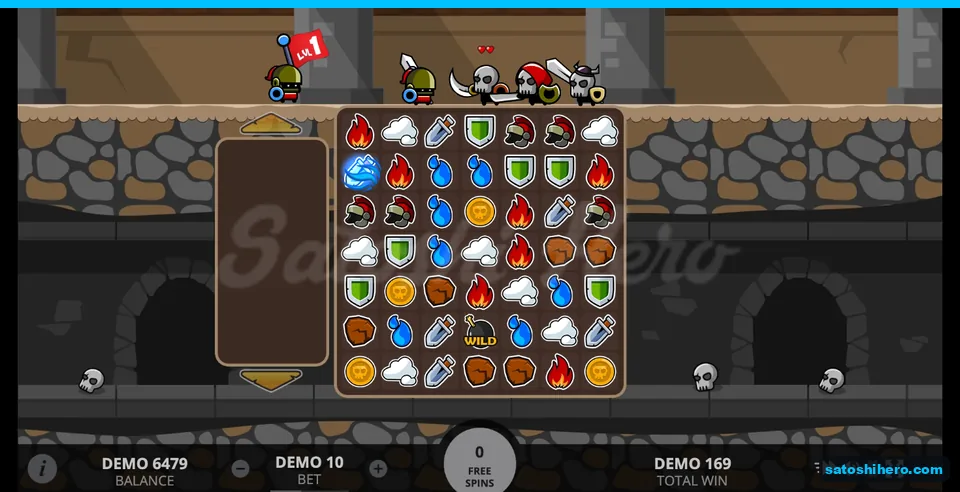
The modifier can rescue disconnected layouts without guaranteeing an improvement. My tested result landed below Maximus and the best Spintacus round, yet that ranking rests on tiny samples. For practical play, focus on transformed positions rather than assuming every extra Wild carries equal value.
Spintacus Swaps
Spintacus moves two random symbols after a spin to create or enlarge a connected group. Each enemy defeated adds one more swap, changing positions rather than creating Wilds or multiplying payouts. You can see the board rearrange after its initial layout has settled.
Symbol Repositioning
A useful swap can connect matching icons that previously sat apart. Other moves may shift irrelevant symbols and produce little extra value, making this modifier especially uneven. You won’t know whether the intervention helps until the selected positions change.
I found the mechanic less immediately powerful than a visible multiplier. But it fits the cluster system because one moved icon can join several neighbours and expand a group. The strongest moments come when a swap bridges two matching pockets that couldn’t connect before.
Three Test Results
Spintacus appeared in three consecutive tested features and returned 32.8x, 13.5x, and 15.3x. That spread shows how the same modifier can produce very different totals. You shouldn’t assume the next swap round will resemble the previous one.
My first Spintacus result nearly doubled either of the next two. Board state and random selections mattered more than the modifier’s name, which kept expectations in check. Across my sample, Spintacus offered variety rather than consistent strength, and its success always depended on useful repositioning.
Extra Bonus Card Pick
An Extra Bonus card-selection event can appear after standard free spins end. It offers one of three prizes, but my five tested rounds never reached this event. You should treat it as a possible extension rather than a routine closing step.
Possible Card Prizes
The available card rewards are:
- A 2x win multiplier.
- A 3x win multiplier.
- Twenty additional free spins.
The card event can’t trigger again after the extra free spins finish. That rule limits the pick to one extension within a completed feature sequence. I think the restriction keeps the structure understandable, though it also stops repeat card picks.
Test Observation
Across all five rounds, I didn’t see the card selection after any gladiator. Without an observed trigger, I can’t support a frequency claim or compare its prizes firsthand. You still know the available outcomes, but not how often your sessions may reach them.
That absence matters because it separates confirmed rules from my actual play. The event exists within Epic Gladiators slot, yet my 100-spin sample supplied no result to assess. Treat any appearance as extra variation beyond the standard free-spin modifiers.
Frequently Asked Questions About Epic Gladiators
What is the Epic Gladiators slot?
It is Evoplay’s 7×7 cluster game with falling symbols and a gladiator fighting skeletons. Connected groups replace fixed paylines.
How do you win in the Epic Gladiators slot?
Connect five or more matching symbols horizontally or vertically. The group-size value multiplies your total bet, and only its highest applicable payout counts.
How do free spins start in the Epic Gladiators slot?
Each completed drop damages the active enemy. Defeating one, two, or three enemies in that sequence grants 10, 15, or 20 spins.
What do the three free-spin gladiators do in the Epic Gladiators slot?
Maximus uses a growing multiplier, Wild Crixus converts random symbols into Wilds, and Spintacus swaps symbols to create or enlarge clusters.
Can you buy the bonus in the Epic Gladiators slot?
No, free spins require enemy defeats during an uninterrupted chain. You can try Epic Gladiators free through SatoshiHero’s play-money demo before choosing real play.
What did the Epic Gladiators slot 1,000-spin simulator show?
The median ended 61.9x down, with the central 90% spanning 265.8x down to 220.4x up. Those outcomes aren’t predictions.
How did the Epic Gladiators slot 100-spin test go?
I finished 124.4x ahead after 36 paying spins and five features. My biggest round reached 49.1x, but this sample shouldn’t set expectations.
What are the Epic Gladiators slot RTP and maximum win?
The RTP is 95%, volatility is medium-high, and the maximum win is 1,328x the bet.
Closing Thoughts
Epic Gladiators stands out by tying every continued cluster to a visible skeleton fight. Its three modifiers add variety, though the modest top prize feels underwhelming beside the uneven risk.

My Verdict
Drop-chain fans should try the demo and watch how enemy healing shapes each round. Expect volatile pacing, random modifier strength, and no shortcut into free spins.
I liked the clear cluster explosions and the unusually active feature run in my test. Enemy progress disappears too quickly when replacement symbols fail, and the absent card pick left one feature untested.
The Epic Gladiators slot guide reflects direct play, simulator modelling, and rules that are checked regularly.

Pros:
 Readable clusters: Clear explosions make connected wins easy to follow.
- Purposeful drops: Every continued win also advances the skeleton battle.
- Distinct modifiers: Three gladiators change free spins in noticeably different ways.
- Strong demo access: Play money lets you learn enemy healing without real stakes.

Cons:
 Modest ceiling: The maximum payout feels restrained beside the volatility.
- Resetting damage: Enemies heal whenever a drop chain ends.
- No direct entry: You can’t buy immediate access to free spins.

Best For: Cluster-slot fans who enjoy visible progression, random board changes, and sharp swings get the strongest match. Careful stake setters should appreciate the free demo before risking real funds.


































































Bets
All Bets
Game
Player
Date
Wager
Mult.Multiplier
Prize
 3 Witches: Bonus Combo
 bjgrandy149
- 00:17:43
- 4.5×
- Halloween Harvest: Rapid Link
 Hidden
- 00:17:42
- 0×
- Big Banker Bonanza
 josh1998
- 00:17:42
- 0×
- Luck of Panda: Bonus Combo
- Hidden
- 00:17:40
- 0×
- 3 Witches: Bonus Combo
- bjgrandy149
- 00:17:40
- 0×
- Halloween Harvest: Rapid Link
- Hidden
- 00:17:39
- 0×
- Galaxy Glitter
- Hidden
- 00:17:39
- 0×
- 3 Witches: Bonus Combo
- bjgrandy149
- 00:17:38
- 0×
- Halloween Harvest: Rapid Link
- Hidden
- 00:17:38
- 0.29×
- Aztec Magic Deluxe
 RicoSoul
- 00:17:36
- 0×