

Gangsterz
By pressing play, you agree that you are above legal age in your jurisdiction and that your jurisdiction allows online gambling.

Gangsterz
RTP96.3%
VolatilityVery high
Max winx12,000
ThemeMilitary
ReleasedNov 2022
Live game stats
Real RTP56.79%
Spins285
Players2
Biggest win$49.43

Dino Mob Rules on the 7×7 Streets
Gangsterz slot throws cartoon dinosaur mobsters onto a 7×7 cluster grid, then makes every connected group count.
According to BGaming, Gangsterz is a very-high volatility slot with 96.3% RTP and 12,000x max win potential. The game features a 7×7 grid layout with cluster pays and a safe counter that can lead into Wild-heavy features. Aimed at patient cluster hunters who like sharp risk, visible progress, and direct testing detail.
Key takeaways
- Best play: Gangsterz slot is a 7×7 cluster-pay slot from BGaming with no fixed paylines.
- RTP / volatility: The slot uses 96.3% RTP and very-high volatility, so you should expect uneven results.
- Max win: The ceiling is 12,000x, but my 100-spin test stayed far below it.
- Risk note: Wins need 5 or more matching symbols touching horizontally or vertically.
- Bankroll note: I saw a 100x Buy Bonus, but I didn’t buy it during testing.

Table of Contents
- Theme & First Impressions of Gangsterz slot
- How Gangsterz slot Works
- Cluster pay rules
- Symbol values
- Countdown and Progress Bar
- Counter movement
- Feature thresholds
- Detonation, Reduction, Separation and Promotion
- Four feature types
- Wild exceptions
- The Safe Feature
- Wild expansion
- After wins
- Big Boss in Gangsterz slot
- Bigger symbols
- Multiplier stacking
- Backlit and Second Chance
- Backlit symbols
- Missed-spin saves
- RTP, Volatility & Our Test
- Simulator projection
- Our 100-spin session
- Frequently Asked Questions About Gangsterz
- Summing It Up
Theme & First Impressions of Gangsterz slot
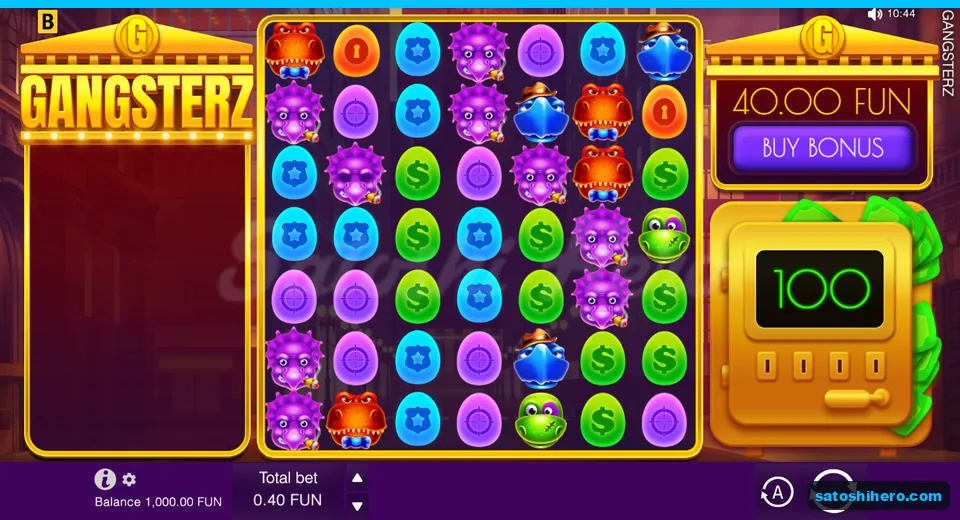
Gangsterz slot uses a cartoon mob-boss dinosaur theme on a dark city street. You see dinos, a 7×7 board, a safe counter, and a clear win list before the first spin even resolves.
The red T-rex wears a bow tie, the blue dino has a fedora, and the purple triceratops carries a cigar. A green turtle with a stitched scar rounds out the high symbols. You don’t need to guess which characters matter, because the bigger-pay symbols stand out fast.
The low symbols use colored eggs with a keyhole, police badge, crosshair, and dollar-sign icon. A golden safe sits on the right, while cluster wins stack on the left. That layout helped me track small wins without opening the paytable every few spins.

Highlight: The safe counter starts at 100 and stays beside the board, so you can watch it while clusters land.
The theme won’t win originality awards, but the dino-gangster mix feels clearer than another generic crime slot. If you like city crime atmosphere but want a different tone, Wild Chicago gives you a useful comparison point. This one looks lighter, cleaner, and easier to read during quick spin.
In my base-game screen, the board showed the safe counter at 100, a $0.40 bet, a $1,000.00 balance, and a $40.00 Buy Bonus button. You can read those details quickly, which matters when you play a feature-heavy grid. The theme does its job without getting in your way.
How Gangsterz slot Works
Gangsterz slot works through cluster pays on a 7×7 grid, with no fixed paylines to follow. Five or more matching symbols must touch horizontally or vertically before the game pays a win.
Cluster pay rules
Touching sides count, but diagonal contact alone doesn’t. That distinction matters because you can see several near-misses that look close but pay nothing. You should watch shape and size, not line paths.
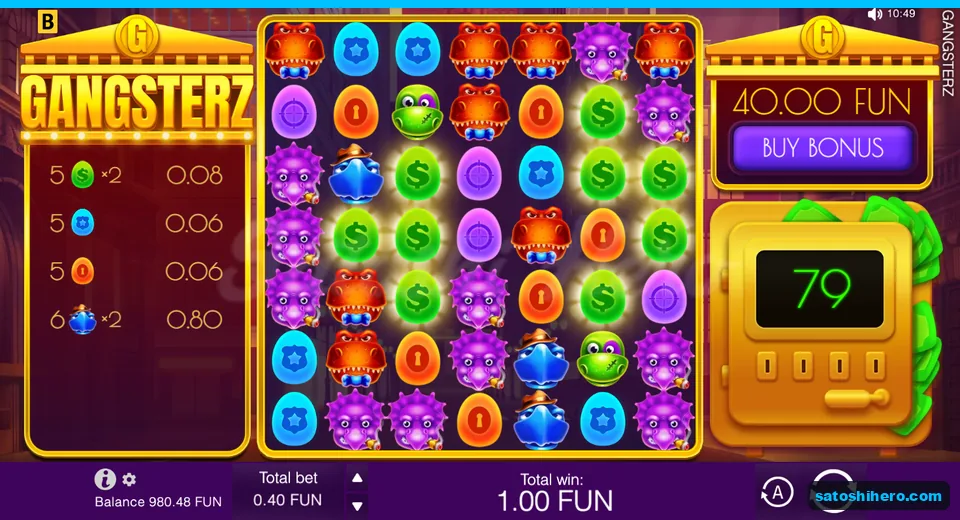
Each winning cluster appears on the left of the board with its pay. I checked the pay list against real logged wins, and the values matched what appeared during play. Five badge eggs paid $0.06 at a $0.40 bet, which equals 0.15x.
Wild Clusters makes a fair comparison if you care most about cluster-pay mechanics. Gangsterz adds more board manipulation, while the core skill for you stays the same: spot growing groups and judge whether the spin has real follow-through. I like that because it keeps your eyes on the grid.

Expert Advice: Don’t look for paylines here. Watch cluster size and symbol quality instead, because bigger connected groups scale sharply.
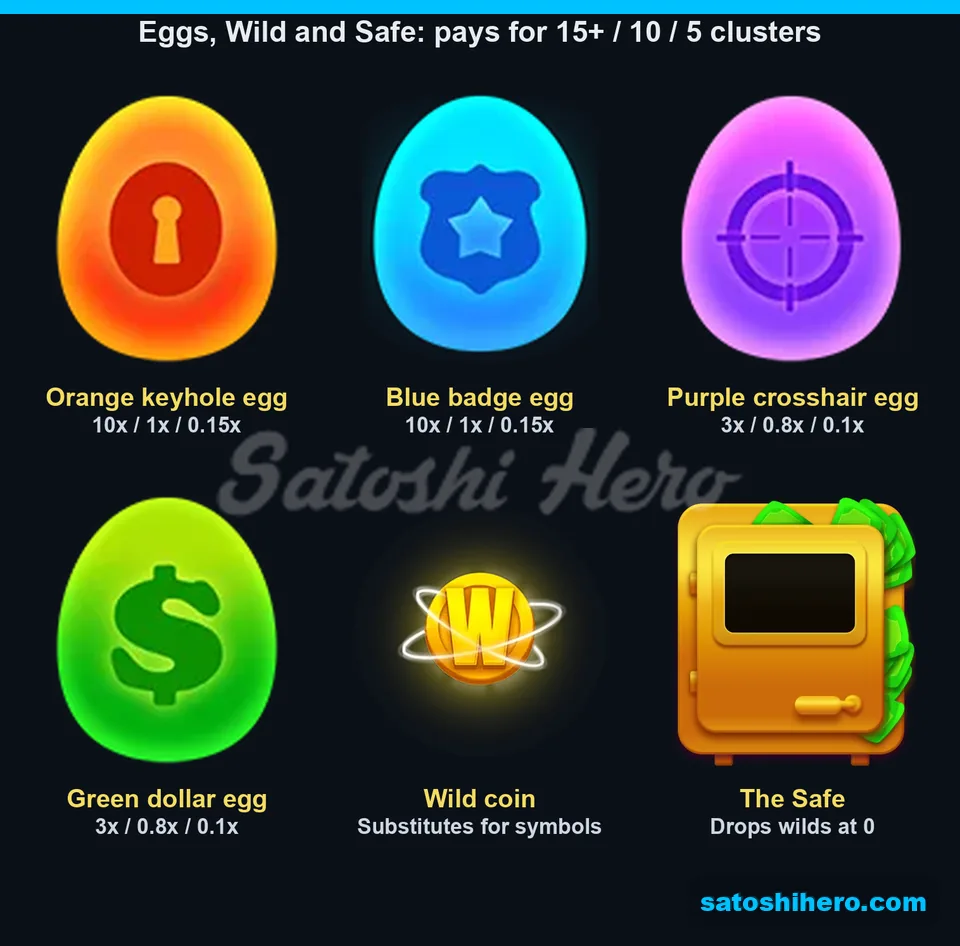
The Wild symbol is a gold coin stamped W, and it replaces any symbol. The board, safe counter, pay list, and Buy Bonus button stayed easy to read on both desktop and mobile layouts. You get enough information without squinting.
Symbol values
The red T-rex pays 1x, 20x, and 750x for clusters of 5, 10, and 15 or more. The blue hat dino pays 0.8x, 10x, and 300x on the same scale. Those top steps explain why small wins can feel tame while big groups carry the real threat.
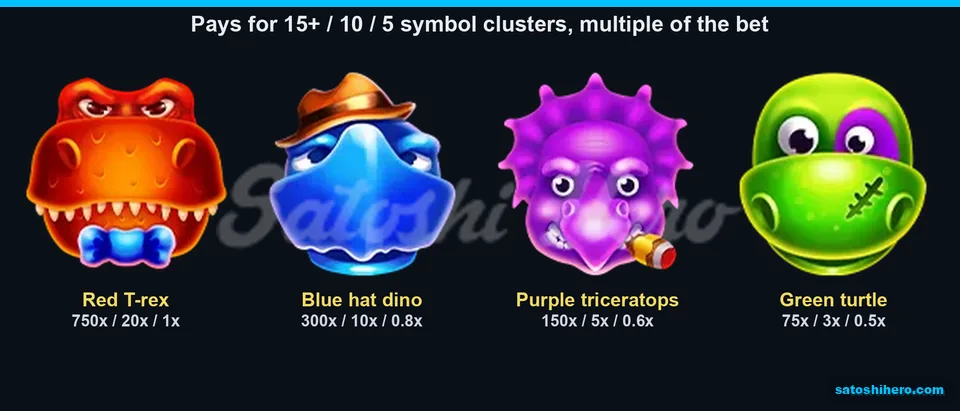
The purple triceratops pays 0.6x, 5x, and 150x. The green turtle pays 0.5x, 3x, and 75x. I don’t find the lower high-symbol tiers thrilling, but the top-end jumps give the paytable bite.
Orange keyhole eggs and blue badge eggs each pay 0.15x, 1x, and 10x. Purple crosshair eggs and green dollar eggs each pay 0.1x, 0.8x, and 3x. Six blue hat dinos paid $0.40 before doubling in my test, which equaled 1x the bet.
Bigger groups matter because the scale climbs hard after the first few symbols. You should care more about expanding a good symbol than landing many tiny clusters. That mindset makes this 7×7 cluster slot easier to read.
Countdown and Progress Bar
The safe counter starts at 100 and drops by one for every symbol in a winning cluster. That counter creates the route into extra random features and the Safe feature, but it didn’t feel like steady banked progress in my test.
Counter movement
I saw the counter show 95 after one five-symbol cluster. Another spin with four clusters totaling 21 symbols dropped it to 79. That second example felt more useful than the payout itself, because the board had actually moved the feature meter.
A low-paying win can still matter if it removes enough symbols from the counter. You shouldn’t ignore small clusters when they cover wide groups. They may not pay much, but they can push the counter toward a trigger.
The important catch came at the start of fresh spins I checked. The counter had returned to 100. That made the feature chase feel spin-by-spin rather than like a session-long meter, and you should read it that way.
Feature thresholds
Every 25 counted symbols can trigger one random extra feature. The first four feature types are Detonation, Reduction, Separation, and Promotion. When the counter reaches 0, the Safe feature starts.

Notable Detail: In gangster fiction, a safe usually hides the prize. Here, the safe also acts as the visual timer, which makes the board’s goal easy to follow.
I like the counter because it gives you something clear to watch. Still, I wouldn’t oversell it as a guaranteed path to action. You need enough winning symbols inside one counted sequence, and that can be harder than the cartoon style suggests.
Detonation, Reduction, Separation and Promotion
Detonation, Reduction, Separation, and Promotion reshape the board, but they don’t guarantee a payout. These counter-triggered features can create better setups, yet the final cluster result still decides whether you win.
Four feature types
Detonation turns 3 to 6 symbols into Wilds. Each new Wild destroys the symbols above, below, left, and right. Destroyed symbols don’t pay, so the effect can look bigger than the actual result.
Reduction removes every low symbol from the board without payment. That can clear clutter, but it doesn’t hand you a win by itself. You still need the refill to create connected groups.
Separation places a Wild in the center. It then turns symbols on the diagonals through that Wild into one randomly chosen symbol. Wilds already on those diagonals stay Wild, which keeps the feature from undoing its strongest pieces.
Promotion picks one random symbol and changes it plus all copies into another symbol. I like the idea because it can swing board shape quickly. You shouldn’t treat it as a bonus booster, though, because the new layout may still miss.
Wild exceptions
Wilds aren’t affected by these four features. That rule helps protect the best symbol on the grid, but it doesn’t mean every Wild improves the result. Position still matters more than flash.
You should read these effects as board-shaping tools, not as automatic payouts. The slot can build drama from moving parts, and then still leave you with a small result. That tension fits the very-high volatility profile.
The best player angle here is simple. Watch where the feature leaves matching symbols after the refill. If it doesn’t build side-touching groups, the animation has done more for suspense than for your balance.
The Safe Feature
The Safe starts when the progress counter hits 0 and places a large Wild on the grid. It sounds powerful on paper, but it didn’t define my measured 100-spin result.
Wild expansion
The sequence starts with a 3×3 Wild symbol. On the second refill, that large Wild splits into 2×2 Wild symbols. On the third refill, it splits again into nine single Wilds.
That progression gives the feature clear visual stages. You can see why the official 12,000x cap exists when the board begins with such a large Wild footprint. My test never came close to that ceiling, which keeps the excitement grounded.
Train to Rio Grande offers a useful comparison if you like games that build toward a special event. This Safe feature has that same chase feeling, but it sits inside a cluster grid rather than a more traditional reel setup. I found the concept strong, even without seeing it drive my session.
After wins
Winning Wilds disappear after they pay. That rule stops the feature from feeling like permanent board control. It also keeps the tension high, because each successful Wild use reduces future coverage.
You shouldn’t call this a free spins round. It is a Wild expansion feature tied to the counter, and that distinction matters. The game gives you a special board state, not a separate spin mode.
I like the Safe because it has a clean visual story. The downside is just as clear: if you don’t reach the trigger, it remains a promise on the side of the screen. In my test, the base game carried the actual result.
Big Boss in Gangsterz slot
Big Boss turns four matching symbols in a square into one big 2×2 symbol that can double a cluster win. If several big symbols join the same win, their multipliers multiply each other.
Bigger symbols
Four matching symbols must sit together as a square. When that happens, they merge into one larger 2×2 symbol. You can read the board differently after that, because position starts to matter as much as count.
A big symbol can split back into four normal symbols on a refill. That keeps the feature from feeling permanent, and it makes timing important. I like this mechanic because it rewards board awareness, not just waiting for high symbols.
Big Boss doesn’t apply to Wilds. That limit makes sense, because Wilds already carry strong substitution value. You should watch normal symbols that can form squares, especially near other matching groups.
Multiplier stacking
When a big symbol joins a winning cluster, that win doubles. If several big symbols join the same cluster, those multipliers multiply each other. The game doesn’t need huge animations to make that clear, because the win frame labels the effect.
My win frame showed x2 tags on two of the four listed clusters. That helped confirm how the feature displays during real play. I didn’t see wild stacking drama from it, but the table-reading value was obvious.
This is one of the more interesting mechanics in the game. It makes the 7×7 board feel spatial rather than purely random. You should scan for squares before you judge whether a spin has real potential.
Backlit and Second Chance
Backlit and Second Chance soften some dead-board moments, but they don’t remove the very-high-volatility risk. They add late movement to spins that might otherwise feel finished.
Backlit symbols
After each spin, a group of identical low symbols can start to shine. If those shining symbols form part of a win, they disappear. Two Wilds then appear in their place.
One refill can only give two Wilds this way. That cap matters, because the feature sounds stronger if you only read the first part. In practice, you get a chance at improvement rather than a full board rescue.
I like Backlit because it makes low symbols worth watching. The egg symbols don’t pay much at small cluster sizes, yet this feature gives them a second role. You still need the grid to cooperate.
Missed-spin saves
Second Chance works on non-winning spins. A random number of symbols can turn into Wilds, then the game recalculates the result. That can rescue a blank spin, which feels good when autoplay has gone flat.
There is a catch. Second Chance can break a Big Boss, so more Wilds don’t always mean a cleaner setup. That detail gives the feature a sharper edge than a plain save mechanic.
I wouldn’t treat either feature as a risk cure. They keep the game lively and can improve ugly boards, but the slot still leans into swingy outcomes. You should enjoy the extra motion without assuming smoother returns.
RTP, Volatility & Our Test
Gangsterz slot has 96.3% RTP, very-high volatility, and a 12,000x max win, so the math points to sharp swings rather than steady returns. It also uses cluster pays, not fixed paylines.

Risk Note: Very-high volatility plus a 12,000x cap means you should treat the 100x Buy Bonus and larger stakes carefully. A 2,500-bet demo balance sounds huge, but high-variance games can still move sharply.
Simulator projection
I ran 1,000 spins at one bet unit through the SatoshiHero Slot Simulator. The inputs used the game’s return, volatility level, and cap. The median session finished 103.8x the bet down.
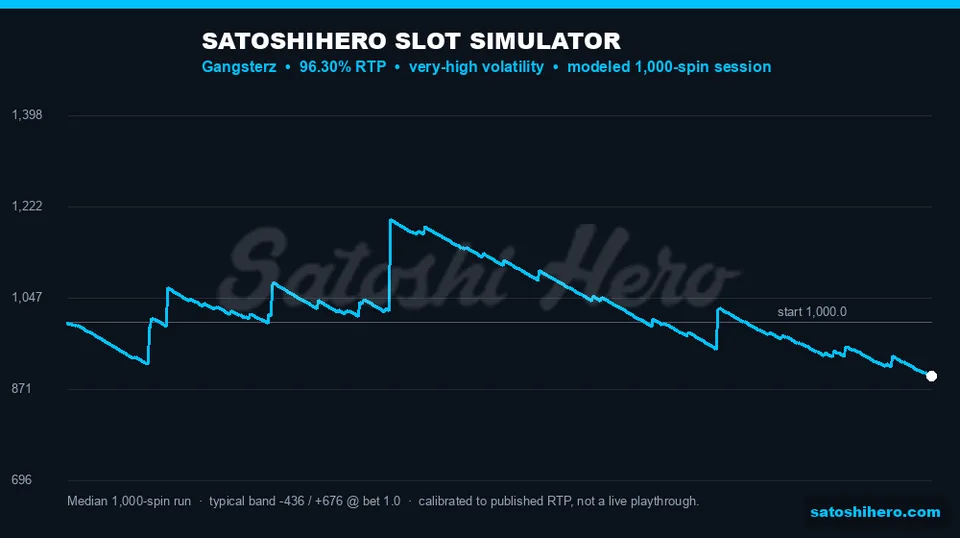
Nine runs in ten ended between 435.8x down and 675.8x up. That spread tells you more than a single headline number. You can land a rough session, a strong session, or something in between without anything looking unusual.
A larger win appeared about once every 54 spins. A very big win appeared about once in 811 spins. Those frequencies explain why my practical advice leans conservative, even though the hit count in my session looked busy.
This simulator result isn’t a forecast for your next session. It shows possible spread using the game inputs. You should use it to size your bet, not to predict the next 100 spins.
Our 100-spin session
I played 100 autoplay spins with quick spin on at a $0.40 stake. My balance moved from $1,000.00 to $981.88. That left me 45.3x the bet down.
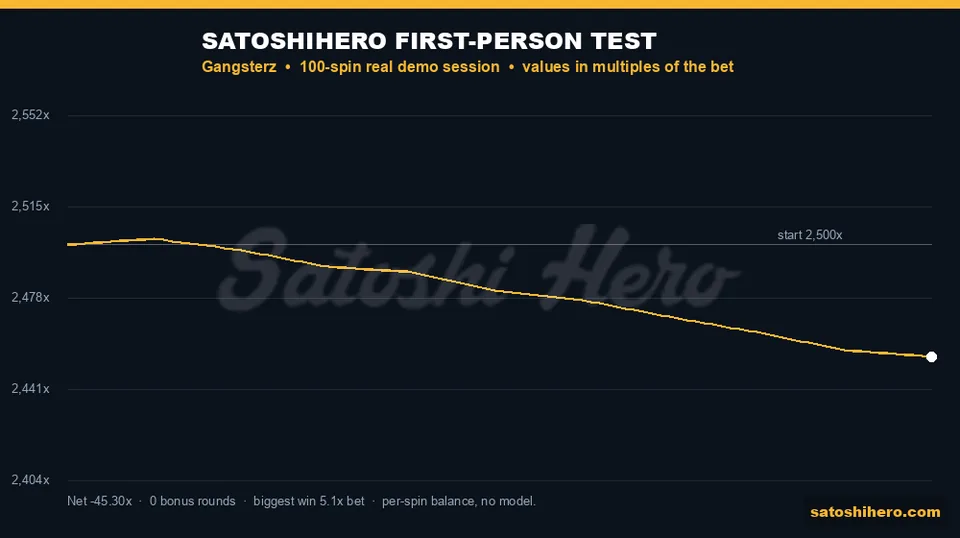
The session paid something on 58 of 100 spins. My longest dry patch lasted 6 spins, which felt manageable. The issue wasn’t dead air, it was that the biggest wins stayed small.
My best logged win was 5.1x, or $2.04, on spin 91. That put the balance at $984.58 at that point. The next best result reached 5.0x, so the session never found a real breakout.
I didn’t log any add-on feature triggers separately. After autoplay, I spun by hand to capture a clean win frame, and those extra spins aren’t part of the 100-spin numbers. That separation keeps the test tidy.
The theoretical RTP is the operator-published return figure, while one 100-spin test doesn’t prove or change it. Simulator results show possible spread using game inputs, not what your next session does. Bonus-buy or feature-specific returns may sit slightly apart from base-game RTP by design, but I didn’t buy the bonus.
Frequently Asked Questions About Gangsterz
How do wins work in Gangsterz slot?
Gangsterz slot pays clusters on a 7×7 grid. Five or more matching symbols must touch horizontally or vertically. Each winning cluster appears on the left of the board with its pay.
What does the red T-rex pay in Gangsterz slot?
The red T-rex is the top symbol. It pays 1x for 5 symbols, 20x for 10 symbols, and 750x for 15 or more. You should watch this symbol closely because its paytable jumps hard.
What is the safe counter that starts at 100?
The safe counter drops by one for every symbol in a winning cluster. I saw it read 95 after one five-symbol cluster and 79 after four clusters totaling 21 symbols. It was back at 100 at the start of each new spin I checked.
What are Detonation, Reduction, Separation and Promotion?
They are four random features triggered by the counter. Detonation creates Wilds that destroy adjacent symbols, Reduction removes low symbols, Separation changes diagonal symbols, and Promotion changes one symbol type and its copies. None of them guarantees a payout.
What does Big Boss do in Gangsterz slot?
Big Boss merges four matching symbols in a square into one 2×2 symbol. When that big symbol joins a winning cluster, it doubles the win. My win frame showed x2 tags on two of four clusters.
Did I buy the bonus in Gangsterz slot?
No, I didn’t buy the bonus during the test. The Buy Bonus button cost 100x the bet, which was $40.00 at my $0.40 stake. I played 100 plain autoplay spins instead.
What are the RTP and volatility of Gangsterz slot?
Gangsterz slot has 96.3% RTP and very-high volatility. The maximum win is 12,000x. That mix means the game can swing hard, even when many spins pay small amounts.
What did the 1,000-spin simulator say?
The median 1,000-spin simulator run finished 103.8x the bet down. Nine runs in ten landed between 435.8x down and 675.8x up. That range shows variance, not a prediction.
How did the 100-spin Gangsterz slot test end?
My 100-spin test started at $1,000.00 and ended at $981.88. That was 45.3x my bet down at a $0.40 stake. I logged 58 paying spins, and my best win was 5.1x.
Summing It Up
Gangsterz stands out because it mixes cartoon mobster dinosaurs with a busy but readable cluster system. The main drawback is the risk curve, because small hits can appear often while meaningful wins stay scarce.

My Call
Patient grid-slot fans can enjoy this if they respect the variance and keep stakes modest. You should expect board movement, small wins, and long waits for the bigger mechanics to matter. I wouldn’t chase the 100x Buy Bonus without a clear bankroll limit.
I like the safe counter, Big Boss squares, and Wild replacement ideas because they give you more to watch than plain clusters. I don’t like how my 100-spin test stayed shallow despite 58 paying spins. The slot felt active, but it didn’t feel forgiving.
Players comparing BGaming titles with animal-led themes can also check Wild Tiger and Wild Heart before deciding whether this grid format is the better match. Gangsterz slot is checked regularly so the guide stays aligned with the tested mechanics and published specs. If you play it on SatoshiHero, try the demo first and watch how the counter behaves before raising your stake.

Pros:
 Clear grid: The 7×7 layout makes cluster wins easy to follow.
- Strong top symbol: The red T-rex gives big clusters serious upside.
- Interesting mechanics: Big Boss and Safe features add real board tension.
- Readable interface: The counter, wins, balance, and buy button stay visible.

Cons:
 Sharp variance: Very-high volatility can drain stakes before big features arrive.
- Small test wins: My best logged hit reached only 5.1x.
- Bonus cost: The 100x Buy Bonus demands careful bankroll control.

Best For: Cluster-slot fans, volatility hunters, and players who like visible board mechanics get the most value here. You should enjoy watching counters, Wilds, and symbol shapes develop. If you need steady low-risk play, this one may feel too jagged.































































Bets
All Bets
Game
Player
Date
Wager
Mult.Multiplier
Prize
 Halloween Harvest: Rapid Link
 Hidden
- 00:18:07
- 2.79×
- Halloween Harvest: Rapid Link
- Hidden
- 00:18:06
- 0×
- Royal Fruits 9: Hold 'n' Link
- mike_721
- 00:18:06
- 0×
- Halloween Harvest: Rapid Link
- Hidden
- 00:18:05
- 0×
- 3 Witches: Bonus Combo
 bjgrandy149
- 00:18:05
- 0.3×
- Halloween Harvest: Rapid Link
- Hidden
- 00:18:04
- 0×
- Halloween Harvest: Rapid Link
- Hidden
- 00:18:03
- 0×
- Royal Fruits 9: Hold 'n' Link
- nina87
- 00:18:02
- 0×
- 3 Witches: Bonus Combo
- bjgrandy149
- 00:18:02
- 0×
- Halloween Harvest: Rapid Link
- Hidden
- 00:18:02
- 0×