

Fish Fever
By pressing play, you agree that you are above legal age in your jurisdiction and that your jurisdiction allows online gambling.

Fish Fever
RTP95.09%
VolatilityVery high
Max winx15,000
Hit rate22.57%
ReleasedApr 2025
Live game stats
Real RTP43.81%
Spins207
Players2
Biggest win$22.56

Reef Rushes and Ruthless Dry Spells
Fish Fever slot is a very-high-volatility pay-anywhere game from TrueLab, built on a clear 6×5 grid. Eight matching symbols can win anywhere without paylines or adjacency. Its 96.08% RTP and 15,000x maximum win target risky-cascade and huge-multiplier fans, while cautious players can find the dry spells harsh.
The Fish Fever slot arrived as a traditional slot from TrueLab. I tested it with a fresh $60,000 balance, a $1.20 stake, fast autoplay, Bonus Bet off, and no bonus purchase. The ceiling is substantial, but ordinary sessions can feel unforgiving.
Key Takeaways
Here’s the short version before you commit a stake:
- Best bonus: I tested only standard base-game spins, so neither paid feature earns an evidence-based recommendation.
- RTP / volatility: The theoretical RTP is 96.08%, paired with very-high volatility.
- Max win: The top award reaches 15,000x the bet.
- Risk note: Eighty of my 100 spins paid nothing, including a 15-spin losing run.
- Bankroll note: The 100x Buy Feature costs $120 at my tested $1.20 stake.
Treat those figures as a risk map, not a promise. You should start with standard play before considering either paid option.

Table of Contents
- How the Fish Fever slot Works
- Higher-Paying Fish
- Lower-Paying Gems
- Fish Fever slot Theme and First Impressions
- Scatter Pays and Cascades
- Cascade Sequence
- Tested Win Example
- Multiplier Feature
- Free Spins
- Trigger and Retriggers
- Test Outcome
- Fish Fever slot RTP, Volatility and Test Results
- Simulator Projection
- Our 100-Spin Session
- Buy Feature
- Cost and Entry
- Testing Limitation
- Bonus Bet
- Added Spin Cost
- Scatter Boost
- Frequently Asked Questions
- Wrap-Up
How the Fish Fever slot Works
Fish Fever uses a 6×5 pay-anywhere grid with no fixed paylines. Eight separated matching symbols can pay anywhere, so they don’t need to touch. Awards increase across three count bands: 8 to 9, 10 to 11, and 12 or more. Every award uses a multiple of your total bet.
You won’t find a Wild symbol here. Instead, winning icons disappear and replacements fall into the gaps, creating possible follow-up wins. The interface fits mobile and desktop screens without changing the core rules. I verify the gameplay rules and feature details so you can understand each symbol.
Higher-Paying Fish
The five creature symbols carry the strongest regular values. You should count each species across the entire board rather than tracing a route between reels.
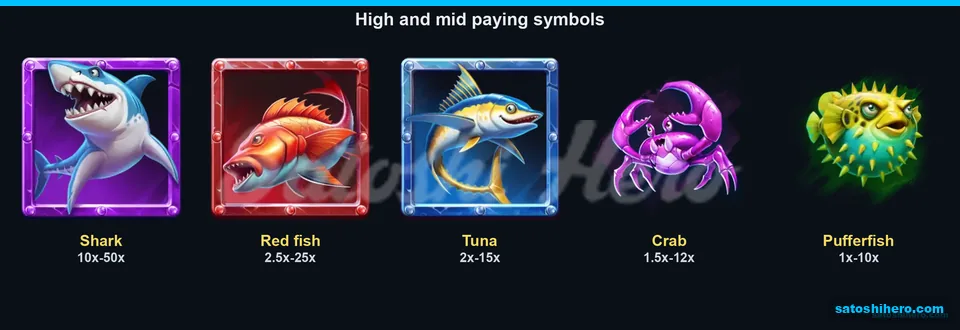
| Symbol | 8 to 9 | 10 to 11 | 12 or more |
|---|---|---|---|
| Shark | 10x | 25x | 50x |
| Red fish | 2.5x | 10x | 25x |
| Tuna | 2x | 5x | 15x |
| Crab | 1.5x | 2x | 12x |
| Pufferfish | 1x | 1.5x | 10x |
I saw eight Sharks pay $12 during one cascade step at my $1.20 stake. That matched the 10x table value within a longer chain. The Shark pays well, though you still need enough copies across thirty positions.
Lower-Paying Gems
Four glowing gems resemble card suits, but they don’t follow line-based rules. Count every matching gem across the board, even when large gaps separate them.
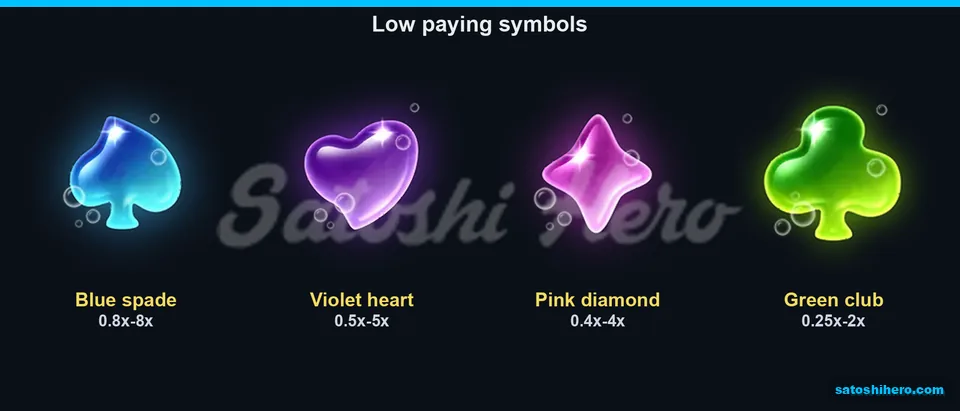
| Symbol | 8 to 9 | 10 to 11 | 12 or more |
|---|---|---|---|
| Blue spade | 0.8x | 1.2x | 8x |
| Violet heart | 0.5x | 1x | 5x |
| Pink diamond | 0.4x | 0.9x | 4x |
| Green club | 0.25x | 0.75x | 2x |
| Golden fish Scatter | 3x for four | 5x for five | 100x for six |
The smallest gem groups can return less than your stake, which happened eight times across my paying spins. You should read any sub-bet award as a partial recovery, not a profitable result.

Stat Check: Fish Fever doesn’t use paylines or adjacency rules. Eight matching symbols anywhere on the 6×5 board are enough to form a win.
Scan the whole grid, then judge the complete cascade rather than one symbol cluster.
Fish Fever slot Theme and First Impressions
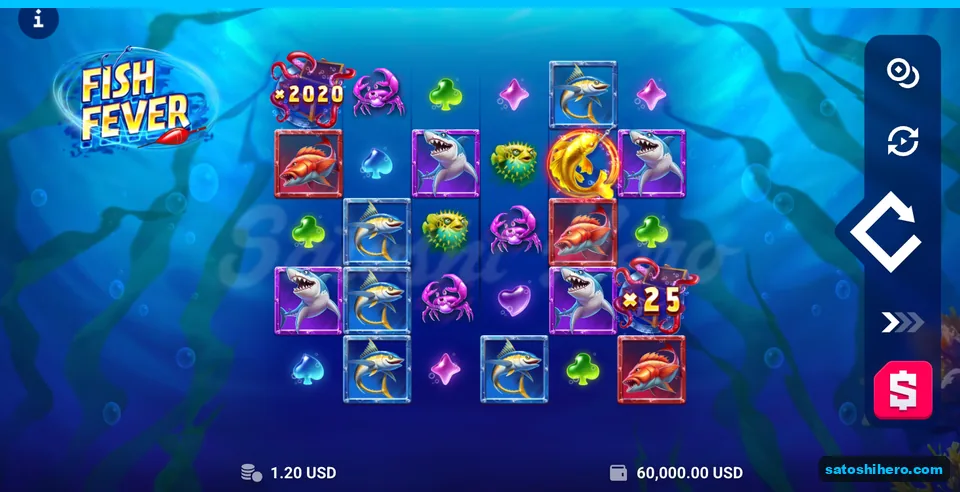
Fish Fever uses a bright underwater reef that keeps the grid readable during busy cascades. Blue water, kelp, and coral frame a six-reel presentation filled with sharks, red fish, tuna, crabs, and pufferfish. You can separate the high symbols quickly from the glowing card-suit gems. That clarity matters when several icons vanish at once.
The two special symbols stand out immediately. A hooked golden fish acts as the Scatter, while octopus tentacles wrap around each Multiplier treasure chest. I don’t think the reef theme wins any originality prize, but the hierarchy feels clean and functional. You can follow a cascade without losing the important symbols in visual clutter.
Fish Eye can appeal more if you put underwater atmosphere ahead of cascading action. Fish Fever defines itself through scatter pays and repeated drops instead. Fish Store offers another aquatic alternative without implying shared math or mechanics. Compare each game by its actual rules, not merely its sea setting.

Fun Detail: The two special symbols continue the sea theme: a hooked golden fish triggers the feature, while an octopus guards each Multiplier chest.
The reef shows large chest values clearly, including x2020 and x25 tiles. Those labels create tension even when the surrounding grid fails to win. Clarity, rather than originality, remains the design’s strongest quality for you.
Scatter Pays and Cascades
Eight or more matching symbols anywhere start a win, then winners disappear and replacements drop into place. Cascades continue until the refreshed grid forms no further award. Fish and gems use this anywhere-on-grid system, while the golden fish Scatter remains a separate feature symbol. You pay for only the original spin, even when several drops follow.
Cascade Sequence
Each paid spin follows a clear order:
- Count matching symbols across all thirty grid positions.
- Award qualifying groups of 8 to 9, 10 to 11, or 12-plus symbols.
- Remove every winning symbol from that step.
- Drop replacement symbols into the open spaces.
- Check the refreshed grid for another qualifying group.
- Add each successful step to the running cascade total.
Multiple symbol drops don’t create new wagers. You can watch the amount above the reels grow as each step joins the same chain. I like this display because it prevents small early wins from hiding the spin’s complete value. Still, a cascade can stop immediately after a modest return.
Tested Win Example
Spin 52 showed how the system can build. My first visible step paid $0.60, then a later step added $12. The complete spin returned $12.60 after the chain ended. That $12 step came from eight Sharks at the $1.20 stake, exactly 10x the wager.
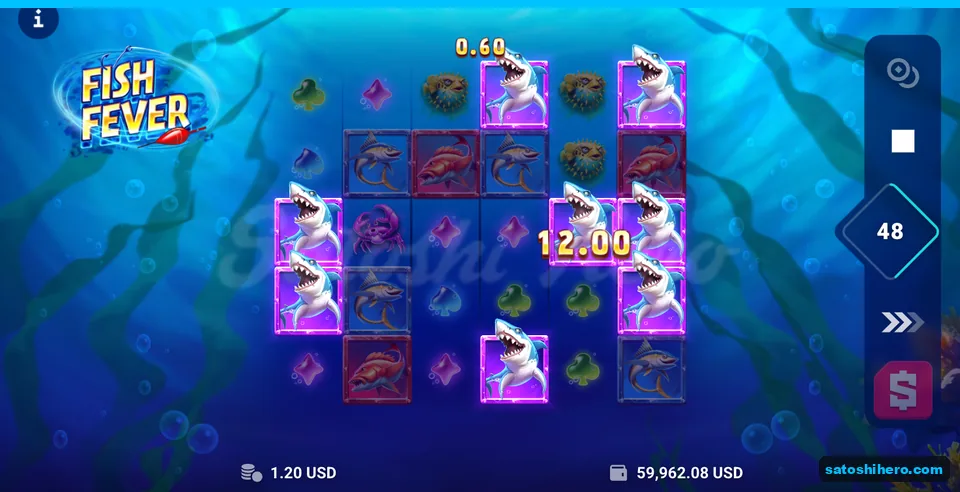

Player Hint: Read the running cascade total rather than treating every drop as a separate spin. The final award can include several smaller steps.
This sequence surprised me because the opening $0.60 looked weak before the Sharks arrived. You should wait until every replacement settles before judging a paid spin. The practical value lies in the full chain, not its first small award.
Multiplier Feature
The octopus treasure chest applies its collected multiplier to the complete cascade win after the chain ends. Values range from x2 to x2025, with x2020 available in the base game and x2025 inside free spins. Multiple chests add their values, so x2 plus x3 becomes x5 rather than x6. You need a qualifying win on that spin before any chest matters.
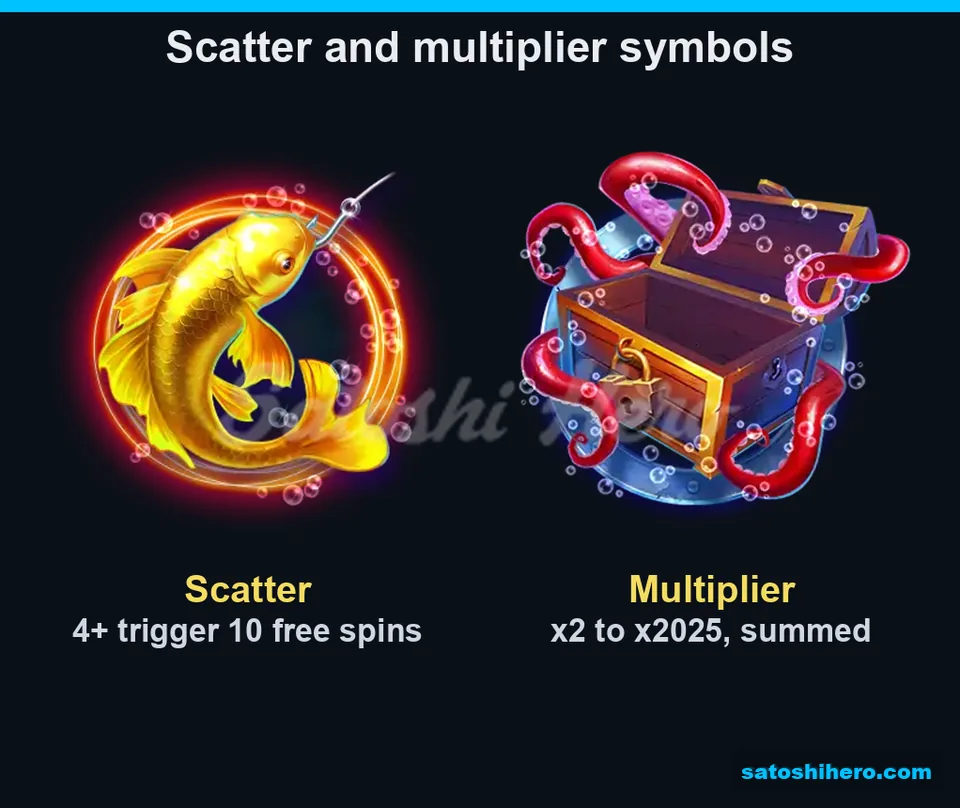
Chests can appear during the base game and free spins, though the bonus mode uses them more often. The total applies after every cascade step finishes, then resets. You can’t save a large chest for another spin, which keeps each Fish Fever slot result self-contained.
A chest can look spectacular and still contribute nothing. The x2025 label creates instant drama, but a dead grid leaves that value unused. You should focus first on whether eight matching symbols form, then check the chest total. Honestly, that dependency makes the feature exciting and cruel in equal measure.
Several chest values reward addition, not multiplication between chests. Watch the collected figure after each drop, especially when replacements introduce another chest. Values add together and affect only the active cascade.
Free Spins
Four or more golden fish Scatters anywhere award 10 free spins at the triggering stake. The feature didn’t trigger during my 100 counted spins, so I can explain its rules but can’t claim a personal payout pattern. Trigger symbols also pay through the Scatter table. You should separate that immediate award from the free-spin entry itself.
Trigger and Retriggers
Three or more Scatters during free spins add five extra spins. The rules set no retrigger limit, and additional Scatters still use the published symbol values. Multiplier chests appear more often in this mode, where their top value reaches x2025. The same pay-anywhere groups and cascade sequence remain active throughout the round.
A chest still needs a qualifying symbol win before it can increase anything. Watch the regular fish and gems first, then read the collected total. I find that easier than assuming every special symbol creates value.
Test Outcome
No natural trigger appeared in the counted session. I also didn’t buy entry, so my test provides no bonus total, average award, or retrigger result. Inventing those figures would misrepresent what happened. The 100 spins only show that one short run can pass without four Scatters landing together.
The absence felt harsh because multipliers appear more often inside the feature. Yet one missed trigger doesn’t establish your likely access rate. Use a controlled stake and expect no fixed schedule. The feature’s practical performance remains untested here.
Fish Fever slot RTP, Volatility and Test Results
Fish Fever slot carries a 96.08% theoretical RTP, very-high volatility, and a 15,000x maximum win. My uneven session matched the risk label in feel, though one small sample can’t define the game. You can face frequent blank spins and still see occasional cascades recover several stakes. I’d call the ceiling impressive, but the path toward it looks severe.
Across 100 spins, 20 paid something and 80 returned nothing. Twelve wins met or beat my $1.20 stake, while eight paid less than the wager. Only four returns reached $6 or more. A 15-spin dry run made the short session feel especially unforgiving for your balance.
Simulator Projection
The SatoshiHero Slot Simulator modeled 1,000 spins at a $1.20 stake. Its median outcome finished $171.60 down, while the 5th percentile ended $565.80 down. The 95th percentile reached $883.10 up, showing a broad range between weaker and stronger modeled sessions. You shouldn’t read any point as a forecast.
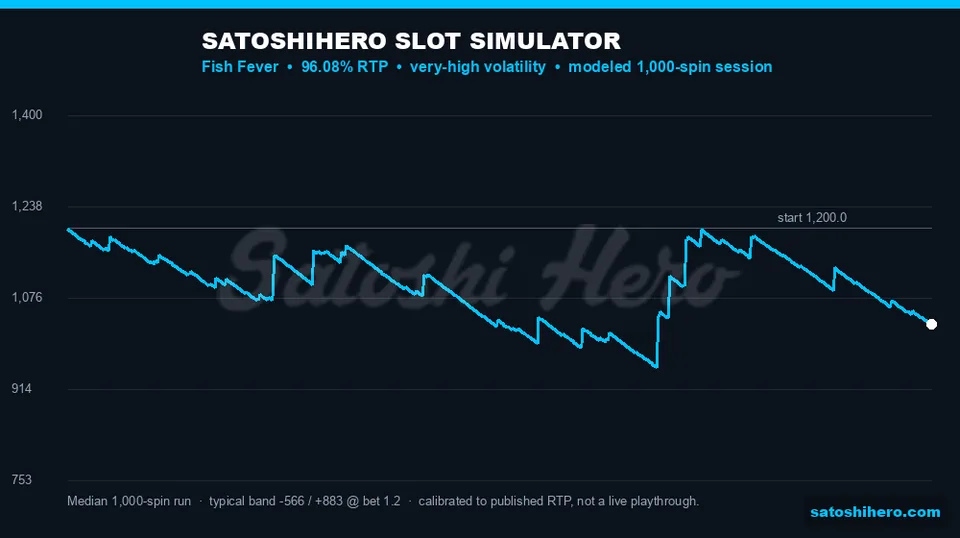
About 14% of modeled spins paid something. A feature-tier result appeared roughly once per 56 spins, while a top-tier result appeared about once per 819 spins. Those frequencies describe the probability model, not the game’s RNG. I think the wide spread explains the volatility more clearly than a label alone.
The model can’t know when another win arrives or promise that real spins resemble its median case. Use the range to understand divergence, not schedule a feature or top-tier return. That keeps the projection useful without creating false certainty.
Our 100-Spin Session
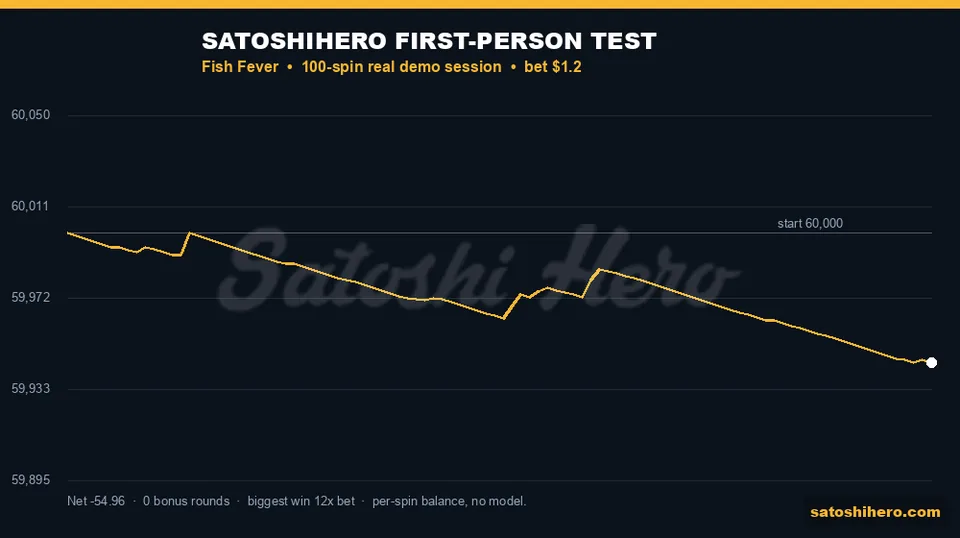
I lost $54.96 after staking $120 across 100 spins. My fresh balance started at $60,000 and finished at $59,945.04, using $1.20 per spin. I selected fast autoplay, kept Stop upon bonus game off, left Bonus Bet disabled, and made no bonus purchase. This setup tested only the standard base game.
Autoplay offered 10, 25, 50, 75, 100, 500, 750, 1,000, and unlimited selections. You can also set stop-on-bonus, loss-limit, and single-win-limit controls. The speed button cycles through normal, fast, and turbo modes. I chose fast because it kept cascades readable.
Spins one through five returned nothing. My longest dry stretch ran from spin 67 through spin 81, producing 15 consecutive blanks. The balance peaked at $60,000.36 after spin 14, then reached its low of $59,945.04 after spins 98 and 100. An early lead gave way to a sustained decline.
My largest return was $14.40 on spin 61, equal to 12x the stake. Other notable wins included $12 on spin 14, $12.60 on spin 52, and $6 on spin 55. Even the largest hit recovered only a small slice of the $120 session cost. I found that contrast more revealing than the top prize printed in the rules.

Beware: Very-high volatility can produce long losing stretches. My test included 15 consecutive spins without a return, so a smaller stake gives you more room for short-term swings.
This was one short session, not a guaranteed outcome. The published theoretical return describes the game’s math, while my result can’t confirm or disprove it. The simulator illustrates probability rather than predicting the RNG. Separate bonus modes can use slightly different return designs without promising any result.
Buy Feature
The Buy Feature opens free spins for exactly 100x the selected bet and guarantees at least four Scatters. At my $1.20 stake, one purchase costs $120. That price equals 100 standard spins paid upfront before you receive any return. The guaranteed trigger provides entry, not profit or a minimum bonus payout.
Cost and Entry
Concentrating 100 stakes into one round creates sharp exposure. You exchange many separate base-game outcomes for direct feature access, while retaining the game’s severe variance. I don’t see that as a shortcut, just a different risk shape. You should judge the full $120 as committed before pressing the purchase button.
Compare the purchase against your planned budget, not the headline prize. If $120 represents most of that budget, one weak feature can end your session. You receive entry certainty, not return certainty.
Testing Limitation
I didn’t purchase the bonus during my counted spins. That means I can’t compare its result with standard play or call it the strongest option. My evidence supports only the cost calculation and guaranteed entry rule. Any performance claim beyond those facts would be guesswork.
Immediate access doesn’t establish better value. My test offers no bought bonus total, retrigger count, or multiplier pattern. Let me be real, the 100x price feels aggressive beside the harsh base-game session. Treat it as a complete upfront commitment, never a shortcut to profit.
Bonus Bet
Bonus Bet raises every spin’s cost by 25% and doubles the base-game chance of landing Scatters. It remains separate from the 100x Buy Feature, and I kept it off throughout my test. At the standard $1.20 stake, the added charge is $0.30. Your effective cost becomes $1.50 per spin.
Added Spin Cost
One hundred standard spins cost $120, while 100 Bonus Bet spins cost $150. The difference reaches $30 across the same spin count. That comparison describes spending only, not expected session returns. I think the recurring charge deserves more attention than the attractive Scatter boost.
You should adjust your spin count or base stake before enabling it. The option doesn’t remove blank spins, weak cascades, or sub-bet returns. Its clearest guaranteed effect is the higher cost attached to every press.
Scatter Boost
Doubling the Scatter chance doesn’t make four Scatters certain. It also doesn’t promise a stronger short session or soften the volatility. Since I left the option disabled, I can’t compare its trigger count or returns against standard play. You can access demo and real play on SatoshiHero, but test the recurring cost carefully.
Idol Pop Fever offers a different stage theme if you want spectacle without this reef setting. Yukon Fever can appeal when you prefer colder visuals, while Fish ‘n’ Nudge points toward a traditional feature identity. None of those names should replace checking each game’s actual rules and risk.
Bonus Bet changes each spin’s cost and Scatter probability, whereas Buy Feature purchases one direct entry. Choose neither on the assumption that extra spending creates guaranteed value. My test leaves both modes without a performance recommendation.
Frequently Asked Questions
How do wins work in Fish Fever slot?
Eight matching symbols anywhere on the 6×5 grid pay, with larger awards at 10 to 11 and 12-plus. Winners disappear, then replacements cascade into place. Eight Sharks paid me $12 at the tested $1.20 stake. You don’t need paylines or touching symbols.
What triggers free spins in Fish Fever slot?
Four or more golden fish Scatters award 10 spins at the same stake. Three or more Scatters during the feature add five spins, with no stated retrigger limit. My test produced no natural trigger. You should view access as random, not scheduled.
How do multipliers work in Fish Fever slot?
Octopus treasure chests carry values from x2 to x2025. Multiple values add together before applying to the completed cascade total, and they reset after each spin. A chest needs a qualifying win to matter. You can’t carry its value forward.
Can I buy the free spins in Fish Fever slot?
Yes. The Buy Feature costs 100x, or $120 at a $1.20 stake, and guarantees at least four Scatters. Bonus Bet is separate and adds 25% to each spin. I tested neither paid option, so I can’t compare their performance.
How did Fish Fever slot perform over 100 spins?
My balance fell from $60,000 to $59,945.04, a $54.96 loss after $120 in wagers. Twenty spins paid, 80 returned nothing, and the largest return reached $14.40. This short sample doesn’t define another session.
What does the Fish Fever slot simulator show over 1,000 spins?
The median modeled session ends $171.60 down. Its 5th percentile ends $565.80 down, while the 95th percentile finishes $883.10 up. About 14% of modeled spins pay something. The projection illustrates a range and can’t predict the RNG.
Which RTP, volatility, and maximum win apply to Fish Fever slot?
The slot uses the figures explained in the test-results section above. Its sharp risk showed up through my 15-spin dry spell, though that run isn’t a typicality claim. You should use the risk profile to set a manageable stake. One session can diverge sharply from another.
Wrap-Up
Fish Fever stands out through easy-to-read scatter pays, chain reactions, and dramatic octopus chest multipliers. Its main drawback is equally clear: ordinary play can drain your balance through long blank stretches and weak partial returns. You need patience more than flashy expectations.

My Verdict
High-risk cascade hunters can appreciate the clean mechanics and rare upside. Expect many uneventful spins between stronger chains, and don’t assume paid access improves value. I’d use a modest stake and judge entertainment first.
I like how spin 52 grew from a $0.60 step into a $12.60 total. I don’t like that 80 spins paid nothing, while my largest $14.40 hit barely dented the overall loss. Missing the natural bonus also left its practical performance unresolved.
This Fish Fever slot guide keeps the mechanics and gameplay details updated periodically. You should still treat every session as independent and keep spending within a fixed limit.

Pros:
 Clear scatter pays: Whole-grid counting makes every winning group easy to verify.
- Rewarding cascades: One wager can create several drops and a larger combined return.
- Huge chest range: Multipliers can reach x2025 during free spins.
- Useful controls: Speed and autoplay limits help you shape each session.

Cons:
 Severe dry spells: My test included 15 straight spins without any return.
- Expensive direct entry: One bonus purchase costs 100 standard stakes upfront.
- Untested paid modes: My session provides no performance evidence for either option.

Best For: Risk-tolerant cascade fans who enjoy whole-grid symbol counting and volatile multiplier potential. Careful bankroll managers should lower the stake, since long blank runs can arrive before any meaningful chain.



































































Bets
All Bets
Game
Player
Date
Wager
Mult.Multiplier
Prize
 Pelican's Bay: Rapid Link
 Hidden
- 16:49:30
- 1.4×
- Mighty Stars
 josh1998
- 16:49:30
- 0×
- Luck of Panda: Bonus Combo
- Hidden
- 16:49:29
- 0×
- Luck of Panda: Bonus Combo
 Misschelsey_
- 16:49:27
- 0×
- Mighty Stars
- josh1998
- 16:49:27
- 0×
- Luck of Panda: Bonus Combo
- Misschelsey_
- 16:49:24
- 0×
- Mighty Stars
- josh1998
- 16:49:24
- 0×
- Pelican's Bay: Rapid Link
- Hidden
- 16:49:22
- 0×
- Slime Bonanza
 thomas032172
- 16:49:22
- 0×
- Slime Bonanza
- thomas032172
- 16:49:21
- 0×