


Choosing Your Stack Inside an Ancient Temple
Spin the 5×3 grid in Times Of Egypt slot and choose between two stacked-symbol Free Spins modes.
Times Of Egypt is a medium-high volatility slot from Spinomenal with a 95.83% RTP, 1,000x maximum win, 5 reels, 3 rows and 30 fixed paylines. My 100-spin test finished 41.33x the total bet down, with 29 paying spins, a 4.67x best win and no natural Free Spins trigger. Traditional line-play fans get a clear game with selectable stacked-symbol bonuses, though the win cap looks restrained.
Key takeaways
- Best bonus: Land three pyramids, then choose 20 spins with 1×2 stacks or 10 with 1×3 stacks. You can’t assume either choice pays better.
- RTP / volatility: Times Of Egypt slot has a 95.83% RTP and medium-high volatility, so you should expect uneven short sessions.
- Max win: The official 1,000x bet cap feels modest beside that risk profile.
- Risk note: My 100 spins lost 41.33x, while both largest hits returned only 4.67x.
- Bankroll note: Size your stake for dry patches. My balance never beat its starting level and suffered nine straight losing spins.
The selectable modes provide the main attraction, but my test reached neither one. I think that honest gap matters because you can understand the choice without mistaking an unplayed feature for proven performance.

Table of Contents
- Theme and first impressions
- RTP, volatility and our test
- Simulator projection
- Our 100-spin session
- How Times Of Egypt works
- Symbol values and payout potential
- Free Spins choices
- Buy Feature
- What 100 spins felt like
- Bet sizing and bankroll
- Who it fits
- Times Of Egypt slot FAQ
- Final Take
Theme and first impressions
Times Of Egypt slot places its 5×3 reels inside an ancient temple, framed by heavy carved pillars. Spinomenal fills the grid with a gold ankh, hourglass, winged scarab, jeweled eye ring, card ranks and pyramid Free Spins symbols. A woman wearing a gold headdress serves as the Wild. You can read each icon quickly, even when several line wins overlap.
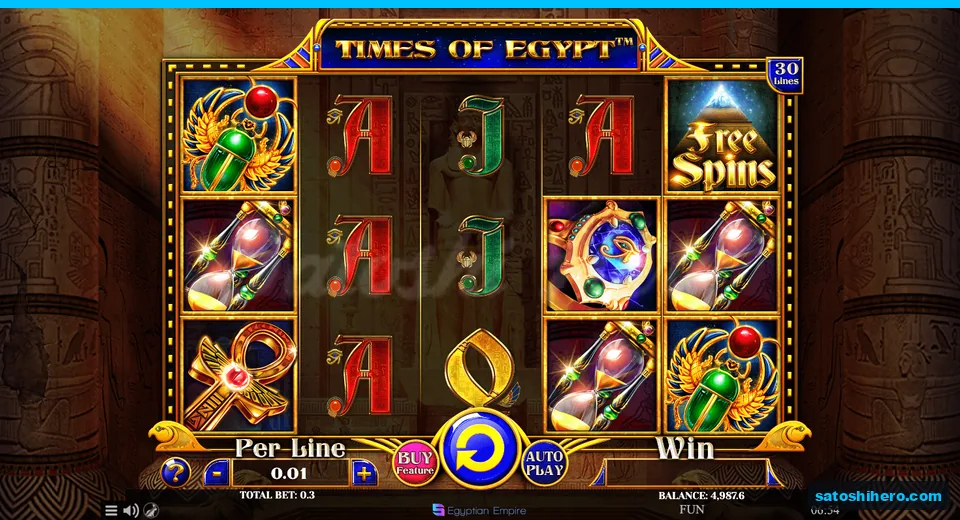
Some medium symbols occupy 1×2 or 1×3 vertical stacks, foreshadowing the bonus mechanic before you reach Free Spins. The temple won’t win originality awards, but you immediately see that stacked pictures matter more than card ranks.
I tested the play-money demo with a $5,000.00 opening balance. My $0.01 line bet created a $0.30 total stake, and every result uses that complete stake. This approach helps you compare outcomes without exaggerating line-bet multipliers.
Times Of Egypt – Pharaoh’s Reign gives Egyptian-theme fans another feature structure to compare against this stack-focused setup. Story Of Vikings provides a different historical setting from the same provider. I prefer the visible tiles here because they explain the hook at a glance. This is a stylised temple, not a factual map of Egypt in ancient times.

Discovery: The design combines the ankh, scarab, pyramid and jeweled eye across one temple-themed reel set. Those familiar motifs make the screen readable, even if the setting feels well worn.
Tall symbol blocks provide a stronger identity than the sandstone backdrop. You can follow the feature concept before opening the rules.
RTP, volatility and our test
Times Of Egypt slot carries a 95.83% theoretical RTP, medium-high volatility and a 1,000x maximum win. That combination creates an awkward trade: the balance can move unevenly, while the upside remains fairly contained. You can still see regular small hits, as I did, without recovering earlier losses. I find the cap conservative for this level of risk.
Short sessions can finish almost anywhere inside a broad range. My live result and the simulator offer two different views, yet neither predicts what you’ll receive. Focus on the spread rather than treating a frequency estimate as a countdown. The surprise here is how ordinary line activity can hide a persistent overall decline.
Simulator projection
The modelled 1,000-spin session at a $1 bet finished 58.2x below its starting point at the median. Its 5th-to-95th-percentile band stretched from 266.9x below to 230.2x above. Roughly 21% of spins paid under the model assumptions. I think that wide interval says more about risk than the middle result alone.
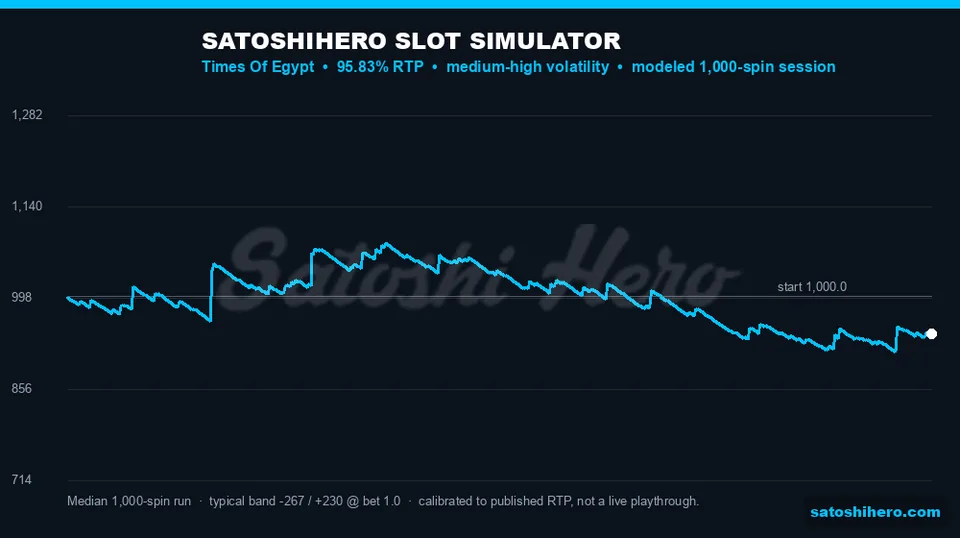
A feature-sized win appeared roughly once per 45 spins in the projection, while a top-end result appeared roughly once per 3,497 spins. Neither estimate promises an event after that many attempts. You could see one sooner, much later or not at all during a fixed session. Treat those frequencies as model inputs that describe many possible runs.
The broad gap between both boundaries shows why one average hides so much. Read the graph as possible paths, not a route your balance must follow. I wouldn’t use the median loss to predict a stopping point.

Proceed Carefully: Medium-high volatility and the wide simulator range can leave your short session far from the theoretical RTP. Set a loss limit before playing instead of chasing a falling balance.
Our 100-spin session
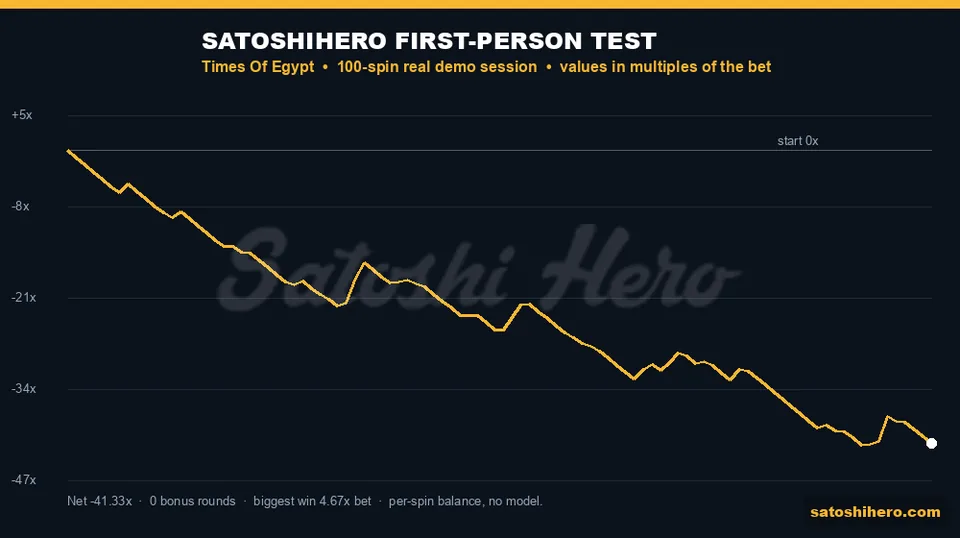
I lost $12.40 across 100 spins, equal to 41.33x my $0.30 total bet. The balance started at $5,000.00 and finished at $4,987.60. Although 29 spins paid, none returned 5x or more. You can see why hit count alone doesn’t describe session quality.
- Starting balance: $5,000.00
- Finishing balance: $4,987.60
- Paying spins: 29 from 100
- Best win: 4.67x on spins 34 and 95
- Highest balance: $4,999.70 after spin 1
- Lowest balance: $4,987.50 after spin 92
- Longest losing run: Nine spins, from spin 79 through spin 87
- Free Spins triggers: None
- Bonus purchases: None
My highest point arrived after the opening spin and still sat $0.30 below the start. The low after spin 92 stood 41.67x beneath the opening balance. Two 4.67x hits offered brief relief on spins 34 and 95, but neither repaired the gradual slide. I found the steady leakage more frustrating than a dramatic swing because small wins kept suggesting a turn.
The theoretical return comes from the operator’s published game figure. One live session doesn’t alter that number, and feature configurations can use slightly different mathematical returns by design. I haven’t assigned a separate return to either mode because no verified figure supports one.
Together, the simulator and my play show uncertainty, not a repeatable script. Your session can move differently.
How Times Of Egypt works
Times Of Egypt slot is a traditional 5-reel, 3-row game with 30 fixed paylines. Wins start on the leftmost reel and continue right through adjacent reels. Each symbol needs three matches. You receive the highest prize on each line, while separate line wins add together.
My $0.01 line bet created a $0.30 total stake. I divided each listed line-bet multiple by 30 for comparison with that full cost. Without conversion, you could mistake one line’s prize for the return across all lines. I find the original display easy to misread.
Spin 34 confirmed the unit. Three kings paid $0.10, ten times my $0.01 line bet but only 0.33x the $0.30 total stake. That distinction keeps comparisons honest.
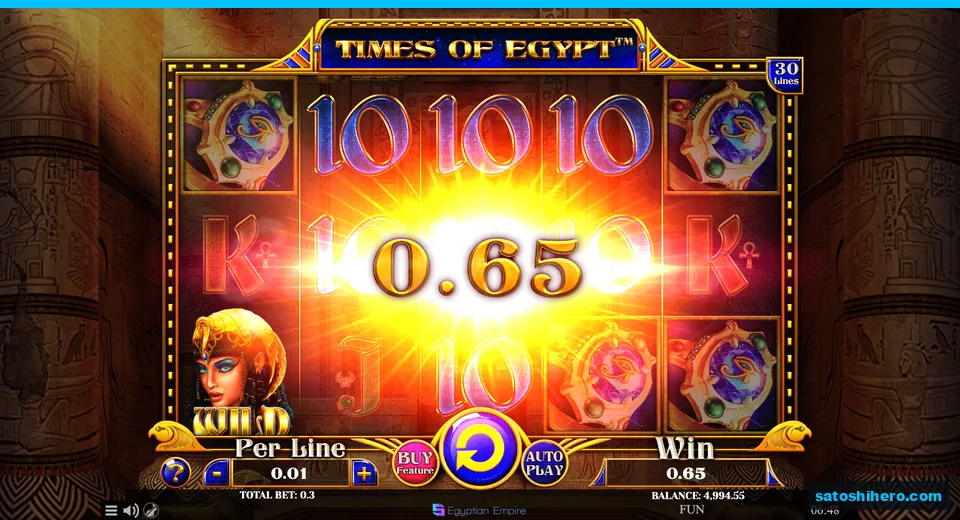
Medium pictures can appear as 1×2 or 1×3 stacks, with every position retaining its normal value. You see these blocks before the bonus standardises their size. I like how the special mode grows from a visible base-game element.
The Wild substitutes for everything except the pyramid. It appeared on reels 1 through 4 during 55 spins. Three shared the grid on spins 19, 39, 52, 67 and 90, without creating a large payout. Five across one line can return 33.33x.
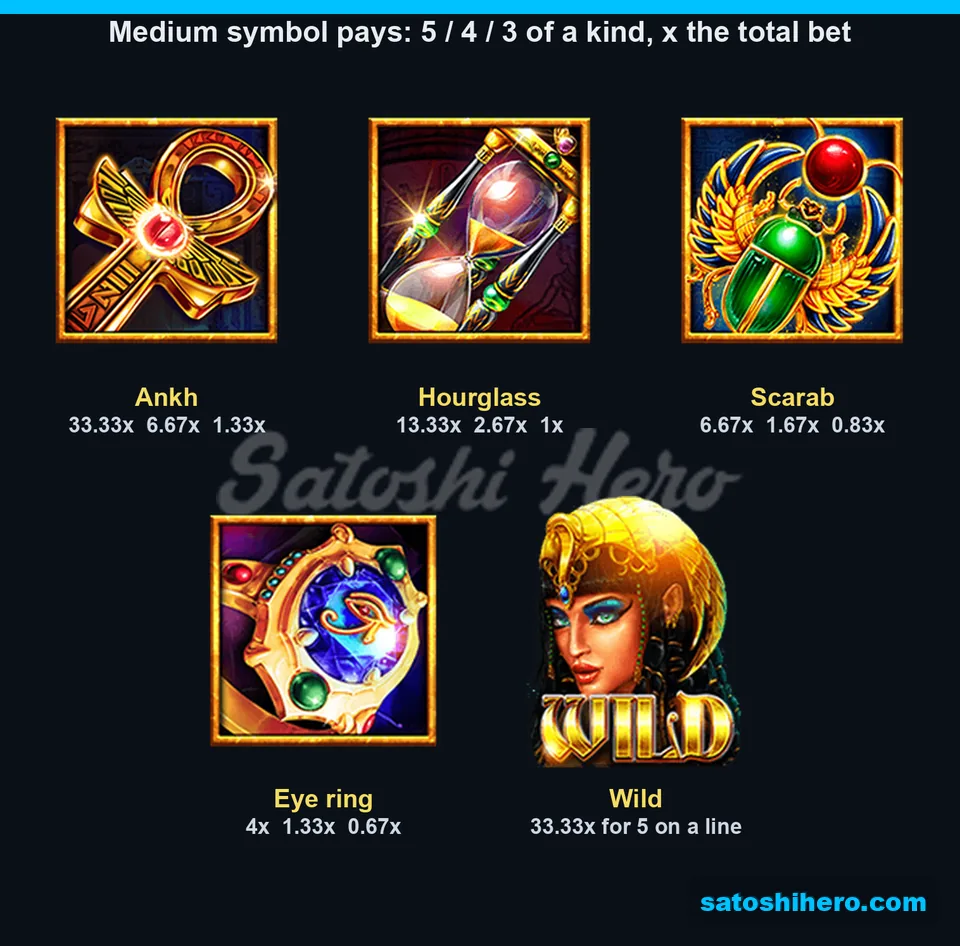

Factoid: The panel’s 1,000-times-line-bet Wild award equals 33.33x the total bet because your stake covers 30 lines. Always compare that award with the complete spin cost.
Browser controls group both bets and the spin button. I think that layout reduces mistakes. Judge results against all lines.
Symbol values and payout potential
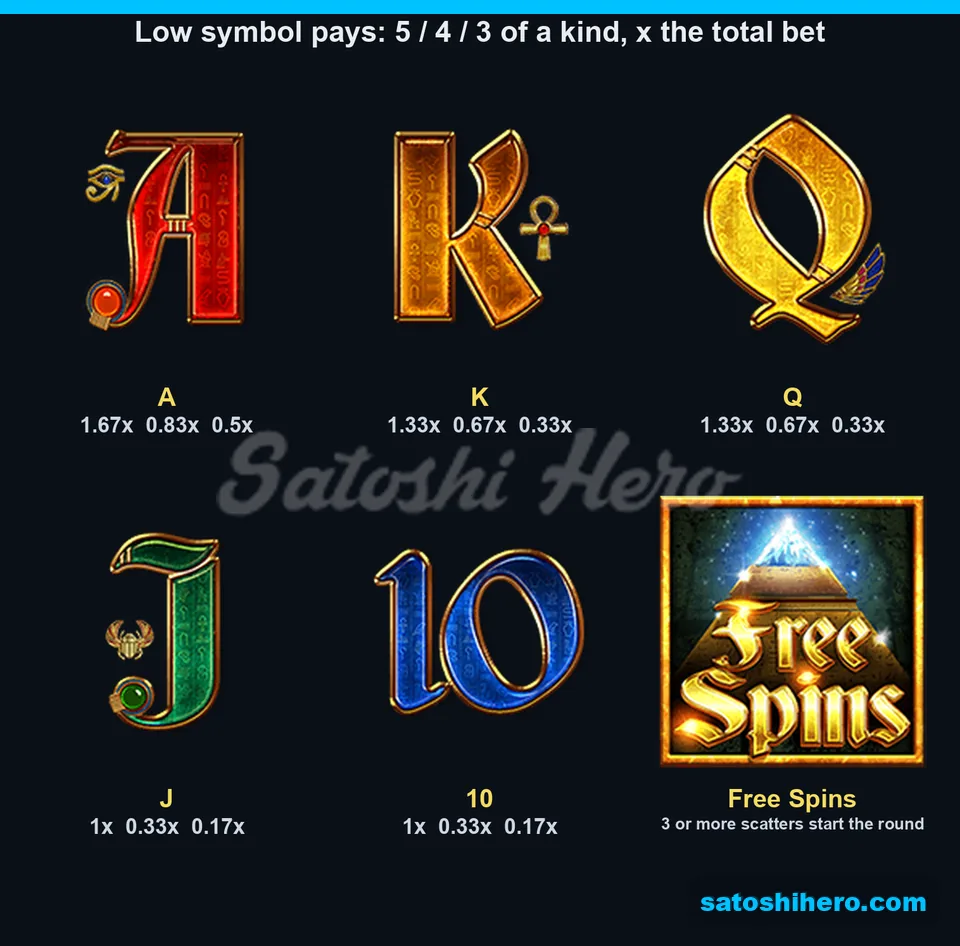
The ankh leads all symbols, returning 33.33x on one line. Every icon pays from three matches. The four Egyptian pictures are medium symbols, while card ranks are low symbols. You can read the hierarchy easily, though I find ordinary prizes restrained.
| Symbol | Five | Four | Three |
|---|---|---|---|
| Ankh | 33.33x | 6.67x | 1.33x |
| Hourglass | 13.33x | 2.67x | 1x |
| Scarab | 6.67x | 1.67x | 0.83x |
| Eye ring | 4x | 1.33x | 0.67x |
| Ace | 1.67x | 0.83x | 0.5x |
| King | 1.33x | 0.67x | 0.33x |
| Queen | 1.33x | 0.67x | 0.33x |
| Jack | 1x | 0.33x | 0.17x |
| Ten | 1x | 0.33x | 0.17x |
Premium pictures carry much stronger line values than card ranks. Even five ankhs reach 33.33x on one line, not the headline ceiling. I won’t invent an unsupported route to the cap. You can assess confirmed prizes instead.
My 29 paying spins stayed below 5x. Four returned under 1x, ten reached 1x to below 2x, and fifteen reached 2x to below 5x. None produced a decisive recovery. I thought the reels looked busier than the balance felt.
The capped upside seems modest against the risk. If you prioritise extreme jackpots, these numbers won’t impress you. Stacks and selectable Free Spins provide the stronger draw, while my hits stayed far below the cap.
Free Spins choices
Three or more pyramid symbols anywhere on the grid start Free Spins and present two stacked-symbol modes. You can choose 20 spins with all medium icons appearing as 1×2 stacks. The alternative supplies 10 spins with those pictures appearing as 1×3 stacks. I like the clear trade-off, though I can’t rank choices I never reached.
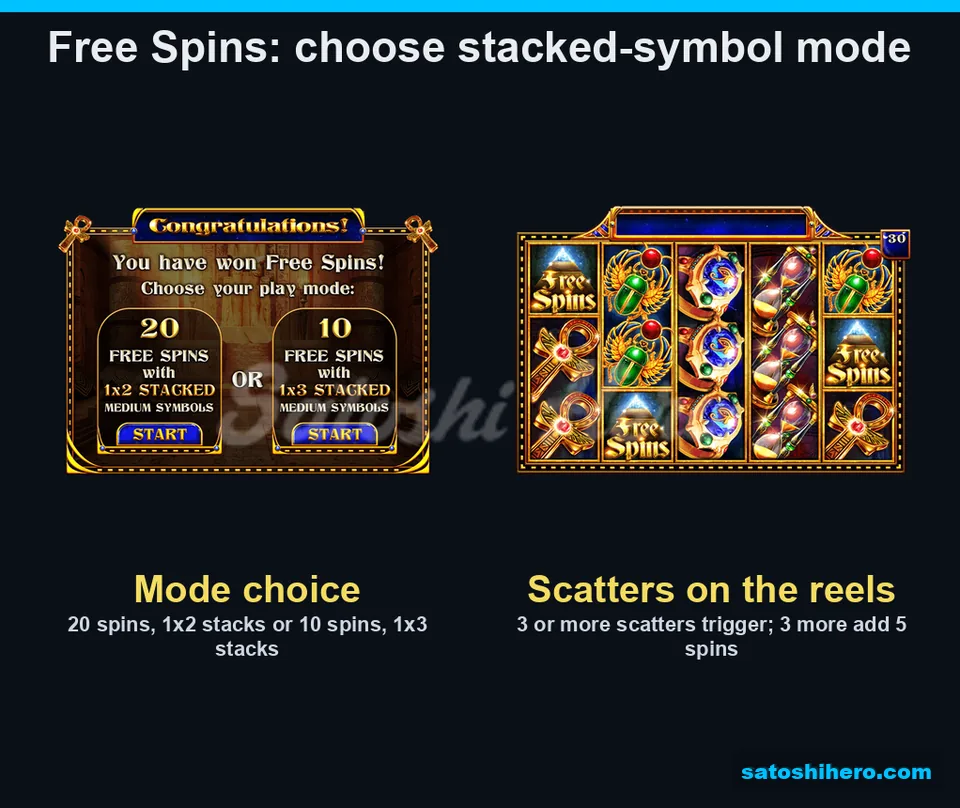
The longer mode gives you twice as many attempts with shorter stacks. Taller blocks cover a reel but halve the starting spins. Neither structure proves a higher return, so choose by feature shape rather than a presumed edge.
Three pyramids during the round add five spins. The chosen mode and triggering bet remain active, while bet controls stay disabled. I like that firm choice because you can’t switch halfway through.
Pyramids appeared during 43 spins, but no grid held more than two. I never entered either mode. You shouldn’t read near misses as progress toward another trigger.
Book Of Rampage uses a book-style decision point instead of a pre-feature stack-height choice. Book Of Rampage Reloaded gives the comparison another book-themed alternative. I prefer these two clear labels, though the absent trigger left both modes untested.

Tactic: Choose 20 spins when you prefer more individual attempts, or 10 when taller stacks appeal more. Don’t treat either option as a guaranteed advantage.
The choice changes the bonus shape, not return certainty. My test gives no evidence that either route performs better.
Buy Feature
The Buy Feature button opens Free Spins immediately instead of waiting for three pyramids. It sits beside the main spin control, and its window lets you select the feature stake. The game then calculates a purchase price from that amount. You get faster access, not proof of stronger value.
I didn’t buy the bonus during my 100-spin session. That choice means I can’t compare a purchased round against a natural trigger or recommend one configuration as the better buy. I think any stronger claim would overstate the test. You deserve a clean line between observed controls and unobserved outcomes.
Buying removes trigger waiting but commits a larger amount in one action. Treat the full displayed cost as one risk event before confirming it. If you choose natural spins, you retain a slower stake-by-stake path with no promise that three pyramids appear. Neither route changes the need for a firm spending limit.
Repeated purchases can make a weak result feel like a debt that the next round must repay. It doesn’t. You should judge each price before clicking, then stop when your limit arrives. The purchase offers speed and certainty of entry, not evidence of better returns.
What 100 spins felt like
My 100-spin session felt like a steady balance leak through small line wins, not a sequence of violent swings. The balance never moved above its starting point, even after 29 paying spins. Two 4.67x returns on spins 34 and 95 became the clear peaks. I found that rhythm active enough to hold attention but too weak to restore momentum.
Spin 1 left $4,999.70, my highest balance. Small awards then interrupted the decline without reversing it. Spin 92 reached the $4,987.50 low, which you could miss by watching only win animations.
Nine losing spins from 79 through 87 formed my longest dry patch. That run felt noticeable, though not extraordinary for medium-high volatility. Your own 100 spins could deliver a calmer path, sharper swings or a bonus that I missed. My sample describes one experience, not a normal sequence.
The live test paid on 29% of spins, compared with roughly 21% in the simulator projection. Short-run variation can easily produce that difference, and neither figure cancels the other. I actually saw more paying spins than the modelled rate while still losing 41.33x. That contrast shows why hit rate and return aren’t interchangeable.
One or two pyramids appeared often enough to create repeated near-trigger moments. The third never joined them, despite pyramid symbols appearing somewhere on 43 spins. You shouldn’t treat visual closeness as stored progress. The sample delivered regular low-value activity, but it can’t define how the next session behaves.
Bet sizing and bankroll
Budget in total-bet multiples because 30 lines can make a small line stake look cheaper than the complete spin. My $0.01 line setting produced a $0.30 total bet. The 41.33x session loss therefore equalled $12.40. You can use the same multiple-based view after changing your stake.
This method separates game behaviour from one chosen amount. A 4.67x result means the same relative return whether your total wager changes or not. I think it gives a more honest picture than quoting the line-bet award alone. Always confirm the total field before pressing spin.
The simulator’s 266.9x lower boundary illustrates how much downside a modelled 1,000-spin run can contain. It isn’t a recommended bankroll, predicted drawdown or target you need to cover. Use it as evidence that longer sessions demand more tolerance than my short trial. Your limit should come from money you can afford to spend, not the most pessimistic graph point.
A 1,000x cap also restrains the top end despite the uneven risk profile. Set both a spending ceiling and a session limit before starting. If either arrives first, stop rather than stretching the plan around a near-trigger or small recovery. I consider this especially important when the Buy Feature compresses several risks into one click.
You can use the free SatoshiHero demo to learn the 30-line stake, stacks and Free Spins choice before using real funds. Treasures Of The Trident offers a non-Egyptian alternative if you enjoy treasure-led designs.
Who it fits
Likely fit:
- You enjoy traditional left-to-right paylines.
- You like temple imagery and visible stacked symbols.
- You want a choice between more spins and taller stacks.
- You prefer fixed lines over clusters or variable ways.
Less suitable:
- You prioritise very large maximum-win potential.
- You expect frequent bonus triggers in short sessions.
- You prefer cluster pays, cascades or variable win systems.
- You dislike long patches where line hits don’t recover the stake.
The line structure and bonus choice matter more than the headline cap. Judge those mechanics first, because they shape every spin you actually see.
Frequently Asked Questions
What are the Times Of Egypt slot RTP, volatility and maximum win?
Times Of Egypt slot has a 95.83% RTP, medium-high volatility and a 1,000x maximum win. It uses 5 reels, 3 rows and 30 fixed paylines. You should treat those figures as the game profile, not a promise for one session.
How many paylines does Times Of Egypt slot have?
Times Of Egypt slot has 30 fixed paylines. I used $0.01 per line, creating a $0.30 total stake. Wins run left to right through adjacent reels, only the highest prize pays on each line, and separate line awards add together.
How do Times Of Egypt slot Free Spins work?
Three pyramids anywhere trigger a choice between 20 spins with 1×2 medium stacks and 10 spins with 1×3 stacks. Three pyramids inside the feature add five spins under the same mode and bet. Pyramids appeared during 43 tested spins, but I never landed the required three together.
What does the Wild do in Times Of Egypt slot?
The Wild substitutes for every symbol except the pyramid. Five Wilds across one line return 33.33x the total bet. Wilds appeared during 55 of my tested spins, and I saw three together on five separate grids.
Which Times Of Egypt slot symbols pay the most?
The ankh leads the regular paytable at 33.33x, 6.67x and 1.33x for five, four and three matches. The hourglass reaches 13.33x, the scarab 6.67x and the eye ring 4x. Those figures compare each line award with the full bet.
Does Times Of Egypt slot have a bonus buy?
Yes. The Buy Feature opens Free Spins immediately and calculates its price from your selected feature stake. I didn’t purchase it, so my test provides no bought-round result or basis for ranking its two configurations.
How did the Times Of Egypt slot 100-spin session go?
I finished 41.33x down after 100 spins, with 29 paying outcomes and two best wins of 4.67x. My longest losing run covered nine spins. Free Spins never triggered, and I didn’t buy the feature.
What did the Times Of Egypt slot 1,000-spin simulator show?
The median modelled session finished 58.2x below its start. Its range ran from 266.9x below to 230.2x above, while roughly 21% of spins paid. The projection describes broad possibilities rather than predicting your individual session.
Final Take
Times Of Egypt centres on choosing longer 1×2 stacks or shorter 1×3 stacks. Its restrained ceiling clashes with uneven risk, and my test never reached the feature. You get clear line play, not a proven bonus performer.

My Read
Traditional payline fans who enjoy visible stacked symbols can find a clean, focused game here. Expect many ordinary line results and prepare for sessions where those hits don’t prevent a decline.
I like how base-game stacks foreshadow both Free Spins choices. I don’t like that 29 paying spins left me 41.33x down, with nothing above 4.67x. Two-pyramid teases made the absent trigger feel sharper.
This Times Of Egypt slot guide is updated periodically with verified details. Fixed lines and selectable stacks deserve attention, while the modest cap remains the compromise. You can judge that trade before playing.

Pros:
 Clear bonus choice: Two labelled modes make the stack trade-off easy to understand.
- Readable paytable: Distinct pictures help you identify premium symbols quickly.
- Visible feature clue: Base-game stacks explain the bonus before it triggers.
- Straightforward lines: Fixed left-to-right wins keep result checking simple.

Cons:
 Restrained ceiling: The 1,000x cap feels modest beside the uneven risk.
- Elusive trigger: My 100 spins never produced three pyramids together.
- Weak recovery: Frequent paying spins couldn’t stop the balance decline.

Best For: Fixed-line fans who value simple rules, Egyptian imagery and stack-height choices get the strongest match. Jackpot hunters expecting quick bonuses should look elsewhere.



































































Bets
All Bets
Game
Player
Date
Wager
Mult.Multiplier
Prize
 Luck of Panda: Bonus Combo
 josh1998
- 16:25:09
- 0×
- Ultimate Fruits 5: Classic$$erieS
 Hidden
- 16:25:08
- 0×
- Luck of Panda: Bonus Combo
- josh1998
- 16:25:06
- 0.45×
- Gems Bonanza
 rsbam242997
- 16:25:04
- 0.2×
- Galaxy Glitter
- mike_721
- 16:25:04
- 0×
- Luck of Panda: Bonus Combo
- josh1998
- 16:25:03
- 6.6×
- Pompeii Gold: Rapid Link Bonus Buy
- mdp0fxo
- 16:25:03
- 0×
- Gems Bonanza
- rsbam242997
- 16:25:02
- 0×
- Gems Bonanza
- rsbam242997
- 16:25:00
- 0.5×
- Luck of Panda: Bonus Combo
- josh1998
- 16:25:00
- 0×