


Dice, Jesters, and 100 Lines of Madness
Spinomenal builds Joker Madness slot as a colorful five-reel, four-row dice game with 100 adjustable left-to-right paylines. This medium-high volatility game has a 96.1% RTP and 3,000x maximum win. My 100-spin test finished 33.3x down, with 19 paying spins and a 9.8x best result.
You get stacked Wilds and cash-paying Scatters instead of layered bonuses. That lean setup feels dated, though the prize ceiling remains respectable for such a simple line game.
Key Takeaways
- Recommended approach: There’s no bonus choice or buy feature, so choose a sustainable total stake through the line and bet controls.
- Math profile: Joker Madness slot combines a 96.1% theoretical RTP with medium-high volatility.
- Prize ceiling: The largest possible win reaches 3,000x the bet.
- Test result: Nineteen spins paid, the strongest hit reached 9.8x, and my session finished 33.3x down.
- Risk lesson: A 15-spin losing run occurred, so allow for dry spells instead of chasing Wilds or Scatters.
You can try the free demo or switch to real play here on SatoshiHero. The recorded session below shows how the simple rules behaved, not what your own spins must produce.

Table of Contents
- Theme and First Impressions
- How Joker Madness slot Works
- A worked line win
- Payline Math and Symbol Values
- Higher-paying symbols
- Lower-paying dice
- Scatter Payouts in Practice
- Betting Controls and Test Setup
- What Happened Over 100 Spins
- Early peak
- Largest win and decline
- RTP, Volatility and Our Test
- Simulator projection
- Our 100-spin session
- Session Risk and Bankroll Lessons
- Frequently Asked Questions About Joker Madness
- Final Take
Theme and First Impressions
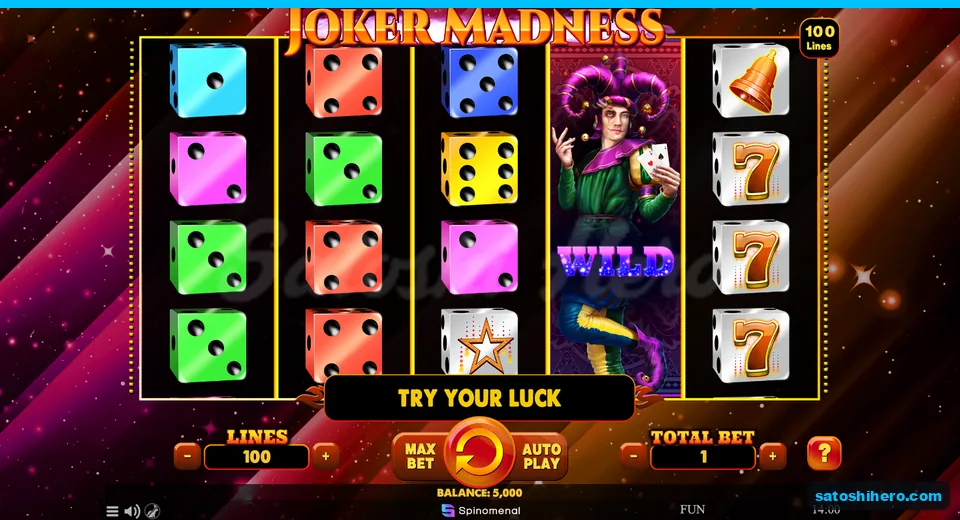
Joker Madness slot uses bright casino-dice artwork instead of an elaborate story. Standard dice show one through six pips, while white dice carry a bell, seven, or gold-star Scatter. A jester in a purple horned hat forms the tall Wild panel. It can fill a reel or cover only part of one.
Gold frames surround the 5×4 layout against a dark-pink field with light streaks. A gold title crowns the reels, keeping each color clear. That clarity matters when several of the 100 lines pay together. The theme won’t win originality prizes, but it handles a busy payline screen well.
My test used all 100 lines, with $0.01 assigned to each line and a $1 total bet. The opening balance was $5,000, and every recorded result appears as a total-bet multiple. That approach lets you compare the outcomes with your own stake. It also stops small line values from looking larger than they really are.
Joker Win offers another direct joker-and-casino presentation, making it a natural comparison if you favor familiar symbols over story-heavy worlds. Wildfire Fruits Dice takes a different visual route by mixing dice-led art with fruit imagery, while Snegurochka and Kupala provide folklore-themed alternatives. Those comparisons don’t change the appeal here: you get crisp symbols, quick reads, and little visual depth.

Discovery: My $1 test stake split into $0.01 across each of the 100 active lines. Read the paytable as per-line values, then judge the complete result against the total bet.
The design favors instant recognition, which feels more useful than extra decoration on this crowded grid.
How Joker Madness slot Works
Wins follow 100 traditional paylines from the leftmost reel through adjacent reels. The five-reel, four-row structure requires at least three matching regular symbols from the left. Only the highest award on each line counts, while separate winning lines add together. You should keep those line wins separate from Scatter prizes, which pay anywhere.
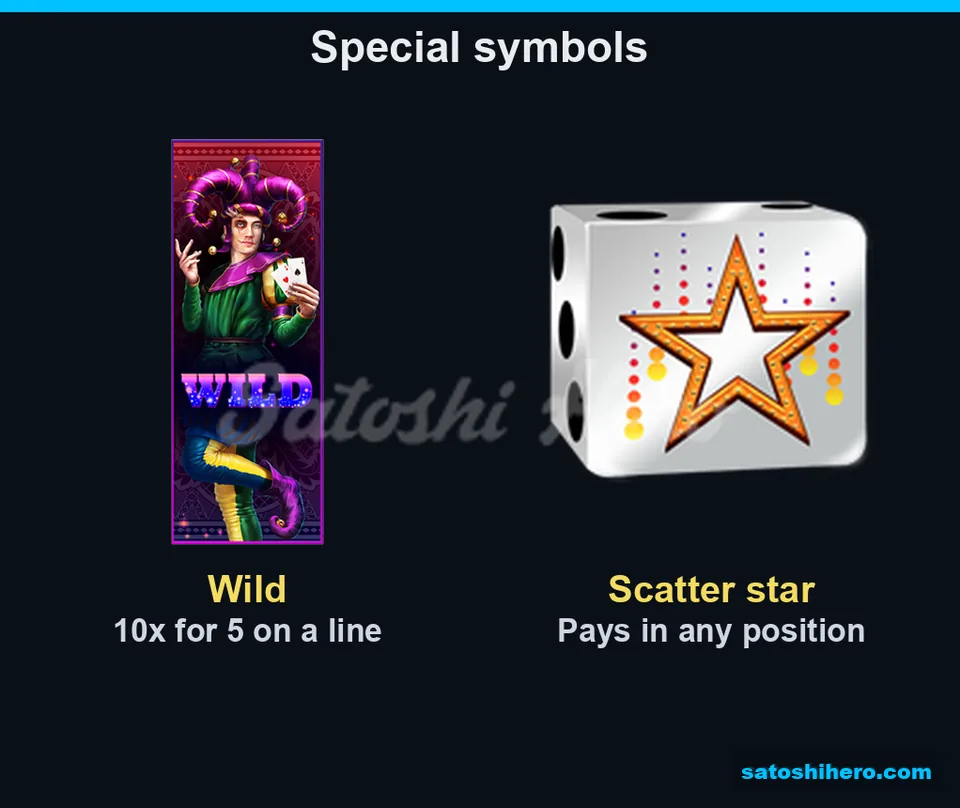
The jester Wild substitutes for every regular symbol but never replaces the Scatter. It appeared as full and partial stacks across all five reels during my test, though that doesn’t imply equal frequency. Five Wilds on one line pay 1,000x the $0.01 line stake. With all 100 lines active, that single-line award equals 10x the $1 total bet.
A worked line win
Spin 65 gave the clearest example of several lines combining. Wilds on reels two and three helped create ten three-bell wins, contributing $5.00. Six four-red-die wins added $1.50, while one three-red-die win added $0.10. The screen displayed $6.60 in total, equal to 6.6x my stake.
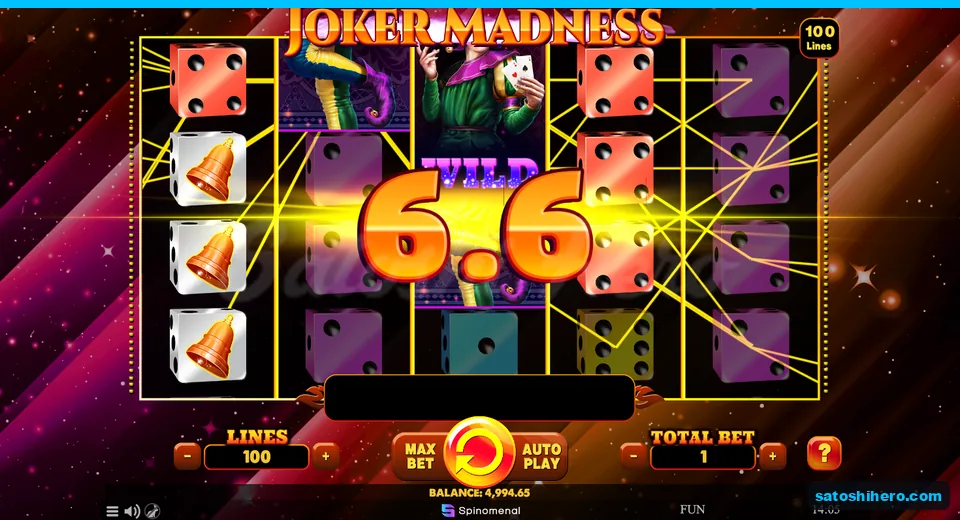
That spin shows why the reels can look busier than the final value suggests. You can see many highlighted paths, yet each modest line award contributes only a small piece. The controls remain within the same core interface on different screens, so they don’t create another game mode. In my view, the overlapping arithmetic provides the real interest here.

Tactic: Check both the active-line count and total bet before every session. Reducing line coverage changes the wager structure and makes comparison with this 100-line test less useful.
Once you understand the line conversion, Joker Madness slot becomes straightforward: overlapping combinations drive results, not separate bonus events.
Payline Math and Symbol Values
The paytable lists awards in per-line units, so my test converted each figure into total-bet multiples. Dividing the displayed values by 100 matched the setup with every line active. On spin 1, three green dice paid $0.10, ten times the $0.01 line stake. That result also equaled 0.1x the complete $1 wager.
You should use the following values only with all 100 lines active. Changing the line count alters the relationship between a line award and total cost. I find the conversion essential because a large-looking line multiplier can hide a modest whole-spin return.
Higher-paying symbols
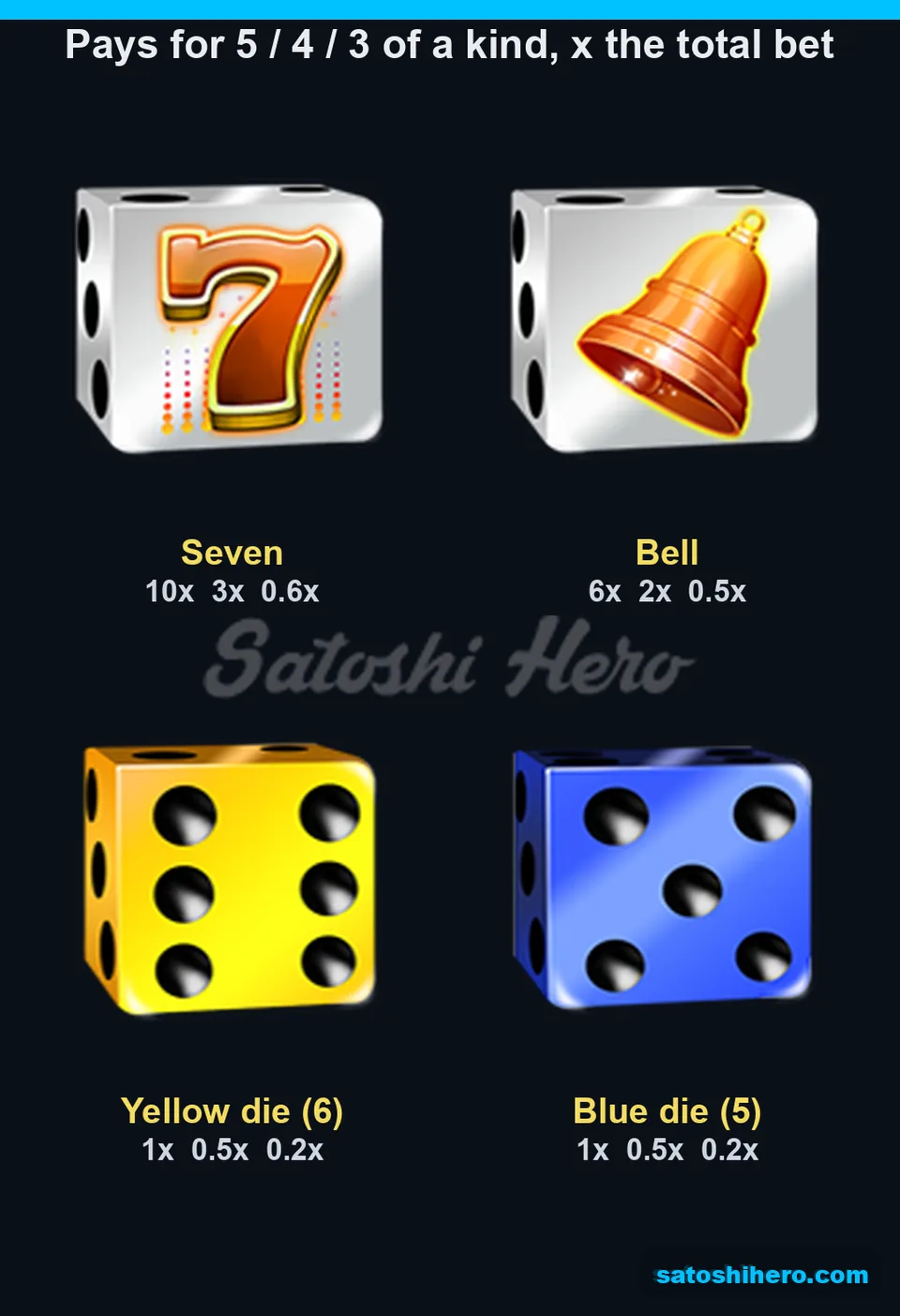
The seven leads the regular paytable:
- Five sevens pay 10x the total bet.
- Four sevens pay 3x.
- Three sevens pay 0.6x.
The bell sits just below it:
- Five bells pay 6x the total bet.
- Four bells pay 2x.
- Three bells pay 0.5x.
The yellow six-pip and blue five-pip dice share these awards:
- Five symbols pay 1x the total bet.
- Four symbols pay 0.5x.
- Three symbols pay 0.2x.
These top symbols can still need several line connections to build a substantial result. You shouldn’t mistake one three-symbol path for a meaningful session swing.
Lower-paying dice
The red four-pip and green three-pip dice each pay 0.8x, 0.25x, and 0.1x for five, four, and three symbols. Pink two-pip and cyan one-pip dice pay 0.5x, 0.15x, and 0.05x across those same lengths. Every regular symbol begins paying from three matching icons.
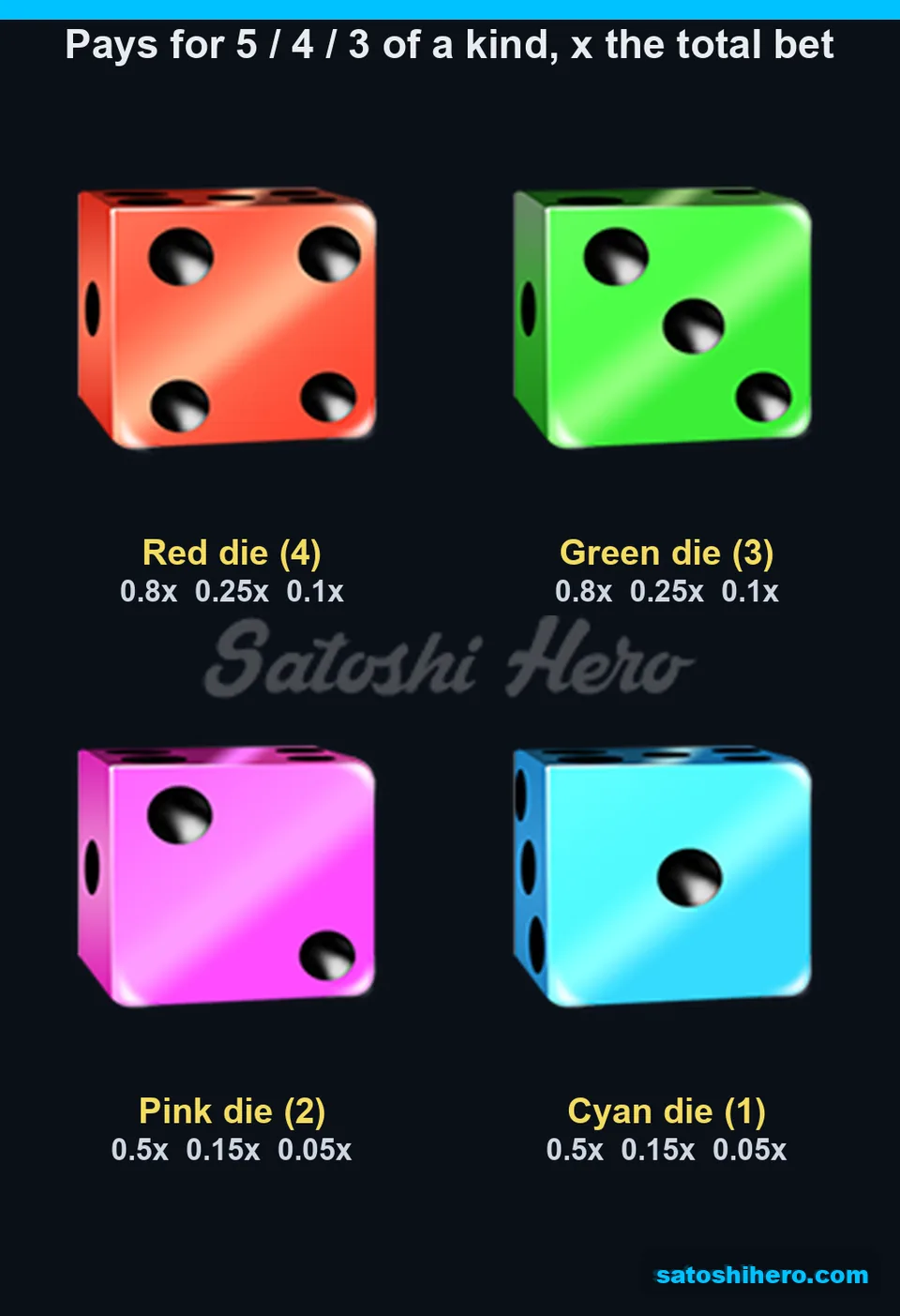
Low-symbol lines rarely move the balance much by themselves. Stronger base-game hits generally need many paths to overlap, as spins 4, 46, and 65 demonstrated. You’ll understand the result faster if you compare the final display with the whole stake, not one highlighted route. That total-bet view keeps the paytable honest and readable.
Scatter Payouts in Practice
The gold-star white die pays anywhere, but it gives cash rather than opening a bonus mode. Three Scatters pay 2x the total bet, four pay 25x, and five pay 250x. They don’t need to sit on a line or connect from the first reel. You can judge the award directly against the full stake.
I landed three Scatters on spins 9, 13, and 54. Each occurrence returned $2.00 from my $1 bet, confirming the 2x position prize. None of those hits opened free spins. The repeat cash result felt transparent, although seeing the same small award three times made the feature feel limited.
Joker Madness slot has no free spins, bonus round, or bonus-buy option. That stripped-back structure gives you visible cash values without waiting through another mode. If you prefer expanding bonuses or purchasable features, the base game can feel too thin. Direct line action is the whole experience here.

Factoid: Five Scatters can pay 250x, far above the 10x total-bet value of five Wilds on one line. My test produced no four- or five-Scatter result.
The Scatter works as a simple cash prize, and you shouldn’t expect it to become a gateway elsewhere.
Betting Controls and Test Setup
My real test cost $1 per spin because 100 active lines each carried $0.01. The left-side plus and minus controls change the number of paylines, while the right-side controls adjust the total bet. You should check both figures together because the small line value isn’t the complete cost. This setup looks simple, but careless clicks can change session exposure quickly.
MAX BET raises the stake and deserves a deliberate press, not an automatic one. AUTO PLAY handles repeated spins, while turbo accelerates the reel sequence. Neither option changes the mathematical return. Faster play simply lets the same wager pattern consume your budget in less time.
I record results as stake multiples because that format travels across different bet sizes. My $9.80 top result equaled 9.8x, whether you compare it with $1 spins or scale the example elsewhere. Raw dollar amounts describe my chosen setup only. You’ll get a clearer picture by tracking the multiple beside each displayed win.
The 15-spin losing run shows why a session budget needs room beyond a few wagers. At my stake, that sequence used $15 before another paying spin appeared. Fewer lines don’t create a stronger strategy, and a higher speed can’t overcome the house edge. Careful setup matters much more than fast controls in this lean game.
What Happened Over 100 Spins
My 100-spin session fell from $5,000 to $4,966.70, finishing 33.3x down at $1 per spin. Nineteen spins paid, and three returned less than the stake. This sample records one path through Joker Madness slot, not a prediction for you. The session felt grindy despite frequent line highlights.
Early peak
Spin 4 created the first major lift. Seven five-red-die lines contributed $5.60, five four-red-die lines added $1.25, and nineteen three-red-die lines supplied $1.90. The $8.75 total equaled 8.75x and raised my balance to $5,006.65. That point stood 6.65x above the opening balance and became the session high.
I stayed near the start through the early spins, but the balance never returned there after spin 16. A 15-spin non-paying stretch then ran from spin 14 through spin 28. You can see how quickly a lively-looking line game turns cold when highlighted combinations disappear. That dry run shaped the session more than any single visual flourish.
Largest win and decline
Spin 46 delivered my top result. Seventy-seven three-green-die lines paid $7.70, four five-cyan-die lines added $2.00, and two three-cyan-die lines added $0.10. The complete $9.80 return equaled 9.8x, moving my balance from $4,975.45 to $4,984.25. Many tiny green-die paths did nearly all the work.
Spin 65 provided the third notable hit at $6.60, or 6.6x. Ten Wild-assisted three-bell wins supplied $5.00, while red-die combinations supplied the remaining $1.60. That result looked varied on screen, yet it still couldn’t reverse the broader decline. I found the combined line build more engaging than the final number.
The three Scatter results added another useful pattern. Spins 9, 13, and 54 each paid exactly $2.00, so none matched the stronger line combinations. They broke up losing stretches without changing the overall direction. If you focus only on symbol rarity, those star landings can look more important than their recorded effect.
The lowest point arrived after spin 98 at $4,964.70, equal to 35.3x below the start. Of all 19 paying spins, three returned under 1x, ten landed from 1x to under 5x, and six reached at least 5x. A paying result didn’t always mean profit on that spin. You should separate visible activity from useful returns when reading this payline system.
Small combined wins dominated the sample, while the strongest result stopped at 9.8x.
RTP, Volatility and Our Test
Joker Madness slot carries a 96.1% theoretical RTP, medium-high volatility, and a 3,000x maximum win. That profile allows uneven sessions without promising any fixed hit pattern. The ceiling sits far above my 9.8x peak, which made the short sample feel modest. You shouldn’t treat either test below as a personal forecast.
Simulator projection
The SatoshiHero Slot Simulator modeled 1,000 spins at a $1 bet. Its median path finished 53.9x below the starting point, while the fifth-to-95th-percentile band stretched from 261.4x down to 224.4x up. About 21% of modeled spins paid. A result of at least 100x appeared roughly once per 3,472 modeled spins.
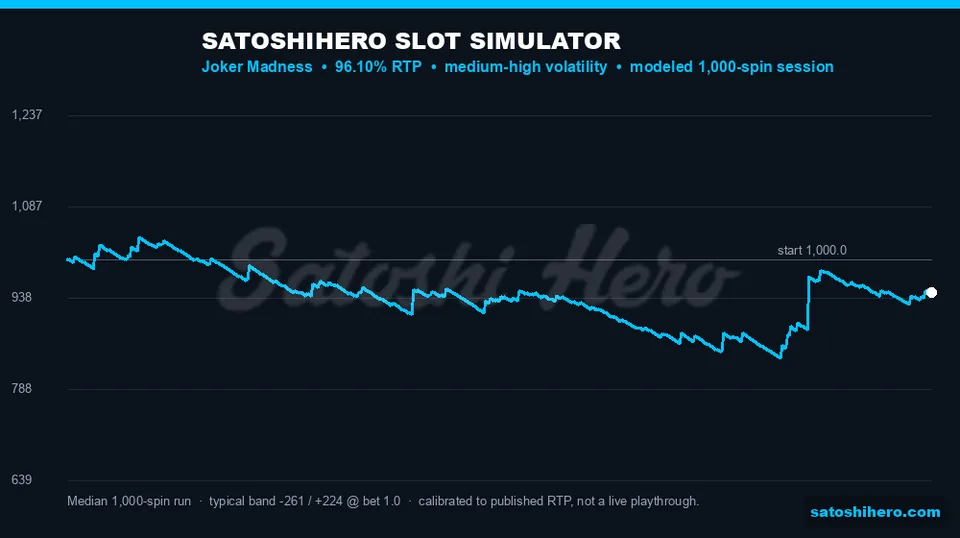
The model used the published RTP, volatility level, and prize cap as inputs. Its broad span illustrates how far sessions can separate under the same settings. You can’t turn the 100x frequency into a countdown, since each run develops independently. The range is useful context, but the width matters more than its center.
Our 100-spin session
My live sample produced a 19% paying-spin rate, ended 33.3x down, and peaked at a 9.8x win. That 19% figure sits near the modeled 21%, though one short run can’t prove a projection. No spin reached 100x. The ending point remained inside the model’s broad band, which doesn’t validate either outcome.
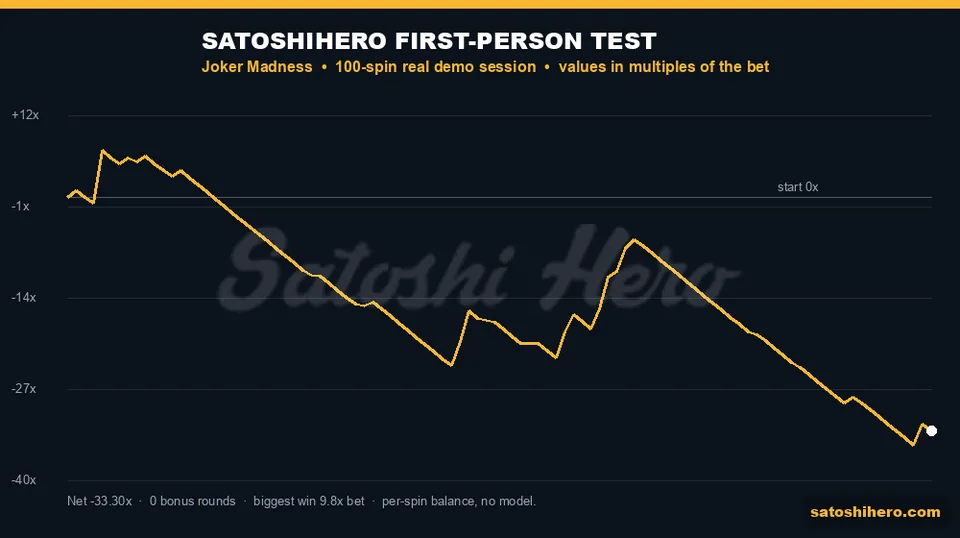
The 15-spin drought also fits the uneven feel implied by medium-high volatility. Yet the session included several small returns, so it wasn’t simply empty reels followed by one huge prize. You could experience a very different balance path within the same broad risk profile. I consider that distinction crucial when comparing observed and modeled evidence.
Comparing the two hit rates needs restraint. The model counted paying spins across simulated paths, while my 19% figure came from one recorded sequence. A two-point gap looks small, but the payout sizes and order still shaped a clear loss. You should read hit rate as activity, not as a shortcut to session return.
The 96.1% figure is Spinomenal’s published theoretical return, and one 100-spin session doesn’t alter it. Every 1,000-spin value above comes from a model rather than live play. No separate bonus-mode return applies because the game offers no free spins or bonus buy.

Proceed Carefully: Medium-high volatility produced a 15-spin losing run in my test, while the model showed a wide outcome range. Set a fixed session budget, and never assume a win becomes due after losses.
Official math supplies the baseline; the model and my test show two different forms of session variation.
Session Risk and Bankroll Lessons
Transparent 100-line wins and direct cash Scatters define this game, while bonus-focused play has no place here. The missing feature rounds keep every cost visible on the main reels. You still face meaningful risk because three of my 19 paying spins returned less than $1. Simplicity makes losses easier to track, but it doesn’t make them smaller.
A 15-spin dry spell can remove 15 stake units before the screen shows another award. At $1 per spin, my recorded sequence cost $15. You should pick the total bet before using turbo or AUTO PLAY, since faster motion doesn’t change the odds. The brisk pace can make a fixed budget disappear with less time to reassess.
Three actions keep the setup grounded:
- Choose your total stake before enabling faster play.
- Judge affordability in complete-bet units, not the $0.01 line figure.
- Don’t raise your wager because the balance has fallen below its starting point.
Joker Madness slot works better as a lean line game than a destination for elaborate feature hunting. You get readable outcomes, but no side mode can change the rhythm after a cold stretch. The direct design has some charm, although the lack of variety became obvious during my test. Sustainable stake sizing matters more than waiting for a feature that doesn’t exist.
Frequently Asked Questions About Joker Madness
What are the RTP, volatility, and maximum win of Joker Madness slot?
Joker Madness slot has a 96.1% theoretical RTP, medium-high volatility, and a 3,000x maximum win. It uses five reels, four rows, and 100 traditional left-to-right paylines.
What does the Wild do in Joker Madness slot?
The jester Wild substitutes for every regular symbol except the Scatter. Five Wilds on one line pay 10x your total bet with all 100 lines active. Full and partial stacks appeared across all five reels during my test.
How does the Joker Madness slot Scatter pay?
The Scatter pays 2x, 25x, or 250x for three, four, or five symbols anywhere. I landed three on spins 9, 13, and 54, and each hit returned $2 from a $1 bet.
Which Joker Madness slot symbols pay the most?
The seven pays 10x, 3x, and 0.6x for five, four, and three symbols. The bell pays 6x, 2x, and 0.5x. Yellow and blue dice pay 1x, 0.5x, and 0.2x; red and green pay 0.8x, 0.25x, and 0.1x; pink and cyan pay 0.5x, 0.15x, and 0.05x.
Does Joker Madness slot have free spins or a bonus buy?
No. Joker Madness slot has no free spins, bonus round, or buy option. Its Scatter awards cash directly instead of opening another mode. That setup feels lean if you expect feature rounds.
How did the 100-spin Joker Madness test go?
My sample ended 33.3x down with 19 paying spins and a 9.8x largest win. The balance reached a 35.3x low point, and the longest non-paying stretch lasted 15 spins. It was one short session, not a forecast.
What did the 1,000-spin Joker Madness simulator project?
The model produced a median finish 53.9x below the start. Its fifth-to-95th-percentile span ran from 261.4x down to 224.4x up, with about 21% of spins paying. You should treat those numbers as projections, not promised outcomes.
Final Take
Joker Madness stands out through readable 100-line wins, stacked Wilds, and direct cash Scatters. Its main drawback is clear: no bonus mode interrupts the base-game grind. You should expect simple arithmetic rather than feature spectacle.

My Read
Choose this game when you want traditional paylines, direct cash prizes, and a clearly displayed stake. Expect uneven runs and many modest combined wins, not a steady stream of large payouts.
I liked how spin 46 built $9.80 from dozens of small green and cyan lines. I didn’t like that my strongest hit stopped at 9.8x while the balance still finished 33.3x down. The absence of free spins made the later stretch feel repetitive.
The Joker Madness slot specifications and gameplay details are checked regularly, while the recorded test remains one fixed sample.

Pros:
 Clear line structure: Every regular win follows familiar left-to-right paths.
- Cash Scatters: Position-paying stars give direct awards without bonus uncertainty.
- Readable symbols: Strong colors separate overlapping wins across the busy grid.
- Useful Wild stacks: Full and partial stacks can connect several paylines together.

Cons:
 No bonus modes: Repeated base spins can become monotonous during longer sessions.
- Modest test peak: My largest result reached only 9.8x the stake.
- Sharp dry spell: Fifteen spins passed without any paying result.

Best For: Traditional line-slot fans who value clear symbols, cash Scatters, and simple controls get the strongest match. Bonus hunters and feature buyers should look elsewhere, because the base game never opens another mode.



































































Bets
All Bets
Game
Player
Date
Wager
Mult.Multiplier
Prize
 Galaxy Glitter
 Hidden
- 09:03:27
- 2.4×
- Galaxy Glitter
- Hidden
- 09:03:24
- 0×
- Galaxy Glitter
- nina87
- 09:03:23
- 0×
- Royal Fruits 9: Hold 'n' Link
- mike_721
- 09:03:23
- 0×
- Buffalo Smash: Supercharged
 Hidden
- 09:03:21
- 0×
- Galaxy Glitter
- Hidden
- 09:03:21
- 0×
- Triple 5's: Megacharged
 Hidden
- 09:03:20
- 0×
- Katana Klash: Hold'n'Link
 mdp0fxo
- 09:03:19
- 0×
- Buffalo Smash: Supercharged
- Hidden
- 09:03:18
- 0×
- Triple 5's: Megacharged
- Hidden
- 09:03:18
- 0×