


Dancing Through Kupala’s Midsummer Fire
Spin through a Slavic midsummer night where stacked Wilds spread wins across 100 fixed paylines.
Kupala is a traditional Spinomenal slot with medium-high volatility, a 5×4 grid, and a Slavic festival theme. Its 96% RTP and 1,000x maximum win frame a simple game of left-to-right line wins and anywhere-paying Scatters. The Kupala slot targets classic line-game fans who prefer direct cash results without bonus rounds or feature buys.
Key takeaways
- Best play: Try the demo first and keep stakes measured because no enhanced mode or bonus buy changes the base game.
- RTP / volatility: The Kupala slot has a 96% RTP and medium-high volatility, creating uneven short sessions.
- Max win: The maximum win reaches 1,000x the total bet, which feels restrained beside the risk level.
- Risk note: All play comes from 100 fixed paylines, stacked Wilds, and anywhere-paying Scatters, with no free spins or bonus rounds.
- Bankroll note: My test included a 13-spin losing run and finished 51.55x down, showing how quickly pressure can build.

Table of Contents
- Theme and First Impressions
- How the Kupala slot Works
- Line Win Rules
- Symbol Values
- Stacked Wild
- Scatter Pays
- A Stripped-Back Feature Set
- Maximum Win and Prize Potential
- RTP, Volatility and Our Test
- Simulator Projection
- Our 100-Spin Session
- Session Pace and Bankroll Pressure
- Who Will Enjoy Kupala?
- Frequently Asked Questions About Kupala
- Final Take
Theme and First Impressions
Spinomenal builds the setting around the Slavic Kupala midsummer celebration. You see the 5×4 reels resting in a pine forest at dusk, with mountains fading into the distance. That darker backdrop makes the glowing symbols easy to read. I think the folk setting has far more character than another standard fruit machine.
Flower-crowned letters sit beside a bonfire, candle wreath, and bright fern flower. The Wild shows a woman wearing a flower crown and embroidered white blouse. A wreath wrapped in red and blue ribbons acts as the Scatter. You can identify each shape quickly, which helps when many highlighted paylines cross the grid.
My first screen also showed a full Wild stack on reel four, the 100-line setting, a total bet of $1, and a $5,000 demo balance. The clear presentation made the rules feel approachable, though it didn’t hint at any deeper feature layer. You get a memorable visual identity rather than elaborate animation. That choice works because the line action can already make a busy screen.
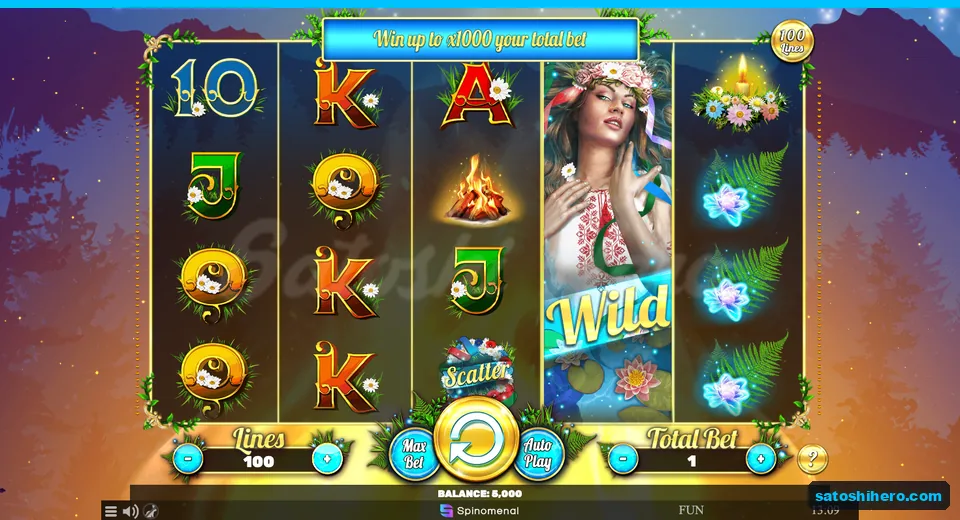

Factoid: Kupala refers to a Slavic midsummer celebration, which explains the bonfire, wreath, and glowing fern imagery.
The art gives this simple game a distinct face without pretending that extra features sit behind the symbols. If atmosphere matters to you, the woodland scene does useful work.
How the Kupala slot Works
The game uses 100 fixed paylines, and regular wins start on the leftmost reel. Matching symbols must continue across adjacent reels from left to right. Only the highest combination on each line pays, while the paytable multiplies each value by your bet per line. You should read the central spin total as the sum of every paying line.
A $1 total bet across 100 lines puts $0.01 on each line. At that setting, each displayed paytable award also reads cleanly as a multiple of your total bet. One result may contain dozens of overlapping combinations, so stacked layouts can turn modest symbols into a useful total. I like that transparent arithmetic, even when the returns themselves stay small.
You can play the browser-based game on desktop or mobile at SatoshiHero. The interface keeps the spin total visible, which matters more here than flashy side panels. You won’t need to track meters or separate feature states.
Line Win Rules
My log confirmed how the line math works. Three A symbols on one line returned $0.20, while three candle wreaths paid $0.50. On spin 54, eight separate three-A lines combined for $1.60. You need to count all highlighted paths before judging whether a layout performed well.
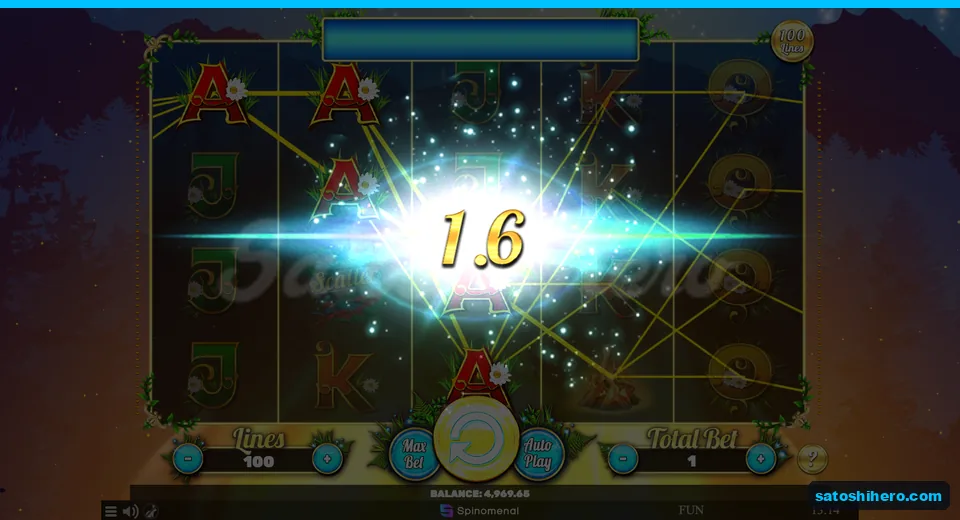
That example also shows why one obvious symbol chain can mislead you. The grid may repeat the same combination across several fixed paylines, and each valid path adds its own award. In my view, the summed result feels satisfying when the highlights spread, but the visual bustle can make a modest return look larger.

Symbol Values
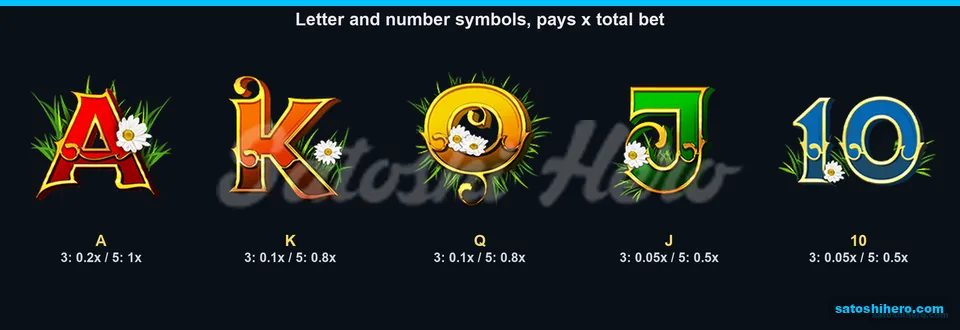
The fern flower leads the regular paytable at 0.6x for three, 3x for four, and 10x for five. Candle wreaths return 0.5x, 2x, and 6x. Bonfires and A symbols each pay 0.2x, 0.5x, and 1x, while K and Q pay 0.1x, 0.25x, and 0.8x. J and 10 sit lowest at 0.05x, 0.15x, and 0.5x.


Tactic: Judge the complete line-win total instead of one combination, because stacked layouts can pay across many paths.
These values explain why frequent low symbols don’t guarantee a strong spin. You need broad overlap, premium symbols, or Wild support to build a meaningful total. Understanding that pattern matters more than waiting for a separate feature, because none exists.
Stacked Wild
The Wild replaces every regular symbol except the Scatter and can occupy tall stacks. Five Wilds on one payline return 10x the total bet, but that amount remains a normal line award. You don’t receive a multiplier, respin, or extra sequence when it appears. Its value comes from connecting the same layout across many paylines.
Spin 76 gave me the clearest example. Six Wild positions helped create 27 separate wins of three bonfires, with each line returning $0.20. The combined result reached $5.40. Watching that grid unfold felt busier than the final amount, yet the Wild stack plainly rescued an otherwise ordinary symbol.
My strongest spin used the same principle on candle wreaths. Three Wild positions supported nineteen winning combinations across the 100 fixed paylines, producing the best result in my test. You should focus on how many paths a stack connects rather than expecting a special animation. That practical role makes stacked Wilds useful, though players used to expanding multipliers may find them plain.
A tall stack can also appear without creating a large return. It still needs matching symbols from the first reel and across adjacent reels. You may see several Wild positions but little value if the left side doesn’t cooperate. I prefer this readable interaction to a vague mystery mechanic, but it leaves little room for surprise.
The Wild gains strength by multiplying ordinary line wins across the grid. Once you watch the highlighted routes, its contribution becomes easy to understand.
Scatter Pays
The Scatter pays from any grid positions and doesn’t need to follow a payline. Three Scatters return 2x the total bet, four return 25x, and five return 250x. You receive a direct cash result only. The symbol doesn’t activate free spins, a pick game, or another feature.
I landed three Scatters on spins 39, 83, and 85. Each appearance returned $2 at my $1 total bet, exactly matching the 2x award. Two hits arrived close together near the session’s end, but neither changed the falling balance trend. I found the clean cash pay useful, although three symbols felt less dramatic than their special artwork suggests.
The ribbon-wrapped wreath remains the largest individual symbol award available. Five can produce 250x from anywhere, while the top regular symbols still depend on line positions. You should treat that potential as a direct payout, not a hidden route into a richer game state. That distinction prevents false expectations when the third Scatter lands.

Discovery: The wreath fits the midsummer theme, while its Scatter label describes anywhere-pay behavior rather than a free-spins trigger.
Because the Scatter ignores paylines, it can return money from a broken layout that regular symbols can’t use. Yet you still need three or more on the same spin. I like the immediate result, but the lack of a follow-up feature makes the moment brief.
A Stripped-Back Feature Set
The complete game contains no free spins, bonus game, or bonus buy. Its loop consists of left-to-right line wins, stacked Wild substitutions, and Scatter cash awards. You see the outcome immediately, with no trigger hunt followed by retriggers or purchase choices. That simplicity feels refreshing for a few spins.
You can also understand every result without learning layered rules. The game highlights each winning line, adds the awards, and moves straight to the next spin. Nothing carries between rounds, so you don’t need to monitor meters or persistent symbols. I appreciate that clarity, particularly when checking how an observed result formed.
The trade-off becomes obvious during a dry stretch. With no secondary mode, the same reel cycle repeats until another line or Scatter pays. If you want escalating multipliers, selectable bonuses, or long feature sequences, this design offers little variety. In my test, the direct format became repetitive when the balance kept sliding.
Measured demo play gives you a sensible way to learn that pace before using a real balance. You can check whether busy line highlights provide enough interest without chasing a missing trigger. Don’t raise your stake just to manufacture excitement, because a larger bet doesn’t unlock anything new.
I see the limited feature set as a preference point, not an automatic flaw. Traditional line fans get a focused game, while feature hunters will likely lose interest quickly.
Maximum Win and Prize Potential
The game’s hard ceiling is 1,000x the total bet. That cap defines potential rather than a likely session result, and no jackpot or bonus multiplier pushes it higher. You need several line wins to pay together when chasing larger totals. I consider the ceiling modest beside the stated risk profile.
Visible symbol awards show how those totals can form. Five Scatters return 250x, while five fern flowers on one line return 10x. Five Wilds on a payline also return 10x. You therefore need overlap across many fixed paylines for an unusually strong regular spin.
My best result reached only 9.5x on spin 49. Three Wild positions supported nineteen candle-wreath winning combinations across the 100 fixed paylines, with every combination paying $0.50. Together they returned $9.50 at my $1 total bet. That spin illustrates the line system well, but it says nothing about how close you might come to the ceiling.
The gap between my strongest hit and the cap also frames realistic short-play expectations. You may see an active grid with many winning paths while receiving a result below 10x. I enjoyed seeing nineteen combinations connect across the fixed paylines, yet the total didn’t recover the session. The animation and highlighted paths can feel bigger than the money returned.
A 1,000x limit asks you to value classic multi-line action instead of a huge bonus payout. If you mainly chase five-figure bet multipliers, the prize range will feel cramped. The maximum remains a firm potential boundary, not a target that ordinary play steadily approaches.
RTP, Volatility and Our Test
The Kupala slot carries a theoretical RTP of 96% and medium-high volatility. My test matched the risk label through a low hit count, two long dry runs, and a best result that couldn’t repair the loss. You should keep official settings, modelled projections, and firsthand outcomes separate. I find that distinction more useful than treating one sample as proof of anything broader.
Simulator Projection
The SatoshiHero Slot Simulator modelled 1,000 spins at a $1 total bet. Its median session finished 58.7x down, while the middle 90% ranged from 258.8x down to 213x up. About 21% of modelled spins paid something. A result of at least 100x appeared roughly once per 3,788 modelled spins.
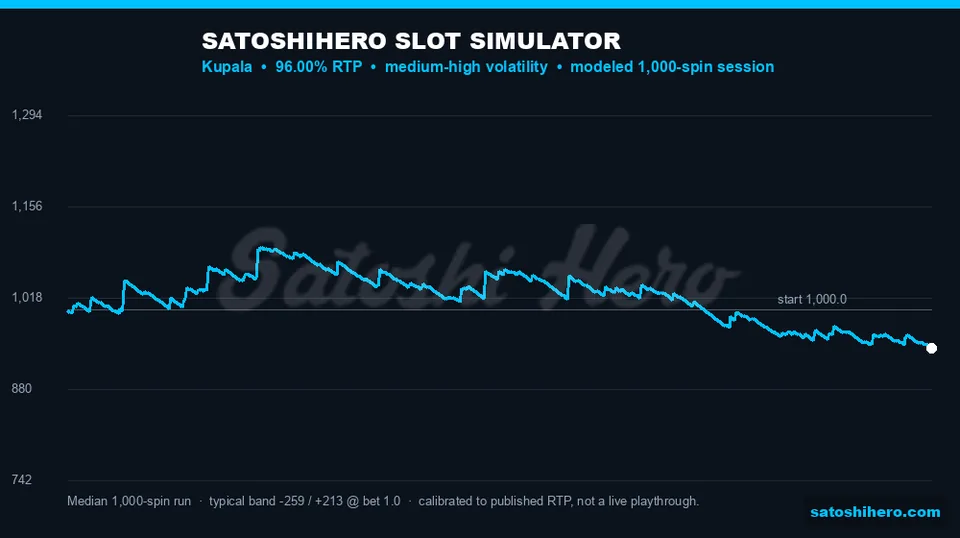
That broad range shows how sharply sessions can separate. You could finish well above the median or far below it without changing the stake. The model doesn’t reproduce Spinomenal’s random number generator, and it can’t predict your next session. I see it as a pressure map, not a forecast.
A blue balance line can make one simulation look like a likely journey. It isn’t. You should read the line as one possible path among many, while the range carries the more useful message. The 100x frequency also shows why a short demo may never display the upper end.
Our 100-Spin Session
I began with $5,000 and played 100 spins at $1 each. My balance ended at $4,948.45 after $100 staked and $48.45 returned, leaving me 51.55x down. Only 19 spins paid. The session never climbed above its starting balance.
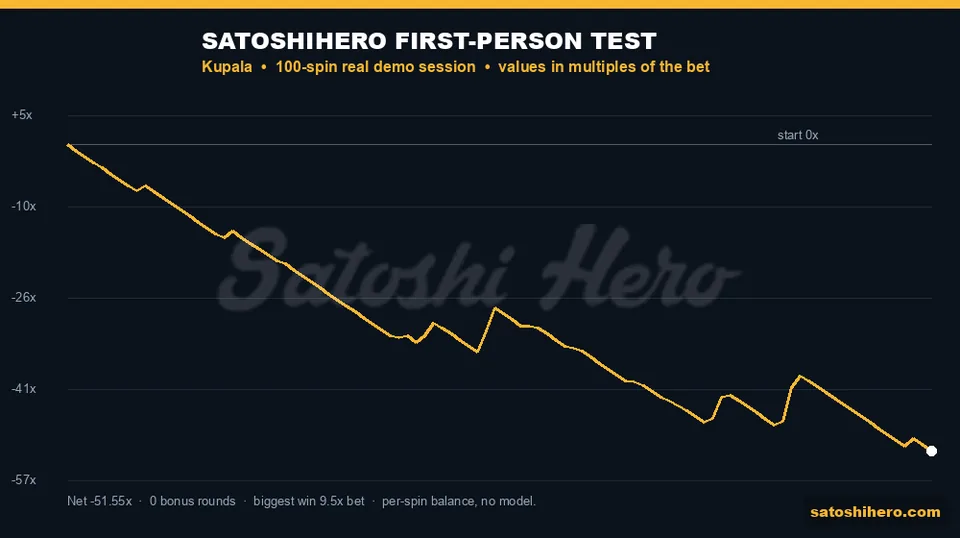
My high point was $4,999 after spin one, while the final balance also marked the low. Five wins paid below 1x, ten landed between 1x and under 3x, and four reached at least 3x. Spin 49 led with $9.50, or 9.5x, through nineteen candle-wreath combinations across the 100 fixed paylines supported by three Wild positions. You can see why one busy result failed to erase the surrounding losses.

Proceed Carefully: Medium-high volatility can cause sustained drawdowns, so don’t treat theoretical RTP as a promise for one session.
The 96% theoretical RTP comes from the operator’s published game information. One 100-spin session neither changes nor verifies that figure, and the simulator uses its stated inputs rather than the internal RNG. Any feature-specific return would differ from base play by design, though this game has no purchasable feature. I think the sample demonstrates short-session risk more honestly than a single headline percentage.
Session Pace and Bankroll Pressure
My test moved through long dry sequences, then briefly woke up with clusters of overlapping lines. The longest winless run lasted 13 spins, covering spins 26 through 38. Another 12-spin drought stretched from spin 86 through spin 97. You need a stake that leaves room for both patterns without forcing a reaction.
Spin 49 interrupted the slide with $9.50 from nineteen candle-wreath combinations across the 100 fixed paylines. Spin 84 returned $7.50 through 33 bonfire lines and nine K lines. Earlier, spin 42 paid $5.10 from 51 K lines. Those grids looked lively, but none lifted my balance above the original $5,000.
Many highlighted lines can combine into a modest total because low symbols pay little per path. You may feel that a crowded win should recover more. I found that mismatch frustrating during the second half.
A steady stake makes more sense than increasing bets after losses. Every spin remains independent, so a 13-spin drought doesn’t make the next result more likely to pay. You should choose the stake before starting, then keep it unchanged through both quiet and active stretches. Chasing the balance would only expose more money to the same uneven rhythm.
The $5,000 demo balance lets you observe that pressure without risking real funds. Try enough spins to see how often line clusters interrupt the empty rounds. In my view, the demo reveals the game’s temperament faster than the paytable does. Calm bankroll control fits this pace better than emotional stake changes.
Who Will Enjoy Kupala?
The Kupala slot fits classic payline fans who value immediate cash awards and folk-inspired visuals. You may enjoy it when many small lines combining into one total feels more engaging than waiting for a bonus. Base-game purists get an uncluttered loop with readable outcomes. I think that focused design is the game’s clearest strength.
Three other Spinomenal games on SatoshiHero provide useful comparisons: Wildfire Fruits, Wild Penguin, and Wacky Monkey.
Traditional left-to-right paylines should also appeal if you like checking exactly why a spin paid. Stacked Wilds add breadth without changing the rules, while anywhere-paying Scatters break the line pattern for direct cash. You must still accept medium-high volatility and occasional non-paying runs. The 13-spin drought in my sample shows that simplicity doesn’t mean gentle play.
Feature-focused players face a weaker match. You won’t find free spins, retriggers, progressive mechanics, or escalating multipliers. Anyone seeking potential far beyond 1,000x may also find the ceiling restrictive. I wouldn’t choose this game for spectacle after seeing how quickly its loop repeats.
The game is playable in demo and real mode on SatoshiHero. I compare its details against the playable version during editorial checks. You can use the demo to decide whether the woodland theme and overlapping line totals hold your attention.
Choose this traditional line game for its direct structure, not for hidden depth. If you know that difference before spinning, its narrow focus becomes easier to judge fairly.
Frequently Asked Questions About Kupala
What are the RTP, volatility, and maximum win in the Kupala slot?
The Kupala slot uses the game settings explained above on a 5×4 grid with 100 fixed paylines. Its prize ceiling applies to the total bet, and short sessions can finish far from the theoretical return. You should treat the stated figures as game settings rather than a prediction for your play.
Does the Kupala slot have free spins or a bonus buy?
No. The Kupala slot has no free spins, bonus game, or buy feature. Its gameplay consists entirely of line wins, stacked Wilds, and anywhere-paying Scatters, so you won’t unlock a second mode.
What does the Scatter pay in the Kupala slot?
Three Scatters pay 2x, four pay 25x, and five pay 250x from any positions. I landed three on spins 39, 83, and 85, with each appearance returning $2 at a $1 total bet.
How does the Wild work in the Kupala slot?
The Wild replaces every regular symbol except the Scatter and may land in tall stacks. Five Wilds on one line pay 10x, while three Wild positions supported my strongest spin’s nineteen candle-wreath combinations across the 100 fixed paylines.
What did the 1,000-spin Kupala slot simulator project?
The median modelled session ended 58.7x down. The middle 90% ranged from 258.8x down to 213x up, 21% of modelled spins paid, and a 100x result appeared roughly once per 3,788 spins.
What happened during my 100-spin Kupala slot test?
My balance fell from $5,000 to $4,948.45 after $100 in total bets. Nineteen spins paid, the strongest returned 9.5x on spin 49, and the longest winless run lasted 13 spins.
Final Take
Kupala stands out through its dark folk setting and unusually clear 100-line structure. Its main drawback is equally plain: no bonus mode breaks the repetition, while the 1,000x ceiling feels restrained for the risk.

My Read
Classic line-game fans should try the demo and expect clusters of modest overlapping wins between dry runs. Feature hunters won’t find enough variety here, and disciplined stakes matter more than chasing a dramatic trigger.
I liked how three Wild positions turned spin 49 into nineteen separate candle-wreath combinations across the 100 fixed paylines. I didn’t like that the $9.50 result still left the session sliding, especially after repeated empty stretches. The screen looked more generous than the balance felt.
This Kupala slot guide is checked regularly against the playable version.

Pros:
 Readable line math: Highlighted paths explain how every combined award forms.
- Distinct folk art: Forest, wreath, and fern symbols give the base game personality.
- Useful stacked Wilds: Tall stacks connect many low-value lines in one spin.
- Direct Scatter cash: Anywhere-paying symbols add value without complicated trigger rules.

Cons:
 No bonus mode: Repeated base spins can feel stale during long droughts.
- Modest prize ceiling: The cap looks conservative beside the uneven risk.
- Busy modest wins: Numerous highlighted lines can return less than their presentation suggests.

Best For: Traditional payline fans who enjoy clear math, Slavic folk imagery, and immediate cash results get the strongest match. You should also feel comfortable managing dry runs without raising your stake.



































































Bets
All Bets
Game
Player
Date
Wager
Mult.Multiplier
Prize
 Galaxy Glitter
 Hidden
- 09:03:48
- 0×
- Galaxy Glitter
- nina87
- 09:03:46
- 0×
- Galaxy Glitter
- Hidden
- 09:03:45
- 0×
- Almighty Diamonds: Hold 'N' Link
- josh1998
- 09:03:43
- 0×
- Galaxy Glitter
- Hidden
- 09:03:42
- 0×
- Royal Fruits 9: Hold 'n' Link
- mike_721
- 09:03:42
- 0×
- Buffalo Smash: Supercharged
 Hidden
- 09:03:41
- 0×
- Buffalo Smash: Supercharged
- Hidden
- 09:03:41
- 8×
- Galaxy Glitter
- Hidden
- 09:03:39
- 0×
- Galaxy Glitter
- Hidden
- 09:03:36
- 0×