

Razor Shark
By pressing play, you agree that you are above legal age in your jurisdiction and that your jurisdiction allows online gambling.

Razor Shark
RTP95.05%
VolatilityHigh
Max winx85,475
Lines20
ThemeUnderwater world
Live game stats
Real RTP38.72%
Spins1,008
Players1
Biggest win$10.18

Diving Into a Wreck Full of Hungry Sharks
Razor Shark drops you into a high-risk underwater hunt driven by Mystery Stacks, nudges, and Golden Shark reveals.
Push Gaming built Razor Shark as a high volatility slot with 96.7% RTP and 85,475x max win potential. Its 5×4 grid uses 20 fixed paylines and targets players comfortable with dry spells and highly uneven features. My 100-spin session finished 45.9x down, and its only Shark Bonus returned $0.00. The demo used play money, and changing the stake changed the reel symbols. You can play free or for real on SatoshiHero.
Key takeaways
- Best starting point: Use the Razor Shark free demo to learn how Mystery Stacks move before risking your bankroll.
- RTP / volatility: The game combines 96.7% theoretical RTP with high volatility.
- Max win: The payout ceiling reaches exactly 85,475x the bet.
- Risk note: My 100 spins ended 45.9x down, while 13 of 27 paying spins returned less than my stake.
- Bankroll note: You should use smaller stakes because the simulator’s median 1,000-spin result finished 64.8x down.

Table of Contents
- How Razor Shark Works
- Understanding the reel layout
- Reading the winning lines
- Symbols and payout values
- Comparing the shark symbols
- Dive gear and scatters
- Theme and first impressions
- Exploring the underwater setting
- Changing the bonus atmosphere
- Mystery Stacks and Nudge and Reveal
- Landing a Mystery Stack
- Following the nudge cycle
- Razor Reveal
- Adding the coin values
- Resolving the scatter outcomes
- Shark Bonus Free Games
- Starting the bonus round
- Building the win multiplier
- What happened over 100 spins
- Wins and dry spells
- Explaining the session interruption
- RTP, volatility and our test
- Reading the simulator projection
- Comparing my live session
- Frequently Asked Questions
- Final Verdict
How Razor Shark Works
Razor Shark uses five reels, four rows, and 20 fixed paylines paying left to right across adjacent reels. Only the highest combination on each line pays, so you shouldn’t read this as a cluster, Megaways, or pay-anywhere game.
Three or more Sea Mine scatters can trigger the Shark Bonus from any grid positions. The Wild Shark replaces every regular symbol, but it can’t replace that scatter. You can read the browser game clearly on supported desktop and mobile screens, though the compact layout feels sharper on a wider display.
My test began in demo mode with play money and a default $0.50 stake. Changing that stake changed the symbols displayed on the reels, so you should check both the amount and visible layout before spinning. Razor Shark online offers free-demo and real-play modes through SatoshiHero, but learning the line pattern first is the sensible route.
Understanding the reel layout
The 5×4 grid places four visible positions on each reel inside a rusted frame. Your stake sits below the board, while the paytable explains each shark, dive-gear symbol, wild, and scatter. I found the screen uncluttered, although the changing symbol presentation deserves attention whenever you adjust the stake.
Fixed lines matter because a matching sequence must start on reel one and continue without a gap. A shark on reels one, two, and four creates no three-symbol line win. You need to follow the marked route through adjacent reels rather than count matching icons anywhere.
Reading the winning lines
My clearest check came from three Orange Sharks on one active line. A $0.50 spin returned $0.75, exactly 1.5x the bet shown in the paytable. That modest hit looked more exciting than it paid, which captures the base game’s tendency to dress small returns brightly.
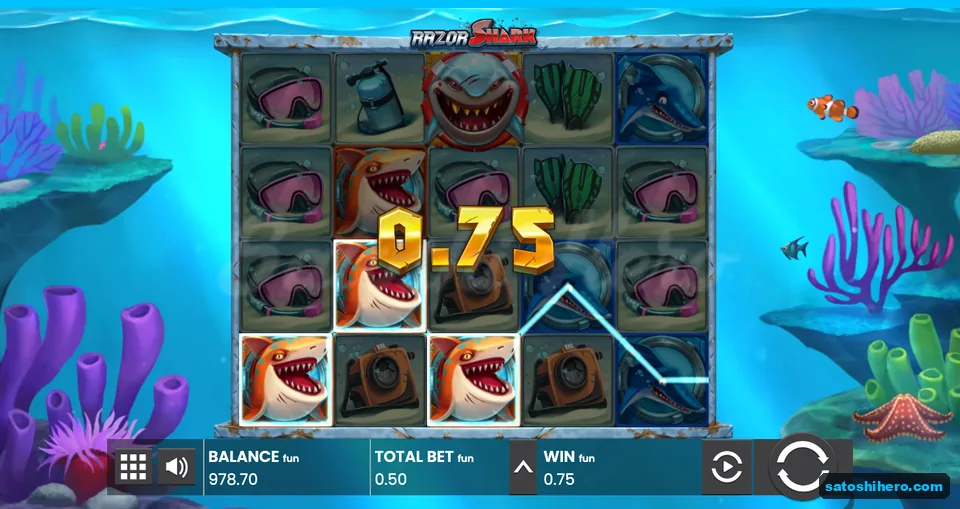
Scatters follow different logic because their positions don’t need to form a normal line. Regular combinations still settle through adjacent reels, and only their highest result counts on each line. Once you understand that split, feature outcomes become much easier to follow.

Key Stat: Three Orange Sharks paid 1.5x the bet during my test, matching the displayed paytable exactly.
Symbols and payout values
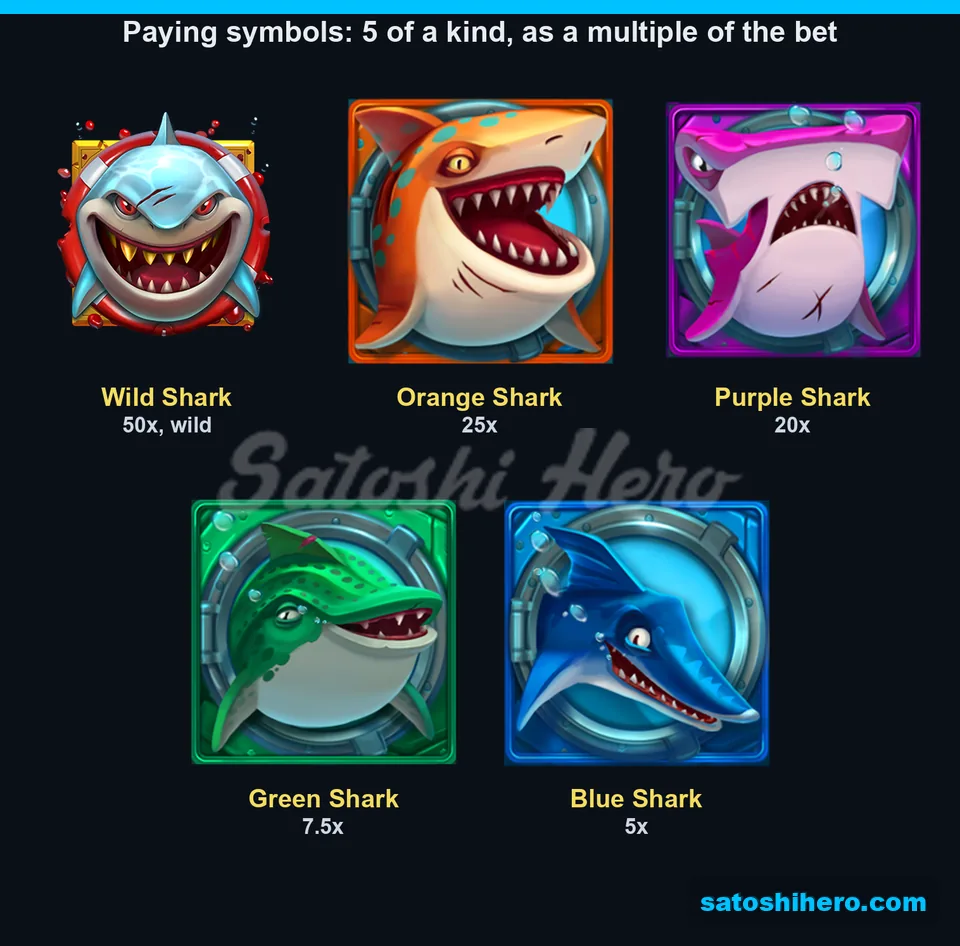
The Wild Shark is the strongest regular symbol, while four dive-gear icons share the lowest values. You should compare both value and frequency, since a shark symbol doesn’t automatically create a large return. I like the clear hierarchy, but the weaker three-symbol hits can make a busy board feel underpaid.
Comparing the shark symbols
The Wild Shark carries the biggest regular payouts and substitutes for every symbol except the Sea Mine. It pays 50x for five, 12.5x for four, and 2.5x for three. You get both replacement value and a standalone premium symbol, which makes it the one shark worth tracking first.
The remaining coloured sharks step down in a simple order:
- Orange Shark: 25x for five, 7.5x for four, and 1.5x for three.
- Purple Shark: 20x for five, 5x for four, and 1x for three.
- Green Shark: 7.5x for five, 2.5x for four, and 0.5x for three.
- Blue Shark: 5x for five, 2x for four, and 0.4x for three.
Dive gear and scatters
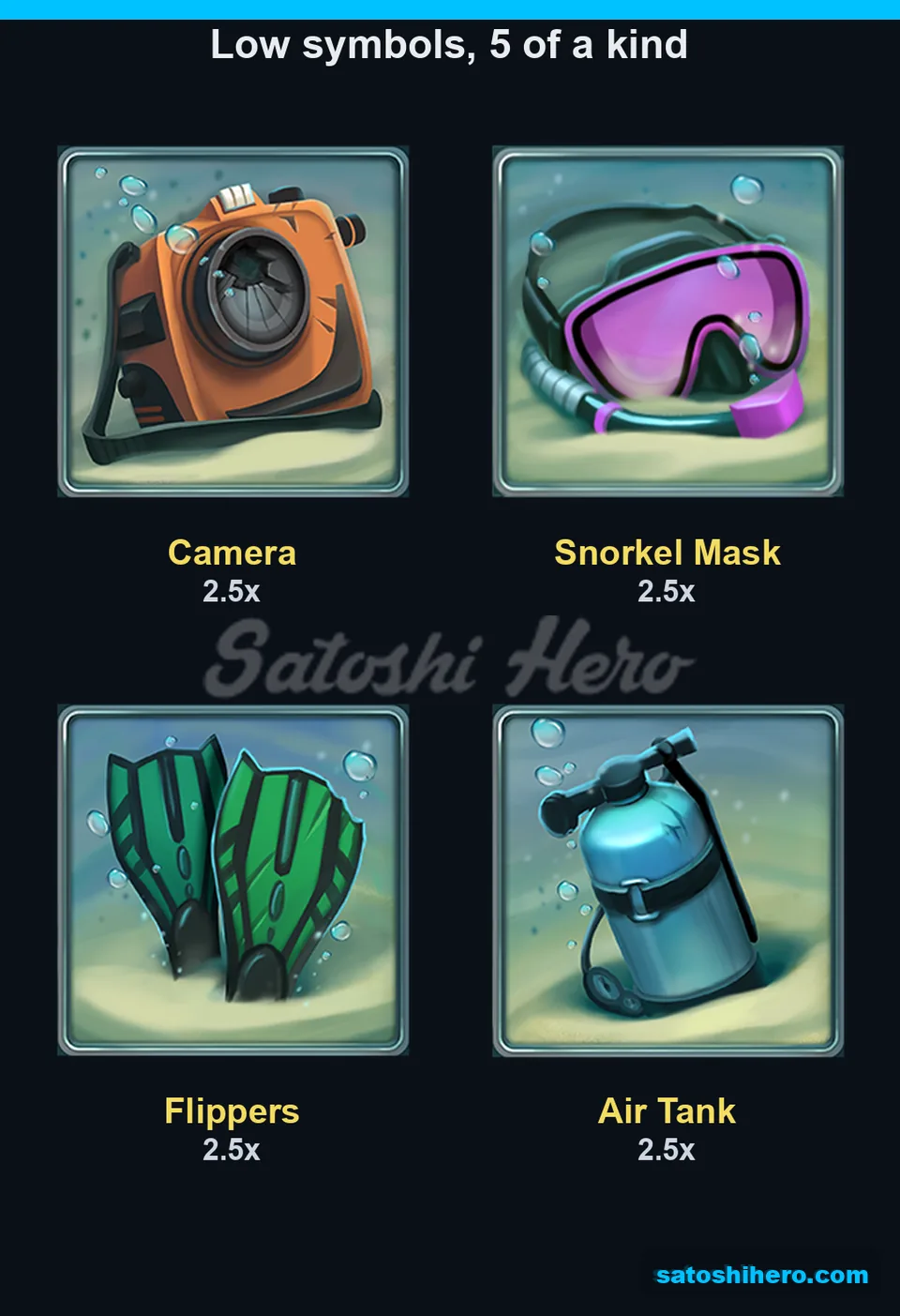
The camera, snorkel mask, flippers, and air tank carry identical low-symbol values. Each pays 2.5x for five, 0.5x for four, and 0.1x for three. Their equal pricing makes the bottom of the paytable easy to learn, though I find those 0.1x hits almost cosmetic.
The Sea Mine carries a BONUS marker and acts as the scatter. It activates features instead of behaving like a normal line symbol, so you should watch the whole grid for mines. This paytable has a clean premium-to-low structure, with no reason to confuse dive gear with feature symbols.
Theme and first impressions
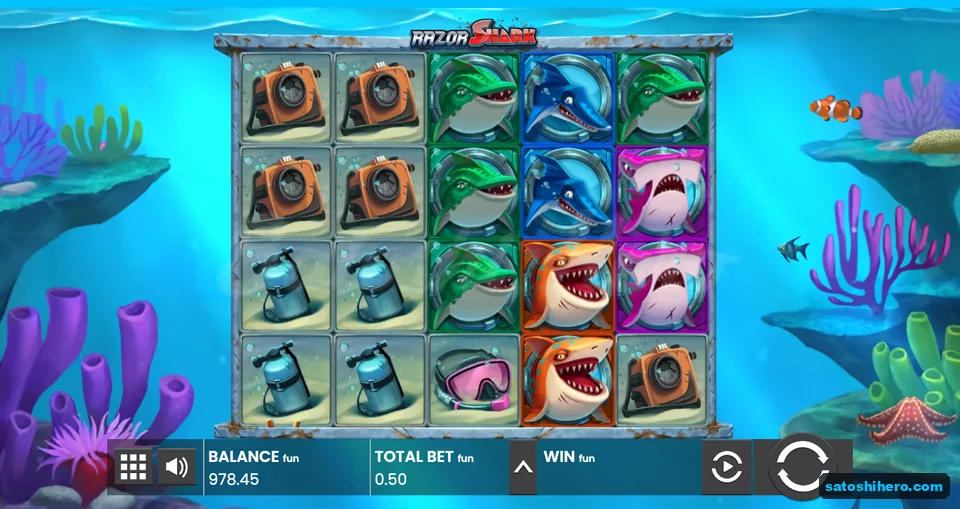
The game uses bright cartoon sharks around a sunken wreck, coral reef, and scattered diving equipment. You see five shark characters inside coloured portholes, all framed by a rusted metal plate. The theme won’t win originality awards, but its wreckage gives the familiar shark idea a coherent home.
Exploring the underwater setting
Open water and a sunlit reef sit behind the base-game reels. Rust, broken plating, and portholes suggest that the grid belongs to the wreck rather than floating over a generic ocean. You can separate premium symbols quickly because each shark has a distinct colour and frame.
The camera, snorkel mask, flippers, and air tank keep every low symbol tied to diving. I prefer that consistency over card ranks, since you never leave the underwater setting. Shark Wash offers another cartoon-shark presentation, while this game leans harder on wreckage, diving gear, and moving stacks. Compare its theme with Pool Shark, Hot to burn, and Journey to the West.

Insight: The five shark symbols sit inside coloured portholes built into a rusted wreck frame, tying the cast directly to the underwater theme.
Changing the bonus atmosphere
The Shark Bonus moves from bright open water to a dark ocean floor. That visual shift tells you the pace has changed before any multiplier starts building. I think the deeper backdrop works well because it makes every remaining Mystery Stack easier to monitor.
Darker water also gives the Sea Mines and Golden Sharks more visual weight. You should still watch the stack positions rather than let the scenery distract you. The contrast is practical as well as decorative, helping you recognise the bonus state instantly.
Mystery Stacks and Nudge and Reveal
A Mystery Stack holds four symbols and starts Nudge and Reveal whenever it lands on a reel. The stack can expose regular paying icons or Golden Sharks, and each result follows a different path. You need to watch the stack’s remaining positions because one landing can shape several consecutive spins.
Landing a Mystery Stack
A four-position Mystery Stack can appear on any reel. Standard symbols create matching left-to-right payouts, while Golden Sharks launch Razor Reveal instead of paying as ordinary icons. I like that clear fork, though the closed stack gives you no useful clue about which outcome sits underneath.
Existing line wins also count when a standard-symbol stack opens. This means you should read the full board, not only the newly revealed positions. Sea Mines can connect the stack sequence to the Shark Bonus, while extra mines can alter how long that feature lasts.
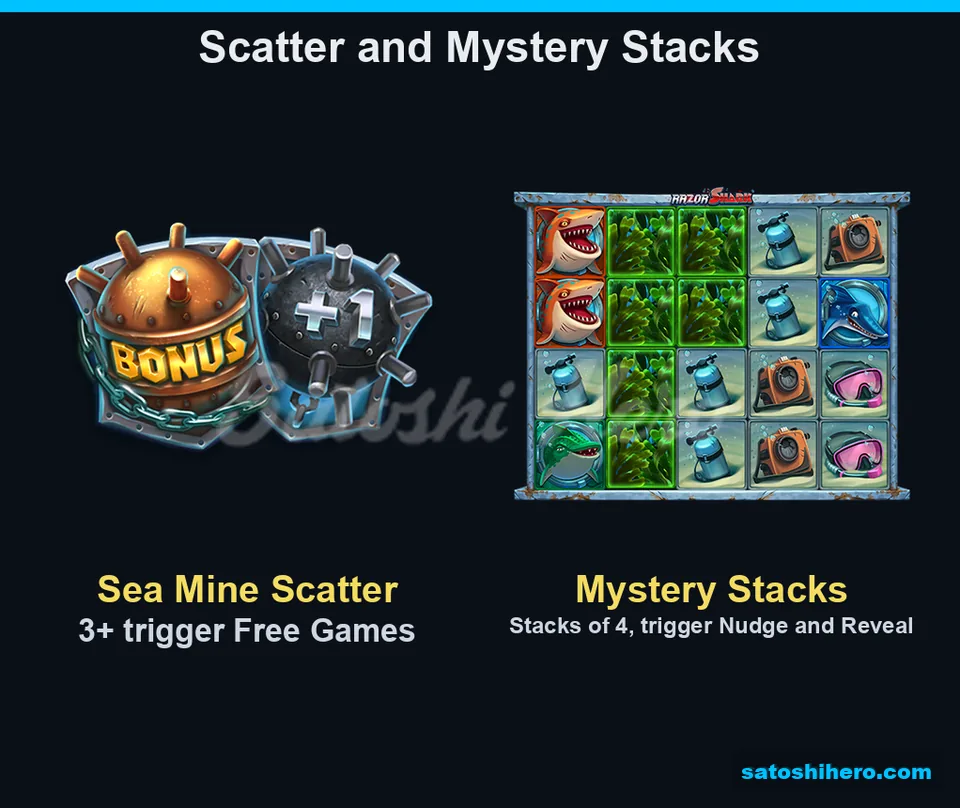
During Free Games, reels two and four begin filled with Mystery Stacks. Those starting columns create the round’s open-ended structure, since the feature continues while any stack remains visible. You should track both columns separately because their remaining heights can differ after nudges.
Following the nudge cycle
After standard symbols appear, all matching line wins pay alongside combinations already present. On the next spin, the stack moves down one position while every other reel spins normally. The cycle repeats until the final part drops below the grid, which feels more engaging than a one-spin mystery reveal.
Watch the bottom edge of the reel to judge how much of the stack remains. A visible section means another nudge step can follow, but it doesn’t promise another win. In my view, this mechanic creates better tension than the ordinary line payouts, even when its rewards stay small.
Razor Reveal
Razor Reveal starts when a Mystery Stack opens to show Golden Sharks. Every stack position then spins independently and lands either a Bet Multiplier Coin or Sea Mine scatter. You can get several low coins or a far stronger total, but the large printed values shouldn’t shape your expectations.
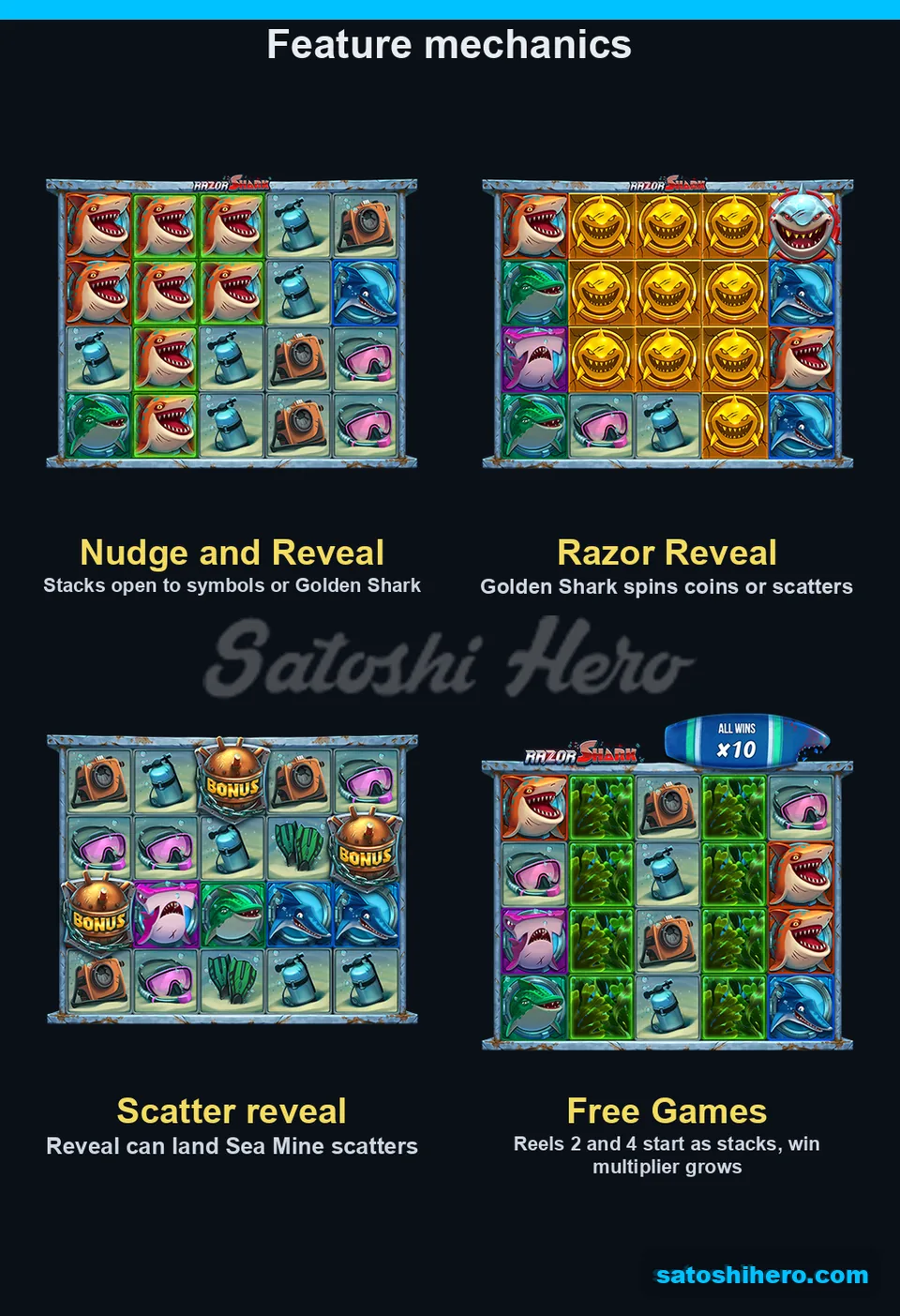
Adding the coin values
Bet Multiplier Coins can show 1x, 2x, 5x, 10x, 25x, 50x, 100x, 250x, 500x, 1,000x, or 2,500x your bet. After every position stops, the game adds all coin values and pays the completed total. I like the transparent addition, since you can verify the reward without decoding a separate paytable.
A single position can show 2,500x, yet smaller values can fill the reveal. The numbers suggest enormous upside, but they don’t describe how often any particular coin appears. You should treat the top coin as a possible outcome rather than a practical session target.
Resolving the scatter outcomes
Three Sea Mine scatters inside Razor Reveal start Free Games after existing wins settle. Every extra scatter adds one Free Game and nudges Mystery Stacks upward by one position. If three scatters already landed outside the stack, the reveal can only add scatters carrying the extra-spin effect.
Inside Free Games, Razor Reveal produces coins and scatters that nudge stacks one position. Coins create the immediate payout, while scatters change the round’s remaining structure. You should value an extra nudge for its extension potential, but it still can’t guarantee another paying event.
Starting the bonus round
The game announces the feature as unlimited free spins with increasing multipliers. “Unlimited” describes an open-ended stack system rather than endless play. The round continues only while at least one Mystery Stack remains visible, so you must monitor those columns instead of expecting a fixed counter.
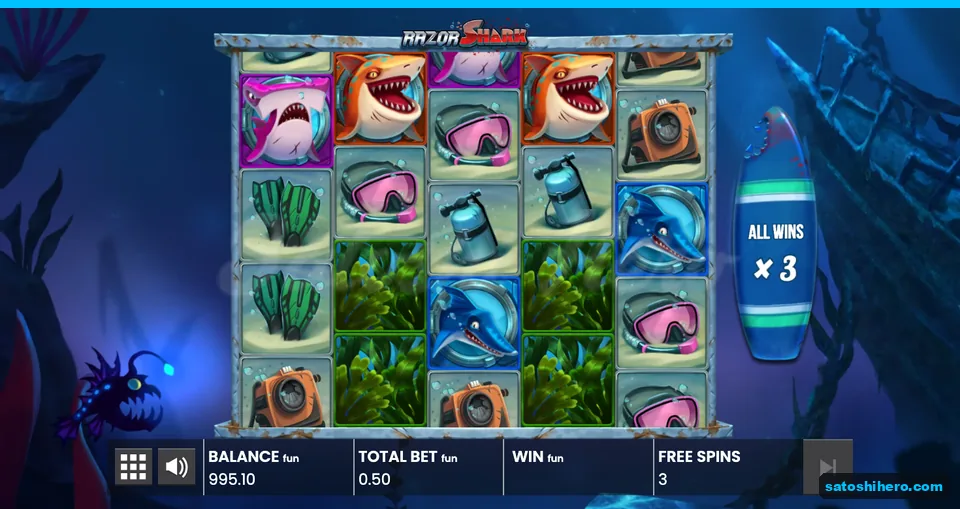
Extra scatters can raise the stacks and add one Free Game apiece. Reels two and four already begin full, creating two potential paths through the nudge sequence. I find this setup exciting in theory, but my empty return exposed how quickly the promise can collapse.
Building the win multiplier
The all-wins multiplier begins at 1x and applies to every bonus payout. Each Nudge and Reveal activation raises it, giving later wins more weight if the stacks stay visible. The round ends when no Mystery Stacks remain on screen, regardless of how little it has returned.
My feature finished at $0.00 despite that increasing-multiplier structure. No useful win arrived for the multiplier to improve, so the mechanic never rescued the round. I don’t like how unrewarding that felt, but the outcome gives you a more honest picture than a highlight reel.


Strategy Insight: Use the Razor Shark free demo to watch a complete nudge cycle before playing for real. Remaining stacks control the ending, not a familiar fixed counter.
What happened over 100 spins
My 100-spin session finished 45.9x the bet down despite recording 27 paying spins. I used the default $0.50 stake, with autoplay handling most rounds. You might expect a 27% observed hit count to feel active, but almost half those wins returned less than my stake.
Wins and dry spells
The balance peaked 4.9x up after spin 20. That same spin delivered my largest hit, worth 15.2x the bet or $7.60. I liked the early lift, though one decent result couldn’t offset the weaker stretches that followed.
Thirteen of 27 paying spins returned below $0.50. Those outcomes slowed the decline without reversing it, which made the game feel colder than the hit count suggests. You can see frequent win animations while your balance keeps falling, a crucial distinction when reading slot statistics.
My longest dry spell ran from spin 65 through spin 73, covering nine consecutive losses. The final spin marked the session’s lowest balance, 45.9x below its starting point. You should allow room for both empty spins and sub-stake wins because either pattern can sustain a downswing.
The Shark Bonus landed once on spin 42 and returned $0.00. That feature result hurt more than the dry run because the trigger created a stronger expectation. In my opinion, the session’s toughest lesson was that access to the bonus and value from the bonus are separate events.
Explaining the session interruption
A Serialization error appeared on the attempted 31st spin and removed that spin’s result. I excluded it from every total, reloaded the game, and recorded 70 further spins in a new session. You get a transparent 100-spin trace because I carried the running balance into the second part.
The graph joins both recorded segments without treating the unresolved spin as a win or loss. That error isn’t evidence about normal slot performance, so it doesn’t belong in hit-rate or balance calculations. I think excluding it provides the cleanest account of what I could actually verify.
RTP, volatility and our test
The 96.7% theoretical RTP sits beside high volatility and an 85,475x maximum win. That cap looks enormous, but you shouldn’t treat it as a practical target for ordinary play. I consider stake size more important than chasing a remote top-end result.
Reading the simulator projection
The SatoshiHero Slot Simulator used a stake normalized to 1x, a 1,000-spin session, and the published game inputs. Its median session finished 64.8x down. You should read that central result alongside the full spread, since one midpoint can’t describe this slot’s wide range.
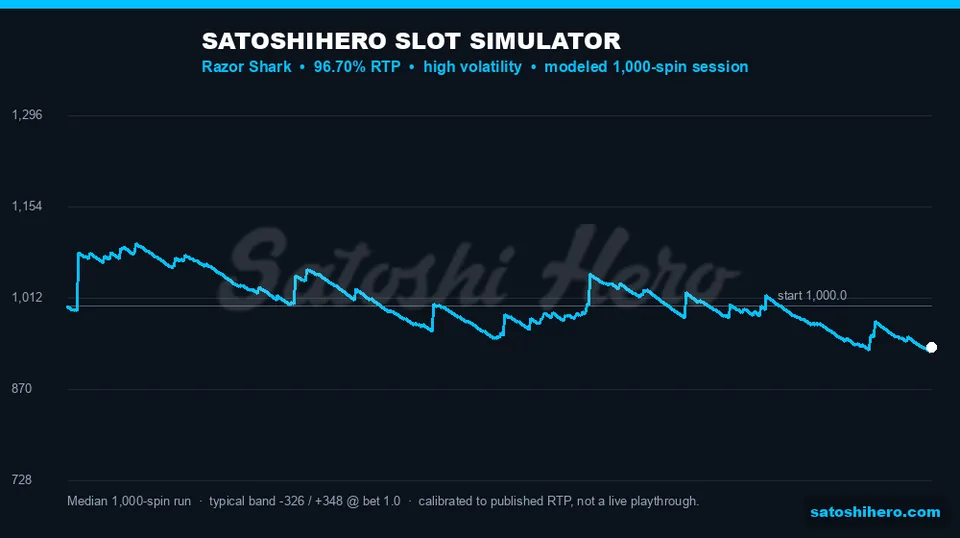
The fifth percentile finished 325.6x down, while the ninety-fifth percentile ended 348.4x up. About 18% of simulated spins paid, and a feature tier appeared roughly once every 45 spins. A win worth at least 100x appeared roughly once every 1,618 spins, highlighting how sparse larger events can be.
The model can’t predict your next session, the live random-number generator, or any result’s timing. It maps possible outcomes from the stated inputs rather than issuing a countdown. I find the percentile band more useful than the median because it shows how far two sessions can separate.
Comparing my live session
My 100 spins finished 45.9x down and produced 27 paying rounds. Thirteen returns fell below the stake, the balance peaked 4.9x up, and one bonus paid $0.00. You can see why a higher observed hit count didn’t deliver a better balance result.
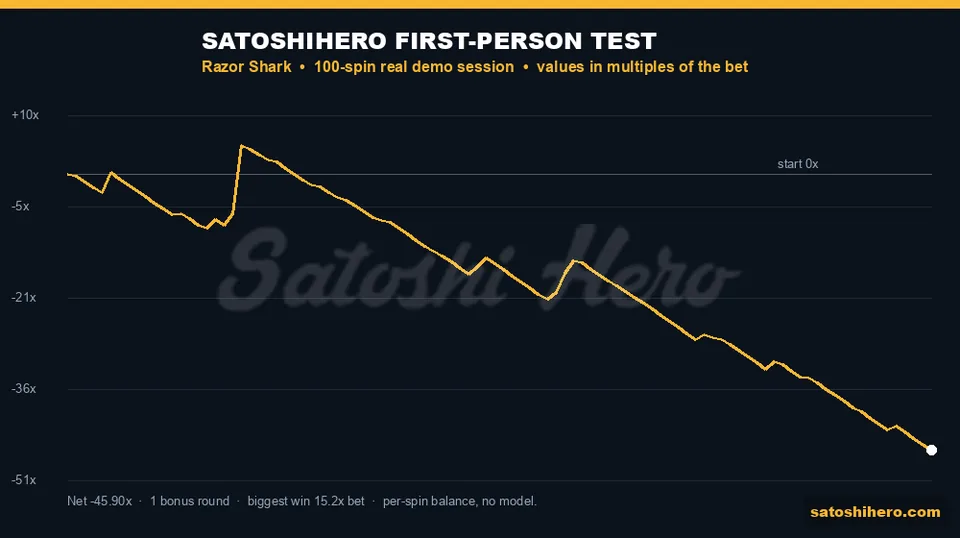
The live sample and 1,000-spin model aren’t equal datasets. My test records one short path, while the simulator projects a broader distribution from fixed inputs. I wouldn’t use either figure to time a feature, but together they show how small wins can coexist with a deep loss.

Warning: Severe swings can follow from this risk profile and huge ceiling. Reduce your stake, set a firm loss limit, and don’t chase a bonus after a losing run.
The theoretical RTP is the operator’s published return figure, and one live session doesn’t alter it. Simulator values remain projections rather than outcomes from the live random-number generator, while feature-specific returns can differ slightly from base play by design.
Frequently Asked Questions
What triggers the Free Games in Razor Shark?
Three or more Sea Mine scatters anywhere trigger the Shark Bonus. Three scatters inside Razor Reveal also start it after current wins settle. Each extra scatter adds one Free Game and nudges the Mystery Stacks upward.
How does the Razor Shark Free Games multiplier work?
The all-wins multiplier starts at 1x and rises whenever Nudge and Reveal activates. The round continues while at least one Mystery Stack remains visible. No fixed spin count guarantees a particular feature length.
What are the Bet Multiplier Coins in Razor Reveal?
Golden Sharks start Razor Reveal, where each stack position lands a coin or scatter. Values are 1x, 2x, 5x, 10x, 25x, 50x, 100x, 250x, 500x, 1,000x, and 2,500x. The game adds every landed coin and pays the combined total.
Which RTP and maximum win does Razor Shark have?
Razor Shark has 96.7% theoretical RTP, high volatility, and an 85,475x maximum win. The game uses a 5×4 grid with 20 fixed paylines. These figures don’t guarantee your result from one session.
How did my 100-spin Razor Shark test go?
I finished 45.9x down after 27 paying spins, with a 15.2x biggest win. The balance peaked 4.9x up, while my only Shark Bonus paid $0.00. This single test shows variance rather than predicting future play.
What did the 1,000-spin Razor Shark simulator show?
The median result finished 64.8x down. Its percentile band stretched from 325.6x down to 348.4x up, and about 18% of simulated spins paid. That projection can’t predict the next live result.
What does the Wild Shark do?
The Wild Shark substitutes for every symbol except the Sea Mine scatter. It pays 50x for five, 12.5x for four, and 2.5x for three. You can inspect those values through the free demo on SatoshiHero.
Final Verdict
Razor Shark stands out through moving stacks, branching reveals, and an unusually open-ended bonus structure. Its main drawback is simple: feature access can still produce no return, as my test showed. You need patience and strict stake control here.

My Take
The shifting stacks create genuine tension, and the coin-or-scatter reveal gives each feature several possible paths. Play the demo first, then keep real stakes small enough to absorb weak wins and long balance declines.
I like how the nudge cycle makes consecutive spins feel connected. What I don’t like is that my only bonus returned $0.00 after 42 spins of waiting. The 27 paying rounds also sounded far healthier than the final balance looked.
Razor Shark remains compelling for readers who value layered mechanics over steady returns. Its mechanics and key game information are checked regularly, so you can assess the risk with clear figures.

Pros:
 Layered stack system: Nudges connect multiple spins and keep feature progress visible.
- Clear paytable: Distinct symbol tiers make every line result easy to verify.
- Branching reveal: Coins and scatters create several outcomes from one Golden Shark stack.
- Strong visual contrast: Dark bonus scenery clearly separates feature play from base spins.

Cons:
 Punishing bonus variance: My only Shark Bonus returned nothing after a long wait.
- Weak paying spins: Nearly half my wins returned less than the stake.
- Misleading activity: Frequent animations can hide a steadily falling balance.

Best For: Patient high-variance players who enjoy tracking persistent stacks get the clearest appeal. You should prefer layered feature mechanics over regular payouts and accept that a bonus can return nothing.











Other Push Gaming Games






















































Bets
All Bets
Game
Player
Date
Wager
Mult.Multiplier
Prize
 Royal Fruits 9: Hold 'n' Link
 Hidden
- 00:20:59
- 0×
- Galaxy Glitter
 nina87
- 00:20:55
- 0×
- Royal Fruits 9: Hold 'n' Link
- Hidden
- 00:20:53
- 24.99×
- San Chong Baozha Blue: Bonus Combo
 mdp0fxo
- 00:20:51
- 0×
- Elephant's Gold: Bonus Combo
- Hidden
- 00:20:50
- 0.49×
- Wild Buffalo: Megaways
- mike_721
- 00:20:49
- 0×
- Royal Fruits 9: Hold 'n' Link
- Hidden
- 00:20:49
- 0×
- Galaxy Glitter
- nina87
- 00:20:46
- 4.8×
- Royal Fruits 9: Hold 'n' Link
- Hidden
- 00:20:46
- 0×
- Royal Fruits 9: Hold 'n' Link
- Hidden
- 00:20:45
- 0×