

Goat Getter
By pressing play, you agree that you are above legal age in your jurisdiction and that your jurisdiction allows online gambling.


Chasing the Goat Through a Forest of Cascades
Goat Getter is a Push Gaming slot built around cascading pay-anywhere wins, coin pots and a Goat-led Free Spins feature.
Goat Getter has a 96.44% RTP, medium-high volatility and 10,000x maximum win potential. Six matching symbols pay anywhere on a 5×6 grid, giving cascade fans layered collection features and uneven sessions. You can play the game on SatoshiHero in demo or real-play mode; my 100-spin test lost 62.8x, despite four Coin Drops.
Key takeaways
- Best bonus: I tested standard $0.50 base play with Push Bet off, so no purchase earns a proven ranking.
- RTP / volatility: The theoretical RTP is 96.44%, paired with a medium-high volatility profile.
- Max win: The official maximum win reaches 10,000x the bet.
- Risk note: My 100 spins returned $18.60 from $50.00 staked, leaving a $31.40 loss.
- Bankroll note: Choose a stake that can absorb 14 losing spins and frequent sub-bet returns.

Table of Contents
- How Goat Getter Works
- Pay-anywhere cascades
- Symbols and values
- Theme and First Impressions
- Coin Drop Feature
- Observed pot results
- Push Bet Option
- Free Spins and Goat Meter
- Meter progression
- Gamble Wheel Choices
- Bonus Buy Menu
- RTP, Volatility and Our Test
- Simulator projection
- Our 100-spin session
- Frequently Asked Questions About Goat Getter
- Final Verdict
How Goat Getter Works
Six or more identical symbols pay anywhere across the 5×6 grid. You don’t need adjacent symbols or left-to-right alignment, and there are no fixed paylines or wild symbols.
Pay-anywhere cascades
Five pay bands cover groups of 6 to 8, 9 to 11, 12 to 14, 15 to 17, and 18 or more. Winning symbols vanish, the remaining icons fall, and replacements enter from above. Another qualifying group can then pay without charging you for another spin.
Watch the whole board after each clear, not just the area that produced the first win. Fresh symbols can complete groups in separate columns because position doesn’t matter. The 5×6 play area remains the core layout on desktop and mobile, so you read cascades the same way on either screen.
Spin 66 showed the mechanic at its busiest during my test. Five groups paid across its linked drops, producing $2.35, or 4.7x from my $0.50 bet. That sequence felt much better than the common one-group returns, although it still stopped short of a feature-sized result.
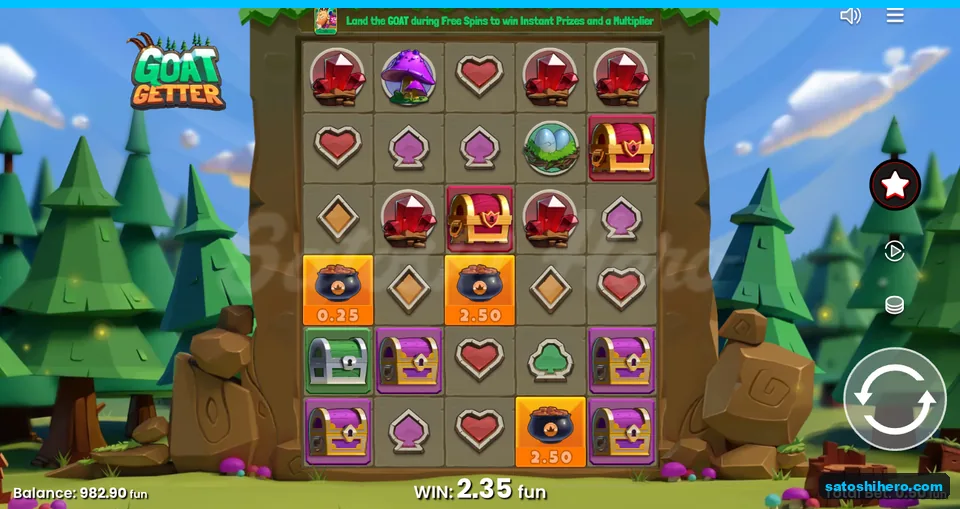
Tiki Tumble also appeals when you enjoy winning symbols clearing before another drop. Here, the broader pay-anywhere rule makes counting matching icons more important than tracing connected clusters. You should scan every symbol type after each fall, since six scattered matches qualify.
Symbols and values
The paytable uses bet multipliers, even though my selected stake displayed dollar amounts. High symbols rise sharply across the five listed bands. Red chests pay 5x, 30x and 500x for 6 to 8, 12 to 14 and 18 or more. Purple chests pay 3x, 20x and 300x, while green chests return 2x, 15x and 200x across those bands.
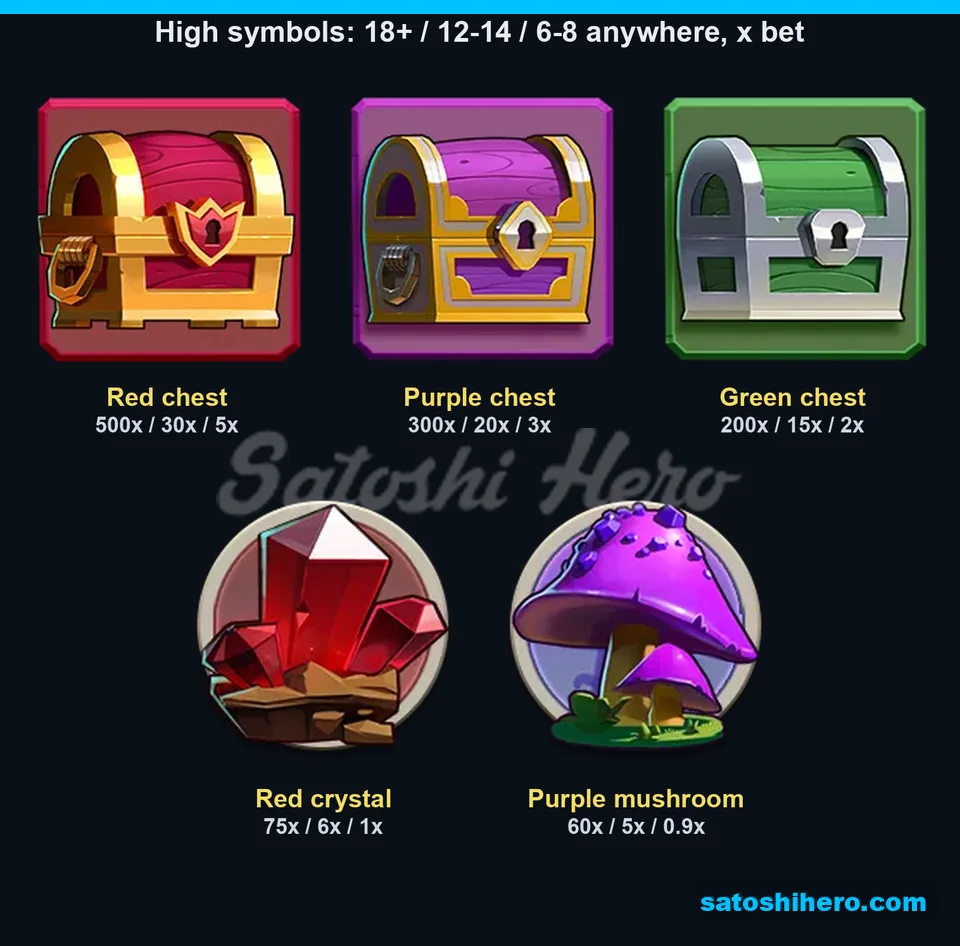
Red crystals pay 1x, 6x and 75x at the same checkpoints. Purple mushrooms return 0.9x, 5x and 60x. These upper icons carry the board’s real symbol potential, but you need unusually large groups before their top values matter.
Lower symbols pay less at each listed checkpoint. Egg nests return 0.8x, 4x and 45x; hearts pay 0.6x, 3x and 30x. Spades offer 0.5x, 2.5x and 25x, clubs give 0.4x, 2x and 20x, and diamonds pay 0.3x, 1.5x and 15x.
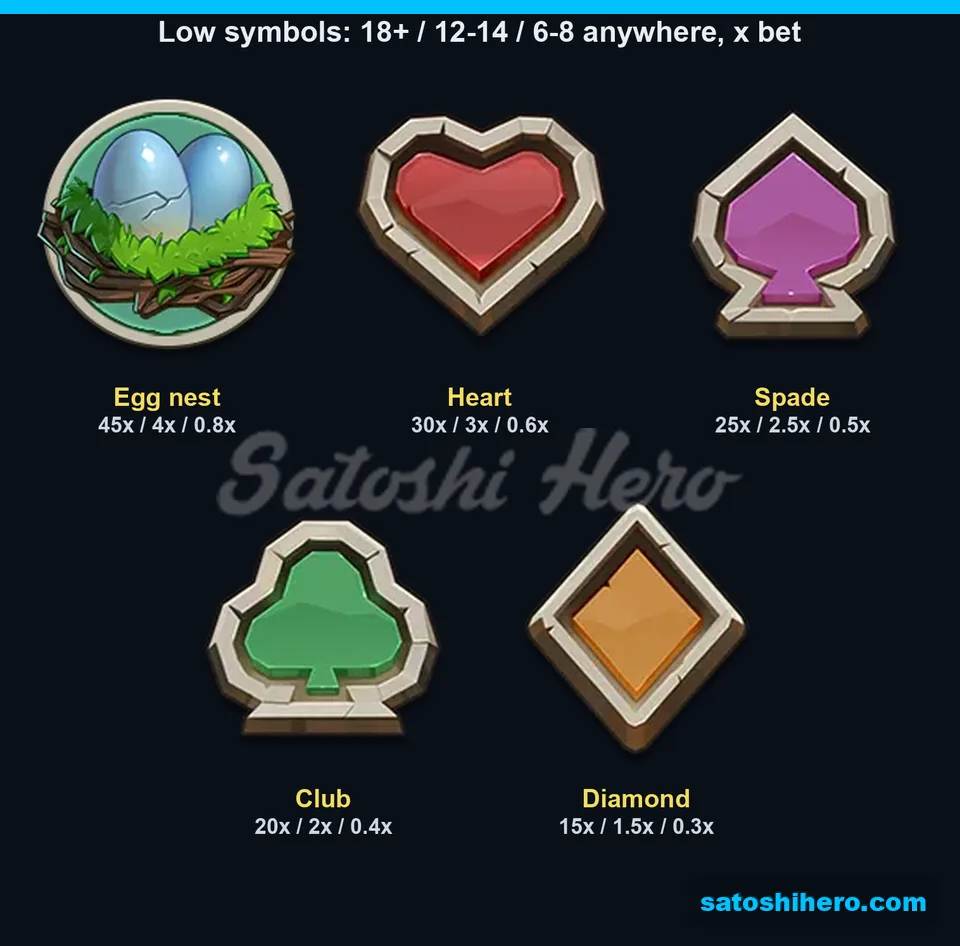
My test log matched those paytable values precisely. Seven diamonds returned $0.15, or 0.3x, while eleven hearts paid $0.60, or 1.2x. Small groups can look busy without moving your balance much, which I found slightly deflating during repeated low-symbol hits.
The purple Bonus badge acts as the scatter. Coin pots carry printed values but don’t form ordinary matching wins, while the Goat only collects pots during Free Spins. You should treat these special icons as feature components, not substitutes for a wild.

Key Stat: Goat Getter has no fixed paylines. Six or more matching symbols can pay anywhere on its 5×6 grid.
Symbol volume drives every base-game result, so count matches rather than looking for familiar line patterns.
Theme and First Impressions
A bright pine forest surrounds a moss-covered wooden grid and chunky boulders. You can read the crowded board quickly because thick outlines and bold colours separate each symbol.
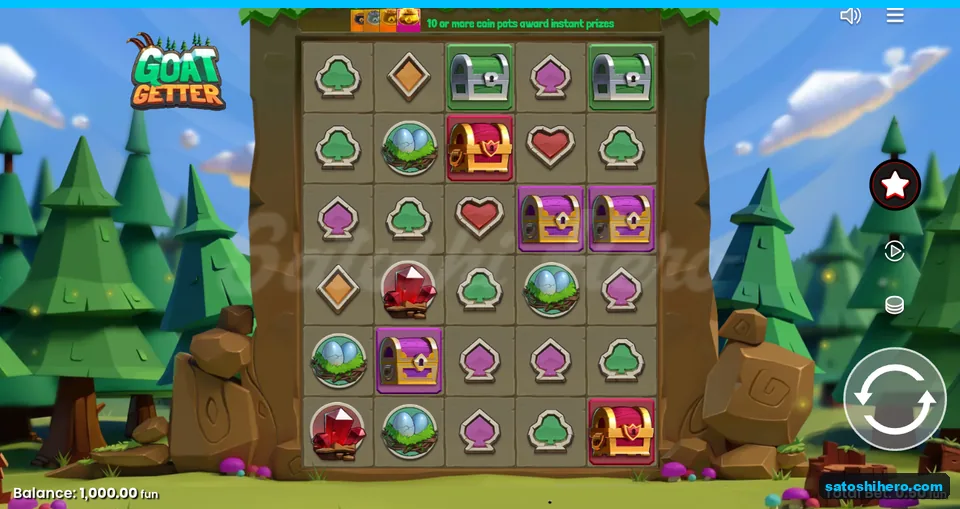
Treasure chests, a red crystal, a purple mushroom and an egg nest fill the upper visual tier. Stone-edged hearts, spades, clubs and diamonds cover the simpler values. The woodland idea won’t win originality awards, but its shapes stay clear when several symbols tumble together.
Gold and silver coin pots stand apart through their metallic rims and printed values. Purple Bonus badges draw your eye immediately, while the saddle-blanketed Goat looks distinct from everything else. That clarity helps you count feature symbols before the next drop changes the board.
You can see the full Goat Getter online presentation on SatoshiHero without losing detail around the grid. Shamrock Saints offers a stronger lucky-folklore identity, while this game keeps its fantasy lighter and more rustic. Samurai’s Katana offers another distinct theme for comparison. I prefer the practical contrast here because you rarely mistake a chest for a special symbol.

Insight: The Goat is the visual focus, but regular symbols mix woodland objects with treasure and stone-edged card suits.
Visual clarity matters more than the familiar forest concept, especially when you track several moving symbol groups.
Coin Drop Feature
Coin Drop starts when six or more coin pots remain after ordinary wins and cascades finish. You should count the pots first, because the total determines whether fixed awards or printed values apply.
Paying symbols clear before pots and Bonus badges fall to the bottom. Mystery Boxes then fill open spaces, revealing a dud stone, another pot or a Bonus symbol. New boxes keep arriving until no spaces remain or only duds appear, which gives the feature a pleasing reveal rhythm.
Six pots pay 0.5x, seven pay 1x, eight pay 2x and nine pay 4x. Ten or more pots activate every printed value, with individual pots ranging from 0.5x to 1,000x. Three revealed Bonus symbols can start Free Spins after existing wins finish.
Observed pot results
My recorded test triggered Coin Drop on four spins. Spin 25 reached eight pots and paid $1.00, while spins 39 and 59 each found six pots for $0.25. Spin 62 reached nine pots and returned $2.00 from the feature.
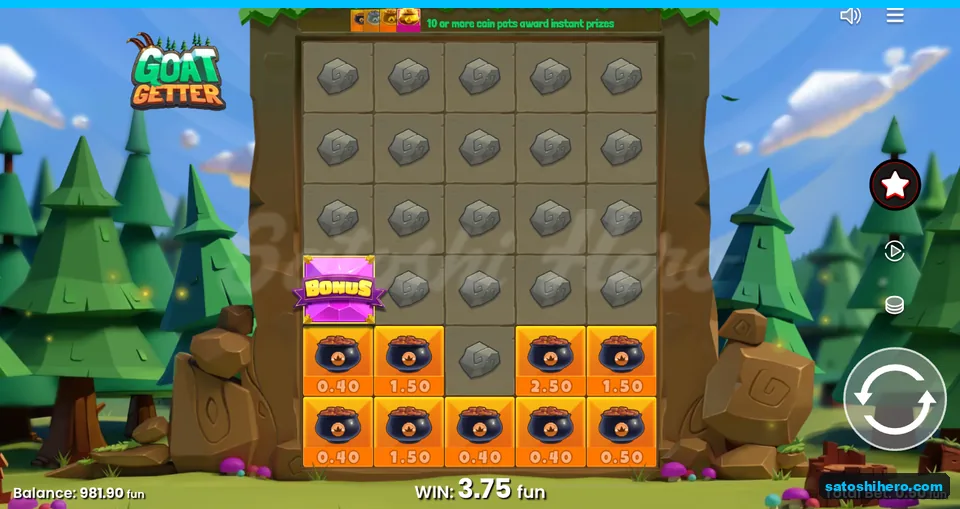
That last spin also included earlier mushroom, club, spade and egg-nest cascades. Its complete result reached $3.75, or 7.5x my $0.50 stake. I liked seeing pots often enough to understand the lower awards, but none of the four triggers activated printed values.

Strategy Insight: Don’t confuse the values printed on pots with guaranteed awards. Below ten pots, Coin Drop pays the fixed 0.5x to 4x pot-count award.
Visible values can tempt you to overrate a six-pot screen. Count before judging the result, since only ten pots or more unlock the stronger collection stage.
Push Bet Option
Push Bet adds 20% to your selected stake and improves the chance of reaching Free Spins. Ordinary prizes still use the base bet, so you must budget from the higher amount charged rather than the displayed base value.
You enable it through the bet panel, and you can’t disable it until the active round ends. I kept Push Bet off for all 100 recorded spins, which means my results support standard base play only. Any claim about its practical trigger improvement would go beyond my evidence.
The option can appeal when bonus access matters more than spin count. Still, paying 20% extra doesn’t secure three Bonus symbols, and I wouldn’t treat the surcharge casually during an uneven session.

Warning: The 20% surcharge exposes your balance faster. Set your session budget from the full Push Bet cost, not the displayed base stake.
Compare the added charge with your total budget before enabling it, because the test provides no measured value case for the upgrade.
Free Spins and Goat Meter
Three to five Bonus symbols award an initial package of 6 to 16 Free Spins. You get a defined range based on the trigger count, but the exact starting award still varies within that range.
- Three Bonus symbols can give 6, 7, 8, 10, 11 or 12 spins.
- Four Bonus symbols can give 10, 11, 12, 14, 15 or 16 spins.
- Five Bonus symbols can give 14, 15 or 16 spins.
Mystery Boxes reveal a dud, coin pot or Goat during the round. One Goat collects every visible pot value, and multiple Goats collect those values once per Goat. The active Goat multiplier then increases each collected value, which creates the bonus’s main growth path.

Meter progression
Every five Goats advance the meter by one level. Level one adds five spins and a 2x multiplier; level two adds five and moves to 3x. Levels three and four add another five spins each, while raising the multiplier to 5x and 10x.
Wild Swarm makes visible progress a central source of anticipation, and this meter offers a related appeal. Here, you can watch Goat counts build toward extra spins and stronger collections. I find that progression more interesting than a flat free-spin multiplier because each five-Goat step changes two parts of the round.
My recorded session never reached the Free Spins feature. Two Bonus symbols appeared together on six spins, yet a third symbol didn’t join them. You can understand the layered potential from the rules, but you shouldn’t mistake that potential for an outcome I observed.
The failed entries also explain why the base game felt unforgiving. Six near-triggers created anticipation without producing a single Goat collection, so the strongest mechanic remained out of reach. Expect meaningful progression if entry happens, while accepting that my test showed how elusive it can feel.
Gamble Wheel Choices
The Gamble Wheel appears after the final Bonus symbol sets your initial Free Spins award. You can collect those spins or risk them for a larger package, making this an optional choice rather than a separate cash feature.
A No Prize segment removes the awarded spins and returns you to the base game. Success opens another wheel with larger spin prizes, while reaching at least 14 spins through the wheel starts the bonus. You don’t influence the result after choosing to gamble.
My wheel never appeared because I didn’t land three Bonus symbols. That absence matters: I can explain the decision, but I can’t claim that either choice performed better in live play. I would protect a solid spin award rather than risk losing access, although aggressive bonus hunters can reasonably prefer the extra chance.
Choose collection when preserving earned spins matters most. Take the wheel only if you accept a complete loss of those spins, since it isn’t a skill-based route to better results.
RTP, Volatility and Our Test
Goat Getter combines a 96.44% theoretical RTP, medium-high volatility and a 10,000x maximum win. You should expect uneven short sessions, not a smooth return that tracks the headline percentage.
My 100-spin session produced 23 paying results overall. Twelve returned less than 1x, ten landed between 1x and 5x, and only one exceeded 5x. The longest losing run lasted 14 spins, which supports the volatility label far better than the polished presentation suggests.
The official cap sits far above my 7.5x best result. That contrast doesn’t predict your ceiling or imply that another session moves closer to the cap. I found the small-win concentration harsher than the hit count first suggests, since over half of my wins failed to return one full stake.
Simulator projection
The SatoshiHero Slot Simulator modelled 1,000 spins at a $1 stake, so each output reads directly as a bet multiple. Its median modelled session finished 56.1x down overall. You should read that midpoint as a model result, not a target for your play.
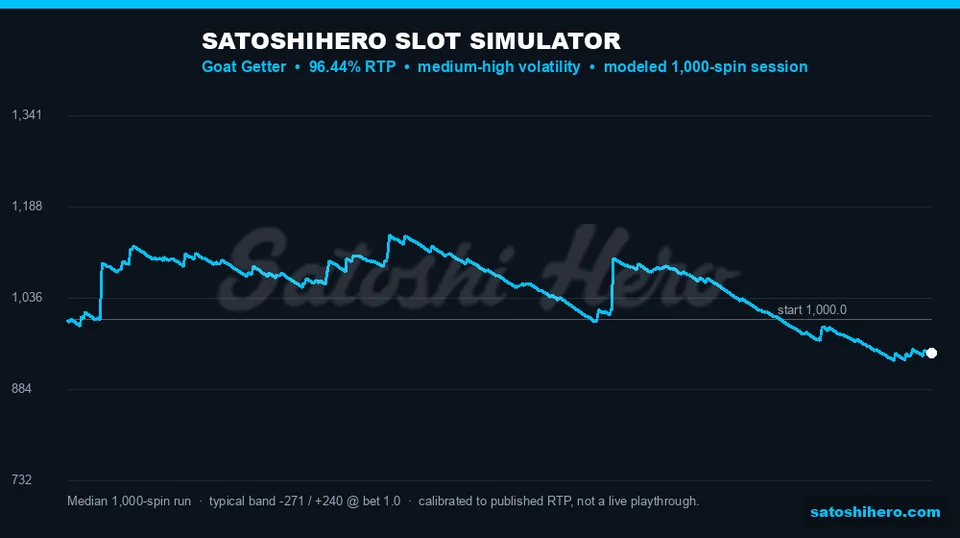
Five percent of modelled sessions ended 271.1x or more down. At the opposite edge, five percent finished 239.9x or more up. That broad band shows why one headline average can’t describe the likely shape of every session.
Roughly 21% of all modelled spins returned something. The model generated a feature-sized hit about once per 45 spins and a 100x-or-higher result about once per 3,571 spins. Those frequencies aren’t countdowns, promises or measured trigger rates.
Numbers indicate wide balance swings even when the median remains negative. You can use the spread to size a bankroll for uncertainty, but you can’t use it to forecast a specific stopping point. I consider the lower tail more useful than the median because it shows how deep an ordinary-length downswing can become.
Our 100-spin session
I staked $50.00 across 100 spins and received $18.60 back. The $31.40 loss equalled 62.8x my $0.50 bet, with Push Bet off throughout. You should treat that result as one observed path, not an expectation for your next session.
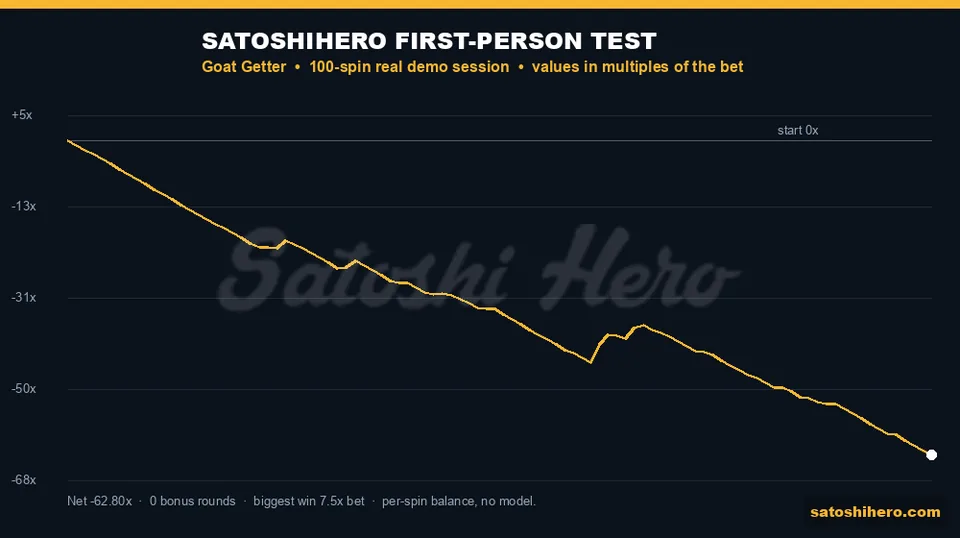
A technical interruption split the play into two loads. My first session completed two losing spins before a Serialization error, and the third request failed without taking a bet. I reloaded with a fresh $1,000.00 balance, completed the remaining 98 spins, and kept the first $1.00 loss in the combined graph.
Spin 62 delivered my largest win at $3.75, or 7.5x. Mushroom, club, spade and egg-nest groups paid through successive cascades before nine pots added a $2.00 Coin Drop award. That layered sequence was easily the session highlight, yet it couldn’t reverse the broader decline.
My balance never recovered to its starting point after spin one. The final balance and session low both reached $968.60, while the longest blank stretch ran from spin four through spin seventeen. I disliked how quickly repeated sub-bet wins lost their excitement, even though the four Coin Drops broke up the colder stretches.
The theoretical RTP is the operator-published figure, and one 100-spin session doesn’t alter that mathematical specification. Individual Bonus Buy configurations can use slightly different designed returns, so I won’t invent per-buy figures. Keep the official specification, model projection and my live result separate: the loss demonstrates short-session variation, not a changed RTP.
Frequently Asked Questions About Goat Getter
How did my 100-spin Goat Getter test go?
I played 100 spins at $0.50, staking $50.00 and receiving $18.60 back. My $31.40 loss equalled 62.8x the bet, with 23 paying spins. The largest result was $3.75, or 7.5x, and Free Spins never started.
What does the Coin Drop Feature pay in Goat Getter?
Coin Drop begins when six or more pots remain after ordinary wins finish. Six, seven, eight and nine pots pay 0.5x, 1x, 2x and 4x; ten or more activate values from 0.5x to 1,000x. My four awards were $0.25, $0.25, $1.00 and $2.00.
How do Free Spins and the Goat work in Goat Getter?
Three to five Bonus symbols provide an initial 6 to 16 Free Spins. The Goat collects every visible pot value, while each five-Goat meter step adds five spins and raises multipliers through 2x, 3x, 5x and 10x. I didn’t trigger the feature during my test.
What did the 1,000-spin simulator show for Goat Getter?
The model produced a median result of 56.1x down. Its lower and upper five-percent markers stretched from 271.1x down to 239.9x up, and about 21% of modelled spins paid. These outputs illustrate risk and can’t predict your session.
Which RTP and maximum win apply to Goat Getter?
Goat Getter has a 96.44% theoretical RTP, medium-high volatility and a 10,000x maximum win. Six or more matching symbols pay anywhere across its 5×6 grid. You never need to follow any fixed paylines.
What is the Gamble Wheel in Goat Getter?
The wheel lets you collect awarded Free Spins or risk them for a larger package. A No Prize segment removes those spins, while success opens wheels with bigger awards. Reaching at least 14 Free Spins through the wheel starts the bonus round.
Final Verdict
Goat Getter stands out through a smart link between cascades, pot counts and Goat progression. Its strongest ideas sit behind a bonus that my 100-spin session never reached, leaving the base game rather severe.

My Take
Play it when you value layered collection mechanics more than frequent headline wins. Expect small returns and dry stretches between the more involved Coin Drop sequences, and keep your stake conservative.
I liked how four Coin Drops gave the base game clear moments of tension. I didn’t like that twelve of 23 wins returned less than my stake, while six two-scatter teases produced no Free Spins.
Goat Getter rewards careful symbol counting, but its best feature needs patience and enough budget for uneven play. Game information and test details are checked regularly.

Pros:
 Clear mechanics: Bold symbols make pay-anywhere groups and feature pots easy to count.
- Layered cascades: Repeat drops can combine ordinary wins with Coin Drop triggers.
- Progressive bonus: Goat milestones add spins while lifting collection multipliers.
- Useful demo: Base play lets you inspect mechanics without purchasing a bonus.

Cons:
 Small base returns: Twelve tested wins returned less than one full stake.
- Elusive entry: Six two-scatter appearances never developed into Free Spins.
- Costly access: Fixed Bonus Buys start at 100x the selected bet.

Best For: Cascade fans who enjoy counting symbols, tracking pots and building a visible bonus meter. You need patience for cold runs and discipline around the expensive feature-access choices.










Other Push Gaming Games






















































Bets
All Bets
Game
Player
Date
Wager
Mult.Multiplier
Prize
 Galaxy Glitter
 josh1998
- 22:18:15
- 0×
- THE VIP
 bCreative79
- 22:18:14
- 0×
- Plinko Max
 JIMAT992WIRE
- 22:18:14
- 0.67×
- Master Joker
 Aiiken
- 22:18:13
- 0×
- THE VIP
- bCreative79
- 22:18:12
- 0×
- Master Joker
- Aiiken
- 22:18:11
- 0×
- THE VIP
- bCreative79
- 22:18:10
- 0×
- Master Joker
- Aiiken
- 22:18:10
- 0×
- Mr. Crystalman: Hold 'N' Link
 Hidden
- 22:18:10
- 0×
- THE VIP
- bCreative79
- 22:18:09
- 0.71×