

Fat Rabbit
By pressing play, you agree that you are above legal age in your jurisdiction and that your jurisdiction allows online gambling.


Carrots, Tractors and Sharp Swings on the Farm
Fat Rabbit slot spreads carrots, expanding rabbit mechanics, and 50 win lines across Push Gaming’s 5×5 farm grid.
Fat Rabbit is a high volatility slot from Push Gaming with 96.45% RTP and 3,844x max win potential. My 100-spin test finished 30.4x down, with a 13.6x best hit and no Free Games trigger. It targets patient players comfortable with sharp swings, although that win ceiling feels modest beside the risk.
Key takeaways
- Test setup: I played 100 regular spins at $0.50 and didn’t test a bonus-buy mode.
- RTP / volatility: The theoretical return is 96.45%, while high volatility can drive sharp short-session swings.
- Max win: The official ceiling is 3,844x the bet, which feels restrained for this risk level.
- Risk note: My test lost 30.4x, peaked at 4.6x profit, and never triggered Free Games.
- Bankroll note: A 14-spin dry streak shows why you need space for losses without raising your stake.
You should read these points as a test snapshot, not a forecast for your play. I think the modest ceiling deserves attention before you accept the high-risk profile.

Table of Contents
- How the Fat Rabbit slot Works
- Starting your session
- Harvest Feature and Tractor Wilds
- Farm Theme and First Impressions
- Board clarity
- Symbols, Payouts and Wild Rules
- Higher-paying symbols
- Low pays and wilds
- Free Games and the Carrot Meter
- Meter pressure
- My 100-Spin Test
- Balance path
- Hit Rate, Returns and Dry Spells
- Cold run
- RTP, Volatility and Simulator Results
- Simulator projection
- Comparison with my test
- Frequently Asked Questions About Fat Rabbit
- Final Verdict
How the Fat Rabbit slot Works
The Fat Rabbit slot uses a 5×5 grid with 50 traditional win lines. Matching symbols form wins across active lines, while three wild types help complete those connections. You choose a stake, spin manually or use autoplay, then read each payout against your selected bet. I used the default $0.50 stake, which kept every logged result easy to compare.
The Rabbit appears only on reel 1 and replaces every other symbol. Wild Carrots and regular Carrots replace everything except the Rabbit. When a Rabbit lands with one or more Wild Carrots anywhere on the grid, Free Games begin. I like that distinction, but you need to learn it before the busy board makes sense.
Starting your session
The Fat Rabbit slot game asks you to connect symbols while watching for carrot mechanics. Its interface adapts across desktop and mobile screens without changing the 5×5 format. You can use the demo or play for real on SatoshiHero, though I tested with play money. The Fat Rabbit slot machine expresses all reported results below in bet multiples and $ amounts.

Strategy Insight: Separate the reel-one Rabbit from both carrot wilds. You won’t misread triggers or substitution rules when several special symbols share the grid.
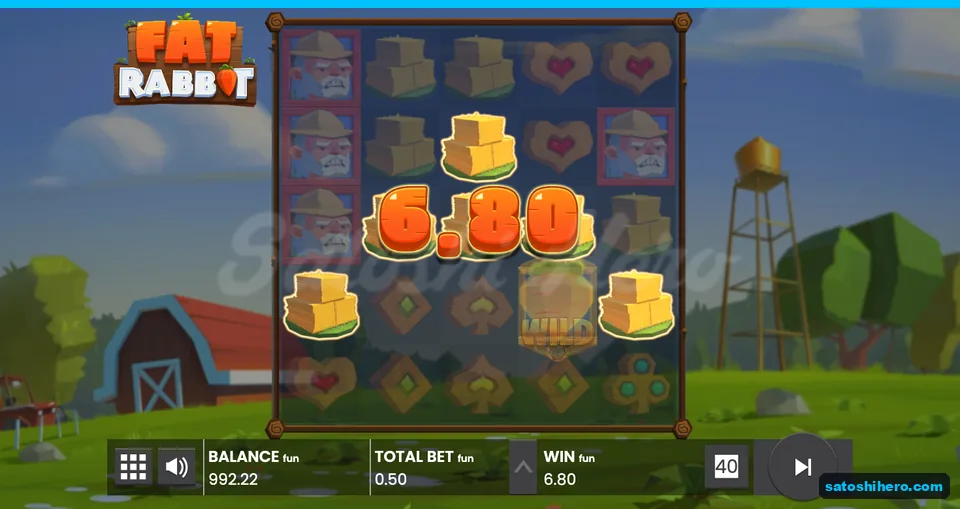
My clearest base-game example came on spin 60. Hay bales helped produce a $6.80 win from the $0.50 stake, equal to 13.6x. That result also became my largest hit, so even an ordinary line win can lead a short session. Learn the three wild rules first, and every later feature becomes easier to follow.
Harvest Feature and Tractor Wilds
The Harvest Feature can start randomly while the reels spin, sending a tractor across the grid. It adds Wild Carrots in random positions, and each one replaces every symbol except the Rabbit. You can’t choose the activation point or carrot placement. I find that lack of control fair for a random feature, though it can make weak placements feel flat.
I saw the tractor on spin 8 of my test. Three Wild Carrots remained on the board, and the spin returned $4.26 from my $0.50 stake. That equals 8.52x, an encouraging early result that pushed the balance upward. You should still judge the final line connections, not the number of carrots alone.
Position matters because a Wild Carrot only helps when it connects useful symbols across an active line. Three scattered carrots can produce less than one well-placed substitute. The feature supplied my first notable lift, yet it didn’t beat the later 13.6x hay-bale result. In my view, the tractor adds tension without pretending every appearance has major value.
The feature illustration also shows a larger rabbit, connecting the tractor artwork with the Free Games growth mechanic. That link helps you understand why carrots matter. Still, the tractor can improve a spin but can’t guarantee a strong payout.

Farm Theme and First Impressions
Push presents a bright cartoon farm led by a large white rabbit, a grumpy farmer, and a snarling purple dog. A red barn, water tower, and open blue sky sit behind the 5×5 board. Gold frames highlight the Rabbit, while carved wooden card suits fill the lower paytable. You can identify the key characters quickly, which matters on a crowded grid.
Buckets and hay bales complete the farm equipment, but carrots carry the strongest visual role. They connect the artwork to wild substitutions, the Harvest Feature, and Free Games. The Fat Rabbit cartoon style won’t win originality awards, yet it keeps events readable. I think clarity matters more than a fresh story.
Board clarity
Several line wins can make the board look busy, especially when carrot symbols appear among wooden suits. Strong colors help you separate the Rabbit from the farmer and dog during fast autoplay. If you enjoy rabbit-led garden imagery, Rabbit Garden offers another thematic direction. White Rabbit takes a different visual route, so its atmosphere provides a useful contrast without implying shared mechanics. Fat Panda uses a different animal-led setup, while Fat Santa offers another Push Gaming comparison.

Insight: Carrots aren’t background decoration here. They form the visual thread linking the farm setting, wild substitutions, tractor event, and rabbit-growth sequence.
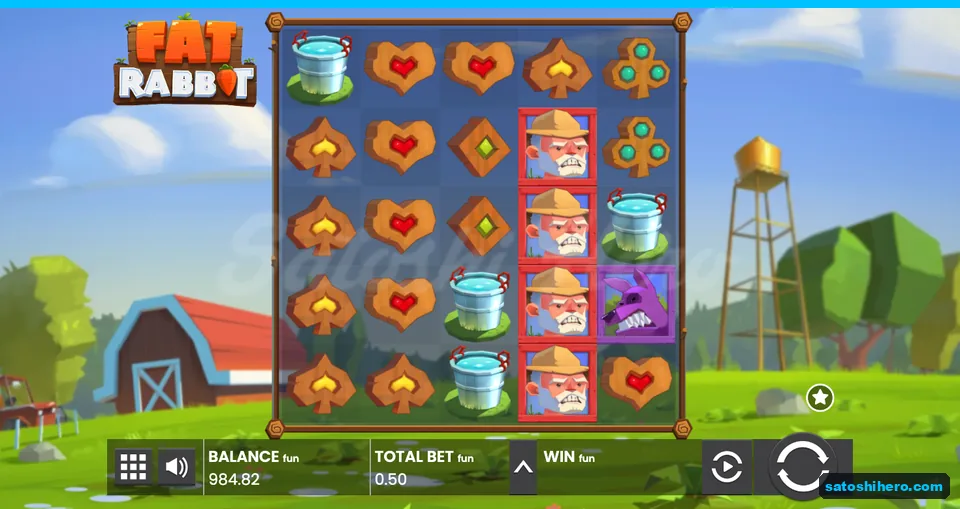
At rest, the grid displays its symbols above balance, total bet, and win fields. I found those controls easy to scan during my $0.50 test. You should value that information bar because the central board carries plenty of detail. The Fat Rabbit slot theme feels familiar, but clarity wins on this Fat Rabbit farm.
Symbols, Payouts and Wild Rules
The Rabbit and Farmer lead the paytable at 20x for five matching symbols. The Rabbit also works as a restricted wild, so its value extends beyond the listed awards. Values below use my $0.50 test bet as the reference, while each figure shows a bet multiple. You should compare symbol strength by both payout and function, not artwork alone.
Higher-paying symbols
- Rabbit: 20x for five, 4x for four, and 0.8x for three.
- Farmer: 20x for five, 4x for four, and 0.8x for three.
- Dog: 16x for five, 3x for four, and 0.6x for three.
- Bucket: 10x for five, 2x for four, and 0.4x for three.
- Hay Bales: 6x for five, 1.6x for four, and 0.32x for three.
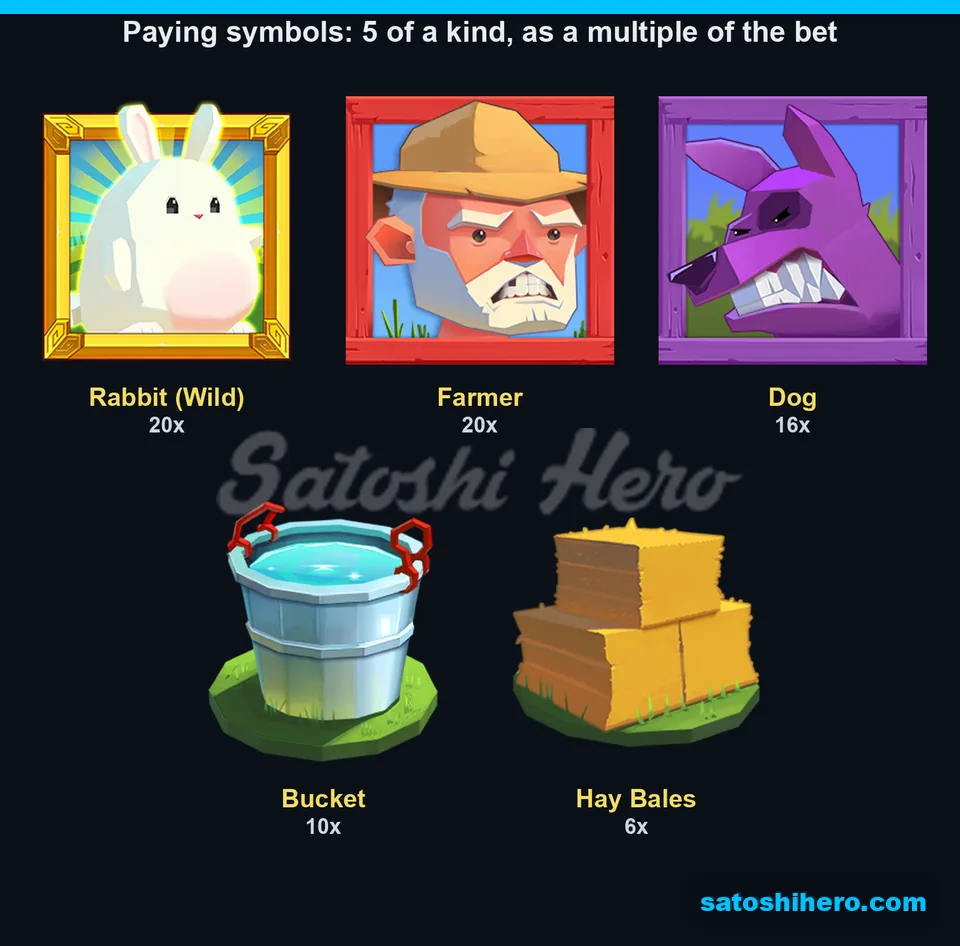
A five-Rabbit or five-Farmer line produces the same listed multiple, but their jobs differ. The Farmer acts as a normal high symbol, while the Rabbit replaces every other symbol. It only lands on reel 1, which limits where that substitution can begin. I like this rule because you can understand its value without mistaking it for a full-grid wild.
Low pays and wilds
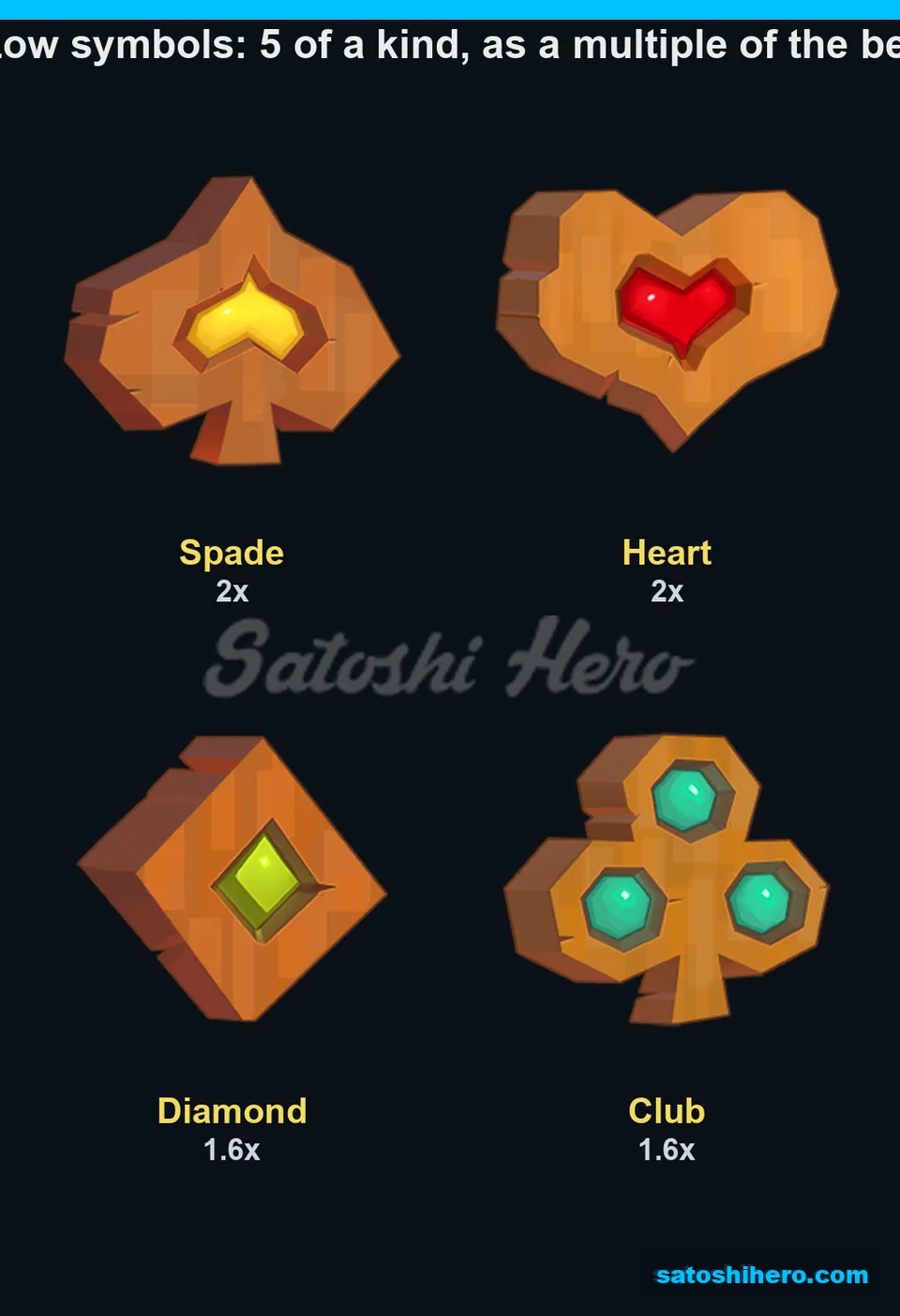
- Spade: 2x for five, 0.8x for four, and 0.2x for three.
- Heart: 2x for five, 0.8x for four, and 0.2x for three.
- Diamond: 1.6x for five, 0.6x for four, and 0.16x for three.
- Club: 1.6x for five, 0.6x for four, and 0.16x for three.
Wild Carrots and Carrots replace every symbol except the Rabbit. That restriction preserves the special trigger relationship instead of letting one carrot imitate the reel-one character. You can still build ordinary line wins through their substitutions. In my test, their effect was easiest to see when the tractor left three Wild Carrots behind.
I logged returns of $0.08, $0.10, $0.16, $0.20, and $0.30 at the $0.50 stake. Those amounts matched the displayed three-symbol paytable values, giving me a direct check against the game log. Some paying spins still returned less than my stake, which is easy to overlook. Track net movement, because a small match doesn’t automatically create profit.
Free Games and the Carrot Meter
Free Games start when a Rabbit lands with at least one Wild Carrot anywhere on the grid. The Rabbit remains limited to reel 1, and the round begins with five free spins. Carrots can then land, letting the Rabbit move onto them and collect them. You should watch the meter because collection, not just line wins, controls the feature’s growth.
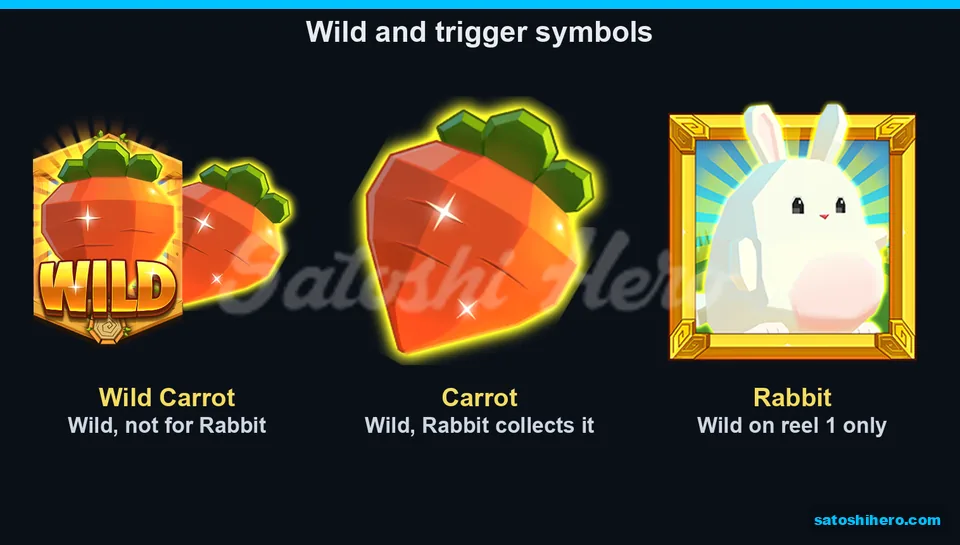
Each collected Carrot advances the on-screen meter. A full meter enlarges the Rabbit and adds free spins through a fixed sequence:
- First fill: 3 extra spins.
- Second fill: 2 extra spins.
- Third fill: 2 extra spins.
- Fourth fill: 1 extra spin.
Four completed fills can add eight spins to the initial five, but collection doesn’t guarantee every fill. That makes the five-spin opening feel short, and I think the feature depends heavily on early carrots. You need meter progress to extend the round meaningfully rather than relying on the starting allocation.
Meter pressure

Key Stat: The round starts with five spins, while the 3/2/2/1 sequence can add eight more. Reaching all four fills isn’t guaranteed.
I didn’t trigger Free Games during my recorded 100 spins. For that reason, I describe the meter from documented rules rather than claiming a personally played bonus. One trigger-free session doesn’t establish a fixed feature frequency. It does show that you can finish a short test without seeing the game’s main growth sequence.
The rabbit-growth artwork gives the feature a clear sense of progress. Its expanding character makes the meter more tangible. Still, the round depends on collecting Carrots before spins run out. Treat extra spins as earned extensions, not an expected total.
My 100-Spin Test
My 100 autoplay spins at $0.50 finished 30.4x down despite an early move above the starting balance. I began with a fresh $1,000.00 play-money balance and excluded a separate exploratory run of fewer than 30 spins. You can therefore read every figure here as one clean session. I think the result shows how quickly a hopeful opening can turn into a steady decline.
The balance peaked 4.6x above its starting point after spin 16. It stayed above the start only from spins 8 through 20, then spent 87 of 100 spins below that line. By spin 97, I reached the session low at 30.6x down. You should notice how little time the early profit lasted compared with the later losing stretch.
Balance path
My largest result landed on spin 60, when a $6.80 win equaled 13.6x the $0.50 stake. It lifted the balance from $992.72 to $999.02, bringing me close to even without fully recovering. The hit felt useful rather than spectacular, and the decline resumed afterward. One decent result couldn’t repair a session shaped by repeated small losses.
The balance curve had three clear phases: an early 4.6x peak, a long slide, and a 30.4x final loss. My Free Games count stayed at zero. The base game and tractor carried all the work. For you, the lesson is simple: don’t judge a session by its best spin.
I used autoplay for consistent pacing, not as a strategy. It doesn’t alter symbol selection, feature chances, or payout odds. The early rise felt encouraging, but watching the balance stay below its start for most spins felt harsher. This test provides experience, not a prediction of your next 100 spins.
Hit Rate, Returns and Dry Spells
Twenty-nine of my 100 spins paid, but that observed 29% rate didn’t prevent a 30.4x loss. Eleven returns came below the $0.50 stake, two returned exactly $0.50, and sixteen exceeded the stake. You need payout size alongside hit count to understand the result. I consider raw paying-spin totals misleading when many wins still lose money overall.
The two break-even spins arrived on spins 33 and 41. They kept the balance unchanged for those rounds, while smaller returns reduced it by less than a complete loss. My 13.6x top hit remained far below the game’s full potential. That gap explains why 29 paying outcomes still lacked enough weight to reverse the downward trend.
Cold run
My longest dry run covered spins 17 through 30. Fourteen consecutive spins returned nothing, beginning just after the session’s high point. You should choose a stake that leaves room for several such runs without forcing a decision. The sequence felt especially sharp because the balance had only just moved into profit.
Autoplay made the cold run pass quickly, but speed didn’t change its odds. Raising the bet because a feature hasn’t appeared would only increase the money exposed on later spins. You can’t turn elapsed spins into a timing signal. I strongly prefer setting one affordable stake before starting rather than reacting to frustration.
Small returns softened individual losses without fixing the broader result. That pattern felt harsher than the 29% observed paying-spin rate suggests. Track your net balance, not every payout flash, when deciding how play has gone.
RTP, Volatility and Simulator Results
The Fat Rabbit slot has a 96.45% theoretical RTP, high volatility, and a 3,844x maximum win. That profile allows uneven short sessions, so your result can sit far from the theoretical figure. The ceiling remains meaningful, but I find it modest beside the stated risk. You shouldn’t treat RTP as a promised return from one session.
Simulator projection
The SatoshiHero Slot Simulator modeled 1,000 spins at a stake of one bet unit using the official profile. Its median session ended 63.0x down. The fifth percentile finished 328.8x down, while the ninety-fifth percentile reached 334.9x up. That wide band gives you a clearer picture of session spread than the median alone.
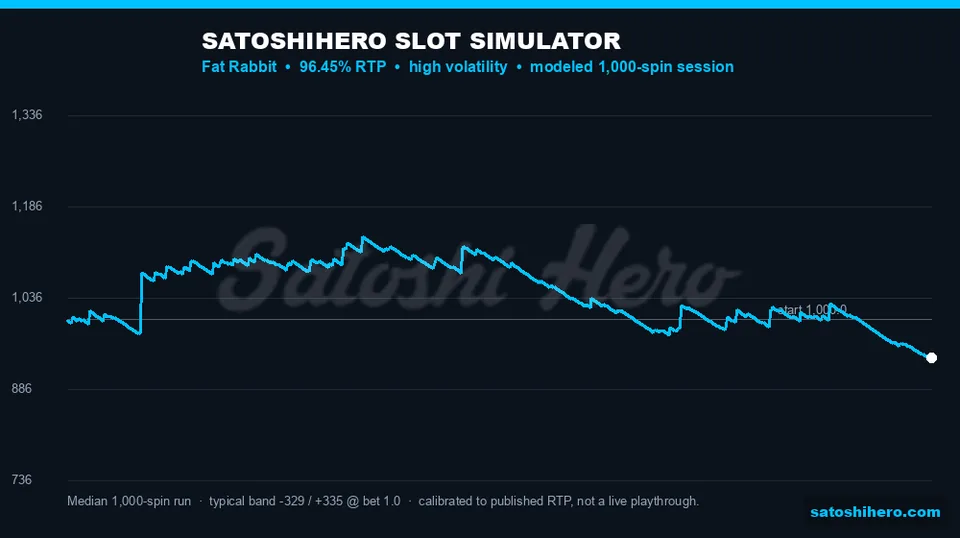
About 18% of modeled spins paid. A feature tier appeared roughly once per 46 modeled spins, while a win of at least 100x appeared about once per 1,618 modeled spins. I find the rare 100x projection notable beside the restrained top prize. These frequencies aren’t countdowns, and they provide no signal about what comes next.
The simulator produces modeled projections, not live outcomes. It doesn’t reveal the game’s random number generator or predict your next session. Use the output to understand spread, not to time a stake increase. The range matters because a median hides deep losses and strong gains.
Comparison with my test
My actual test ended 30.4x down after 100 spins, with 29 paying outcomes and a 13.6x largest win. Free Games never triggered. The observed paying-spin share exceeded the model’s approximate 18%, yet my balance still fell. Numbers indicate that payout size mattered more than the raw number of winning spins.
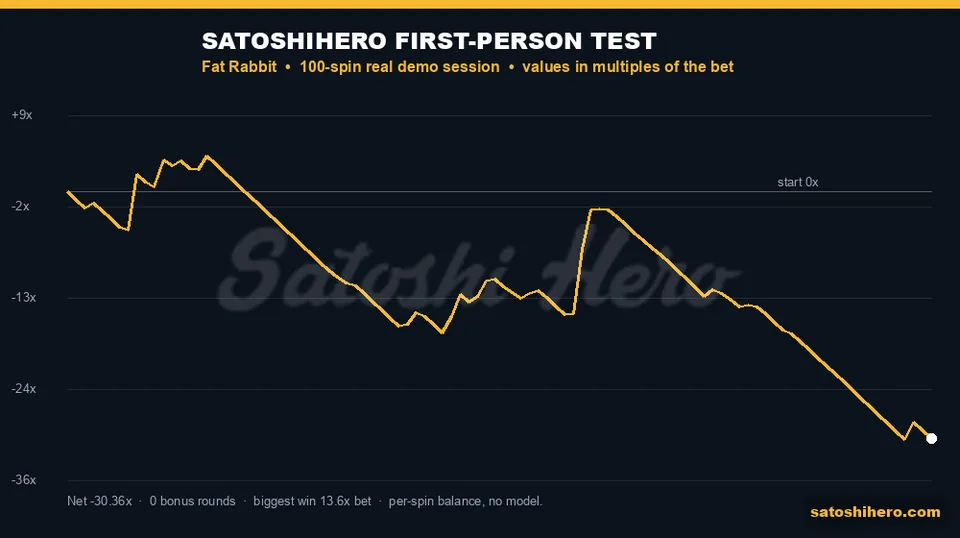
A 100-spin test and a 1,000-spin model answer different questions. My test records what I personally saw, while the simulator describes a wider modeled distribution. You can’t use either result to forecast the next feature or payout. In my opinion, placing them together exposes the volatility more honestly than quoting RTP alone.

Warning: High volatility produced a 14-spin dry streak and a 30.4x loss in my test. Size each stake from your starting bankroll, and don’t chase an earlier loss.
The 96.45% figure is the operator’s published theoretical return, and one play-money session doesn’t alter it. Simulator figures remain modeled projections, while displayed feature configurations can carry slightly different returns by design. No separate feature percentage appears here because I won’t invent one. The profile fits people who accept uneven sessions, not anyone seeking frequent, steady returns.
Frequently Asked Questions About Fat Rabbit
What triggers Free Games in the Fat Rabbit slot?
A Rabbit must land with at least one Wild Carrot anywhere on the 5×5 grid. The round begins with five free spins, and the Rabbit can appear only on reel 1. You then need landed Carrots to advance the meter and extend play.
How does the Carrot meter work in the Fat Rabbit slot?
During Free Games, the Rabbit moves onto landed Carrots and collects them. Each full meter grows the Rabbit and adds spins in a 3, 2, 2, and 1 sequence. Four fills can add eight spins, though you might not complete all four.
What is the Harvest Feature in the Fat Rabbit slot?
A tractor can activate randomly while the reels spin and place Wild Carrots on the grid. Those symbols replace everything except the Rabbit. In my test, it appeared on spin 8 and helped return $4.26 from a $0.50 stake.
Which symbols act as wilds?
The Rabbit, Wild Carrot, and Carrot all act as wilds. The Rabbit replaces every other symbol but appears only on reel 1. Both carrot wilds replace everything except the Rabbit.
What are the RTP and maximum win of the Fat Rabbit slot?
The theoretical RTP is 96.45%, volatility is high, and the maximum win reaches 3,844x the bet. The game uses 50 traditional win lines on a 5×5 grid. That ceiling feels fairly restrained beside the risk level.
How did my 100-spin Fat Rabbit slot test go?
My session ended 30.4x down after 100 spins at $0.50. I recorded 29 paying spins, a 13.6x largest win, a 4.6x peak, and no Free Games trigger. The longest no-win run lasted 14 spins.
What did the 1,000-spin simulator show for Fat Rabbit?
The model produced a median loss of 63.0x and a percentile band from 328.8x down to 334.9x up. About 18% of modeled spins paid. These figures describe projections, not predictions or live outcomes.
What does the Rabbit symbol pay?
The Rabbit pays 20x for five, 4x for four, and 0.8x for three. It also replaces every other symbol and only appears on reel 1. Its substitution role adds value beyond those listed awards.
Final Verdict
Fat Rabbit combines clear carrot mechanics, a readable farm board, and a useful random tractor event. Its main drawback is the gap between high risk and a 3,844x ceiling that feels modest. You get strong mechanical clarity, but the test showed that clarity doesn’t soften the swings.

My Take
Patient players can appreciate the linked wild, tractor, and meter systems. Expect uneven base-game stretches, and don’t assume Free Games must appear within a short session.
I liked how easily I could follow the three wild types once I learned their restrictions. I didn’t like finishing 30.4x down after a 13.6x best hit, especially with no bonus trigger. The early rise gave the session energy, but the long decline defined it.
My Fat Rabbit slot findings are checked regularly and updated periodically. You should treat the recorded test as first-hand evidence from one session, while using the official mechanics for broader expectations.

Pros:
 Clear Wild Rules: Distinct restrictions make Rabbit and carrot substitutions easy to track.
- Linked Theme: Carrots connect the artwork directly with every major feature.
- Verified Paytable: My small wins matched displayed three-symbol values at the tested stake.
- Useful Tractor Event: Random Wild Carrots can improve ordinary base-game line connections.

Cons:
 Modest Ceiling: The 3,844x cap feels restrained beside high volatility.
- Short Bonus Start: Five initial spins place heavy pressure on early Carrot collection.
- Sharp Session Swings: My test included 14 blank spins and a 30.4x loss.

Best For: Patient high-volatility fans who track net balance and accept trigger-free stretches. The farm theme stays playful, but you need enough discipline to withstand uneven results.
Similar Games











Other Push Gaming Games























































Bets
All Bets
Game
Player
Date
Wager
Mult.Multiplier
Prize
 Royal Fruits 9: Hold 'n' Link
 Hidden
- 00:18:00
- 0×
- Galaxy Glitter
 Hidden
- 00:18:00
- 0×
- Elephant's Gold: Bonus Combo
 Hidden
- 00:17:59
- 0×
- Galaxy Glitter
- Hidden
- 00:17:59
- 0×
- Galaxy Glitter
- Hidden
- 00:17:58
- 0×
- Galaxy Glitter
- Hidden
- 00:17:58
- 0.49×
- Royal Fruits 9: Hold 'n' Link
- Hidden
- 00:17:57
- 3.99×
- Galaxy Glitter
- nina87
- 00:17:57
- 0×
- San Chong Baozha Blue: Bonus Combo
 mdp0fxo
- 00:17:56
- 0×
- Galaxy Glitter
- Hidden
- 00:17:56
- 0×