

Rolling in Treasures
By pressing play, you agree that you are above legal age in your jurisdiction and that your jurisdiction allows online gambling.

Rolling in Treasures
RTP96.5%
VolatilityHigh
Max winx5,000
ReleasedFeb 2026
Live game stats
Real RTP64.97%
Spins549
Players3
Biggest win$56.73

Torchlight tumbles in a gold mine chase
Rolling in Treasures turns a torchlit mine into a high-volatility Pragmatic Play slot where tumbles and multiplier overlays do most of the work.
Rolling in Treasures is a high volatility slot from Pragmatic Play with 96.5% RTP and 5,000x max win potential. It uses a 6-reel, 5-row grid with pay-anywhere wins, and my $2 test felt steadier than I expected. You can play Rolling in Treasures online on SatoshiHero in demo or real mode.
Key takeaways
- Best bonus: Standard Free Spins cost $200 at the $2 stake, but my bought round returned $71.90.
- RTP / volatility: The slot has 96.5% RTP and high volatility, so you should expect swings.
- Max win: The official top prize is 5,000x the bet, not a giant 50,000x ceiling.
- Risk note: The $500 and $2,000 Super buys can move your balance fast.
- Bankroll note: Test the grid rhythm at smaller stakes before chasing buy features.

Caution: High volatility plus $200, $500 and $2,000 buy options at a $2 stake means you should treat buys as high-risk shots, not shortcuts to profit. These buy prices are game feature costs, not promotional bonus amounts; any SatoshiHero promotion follows its displayed terms and wagering requirements.

Table of Contents
- How Rolling in Treasures Works
- Pay-anywhere wins
- Symbol values
- Theme & First Impressions
- Mining setting
- Table feel
- Tumble and Multiplier Overlay
- Tumble chains
- Added multipliers
- Free Spins
- Trigger counts
- Persistent multiplier
- Buy Feature and Special Bets
- Three buy levels
- Special bet choices
- Standard Buy Test
- Buy cost
- Test result
- How It Played Across 500 Spins
- Session rhythm
- Balance movement
- RTP, Volatility & Our Test
- Simulator projection
- Our 500-spin session
- Frequently Asked Questions About Rolling in Treasures
- Final Thoughts
How Rolling in Treasures Works
Rolling in Treasures uses pay-anywhere wins on a 6-reel, 5-row grid, so the whole screen matters on every spin. You don’t match fixed paylines here. The slot counts matching symbols anywhere on the grid, then pays once you land enough of the same symbol.
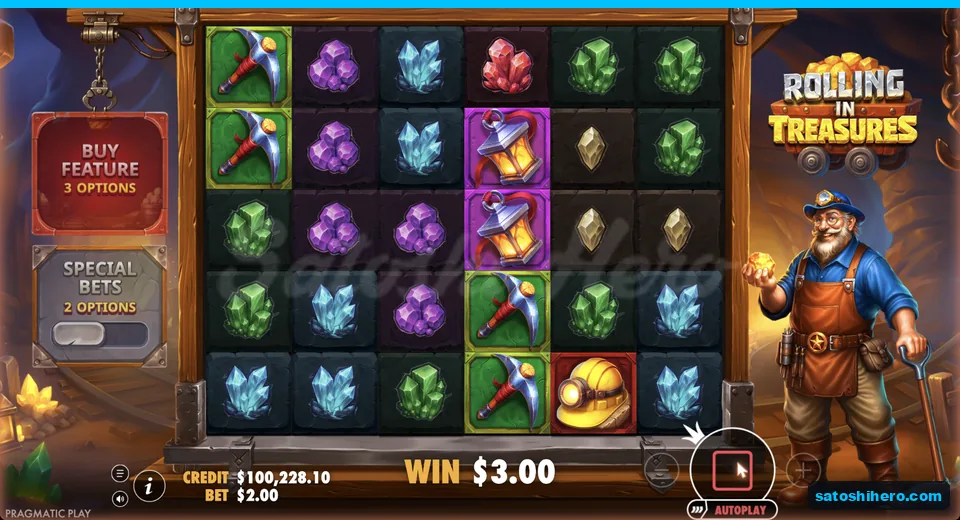
That setup changes how you read the game. You shouldn’t stare at the left side like you would on a line slot. Watch the full grid, because a scatter of matching gems can matter more than a neat row. I like this approach because every drop feels readable once you understand the count.
Pay-anywhere wins
Wins start from 8+ matching symbols anywhere on the screen. After a win, those symbols disappear, and new symbols tumble into the gaps. That can create another win from the same paid spin without asking you for another stake.
The tumble mechanic gives the base game most of its pace. You can get a small hit, watch symbols burst away, then see a better connection land on the next drop. It doesn’t make every spin exciting, but it adds enough motion to keep you watching.
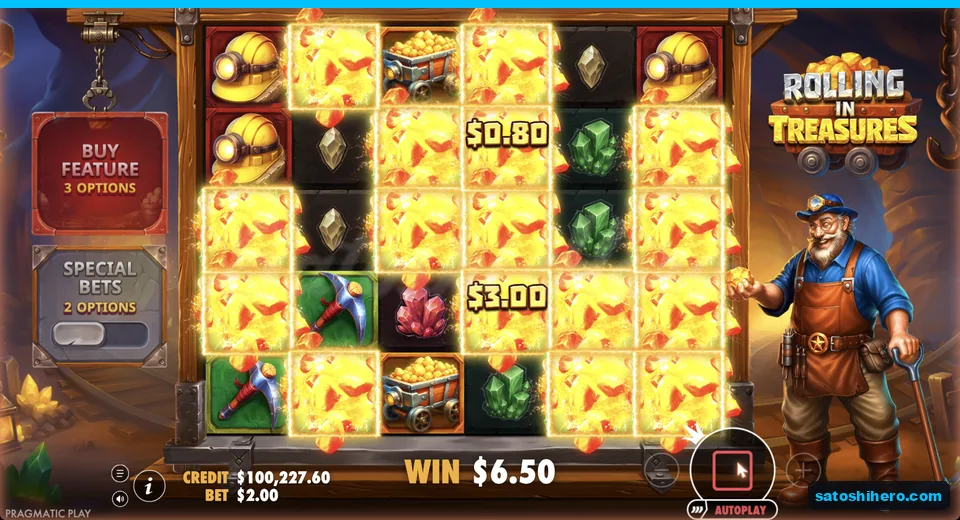
Desktop and mobile play use the same 6×5 layout and feature flow. You get the same core grid, tumbles and bonus symbols either way. That matters because you don’t need to relearn the screen when you switch devices.

Quick Fact: Rolling in Treasures pays from 8+ matching symbols anywhere on the grid, so you read the full screen rather than left-to-right lines.
Symbol values
At the $2 bet, the gold minecart pays $100 for 12+ matching symbols. The hard hat pays $50, the pickaxe pays $30, and the lantern pays $24 for that same 12+ count. Those top values give the grid a clear ladder.
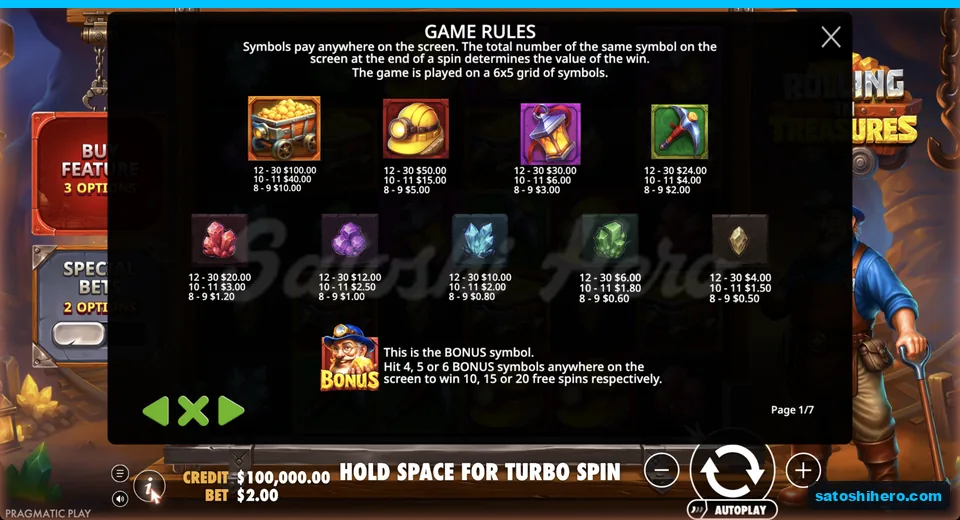
The gem symbols sit lower but still matter during long tumble chains. The red crystal pays $20, the purple gem pays $12, the blue crystal pays $10, the green gem pays $6, and the silver nugget pays $4 for 12+ matches. Smaller pays apply for 10 to 11 and 8 to 9 matching symbols.
The bearded miner is the Bonus symbol. He triggers free spins when enough of him lands, so you should track him as carefully as the high-paying minecart. My practical takeaway is simple: watch the whole grid, not one reel strip.
Theme & First Impressions
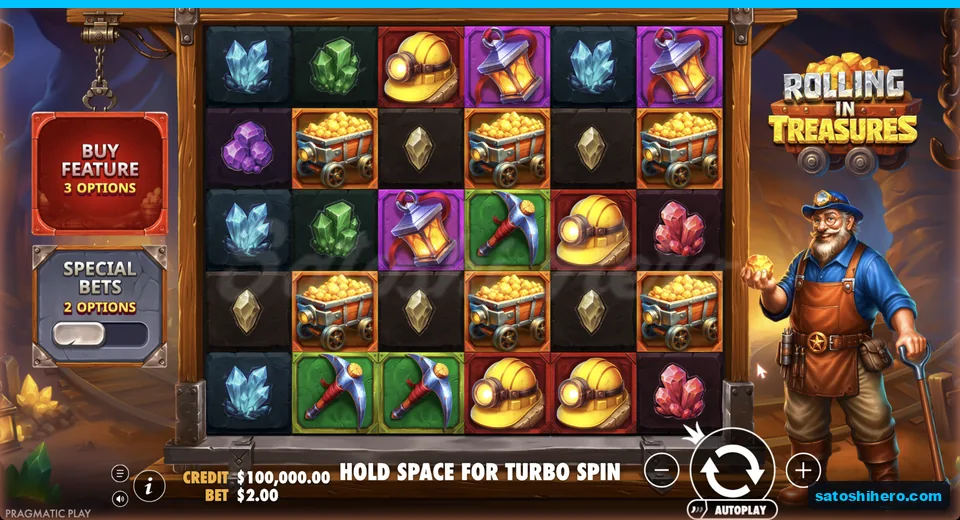
The theme is a torchlit mining setup with gold, gems and tools, and it works because the symbols stay easy to read during tumbles. Rolling in Treasures doesn’t reinvent treasure slots, but I think the clean symbol set helps the gameplay more than a louder theme would.
Mining setting
The mine setting uses warm torchlight, deep rock walls and a simple gold-hunt mood. Minecarts, pickaxes, hard hats, lanterns and gems fill the grid without turning into visual noise. The bearded miner on the side gives the screen a clear character anchor.
I don’t think the theme wins originality points. Plenty of slots already dig for gold, gems and buried riches. Still, this one understands what a tumble slot needs: shapes you can read quickly while wins burst away and new symbols fall.
If you like treasure themes but want a different setting, Treasures of Osiris shifts the hunt toward ancient Egypt. Temujin Treasures leans into a stronger character mood instead. Those comparisons help because this game keeps its mine style simple and practical.

Did You Know? The mining theme works best when symbol shapes stay simple, because tumble slots ask you to read full-screen clusters quickly.
Table feel
The table feel is clean rather than flashy. I could follow the minecart, helmet and gem hits without squinting during cascades. That’s important when multiplier overlays appear, because you need to know which symbols actually joined the paid win.
You won’t get a wild cinematic world here. The slot chooses clarity over spectacle, and I’m fine with that choice. When you’re playing a high volatility game, readable results beat noisy decoration.
SatoshiHero play notes are checked regularly, which helps keep the practical detail aligned with the game screen. The design does its job: it lets you follow wins without needing flashy distractions.
Tumble and Multiplier Overlay
The tumble and multiplier overlay is the main reason the base game feels alive, because wins can keep dropping new symbols and boosted values. You get the best moments when a normal-looking tumble chain adds multiplier overlays to symbols that actually connect.
Tumble chains
After every paid win, the winning symbols disappear. New symbols then fall into the empty spots, and the slot checks the grid again. Tumbling continues with no set limit, so one spin can stretch longer than you first expect.
You should pay attention after even small wins. A $4 or $6 hit can clear space for a better symbol count on the next drop. I like that rhythm because it gives the base game more texture than a simple scatter-chase format.
That said, tumbles still need matching symbols. Empty movement doesn’t help your balance. The feature feels good when it chains, but you shouldn’t mistake motion for value.
Added multipliers
In the base game, new tumbling symbols can randomly carry a 2x multiplier. If another tumble follows, new multiplier symbols increase by +1. Multipliers on winning symbols add together before multiplying that win.
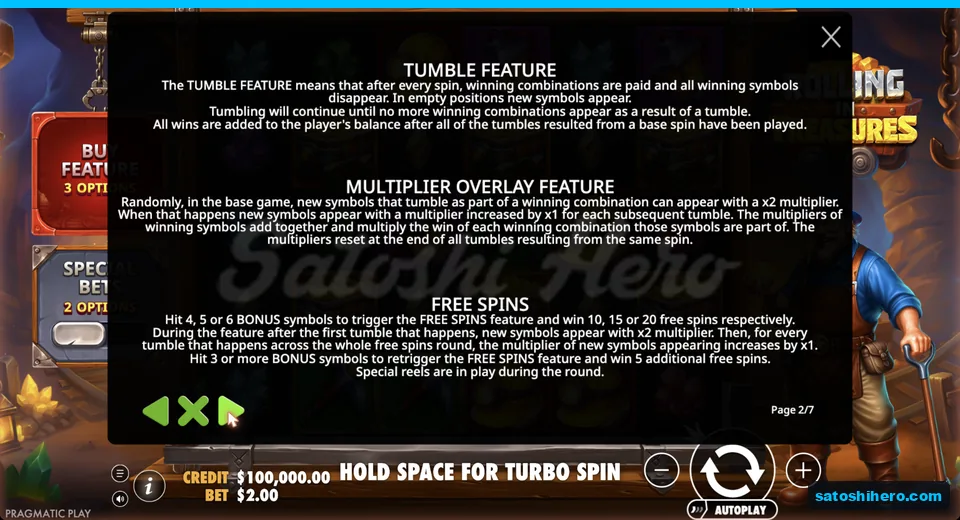
Base-game multipliers reset at the end of each spin. That reset keeps the feature punchy but contained. You can get a sharp burst, yet the slot doesn’t let one base spin carry a growing meter forever.

Pro Tip: Watch for multiplier overlays during tumble chains; the best base-game hits usually come when several multiplied symbols land in the same paid win.
This feature made the base game more interesting than I expected. You can feel a modest hit turn meaningful when overlays land on the right symbols. The overlay doesn’t save every dry spell, but it gives you a reason to watch each tumble finish.
Free Spins
Free spins are the main bonus round, and they matter because the multiplier keeps climbing instead of resetting after each tumble. That one change gives the feature its real upside, since every tumble can improve the next multiplied symbols.
Trigger counts
Landing 4 miner Bonus symbols awards 10 free spins. Landing 5 awards 15 free spins, and landing 6 awards 20 free spins. That trigger ladder feels easy to understand while you play.
The miner symbol has a practical role, not just a decorative one. You’ll spot him quickly because the rest of the grid uses tools, gems and mine objects. I think that clarity helps during fast base-game drops, especially when several symbols burst away together.
You can use the Rolling in Treasures free demo on SatoshiHero to see the free spins flow before staking real funds. That matters because the feature looks simple, but the multiplier pacing changes how you judge each tumble. Try a few rounds before you decide whether the rhythm fits your bankroll.
Persistent multiplier
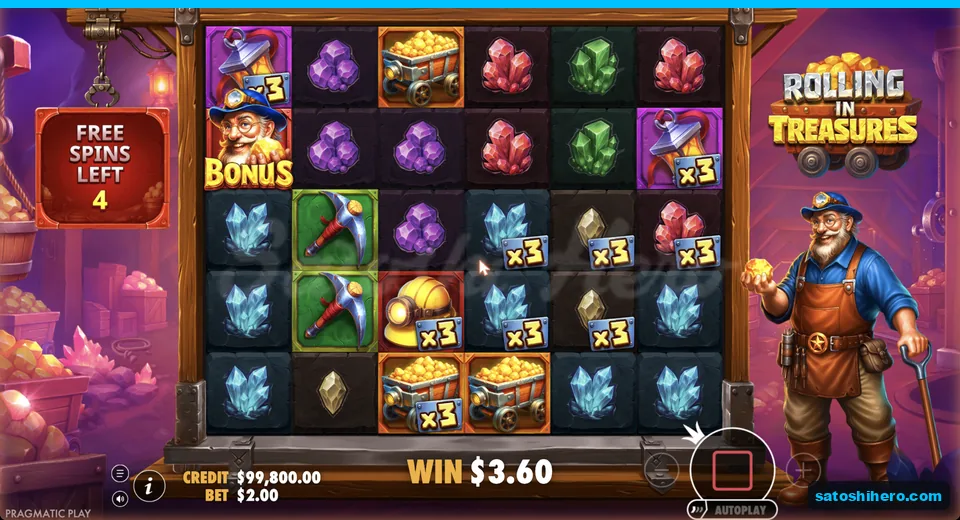
During free spins, the multiplier doesn’t reset. After the first tumble, new symbols carry a 2x multiplier. Every tumble across the full feature adds +1 to the multiplier on new symbols.
That persistent growth creates the strongest upside in the game. Early tumbles can set up later spins with better multiplier values, but they still need matching symbols to matter. I like the idea, though it can feel cruel when the meter climbs and the grid refuses to connect.
Landing 3+ Bonus symbols during the round retriggers 5 extra spins. Extra spins give the multiplier more time to grow, which is exactly what this bonus wants. The round has real upside, but you still need the right symbols at the right time.
Buy Feature and Special Bets
The buy menu gives you three direct bonus options, but each one raises risk fast at the tested $2 stake. You can skip waiting for the trigger, yet you pay a steep price for that shortcut.
Three buy levels
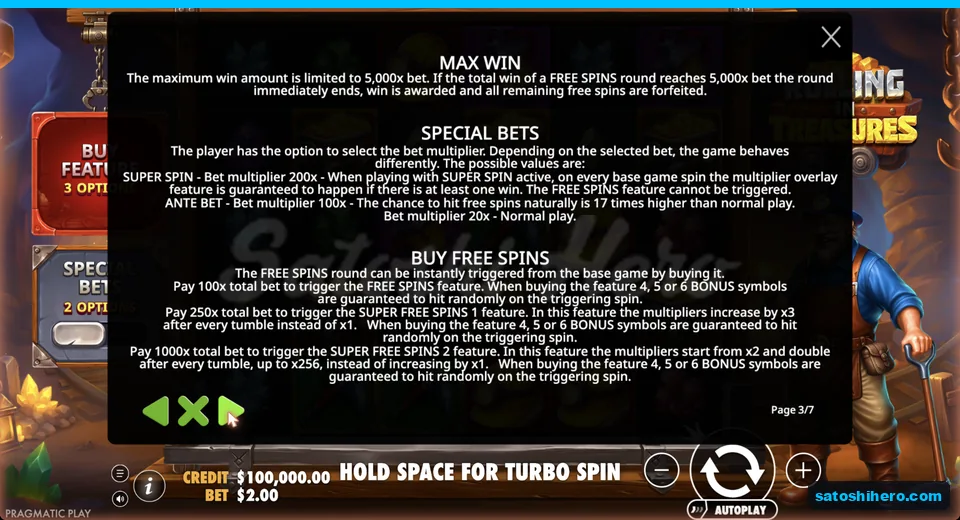
At the $2 bet, standard Free Spins cost $200. That buy gives you the regular bonus where the multiplier grows by +1 every tumble. It costs 100x the stake, so even the cheapest buy needs a clear bankroll limit.
Super Free Spins 1 costs $500 at the same $2 stake. In that version, the multiplier grows by +3 every tumble. The stronger growth sounds attractive, but the higher cost means weak symbol hits can still leave a painful result.
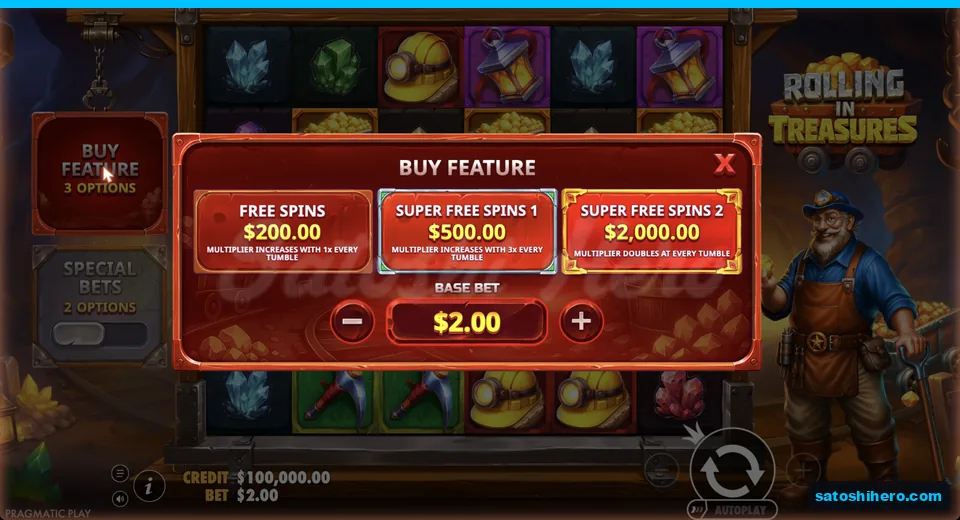
Super Free Spins 2 costs $2,000. It starts at 2x and doubles every tumble up to 256x. That structure looks explosive, but the official 5,000x maximum win still caps the top result.
Caution: At a $2 stake, the top buy costs $2,000, so frame it as an extreme-variance option for experienced high-risk bankrolls.
Special bet choices
The Special Bets add two more paths. Super Spin guarantees the multiplier overlay on every base win, but it disables free spins. That trade feels sharp because you gain base-game consistency while giving up the main bonus trigger.
The Ante bet makes free spins trigger far more often. You still need the round to connect, so don’t treat the ante as a promise. I prefer testing these settings at smaller stakes because each toggle changes the cost and feel of the session.
These choices aren’t automatically better. They simply move risk into different parts of the game. If you want to experiment, start lower, watch how the grid behaves, then decide whether the extra cost earns its place.
Standard Buy Test
The standard Free Spins buy was cold in my test, returning $71.90 from a $200 cost. That result didn’t make the feature bad, but it showed how variance can punish even a strong multiplier setup.
Buy cost
I bought the standard free spins once at the $2 bet. The price was $200, which equals 100x the stake. That’s a meaningful chunk for one feature round, so I wanted the result to show how the buy actually felt.
The buy awarded 10 free spins. The multiplier climbed as tumbles happened, just as the rules promise. The problem was simple: the symbol connections stayed too weak to turn that growing multiplier into a big return.
You can test the Rolling in Treasures demo on SatoshiHero before using real balance. I’d do that if you’re curious about the buy menu, because watching one feature unfold teaches more than reading the price list.
Test result
The round paid $71.90 in total. Against the $200 cost, that put the buy $128.10 below its price. I didn’t love the result, but I did like that it showed the feature honestly.
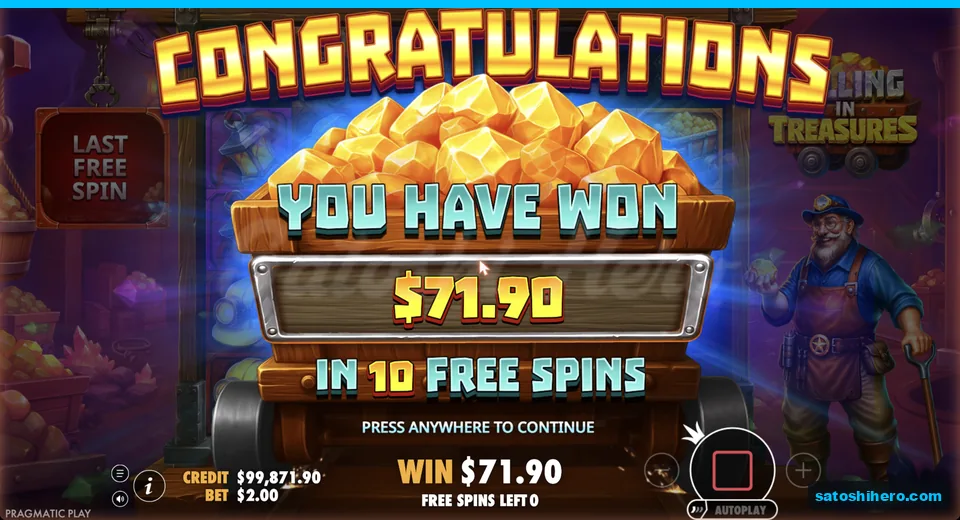
A strong mechanic doesn’t guarantee a strong paid round. You still need matching symbols to land when the multiplier has value. In my buy, the meter climbed, yet the screen didn’t give it enough useful hits.
That’s the lesson I’d take from this test. Bonus buys should fit your bankroll, not your mood. If a cold $200 round would annoy you, the higher buys deserve even more caution.
How It Played Across 500 Spins
Across 500 spins, the base game performed better than the bought bonus and finished about $265 up. That surprised me, because high volatility slots can drain a test balance before the good hits arrive.
Session rhythm
I played 500 spins at $2 per spin from a fresh $100,000 balance. Frequent tumble wins and multiplier overlays kept the session moving. The balance stayed above the start line for most of the run, which felt steadier than I expected from this math profile.
The base game carried the test more than the buy did. Small wins came often enough to soften the dry patches, and the overlays gave several hits extra weight. You shouldn’t read that as a low-risk signal, though.
If you mainly want direct free-spins-led action, Hot to Burn – 7 Deadly Free Spins gives a different pace. This slot leans more on tumble chains and overlay boosts. That makes the base game feel busier, even when the bonus doesn’t show.
Balance movement
My final result landed about $265 ahead. For a 500-spin sample at $2, that felt like a fair win without pretending the slot had gone wild. The session never felt like a max-win chase, but it did feel playable.
You should still frame the result as one session. Another 500 spins could land colder, especially if the overlays miss the right symbol groups. The simulator spread later in this guide makes that swing risk clear.
I came away liking the base game more than the buy result suggested. The overlays gave the session enough lift to hold my interest. If you play, focus on bankroll length first, then feature chasing second.
RTP, Volatility & Our Test
Rolling in Treasures has 96.5% theoretical RTP, high volatility and a 5,000x maximum win, so the math points to a swingy multiplier slot. Pay-anywhere wins, tumbles and escalating multipliers drive that profile, and you can feel the variance even when the base game behaves well.
Simulator projection
Our simulator modelled 1,000 spins at the $2 bet using the 96.5% RTP and high volatility profile. The median result finished about $128 down. The 5th percentile fell near $635 down, while the 95th percentile reached around $738 up.
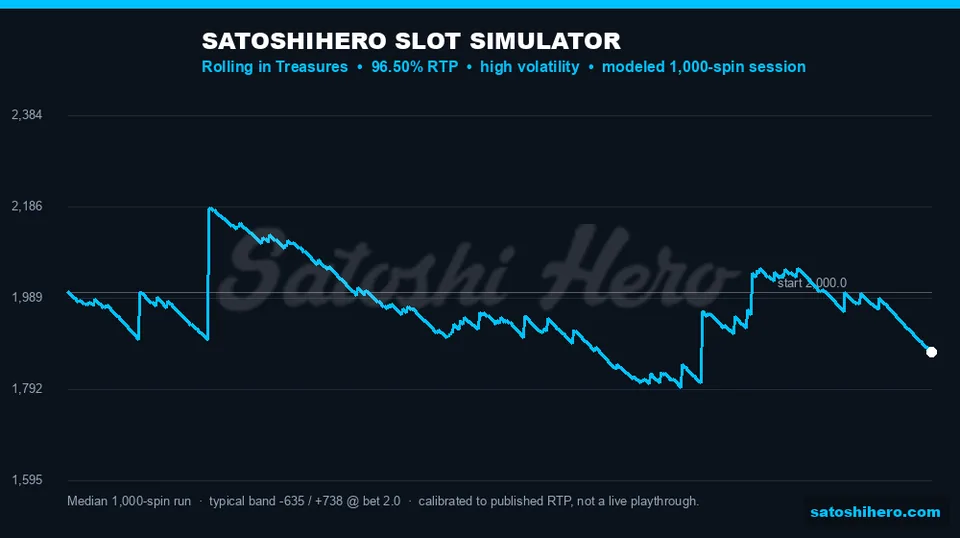
That range tells you more than the headline RTP alone. Short sessions can land on either side of the average, especially when multiplier value depends on the right symbols connecting. I think the curve fits the design.
The slot doesn’t rely on one flat bonus prize. It leans on escalating multipliers, so the best sessions need several moving parts to line up.
Our 500-spin session
My 500-spin session at $2 finished about $265 up. Base multiplier overlays kept the run above starting balance for much of the test. That made the base game feel steadier than the standard bonus buy.
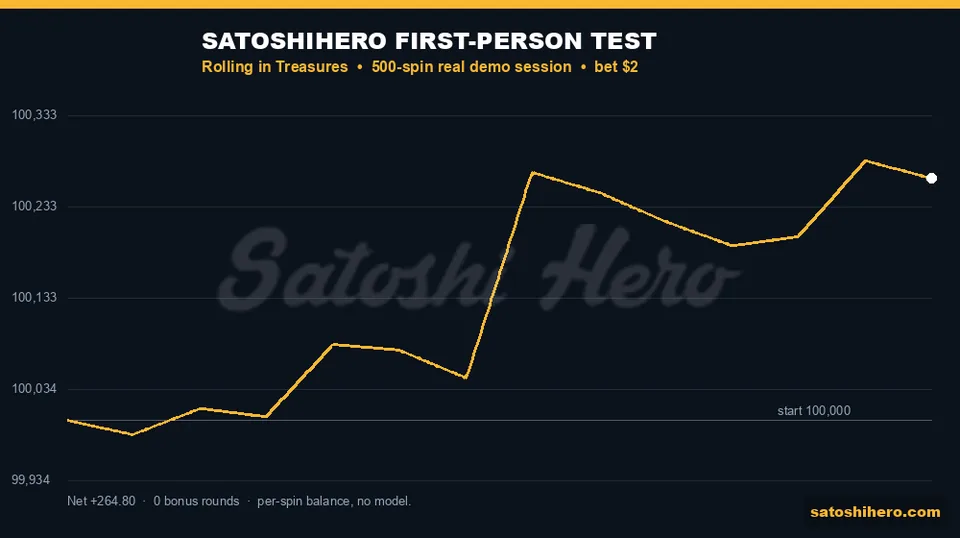
The contrast mattered. My bought round cost $200 and returned only $71.90, while the base session held up through repeated smaller wins. You can see why I wouldn’t judge this game only by the buy menu.
The official volatility is high, and I agree with that label. The wins can cluster, then the grid can go quiet. The theoretical RTP is the operator-published long-run figure, a single live session doesn’t prove or change the theoretical return, and bonus-buy RTPs can sit slightly different from the base game by design.
Frequently Asked Questions About Rolling in Treasures
What is the grid and how do wins work in Rolling in Treasures?
Rolling in Treasures plays on a 6-reel, 5-row grid where symbols pay anywhere. Wins depend on the total number of one matching symbol on the screen at the end of a spin, so there are no fixed lines. Winning symbols then tumble away, and new symbols can create more chances.
How does the multiplier overlay work in Rolling in Treasures?
In the base game, new symbols that tumble into a win can randomly carry a 2x multiplier. Each further tumble on that spin adds +1 to new symbols, and winning multipliers add together before multiplying the win. Base-game multipliers reset each spin, while free spins keep climbing through the round.
How do you trigger the free spins in Rolling in Treasures?
You trigger free spins by landing 4, 5 or 6 miner Bonus symbols, which award 10, 15 or 20 free spins. During the round, the multiplier grows by +1 for every tumble across the feature and doesn’t reset. Landing 3+ Bonus symbols retriggers 5 extra spins.
Which buy feature options does Rolling in Treasures include?
At the $2 bet, standard Free Spins cost $200 and grow the multiplier by +1 every tumble. Super Free Spins 1 costs $500 and grows it by +3. Super Free Spins 2 costs $2,000, starts at 2x and doubles every tumble up to 256x.
What is the volatility and max win in Rolling in Treasures?
Rolling in Treasures is a high volatility slot with a 5,000x maximum win. In my 500-spin session, multiplier overlays kept the balance up and the session finished about $265 ahead. The tested $200 free spins buy paid only $71.90, which shows the swing risk.
Is buying the free spins worth it?
Buying free spins can be exciting, but it carries high variance. My tested standard buy cost $200 and returned $71.90 after the multiplier climbed without strong symbol hits. Results can land far above or far below the buy price, so you should size your stake carefully.
Final Thoughts
Rolling in Treasures stands out because the base game has more life than many high volatility slots. The main drawback is clear: bonus buys can cost a lot and still return very little.

My Verdict
Patient players get the best read on this game through normal spins before touching the buy menu. Expect visible swing potential, useful multiplier moments, and dry patches that can still test your balance. I’d treat the $200 buy as a serious risk, not a routine shortcut.
I like the way the base multiplier overlay carried my 500-spin session. I don’t like how quickly the buy feature can punish a weak round, even when the multiplier climbs. That mix makes the game interesting, but not gentle.
Rolling in Treasures earns a place on my list for pay-anywhere grid fans, clear-symbol readers and high volatility tumble chasers. The guide is checked regularly so the practical notes stay aligned with the playable version on SatoshiHero.

Pros:
 Clear grid: Pay-anywhere wins make the whole screen easy to track.
- Strong base feature: Multiplier overlays can turn modest tumbles into useful hits.
- Flexible bonuses: Three buys let you choose different risk levels.
- Fair headline math: 96.5% RTP sits solidly for this style.

Cons:
 High variance: Dry spells can still pressure smaller bankrolls.
- Expensive top buy: The $2,000 option can drain balance fast.
- Modest ceiling: A 5,000x cap feels controlled for high volatility.

Best For: High volatility players who like tumble chains, visible multipliers and clear mining symbols get the most value here. Careful bankroll managers should start with base spins or demo play before testing buys. Cold-bonus haters should keep the buy menu at arm’s length.





























































Bets
All Bets
Game
Player
Date
Wager
Mult.Multiplier
Prize
 Royal Fruits 9: Hold 'n' Link
 nina87
- 22:15:06
- 3×
- Big Banker Bonanza
 josh1998
- 22:15:05
- 0×
- Big Bass Hold & Spinner Megaways
 gavthornberry
- 22:15:02
- 0×
- Royal Fruits 9: Hold 'n' Link
- mdp0fxo
- 22:15:01
- 0×
- Big Bass Hold & Spinner Megaways
- gavthornberry
- 22:15:00
- 0.5×
- Royal Fruits 9: Hold 'n' Link
- mdp0fxo
- 22:14:54
- 2×
- Big Bass Hold & Spinner Megaways
- gavthornberry
- 22:14:48
- 0×
- Big Bass Hold & Spinner Megaways
- gavthornberry
- 22:14:44
- 0×
- Big Bass Hold & Spinner Megaways
- gavthornberry
- 22:14:40
- 0×
- Royal Fruits 9: Hold 'n' Link
- nina87
- 22:14:38
- 0×