

Fruit Party
By pressing play, you agree that you are above legal age in your jurisdiction and that your jurisdiction allows online gambling.


Fruit Party slot Turns a Bright Fruit Board into a Multiplier Chase
Fruit Party slot looks cheerful, but the real story is a high-volatility cluster game where one multiplier-heavy bonus can decide the whole session. I read it as a bright 7×7 fruit board with simple clusters, fast tumbles, and sharp bonus pressure, so the friendly surface needs a careful stake plan.
Key takeaways
Fruit Party is a high-volatility slot from Pragmatic Play with 96.5% RTP and 5000x max win potential. It uses a 7×7 grid with cluster pays instead of fixed lines, stakes run from $0.20 to $100.00, and you can play the fruit party demo or real mode on SatoshiHero. Aimed at cluster-slot fans who like bright boards, multiplier swings, and bonus-led sessions more than steady low-risk play.
- Best bonus: Free Spins carry the biggest upside because multiplier symbols appear more often there.
- Best play: The Buy Free Spins option costs 100x stake, and my $200 buy returned $207.10.
- RTP / volatility: The official profile shows 96.5% RTP, high volatility, and a 5000x maximum win.
- Risk note: Base-game tumbles create small action, but the session can stay flat until a bonus lands.
- Bankroll note: Use smaller stakes when buying bonuses because 100x stake per buy drains fast.

Table of Contents
- How Fruit Party slot Works
- Cluster pay basics
- Symbol value ladder
- Symbols and Payouts
- Theme & First Impressions
- Candy-orchard look
- Readability and pace
- Tumble Feature
- Cascading win sequence
- How wins settle
- Random Multiplier
- Base-game multipliers
- Bonus multiplier stack
- Free Spins
- Scatter trigger rules
- Retrigger potential
- Bonus Buy Test
- Buy price
- Test result
- How It Played
- Base-game grind
- Bonus-led finish
- RTP, Volatility & Our Test
- Simulator projection
- Our 500-spin session
- Frequently Asked Questions About Fruit Party
- Final Thoughts
How Fruit Party slot Works
Fruit Party slot is a 7×7 cluster-pay game, not a fixed-payline slot. You need at least five matching symbols connected side to side or top to bottom, so you’re watching blocks rather than lines.
Cluster pay basics
The board gives you 49 positions, and each spin checks the full grid for connected fruit. That setup feels easy to read once you stop looking for paylines. I think that matters, because the game moves quickly and doesn’t give you much time to overthink each drop.
Tumbles and random multipliers sit on top of the cluster system. A paid cluster clears, new fruit drops in, and the spin keeps checking for more matches. You should wait until the whole chain ends before judging the result, since one modest hit can grow through several drops.
Mobile and desktop play keep the same layout and controls, so you don’t need to relearn the board on a smaller screen. The 7×7 grid still feels clear, though I prefer the wider view when multipliers start stacking.
Symbol value ladder
The gold bomb scatter appears across the board and triggers Free Spins with three or more. It doesn’t join normal fruit clusters, so you should treat it as a separate bonus symbol. Once you understand clusters and scatters, Fruit Party slot becomes much easier to read.

I don’t like calling this a line slot because that misses the whole point. You’re chasing connected blocks, tumbling follow-ups, and multiplier overlap. That mix gives the game its simple surface and sharp bite.
Symbols and Payouts
The paytable stays simple, but bigger connected fruit blocks matter because payouts scale by cluster size. At a $2 stake, the seven paying symbols run from small heart hits to premium strawberry clusters.
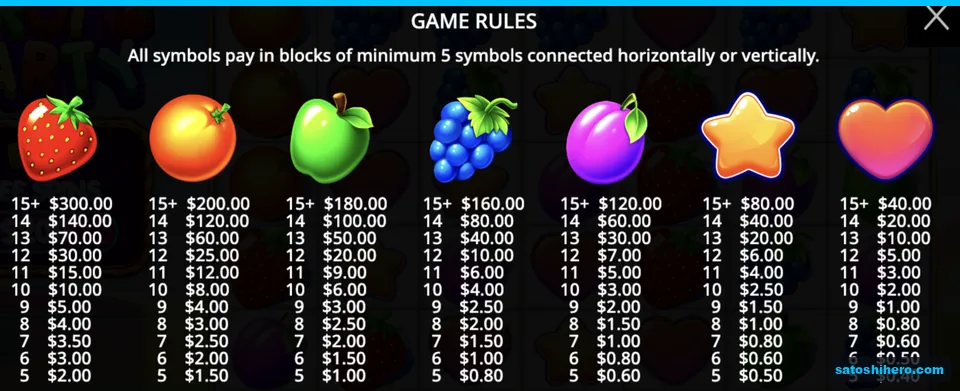
- Strawberry pays $2.00 for five and up to $300.00 for 15 or more.
- Orange pays $1.50 for five and up to $200.00 for 15 or more.
- Green apple pays $1.00 for five and up to $180.00 for 15 or more.
- Blue grapes pay $0.80 for five and up to $160.00 for 15 or more.
- Purple plum pays $0.60 for five and up to $120.00 for 15 or more.
- Gold star pays $0.50 for five and up to $80.00 for 15 or more.
- Red heart pays $0.40 for five and up to $40.00 for 15 or more.
You don’t need to memorize every paytable step. Focus on the premium fruit first, then watch how large the connected block gets. I feel the ladder works because it rewards clear visual patterns rather than hidden line math.
The scatter sits outside those fruit payouts. Three or more gold bomb scatters start the Free Spins round, while normal fruit clusters keep the base game moving. You’re not chasing lines here, you’re watching connected blocks build value.
Fruit Party slot can make low symbols matter when multipliers join the cluster. A heart block alone doesn’t excite me much, but a multiplied heart cluster can still lift a weak spin. Premium fruit matters most when the multiplier system joins the hit.
Theme & First Impressions
The game looks like a bright candy-orchard board, but it plays with sharper risk than the theme suggests. Glossy strawberries, oranges, apples, grapes, plums, stars, and hearts fill a clean 7×7 layout.
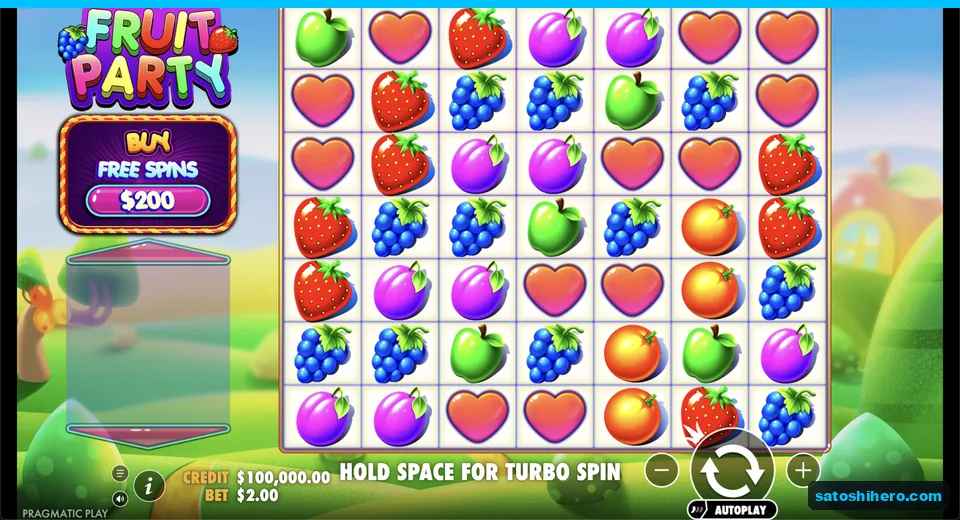
Candy-orchard look
There’s no character-led story or deep world here. The fruit-board style feels closer to a colorful fruit tray for party visuals than a narrative slot theme. That isn’t a complaint, because the simple look helps you follow fast clusters.
I like the cheerful palette, though it won’t win originality awards. Fruit Rainbow makes sense as a comparison if you’re drawn to bright fruit visuals and readable boards. This game feels cleaner and more math-driven than its soft artwork suggests.

Quick Fact: The friendly fruit-board look hides a high-volatility game with a 5000x cap.
Readability and pace
The art stays crisp during quick spins, and the packed board rarely turns into visual noise. You can spot the premium fruit quickly, which matters when tumbles begin. I think the clear symbol shapes do more work than the theme itself.
The sunny fruit-board look feels friendlier than the math underneath. SatoshiHero guide maintenance includes screenshots and live checks, so the visual notes stay checked regularly. You get a simple theme, but the risk profile has real teeth.
Tumble Feature
Every paid spin can keep going because winning clusters clear, symbols drop, and fresh fruit falls in. That tumble loop gives Fruit Party slot its base-game rhythm.
Cascading win sequence
The sequence starts when a cluster pays. Those winning symbols vanish, the remaining symbols drop down, and fresh fruit falls from above. If another cluster forms, the process repeats from the same paid spin.
You shouldn’t judge a result after the first hit. I saw small base-game clusters grow through extra drops, even when the total stayed modest. The $2.50 base-game hit with multiplier action showed that the board can add value after a plain-looking start.
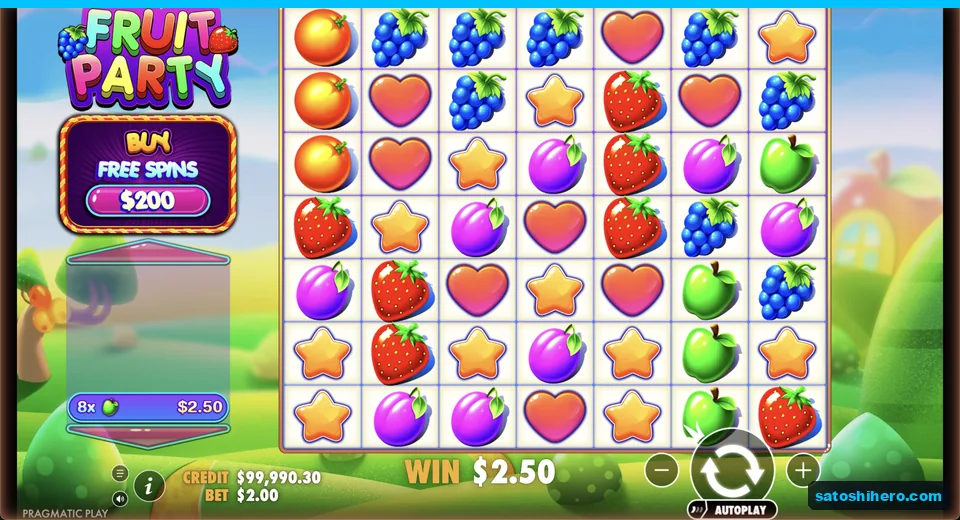
The mechanic feels satisfying because each drop gives the spin another chance. Still, most base-game sequences stay small. I like the pace, but I wouldn’t mistake frequent movement for frequent strong returns.
How wins settle
All tumble wins from one spin add together. The game pays the total once the chain ends, not after each drop. That timing matters because the balance only updates when the full sequence settles.
You should watch the left side and the board together. Multipliers can change the value of a cluster fast, and a final drop can matter more than the first match. The practical lesson is simple: wait for the whole chain before you judge the spin.
Fruit Party slot gets much of its entertainment from this stop-start rhythm. The feature keeps quiet stretches from feeling totally dead, but it doesn’t remove the high volatility. You still need patience when the bonus refuses to show.
Random Multiplier
Random multipliers create the game’s biggest jump potential because several values can land on one winning cluster. This is the feature that gives the fruit board real bite.
Base-game multipliers
In the base game, any symbol inside a winning cluster can randomly carry a 2x multiplier. If more than one multiplier lands on the same winning block, the values multiply together. One block can reach a 256x multiplier cap.
That rule makes small fruit clusters more interesting than they look. You may see a weak symbol group turn meaningful when two or more multipliers join it. I like that tension, because the board can surprise you without adding complicated bonus rules.

Did You Know? Multiple multiplier symbols on one winning cluster multiply together, up to a 256x cap on a single block.
Bonus multiplier stack
Free Spins use 2x or 4x values, and they appear far more often during the feature. The meter on the left stacks those values as the round plays, which makes the bonus feel much more volatile than the base game.
During my test, one Free Spins apple cluster hit a 128x multiplier and paid $128.00 from a single block. That moment explained the whole slot better than the paytable could. You can grind through many ordinary drops, then one multiplied cluster does the work.
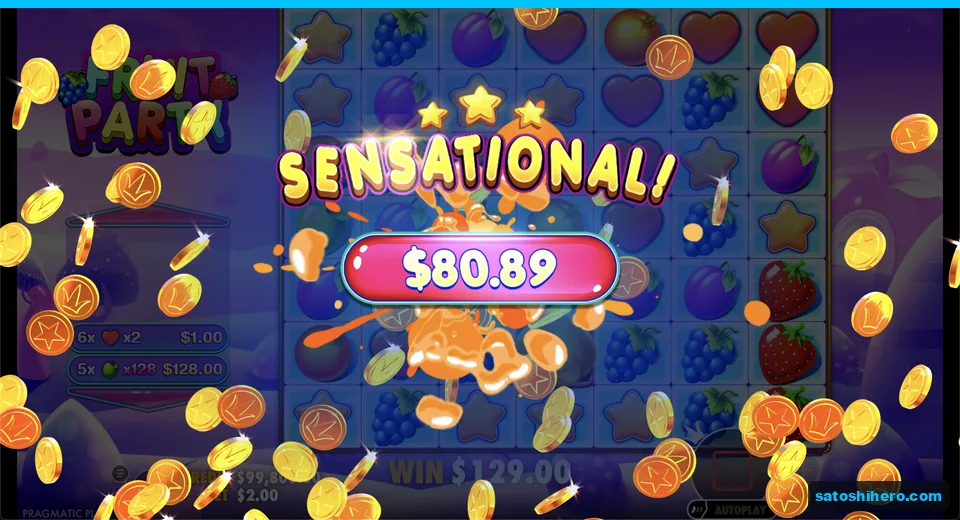
Fruit Party slot rewards you when multiplier overlap meets a decent cluster. The base game gives flashes of it, but the bonus shows the system at full strength. You need to respect that swing, because the gap between dull and explosive can feel huge.
Free Spins
Free Spins are the main bonus, and the biggest results come from their higher multiplier frequency. Three or more gold scatter bombs trigger the round with 10 spins on special reels.
Scatter trigger rules
The scatter rule is easy to follow. Three gold bombs start the feature, and the bonus keeps the same cluster-pay idea while boosting multiplier chances. You’re still watching connected fruit blocks, but each hit feels more dangerous.

Caution: High volatility means long quiet stretches are normal. Size your stake so you can survive the wait for Free Spins.
I triggered two organic Free Spins rounds in my 500-spin test. The strongest paid $1,282.90 at a $2 stake, which landed around 641x. The second paid $79.20, and that contrast shows why I don’t treat every bonus as a rescue.
Retrigger potential
Scatters can retrigger during Free Spins. Three more add 10 spins, four add 11, and the scale reaches 14 extra spins for seven scatters. You want extra spins because the whole feature carries stronger multiplier frequency.
This is where the 5000x cap becomes theoretically relevant, even though most rounds don’t get close. Fruit Party 2 makes a natural sequel comparison if you like this cluster and multiplier family. I’d still judge the original on its own sharp, bonus-heavy rhythm.
Fruit Party slot lives and dies by this round. If the feature lands cold, the session may barely move. If a multiplier-heavy block connects, one bonus can carry everything.
Bonus Buy Test
Buy Free Spins gives instant access to the 10-spin bonus for 100x stake, but it acts as a high-variance shortcut rather than a reliable edge. At a $2 bet, my buy cost $200.
Buy price
The button purchases the same 10-spin feature without waiting for scatters. That sounds tempting, especially after a dry base-game stretch. I don’t think you should treat it as a fix for cold spins, because the cost lands hard.
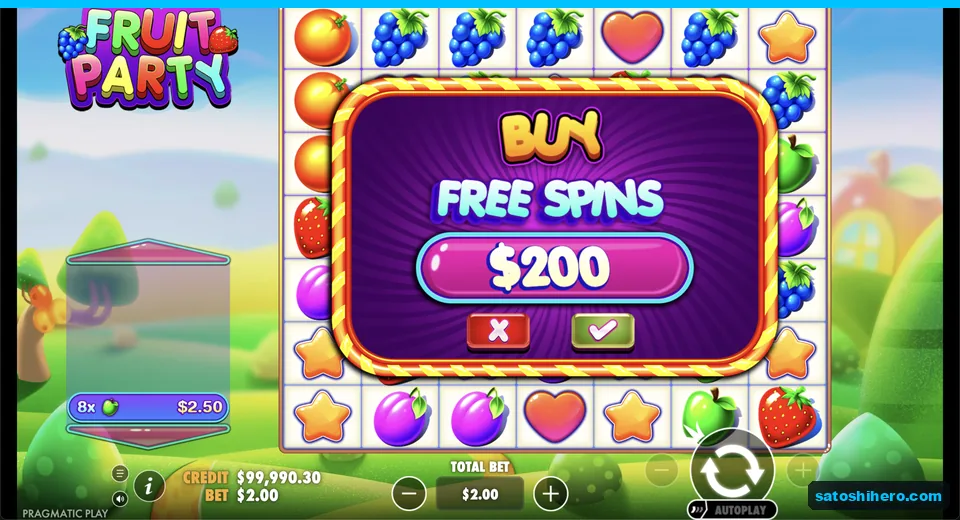

Pro Tip: If you test the buy, separate that bankroll from normal spins so you can judge the purchase cleanly.
Repeated buys magnify bankroll swings. Gold Party fits the comparison here because party-style Pragmatic pacing can make feature access feel exciting, yet the risk still sits in the price. You need discipline before clicking a 100x stake button.
Test result
My bought round opened with a 128x apple block and paid $207.10 total; that returned just above cost at 103.55x stake. It felt like a lucky escape rather than a strong win.
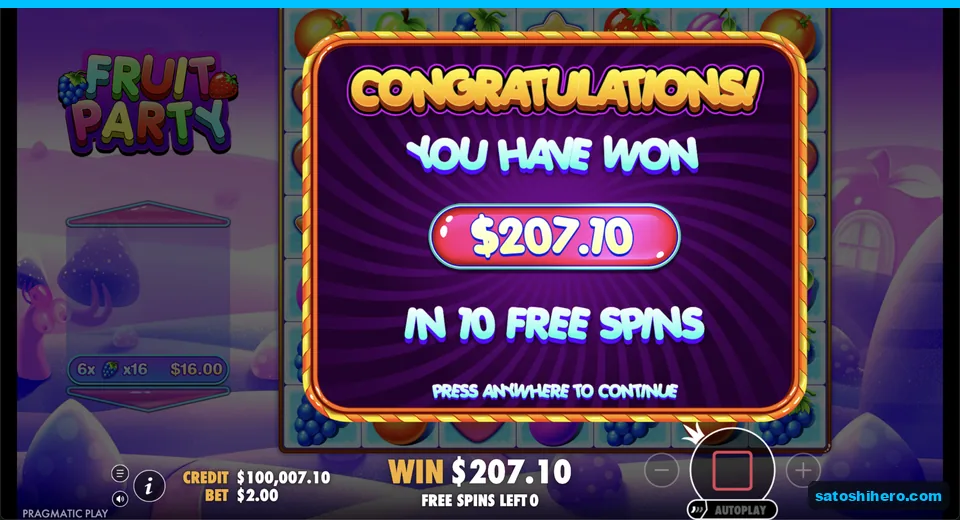
The buy was technically profitable in this sample, but barely. A weaker first cluster could have turned the whole purchase red. Fruit Party slot gives you a fast route to the bonus, not a dependable strategy.
I’d only test the buy at a stake that feels smaller than your normal comfort level. You’re compressing a lot of risk into one click. The feature can pay, but the price makes every poor round sting.
How It Played
The 500-spin test played flat for long stretches, then one large bonus flipped the whole session. I ran it at a $2 stake from a fresh $100,000 demo balance.
Base-game grind
The fruit party demo helped me evaluate session shape without treating the result as a real-money forecast. The base game ground slowly and often sat under the start line. You could see tumbles, but most didn’t create meaningful balance movement.
That part felt honest to the high rating. I don’t mind cold stretches when the payoff path looks clear, but this game can test your patience. If you chase every dip, you’ll probably overbet before the feature arrives.
Dance Party works as an alternative to compare if you like party-themed slots but want different pacing and feature dependence. This game feels more focused on clusters and multiplier pressure. You get fewer big moments, but those moments can land hard.
Bonus-led finish
Two organic Free Spins rounds flipped my test green. The best paid $1,282.90, while the second added $79.20. The final balance reached $100,744.80, giving me a net result of +$744.80.
That outcome looks strong, but the path mattered more than the total. The base game didn’t build the win slowly. One large bonus carried most of it, which tells you how sessions can feel.
Fruit Party slot is a flat-then-spike game. You may sit through a dull stretch, then one feature changes the graph. I like that drama, though I’d never call it gentle.
RTP, Volatility & Our Test
The official profile is 96.5% RTP, high volatility, and a 5000x cap, and my test matched that swingy shape. Pragmatic Play built this as a Slots title with 7×7 cluster pays instead of fixed lines.
The in-game rules page lists 96.47%, while the headline official RTP remains 96.5%; stakes run from $0.20 to $100.00, and the maximum win is 5000x your stake; at $2, that cap equals $10,000 before the round closes at the limit.
Snow Party gives a useful comparison point if you’re weighing party-style titles by volatility and session swings. I’d place this one firmly in the patience-required camp. You need a bankroll plan before the bonus does any heavy lifting.
Simulator projection
Our simulator modeled 1,000 spins at a $2 stake using the published 96.5% RTP, high volatility, and the 5000x cap. The median session finished about $151 down. The typical band ran from about $643 down at the 5th percentile to about $637 up at the 95th percentile.
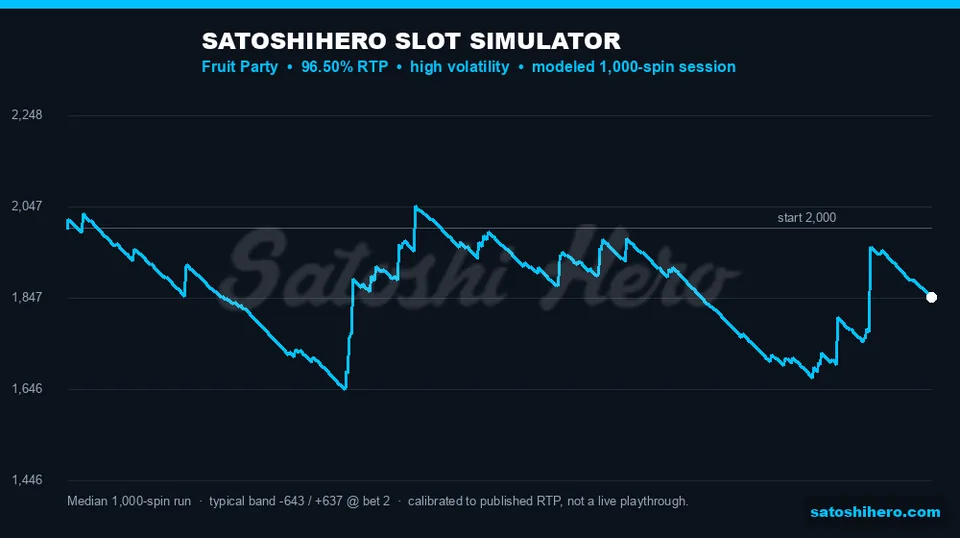
A feature-sized result, meaning 10x a spin or better, modeled around once every 46 spins. A 100x-plus hit modeled around once every 1,629 spins. I like those numbers because they show the shape without pretending to call the next result.
The model points to uneven returns, not a smooth climb. You might see action through tumbles, but the larger hits sit far apart. That fits my table feel almost exactly.
Our 500-spin session
I played 500 spins at $2 from a $100,000 starting demo balance; the end balance hit $100,744.80, giving me a +$744.80 net result. Two organic Free Spins rounds paid $1,282.90 and $79.20.
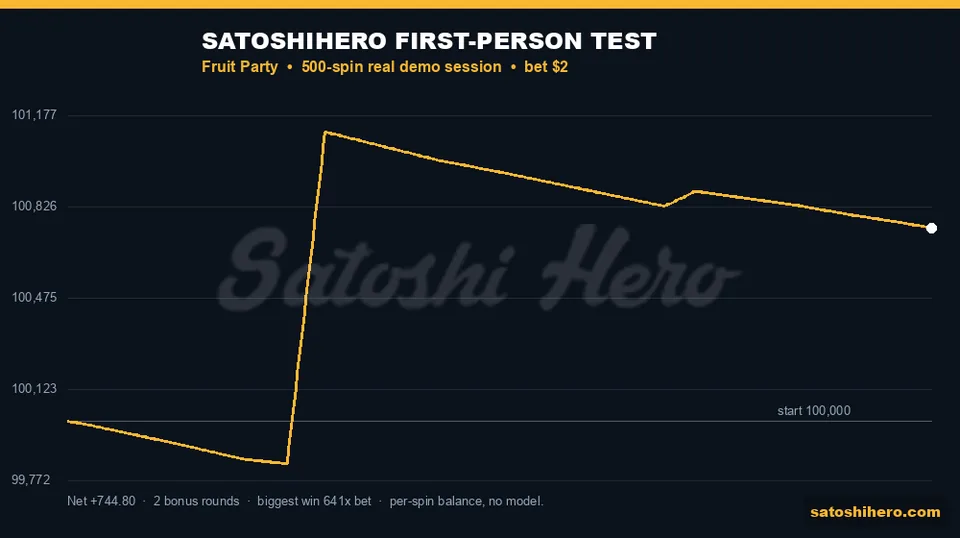
I also bought Free Spins once for $200 and got $207.10 back. That bonus opened with a 128x apple block, which made the result feel lucky despite the tiny profit. The whole test looked like classic high volatility: long flat sections, then one bonus decides the outcome.
The theoretical RTP is the operator’s published return figure. A single live or demo session doesn’t change that figure, and bonus buys or feature modes can sit slightly different from base play by design. The simulator is a model, not a prediction of any individual session.
Frequently Asked Questions About Fruit Party
How do the random multipliers work in Fruit Party slot?
Any symbol that forms part of a winning cluster can randomly carry a multiplier. In the base game, that value is 2x per symbol, and several multipliers on one win multiply together up to a 256x cap on one block. Free Spins use 2x or 4x values more often, so the biggest jumps usually happen there.
What does it take to trigger Free Spins in Fruit Party slot?
Three or more gold scatter bombs anywhere on the board start the Free Spins round. The feature begins with 10 spins on special reels, and extra scatters can retrigger it for 10 to 14 more spins. My best organic round paid $1,282.90 at a $2 stake.
What is the Tumble feature in Fruit Party slot?
After a cluster pays, the winning symbols vanish and the remaining fruit drops down. New symbols fall from above, and the sequence repeats if another cluster forms. The game adds all wins from that spin together and pays them when the tumble chain ends.
What did the 1000-spin simulator show for Fruit Party slot?
At a $2 stake, using 96.5% RTP and the 5000x cap, the median run finished about $151 down. The typical range ran from roughly $643 down to about $637 up. A 100x-plus hit modeled around once every 1,629 spins, so the model showed swingy session shape.
How did the real 500-spin Fruit Party test go?
I started with a fresh $100,000 demo balance and played 500 spins at $2. The run finished at $100,744.80 for a +$744.80 net result. Two organic Free Spins rounds did the work, paying $1,282.90 and $79.20.
What are the RTP and maximum win on Fruit Party?
The headline RTP is 96.5%, while the in-game rules page lists 96.47%; volatility is high, and the maximum win is capped at 5000x your stake. A $2 spin can return up to $10,000 before the cap closes the round.
Is buying the Free Spins in Fruit Party worth it?
The Buy Free Spins button costs 100x stake, so my $2 test buy cost $200. It returned $207.10 after opening with a 128x apple block, which beat the price by a tiny margin. I’d treat it as a high-variance shortcut, not a reliable edge.
Final Thoughts
Fruit Party stands out because it turns a simple fruit board into a sharp multiplier chase. The main drawback is the wait, because high volatility can make the base game feel flat before Free Spins arrive.

My Verdict
Patient cluster-slot fans get the most from this game, especially if they like bonus-led results. Expect quiet sections, small tumble hits, and sudden swings when multipliers stack inside Free Spins. I’d keep stakes modest and let the feature do the talking.
I like the clean grid, fast tumbles, and honest sense of risk. I don’t like how quickly a bonus-buy run can pressure your balance, even when the feature looks close. My 500-spin test finished well, but one strong organic bonus carried most of the result.
Fruit Party slot deserves attention if you enjoy bright cluster games with real swing potential. SatoshiHero screenshots, specs, and test notes are updated periodically so the guide stays aligned with live checks.

Pros:
 Clear cluster play: Connected blocks make wins easy to follow on every spin.
- Strong bonus ceiling: Free Spins can turn one multiplier block into a major hit.
- Readable design: Bright fruit symbols stay clear during fast tumble chains.
- Useful buy test: The $200 buy result shows real feature-buy risk.

Cons:
 Cold base game: Long flat stretches can drain impatient bankrolls.
- Expensive buy: A 100x stake cost makes repeated purchases dangerous.
- Modest cap: The 5000x ceiling feels controlled for this volatility.

Best For: Bonus hunters, cluster-pay fans, and patient bankroll managers get the most value here. The theme looks light, but the math asks you to handle swings calmly. If you prefer steady small wins, this fruit board may feel too spiky.






























































Bets
All Bets
Game
Player
Date
Wager
Mult.Multiplier
Prize
 Heat Hit
 lakidd1987
- 20:33:14
- 0×
- Elephant's Gold: Bonus Combo
 Hidden
- 20:33:10
- 0×
- Royal Fruits 9: Hold 'n' Link
 Hidden
- 20:33:10
- 0×
- Elephant's Gold: Bonus Combo
- Hidden
- 20:33:10
- 0×
- Royal Fruits 9: Hold 'n' Link
- Hidden
- 20:33:10
- 0×
- Flynn's Gold Clovers: Hold And Win
 Hidden
- 20:33:08
- 0×
- Heat Hit
- lakidd1987
- 20:33:07
- 0.89×
- Elephant's Gold: Bonus Combo
- josh1998
- 20:33:05
- 0×
- Flynn's Gold Clovers: Hold And Win
- Hidden
- 20:33:04
- 0×
- Elephant's Gold: Bonus Combo
- Hidden
- 20:33:04
- 0×