

Money Mansion
By pressing play, you agree that you are above legal age in your jurisdiction and that your jurisdiction allows online gambling.


Trapped After Dark in the Money Mansion slot
The Money Mansion slot sends a frightened girl racing through a comic haunted house. This Popiplay game has very-high volatility, a 95.98% RTP, and 3,525x maximum win potential. Its 5×3 grid uses 20 fixed paylines, x2 and x3 Wild multipliers, and sticky Wilds during Free Spins.
Sharp swings favor patient risk takers. I tested $0.60 spins from $1,000.00; stakes run from $0.20 to $50.00. You can play the demo or real version here on SatoshiHero. The modest ceiling leaves sharp risk, so I separate rules, models, and observed play.
Key takeaways
- Best bonus: Standard play supplied my only evidenced Free Spins trigger; I didn’t test the Buy Bonus.
- RTP / volatility: The theoretical RTP is 95.98%, paired with a very-high volatility profile.
- Max win: The top prize stops at 3,525x the bet.
- Risk note: My 100 spins lost 65.25x, while the only bonus round returned just 7.7x.
- Bankroll note: Pick a stake that leaves room for long slides because most observed wins didn’t cover later spins.

Table of Contents
- How Money Mansion Works
- Reels and win lines
- Symbols and pay values
- Theme and First Impressions
- Haunted comic setting
- Pace and readability
- Wild Multipliers
- Random multiplier rules
- What appeared in testing
- Free Spins Behind the Doors
- Trigger and spin count
- Sticky Wild results
- Maximum Win and Payout Potential
- Official win ceiling
- Results versus potential
- Buy Bonus
- How the buy works
- Testing limitation
- Bankroll Lessons From 100 Spins
- Session flow
- Practical stake choice
- RTP, Volatility and Our Test
- The simulator projection
- Our 100-spin session
- Frequently Asked Questions
- Bottom Line
How Money Mansion Works
The Money Mansion slot is a traditional 5×3 game with 20 fixed paylines. Regular combinations start on reel 1 and continue across adjacent reels from left to right. You need symbols in the correct line positions, while the Bonus follows a separate anywhere-pay rule. I find this structure conventional, but you can grasp it within a few spins.
Reels and win lines
The game pays only the highest combination on each active line, then adds awards from different lines. All 20 lines stay active, so you adjust the total stake instead of choosing fewer lines. That setup keeps the Money Mansion slot machine simple, though you should inspect screens containing several highlighted lines.
Three Bonus symbols pay 5x from anywhere on the grid. They start Free Spins only when they occupy reels 1, 3, and 5. This exception matters because ordinary symbols must follow a fixed line from the leftmost reel. The uncluttered layout also stays readable across desktop and mobile screens, which I consider a practical strength.
Symbols and pay values
Four premium characters lead the table: Vampire, Clown, Zombie, and Mummy. Candle and Eyeball symbols sit below them, followed by A, K, Q, J, and 10. At five of a kind, their values are:
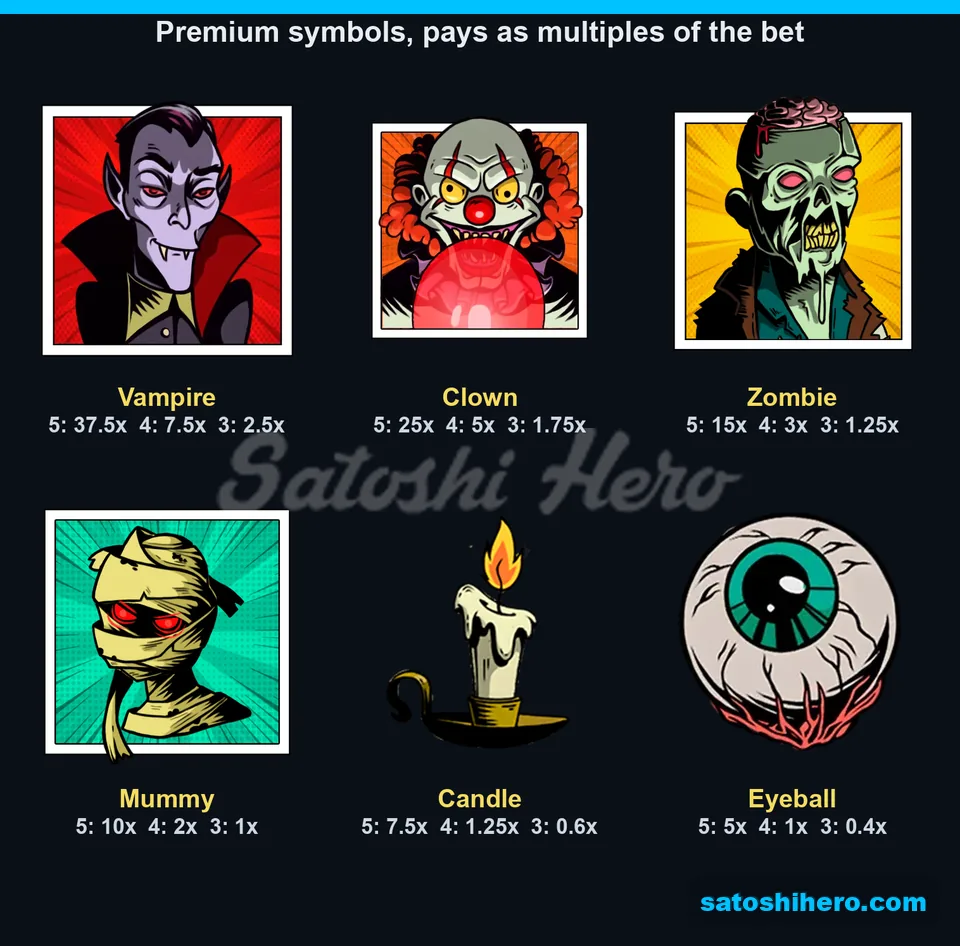
- Vampire: 37.5x
- Clown: 25x
- Zombie: 15x
- Mummy: 10x
- Candle: 7.5x
- Eyeball: 5x
- A and K: 2.5x each
- Q, J, and 10: 1.25x each
The paytable converts those multipliers into dollar amounts for your selected stake. At my $0.60 bet, five Vampires displayed $22.50, exactly 37.5x, while three displayed $1.50 or 2.5x. The ladder is easy to scan, though low-symbol hits remain small. Line position controls regular awards, while the Bonus pays from anywhere.
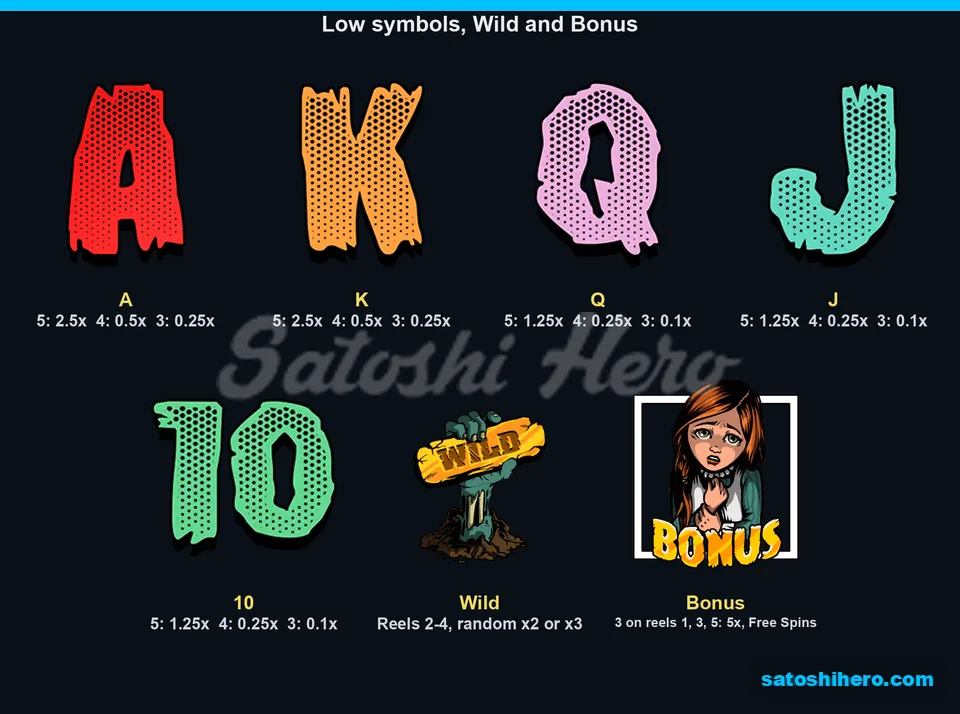

Data Point: Three Bonus symbols pay 5x from anywhere, but reels 1, 3, and 5 must hold them to start Free Spins.
Theme and First Impressions
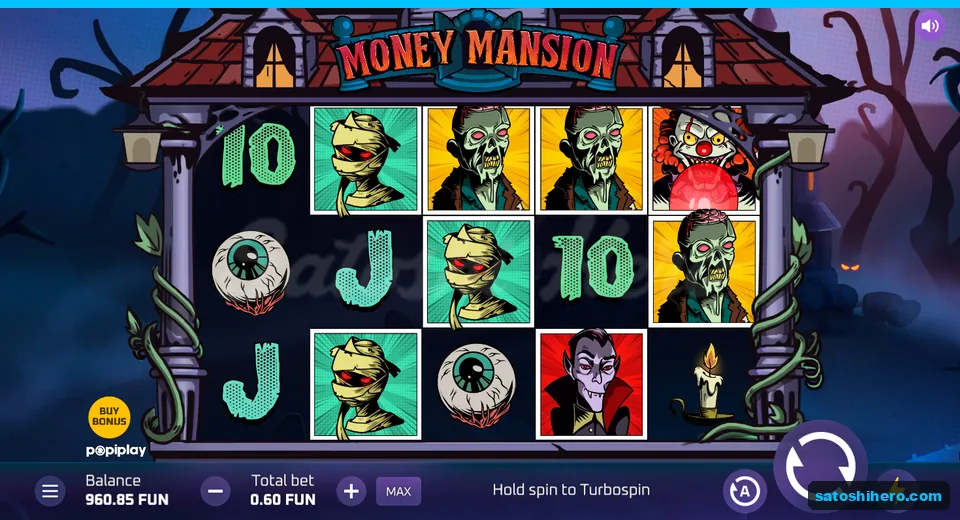
The Money Mansion slot uses bold comic horror rather than a realistic haunted-house style. A frightened girl enters an abandoned mansion filled with familiar movie monsters. You can read the action quickly because thick outlines separate every symbol. I liked that immediate clarity more than the familiar premise.
Haunted comic setting
A moonlit porch frames the reels, with twisted trees and a dark mansion behind them. The Vampire, crystal-ball Clown, Zombie, and Mummy provide the main cast. Candle and Eyeball symbols reinforce the spooky setting instead of feeling like stray paytable filler. You get a coherent scene, even if the monster-mansion idea won’t win originality awards.
The Wild shows a zombie hand pushing a wooden sign from the ground. Meanwhile, the Bonus depicts the frightened girl from the game’s premise. Both special symbols stand apart clearly from the regular cast, which helps you spot them instantly. In my view, that visual clarity matters more than elaborate background detail.
Pace and readability
The settled grid stays clean, and the premium hierarchy remains obvious after each spin. Turbo and autoplay moved my test quickly without hiding final positions. You can inspect each completed grid without visual clutter, a restraint I prefer to long animations.
Bold artwork gives the game a cohesive identity, but it doesn’t attempt much beyond classic comic horror. The quick rhythm fits short checks of the grid and payline highlights. If you value clarity over spectacle, the presentation does its job. Plain and simple, the design favors speed and readable outcomes. Other Popiplay alternatives on SatoshiHero include Unipopcorn, Spinguin, and RoxDogs.

Fun Fact: The Bonus symbol portrays the frightened girl from the premise, while the Wild shows a zombie hand raising a wooden sign.
Wild Multipliers
Wilds appear only on reels 2, 3, and 4 in the Money Mansion slot. They replace every symbol except the Bonus and receive a random x2 or x3 multiplier. Several qualifying Wild modifiers add together rather than multiplying each other. You can’t influence their value, and I think the additive rule keeps the feature understandable but less explosive.
Random multiplier rules
Each Wild applies its modifier to every winning line it helps complete, so one can affect several paylines. If two qualifying Wilds carry x2 and x3, they combine as x5 rather than x6. You should check each highlighted line because the full total can exceed one visible line amount.
The game assigns x2 or x3 automatically, with no player input. I like the clear arithmetic, though multiplication would feel more dramatic. For you, the key rule is simple: add all qualifying modifiers.
What appeared in testing
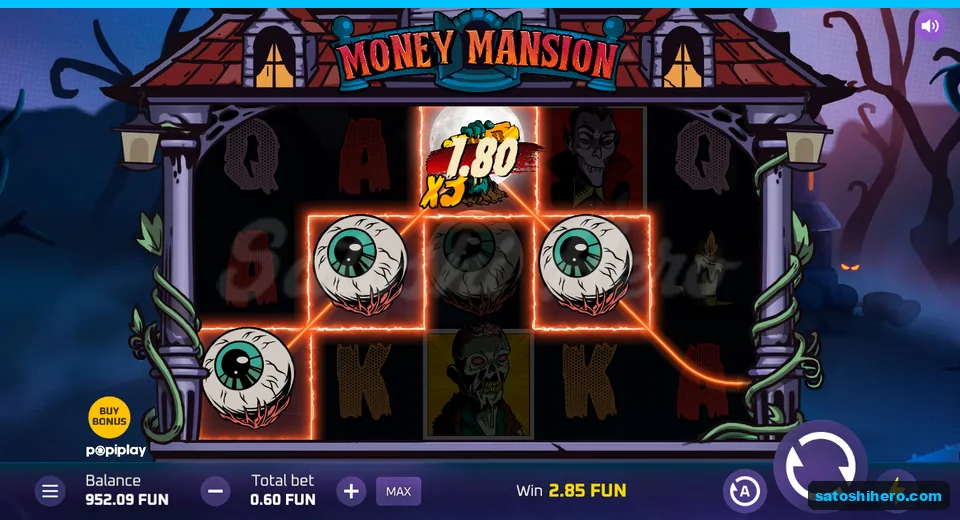
After my counted session, I captured an extra spin with an x3 Wild on the middle reel’s top row. It helped complete an Eyeball line displaying $1.80. The whole spin returned $2.85 at my $0.60 stake, equal to 4.75x. You can see why the line display and total-win field sometimes show different amounts.
That extra result doesn’t belong in my 100-spin totals, graph, or best-win comparison. I used it only to verify how the multiplier and separate line amounts appeared on screen. The screenshot supports the rule without improving the recorded session. That distinction keeps the firsthand results honest.

Suggestion: Check every winning line containing a Wild. One modifier can affect several lines, while multiple qualifying modifiers add together.
Free Spins Behind the Doors
Three Bonus symbols on reels 1, 3, and 5 trigger 9 to 18 Free Spins. They also pay 5x the bet before the feature starts. Sticky multiplier Wilds supply the main potential, yet my only round returned 7.7x in total. You shouldn’t treat a trigger as an automatic recovery, and I found this result distinctly underwhelming.
Trigger and spin count
A closed-door screen appears before the round begins. The Poltergeist opens the doors and settles an award between 9 and 18 spins. Tapping a door adds presentation, not skill, so your choice doesn’t improve the outcome. In my test, the feature arrived on counted spin 16 and awarded 10 spins.
The game kept my $0.60 bet and fixed lines, then ran the spins automatically. A corner counter tracked the remaining turns. You get suspense from the doors but no strategic choice, and I liked the brief setup.
Sticky Wild results
Every Wild landing on reels 2 through 4 stays fixed until the last Free Spin. It also keeps its assigned x2 or x3 modifier throughout the round. The feature can’t retrigger, which limits any chance of extending a strong sticky layout. You need several useful Wild placements early for the mechanic to show its best side.
My complete feature return reached $4.62 at $0.60, equal to 7.7x. That total included the $3.00 trigger payment, plus two free-spin awards of $0.18 and $1.44. Most feature spins added nothing, despite the visible sticky-Wild potential. I had to click the Total Win card before returning to the base game.
No sugarcoating: the mechanic looked stronger than my payout proved. You can build useful multipliers, but one trigger needn’t rescue a falling balance. My best overall event still remained small.
Maximum Win and Payout Potential
The maximum award in the Money Mansion slot reaches 3,525x the bet, while my largest logged event returned 7.7x. Those figures describe entirely different things: one is an upper limit, and one is observed play. You shouldn’t treat the advertised ceiling as a routine feature target. I consider that cap restrained beside the game’s sharp variance.
Official win ceiling
The 3,525x figure marks the upper multiplier limit for one result. Raising or lowering your stake changes its dollar value, but the multiplier cap remains unchanged. The number describes what can happen, not how often you can expect it. Keeping that distinction clear prevents a maximum from sounding like an average target.
A larger bet increases potential dollar returns and every losing spin’s cost. You gain no evidence that a higher stake makes the cap easier to reach. I prefer judging that limit against the sharp risk.
Results versus potential
My best overall event was the 7.7x Free Spins round. The strongest counted base-game result came on spin 92, paying $3.15 or 5.25x at $0.60. Neither approached the official limit, and the gap wasn’t remotely close. You should expect ordinary short play to look very different from a theoretical maximum.
The later $2.85 screenshot spin equaled 4.75x but remained outside all counted comparisons. Including it would blur the clean boundary around my 100 autoplay spins. I think disciplined reporting matters most when advertised potential dwarfs observed results. This test shows how wide the gap between possibility and a short session can become.
Buy Bonus
A Buy Bonus button sits left of the Money Mansion slot reels, and its price changes with your selected bet. A purchase makes the next spin run automatically and start Free Spins. I didn’t buy the feature during testing, so I can’t judge its returns from experience. You should treat its verified operation and its untested value as separate questions.
How the buy works
The displayed price follows the active stake, but I won’t invent a fixed cost or multiplier. After purchase, the next spin starts automatically and launches the same Free Spins feature. The button switches off while that round runs. You get a convenient shortcut, though convenience alone doesn’t prove good value.
The Money Mansion slot demo lets you inspect rules with play money on SatoshiHero. You can assess pace, symbols, and standard triggers before considering the shortcut. My view stays cautious because a visible button doesn’t establish value.
Testing limitation
No purchased feature formed part of my 100-spin session. I won’t estimate its price, projected return, or preferred buying method without direct evidence. The organically triggered 10-spin round remains my only firsthand bonus result. You deserve that boundary instead of a guess dressed up as testing.
I also can’t rank a purchase against an ordinary trigger. The facts cover its location, stake-linked price, automatic activation, and deactivation during the round. So, I verified the operation but not its performance.
Bankroll Lessons From 100 Spins
My 100-spin session fell from $1,000.00 to $960.85 at $0.60 per spin. That equals a $39.15 loss, or 65.25x my bet, even though 31 spins paid something. You need to look beyond the number of winning spins because only nine covered the stake. I found the decline harsher than the raw payout count suggests.
Session flow
I used turbo mode with autoplay set to 100 spins. Spin 1 returned $2.70 and lifted the balance immediately to its session peak of $1,002.10. From there, small losses and occasional bumps created a steady downward path. You could see regular payment flashes while the balance kept shrinking.
Thirty-one spins returned some amount, yet just nine paid at least $0.60. Most base-game wins couldn’t cover the next spin, let alone rebuild the earlier losses. The best counted base result paid $3.15 on spin 92. You shouldn’t confuse visible win frequency with a healthy session balance.
Practical stake choice
The $0.20 to $50.00 range makes bankroll planning important. Choose a stake by estimating how many spins your balance can sustain. An early payout doesn’t justify an increase, and I think durability matters more than chasing one feature.
This single run illustrates short-session risk but doesn’t predict your next attempt. Leave enough room for extended dry stretches, and don’t assume small payouts restore what prior spins cost. You can stop or lower the stake before a slide dictates the decision. A durable bankroll plan offers more control than chasing one stronger bonus round.

Watch Out: Very-high volatility can pair frequent-looking small payouts with a declining balance. My 31 paying spins still produced a 65.25x loss because only nine covered the stake.
RTP, Volatility and Our Test
The 95.98% theoretical RTP, a 1,000-spin model, and my 100-spin result answer different questions. The first describes the game’s return setting, the second estimates possible session shapes, and the third records one run. None predicts your next spin. I find the separation essential because mixing them can make a rough test seem more meaningful than it is.
The simulator projection
The model used the published return, very-high volatility, the 3,525x cap, and 1,000 one-unit stakes. Every outcome appears as a bet multiple. Its midpoint ended 131.2x down, with a typical spread from 448.2x down to 651.9x up. You can see the risk in that broad range.
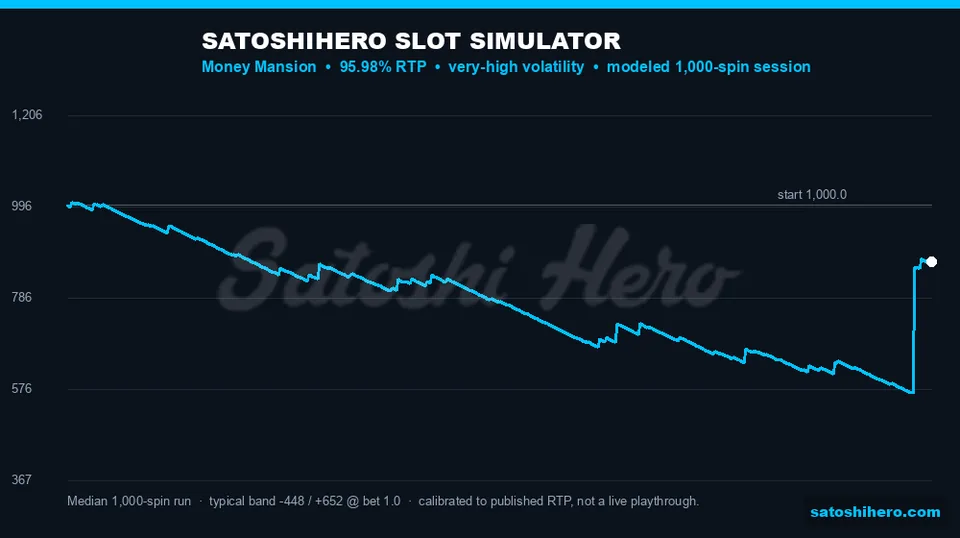
Modeled frequencies looked like this:
- About 14% of spins returned something.
- A feature-sized result appeared roughly once per 54 spins.
- A result worth at least 100x appeared roughly once per 818 spins.
These rates describe possible shapes, not countdowns or fixed intervals. A 1-in-54 feature rate doesn’t mean spin 54 must trigger anything. You can’t use the projection to time the next bonus or large result. In my opinion, the wide spread fits the game’s unforgiving profile.
Our 100-spin session
My counted run ended 65.25x down after 100 spins. It contained 31 paying spins, nine stake-covering results, and a 5.25x best base-game award. The lone Free Spins trigger arrived on spin 16, supplied 10 turns, and produced the 7.7x best overall event. You can compare those facts with the model without claiming one proves the other.
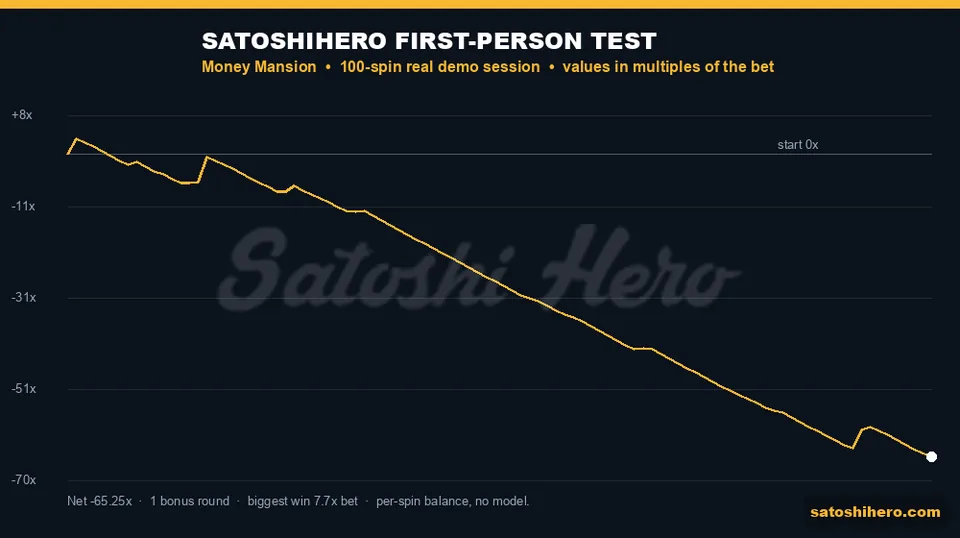
The observed loss sits inside the modeled range, but one short run can’t validate or reject that projection. My later 4.75x screenshot result remains outside every count and balance figure. You could land elsewhere within a broad range during another session. This live test exposed downside risk much more clearly than headline feature potential.
The 95.98% figure is the operator’s published theoretical RTP, and one live session doesn’t change it. Our simulator only models possible session shapes, while neither source predicts the next spin or recreates demo results. Any feature-specific return shown in the interface should stay separate because bonus-mode return can differ slightly by design.
Frequently Asked Questions
How many paylines does the Money Mansion slot have?
The Money Mansion slot has 20 fixed paylines on a 5×3 grid. Regular wins begin on reel 1 and continue across adjacent reels from left to right. Only the highest combination on each line pays, and the game adds awards from separate winning lines.
What are the RTP and volatility of the Money Mansion slot?
The theoretical RTP is 95.98%, volatility is very-high, and the maximum award reaches 3,525x. My observed 100-spin session ended 65.25x down. Separately, the 1,000-spin model produced a midpoint of 131.2x down.
How do Free Spins start in the Money Mansion slot?
Three Bonus symbols on reels 1, 3, and 5 pay 5x and trigger Free Spins. The door sequence then supplies between 9 and 18 turns. My trigger arrived on spin 16 and gave me 10 spins.
What does the Wild do in the Money Mansion slot?
Wilds appear only on reels 2 through 4 and replace every symbol except the Bonus. Each carries a random x2 or x3 multiplier on qualifying lines. Several Wild modifiers in one combination add together rather than multiply.
Are Wilds sticky during Money Mansion Free Spins?
Yes. Every Wild stays fixed until the bonus ends and retains its x2 or x3 multiplier. The round can’t retrigger, so the awarded spin count doesn’t extend.
How much did the tested Money Mansion Free Spins round pay?
My round returned $4.62 from a $0.60 stake, equal to 7.7x. That total included the $3.00 trigger payment and two free-spin awards worth $0.18 and $1.44.
What do symbols pay in the Money Mansion slot?
Five-of-a-kind values run from 37.5x for the Vampire to 1.25x for Q, J, and 10. Between them, the Clown pays 25x, Zombie 15x, Mummy 10x, Candle 7.5x, Eyeball 5x, and A or K 2.5x. All values use multiples of the total bet.
Can you buy the bonus in the Money Mansion slot?
Yes. The Buy Bonus button appears left of the grid, and its price follows your selected stake. The next spin starts Free Spins automatically, but I didn’t purchase the bonus during my test.
Bottom Line
Money Mansion delivers clear fixed-line play, useful Wild modifiers, and a sticky-Wild bonus inside a readable comic-horror package. Its main drawback is a restrained top prize beside the severe swings, while my tested feature produced little relief.

My Verdict
Patient volatility fans can appreciate the fast pace and straightforward multiplier rules. Expect small awards that often won’t cover your stake, and don’t assume one feature can repair a poor run.
I like how quickly the grid communicates paylines, Wild values, and bonus symbols. I don’t like that 31 paying spins still left me 65.25x down, while my lone feature returned only 7.7x. The firsthand result made the risk feel sharper than the feature presentation suggested.
The Money Mansion slot remains easy to understand but difficult to recommend for cautious bankrolls. This page is checked regularly so its interface details remain useful.

Pros:
 Readable structure: Fixed paylines and bold symbols make each completed grid easy to inspect.
- Useful Wilds: Random x2 and x3 modifiers can improve several winning lines.
- Sticky feature: Bonus Wilds remain fixed and retain their multiplier through the round.
- Fast play: Turbo and autoplay keep repeated spins moving without obscuring outcomes.

Cons:
 Harsh variance: Small, frequent-looking payouts can still produce a steep balance decline.
- Restrained ceiling: The maximum feels modest beside the game’s very-high risk.
- No retrigger: Free Spins can’t extend after the initial door award.

Best For: Patient players who understand sharp swings and prefer simple fixed paylines over complex bonus systems. The comic-horror theme, quick pace, and sticky Wild potential reward careful bankroll limits, not aggressive stake chasing.
Similar Games


































































Bets
All Bets
Game
Player
Date
Wager
Mult.Multiplier
Prize
 Mr. Crystalman: Hold 'N' Link
 Hidden
- 10:44:39
- 0×
- Galaxy Glitter
 blazecraft
- 10:44:39
- 0×
- Egypt Fortunes: Bingo Bounty
 mdp0fxo
- 10:44:39
- 0×
- Royal Fruits 9: Hold 'n' Link
- Hidden
- 10:44:37
- 0×
- Mr. Crystalman: Hold 'N' Link
- Hidden
- 10:44:37
- 0×
- Egypt Fortunes: Bingo Bounty
- mdp0fxo
- 10:44:36
- 0×
- Amazing Diamonds: Hold 'N' Link
 nina87
- 10:44:36
- 0×
- Almighty Diamonds: Hold 'N' Link
- novaone948
- 10:44:36
- 0×
- Luck of Panda: Bonus Combo
- josh1998
- 10:44:35
- 0×
- Mr. Crystalman: Hold 'N' Link
- Hidden
- 10:44:35
- 0.1×